

U.S. Menopause Skin Care Market Size and Forecast – 2026 To 2033
The U.S. menopause skin care market is expected to grow from USD 956.5 Mn in 2026 to USD 1,936.2 Mn by 2033, registering a compound annual growth rate (CAGR) of 10.6% from 2026 to 2033. The market is expanding rapidly, supported by a growing menopausal population with strong purchasing power and an increasing willingness to spend on health and wellness solutions. As per the National Institutes of Health statistics, approximately 1.3 million women in the U.S. enter menopause annually, continuously expanding the target population base each year. (Source: National Institutes of Health)
Key Takeaways of the U.S. Menopause Skin Care Market
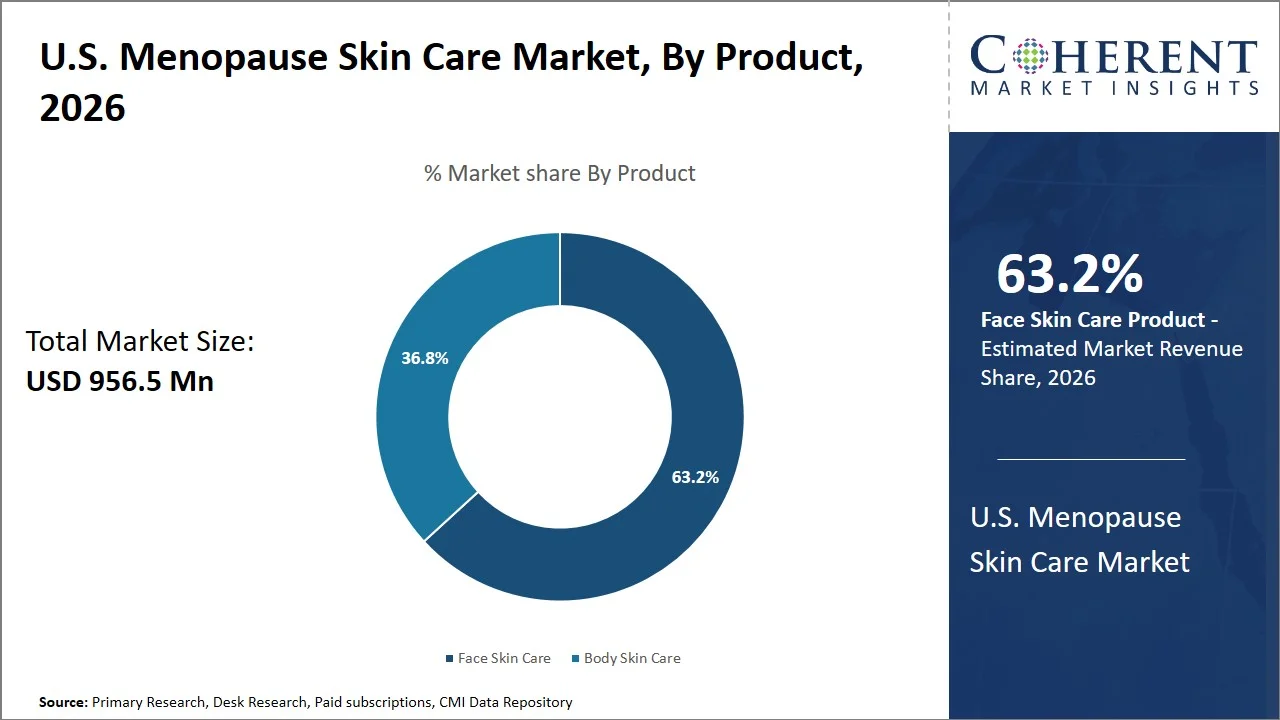
- The face skin care segment is projected to hold 63.2 % of the U.S. menopause skin care market share in 2026, making it the dominant product segment. Facial skin care products remain the preferred choice among menopausal consumers due to rising concerns related to dryness, wrinkles, sensitivity, and loss of elasticity caused by hormonal changes. Increasing adoption of hydrating creams, collagen-support serums, barrier-repair moisturizers, and dermatologist-recommended formulations is further driving the segment growth in the U.S. For instance, brands such as Stripes Beauty and No7 Menopause Skincare have introduced targeted facial products designed specifically for menopausal skin concerns. (Source: No7 Beauty Company)
- Menopause is projected to hold 41.3 % of the U.S. menopause skin care market share in 2026. Women undergoing menopause represent the largest consumer group due to visible hormonal skin changes such as dryness, uneven skin tone, reduced firmness, and weakened skin barriers. Growing awareness regarding menopause-related skincare issues and increasing demand for clinically tested, hormone-focused formulations continue to strengthen this segment. For example, Pause Well-Aging and State of Menopause offers products specifically developed for menopausal women seeking hydration, skin repair, and anti-aging benefits.
- The mid-tier segment is projected to hold 44.3 % of the U.S. menopause skin care market in 2026, by pricing category in 2026. Mid-priced menopause skincare products are gaining significant consumer preference as they offer a balance between affordability and premium-quality ingredients. Consumers increasingly seek effective formulations containing hyaluronic acid, peptides, ceramides, collagen-support ingredients, and botanical extracts without the high price point associated with luxury skincare brands. The segment is further benefiting from growing availability across retail chains, pharmacies, and e-commerce platforms. For instance, Olay’s Regenerist and Hyaluronic skincare ranges are widely positioned within the mid-tier skincare category and are popular among menopausal consumers seeking anti-aging, hydration, and skin-firming benefits without paying premium luxury prices. (Source: Olay)
- Hormone-Focused Skin Care Innovation: The U.S. menopause skin care market is increasingly witnessing the development of scientifically formulated and hormone-conscious skincare products designed specifically to address menopause-related concerns such as dryness, sensitivity, collagen loss, and weakened skin barriers. Brands are introducing targeted formulations enriched with peptides, ceramides, hyaluronic acid, and barrier-repair ingredients to improve long-term skin health and resilience.
- Market Growth Driven by Wellness Integration & Personalized Solutions: Growing consumer awareness regarding hormonal skin changes, combined with the expansion of telehealth, personalized skincare consultations, and menopause-focused wellness ecosystems, is significantly propelling market growth in the U.S. Increasing demand for clinically backed, simplified, and condition-specific skincare routines is encouraging companies to launch integrated menopause care platforms and specialized beauty solutions like beauty devices.
Segmental Insights
Why Does the Face Skin Care Segment Dominate the U.S. Menopause Skin Care Market ?
The face skin care segment expected to account for the largest market share of 63.2% in 2026. Menopause-related skin changes are often first noticed on the face, including dryness, fine lines, sagging and skin tone changes, which make daily skincare targeted to the face a consumer priority. Skincare routines are pretty regimented in the U.S. and there is a significant uptake of multiple products like wash, serum, moisturizer and SPF, thus, driving the consistency of demand for facial care solutions.
For instance, brands like Estée Lauder’s (Clinique) have seen surging sales of their "Menopause Skincare" line, featuring hyaluronic acid serums and retinol creams, as women in their 40s-50s stock up on 4-5 product routines to combat visible aging. (Source: Estee Lauder)
- Current Industry Events of 2026
- Market Size Estimation
- Regional Breakdown
- Competitive Landscape
- Customer Intelligence
- Segmental Analysis
- Pricing Analysis
- Key Market Drivers, Challenges & Future Trends
- Customized Insights Section
Why is Menopause a Key Target Segment in the U.S. Menopause Skincare Market?
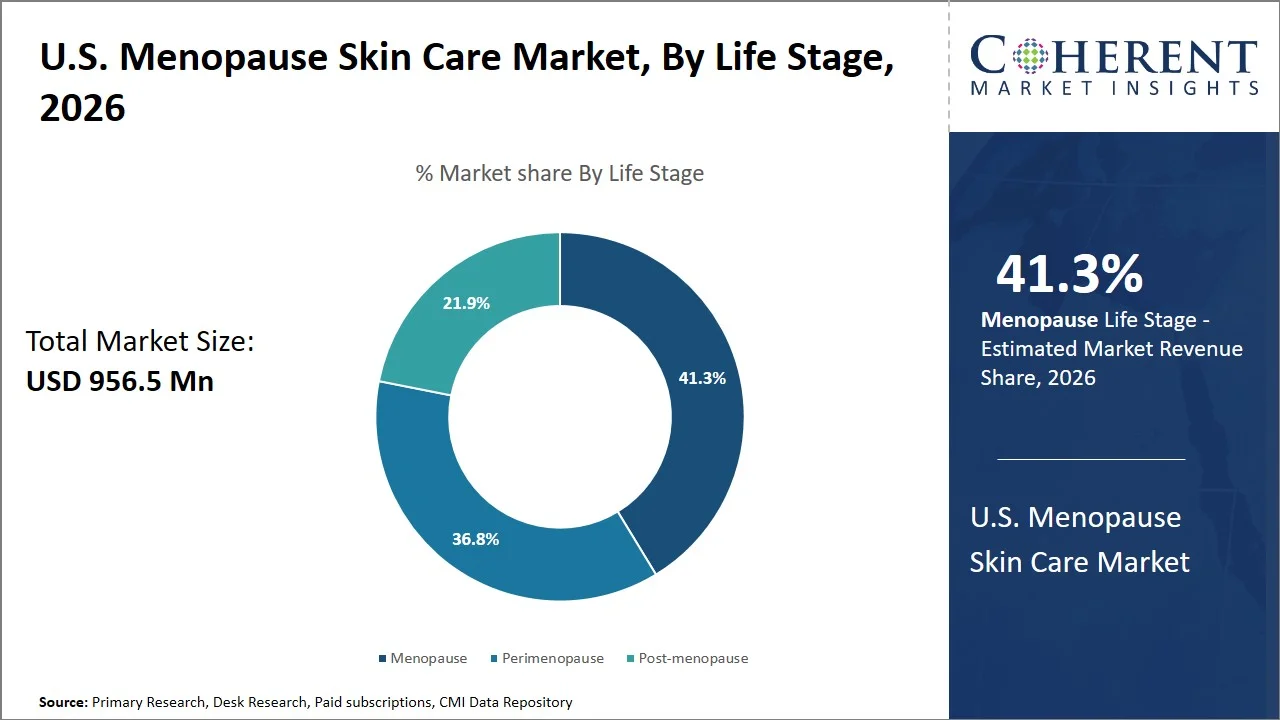
The menopause segment is expected to account for 41.3% of the U.S. menopause skin care market share in 2026, due to their popularity among consumers wanting to care for their skin in a way that acknowledges the hormonal changes occurring during menopause. Consumers in the U.S. are looking for product formulations that are clinically proven, dermatologist recommended, provide visible results and are gentle on sensitive skin. The products are commonly employed to solve problems like uneven tone, loss of firmness, and damaged barriers, and are essential to daily skin care regimens.
For example, Midi Health's Estriol+ Face Cream, which blends estriol (a mild estrogen), hyaluronic acid, and DMAE to restore hydration and firmness is earning praise from users for mimicking pre-menopausal skin based on hormonal biology. (Source: Midi Health)
Mid-Tier Dominates the U.S. Menopause Skin Care Market
The mid-tier segment is projected to account for 44.3% of the U.S. menopause skin care market share in 2026, driven by increasing demand for reliable everyday skincare solutions that fit into routine, long-term usage patterns. Consumers are consistently more interested in the products that deliver predictable results, without the need to swap to different brands so often, and as a result more of the mid-tier brands that are associated with more stable formulations and consistent performance are being adopted.
For example, Womaness, available at major U.S. retailer, Target, offers mid-tier menopause-targeted products like the Overnight Magic Night Repair Cream (USD 28.99), featuring HYACLEAR 7 for hydration and bakuchiol as a gentle retinol alternative to smooth and supple skin overnight without irritation—aligning with demand for reliable, routine-friendly formulas. (Source: Beauty Independent)
Currents Events and their Impact
Current Events | Description and its Impact |
Proliferation of menopause-care awareness programs in the U.S. |
|
Increasing dermatology and telehealth support for menopausal skincare |
|
(Source: menopause.org, Midi Health)
U.S. Menopause Skin Care Market Dynamics
Market Drivers
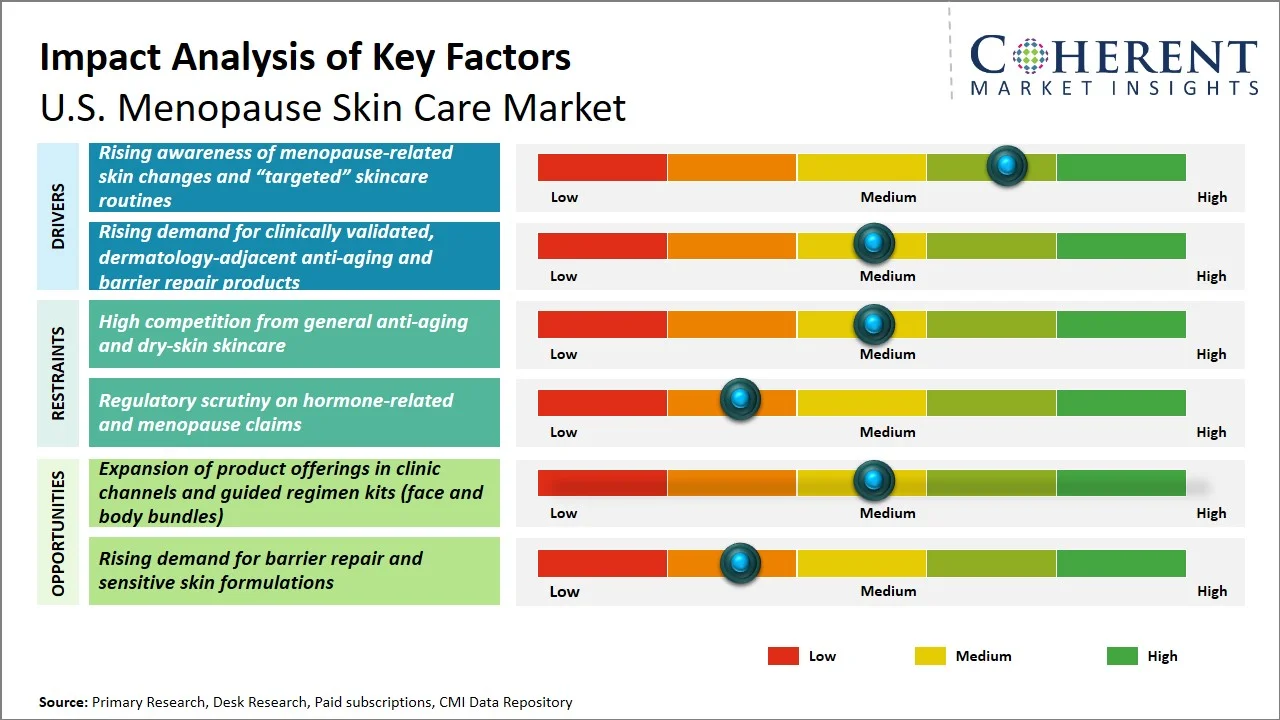
- Rising awareness of menopause-related skin changes and “targeted” skincare routines: Rising awareness of menopause-related skin changes and adoption of targeted skincare routines in the U.S. is significantly accelerating market growth. There is growing evidence of increased behavioral and clinical awareness of menopause-related skin concerns in the U.S. Nearly 70% of women report noticing changes in their skin during menopause, while around 80% experience menopause-related symptoms overall. As awareness rises, more women are seeking targeted menopause-specific skincare solutions rather than relying on general skincare products. (Source: National Institutes of Health)
- Growing Demand for Clinically Validated, Dermatology-Adjacent Anti-Aging & Barrier Repair Formulations: Growth in the U.S. menopause skin care market is on the rise with increased demand for clinically validated and dermatology-adjacent skin care formulations, as well as superior anti-aging + barrier repair products. Consumer purchasing behavior in the U.S. is also largely in favor of dermatologist-recommended skin care, as more than 40% of facial skin care products sold in the prestige segment are dermatologist recommended.
- For example, SkinCeuticals Triple Lipid Restore 2:4:2 cream, with ceramides, cholesterol, and fatty acids in a 2:4:2 ratio, clinically restores barrier function and reduces fine lines—dermatologist-favored in prestige menopause routines for proven hydration and firmness. (Source: Skinceuticals)
Emerging Trends
- Premiumization and Clinical-Experience Positioning: Menopause skincare is moving beyond the ordinary moisturizer to high-end science-driven products with dermatologically-proven ingredients, biotech actives and “clinic-grade” formulations. Brands are also focusing on spa-like experiences and sensory-rich textures to deliver a luxury self-care experience.
- Rising Awareness of Hormonal Skin Changes Driving Demand for Targeted, Dermatologist-Approved Skincare: Increase in awareness of hormone changes in the skin is creating new opportunities for the growth of products explicitly created for hormone deficient skin such as barrier repair creams, microbiome friendly skin care, and fragrance free clean beauty cosmetics. Consumers are also looking for skin-friendly, dermatologist approved ingredients.
Role of Digital Education and Communities in the U.S. Menopause Skincare Market
Data Dimension | Digital Education / Community Layer | Skin Care Market Impact | Example |
Awareness Stage | Menopause education content (blogs, videos, webinars) | Increases first-time skincare demand | Women learning about estrogen decline & skin dryness |
Symptom Tracking | Apps (hot flashes, skin dryness tracking) | Drives targeted skincare purchases | Tracking “dry skin severity score” in apps |
Telehealth Integration | Digital menopause clinics & prescriptions | Bundles skincare with hormone care | Evernow-style hormone + wellness platforms |
How is the expansion of product offerings in clinic channels and guided regimen kits (face and body bundles) creating new growth opportunities in the U.S. menopause skin care market?
Clinic channels and guided regimen kits (face + body bundles) are driving growth in the U.S. menopause skin care market by meeting the demand for more trusted, structured and comprehensive care solutions to meet the needs of hormonally-changed skin. But as menopause-related issues like dryness, barrier weakening, loss of elasticity and sensitivity become more familiar and popular, dermatology clinics and med-spa distribution networks are becoming high trust points of entry for product adoption.
For example, dermatologist-backed menopause skincare such as No7 Beauty's Menopause Skin Care Collection is localized around clinically proven skin concerns like loss of moisture and firmness, filling a gap for consumers who are looking for science-based products. (Source: No 7 Beauty)
Market Players, Key Development, and Competitive Intelligence
Key Developments
- In January 2026, Stripes Beauty announced its entry into Ulta Beauty through the retailer’s wellness-focused assortment, marking a significant step toward the mainstream retail integration of menopause-specific skincare solutions. The launch reflects increasing recognition of menopause as a distinct consumer segment within beauty and personal care, with retailers beginning to allocate dedicated shelf space to life-stage-driven product categories. This expansion underscores the growing demand for targeted, midlife-focused skincare offerings and signals continued momentum toward category formalization in the U.S. menopause skin care
- In November 2025, skinbetter science introduced its menopause-focused formulation, the Mystro Revive Renewing Serum, designed specifically to address perimenopausal and menopausal skin concerns. The product incorporates advanced ingredients to improve skin resilience, hydration, and overall balance in response to hormonal changes. This launch highlights the broader industry shift toward science-backed, life-stage-specific skincare solutions, with increasing emphasis on dermatological efficacy and personalized treatment approaches within the premium segment.
- In August 2025, Dove introduced a Women’s Wellness range focused on supporting women during perimenopause and menopause. The products address concerns such as dryness, sensitivity, and changes in body odor, and were launched on Amazon as part of a broader effort to provide targeted care for this life stage.
Competitive Landscape
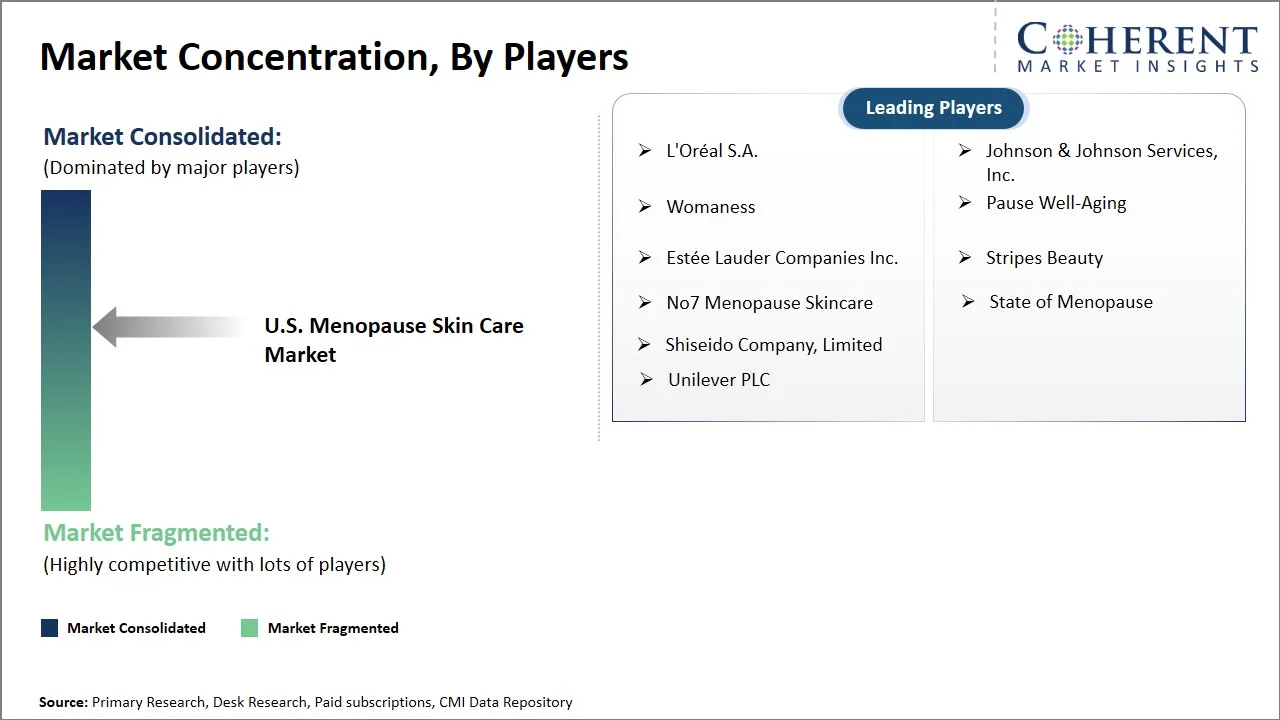
With growing awareness of "hormonal skin aging" and the ever increasing demand for targeted dermatological solutions, the U.S. menopause skin care market is becoming more competitive. Older skin and personal care companies capitalize on brand identity, research and development and extensive distribution networks; while newer niche brands differentiate themselves with focus, clinical and community marketing. Some of the focus areas are:
- Appointed by dermatologists and clinically proven formulations based on scientific data
- Dermatologist approved and clinically proven formulations based on scientific data
- Product diversification – Lifestyle and hormone specific skin care ranges
- Collaborations, DTC growth, and connecting with wellness ecosystems
Market Report Scope
U.S. Menopause Skin Care Market Report Coverage
| Report Coverage | Details | ||
|---|---|---|---|
| Base Year: | 2025 | Market Size in 2026: | USD 956.5 Mn |
| Historical Data for: | 2020 To 2024 | Forecast Period: | 2026 To 2033 |
| Forecast Period 2026 to 2033 CAGR: | 10.6% | 2033 Value Projection: | USD 1,936.2 Mn |
| Segments covered: |
| ||
| Companies covered: | L'Oréal S.A., Womaness, Estée Lauder Companies Inc., No7 Menopause Skincare, Shiseido Company, Limited, Unilever PLC, Johnson & Johnson Services, Inc., Pause Well-Aging, Stripes Beauty, and State of Menopause | ||
| Growth Drivers: |
| ||
| Restraints & Challenges: |
| ||
Analyst Opinion (Expert Opinion)
- The U.S. menopause skin care market is shifting from a niche market into a well-defined, science-driven skin care segment of the larger anti-aging and women's health industry. In the past, menopause skin problems were lumped in with general skin care, but a growing understanding of hormonal health, the growth of telehealth and dermatology-sponsored consumer education is developing a new product category. In the next 5-7 years, menopause skincare will become a lifecycle-based product category, and that product usage will be correlated to the perimenopause, menopause and post-menopause stages.
- Eventually, when the category is saturated with large firms, the winners will be those who get to the point of ‘where clinical dermatology meets wellness and beauty meets the consumer'. Perimenopausal and hormone-sensitive skin care products in the United States offer the best growth potential in hormone-sensitive applications targeted to the urban, high-income female consumer segment (ages 40-60) in metros like California, New York, Texas, and Florida.
- The most scalable application layer is the barrier repair moisturizers, collagen support serums and microbiome friendly products especially designed for the changes women experience during menopause. Mass-market retail is not the best initial point for the best commercial service; dermatologist clinics, telehealth platforms and DTC subscription ecosystems are best places for a consumer to seek out condition-specific solutions, not general beauty products.
Speak to the analyst
Want personalized insights?
Take the findings above to one of our principal consultants, or have the report rebuilt around the segments, geographies and competitors you actually track.
Market Segmentation
- Product Insights (Revenue, USD Mn, 2021 - 2033)
- Face Skin Care
- Lotions, Face Creams & Moisturizers
- Cleansers & Face Wash
- Facial Serums
- Sunscreen / Sun Care (Face)
- Others (Face)
- Body Skin Care
- Lotions, Creams & Moisturizers
- Body Sunscreen / Sun Care
- Body Oil & Serums
- Others (Body)
- Face Skin Care
- Life stage Insights (Revenue, USD Mn, 2021 - 2033)
- Perimenopause
- Menopause
- Post-menopause
- Price Range Insights (Revenue, USD Mn, 2021 - 2033)
- Mass
- Mid-Tier
- Premium & Luxury
- Distribution Channel Insights (Revenue, USD Mn, 2021 - 2033)
- Supermarkets & Hypermarkets
- Pharmacies & Drugstores
- Specialty Beauty Stores
- Dermatology & Aesthetic Clinics
- Online / E-Commerce
- Others
- Key Players Insights
- L'Oréal S.A.
- Womaness
- Estée Lauder Companies Inc.
- No7 Menopause Skincare
- Shiseido Company, Limited
- Unilever PLC
- Johnson & Johnson Services, Inc.
- Pause Well-Aging
- Stripes Beauty
- State Of Menopause
Sources
Primary Research Interviews
- Menopause skin care product manufacturers
- Dermatologists specializing in menopausal skin health
- Gynecologists and hormone health specialists
- Brand managers of women’s wellness and skincare companies
- Retail category managers for beauty and personal care products
Stakeholders
- Manufacturers of menopause-focused skincare products (e.g., No7 Beauty Company, Stripes Beauty)
- End-use Sectors
- Dermatology Clinics and Medispas
- Beauty & Personal Care Retailers (e.g., Ulta Beauty, Sephora)
- E-commerce Platforms (e.g., Amazon, Dermstore)
- Regulatory & Certification Bodies: o U.S. Food and Drug Administration (FDA), American Academy of Dermatology (AAD), National Eczema Association
- Technology Integration Players: Croda International, BASF Personal Care
Databases
- U.S. Census Bureau Retail Trade Data
- Statista Beauty & Personal Care Database
- UN Comtrade Database
- Euromonitor International Beauty and Personal Care Database
Magazines
- Allure Magazine– Menopause skincare trends and product launches
- Beauty Independent– Emerging menopause beauty brands
- Dermascope Magazine – Clinical skincare innovations
Journals
- Journal of Cosmetic Dermatology
- International Journal of Women’s Dermatology
- Dermatologic Therapy
- Skin Research and Technology
- Menopause Journal
Newspapers
- The Wall Street Journal – Beauty and wellness consumer trends
- The New York Times – Menopause wellness market coverage
Associations
- American Academy of Dermatology (AAD)
- Personal Care Products Council (PCPC)
- Society of Cosmetic Chemists (SCC)
- North American Menopause Society (NAMS)
- Women’s Dermatologic Society (WDS)
Public Domain Sources
- U.S. Food and Drug Administration (FDA) Cosmetics Guidance
- National Institutes of Health (NIH) – Research on menopause and skin aging
- Centers for Disease Control and Prevention (CDC) – Women’s health statistics
- U.S. Department of Health & Human Services– Menopause awareness resources
Proprietary Elements
- CMI Data Analytics Tool, Proprietary CMI Existing Repository of information for last 10 years.
Get access to 250+ pages report
Every segment, forecast, competitor profile and data table behind the analysis above — available for instant download.
- ESOMAR Member
- ISO 9001:2015 Certified
- D-U-N-S Registered
- GDPR & CCPA Compliant
Missing comfort of reading report in your local language? Find your preferred language:
Transform your Strategy with Exclusive Trending Reports
Frequently Asked Questions
The U.S. menopause skin care market is estimated to be valued at USD 956.5 Mn in 2026 and is expected to reach USD 1,936.2 Mn by 2033.
Menopause skin care refers to products specifically designed to address skin changes associated with hormonal shifts during menopause, such as dryness, loss of elasticity, wrinkles, sensitivity, and uneven skin tone.
The CAGR of U.S. menopause skin care market is projected to be 10.6% from 2026 to 2033.
Rising awareness of menopause-related skin changes and “targeted” skincare routines and rising demand for clinically validated, dermatology-adjacent anti-aging and barrier repair products are the major factors driving the growth of the U.S. menopause skin care market.
Women in the perimenopausal and postmenopausal age groups, typically between 40 and 60 years, represent the primary consumer base.
High competition from general anti-aging and dry-skin skincare, regulatory scrutiny on hormone-related and menopause claims are the major factors hampering the growth of the U.S. menopause skin care market.
In terms of product, face skin care is estimated to dominate the market revenue share in 2026.