

U.S. Povidone Iodine-based Nasal Sprays Market Size and Forecast – 2026 To 2033
The U.S. povidone iodine-based nasal sprays market is expected to grow from USD 28,195.5 Mn in 2026 to USD 44,962.4 Mn by 2033, registering a compound annual growth rate (CAGR) of 6.9% from 2026 to 2033. The U.S. povidone iodine-based nasal sprays market is poised for significant expansion, fueled by growing emphasis on respiratory infection prevention and nasal cleansing practices.
According to the U.S. Centers for Disease Control and Prevention (CDC), during the 2024–25 influenza season, 489,579 respiratory specimens tested positive for influenza, with weekly positivity rates peaking at 31.6%, the highest level recorded in the past nine influenza seasons.
(Source: Centers for Disease Control and Prevention)
Key Takeaways of the U.S. Povidone Iodine-based Nasal Sprays Market
- OTC (Over-the-Counter) is projected to hold 91.0 % of the U.S. povidone iodine-based nasal sprays market share in 2026, making it the dominant prescription type segment, owing to easy accessibility of OTC drugs, growing consumer preference for self-care products, and increasing awareness of respiratory hygiene. The segment continues to benefit from the shift toward preventive healthcare and non-prescription infection-control solutions. For instance, the U.S. FDA's OTC Monograph framework enables eligible non-prescription healthcare products to be marketed without individual premarket approval, supporting broader consumer access to self-care products (Source: Food and Drug Administration)
- Infection prevention / antiviral is projected to hold 32.9 % of the U.S. povidone iodine-based nasal sprays market share in 2026, making it the dominant indication segment, driven by increasing awareness of respiratory infection prevention and growing adoption of proactive hygiene measures. The segment continues to benefit from rising concerns regarding viral transmission and demand for non-invasive infection-control solutions. For instance, according to the U.S. Centers for Disease Control and Prevention, an estimated 110,000–180,000 adults ages 50 and older in the U.S. are hospitalized due to respiratory syncytial virus (RSV), highlighting the significant burden of respiratory viral infections and the importance of preventive healthcare measures. (Source: Centers for Disease Control and Prevention)
- Retail pharmacies are projected to hold 36.4 % of the U.S. povidone iodine-based nasal sprays market share in 2026, making it the dominant distribution channel segment, due to widespread product availability, pharmacist guidance, and convenient consumer access to OTC healthcare products. The segment benefits from the extensive community pharmacy network across the U.S., which facilitates easy product availability and supports preventive healthcare adoption. For instance, a nationwide analysis published in the National Library of Medicine found that across the overall U.S. population, 48.1% lived within 1 mile of any pharmacy, 73.1% within 2 miles, 88.9% within 5 miles, and 96.5% within 10 miles of a community pharmacy, highlighting the strong accessibility of pharmacy-distributed healthcare products. (Source: National Library of Medicine)
- Expansion of Pre-Procedure Nasal Antisepsis Protocols: The increasing implementation of pre-operative nasal decolonization and antisepsis procedures has opened a niche growth market for povidone iodine-based nasal sprays. As hospitals and ambulatory surgical centers continue to implement nasal antiseptic products into infection control measures, the microbial load and subsequent risk for healthcare-associated infections is being reduced.
- Rising Demand from High-Risk and Immunocompromised Populations: Growing attention toward elderly, immunocompromised and chronic respiratory diseases patients is increasing the demand for nasal hygiene preventive products. Nasal spray with Povidone iodine is emerging as user-friendly complement to other widespread infection control, allowing manufacturers the scope to develop specific formulation for susceptible population.
Segmental Insights
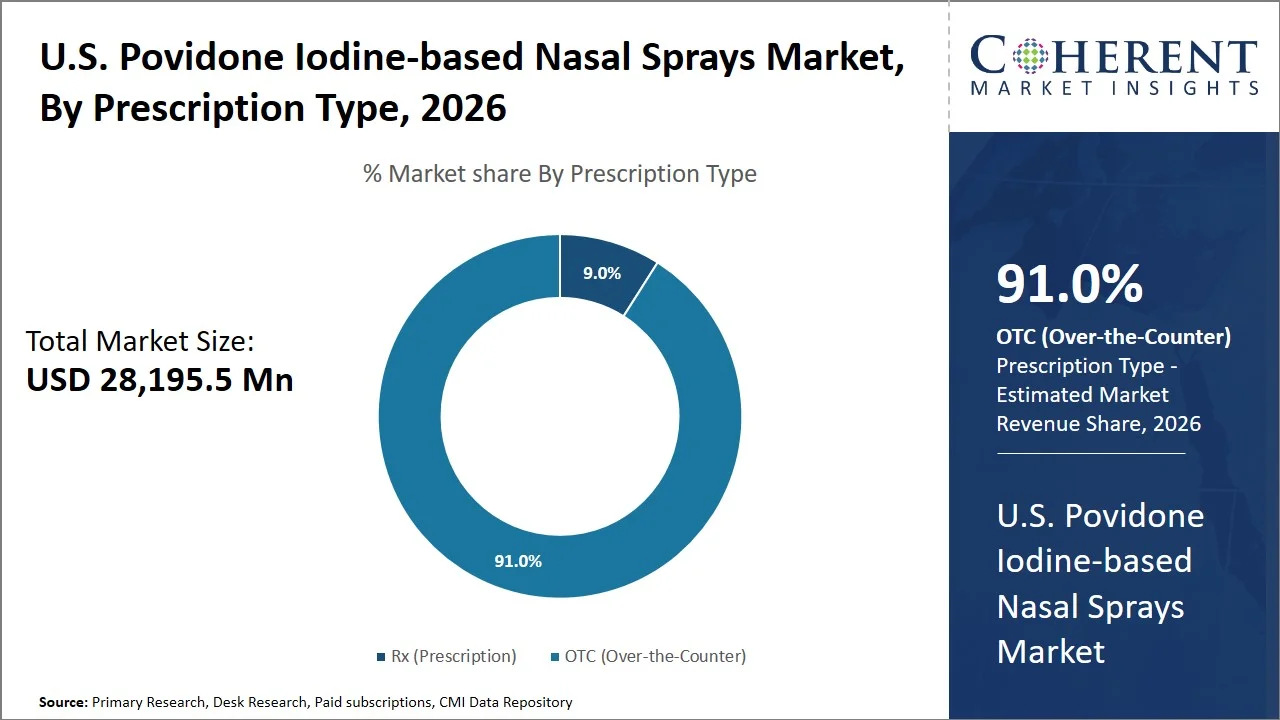
Why Does OTC (Over-the-Counter) Dominate the U.S. Povidone Iodine-based Nasal Sprays Market?
OTC (Over-the-Counter) is projected to hold a market share of 91.0% in 2026, due to consumer preference towards individual self-care approach and easy availability of infection-control products without physician prescription. Increasing consciousness towards respiratory hygiene coupled with the ease of buying the product from retail pharmacies and through online will drive the segment's growth. Moreover, availability of OTC solutions permits consumer to integrate nasal antiseptic solutions within personal care regimen. For instance, more than 240 million Americans use an OTC medication each year, with an estimated 60 million of those consumers relying solely on OTC medications for access to care and treatment. (Source: Pharmacy Times) The growing consumption of OTC drugs, along with increased customer preference toward proactive self-treatment, will continue to foster the segment’s growth in the U.S. povidone iodine-based nasal sprays market.
- Current Industry Events of 2026
- Market Size Estimation
- Regional Breakdown
- Competitive Landscape
- Customer Intelligence
- Segmental Analysis
- Pricing Analysis
- Key Market Drivers, Challenges & Future Trends
- Customized Insights Section
Why Does Infection Prevention / Antiviral Represent the Largest Indication Segment in the U.S. Povidone Iodine-based Nasal Sprays Market?
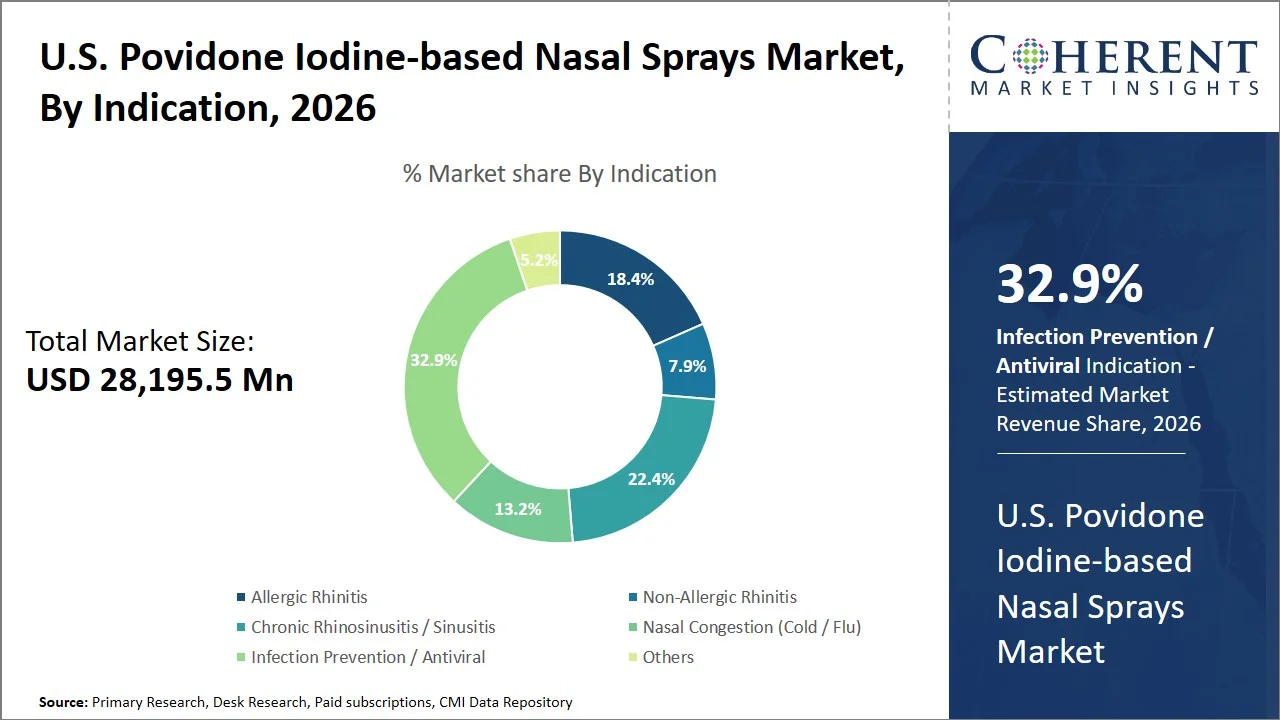
Infection Prevention / Antiviral is projected to hold 32.9% of the market share in 2026, fueled by heightened awareness for respiratory hygiene and growing importance of preventing infectious agent transmission. There is increasing awareness and use of preventative measures among consumer and health professionals to reduce exposure to respiratory viruses in settings like hospitals, clinics and public gathering place. Povidone iodine possesses effective broad-spectrum antimicrobial activity against virus, bacteria and fungus making it an ideal option for use as a preventative nasal antiseptic nasal spray. For instance, according to the U.S. Centers for Disease Control and Prevention, about one in 31 hospital patients has at least one healthcare-associated infection, demonstrating the persistent need for efficient infection prevention measures across healthcare settings. (Source: Centers for Disease Control and Prevention)
Retail Pharmacies Segment Dominates the U.S. Povidone Iodine-based Nasal Sprays Market
The retail pharmacies segment is expected to hold 36.4% of the U.S. povidone iodine-based nasal sprays market share in 2026, owing to its widespread distribution across rural and urban areas, broader portfolio of OTC products, and immediate access to preventive health and wellness products. Customers frequently turn to pharmacies to treat ailments and to access infection and respiratory care products on their own. The role of pharmacist recommendation and store convenience also play a role in the product's adoption. For instance, nearly 73% of prescriptions dispensed in the U.S. were filled at retail pharmacies, emphasizing the importance of its core functions in terms of product distribution to health and customer interaction. (Source: The National Association of Chain Drug Stores)
Currents Events and their Impact
Current Events | Description and its Impact |
U.S. FDA Draft Guidance on Generic Fluticasone Propionate Nasal Spray (May 2025) |
|
FDA Testimony Supporting OTC Monograph Modernization and OMUFA Reauthorization (June 2025) |
|
(Source: Federal Register, U.S. Department of Health and Human Services)
U.S. Povidone Iodine-based Nasal Sprays Market Dynamics
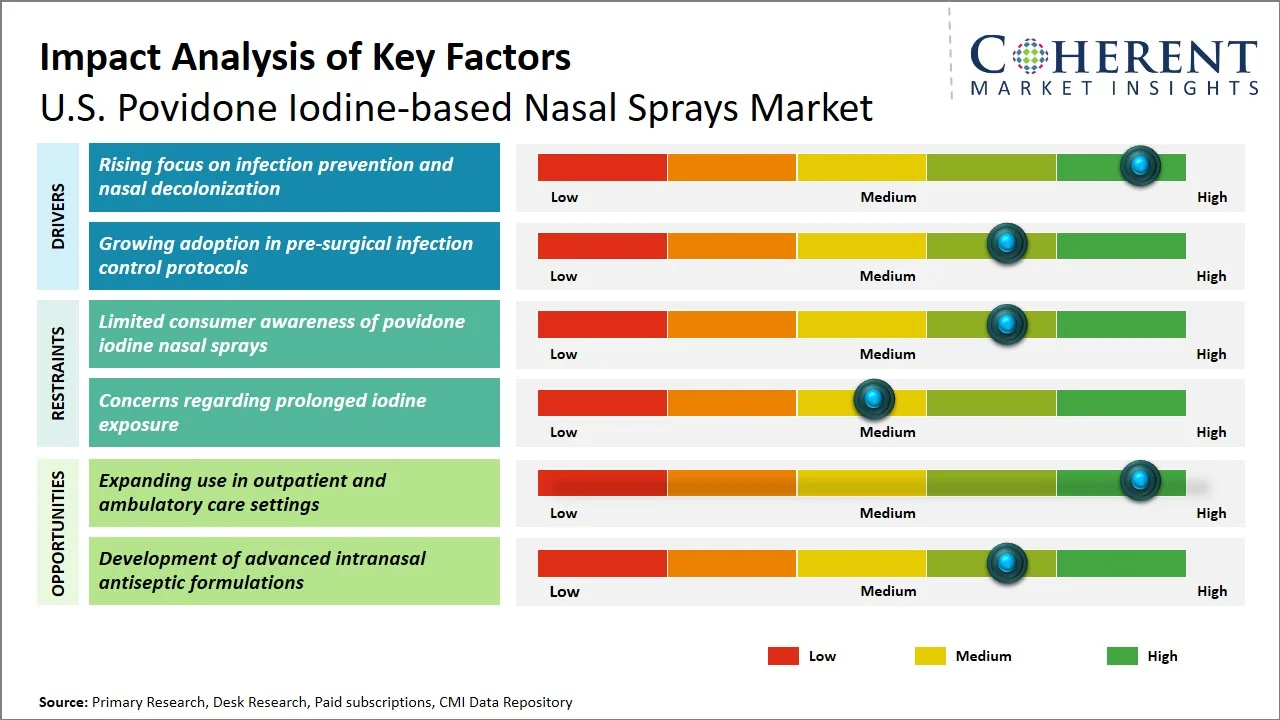
Market Drivers
- Rising focus on infection prevention and nasal decolonization: Due to the growing use of infection-control procedures in health care facilities the U.S. demands for nasal sprays with povidone iodine as its main ingredient is expected to rise. Nasal decolonization is increasing in popularity as a method to limit the microbial burden in health care facilities and thus reducing rates of surgical site infections and other health care associated infections. The broad-spectrum antimicrobial activity of povidone iodine has made it a popular choice for pre-procedural antisepsis and prophylactic treatment. For instance, the U.S. Centers for Disease Control and Prevention (CDC) estimates that roughly two million people in the U.S. will develop bacterial infections while in the hospital and that nearly 90,000 will die from associated complications.(Source: National Library of Medicine) With an increasing focus on infection control measures by healthcare practitioners and pre-procedural decolonization, sales of povidone iodine-based nasal sprays will continue to grow across health care settings.
- Growing adoption in pre-surgical infection control protocols: Povidone iodine-based nasal sprays are a part of pre-operative infection prevention due to a heightened interest in lowering surgical site infections (SSIs). Hospitals are instituting nasal decolonization with the goal of decreasing bacterial counts within the nares and decrease post-operative complications. Povidone iodine has been chosen over other antiseptics because it is easy to administer before surgical procedures and has a broad antimicrobial spectrum. For instance, the U.S. Centers for Disease Control and Prevention (CDC), estimated 110,800 surgical site infections (SSIs) associated with inpatient surgeries performed in the U.S., emphasizing the sustained need for effective preoperative infection-control strategies. (Source: Centers for Disease Control and Prevention)
Emerging Trends
- Growing Expansion of E-commerce and Direct-to-Consumer Sales Channels: Online pharmacies and digital health sites have emerged as crucial distribution channels for povidone iodine nasal sprays. Customers' preferences for the convenience of buying products online, opting for subscription-based healthcare services, and having products delivered to their homes will only grow. With increased consumer interest in online purchasing, it will become easier for manufacturers to reach a wider market and have higher product visibility and consumer interaction through online marketing strategies.
- Increasing Development of Combination and Specialized Formulations: Manufacturers are developing advanced formulations containing povidone iodine along with emollients, soothers or mucosal protecting excipients to improve comfort and compliance for the user. The tendency towards "specialty formulation" targeted to the needs of repeated application and sensitive mucosa, or the demands of long-term preventative usage, will provide a new product differentiation and widen the consumer base.
Key Regulatory Factors Influencing the U.S. Povidone Iodine-based Nasal Sprays Market
Factor | Current Scenario | Impact on Market |
OTC Product Regulations | U.S. FDA oversight of non-prescription nasal products | Facilitates consumer access while ensuring safety |
Product Claims & Advertising | Restrictions on antimicrobial and infection-prevention claims | Influences product positioning and marketing strategies |
Manufacturing & Sterility Standards | Compliance with cGMP requirements | Increases product quality and consumer confidence |
Post-Market Surveillance | Safety monitoring and adverse event reporting | Supports long-term market credibility |
Clinical Infection-Control Guidelines | Growing emphasis on nasal decolonization protocols | Expands healthcare-sector adoption |
How is the expanding use in outpatient and ambulatory care settings creating new growth opportunities in the U.S. povidone iodine-based nasal sprays market?
This transition toward ambulatory clinics and surgical centers leads to a growth in the market for nasal sprays, specifically those that utilize povidone iodine. Since facilities are incorporating preventive measures against the spread of infection to ambulatory procedures as a primary factor in patient safety, povidone iodine nasal sprays, due to the speed with which it provides antiseptic coverage, its fast-acting capabilities, and its applicability for pre-operative application, appear ideally suited for these health facilities. For instance, Ambulatory Surgery Center Association (ASCA) reported that more than 6,300 Medicare-certified outpatient surgery centers are operating throughout the country, underscoring a growth infrastructure of outpatient facilities where infection-prevention practices are being implemented more. (Source: Johnson & Johnson)
Market Players, Key Development, and Competitive Intelligence
Key Developments
- In April 2024, Firebrick Pharma launched Nasodine Nasal Spray in the U.S., making the product the first and only one available in the world. The nasal spray, which combines povidone-iodine (an antiseptic with wide-spectrum antimicrobial action) with the nasal administration of a disinfectant previously confined to sore throat remedies, is an example of the increase in povidone-iodine-based nasal antiseptics.
- In March 2024, the John Wiley & Sons, Inc. published results from a Phase II clinical trial showing that Nasodine 0.5% povidone iodine nasal spray produced a statistically significant decrease in viable SARS-CoV-2 virus load within the nasal passages relative to the placebo. The clinical study met its primary endpoint with all subjects in the treatment arm clear of nasal virus by Day 5 and provide clinical data supporting the use of povidone iodine nasal spray for nasal disinfection. These findings support a scientific basis for marketing and widespread application of intranasal antiseptics in the United States.
Competitive Landscape
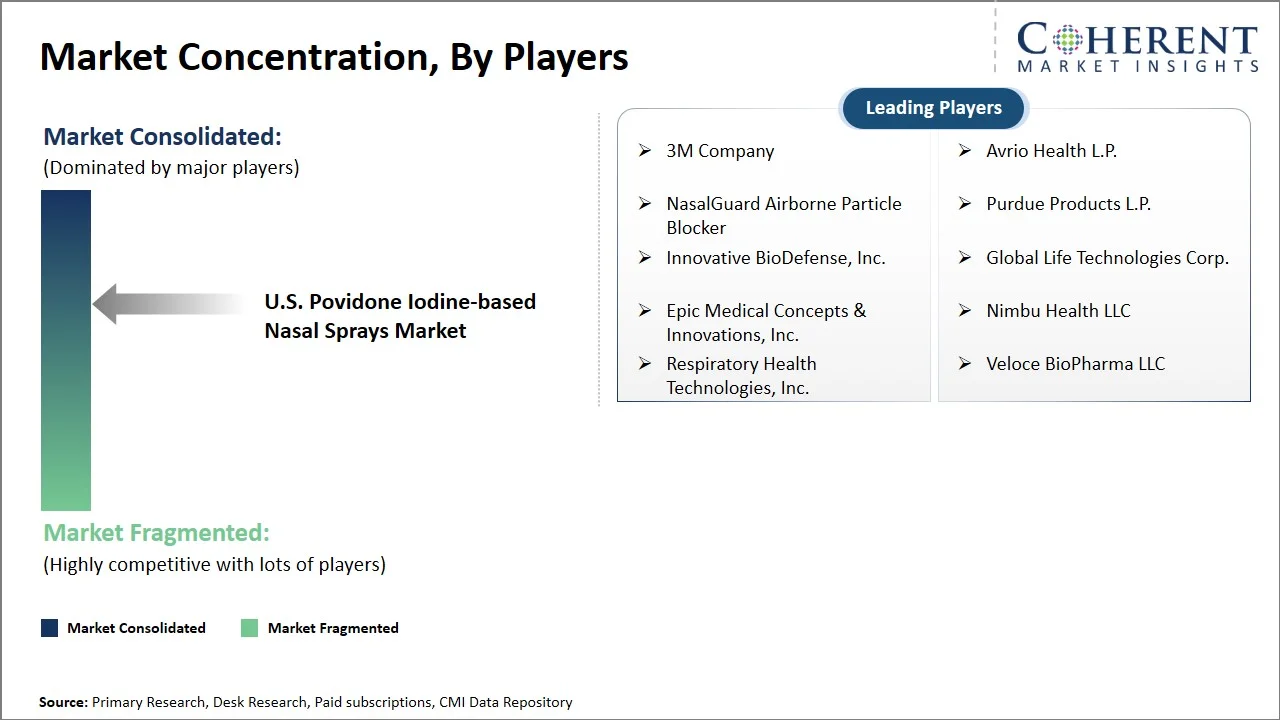
The U.S. povidone iodine-based nasal sprays market is moderately competitive, where players are concentrating on diversifying their infection prevention portfolios by bringing in new products, validating the use of these products through clinical evidence, and through a wider product distribution. Companies are trying to improve their market share in the infection prevention sector by leveraging product innovations, scientifically-proven product formulations, intuitive product delivery systems, and OTC accessibility of products, and are forging partnerships with healthcare organizations and ambulatory care centers. Key focus areas include:
- Development of advanced povidone iodine formulations with enhanced tolerability and efficacy
- Expansion of OTC and e-commerce distribution channels to improve product accessibility
- Generation of clinical evidence supporting nasal decolonization and infection-prevention applications
- Strengthening partnerships with hospitals, ambulatory surgical centers, and healthcare providers
- Investment in innovative spray delivery technologies and patient-friendly packaging solutions
Market Report Scope
U.S. Povidone Iodine-based Nasal Sprays Market Report Coverage
| Report Coverage | Details | ||
|---|---|---|---|
| Base Year: | 2025 | Market Size in 2026: | USD 28,195.5 Mn |
| Historical Data for: | 2020 To 2024 | Forecast Period: | 2026 To 2033 |
| Forecast Period 2026 to 2033 CAGR: | 6.9% | 2033 Value Projection: | USD 44,962.4 Mn |
| Segments covered: |
| ||
| Companies covered: | 3M Company, Avrio Health L.P., NasalGuard Airborne Particle Blocker, Purdue Products L.P., Innovative BioDefense, Inc., Global Life Technologies Corp., Epic Medical Concepts & Innovations, Inc., Nimbu Health LLC, Respiratory Health Technologies, Inc., and Veloce BioPharma LLC | ||
| Growth Drivers: |
| ||
| Restraints & Challenges: |
| ||
Analyst Opinion (Expert Opinion)
- In the coming years, U.S. povidone iodine-based nasal sprays market will be driven by increasing focus on infection control, increasing adoption of nasal decolonization protocols and increasing consumer awareness on nasal hygiene. The market is predicted to shift from its existing small clinical applications towards widespread applications in outpatient departments, ambulatory surgical centers, and preventative healthcare.
- The greatest growth opportunity in the OTC povidone-iodine nasal spray market lies in its use for infection prevention and nasal decolonization. Market expansion is expected to be driven by increasing adoption across ambulatory surgery centers, outpatient clinics, and home-based preventive care settings. Additionally, the growing implementation of pre-procedural nasal antisepsis protocols is expected to further accelerate demand and support long-term market growth.
- To gain a competitive advantage, market participants should focus on generating robust clinical evidence demonstrating the efficacy and safety of their products, while developing user-friendly formulations with improved tolerability. Expanding product availability through retail pharmacies, e-commerce platforms, and other accessible distribution channels will be critical for broader market penetration. Additionally, strategic collaborations with healthcare professionals, ambulatory surgery centers, and infection prevention programs can help drive adoption, strengthen brand positioning, and enhance product differentiation in an increasingly competitive market.
Speak to the analyst
Want personalized insights?
Take the findings above to one of our principal consultants, or have the report rebuilt around the segments, geographies and competitors you actually track.
Market Segmentation
- Prescription Type Insights (Revenue, USD Mn, 2021 - 2033)
- Rx (Prescription)
- OTC (Over-the-Counter)
- Indication Insights (Revenue, USD Mn, 2021 - 2033)
- Allergic Rhinitis
- Non-Allergic Rhinitis
- Chronic Rhinosinusitis / Sinusitis
- Nasal Congestion (Cold / Flu)
- Infection Prevention / Antiviral
- Others
- Distribution Channel Insights (Revenue, USD Mn, 2021 - 2033)
- Retail Pharmacies
- Hospital Pharmacies
- Online Pharmacies
- Key Players Insights
- 3M Company
- Avrio Health L.P.
- NasalGuard Airborne Particle Blocker
- Purdue Products L.P.
- Innovative BioDefense, Inc.
- Global Life Technologies Corp.
- Epic Medical Concepts & Innovations, Inc.
- Nimbu Health LLC
- Respiratory Health Technologies, Inc.
- Veloce BioPharma LLC
Sources
Primary Research Interviews
- Infection Prevention Specialists and Hospital Epidemiologists – nasal decolonization practices and infection-control protocols
- Otolaryngologists (ENT Specialists) – nasal antiseptic utilization and respiratory health management
- Ambulatory Surgery Center (ASC) Administrators – preoperative infection-prevention procedures and product adoption trends
- Retail Pharmacy Managers – OTC nasal care purchasing behavior and consumer demand patterns
- Clinical Microbiologists and Infectious Disease Experts – antimicrobial efficacy and decolonization strategies
Stakeholders
- Povidone Iodine-based Nasal Sprays Manufacturers (e.g., 3M Company, Avrio Health L.P., NasalGuard Airborne Particle Blocker, Purdue Products L.P.)
- End-use Sectors
- Hospitals and Health Systems
- Ambulatory Surgical Centers (ASCs)
- Outpatient and Urgent Care Clinics
- Retail Pharmacies and Drug Stores
- Home Healthcare and Consumer Self-Care Settings
- Regulatory & Health Bodies
- U.S. Food and Drug Administration (FDA)
- Centers for Disease Control and Prevention (CDC)
- Centers for Medicare & Medicaid Services (CMS)
- Agency for Healthcare Research and Quality (AHRQ)
- National Institutes of Health (NIH)
Databases
- U.S. FDA Drug and OTC Monograph Database – OTC product regulations and approvals
- CDC National Healthcare Safety Network (NHSN) – healthcare-associated infection data
- CDC Respiratory Disease Surveillance Systems – respiratory infection trends
- CMS Healthcare Utilization Database – outpatient and ambulatory care statistics
- ClinicalTrials.gov – ongoing nasal antiseptic and infection-prevention studies
Magazines
- Drug Store News – OTC healthcare and pharmacy market trends
- Pharmacy Times – pharmacy practice and OTC product developments
- Managed Healthcare Executive – healthcare delivery and infection-prevention trends
- Pharmaceutical Commerce – pharmaceutical distribution and commercialization updates
- Infection Control Today – infection prevention technologies and clinical adoption
Journals
- American Journal of Infection Control – infection prevention and decolonization research
- Infection Control & Hospital Epidemiology – healthcare-associated infection studies
- The Laryngoscope – ENT and nasal health research
- International Forum of Allergy & Rhinology – nasal treatment and respiratory care studies
- Antimicrobial Stewardship & Healthcare Epidemiology – antimicrobial and infection-control practices
Newspapers
- The Wall Street Journal (Health Section) – healthcare industry and consumer health trends
- USA Today (Health Section) – public health and respiratory care coverage
Associations
- Association for Professionals in Infection Control and Epidemiology (APIC)
- American Academy of Otolaryngology–Head and Neck Surgery (AAO-HNS)
- American Society of Health-System Pharmacists (ASHP)
- National Association of Chain Drug Stores (NACDS)
- Ambulatory Surgery Center Association (ASCA)
Public Domain Sources
- U.S. Food and Drug Administration (FDA) – OTC drug regulations, guidance documents, and safety updates
- Centers for Disease Control and Prevention (CDC) – infection prevention, respiratory disease, and HAI data
- Centers for Medicare & Medicaid Services (CMS) – outpatient care and healthcare utilization statistics
- National Institutes of Health (NIH) – nasal antiseptic and infection-prevention research
- Agency for Healthcare Research and Quality (AHRQ) – patient safety and healthcare quality initiatives
Proprietary Elements
- CMI Data Analytics Tool, Proprietary CMI Existing Repository of information for last 10 years.
Get access to 250+ pages report
Every segment, forecast, competitor profile and data table behind the analysis above — available for instant download.
- ESOMAR Member
- ISO 9001:2015 Certified
- D-U-N-S Registered
- GDPR & CCPA Compliant
Missing comfort of reading report in your local language? Find your preferred language:
Transform your Strategy with Exclusive Trending Reports
Frequently Asked Questions
The U.S. povidone iodine-based nasal sprays market is estimated to be valued at USD 28,195.5 Mn in 2026 and is expected to reach USD 44,962.4 by 2033.
OTC (Over-the-Counter) dominates due to easy accessibility, growing consumer preference for self-care and preventive healthcare products, and the convenience of purchasing infection-control solutions without a physician prescription.
Povidone iodine-based nasal sprays are antiseptic nasal formulations containing povidone iodine that help reduce microbial load in the nasal cavity and support infection-prevention practices.
The CAGR of the U.S. povidone iodine-based nasal sprays market is projected to be 6.9% from 2026 to 2033.
Rising focus on infection prevention and nasal decolonization, and growing adoption in pre-surgical infection control protocols are the major factors driving the growth of the U.S. povidone iodine-based nasal sprays market.
Nasal decolonization is the process of reducing or eliminating potentially harmful microorganisms from the nasal cavity to lower the risk of infection transmission and surgical site infections.
Povidone iodine gradually releases free iodine, which rapidly inactivates bacteria, viruses, fungi, and other microorganisms through oxidation and disruption of cellular structures.