

Global Vision Care Market Size and Forecast – 2026 to 2033
The global vision care market is estimated to be valued at USD 111.81 Bn in 2026 and is expected to reach USD 184.30 Bn by 2033, exhibiting a compound annual growth rate (CAGR) of 7.4% from 2026 to 2033. This significant growth reflects increasing demand for advanced vision correction products and rising awareness about eye health across both developed and emerging markets, driven by a growing global population and advancements in optical technology.
Key Takeaways of the Global Vision Care Market
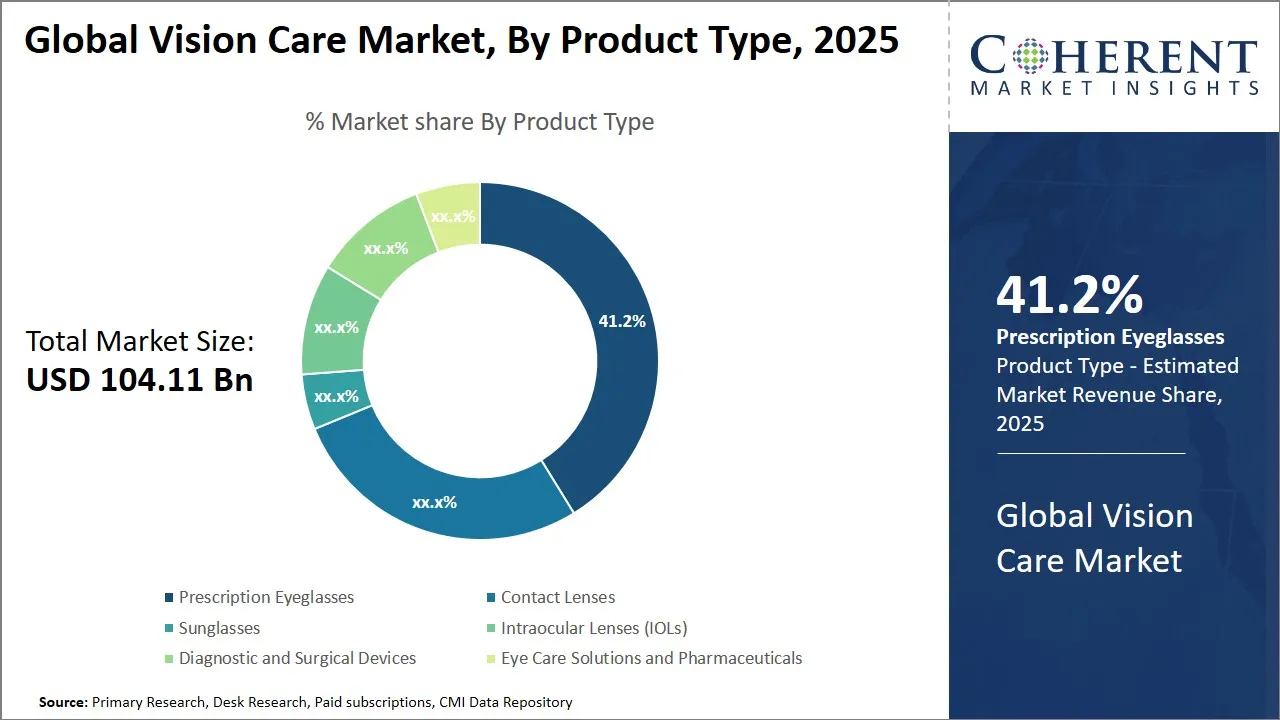
- Prescription eyeglasses segment is expected to hold the largest share in the vision care market, contributing 42.2% share in 2026.
- The refractive errors (myopia, hyperopia, etc.) segment is expected to dominate with 33.3% of the global vision care market share in 2026.
- The corrective vision care segment is forecasted to lead the market, accounting for 44.5% share in 2026.
- North America is expected to lead the market, holding a share of 42.3% in 2026. Asia Pacific is anticipated to be the fastest-growing region, with an estimated market share of 24.5% in 2026.
Market Overview
A prominent market trend is the rapid adoption of innovative vision care solutions such as smart contact lenses and digital eye strain products, fueled by the increasing use of digital devices worldwide. Additionally, the surge in myopia cases, especially among younger demographics, is prompting consumers to seek specialized eyewear, thereby driving product diversification. Furthermore, the integration of AI and tele-optometry services is transforming customer experience, enabling personalized vision care and remote consultations, which contributes to sustained market expansion.
Currents Events and Its Impacts
Current Events | Description and its Impact |
Integration of AI & Telehealth in Eye Care |
|
Rising adoption of daily disposable and cosmetic/colored lenses among younger demographics |
|
Segmental Insights
- Current Industry Events of 2026
- Market Size Estimation
- Regional Breakdown
- Competitive Landscape
- Customer Intelligence
- Segmental Analysis
- Pricing Analysis
- Key Market Drivers, Challenges & Future Trends
- Customized Insights Section
Vision Care Market Insights, By Product Type – Prescription Eyeglasses Drive Demand Amid Rising Visual Impairments
In the product type segment, the prescription eyeglasses segment is expected to hold 42.2% of the market share in 2026. One main reason behind this fact is that they cannot be substituted with any other product in correcting the refractive errors which affect a large section of the global population. The high occurrence of myopia, hyperopia, astigmatism, and presbyopia indicates a great demand for vision correction methods that are basically effective.
Eyeglasses are the most chosen first solution for millions of people all around the world because they provide a simple, non-invasive, and affordable way out for these visual defects. Technological innovations in lens manufacturing have been the introduction of progressive and bifocal lenses which have allowed the eyeglasses to have multiple focal points and thus adding user comfort and convenience.
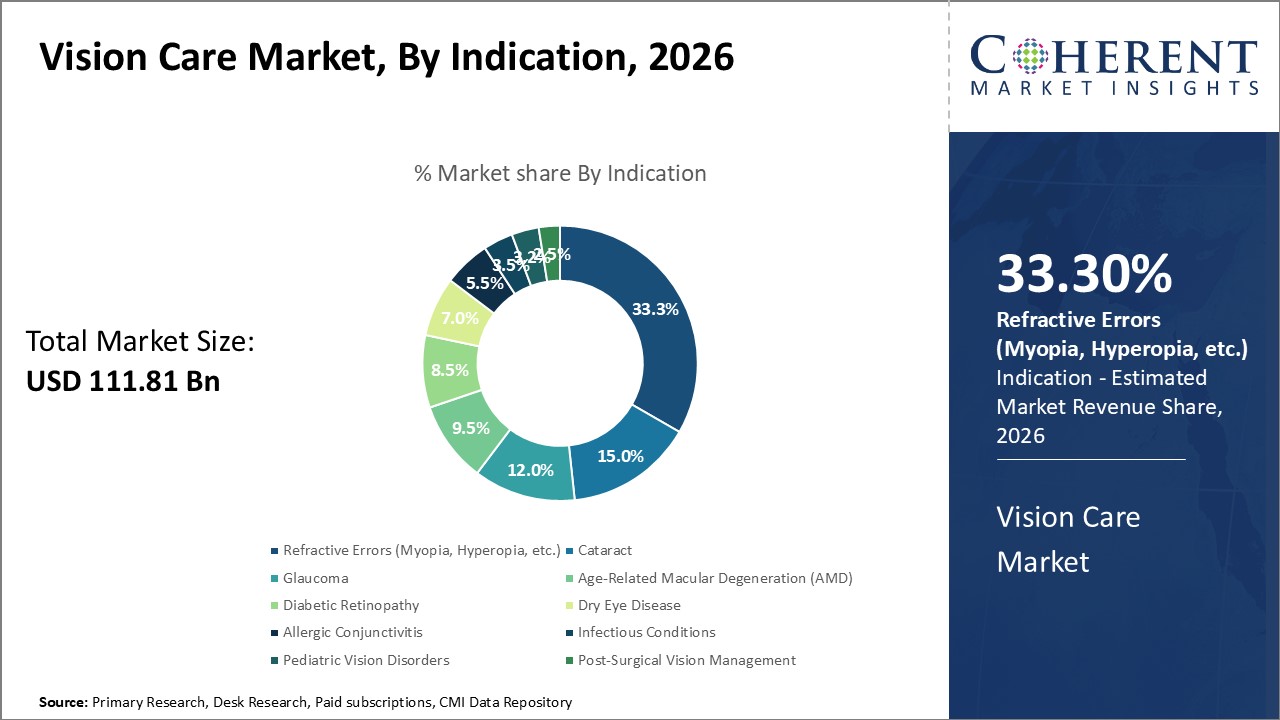
Vision Care Market Insights, By Indication – Refractive Errors (Myopia, Hyperopia, etc.) Lead Due to Universal Prevalence and Life-Long Management Needs
The refractive errors (myopia, hyperopia, etc.) segment is projected to account for 33.3% share in 2026. The factors driving this include global prevalence and long-lasting vision correction need over the entire life span.
Blurred vision caused by these errors makes it difficult for the people to carry out daily activities normally, and the reason for this is that the errors result from irregularities in the cornea shape or the length of the eyeball. Besides, refractive errors are checked at an early age and tend to get worse in time—particularly with myopia in kids and teenagers which has already been popular among the youth owing to factors like the long use of electronic gadgets and less time spent outdoors.
Vision Care Market Insights, By Usage Pattern – Corrective Vision Care Dominates Through Broad Applicability and Technological Advancements
The corrective vision care segment occupies the topmost position in the global vision care market accounting for an estimated 44.5% share in 2026, because of the universal need and their vital role in giving the solution to the desired visual accuracy in all age groups.
In February 2026, Dr. Jeevan Ladi, a Pune-based ophthalmologist, introduced a new eye procedure called VOZ. This innovative technique corrects vision for individuals with thin corneas and refractive errors. A Sudanese patient with high myopia and a thin cornea successfully underwent the procedure, which preserved over 30% of the corneal tissue.
Pricing and Reimbursement Landscape for Corrective Lenses in the Vision Care Market
- Pricing for corrective lenses varies depending on lens type, material, and coatings. Basic single-vision lenses typically start around USD 34, while high-index lenses can cost up to USD 182. Progressive lenses begin at USD 85, with premium options reaching USD 360. Total costs for prescription glasses, including lenses and frames, typically range from USD 200–300 for mid-range pairs, but premium options with designer frames and specialty lenses can exceed USD 1,000.
- Reimbursement for corrective lenses is influenced by insurance plans and employer benefits. Flexible Spending Accounts (FSAs) allow employees to use pre-tax dollars for eye care, but they often have annual contribution limits and may not cover high-end options. For surgical corrections like LASIK or Clear Lens Exchange (CLE), reimbursement is more complex. Insurance may cover part of the costs if deemed medically necessary, but these procedures are typically considered elective, leading many patients to bear the full expense.
Regional Insights
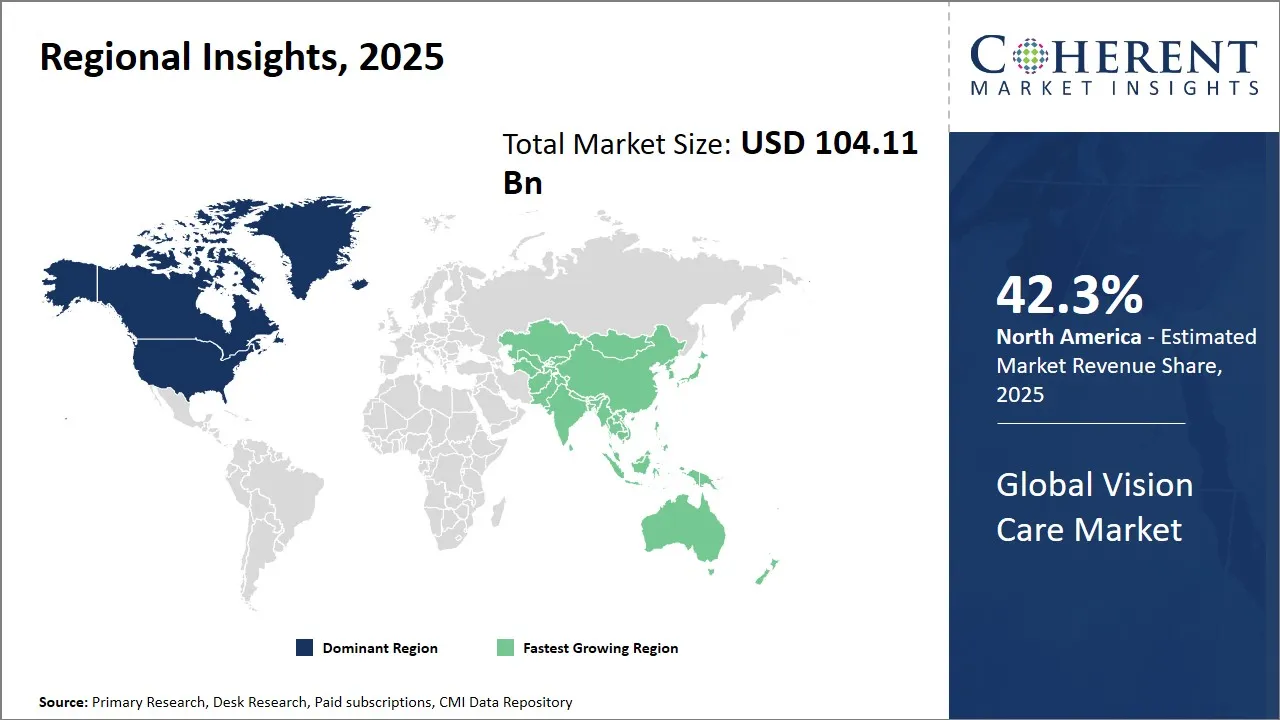
North America Vision Care Market Analysis and Trends
The leading position of North America in the global vision care market can be attributed to various factors that converge and result in an estimated market share of 42.3% in 2026. A lot of things working together first-class infrastructure in healthcare, widespread knowledge regarding eye health, and very good distribution networks are the building blocks of a strong market ecosystem here. Patients’ access to vision care, especially in the U.S., has become easier due to government measures, such as Medicare Medicaid, while the regulatory environment has been a big plus for introducing new products.
The competition has actually increased and innovation has grown as a result of leading companies such as Johnson & Johnson Vision Care, Baush + Lomb (which is part of Bausch Health), and CooperVision disrupting the industry. On top of that, North America’s dominance in the market is being upheld through powerful healthcare reimbursement policies and partnerships between private firms and healthcare institutions.
Asia Pacific Vision Care Market Analysis and Trends
The Asia Pacific region is expected to exhibit the fastest growth in the market contributing 24.5% share in 2026. The factors that contribute to this phenomenon include rapid urbanization, an increase in vision impairments because of lifestyle changes, and a higher level of health awareness among the group and population. Not only that, but the regions mentioned above China, India, and other Southeast Asian countries also gain from the growth of the healthcare infrastructure and the government health programs that intend to make the eye care services more accessible.
Alcon, EssilorLuxottica, and Hoya Corporation have chosen not to wait and are going to Asia Pacific with strategic partnerships, localized production, and marketing campaigns. Moreover, market growth has been accelerated by trade liberalization and improved supply chain mechanisms that have made it easier for high-quality imported products and technologies to be available in the market.
Global Vision Care Market Outlook for Key Countries
U.S. Vision Care Market Trends
The U.S. vision care market benefits from a highly developed healthcare system with widespread access to vision care services. The presence of major companies such as Johnson & Johnson Vision Care and Bausch + Lomb provides continuous innovation, including advanced contact lenses and vision correction surgeries. Strict regulatory oversight by the U.S. FDA ensures high product standards, fostering consumer confidence. Moreover, government health programs and employer-sponsored vision plans contribute to strong market demand across demographics.
In September 2026, Biz4Group, a U.S.-based AI development company, introduced its new AI Avatar Eye Test Companion App to support digital Vision Care. The platform uses interactive avatars to guide patients through remote eye exams with clear instructions and real-time feedback. It aims to improve access in underserved areas and strengthen tele-optometry services.
China Vision Care Market Trends
The evolution of the Chinese vision care market is lightning-fast and is driven mainly by urbanization and an alarming rate of myopia, particularly in the young population. Among the factors that have contributed to improved service accessibility is government policy of assuring visual health and preventive care—penetrating market. Global players like EssilorLuxottica and Hoya Corporation are hopping big on localization strategies that include opening production as well as research facilities. The proliferation of online shopping sites and distance eye care services has made it easy to get access to tier-two and tier-three cities almost overnight.
In October 2026, China launched the WHO SPECS 2030 Initiative to expand access to Vision Care and released its National Action Plan for Refractive Error, led by WHO China and the National Committee for the Prevention of Blindness, which coordinates national eye-health programs.
India Vision Care Market Trends
With the vast population and better awareness about eye health, the India vision care market is driving the Asia Pacific market, and it is extending its brackets with substantial opportunities. The access to health services, especially in very remote and semi-urban locations, has significantly improved due to public health programs for preventable blindness and provision of subsidized eye care. Companies like Carl Zeiss Meditec and EssilorLuxottica have made their positions strong by working together with the government’s initiatives and the vision correction campaigns led by NGOs. More and more people are using digital devices, which in turn, leads to a higher demand for vision care products, whereas price and innovation still play the role of key competitive factors.
In November 2026, ZEISS, a global optics leader, opened its second ZEISS Vision Center in Pune with Bapat Optics to expand premium vision care access. The center offers advanced digital eye tests, personalized lenses, and a curated eyewear range to improve eye care availability in the city.
Germany Vision Care Market Trends
Germany's vision care market very much depends on a developed healthcare system that sets the bar high for vision care. Besides, the presence of top-notch companies such as Carl Zeiss AG and Rodenstock in Europe is felt through their lens technology and custom eyewear solutions. The country's established eye care professionals and healthcare reimbursement policies are quite supportive to the market. Digital lens manufacturing and innovation in presbyopia correction are still among the main factors shaping the competitive landscape.
In July 2026, Santen, a global eye-health company with more than 130 years of expertise, launched Ryjunea in Germany as the first European Commission-approved treatment to slow pediatric myopia progression. The therapy gives specialists a regulated alternative to compounded atropine drops and supports early intervention as childhood myopia rises worldwide.
End User Feedback and Unmet Needs in the Global Vision Care Market
- The global vision care market end user feedback gives two sides of a coin, wherein positives and negatives slide in. Healthcare providers have mentioned anti-reflective coatings and blue light protection as the main benefits, especially in children's myopia management. One of the main eye care products from Hoya Corporation, “MiYOSMART” lenses, has been marketed for, among other things, slowing myopia progression and has received favorable reviews for this. On the other hand, people belonging to lower-income groups mostly see high cost of modern lenses and eye exams as an obstacle, and this is one of the reasons for complaints regarding EssilorLuxottica's pricing policy.
- Market gaps that are not filled deal with personalization and price. Customers are having a hard time getting the right eyewear for their needs as they cannot get personalization done, and there are hardly any affordable options available. Therefore, if manufacturers would provide the market with cheaper and more personalized solutions, not only would the market grow but also the customer retention would increase. By lowering production costs and improving the quality of support services, manufacturers can reach the previously neglected segments, create a wider adoption of advanced solutions and, thus, benefit from it.
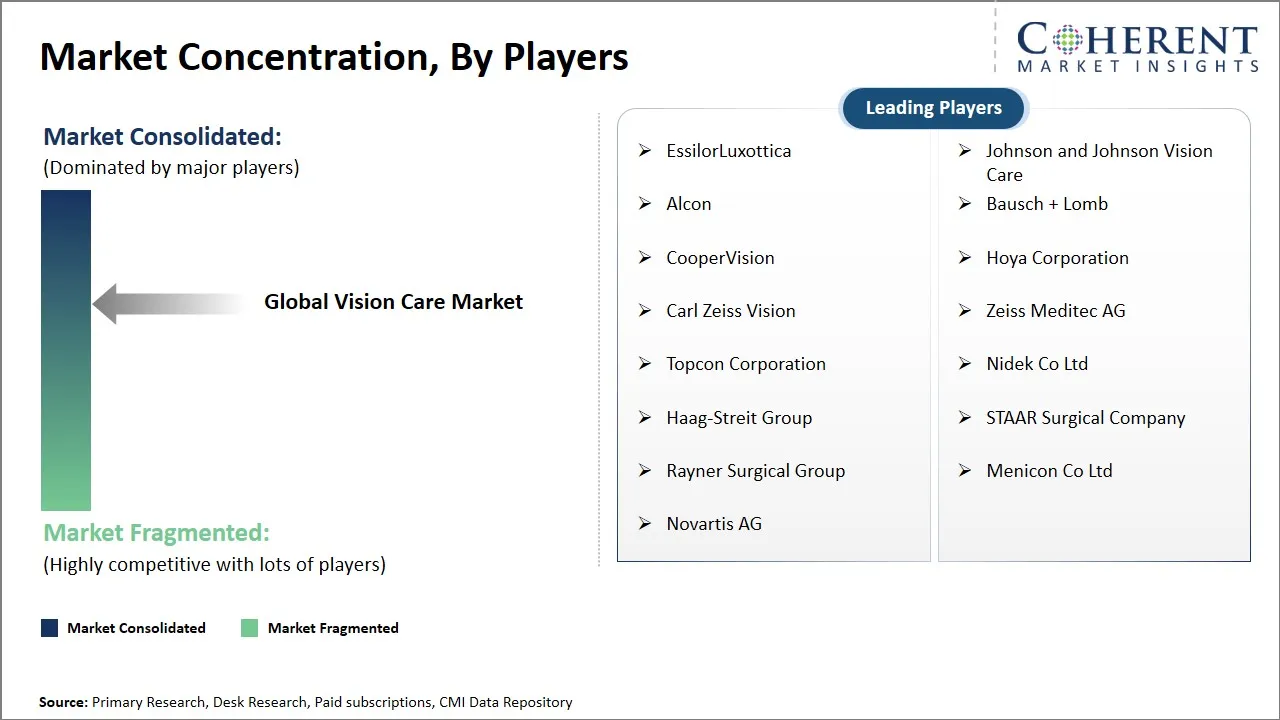
Market Players, Key Developments, and Competitive Intelligence
Key Developments
- On December 01, 2025, Himax Technologies, a major semiconductor and display solutions provider, and Liqxtal Technology, its optical solutions subsidiary, introduced the Pro-Eye vision-care monitor with WiseEye AI at the Taiwan Healthcare+ Expo, offering long-distance virtual viewing and real-time eye-tracking to ease visual strain for seniors, children, and heavy digital users.
- In October 2025, Rajan Eye Care Hospital, a leading Chennai-based vision care provider, launched WaveLight Plus InnovEyes, an AI-powered eye correction technology that maps over 100,000 optical data points to build a precise 3D eye model for personalized vision treatment, marking a major upgrade in clinical accuracy and patient outcomes
- In September 2025, HOYA Vision Care, a global leader in advanced lens technology, introduced its VisuPro All Day and VisuPro Flex lenses for emerging presbyopes, offering improved near-vision support for adults aged 36–44 and strengthening its vision care portfolio with enhanced focus, reduced eye strain, and smoother binocular performance.
- In April 2025, the Clinton Health Access Initiative, a global public health organization, and the OneSight EssilorLuxottica Foundation, a leading global vision care nonprofit, launched a long-term partnership in Africa to expand affordable eyeglass access, strengthen local optical systems, and support governments in building sustainable refractive-error services for underserved communities.
Top Strategies Followed by Global Vision Care Market Players
- Almost everywhere in the market, the giant corporations are on top with their heavy R&D investments, aiming to produce powerful products that would not only attract consumers but also comply with the changing regulations. These companies very often enter into partnerships with other leading companies or OEMs as a strategic move to strengthen their tech and maintain their market share. Not only do these collaborations help in improving the quality of the products and making the range wider, but they also help in making the supply chains more efficient and in bringing the products to the market faster.
- Companies like EssilorLuxottica, Johnson & Johnson Vision, and CooperVision exemplify this strategy. EssilorLuxottica continuously invests in next-gen lens technologies such as Varilux XR and Stellest for myopia control, while Johnson & Johnson Vision advances silicone hydrogel lenses and surgical ophthalmology systems through strong R&D pipelines.
- The mid-tier players in the global vision care market are implementing strategies that are quite different from the other players in the market, and they are mainly targeting the middle-class customers who are not very much quality conscious but are price sensitive. The companies are giving their focus to the provision of solutions that will cost the consumers less, but the quality will be the same, thereby attracting the customers who consider quality-to-price ratio as an important factor in their buying decisions.
- Firms such as Hoya Vision Care, Alcon’s mid-tier lens divisions, and Bausch + Lomb’s value-focused segments fit this category. Hoya scales affordable but high-quality prescription lenses for cost-sensitive markets, while Bausch + Lomb’s SofLens product range targets value seekers without compromising baseline performance.
- The vision care market has various small-scale players, and these are the players who are focusing on specific features or offering innovative products that would attract more customers and, in the process, would also differentiate them from the larger competitors. By highlighting the use of the latest technology in smart lenses, eco-friendly materials, or tailor-made solutions, these small players have managed to sustain their business even with scarce resources.
- Brands like Mojo Vision, EnChroma, and DeepOptics illustrate niche-focused innovation. Mojo Vision develops smart augmented-reality contact lenses, while EnChroma targets color-blindness correction with patented optical filters. DeepOptics’ adaptive-focus smart eyewear shows how small players differentiate through unique, tech-centric features and selective market penetration strategies.
Market Report Scope
Vision Care Market Report Coverage
| Report Coverage | Details | ||
|---|---|---|---|
| Base Year: | 2025 | Market Size in 2026: | USD 111.81 Bn |
| Historical Data for: | 2020 To 2024 | Forecast Period: | 2026 To 2033 |
| Forecast Period 2026 to 2033 CAGR: | 7.4% | 2033 Value Projection: | USD 184.30 Bn |
| Geographies covered: |
| ||
| Segments covered: |
| ||
| Companies covered: | EssilorLuxottica, Johnson and Johnson Vision Care, Alcon, Bausch + Lomb, CooperVision, Hoya Corporation, Carl Zeiss Vision, Zeiss Meditec AG, Topcon Corporation, Nidek Co Ltd, Haag-Streit Group, STAAR Surgical Company, Rayner Surgical Group, Menicon Co Ltd, and Novartis AG | ||
| Growth Drivers: |
| ||
| Restraints & Challenges: |
| ||
Vision Care Market Dynamics
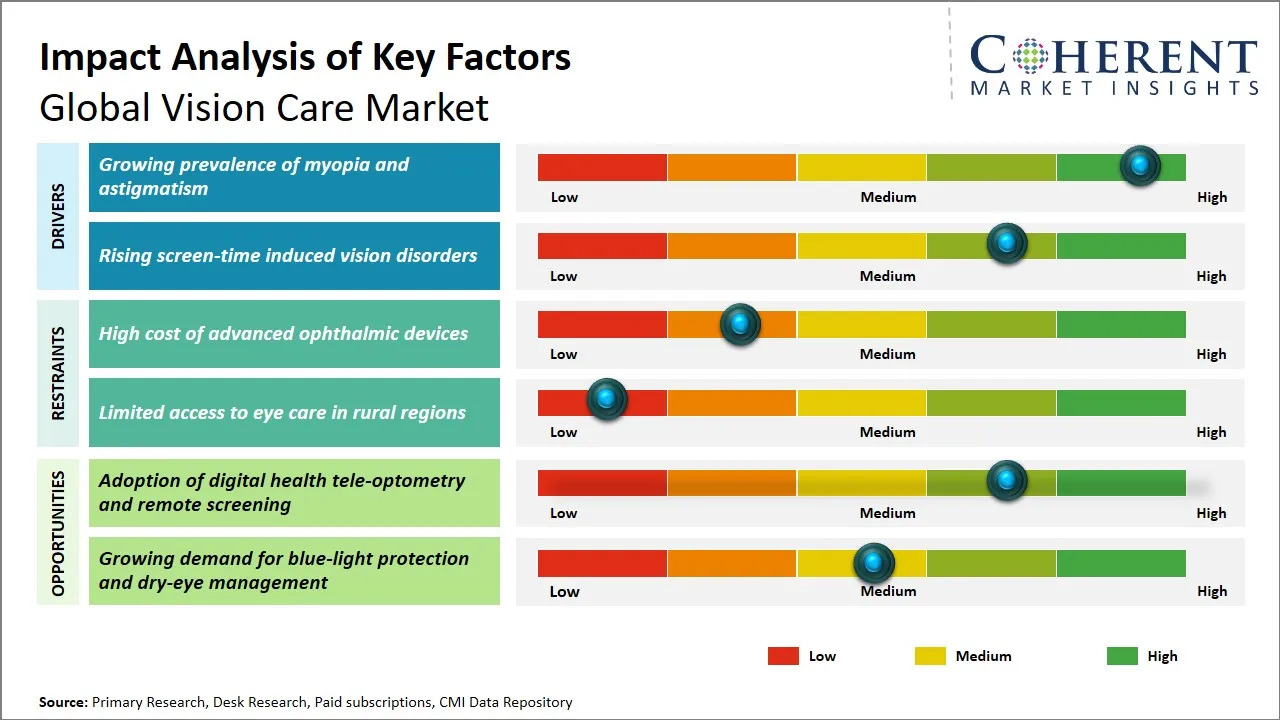
Vision Care Market Driver - Growing Prevalence of Myopia and Astigmatism
The increasing rate of occurrence of refractive errors like myopia and astigmatism is the main factor fostering the growth of the global market for vision care products. The changes in lifestyle habits, digital devices leading to more screen time, and urbanization, among other factors, have resulted in increased incidence of these eye defects in different age groups, especially children and young adults. Consequently, the necessity for optical correction lenses, comprising spectacles and contacts, that are particularly made to correct these usual conditions has been increasing.
Furthermore, a better understanding of the significance of early detection and treatment of myopia and astigmatism has led to more eye examinations being done, and hence the demand for vision care products and services is increasing. Moreover, lens technology is evolving, and that is why patients are given the option of undergoing surgery that not only corrects their vision but also slows down the development of these refractive errors.
On November 26, 2025, the Journal of Contemporary Clinical Practice published new Vision Care findings from Vizianagaram, reporting a 6.5% prevalence of refractive errors among 5893 school children. Myopia dominated with 84%, followed by astigmatism at 15%, while hypermetropia was rare. Girls were affected far more than boys, and only 6.7% of children used spectacles despite having impaired vision. The study showed myopia rising sharply in the 14–17 age group, reinforcing the urgent need for stronger school-based screening and better awareness in India’s semi-urban regions.
Vision Care Market Opportunity - Adoption of Digital Health Tele-Optometry and Remote Screening
The increasing acceptance of digital health technologies such as tele-optometry and remote screening is seen as a significant growth opportunity for the global vision care market. Tele-optometry makes it possible for eye care practitioners to remotely perform eye exams, find out if there are any vision problems, and give recommendations using digital platforms, thus eliminating the limitations of distance and access, particularly in areas that lack services and in rural regions.
To carry out an instant vision evaluation, very sophisticated imaging equipment, artificial intelligence (AI), and smartphone applications are used together; this allows for the early detection and appropriate management of eye disorders that can affect eyesight, such as refractive errors, glaucoma, and diabetic retinopathy. Remote screening also increases the level of comfort for the patients as it cuts down on the need for them to attend many in-person appointments, which is especially beneficial when there are concerns about people's access to the healthcare facilities due to pandemics or other restrictions.
In February 2025, DigitalOptometrics, a U.S. tele-optometry company, introduced its first autonomous slit lamp developed with SlitLED, an Israeli medical device manufacturer, to advance remote vision care. The system offers high-resolution imaging and remote-control features that allow clinicians to perform detailed eye exams from any location. Both companies aim to make advanced diagnostics more accessible through telemedicine-ready technology.
Analyst Opinion (Expert Opinion)
- AI-powered diagnostics, remote examination instruments, and improved lens technologies are quickly becoming the new standard and consequently causing the vision care market to increase in size. Besides that, stronger regulatory push for myopia detection and consumer demand for high-quality eyewear are the main things that the market is relying on, although these have their drawbacks in the form of access gaps and product-cost pressures. Discussions on digital exams, smarter diagnostics, and the future of clinical standards are still being influenced by industry events like Vision Expo East, Vision Expo West, and the Global Ophthalmology Summit.
- Among the recent steps taken, the most significant is DigitalOptometrics’ introduction of an automated slit lamp, rather than EssilorLuxottica’s trial of smart-lens technologies and school screening programs led by governments in Asia Pacific that are all reshaping the priorities of the market. The collaboration of hospitals, device manufacturers, and tele-optometry platforms along with the implementation of more myopia-control initiatives and new OCT systems are not only improving clinical outcomes but also leading the market towards faster and more accessible eye-care innovations.
Speak to the analyst
Want personalized insights?
Take the findings above to one of our principal consultants, or have the report rebuilt around the segments, geographies and competitors you actually track.
Market Segmentation
- Product Type Insights (Revenue, USD Bn, 2021 - 2033)
- Prescription Eyeglasses
- Frames
- Lenses (Single-Vision Lenses, Progressive Lenses, Bifocal Lenses, Trifocal Lenses)
- Contact Lenses
- Soft Contact Lenses
- Rigid Gas Permeable (RGP) Lenses
- Hybrid Lenses
- Daily Disposable Lenses
- Weekly / Monthly Replacement Lenses
- Toric Lenses
- Multifocal Contact Lenses
- Sunglasses
- Prescription Sunglasses
- Non-Prescription Sunglasses
- Intraocular Lenses (IOLs)
- Monofocal IOLs
- Multifocal IOLs
- Toric IOLs
- Accommodating IOLs
- Diagnostic and Surgical Devices
- Retinal Imaging Systems
- Ophthalmic Optical Coherence Tomography (OCT)
- Autorefractors
- Slit Lamps
- Fundus Cameras
- Refractive Surgery Lasers
- Eye Care Solutions and Pharmaceuticals
- Artificial Tears
- Eye Drops (Anti-Allergy, Lubricating, Anti-Inflammatory, Antibiotic)
- Contact Lens Care Solutions (Cleaning, Disinfecting, Rewetting)
- Prescription Eyeglasses
- Indication Insights (Revenue, USD Bn, 2021 - 2033)
- Refractive Errors (Myopia, Hyperopia, etc.)
- Cataract
- Glaucoma
- Age-Related Macular Degeneration (AMD)
- Diabetic Retinopathy
- Dry Eye Disease
- Allergic Conjunctivitis
- Infectious Conditions
- Pediatric Vision Disorders
- Post-Surgical Vision Management
- Usage Pattern Insights (Revenue, USD Bn, 2021 - 2033)
- Corrective Vision Care
- Preventive and Protective Vision Care
- Cosmetic and Aesthetic Vision Care
- Age Group Insights (Revenue, USD Bn, 2021 - 2033)
- Adult
- Pediatric
- Geriatric
- Technology Insights (Revenue, USD Bn, 2021 - 2033)
- Conventional Lenses and Frames
- Digital/Free-Form Lens Technology
- Smart/Connected Eyewear
- Advanced Surgical Technologies
- AI-Enabled Diagnostic and Screening Tools
- Sales Channel Insights (Revenue, USD Bn, 2021 - 2033)
- Online
- Offline
- End User Insights (Revenue, USD Bn, 2021 - 2033)
- Hospitals
- Ophthalmology Clinics and Eye Hospitals
- Optometry Clinics
- Optical Retail Chains
- Independent Optical Stores
- Ambulatory Surgical Centers
- Home-Use/Consumer Segment
- Regional Insights (Revenue, USD Bn, 2021 - 2033)
- North America
- U.S.
- Canada
- Latin America
- Brazil
- Argentina
- Mexico
- Rest of Latin America
- Europe
- Germany
- U.K.
- Spain
- France
- Italy
- Russia
- Rest of Europe
- Asia Pacific
- China
- India
- Japan
- Australia
- South Korea
- ASEAN
- Rest of Asia Pacific
- Middle East
- GCC Countries
- Israel
- Rest of Middle East
- Africa
- South Africa
- North Africa
- Central Africa
- North America
- Key Players Insights
- EssilorLuxottica
- Johnson and Johnson Vision Care
- Alcon
- Bausch + Lomb
- CooperVision
- Hoya Corporation
- Carl Zeiss Vision
- Zeiss Meditec AG
- Topcon Corporation
- Nidek Co Ltd
- Haag-Streit Group
- STAAR Surgical Company
- Rayner Surgical Group
- Menicon Co Ltd
- Novartis AG
Sources
Primary Research Interviews
- Industry Stakeholders
- Optometrists
- Ophthalmic Device Manufacturers
- End Users
- Patients with Refractive Errors
- Contact Lens Wearers
Government and International Databases
- World Health Organization (WHO)
- U.S. FDA
- National Institutes of Health (NIH)
- Centers for Disease Control and Prevention (CDC)
- European Medicines Agency (EMA)
- International Agency for the Prevention of Blindness (IAPB)
Trade Publications
- Optometry Times
- Ophthalmology Times
- Contact Lens Spectrum
- Vision Monday
- EyeWorld Magazine
- 20/20 Magazine
Academic Journals
- Investigative Ophthalmology & Visual Science (IOVS)
- JAMA Ophthalmology
- Ophthalmology Journal
- Contact Lens & Anterior Eye
- American Journal of Ophthalmology
- British Journal of Ophthalmology
Reputable Newspapers
- The New York Times
- The Guardian
- The Wall Street Journal
- Financial Times
- Reuters Health
- The Washington Post
Industry Associations
- American Optometric Association (AOA)
- American Academy of Ophthalmology (AAO)
- European Society of Cataract and Refractive Surgeons (ESCRS)
- Vision Council
- International Council of Ophthalmology (ICO)
- World Council of Optometry (WCO)
Public Domain Resources
- Google Scholar
- ClinicalTrials.gov
- ScienceDirect Open Access
- U.S. Patent and Trademark Office (USPTO)
- National Eye Institute (NEI)
Proprietary Elements
- CMI Data Analytics Tool: Proprietary analytics tool to analyze real-time market trends, consumer behavior, and technology adoption in market
- Proprietary CMI Existing Repository of Information for Last 8 Years
Get access to 250+ pages report
Every segment, forecast, competitor profile and data table behind the analysis above — available for instant download.
- ESOMAR Member
- ISO 9001:2015 Certified
- D-U-N-S Registered
- GDPR & CCPA Compliant
Missing comfort of reading report in your local language? Find your preferred language:
Transform your Strategy with Exclusive Trending Reports
Frequently Asked Questions
The global vision care market is estimated to be valued at USD 111.81 Bn in 2026 and is expected to reach USD 184.30 Bn by 2033.
The CAGR of the global vision care market is projected to be 7.4% from 2026 to 2033.
Growing prevalence of myopia and astigmatism and rising screen-time induced vision disorders are the major factors driving the growth of the global vision care market.
High cost of advanced ophthalmic devices and limited access to eye care in rural regions are the major factors hampering the growth of the global vision care market.
In terms of product type, the prescription eyeglasses are estimated to dominate the market revenue share in 2026.
EssilorLuxottica, Johnson and Johnson Vision Care, Alcon, Bausch + Lomb, CooperVision, Hoya Corporation, Carl Zeiss Vision, Zeiss Meditec AG, Topcon Corporation, Nidek Co Ltd, Haag-Streit Group, STAAR Surgical Company, Rayner Surgical Group, Menicon Co Ltd, and Novartis AG are the major players.
North America is expected to lead the global vision care market in 2026.