

Global Vision Transformer Market Size and Forecast – 2026-2033
Coherent Market Insights estimates that the global vision transformer market is expected to reach USD 0.50 Bn in 2026 and will expand to USD 2.75 Bn by 2033, registering a CAGR of 32% between 2026 and 2033.
Key Takeaways of the Vision Transformer Market
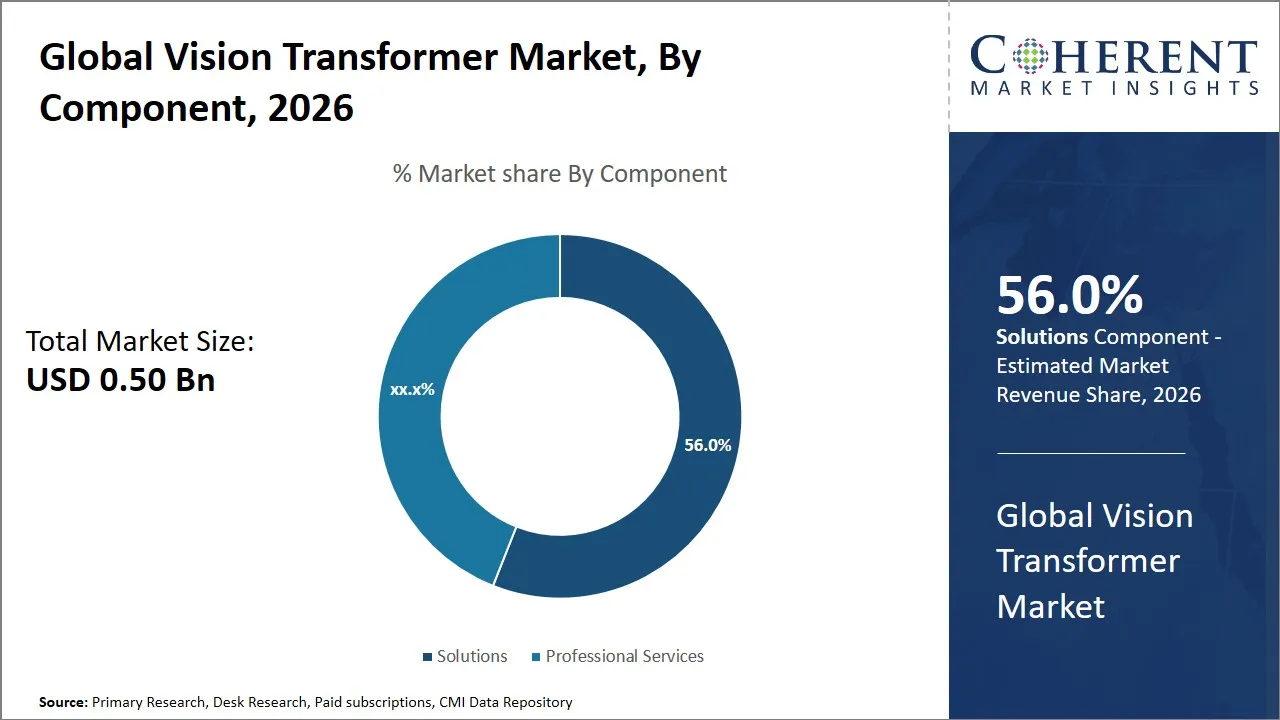
- The solutions segment is expected to account for 56% of the vision transformer market share in 2026.
- The image classification segment is estimated to hold 36% of the global vision transformer market share in 2026.
- The retail and e-commerce segment is projected to capture 32% of the market share in 2026.
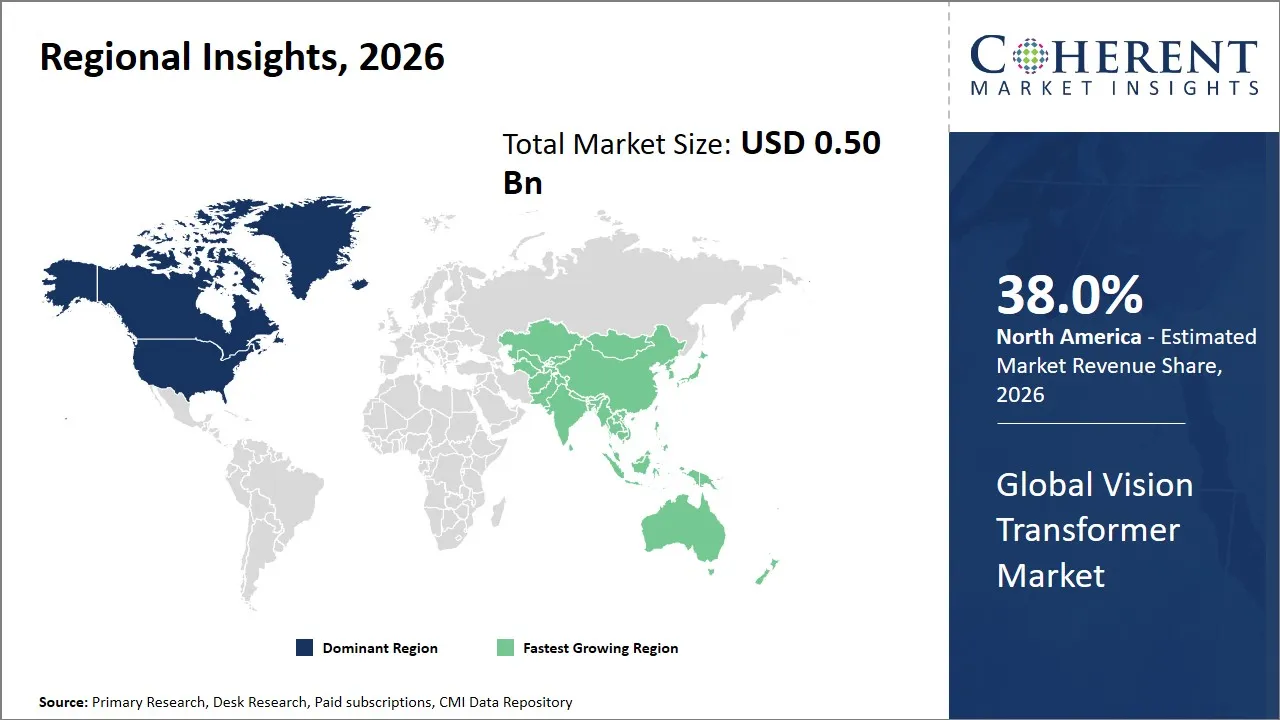
- North America is projected to dominate the vision transformer market in 2026 with a 38% share.
- Asia Pacific will hold 27% share in 2026 and is expected to record the fastest growth over the forecast period.
Current Events and Its Impact
Current Events | Description and its Impact |
NVIDIA DLSS 4 Announcement |
|
Segmental Insights
- Current Industry Events of 2026
- Market Size Estimation
- Regional Breakdown
- Competitive Landscape
- Customer Intelligence
- Segmental Analysis
- Pricing Analysis
- Key Market Drivers, Challenges & Future Trends
- Customized Insights Section
Why Does the Solutions Segment Dominate the Global Vision Transformer Market in 2026?
The solutions segment is expected to hold 56.0% of the global vision transformer market share in 2026. The growth can be attributed to its direct impact on enabling AI-driven visual recognition tasks across diverse industries. Part of this sector covers ready-made vision transformer systems. These tools let companies add sophisticated image recognition functions to current setups.
Strong results drive adoption; accuracy remains high even with complex visuals - something traditional CNN methods sometimes struggle to achieve. Rather than depending only on nearby features, these models use self-attention mechanisms. That brings wider understanding across entire pictures. Improved insight follows, particularly useful when examining elaborate scenes closely. Adjustment happens fluidly, highlighting key areas while moving beyond rigid spatial limits.
Image Classification Segment Dominates the Global Vision Transformer Market
The image classification segment is expected to hold 36.0% of the global vision transformer market share in 2026. Growth finds explanation through broad usefulness alongside a core function in analyzing visuals. What lies behind labeling pictures is recognizing key elements inside them, assigning labels that matter - this supports vital operations driven by artificial intelligence across areas such as medicine, stores, and self-driving transport. Better results seen with vision transformers come from how they capture distant relationships in visual frames, outperforming older techniques when precision counts.
Why is Retail and E-commerce the Most Crucial End User in the Vision Transformer Market?
The retail and e-commerce segment is expected to hold 32.0% of the global vision transformer market share in 2026. Fueled by rising demands, advancement emerges where tailored interactions meet smooth operations. As systems evolve seamlessly, performance improves, setting fresh benchmarks in how services operate. Starting with visual search, moving through shelf checks, down to spotting dishonest activity, vision transformers give retailers tools for sharper image analysis - each piece streamlining operations behind and ahead of the customer view.
For instance, on November 14, 2025, Amazon announced its Lens Live, a new feature that uses camera to scan things in the environment around users, while surfacing matching product listings. When customers with Lens Live open Amazon Lens, the Lens camera will instantly begin scanning products and show top matching items in a swipe-able carousel at the bottom of the screen, allowing for quick comparisons.
(Source: aboutamazon.com)
Hybrid Architectures Adoption
Category | 2023 Adoption Share | 2026 Adoption Share | 2030 Adoption Share |
Pure CNN Architectures | 48% | 32% | 18% |
Pure Vision Transformer Architectures | 22% | 26% | 30% |
Hybrid CNN ViT Architectures | 30% | 42% | 52% |
Regional Insights
North America Vision Transformer Market Analysis and Trends
The North America region is projected to lead the market with a 38% share in 2026. Growth emerges where infrastructure exists, supported by consistent investment flows tied closely to leading players in artificial intelligence and semiconductor production. In the U.S., fresh ideas gain ground because government initiatives prioritize advancement in smart technologies and digital transformation pathways. Names including Google (Alphabet), Microsoft, NVIDIA, and IBM influence how Vision Transformers evolve, steering application into healthcare tools, mobility solutions, everyday electronics. Assistance comes less from money alone, more from strong links between academic centers and industry ventures, helping refine models that interpret visuals. Over time, shared methods bring advanced instruments - tangible or digital - into common use, supporting steady progress. Though they merge gradually, separation remains clear in how results form.
For instance, on August 25, 2025, NVIDIA announced the general availability of the NVIDIA Jetson AGX Thor developer kit and production modules, powerful new robotics computers designed to power millions of robots across industries including manufacturing, logistics, transportation, healthcare, agriculture and retail.
(Source: nvidianews.nvidia.com)
Asia Pacific Vision Transformer Market Analysis and Trends
The Asia Pacific region is expected to exhibit the fastest growth in the market contributing 27% share in 2026. Growth stems from fast digital shifts, broader availability of AI specialists, alongside stronger governmental attention toward new tech fields. In places such as China, Japan, South Korea, India, artificial intelligence progress gains momentum via long-term planning, financial backing, enhanced systems.
A rising network of industrial capabilities supports the area - chips built locally, programs developed nearby - making Vision Transformers easier to produce, roll out within regions. Firms including Huawei, Samsung, SenseTime, TCS move forward with visual AI applications, pushing faster adoption across markets. A region marked by swift technological shifts sees fresh ventures emerge, particularly within artificial intelligence and visual computing. Innovation spreads into areas like store operations, monitoring networks, and self-guided machinery through tailored solutions. Policy changes easing cross-border technology exchange play a role, one mirrored by joint efforts under international commerce pacts. Growth gains momentum where regulatory flexibility meets cooperative frameworks among neighboring economies.
Global Vision Transformer Market Outlook for Key Countries
Why is the U.S. Emerging as a Major Hub in the Vision Transformer Market?
Across the U.S., a dense web of research centers works alongside major technology firms pushing forward artificial intelligence. TensorFlow, developed by one prominent firm, operates together with cloud-based tools from another to advance visual processing models. University partnerships often lead - quietly - to refinements in how these systems are structured and applied outside labs. When policy emphasizes safety and fairness in automated decisions, industries gain clearer paths toward adoption. Healthcare systems, machines that move independently, and self-navigating transport solutions now rely increasingly on such image-analysis methods.
Is China the Next Growth Engine for the Vision Transformer Market?
Driven by heavy spending on artificial intelligence systems, China advances its domestic tech capabilities at scale. Rather than relying on external sources, firms like Huawei and SenseTime lead in adapting Vision Transformers for face detection, urban management, and handheld electronics. With directives favoring national control over data flows, enterprises build tailored models suited to regional dialects and practical needs. Instead of working in isolation, research institutions align with private players, accelerating early-stage testing and product rollout. Progress unfolds through structured collaboration, where policy direction meets real-world application demands.
Japan Vision Transformer Market Analysis and Trends
Adoption of vision transformers continues advancing in Japan, where usage spans manufacturing sites, robotic units, automation tools. Instead of waiting, companies like Sony embed these models straight into hardware setups, leading to quicker output cycles along with improved autonomous function. Driven by policy direction tied to Society 5.0 ambitions, large enterprises as well as modest firms see increasing support emerging. Under coordinated national frameworks, technological development moves more smoothly alongside sector modernization efforts. Through focused engineering, NEC delivers customized platforms capable of rapid response via embedded image interpretation abilities. Progress does not favor only one size - small workshops adapt just as larger plants do.
South Korea Vision Transformer Market Analysis and Trends
A driving force in South Korea’s economy comes from semiconductors and electronic devices, where businesses like Samsung and LG apply Vision Transformers to improve visual analysis and functionality in intelligent gadgets. Rather than relying on traditional methods, state-backed programs encourage artificial intelligence adoption across telecom and production sectors, supporting ongoing experimentation. Although global interest grows, local enterprises focus on embedding these models within mobile systems, networked sensors, and next-generation connectivity platforms and this landscape fosters continuous advancement and practical deployment of new technologies.
India Vision Transformer Market Analysis and Trends
A growing number of AI startups in India now explore Vision Transformers, particularly within retail, farming, and medical imaging fields. Large technology firms like TCS and Infosys move forward, weaving new models into current artificial intelligence systems to improve results. With support drawn from national initiatives such as Digital India, resources reach joint ventures uniting academic institutions and industry players.
As policies shift toward digitization, centers focused on machine learning begin seeing sustained investment follow. Despite scale differences, alignment grows between public strategy and private innovation pathways. New rules around data usage encourage broader deployment, shaping how both government offices and commercial entities adopt advanced systems. Progress unfolds gradually, guided by infrastructure updates and strategic investment patterns across regions.
Data Dependency & Training Cost Intensity
Model Architecture | Typical Training Dataset Size (Million Images) | Avg. Training Cost (USD) |
Traditional CNN | 1–5 | USD 20,000–USD 80,000 |
Pure Vision Transformer | 10–50 | USD 150,000–USD 500,000 |
Hybrid CNN–ViT | 5–20 | USD 80,000–USD 200,000 |
Pretrained / Transfer ViT | 2–10 | USD 30,000–USD 90,000 |
Market Players, Key Development, and Competitive Intelligence
Key Developments
- On July 2, 2024, OpenCV, the preeminent open-source library for computer vision and artificial intelligence, announced a collaboration with Qualcomm Technologies, Inc. Qualcomm Technologies’ commitment to advancing the field of computer vision and AI is demonstrated through their support of OpenCV as a Gold Member, reinforcing their dedication to driving industry-wide innovation.
- On May 22, 2024, Microsoft Corporation introduced GigaPath, a novel vision transformer that attains whole-slide modeling by leveraging dilated self-attention to keep computation tractable. In joint work with Providence Health System and the University of Washington, Microsoft have developed Prov-GigaPath, an open-access whole-slide pathology foundation model pretrained on more than one billion 256 X 256 pathology images tiles in more than 170,000 whole slides from real-world data at Providence.
- On March 18, 2024, NVIDIA Corporation announced Project GR00T, a general-purpose foundation model for humanoid robots, designed to further its work driving breakthroughs in robotics and embodied AI. As part of the initiative, the company also unveiled a new computer, Jetson Thor, for humanoid robots based on the NVIDIA Thor system-on-a-chip (SoC), as well as significant upgrades to the NVIDIA Isaac robotics platform.
Top Strategies Followed by Global Vision Transformer Market Players
Player Type | Strategic Focus | Example |
Established Market Leaders | Meta SAM 2 Launch | On July 29, 2024, Meta introduced the Segment Anything Model 2 (SAM 2). SAM 2 is the first unified model for segmenting objects across images and videos. |
Mid-Level Players | Syntiant Corp. Product Launch | On November 10, 2025, Syntiant Corp. introduced its dual-use vision transformer (ViT), delivering advanced target or vehicle detection, zero-shot classification with no additional training and real-time image processing across aerial and surface platforms. |
Small-Scale Players | Roboflow Fund Raising Round | On November 19, 2024, Roboflow announced it has raised an additional USD 40 million to continue building the open-source tools, platform, and community so developers and enterprises can deploy computer vision applications to production. |
Market Report Scope
Vision Transformer Market Report Coverage
| Report Coverage | Details | ||
|---|---|---|---|
| Base Year: | 2025 | Market Size in 2026: | USD 0.50 Bn |
| Historical Data for: | 2020 To 2024 | Forecast Period: | 2026 To 2033 |
| Forecast Period 2026 to 2033 CAGR: | 32% | 2033 Value Projection: | USD 2.75 Bn |
| Geographies covered: |
| ||
| Segments covered: |
| ||
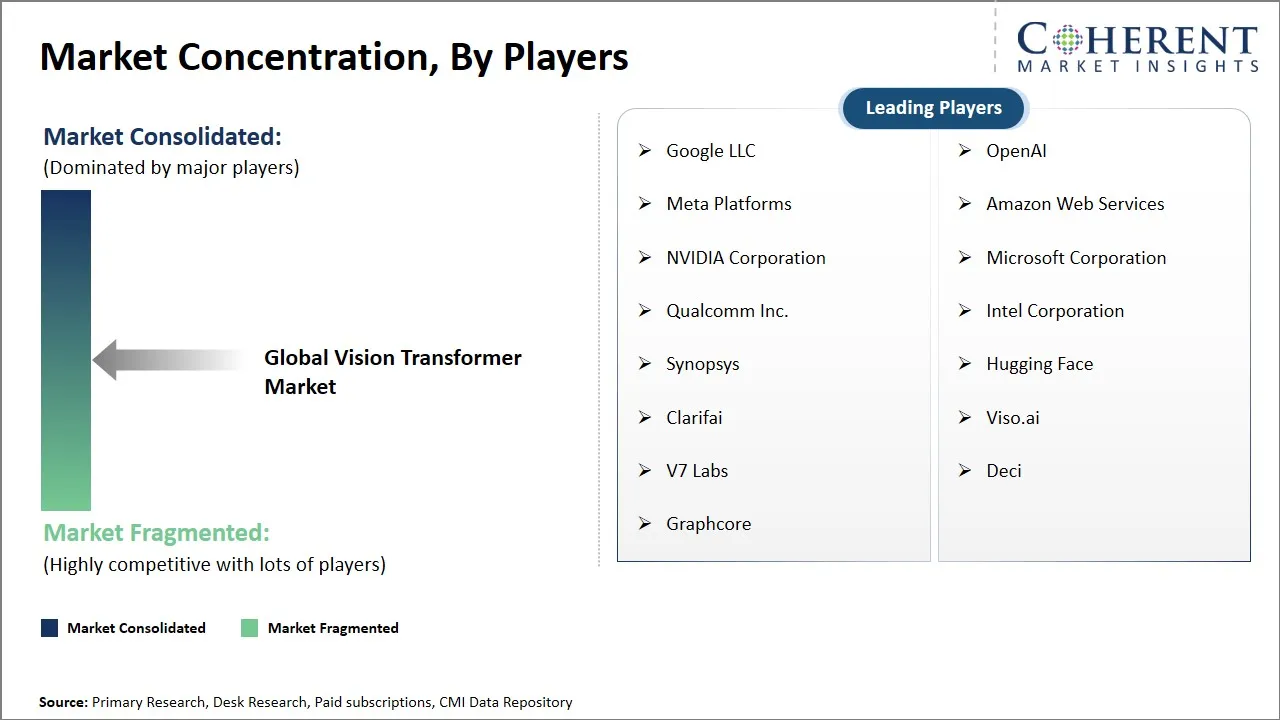
| Companies covered: | Google LLC, OpenAI, Meta Platforms, Amazon Web Services, NVIDIA Corporation, Microsoft Corporation, Qualcomm Inc., Intel Corporation, Synopsys, Hugging Face, Clarifai, Viso.ai, V7 Labs, Deci, and Graphcore | ||
| Growth Drivers: |
| ||
| Restraints & Challenges: |
| ||
Global Vision Transformer Market Dynamics
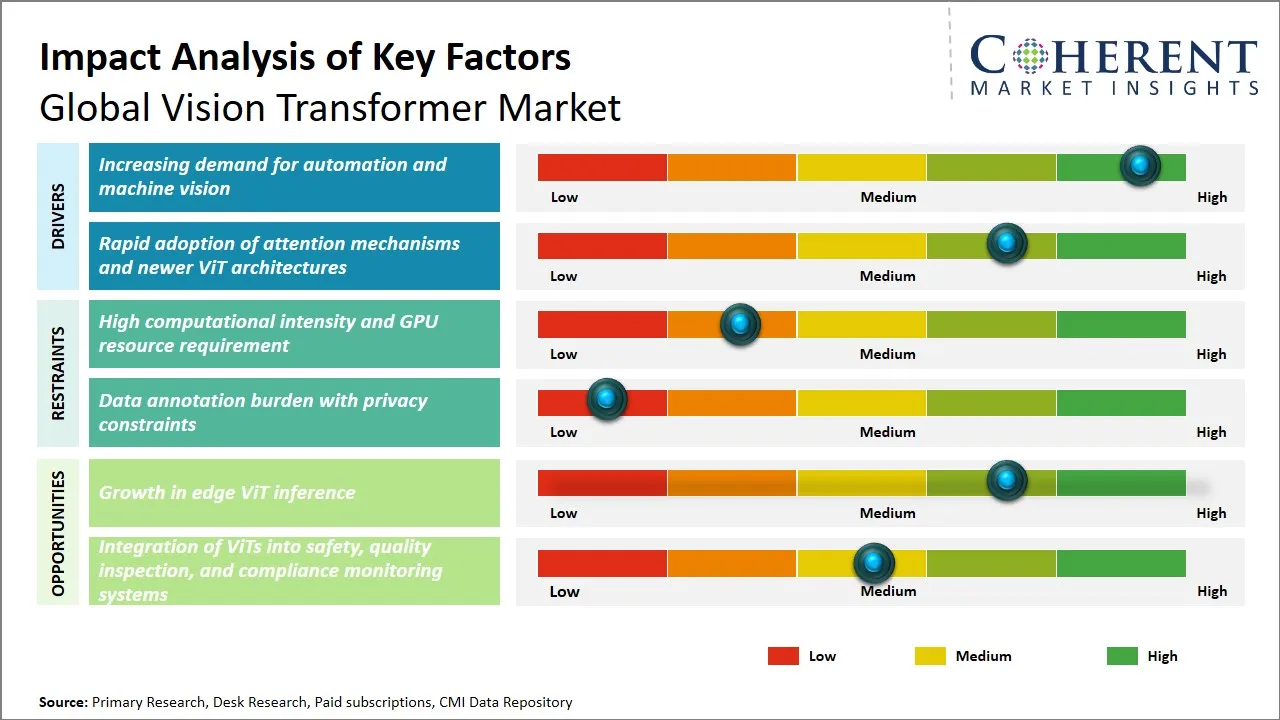
Global Vision Transformer Market Driver - Increasing Demand for Automation and Machine Vision
The growing emphasis on industrial automation across various verticals is significantly driving the adoption of vision transformer technologies. Despite common trends, sectors like manufacturing, healthcare, automotive, and logistics now rely more on machine vision to refine processes, tighten quality checks, fewer mistakes by workers. As they handle intricate imagery with high accuracy, Vision Transformers increasingly support smart automation tools. Unlike older models based on convolutional networks, these systems excel across varied visual challenges, this advantage stands clear in live inspections, spotting flaws, forecasting equipment needs.
For instance, on December 2, 2025, Valens Semiconductor and Imavix engineering S.R.O announced the first production-ready MIPI A-PHY-based platform for implementing the high-performance A-PHY connectivity standard in machine vision. The platform will allow camera vendors to design products that are smaller, more robust, and lower cost than traditional machine vision cameras.
(Source: investors.valens.com)
Global Vision Transformer Market Opportunity - Growth in Edge ViT Inference
Growing needs for instant responses without delay in areas like self-driving cars, monitoring setups, and digital overlays push expansion in edge computing-based vision transformers globally. Instead of relying on distant servers, these systems handle visual tasks locally, cutting reliance on constant internet links while improving safety and confidentiality of information. Improvements in dedicated processors, combined with enhanced regional connectivity, allow intricate visual analysis systems to operate beyond central hubs more effectively. Locating processing closer to information sources aligns with broader shifts in machine learning - reducing reliance on data transfer, yet enabling faster outcomes.
For instance, on August 7, 2025, Ali Corporation and Ceva, Inc announced a strategic licensing partnership to integrate Ceva’s advanced NeuPro-Nano and NeuPro-M Neural Processing Units (NPUs) into Ali’s next-generation Video Display Sub-System (VDSS) platform. This collaboration combines Ali’s expertise in multimedia SoCs with Ceva’s cutting-edge AI technology, enabling the delivery of high-performance audio, video, vision, sensing and AI processing applications in smart edge devices including intelligent smart displays, set-top boxes and a broad range of visual computing devices.
(Source: ceva-ip.com)
Analyst Opinion (Expert Opinion)
- A shift gains ground within the worldwide vision transformer landscape, performance standing out when handling intricate image analysis - outpacing older convolutional network designs. In fields like self-driving vehicles, health diagnostics via imaging, monitoring systems, and factory robotics, uptake rises because context across distant image regions plays a critical role. Progress unfolds through blended frameworks, refined training approaches, alongside faster processing units; together these ease heavy computing needs. As efficiency improves, deployment extends into practical applications outside experimental labs.
- From an investment and strategy standpoint, the market will increasingly favor players that combine ViT innovation with efficient deployment—edge optimization, model compression, and domain-specific fine-tuning. Big tech and semiconductor companies are likely to dominate foundational models, while startups will find opportunity in verticalized solutions (healthcare, retail, robotics). Over the next few years, ViTs are expected to shift from a “high-performance niche” to a mainstream backbone for vision AI, especially as data availability and compute efficiency continue to improve.
Speak to the analyst
Want personalized insights?
Take the findings above to one of our principal consultants, or have the report rebuilt around the segments, geographies and competitors you actually track.
Market Segmentation
- Component Insights (Revenue, USD Billion, 2021 - 2033)
- Solutions
- Professional Services
- Application Insights (Revenue, USD Billion, 2021 - 2033)
- Image Classification
- Image Captioning
- Image Segmentation
- Object Detection
- Others
- End User Insights (Revenue, USD Billion, 2021 - 2033)
- Retail and E-commerce
- Media and Entertainment
- Automotive
- Government and Defense
- Healthcare and Life Sciences
- Others
- Regional Insights (Revenue, USD Billion, 2021 - 2033)
- North America
- U.S.
- Canada
- Latin America
- Brazil
- Argentina
- Mexico
- Rest of Latin America
- Europe
- Germany
- U.K.
- Spain
- France
- Italy
- Russia
- Rest of Europe
- Asia Pacific
- China
- India
- Japan
- Australia
- South Korea
- ASEAN
- Rest of Asia Pacific
- Middle East
- GCC Countries
- Israel
- Rest of Middle East
- Africa
- South Africa
- North Africa
- Central Africa
- North America
- Key Players Insights
- Google LLC
- OpenAI
- Meta Platforms
- Amazon Web Services
- NVIDIA Corporation
- Microsoft Corporation
- Qualcomm Inc.
- Intel Corporation
- Synopsys
- Hugging Face
- Clarifai
- Viso.ai
- V7 Labs
- Deci
- Graphcore
Sources
Primary Research Interviews
- AI/ML Engineers and Computer Vision Specialists
- Technology Solution Providers and Platform Developers
- Enterprise IT Decision Makers and CTOs
- Academic Researchers in Deep Learning
Databases
- IEEE Xplore Digital Library
- Google Scholar Academic Database
- PitchBook Technology Database
Magazines
- AI Magazine
- MIT Technology Review
- VentureBeat AI & Machine Learning
- Analytics India Magazine
Journals
- Nature Machine Intelligence
- Journal of Machine Learning Research
- IEEE Transactions on Pattern Analysis and Machine Intelligence
Newspapers
- The Wall Street Journal Technology Section
- Financial Times Tech Coverage
- TechCrunch
- Forbes Technology Council
Associations
- Association for the Advancement of Artificial Intelligence (AAAI)
- IEEE Computer Society
- Partnership on AI
- AI Infrastructure Alliance
Public Domain Sources
- arXiv.org Research Repository
- GitHub Open-Source Projects
- Google AI Research Publications
- Microsoft Research Publications
Proprietary Elements
- CMI Data Analytics Tool
- Proprietary CMI Existing Repository of information for last 8 years
Get access to 250+ pages report
Every segment, forecast, competitor profile and data table behind the analysis above — available for instant download.
- ESOMAR Member
- ISO 9001:2015 Certified
- D-U-N-S Registered
- GDPR & CCPA Compliant
Missing comfort of reading report in your local language? Find your preferred language:
Transform your Strategy with Exclusive Trending Reports
Frequently Asked Questions
The global vision transformer market is estimated to stand at USD 0.50 Bn in 2026 and is projected to reach USD 2.75 Bn by 2033.
The CAGR of global vision transformer market is projected to be 32% from 2026 to 2033.
Increasing demand for automation and machine vision and rapid adoption of attention mechanisms and newer ViT architectures are the major factors driving the growth of the global vision transformer market.
High computational intensity and GPU resource requirement and data annotation burden with privacy constraints are the major factors hampering the growth of the global vision transformer market.
In terms of component, solutions are estimated to dominate the market revenue share in 2026.
Cloud platforms are critical as they provide the compute power required to train and deploy ViT models efficiently.
Healthcare uses ViTs for medical imaging tasks such as disease detection, diagnostics, and image segmentation.