

Global Water Bus Market Size and Forecast – 2026-2033
The global water bus market is estimated to be valued at USD 1.31 Bn in 2026 and is expected to reach USD 1.82 Bn by 2033, reflecting a compound annual growth rate (CAGR) of 4.8% from 2026 to 2033.
Key Takeaways of the Water Bus Market
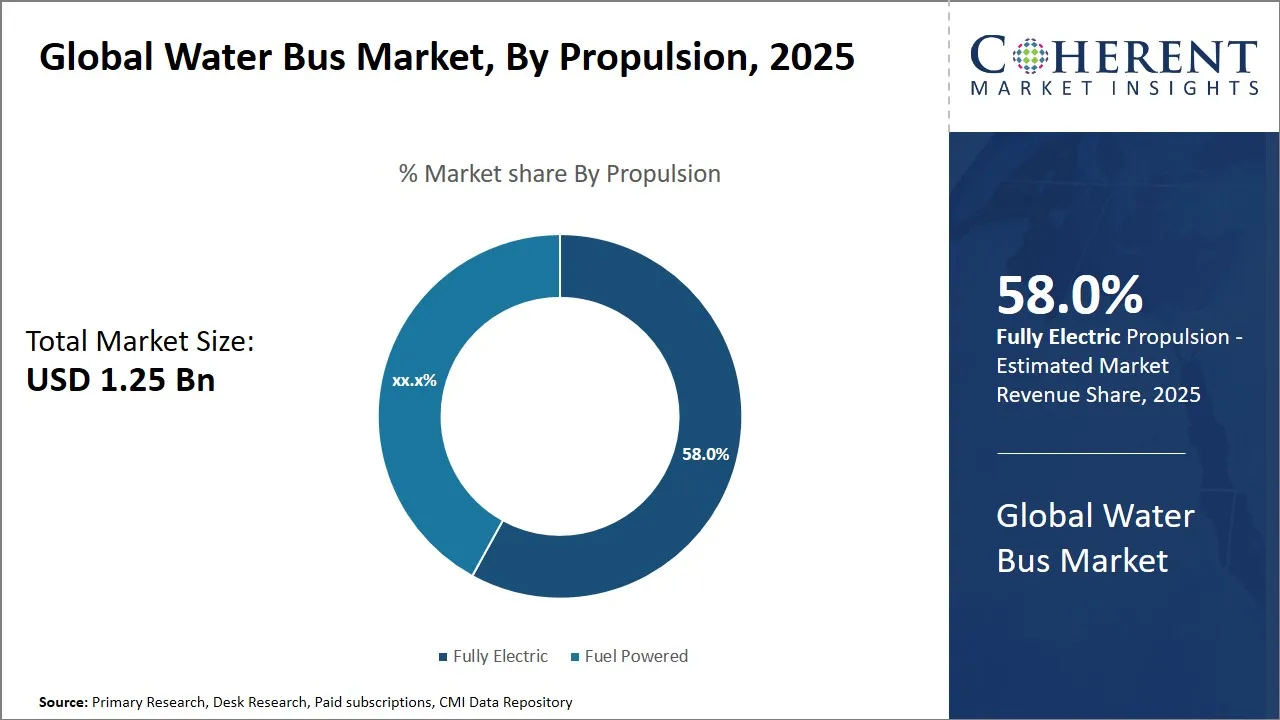
- The fully electric segment is expected to account for 59% of the water bus market share in 2026.
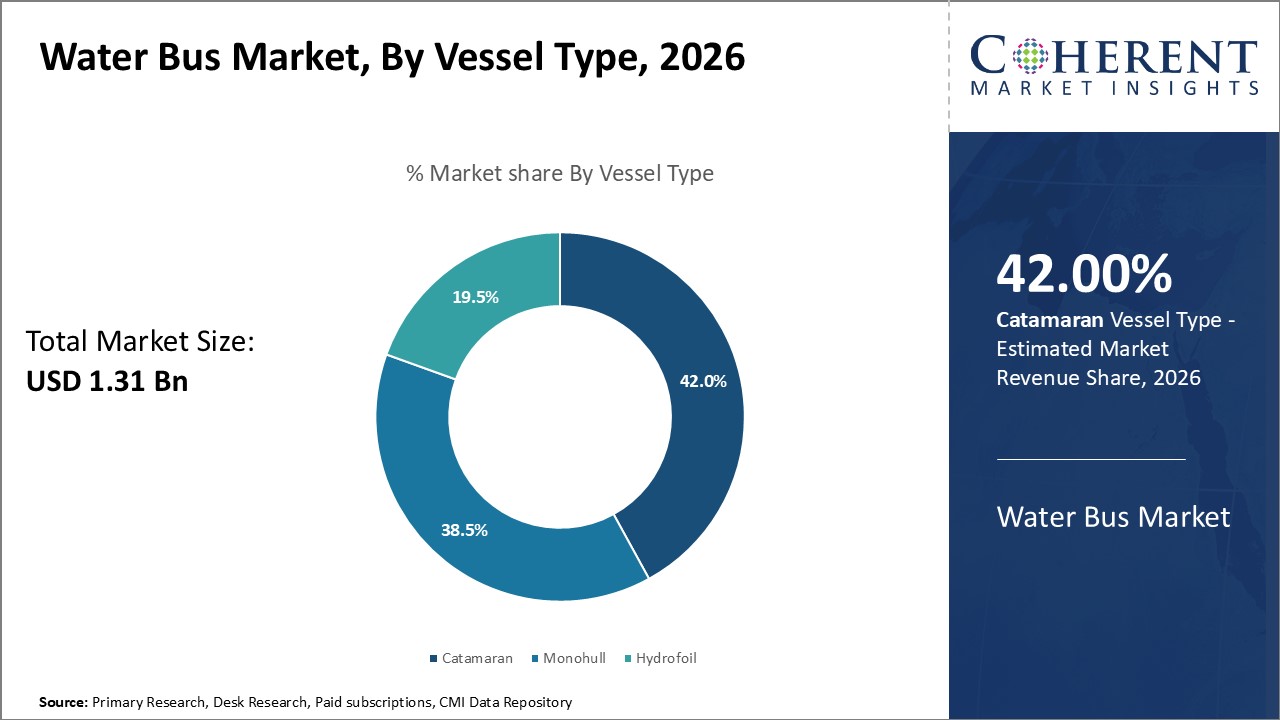
- The catamaran segment is projected to capture 42% of the market share in 2026.
- The less than 50 passengers segment is expected to command 44% share in 2026.
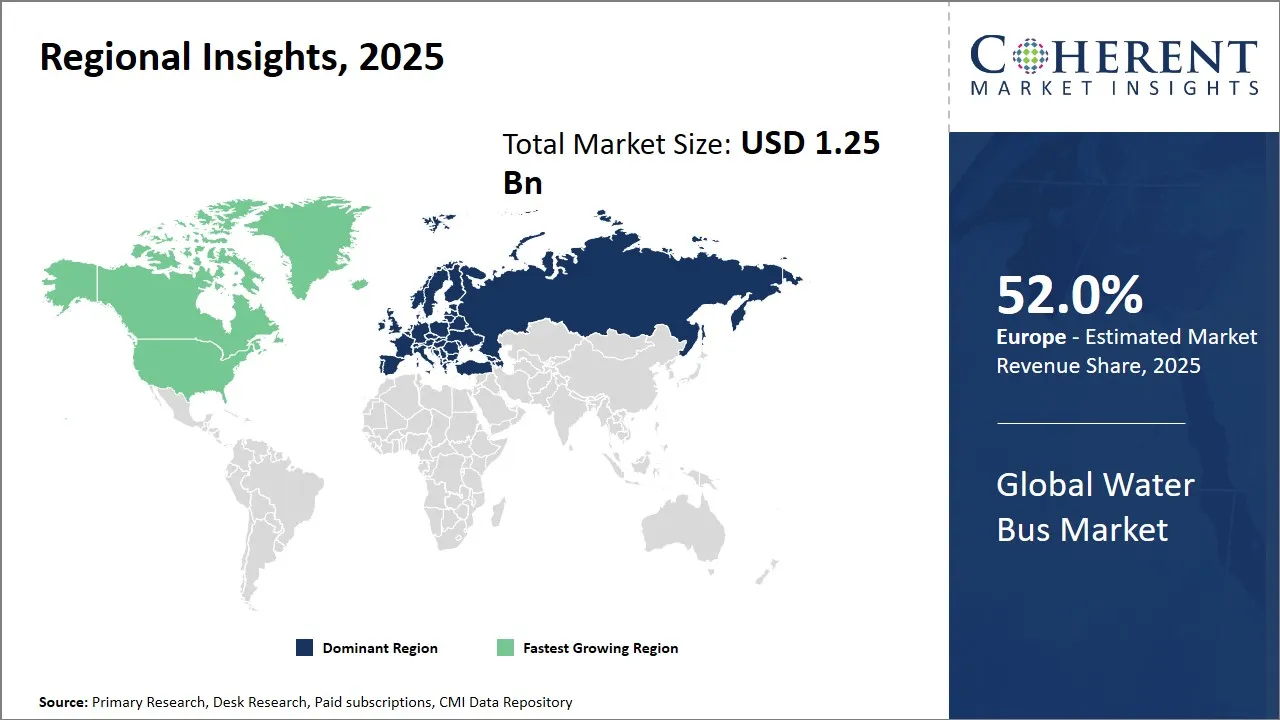
- Europe will dominate the water bus market in 2026 with an estimated 52%
- North America will hold 26% share in 2026 and record the fastest growth.
Current Events and Its Impact
Current Events | Description and its Impact |
South Korea Water Bus Trials |
|
Segmental Insights
- Current Industry Events of 2026
- Market Size Estimation
- Regional Breakdown
- Competitive Landscape
- Customer Intelligence
- Segmental Analysis
- Pricing Analysis
- Key Market Drivers, Challenges & Future Trends
- Customized Insights Section
Why Does Fully Electric Dominate the Global Water Bus Market in 2026?
The fully electric segment is expected to hold 59.0% of the global water bus market share in 2026. The increase comes from growing worries about nature, while more focus falls on greener ways to travel by water. Stricter rules from governments to cut exhaust fumes, combined with city efforts to keep rivers cleaner, help electric drive systems thrive. Water taxis powered only by electricity run without releasing harmful gases, which appeals strongly to urban areas pushing clean transport and responsible tourism alike. They are far quieter than gas-powered vessels, so the journey feels smoother yet reduces damage to sea creatures.
One major factor behind rising use of electric water buses is improved battery systems. Owing to advances, modern lithium-ion and solid-state versions hold greater charge, need fewer recharges, while charging faster - enhancing everyday efficiency. Also, pairing them with renewable sources such as solar or wind at docking points reduces pollution more, increasing their appeal. On top of that, because electric systems cost less to run and maintain, they save money over years, even if initial prices stay high.
Catamarans Segment Dominates the Water Bus Market
The catamaran segment is predicted to dominate the market with a 42% share in 2026. The rise comes from built-in design strengths fitting both service needs and user expectations on inland water routes. Because they have two hulls, catamarans stay steadier than single-hulled boats or foiling types which helps them handle flat rivers just as well as rougher stretches. Their fluid motion minimizes rocking during travel, so riders can unwind - ideal for city travelers or visitors taking water shuttles on brief to mid-range trips.
Running well matters. Because of slim hulls, catamarans face less drag in water - meaning lower fuel use without losing speed safely. This allows teams to follow strict schedules with lower consumption, improving profits and environmental performance. Their wide frame provides extra deck space, enabling larger passenger cabins plus adaptable seating setups. In turn, capacity goes up and comfort improves.
Why is Less than 50 Passengers the Most Preferred Capacity in the Water Bus Market?
The less than 50 passengers segment is projected to dominate the market with a 44% share in 2026. The increase reflects distinct needs for moving around city and suburban waters. Due to adaptability, such vessels manage crowded routes effectively - particularly in narrow zones among islands or near urban ferry points. Although passenger capacity is lower, it leads to quicker turnarounds between journeys while reducing operational expenses, matching fluctuating demand seen during weekday travel periods.
This section benefits due to rising attention on initial and final leg connections, alongside integrated transport solutions. While water buses carry fewer people, they can stop at compact docks near city areas, linking smoothly with bus or rail lines boosting how easy it is to reach public transport. Also, their shallow need allows simpler facilities, cutting startup costs and pier charges for providers.
Electrification & Hybridization Readiness Score
Region | Electric Readiness Score | Hybrid Readiness Score |
North America | 70 | 80 |
Europe | 85 | 90 |
Asia Pacific | 65 | 85 |
Latin America & MEA | 45 | 60 |
Regional Insights
Europe Water Bus Market Analysis and Trends
Europe is projected to lead the market with a 52% share in 2026. The Europe water bus market now grows due to local demand for green city travel, strict eco rules, besides existing river and canal routes that allow boat-based transit to work alongside regular buses or trains. Cities are slowly adding water routes into wider public networks while choosing cleaner engine types due to climate targets.
Towns with old canals, rivers, or ports shift toward electric or mixed-power boats, backed by government policies favoring emission-free transport and access to shipbuilders and technology firms able to deliver modern e-hybrid ferry fleets. Copenhagen’s Harbour Buses are fully powered by electricity, running across the waterfront using rechargeable batteries. They also run trips within the official transport setup, proving how current providers upgrade operations under ecological pressure combined with urban movement plans.
North America Water Bus Market Analysis and Trends
North America is expected to exhibit the fastest growth in the market contributing 26% share in 2026. The North America water bus sector grows as cities adopt water-based transport to ease congestion while supporting eco-friendly mobility. Infrastructure spending rises alongside focus on clean technology and smarter routes. Public bodies and private firms now run more boat services in U.S. and Canadian urban zones, linking business districts, transit points, or scenic shores.
For example, the King County Water Taxi near Seattle moves people across crowded sea lanes using passenger-focused boats, forming one piece of a mixed-transport system meant to cut car use through practical river and harbor commuting.
Global Water Bus Market Outlook for Key Countries
Why is China Emerging as a Major Producer of Water Bus?
China’s water bus sector grows thanks to many rivers and canals, serving crowded cities near aquatic routes. In hubs like Shanghai or Guangzhou, floating transit helps reduce congestion on roads - while also cutting emissions. Firms including China State Shipbuilding build modern boats equipped with smart controls and enhanced security features. Public initiatives favoring green mobility back upgrades and broader use of these river-based services.
India Water Bus Market Analysis and Trends
India's water bus market sees growing attention due to expanded use of rivers and coasts for transit, especially in areas with natural water networks. Thanks to the National Waterways Act along with oversight from the Inland Waterways Authority, upgrades in infrastructure now move forward under clearer rules. Firms like Larsen & Toubro teamed up with Cochin Shipyard bring new boat models suited to regional needs - some run fully on electricity, others mix power sources. Rising eco-awareness plus information drives help boost rider interest in greener travel choices, which, in turn, supports expansion. Despite challenges, consistent investments and localized innovation keep momentum steady across routes.
Japan Water Bus Market Analysis and Trends
Japan keeps advancing its well-developed water bus networks, particularly in urban centers such as Tokyo and Osaka, where rivers serve both commuters and visitors. Thanks to a solid manufacturing foundation, firms like Mitsubishi Heavy Industries alongside Kawasaki Shipbuilding supply advanced boats focused on secure travel, quick transit, or ease for riders. Because authorities enforce strict ecological rules while promoting eco-friendly mobility options, operators consistently update their services accordingly.
U.A.E. Water Bus Market Analysis and Trends
The U.A.E.'s water bus sector is growing fast, thanks to coastal cities like Dubai and Abu Dhabi adding them into modern urban plans. Because leaders want greener transit options while easing traffic jams, they back these efforts with strong policy moves and investment. Firms such as Drydocks World team up with global tech partners instead of working alone, producing advanced boats suited for local sea conditions. With key ports and open trade rules, the country ensures reliable delivery routes necessary for launching operations.
Is Brazil the Next Growth Engine for the Water Bus Market?
Brazil's water bus market is growing fast owing to wide river systems and busy coastal areas such as Rio de Janeiro, where new transit options are needed to ease city traffic. Instead of relying only on roads, authorities at state and city levels fund upgrades to navigable routes. Shipbuilders from within the country work alongside global firms like Damen Shipyards; this cooperation improves vessel numbers and consistent operations. At the same time, tour-focused river paths encourage launches of boats designed for comfort while cutting environmental impact.
Market Players, Key Development, and Competitive Intelligence
Key Developments
- On December 5, 2025, Incat Tasmania and leading Danish operator, Molslinjen, signed a contract for a third 100% battery-electric high-speed ferry, expanding the companies’ partnership and advancing the world’s largest electrification project at sea.
- On January 15, 2025, Damen Shipyards handed over Germany’s first, all-electric catamaran ferry to its operator, AG Reederei Norden Frisia. Capable of taking up to 150 passengers, the vessel will operate between Norddeich and Norderney on the East Frisian Wadden Sea.
Top Strategies Followed by Global Water Bus Market Players
Player Type | Strategic Focus | Example |
Established Market Leaders | Collaboration | In October 2025, ComAp collaborated with its long-standing customer Damen, one of the world’s leading shipbuilders, to deliver a comprehensive power management system (PMS) for Damen’s Waterbus 2907 Hybrid. |
Mid-Level Players | New Service Launch | In August 2024, Winnipeg Waterways, a new boat tour and transit operator running at The Forks, launched its water bus service. The new water bus service aimed to provide a better commuting option, particularly for daily travelers. |
Small-Scale Players | New Market Player Entry | In September 2024, Miami based startup E-lixr introduced a water bus service, helping ease into their eco-friendly vessel plan aimed at reducing city traffic and pollution. |
Market Report Scope
Water Bus Market Report Coverage
| Report Coverage | Details | ||
|---|---|---|---|
| Base Year: | 2025 | Market Size in 2026: | USD 1.31 Bn |
| Historical Data for: | 2020 To 2024 | Forecast Period: | 2026 To 2033 |
| Forecast Period 2026 to 2033 CAGR: | 4.8% | 2033 Value Projection: | USD 1.82 Bn |
| Geographies covered: |
| ||
| Segments covered: |
| ||
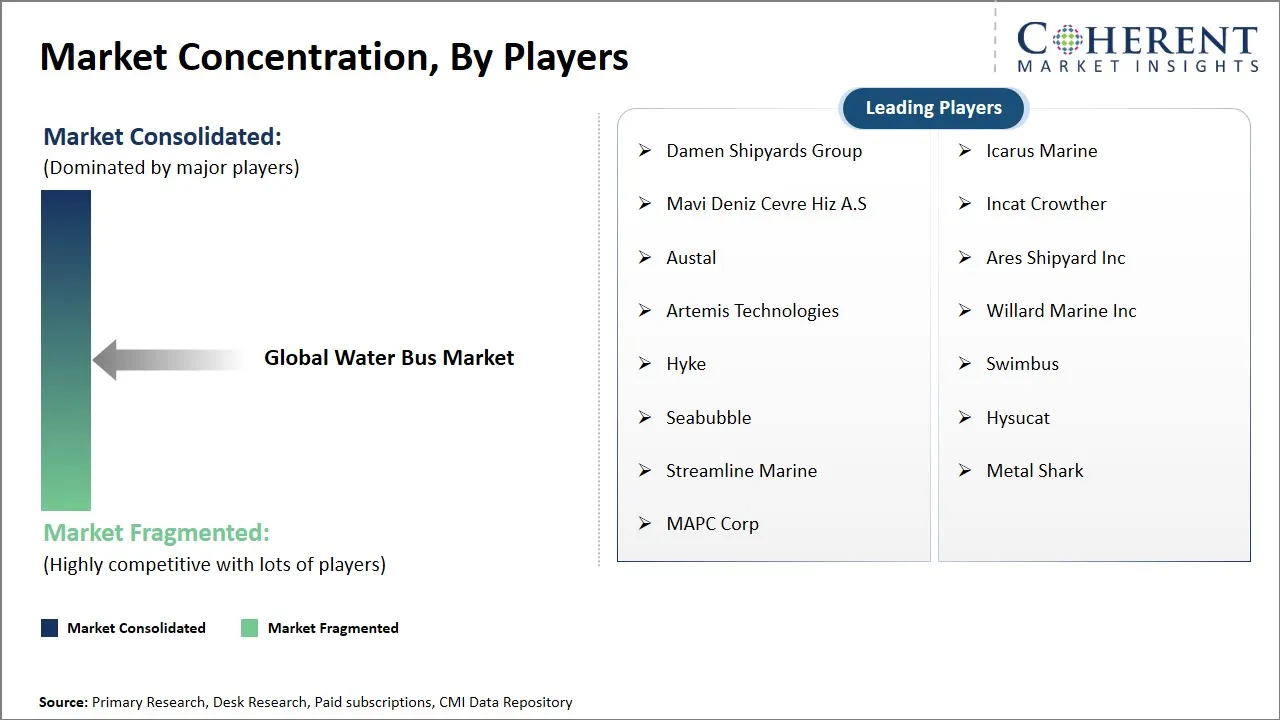
| Companies covered: | Damen Shipyards Group, Icarus Marine, Mavi Deniz Cevre Hiz A.S, Incat Crowther, Austal, Ares Shipyard Inc, Artemis Technologies, Willard Marine Inc, Hyke, Swimbus, Seabubble, Hysucat, Streamline Marine, Metal Shark, and MAPC Corp | ||
| Growth Drivers: |
| ||
| Restraints & Challenges: |
| ||
Global Water Bus Market Dynamics
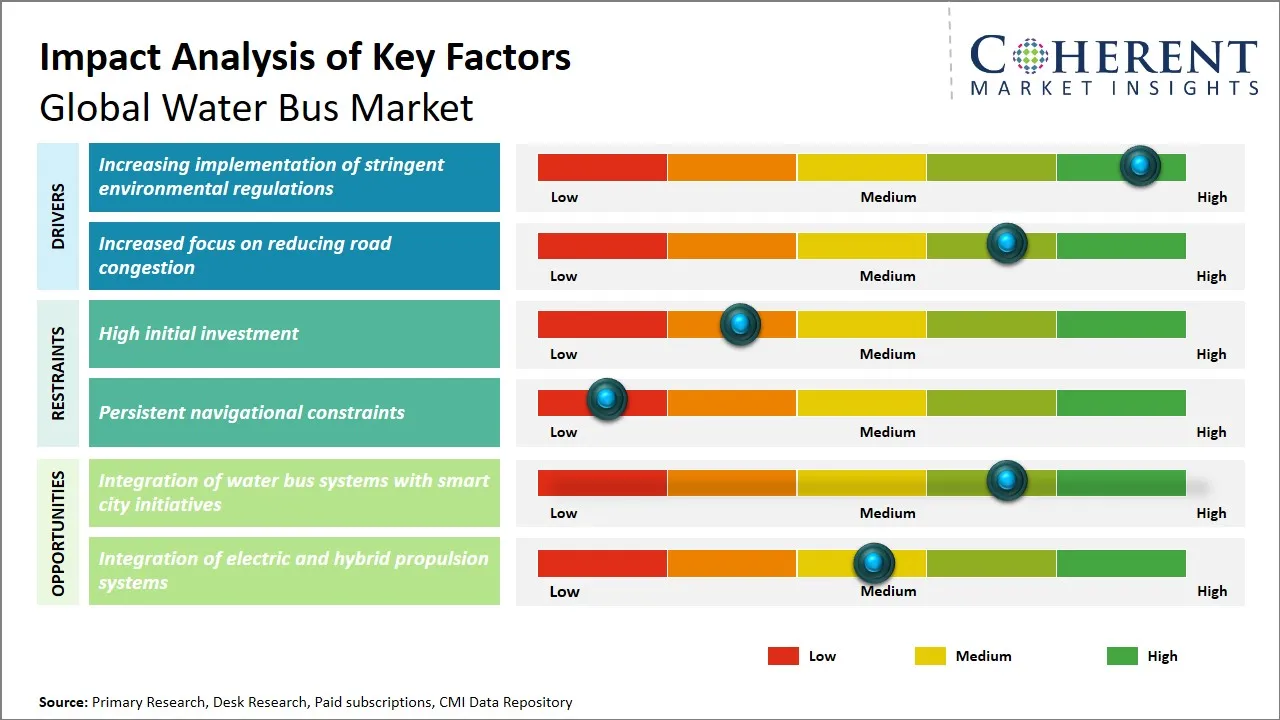
Global Water Bus Market Driver - Increasing Implementation of Stringent Environmental Regulations
The rising use of strict environmental rules in shipbuilding and marine activities worldwide is strongly boosting the growth of water buses. Because governments want lower emissions, they support cleaner transit options - so cities explore more sustainable choices. Electric- or hybrid-powered boats offer a practical shift from fossil-fuel vehicles, fitting new policy goals quite well. Such policies push operators toward eco-conscious upgrades, stimulating advances in boat technology and engine efficiency.
Stricter rules on emissions push city planners to add water buses to transit systems, and these boats provide cleaner trips with less noise and traffic. Such policies boost eco-friendly progress while encouraging practical, legal-compliant ways to move around cities.
For instance, the European Union’s Green Deal and Sustainable and Smart Mobility Strategy promotes low- and zero-emission transport, including cleaner inland waterway services such as electric and hybrid water buses.
(Source: transport.ec.europa.eu)
Global Water Bus Market Opportunity - Integration of Water Bus Systems with Smart City Initiatives
The link between water buses and smart city efforts opens strong potential in the worldwide ferry sector. While cities embrace technology to boost mobility, lower emissions, and simplify travel, aquatic transport is becoming key in mixed-mode transit setups. Urban tech strategies focus on live data use, adaptive routing, or green alternatives - features that match naturally with what modern boat services offer. With IoT devices, location monitoring, along with electronic payment tools, vessel managers gain better control over operations, adjust paths according to current needs, or provide travelers smoother journeys using instant updates and unified platforms.
Moreover, linking water buses with smart city transit platforms improves access to final destinations, cutting down traffic congestion while easing air pollution. Also, urban areas targeting eco-friendly targets may use water-based transit’s smaller emissions - especially when running on clean power like electric or hybrid engines. These benefits support greener commuting solutions and create chances for joint ventures plus financial backing tied to sustainable development plans. As a result, adding aquatic routes into intelligent infrastructure could reshape how people move around cities, boosting both user coverage and returns across the sector.
For instance, in October 2024, the Edo State Government commissioned two more thirty-two-seater water buses to ease transportation of goods and services within the riverine communities of Gelegele, located in Ovia North East Local Government Area.
Analyst Opinion (Expert Opinion)
- Water buses now connect better with city transit networks as urban areas seek greener travel options instead of car dependency; at the same time, upgrades in electric and hybrid engines boost performance while meeting environmental goals and rules on clean transport. Experts note digital routing tools along with electronic fares increase convenience and consistency - shifting ferries from tourist-focused roles toward serious public mobility solutions.
- Infrastructure issues along with weak regulations slow down growth, particularly where building docks, terminals, or waterways is costly, or safety rules differ by area. Experts say progress depends on joint government-industry funding instead of isolated efforts, combined with policies that unify operations while rewarding cleaner vessels. Still, they expect rising demand over time as urban centers focus more on eco-friendly transit and include water routes into broader transportation systems.
Speak to the analyst
Want personalized insights?
Take the findings above to one of our principal consultants, or have the report rebuilt around the segments, geographies and competitors you actually track.
Market Segmentation
- Propulsion Insights (Revenue, USD Billion, 2021 - 2033)
- Fully Electric
- Fuel Powered
- Vessel Type Insights (Revenue, USD Billion, 2021 - 2033)
- Catamaran
- Monohull
- Hydrofoil
- Capacity Insights (Revenue, USD Billion, 2021 - 2033)
- Less than 50 Passengers
- 50 to 100 Passengers
- Above 100 Passengers
- Regional Insights (Revenue, USD Billion, 2021 - 2033)
- North America
- U.S.
- Canada
- Latin America
- Brazil
- Argentina
- Mexico
- Rest of Latin America
- Europe
- Germany
- U.K.
- Spain
- France
- Italy
- Russia
- Rest of Europe
- Asia Pacific
- China
- India
- Japan
- Australia
- South Korea
- ASEAN
- Rest of Asia Pacific
- Middle East
- GCC Countries
- Israel
- Rest of Middle East
- Africa
- South Africa
- North Africa
- Central Africa
- North America
- Key Players Insights
- Damen Shipyards Group
- Icarus Marine
- Mavi Deniz Cevre Hiz A.S
- Incat Crowther
- Austal
- Ares Shipyard Inc
- Artemis Technologies
- Willard Marine Inc
- Hyke
- Swimbus
- Seabubble
- Hysucat
- Streamline Marine
- Metal Shark
- MAPC Corp
Sources
Primary Research Interviews
- Water bus operators and fleet managers
- Marine transportation service providers
- Port authorities and waterway management officials
- Tourism industry executives and travel operators
Databases
- International Maritime Organization (IMO) Database
- World Bank Transport Database
- Maritime Industry Database (Lloyd's List Intelligence)
- Global Tourism Statistics Database
Magazines
- Marine Technology Magazine
- International Water Transport Magazine
- Tourism & Travel Weekly
- Maritime Executive Magazine
Journals
- Journal of Marine Science and Engineering
- Transportation Research Part A: Policy and Practice
- International Journal of Tourism Research
Newspapers
- Lloyd's List
- TradeWinds
- Maritime Reporter and Engineering News
- Travel Trade Gazette
Associations
- International Association of Public Transport (UITP)
- World Tourism Organization (UNWTO)
- International Chamber of Shipping (ICS)
- Passenger Vessel Association (PVA)
Public Domain Sources
- Government maritime transport statistics
- Port authority annual reports
- Tourism ministry publications
- International Maritime Organization reports
Proprietary Elements
- CMI Data Analytics Tool
- Proprietary CMI Existing Repository of information for last 8 years
Get access to 250+ pages report
Every segment, forecast, competitor profile and data table behind the analysis above — available for instant download.
- ESOMAR Member
- ISO 9001:2015 Certified
- D-U-N-S Registered
- GDPR & CCPA Compliant
Missing comfort of reading report in your local language? Find your preferred language:
Transform your Strategy with Exclusive Trending Reports
Frequently Asked Questions
The global water bus market is estimated to be valued at USD 1.31 Bn in 2026 and is expected to reach USD 1.82 Bn by 2033.
The CAGR of global water bus market is projected to be 4.8% from 2026 to 2033.
Increasing implementation of stringent environmental regulations and increased focus on reducing road congestion are the major factors driving the growth of the global water bus market.
High initial investment and persistent navigational constraints are the major factors hampering the growth of the global water bus market.
In terms of propulsion, the fully electric segment is estimated to dominate the market revenue share in 2026.
Real-time tracking, digital ticketing, and predictive maintenance are improving efficiency, safety, and passenger experience.
Yes, especially electric and hybrid water buses reduce emissions compared to conventional diesel-powered vessels.