

Global Welding Gloves Market Size and Forecast – 2026-2033
The global welding gloves market is estimated to be valued at USD 1.93 Bn in 2026 and is expected to reach USD 2.77 Bn by 2033, exhibiting a compound annual growth rate (CAGR) of 5.3% from 2026 to 2033.
Key Takeaways of the Global Welding Gloves Market
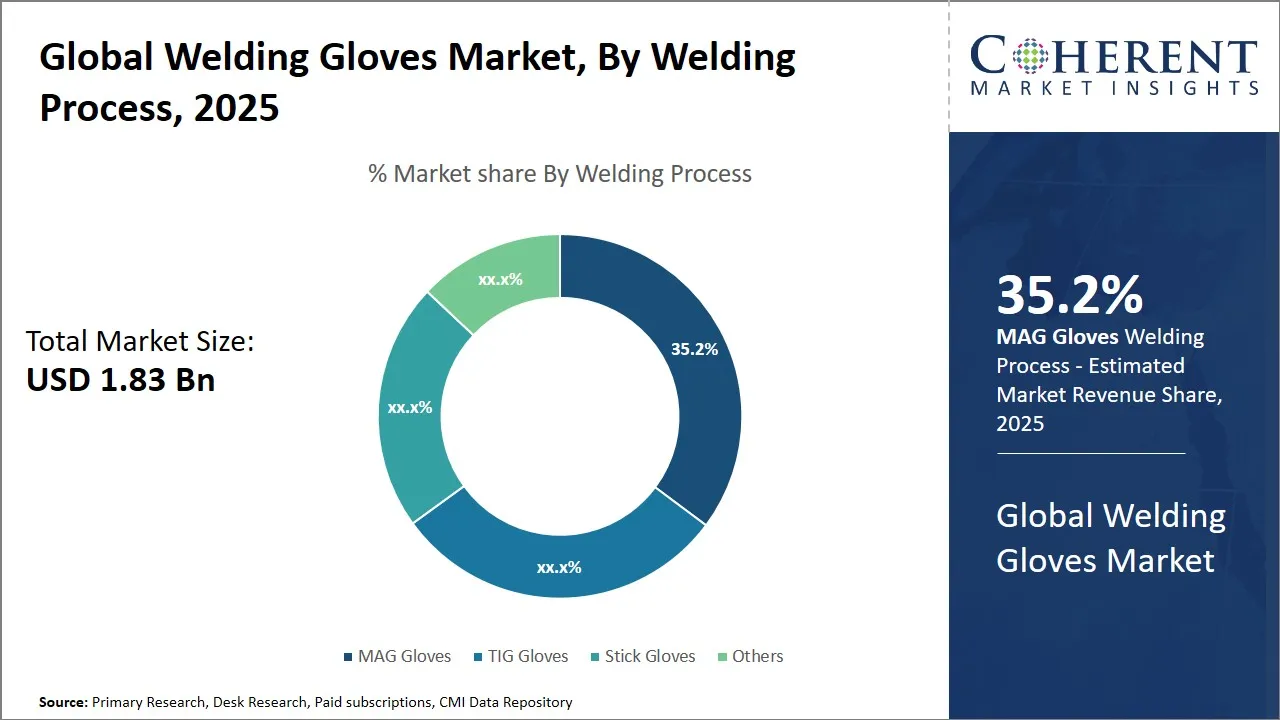
- The MAG gloves segment leads the market holding an estimated share of 36.2 % in 2026.
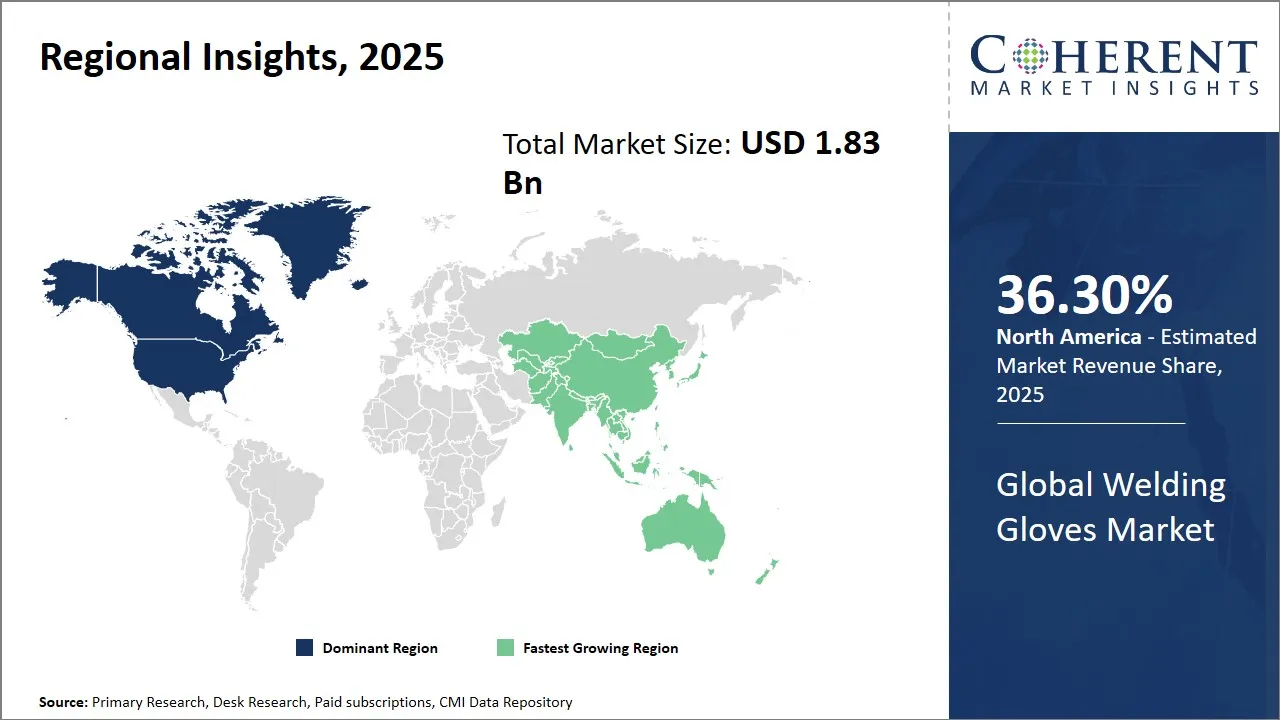
- North America is estimated to lead the market with an estimated share of 36.3 % in 2026.
- Asia Pacific, holding a projected share of 32.4 % in 2026, and it is projected to be the fastest growing region.
Market Overview
The market is seeing a growing preference for technologically advanced welding gloves that offer improved durability, heat resistance, and ergonomic designs. Also, the adoption of eco-friendly and sustainable materials in glove production is becoming popular, as companies aim to reduce environmental impact. Integration of smart features, such as sensors for temperature and injury prevention, can also be seen, reflecting the increasing demand for safety innovation in the welding industry.
Current Events and Its Impact
Current Events | Description and its Impact |
Geopolitical and Trade Developments |
|
Economic and Infrastructure Trends |
|
Segmental Insights
- Current Industry Events of 2026
- Market Size Estimation
- Regional Breakdown
- Competitive Landscape
- Customer Intelligence
- Segmental Analysis
- Pricing Analysis
- Key Market Drivers, Challenges & Future Trends
- Customized Insights Section
Global Welding Gloves Market Insights, by Welding Process – Increasing Adoption of MAG Welding in Industrial Applications Propels MAG Gloves Segment Growth
The MAG gloves segment is projected to account for 36.2% of the market share in 2026. MAG welding is mainly chosen for its efficiency, versatility, and superior weld quality, making it useful in automotive, construction, and heavy manufacturing industries. As MAG welding involves the use of active gases like CO2 or mixed gases, the gloves’ flame-retardant properties and resistance to chemical exposure are big factors driving their market preference.
In 2024, Lincoln Electric introduced new MIG/MAG welding gloves within its Traditional and Premium series, marketed specifically for CO₂ and mixed-gas welding in automotive fabrication and heavy-equipment plants. Also, the increasing focus on occupational health and safety regulations globally has pushed manufacturers and end-users to prioritize high-quality protective gear. MAG gloves align well with compliance requirements due to their durability and protective capabilities, making them indispensable in environments where MAG welding predominates.
Pricing Analysis for the Global Welding Gloves Market
Segment/SKU | Typical Retail Price Range (USD/pair) | Estimated Average Retail Price (USD/pair) | Typical Wholesale/Bulk Price (USD/pair) (bulk = 50–100 pairs) |
TIG (high-dexterity goatskin/kidskin) | USD 8.00 – USD 40.00 | USD 22.00 | USD 6.00 – USD 18.00 |
MIG/MAG (medium-duty leather, MIG/Stick hybrids) | USD 12.00 – USD 60.00 | USD 28.00 | USD 8.00 – USD 22.00 |
Stick (heavy-duty shoulder-split/cowhide) | USD 15.00 – USD 75.00 | USD 30.00 | USD 10.00 – USD 30.00 |
Premium heat-resistant/aluminized/specialty (foundry, contact-heat, multi-standard) | USD 30.00 – USD 150.00 | USD 60.00 | USD 18.00 – USD 50.00 |
Entry-level/commodity leather & cotton-lined (retail, DIY) | USD 3.00 – USD 25.00 | USD 12.00 | USD 2.00 – USD 8.00 |
Synthetic/cut-resistant hybrid (aramid, HPPE liners + leather) | USD 20.00 – USD 80.00 | USD 35.00 | USD 12.00 – USD 30.00 |
Retail pack/multipack (3–6 pair consumer packs) — per pair equivalent | USD 4.00 – USD 20.00 | USD 9.50 | N/A (sold as packs) |
Specialty/certification-rated (ANSI contact/heat, cut A5–A6, NFPA aluminized) | USD 40.00 – USD 200.00 | USD 85.00 | USD 30.00 – USD 90.00 |
Regional Insights
North America Welding Gloves Market Analysis and Trends
The North America region is projected to lead the market with a 36.3% share in 2026, owing to heightened safety regulations and increased automation in manufacturing processes. The region's strict OSHA and ANSI standards push industries to adopt high-performance personal protective equipment, making demand for advanced welding gloves offering cut resistance, heat protection, and dexterity.
Also, North America hosts many renowned companies such as HexArmor, Wells Lamont, and Mechanix Wear, who continuously innovate in glove materials and ergonomic design. Trade policies favor technological import and export, enabling the spread of advanced PPE solutions and fostering collaboration across the U.S., Canada, and Mexico.
Asia Pacific Welding Gloves Market Analysis and Trends
The Asia Pacific region, holding an estimated share of 32.4% in 2026, exhibits the fastest growth the global welding gloves market. This can be largely attributed to the extensive industrial base, particularly in manufacturing and construction sectors in countries like China, India, Japan, and South Korea. The region benefits from a big labor force engaged in welding-intensive industries including automotive, shipbuilding, and infrastructure development.
Supportive government policies promoting industrial growth and export-oriented manufacturing hubs add to the demand for protective welding gear. Also, the presence of numerous domestic and international PPE manufacturers and distributors, such as Ansell, ATG Gloves, and Supermax Corporation, makes the supply ecosystem stronger.
Global Welding Gloves Market Outlook for Key Countries
China Welding Gloves Market Analysis and Trends
China welding gloves market grows because of its huge industrialization drive, particularly in manufacturing heavy machinery, electronics, and construction materials. The country’s government actively supports the PPE market through workplace safety mandates aligning with international standards. Local companies like Ansell China and DWS International have established strong manufacturing and distribution networks, benefiting from cost-efficient labor and raw materials. Rising mechanization in welding activities fuels demand for gloves that balance protection with flexibility, making China a critical hub for both production and consumption.
U.S. Welding Gloves Market Analysis and Trends
The U.S. welding gloves market sees growth because of strong regulatory frameworks focusing on worker safety, adding to the adoption of premium gloves designed to meet rigorous performance criteria. Firms like HexArmor and Wells Lamont are key industry players, focusing on innovation in materials such as Kevlar and leather blends to ensure durability and comfort. The big presence of automotive repair, aerospace, and energy sectors in the U.S. adds to consistent demand, while growing investments in infrastructure rehabilitation projects continue to expand the welding gloves market.
Germany Welding Gloves Market Analysis and Trends
Germany leads the welding gloves market in Europe because of its established manufacturing sector, particularly in automotive, engineering, and metal fabrication industries. German companies such as Uvex and SHOWA Gloves are big contributors, known for their strict quality standards and material advancements. The country’s strict EU-compliant occupational safety policies and strong industrial ecosystem add to widespread adoption of high-grade welding gloves.
Brazil Welding Gloves Market Analysis and Trends
Brazil welding gloves market is influenced by its robust construction, oil and gas, and automotive sectors. The country’s occupational safety regulations are enhancing gradually, encouraging wider adoption of appropriate PPE. Multinational companies such as Ansell and Mechanix Wear have a big presence, collaborating with local distributors to enter different market segments. Trade policies favor regional exports within Latin America, allowing Brazil to serve as a pivotal supply and demand center. Additionally, growing industrial investments linked to infrastructure development sustain long-term demand for the welding gloves.
Market Players, Key Development, and Competitive Intelligence
Key Developments
- In July 2025, Bunzl completed the acquisition of Quindesur, a Spanish distributor of foodservice and cleaning & hygiene products, with a strong focus in Southern Spain.
- In December 2024, 3M launched Speedglas G5-03 Welding Helmet Series. This cost-effective range includes THREE all-new welding helmet platforms combining Speedglas signature features with never-before-seen technology.
- In September 2024, HexArmor introduced HexArmor’s i2 impact protection technology. The result is a superior impact-absorbing material that is the lightest and most flexible in the industry without compromising performance.
- In April 2024, Ansell Limited entered into a binding agreement to acquire 100% of the assets that constitute Kimberly-Clark’s Personal Protective Equipment business from Kimberly-Clark Corporation.
Top Strategies Followed by Welding Gloves Market Players
- Leading companies in this sector heavily invest in research and development to pioneer high-performance, durable, and ergonomically designed gloves that meet stringent safety standards and evolving customer demands.
- HexArmor launched the HeatArmor welding gloves with advanced aramid and high-heat composite materials for foundry and heavy-duty welding. The line was developed through in-house R&D to improve contact-heat protection and dexterity, reinforcing its premium, technology-driven positioning.
- Mid-level players in the welding gloves market typically adopt strategies centered on providing cost-effective solutions that strike a balance between quality and affordability, making these products attractive to price-sensitive segments such as small and medium enterprises and individual welders.
- Magid expanded its WeldPro product range with competitively priced MIG/TIG gloves targeted at contractors and distributors that need ANSI-rated protection at value pricing, a strategy aimed squarely at the cost-sensitive segment.
- Small-scale players in the global welding gloves market frequently operate by identifying niche segments or specialized product attributes where they can differentiate themselves.
- Tillman introduced new cut-rated, multi-function TIG/MIG gloves showcased at FABTECH 2024, focusing on precision welding and niche craft applications.
Market Report Scope
Welding Gloves Market Report Coverage
| Report Coverage | Details | ||
|---|---|---|---|
| Base Year: | 2025 | Market Size in 2026: | USD 1.93 Bn |
| Historical Data for: | 2020 To 2024 | Forecast Period: | 2026 To 2033 |
| Forecast Period 2026 to 2033 CAGR: | 5.3% | 2033 Value Projection: | USD 2.77 Bn |
| Geographies covered: |
| ||
| Segments covered: |
| ||
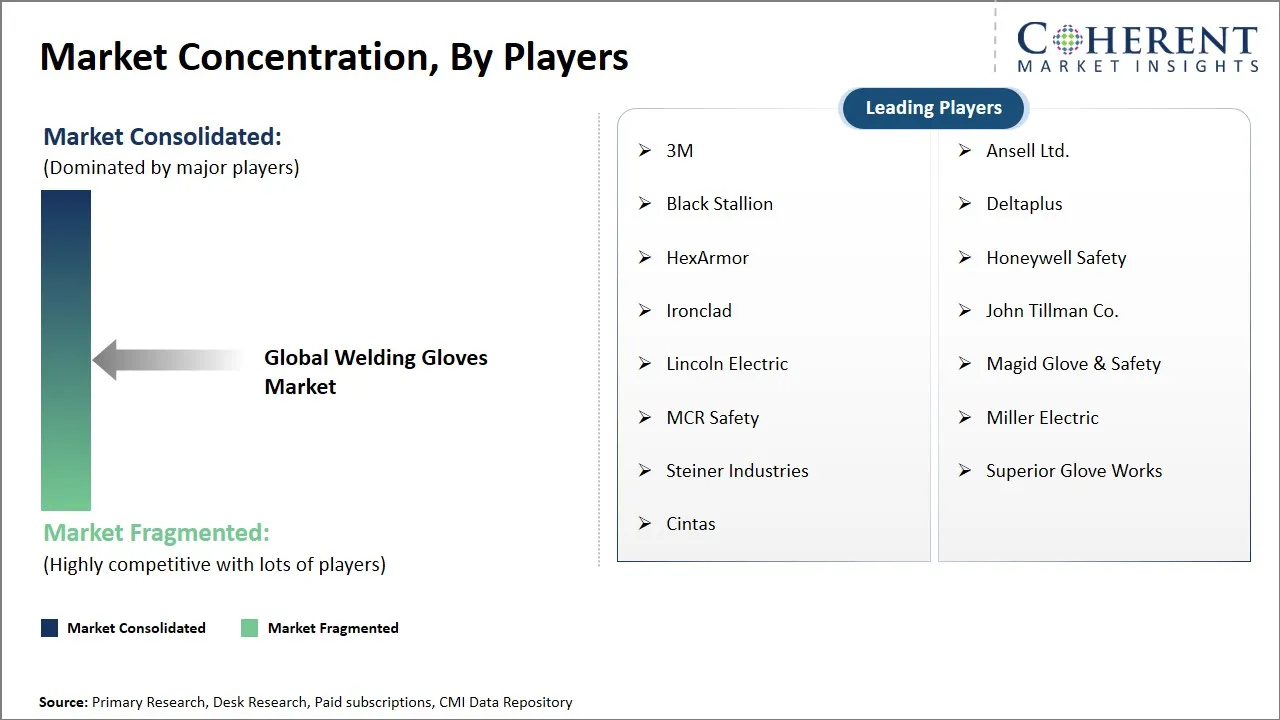
| Companies covered: | 3M, Ansell Ltd., Black Stallion, Deltaplus, HexArmor, Honeywell Safety, Ironclad, John Tillman Co., Lincoln Electric, Magid Glove & Safety, MCR Safety, Miller Electric, Steiner Industries, Superior Glove Works, and Cintas | ||
| Growth Drivers: |
| ||
| Restraints & Challenges: |
| ||
Market Dynamics
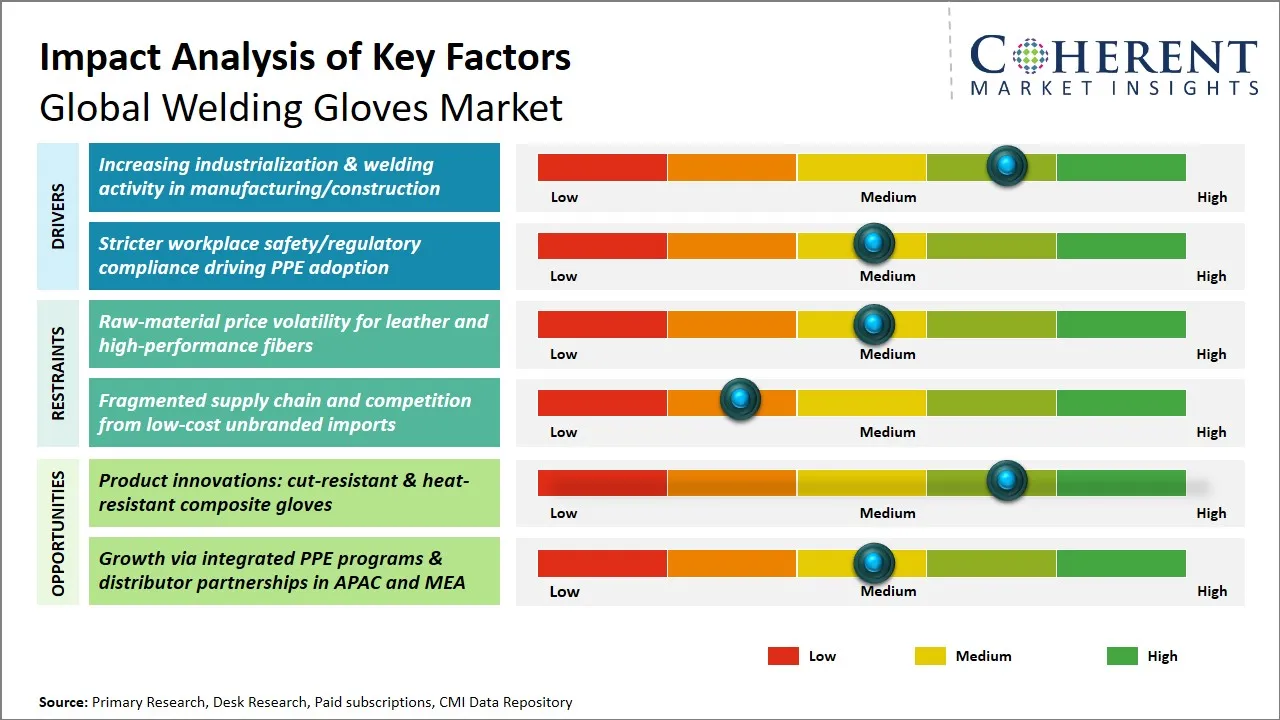
Global Welding Gloves Market Driver – Increasing Industrialization & Welding Activity in Manufacturing/Construction
The accelerating pace of industrialization across emerging and developed economies is significantly fueling the demand for welding gloves, as welding activities become integral to manufacturing and construction sectors. As industries expand their production capacities and new infrastructure projects take shape, the volume of welding operations increases correspondingly, driving the need for specialized protective gear.
Welding gloves provide essential safety against heat, sparks, and mechanical hazards, making them indispensable for workers engaged in metal fabrication, automotive assembly, shipbuilding, and construction frameworks. Furthermore, rising urbanization and governmental investments in large-scale infrastructure development are boosting steel fabrication and heavy machinery manufacturing, where welding is a core process. For instance, India’s national infrastructure pipeline (GatiShakti) and PLI manufacturing incentives are spurring rapid growth in metal fabrication, automotive, and construction sectors.
Global Welding Gloves Market Opportunity – Product Innovations: Cut-Resistant and Heat-Resistant Composite Gloves
As industrial safety standards become increasingly stringent and welding applications grow more complex, the demand for gloves that offer superior protection without compromising dexterity and comfort is rising. Composite gloves, which combine multiple materials such as Kevlar, High-Performance Polyethylene (HPPE), and advanced thermal fabrics, provide enhanced resistance against both mechanical cuts and extreme temperatures encountered during welding. These innovations address critical pain points for welders, such as exposure to sharp metal edges, molten splatter, and prolonged heat, which traditional leather gloves may not effectively mitigate. For instance, HexArmor, HeatArmor welding gloves are built with aramid and high-heat composite materials that offer both ANSI A6 cut protection and extreme contact-heat resistance.
Furthermore, the integration of ergonomic designs into these composite gloves supports improved grip and flexibility, enabling higher productivity and reducing operator fatigue. With growing awareness around workplace safety and escalating regulations across regions including North America, Europe, and Asia Pacific, manufacturers investing in R&D for specialized composite gloves have the opportunity to capture niche segments within the broader welding gloves market. Additionally, the expansion of sectors like automotive manufacturing, shipbuilding, and construction, where precision welding is crucial, further amplifies the need for innovative protective gear, positioning cut-resistant and heat-resistant composite gloves as a key growth driver in the foreseeable future.
Analyst Opinion (Expert Opinion)
- Large-scale fabrication of machinery, shipbuilding, and structural steel continues to dominate welding-glove consumption. These operations require high-durability MIG/MAG and Stick gloves for long welding cycles, sustaining steady replacement demand despite automation gains.
- Ongoing urbanization programs (e.g., India’s GatiShakti, U.S. IIJA) are accelerating structural steel erection, pipelines, and heavy equipment assembly. Contractors typically purchase cost-effective, bulk leather gloves through distributors, creating strong volume growth for mid-tier suppliers.
- TIG welding for thin metals, EV battery enclosures, and aerospace components fuels demand for high-dexterity, cut-resistant composite gloves. This niche commands premium pricing and faster innovation cycles, benefiting players investing in advanced materials and ergonomic designs
Speak to the analyst
Want personalized insights?
Take the findings above to one of our principal consultants, or have the report rebuilt around the segments, geographies and competitors you actually track.
Market Segmentation
- Welding Process Insights (Revenue, USD Bn, 2021 - 2033)
- MAG Gloves
- TIG Gloves
- Stick Gloves
- Others
- Regional Insights (Revenue, USD Bn, 2021 - 2033)
- North America
- U.S.
- Canada
- Latin America
- Brazil
- Argentina
- Mexico
- Rest of Latin America
- Europe
- Germany
- U.K.
- Spain
- France
- Italy
- Russia
- Rest of Europe
- Asia Pacific
- China
- India
- Japan
- Australia
- South Korea
- ASEAN
- Rest of Asia Pacific
- Middle East
- GCC Countries
- Israel
- Rest of Middle East
- Africa
- South Africa
- North Africa
- Central Africa
- North America
- Key Players Insights
- 3M
- Ansell Ltd.
- Black Stallion
- Deltaplus
- HexArmor
- Honeywell Safety
- Ironclad
- John Tillman Co.
- Lincoln Electric
- Magid Glove & Safety
- MCR Safety
- Miller Electric
- Steiner Industries
- Superior Glove Works
- Cintas
Sources
Primary Research Interviews
Stakeholders
- Welding & Fabrication Contractors
- PPE Distributors & Industrial Supply Managers
- Leather Tannery Operators & Specialty Textile Suppliers
- Automotive & Aerospace Welding Engineers
- Construction Firms & Infrastructure Contractors
- Safety Compliance Officers from Manufacturing Plants
- Renewable-Energy Project Welders (offshore wind, solar infrastructure)
Databases
- U.S. Bureau of Labor Statistics (Occupational Safety Data – Welding Injuries)
- Eurostat – Manufacturing & PPE Trade Statistics
- OECD – Industrial Production & Safety Equipment Imports/Exports
- India Ministry of Commerce – Leather Export Data
- International Trade Centre (ITC) – Global PPE Trade Flow Statistics
Magazines
- Industrial Safety Today
- Metal Fabrication Monthly
- Welding & Cutting World
- Protective Equipment Review
Journals
- Journal of Occupational Safety & Ergonomics
- Materials Science for Protective Textiles Journal
- International Journal of Welding Technology
- Journal of Industrial Hygiene & Safety Engineering
Newspapers
- The Fabricator News (U.S.)
- Manufacturing Today (India Edition)
- The Guardian (UK – Industry Section)
- Business Standard (India – Industrial Safety Column)
Associations
- American Welding Society (AWS)
- International Safety Equipment Association (ISEA)
- Leather Industries of America (LIA)
- European Welding Federation (EWF)
- Asia-Pacific Occupational Safety Association (APOSA)
Public Domain Sources
- U.S. Census Bureau – Manufacturing & Trade Data
- EUROSTAT – EU PPE Import/Export Statistics
- World Bank – Global Manufacturing Indicators
- United Nations Industrial Development Organization (UNIDO) Reports
- ResearchGate – Open Access Welding Safety Studies
Proprietary Elements
- CMI Data Analytics Tool, Proprietary CMI Existing Repository of Information (last 8 years)
Get access to 250+ pages report
Every segment, forecast, competitor profile and data table behind the analysis above — available for instant download.
- ESOMAR Member
- ISO 9001:2015 Certified
- D-U-N-S Registered
- GDPR & CCPA Compliant
Missing comfort of reading report in your local language? Find your preferred language:
Transform your Strategy with Exclusive Trending Reports
Frequently Asked Questions
The global welding gloves market is estimated to be valued at USD 1.93 billion in 2026 and is expected to reach USD 2.77 billion by 2033.
The CAGR of the global welding gloves market is projected to be 5.3% from 2026 to 2033.
Increasing industrialization & welding activity in manufacturing/construction and stricter workplace safety/regulatory compliance driving PPE adoption are the major factors driving the growth of the global welding gloves market.
Raw-material price volatility for leather and high-performance fibers and fragmented supply chain and competition from low-cost unbranded imports are the major factors hampering the growth of the global welding gloves market.
In terms of welding process, the MAG gloves segment is estimated to dominate the market revenue share in 2026.
Welding gloves are primarily made of split leather (cowhide, goatskin, pigskin, elk) often lined with Kevlar or aramid for heat and cut resistance.
Stick (SMAW) welding uses the thickest gloves because of its higher spatter and heat exposure.