

West Africa Micro Irrigation Systems Market Size and Forecast: 2026-2033
The West Africa Micro Irrigation Systems Market is estimated to be valued at USD 428.5 Mn in 2026 and is expected to reach USD 1,384.5 Mn by 2033, exhibiting a compound annual growth rate (CAGR) of 18.2% from 2026 to 2033.
Key Takeaways of the West Africa Micro Irrigation Systems Market
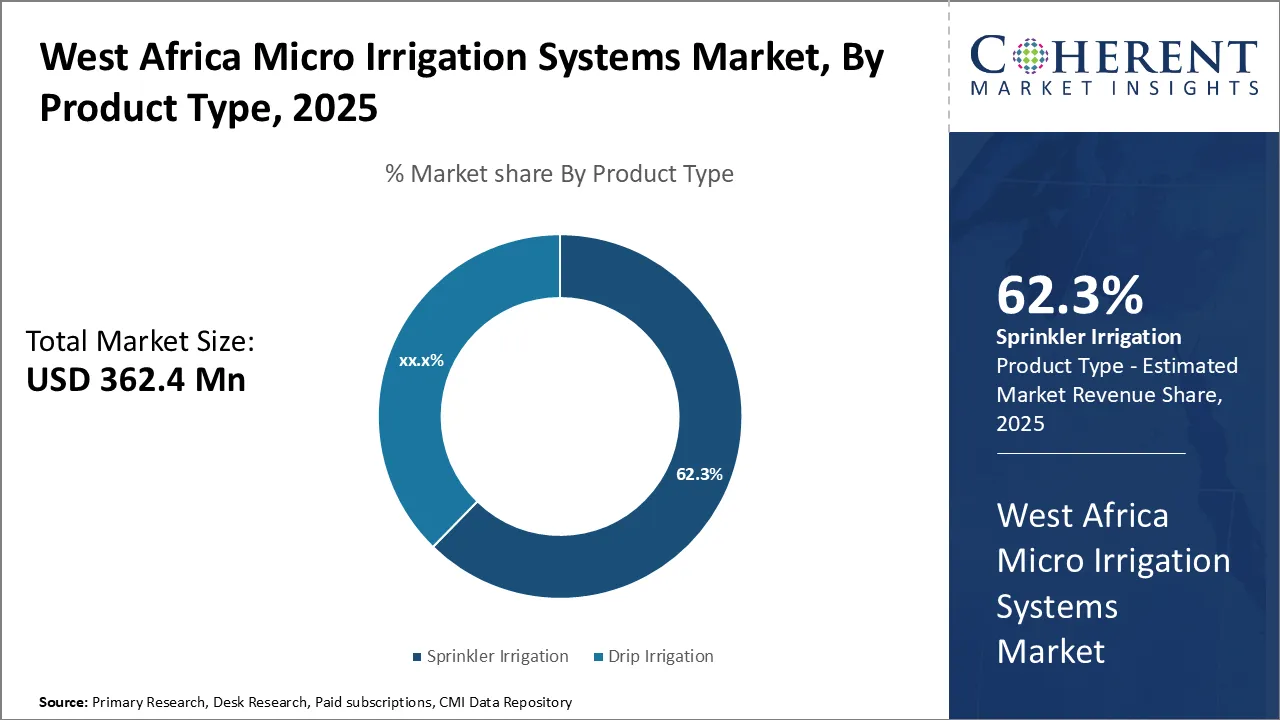
- The sprinkler irrigation segment is projected to capture 63. 3% of the West Africa micro irrigation systems market in 2026, driven by its adaptability and effective water resource management across various agricultural environments.
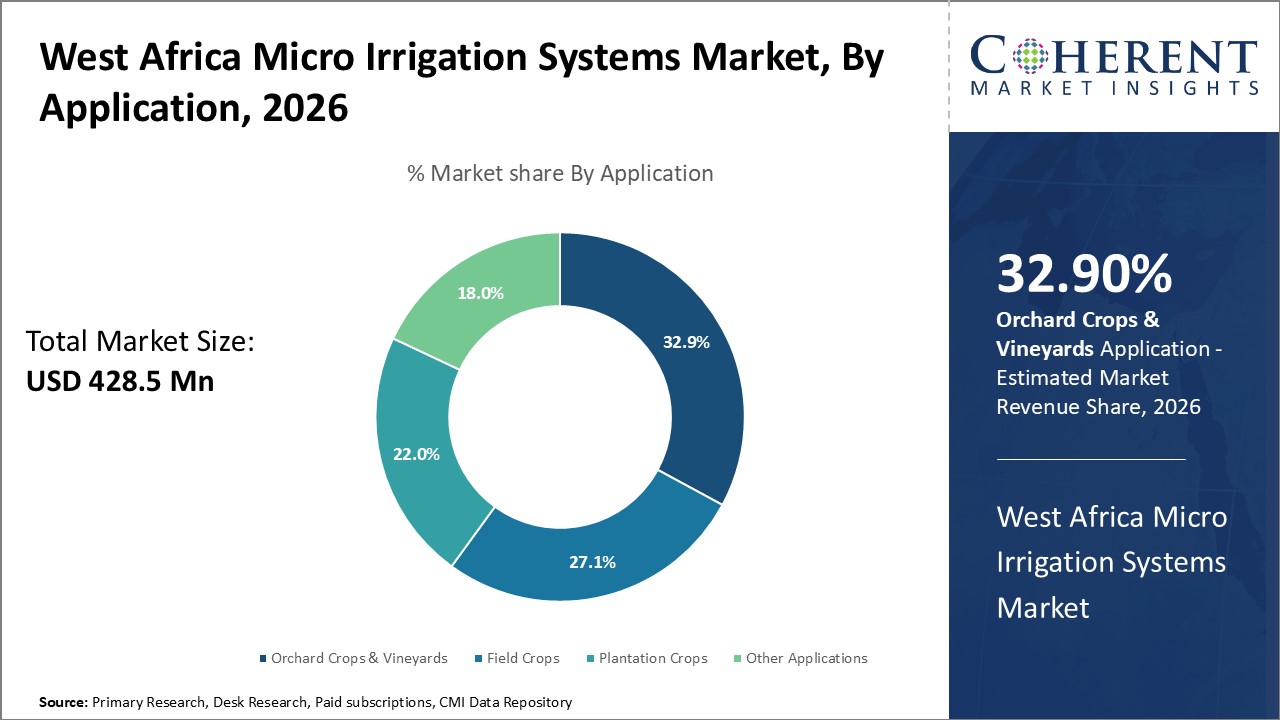
- The orchard crops & vineyards segment is expected to account for 32.9% of the market in 2026, driven by the growth of the region's horticulture and perennial crop industries.
- The farmers segment is set to dominate the market with a 64. 04% share in 2026, fueled by agriculture's essential role in livelihoods and food security throughout the region.
Market Overview
A key trend in the West Africa micro irrigation systems market is the growing emphasis on sustainable agriculture and water conservation. Advancements in drip and sprinkler irrigation technologies, coupled with government initiatives supporting agricultural modernization, are driving market expansion. Additionally, integration of IoT and smart irrigation solutions is enabling precision farming, improving water use efficiency, and reducing operational costs, thereby accelerating the adoption of micro irrigation systems across small and large-scale farms.
Currents Events and their Impact
Current Events | Description and its impact |
Intensifying Water Scarcity Due to Climate Variability |
|
Surge in Adoption of Smart and Precision Agriculture Technologies |
|
Segmental Insights
- Current Industry Events of 2026
- Market Size Estimation
- Regional Breakdown
- Competitive Landscape
- Customer Intelligence
- Segmental Analysis
- Pricing Analysis
- Key Market Drivers, Challenges & Future Trends
- Customized Insights Section
West Africa Micro Irrigation Systems Market Insights, By Product Type - Sprinkler Irrigation Segment Dominates the Market due to its Efficiency and Water Conservation
Sprinkler irrigation segment is expected to hold 63.3% share in the West Africa micro irrigation systems market in 2026, primarily due to its versatility and efficient management of water resources in diverse agricultural settings. Sprinkler irrigation offers a more uniform water distribution compared to traditional flood irrigation, which is crucial in West Africa’s varied topography and soil conditions. This segment is expected to grow at a CAGR of 17.80%. This system can cover large tracts of land with minimal water wastage, addressing the critical need for water conservation in a region where water scarcity and uneven rainfall distribution are persistent challenges.
The adaptability of sprinkler irrigation to different crop patterns and soil types further drives its prominence. Farmers in West Africa benefit from the ease of installation and scalability, allowing systems to be tailored for both small-scale subsistence farms and larger commercial fields. Additionally, the integration of modern technologies such as automated timers and pressure regulation enhances operational efficiency, reducing labor costs and mitigating water loss through evaporation or runoff.
West Africa Micro Irrigation Systems Market Insights, By Application - Orchard Crops & Vineyards Lead Application Segment Driven by Yield Optimization
Orchard crops & vineyards segment is expected to hold 32.9% share of the market in 2026, a trend fueled by the region’s expanding horticulture and perennial crop sectors. These crops are highly sensitive to variations in soil moisture and require precise irrigation management to ensure optimal fruit quality and yield. This segment is expected to grow at a CAGR of 18.73%. Micro irrigation systems tailored to orchards and vineyards offer targeted water delivery directly to the root zones, avoiding water contact with foliage and fruit, which reduces disease incidence and improves crop health.
The rising demand for high-value fruits like mangoes, citrus, and grapes in both local and export markets encourages farmers to invest in efficient irrigation technologies that maximize output per hectare. Orchard crops often represent long-term investments; hence, growers are inclined to implement irrigation solutions that ensure sustainability and consistent production. Micro irrigation facilitates this by improving water use efficiency and nutrient application, which enhances soil fertility and prevents nutrient leaching.
West Africa Micro Irrigation Systems Market Insights, By End User – Farmers Segment Dominates the Market due to its Accessibility and Empowerment Fuel Growth
Farmers segment is projected to hold 65.04% share of the market in 2026, driven by the critical role of agriculture in livelihoods and food security across the region. This dominance is supported by increasing awareness among smallholder and medium-scale farmers about the significant benefits of micro irrigation, especially in areas challenged by erratic rainfall and limited water availability. This segment is expected to grow at a CAGR of 18.32%.
Affordability and adaptability to small-scale farming operations make micro irrigation systems attractive for farmers seeking to improve productivity without large capital outlays. Many farmers recognize the direct correlation between efficient water use and crop yields, motivating them to adopt technologies that promise optimized irrigation with minimal input waste. The availability of modular and easy-to-install kits, often supported by local suppliers and agricultural NGOs, lowers barriers to adoption.
Growth of the Micro Irrigation Systems Market in West Africa is Influenced by Several Macroeconomic and Microeconomic Factors
Macroeconomic factors impacting growth
- Increasing water scarcity, which drives the need for efficient water management systems like micro irrigation to conserve water and improve crop yields.
- Government policies and investments in agriculture, such as capital investments in cotton and wine agriculture in Algeria and support for drip irrigation in Ethiopia.
- Regional water resource availability and distribution, which vary widely and influence irrigation adoption.
- Population growth is increasing food demand and the need for higher agricultural productivity on limited land area.
- Access to financing and subsidies that enable farmers to adopt modern irrigation technologies.
- Broader economic challenges such as fuel costs and maintenance expenses.
Microeconomic factors include
- The affordability and operational costs of various micro irrigation technologies (e.g., motorized pumps vs. manual watering cans).
- Crop type focus, with orchard crops and vegetables having high adoption potential as micro irrigation improves yields and quality.
- Farmer-level demand for higher yields and better crop quality per unit of land, driving adoption of precision irrigation.
- Market demand for high-value irrigated vegetables, including export-oriented production and commercialization of indigenous varieties.
Market Players, Key Development, and Competitive Intelligence
Key Developments
- In August 2024, Rain Bird Corporation acquired the assets of Adritec Group International in Jordan and Mexico, marking a significant move to strengthen its presence across Africa, the Middle East, and Latin America. This acquisition will also enhance the company's access to precision agriculture products.
- In January 2024, Lindsay Corporation unveiled the upgraded ‘FieldNET NextGen,’ a new interface for its FieldNET platform. This advanced remote monitoring and control solution for center pivot irrigation systems helps farmers with routine monitoring and provides agronomic recommendations through the FieldNET Advisor. The next-gen solution boasts a more intuitive and responsive interface, improved mapping and visualization, better remote monitoring capabilities, and enhanced intelligent reporting features.
Top Strategies Followed by West Africa Micro Irrigation Systems Market Players
- Established players dominate the market through substantial investments in research and development (R&D), striving to innovate high-performance micro irrigation products that address the unique climatic and agricultural challenges of West Africa. These companies focus on enhancing efficiency, durability, and automation in their irrigation solutions to meet the growing demand for sustainable water management practices. Such collaborations not only improve product integration but also strengthen their market presence across multiple countries.
- For example, Netafim, a global leader in irrigation technology, has invested in smart irrigation solutions tailored for smallholder farmers in the region, offering automated drip irrigation systems that help conserve water while maximizing crop yields.
- Mid-level market participants adopt a more targeted approach by offering cost-effective micro irrigation systems that balance performance with affordability to cater to the price-sensitive segment of smallholder farmers in West Africa. Their product portfolios often emphasize user-friendly designs and modular components that can be easily adapted to various crop types and farm sizes. To enhance their competitive edge, mid-level players engage in collaborations with technology providers and manufacturing partners, enabling them to scale production, reduce costs, and integrate emerging technologies such as solar-powered irrigation pumps.
- For example, Jain Irrigation Systems, for instance, offers drip irrigation systems designed for small farms, focusing on high value crops such as vegetables and fruits. Its products are modular and adaptable, offering flexible systems to match the diverse crop types and farm sizes in West Africa.
- Small-scale players in the West Africa micro irrigation market distinguish themselves by carving out niches through specialized product features or innovative technologies tailored to specific regional or crop requirements. These firms often focus on smart irrigation solutions, such as sensor-based moisture monitoring or Internet of Things (IoT)-enabled devices, to attract tech-savvy farmers seeking precise water management tools. To remain competitive in a market dominated by larger companies, small players embrace cutting-edge manufacturing techniques and agile innovation cycles.
Market Report Scope
West Africa Micro Irrigation Systems Market Report Coverage
| Report Coverage | Details | ||
|---|---|---|---|
| Base Year: | 2025 | Market Size in 2026: | USD 428.5 Mn |
| Historical Data for: | 2020 To 2024 | Forecast Period: | 2026 To 2033 |
| Forecast Period 2026 to 2033 CAGR: | 18.2% | 2033 Value Projection: | USD 1,384.5 Mn |
| Segments covered: |
| ||
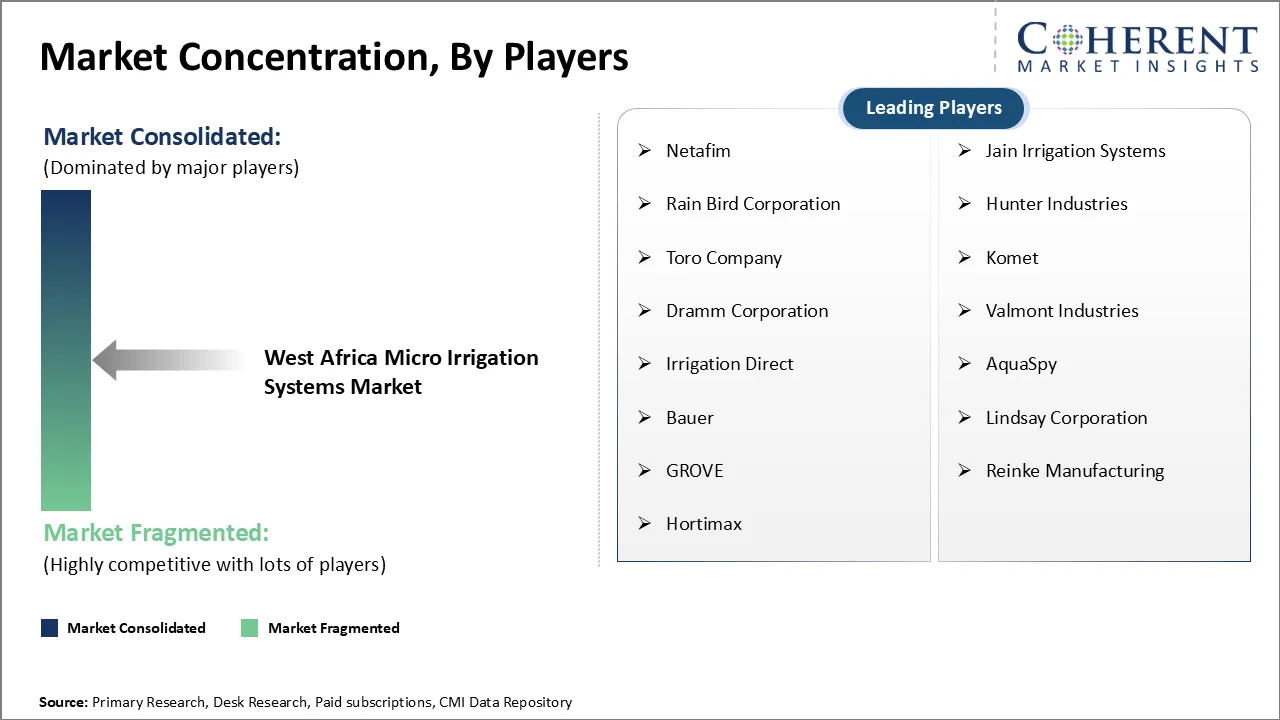
| Companies covered: | Netafim, Jain Irrigation Systems, Rain Bird Corporation, Hunter Industries, Toro Company, Komet, Dramm Corporation, Valmont Industries, Irrigation Direct, AquaSpy, Bauer, Lindsay Corporation, GROVE, Reinke Manufacturing, and Hortimax | ||
| Growth Drivers: |
| ||
| Restraints & Challenges: |
| ||
West Africa Micro Irrigation Systems Market Dynamics
West Africa Micro Irrigation Systems Market Driver - Increasing Water Scarcity and the Need for Efficient Water Management
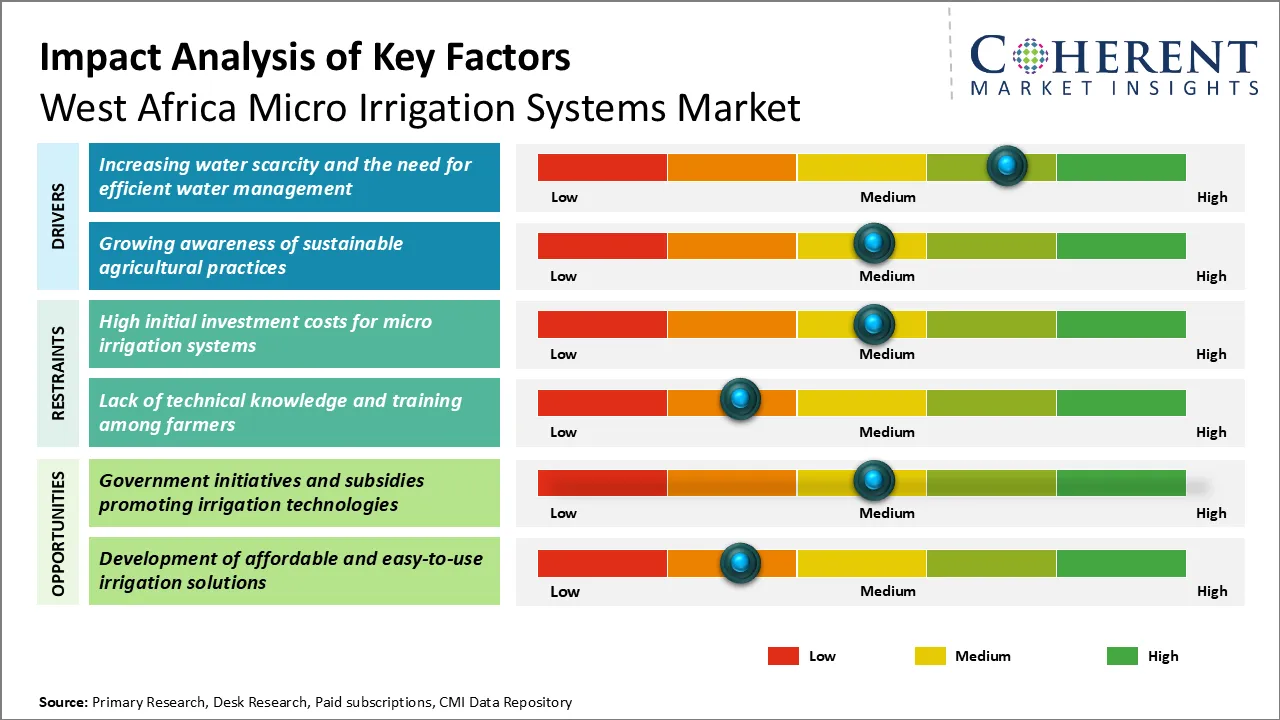
In West Africa, escalating water scarcity driven by changing climatic conditions, irregular rainfall patterns, and over-extraction of groundwater resources has become a critical challenge for the agricultural sector. This growing scarcity has intensified the urgency for more efficient and sustainable water management solutions, making micro irrigation systems highly relevant in this context. Unlike traditional irrigation methods that often lead to substantial water wastage, micro irrigation technologies such as drip and sprinkler systems deliver water directly to the root zones of plants, minimizing evaporation and runoff. These systems ensure optimal water utilization, promoting higher crop yields with significantly less water input.
For instance, in the Sahel region, countries like Mali and Niger have been facing prolonged droughts, with rainfall patterns becoming increasingly unpredictable. The West African Science Service Centre on Climate Change and Adapted Land Use (WASCAL) has highlighted that the region is expected to experience a 20-30% decrease in rainfall by 2050. As a result, traditional irrigation methods, which often lead to substantial water wastage through surface runoff and evaporation, are no longer viable.
West Africa Micro Irrigation Systems Market Opportunity - Government Initiatives and Subsidies Promoting Irrigation Technologies
One of the most significant opportunities driving growth in the West Africa micro irrigation systems market is the increasing support from government initiatives and subsidy programs aimed at enhancing agricultural productivity and sustainability. Several West African governments have recognized the pivotal role of advanced irrigation technologies in combating climate variability, improving water use efficiency, and ensuring food security in a region heavily dependent on rain-fed agriculture. Consequently, various national and regional policies have been introduced to encourage the adoption of micro irrigation systems among smallholder farmers. These initiatives such as Solar Market Gardens (SMGs) project in Benin, often include direct subsidies that reduce the upfront cost of drip and sprinkler irrigation equipment, technical training programs, and extension services that facilitate technology dissemination and capacity building.
Analyst Opinion (Expert Opinion)
- The West Africa micro irrigation systems market is on the cusp of significant growth, fueled by increasing agricultural demands and the urgent need for water conservation. Insights from the West Africa Agricultural Innovations Conference (2023) and the International Irrigation Expo (2022) highlighted the critical role of micro irrigation in enhancing food security and boosting crop yields in the region. Companies like Netafim and Dramm are pioneering innovative solutions, such as solar-powered drip irrigation systems, which not only reduce water usage but also lower operational costs for farmers.
- For instance, Netafim's recent projects in Ghana demonstrate how tailored micro irrigation systems can dramatically improve farming efficiency. Additionally, discussions at these conferences emphasized the importance of training local farmers in these technologies to maximize their impact. As climate change continues to challenge traditional farming practices, the adoption of micro irrigation systems will be key to sustainable agricultural development. Manufacturers that focus on affordability, ease of installation, and robust training programs will likely lead the market, positioning themselves as vital partners in West Africa’s agricultural transformation.
Speak to the analyst
Want personalized insights?
Take the findings above to one of our principal consultants, or have the report rebuilt around the segments, geographies and competitors you actually track.
Market Segmentation
- Product Type Insights (Revenue, USD Mn, 2021 - 2033)
- Sprinkler Irrigation
- Drip Irrigation
- Application Insights (Revenue, USD Mn, 2021 - 2033)
- Orchard Crops & Vineyards
- Field Crops
- Plantation Crops
- Other Applications
- End User Insights (Revenue, USD Mn, 2021 - 2033)
- Farmers
- Industrial Users
- Key Players Insights
- Netafim
- Jain Irrigation Systems
- Rain Bird Corporation
- Hunter Industries
- Toro Company
- Komet
- Dramm Corporation
- Valmont Industries
- Irrigation Direct
- AquaSpy
- Bauer
- Lindsay Corporation
- GROVE
- Reinke Manufacturing
- Hortimax
Sources
Primary Research Interviews
- Agricultural Engineer – Leading Irrigation System Manufacturer in West Africa
- Sustainability Officer – NGO focused on water conservation in Sub-Saharan Africa
- Procurement Manager – Key Distributor of Agricultural Equipment in West Africa
- Government Policy Advisor – Ministry of Agriculture in a major West African country
Stakeholders
- Manufacturers of Micro Irrigation Systems
- End-Use Sectors
- Agriculture (Small-scale and Commercial Farms)
- Government & NGO Initiatives for Rural Development
- Regulatory & Certification Bodies
- Technology Providers IoT-based irrigation solutions, water efficiency technologies
- Distributors and Retailers of Irrigation Equipment
Databases
- UN Comtrade Database
- West Africa Agricultural Data (WAAD) Database
- FAOSTAT – Global and regional agricultural production statistics
Magazines
- Agriculture Today – Trends in water-efficient farming techniques
- Irrigation Management Journal – Innovations in micro irrigation technologies
- Water for Africa – Water management strategies in African agriculture
- Agri-Tech East – Technological advancements in irrigation systems
- The African Farming Magazine – Regional irrigation market and growth analysis
Journals
- International Journal of Agricultural Sustainability – Water-saving irrigation systems
- Journal of Irrigation and Drainage Engineering – Innovations in micro irrigation for water-scarce regions
- Agricultural Water Management Journal – Case studies and policy impacts on irrigation in Africa
Newspapers
- The Financial Times – Agricultural development and irrigation growth in Africa
- The Guardian Africa – Trends in sustainable farming and water management
- Africa Business Journal – Investment in agricultural infrastructure, including irrigation systems
- West Africa Weekly – Government policies supporting agricultural technology adoption
Associations
- West African Farmers Association (WAFA)
- International Commission on Irrigation and Drainage (ICID)
- Water for Africa Foundation
- African Development Bank (AfDB)
- Global Water Partnership Africa
Public Domain Sources
- FAO – Water management guidelines and statistics for Africa
- African Union – Agricultural development policies for water efficiency
- UNICEF – Water scarcity challenges in West Africa
Proprietary Elements
- CMI Data Analytics Tool, Proprietary CMI Existing Repository of information for last 8 years.
Get access to 250+ pages report
Every segment, forecast, competitor profile and data table behind the analysis above — available for instant download.
- ESOMAR Member
- ISO 9001:2015 Certified
- D-U-N-S Registered
- GDPR & CCPA Compliant
Missing comfort of reading report in your local language? Find your preferred language:
Transform your Strategy with Exclusive Trending Reports
Frequently Asked Questions
The West Africa micro irrigation systems market is estimated to be valued at USD 428.5 Mn in 2026 and is expected to reach USD 1,384.5 Mn by 2033.
The CAGR of West Africa micro irrigation systems market is projected to be 18.2% from 2026 to 2033.
Increasing water scarcity and the need for efficient water management and growing awareness of sustainable agricultural practices are the major factors driving the growth of the West Africa micro irrigation systems market.
High initial investment costs for micro irrigation systems and lack of technical knowledge and training among farmers are the major factors hampering the growth of the West Africa micro irrigation systems market.
In terms of product type, sprinkler irrigation is estimated to dominate the market revenue share in 2026.
Netafim, Jain Irrigation Systems, Rain Bird Corporation, Hunter Industries, Toro Company, Komet, Dramm Corporation, Valmont Industries, Irrigation Direct, AquaSpy, Bauer, Lindsay Corporation, GROVE, Reinke Manufacturing, and Hortimax are the major players.