

Global Wet Bench Market Size and Forecast – 2026-2033
The global wet bench market is estimated to be valued at USD 1.59 Bn in 2026 and is expected to reach USD 3.64 Bn by 2033, exhibiting a compound annual growth rate (CAGR) of 12.6% from 2026 to 2033.
Key Takeaways of the Wet Bench Market
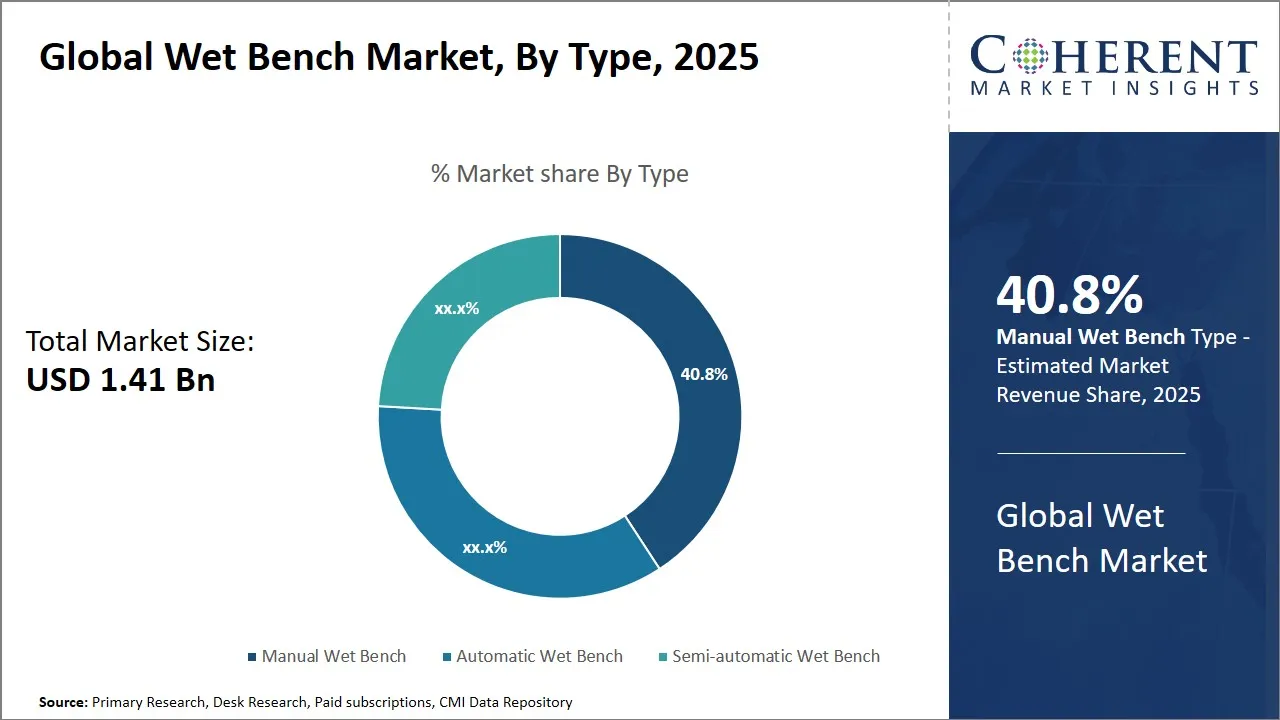
- The manual wet bench segment leads the market holding an estimated share of 41.8 % in 2026.
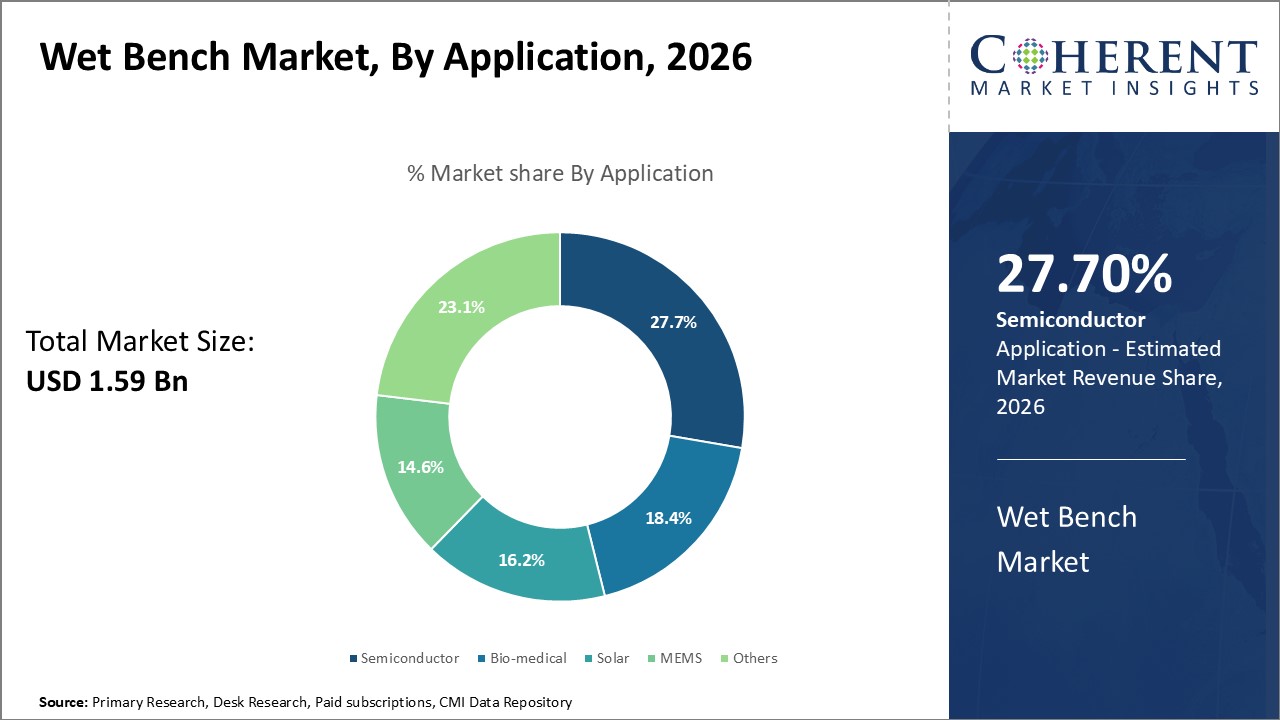
- The semiconductor segment is expected to dominate with a share of 27.7 % in 2026.
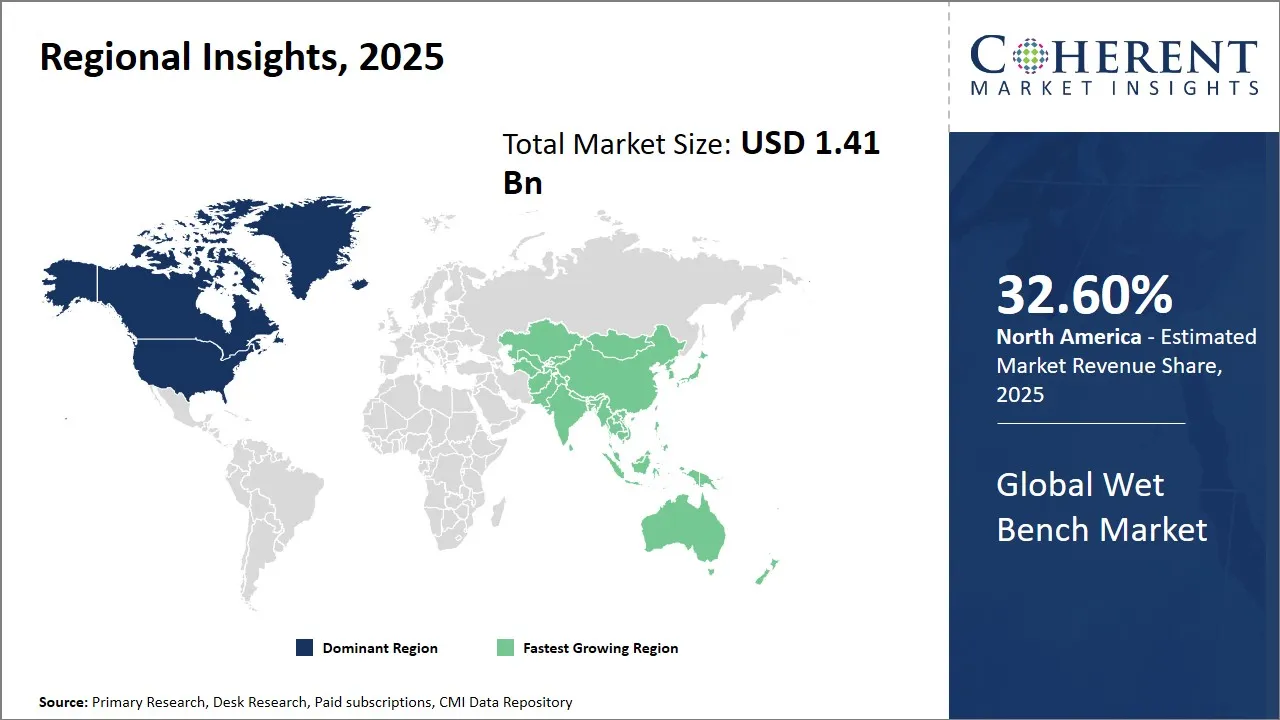
- North America is expected to lead the market, holding a share of 32.6 % in 2026.
- Asia Pacific, holding a share of 28.9 % in 2026, is projected to show the fastest growth.
Market Overview
The wet bench market is seeing the use of automation and smart technologies to improve precision and reduce human error in chemical processing environments. Also, the growing focus on environmental sustainability is pushing the adoption of eco-friendly wet bench systems that minimize chemical waste and energy consumption. These innovations are adding to market growth as companies strive to optimize production efficiency while adhering to regulatory standards.
Current Events and Its Impact
Current Events | Description and its Impact |
Geopolitical and Trade Developments |
|
Economic and Industrial Trends |
|
Segmental Insights
- Current Industry Events of 2026
- Market Size Estimation
- Regional Breakdown
- Competitive Landscape
- Customer Intelligence
- Segmental Analysis
- Pricing Analysis
- Key Market Drivers, Challenges & Future Trends
- Customized Insights Section
Global Wet Bench Market Insights, By Type – Manual Wet Bench Leads Because of its Operational Flexibility and Cost-Effectiveness
The manual wet bench segment, holding an estimated share of 41.8% in 2026, dominates the global wet bench market because of its versatile nature and adaptability in different industrial settings. Manual wet benches are used in laboratories and small to medium-scale manufacturing units where precision and operator control are needed. Manual benches let technicians directly manage the chemical processing steps, making them very useful for applications that need frequent adjustments during processing.
Modutek Corporation’s Manual Wet Bench Series is widely adopted across North American and Asian R&D laboratories for wafer cleaning, etching, and photoresist stripping.
Global Wet Bench Market Insights, By Application – Semiconductor Dominates the Market Because of Rigorous Manufacturing Requirements and Precision Cleaning Needs
The semiconductor segment is projected to hold the largest share of 27.7% in the global wet bench market in 2026, because of the semiconductor industry’s strict process demands. Wet benches are very important in these processes, making possible the removal of impurities, residues, and particles that can highly impact the performance and yield of semiconductor devices. ACM Research’s “Ultra C wb” wet cleaning system features a patented nitrogen-bubbling technology designed to enhance cleaning uniformity and chemical efficiency.
Pricing Analysis of the Wet Bench Market
Type | Estimated Price Range (USD) |
Manual Wet Benches | USD 7,450 – USD 11,100 |
Semi-Automated Wet Benches | USD 20,000 – USD 50,000 |
Fully Automated Wet Benches | USD 100,000 – USD 500,000+ |
Portable Wet Benches | USD 5,000 – USD 15,000 |
Specialized Systems, e.g., Acid Wet Benches | USD 50,000 – USD 150,000 |
Regional Insights
North America Wet Bench Market Analysis and Trends
North America, holding a projected share of 32.6% in 2026, dominates the wet bench market because of innovation-centric semiconductor manufacturing and rising adoption of next-generation technologies like 5-nanometer and below processes. The region sees a mature ecosystem with design houses, foundries, and equipment manufacturers.
Strategic government investments like support for domestic semiconductor fabrication under initiatives like the CHIPS Act in the U.S., are adding to capacity expansions and upgrades needing new wet bench installations. Companies like Applied Materials, Lam Research, and KLA play big roles in advancing wet bench technology through R&D and service support. Trade policies encouraging local manufacturing and supply chain resilience also foster rapid market growth.
Asia Pacific Wet Bench Market Analysis and Trends
Asia Pacific, holding an estimated share of 28.9% in 2026, shows the fastest growth because of its robust semiconductor manufacturing ecosystem, extensive industrial base, and strong government support. Countries like Taiwan, South Korea, China, and Japan host leading semiconductor fabs and electronic manufacturing facilities that heavily utilize wet bench systems for wafer cleaning and processing.
Government initiatives to boost semiconductor self-reliance and technology upgrades have propelled investments in advanced wet bench equipment. The presence of major industry players like Tokyo Electron, Lam Research’s regional units, and Advanced Semiconductor Engineering add to Asia Pacific’s lead. Strong trade linkages and supply chain integration in the region also allow manufacturers to optimize procurement of wet bench components and chemicals.
Global Wet Bench Market Outlook for Key Countries
U.S. Wet Bench Market Analysis and Trends
The U.S. wet bench market includes leading semiconductor equipment manufacturers and a well-established ecosystem of foundries and Integrated Device Manufacturers (IDM). Industry leaders like Applied Materials and Lam Research add to innovation, offering advanced wet bench solutions for high-precision cleaning and etching in cutting-edge node fabrication. Collaborations between semiconductor companies and equipment producers also add to improvement in wet bench technologies.
China Wet Bench Market Analysis and Trends
China is growing its semiconductor manufacturing capabilities fast, making its wet bench market very important for domestic chip production sovereignty. Local and regional players such as Naura Technology Group contribute alongside global suppliers to meet the growing needs. Although trade restrictions make challenges, China's efforts to develop indigenous equipment and chemical suppliers are making the market ecosystem stronger, driving rapid capacity expansions across several provinces.
South Korea Wet Bench Market Analysis and Trends
South Korea continues to lead the wet bench market primarily due to its semiconductor giants like Samsung Electronics and SK Hynix, who operate state-of-the-art fabs with extensive wet cleaning processes. The country's emphasis on innovation and ultra-large-scale production necessitates the procurement of highly sophisticated wet bench systems, both from domestic manufacturers and global suppliers. The presence of local equipment companies like Jusung Engineering complements global players, allowing technology adaptation to specific process needs. Government incentives for R&D and export adds to the market growth in South Korea.
Germany Wet Bench Market Analysis and Trends
Germany wet bench market sees growth because of its huge semiconductor equipment manufacturing sector and strong industrial base in electronics. The country acts as a key hub within Europe for high-precision manufacturing and has a strategic focus on Industry 4.0 integration, which extends into semiconductor fabrication infrastructure. Companies like SÜSS MicroTec play a vital role in supplying wet bench technologies tailored for specialized wafer cleaning and chemical processing. Supportive EU policies for semiconductor technology independence and sustainability are adding to market demands.
Taiwan Wet Bench Market Analysis and Trends
Taiwan wet bench market benefits immensely from TSMC’s leadership in semiconductor foundry services and aggressive technology roadmap execution. The island’s concentration of wafer fabrication facilities creates the need for consistent upgrading and expansion of wet bench systems to maintain competitive process yields and throughput. Taiwanese companies and global equipment suppliers innovate in wet bench automation and chemical use optimization. Collaborative efforts with research institutes allow state-of-the-art equipment to meet the changing fabrication demands, making Taiwan’s role in the global supply chain stronger.
Market Players, Key Development, and Competitive Intelligence
Key Developments
- In September 2025, Modutek Corporation, a leading U.S.-based provider of custom wet process equipment, participated in Semicon India 2025.
- In July 2025, ACM Research, Inc., a leading supplier of wafer and panel processing solutions for semiconductor and advanced packaging applications, announced major upgrades to its Ultra C wb cleaning tool.
- In April 2025, Premier Energies and Germany-based RENA Technologies GmbH, a player in wet chemical process equipment, made a technology partnership focused on process innovation for N-Type solar cells and development of wet chemistry for next generation tandem solar cell technologies. This landmark collaboration brings together Premier Energies' large-scale manufacturing capabilities with RENA's advanced wet chemistry and equipment solutions.
- In February 2025, DNN-TECH and INTECH Group signed a Memorandum of Understanding (MOU) to collaborate. The partnership focuses on semiconductor packaging technology, capacity building, and supply chain optimization.
Top Strategies Followed by Wet Bench Market Players
- Established companies dominate the sector by using their huge financial resources to invest highly in research and development.
- Modutek Corporation specializes in developing and providing advanced wet bench systems and wet process equipment through R&D, particularly for the semiconductor industry.
- Mid-level companies in the wet bench market show a strategic focus on cost-effective solutions that offer a balance between product quality and affordability.
- JST Manufacturing's Tigress XL semi-automated wet bench is a compact, easy-to-use system that processes products up to 200mm in size, supporting semi-automated, automated, or multi-tasking operations.
- Small-scale players in the global wet bench market carve their niche by focusing on specialized product features and innovative solutions tailored to unique customer requirements.
- Teblick specializes in designing and manufacturing high-quality plastic constructions, including wet benches, essential for various applications in industries like semiconductor and chemical distribution.
Market Report Scope
Wet Bench Market Report Coverage
| Report Coverage | Details | ||
|---|---|---|---|
| Base Year: | 2025 | Market Size in 2026: | USD 1.59 Bn |
| Historical Data for: | 2020 To 2024 | Forecast Period: | 2026 To 2033 |
| Forecast Period 2026 to 2033 CAGR: | 12.6% | 2033 Value Projection: | USD 3.64 Bn |
| Geographies covered: |
| ||
| Segments covered: |
| ||
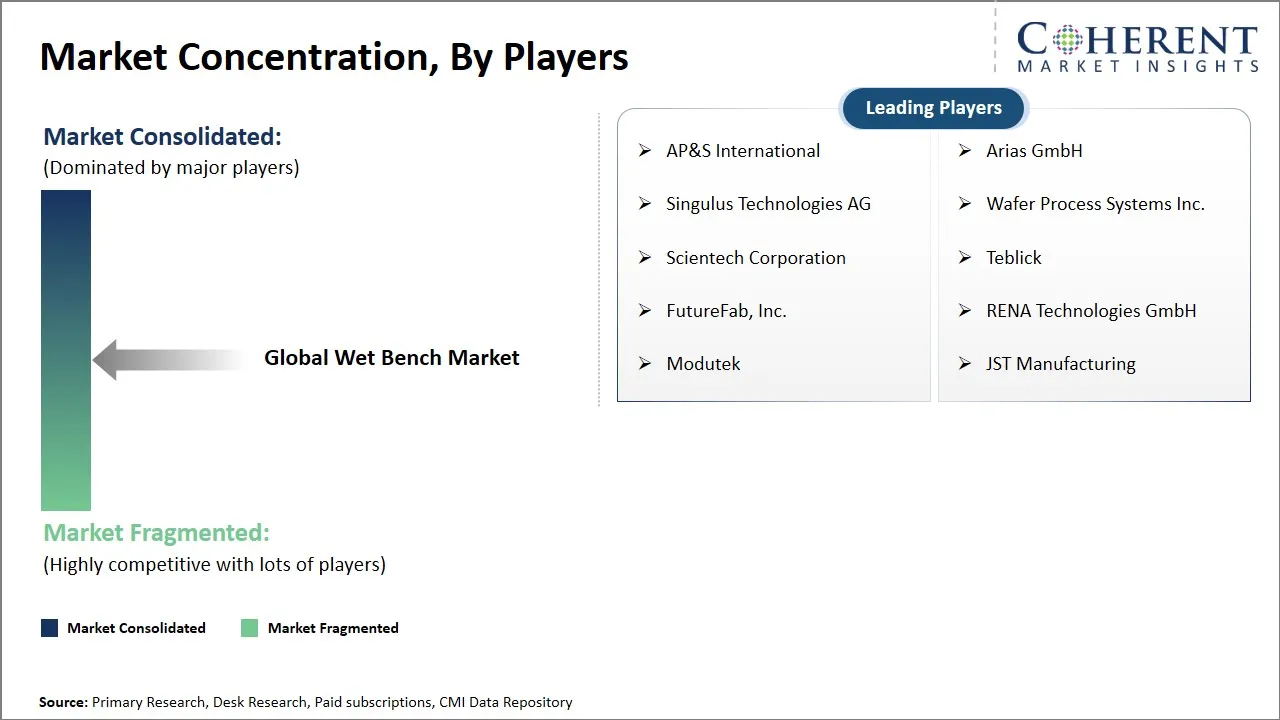
| Companies covered: | AP&S International, Arias GmbH, Singulus Technologies AG, Wafer Process Systems Inc., Scientech Corporation, Teblick, FutureFab, Inc., RENA Technologies GmbH, Modutek, and JST Manufacturing | ||
| Growth Drivers: |
| ||
| Restraints & Challenges: |
| ||
Market Dynamics
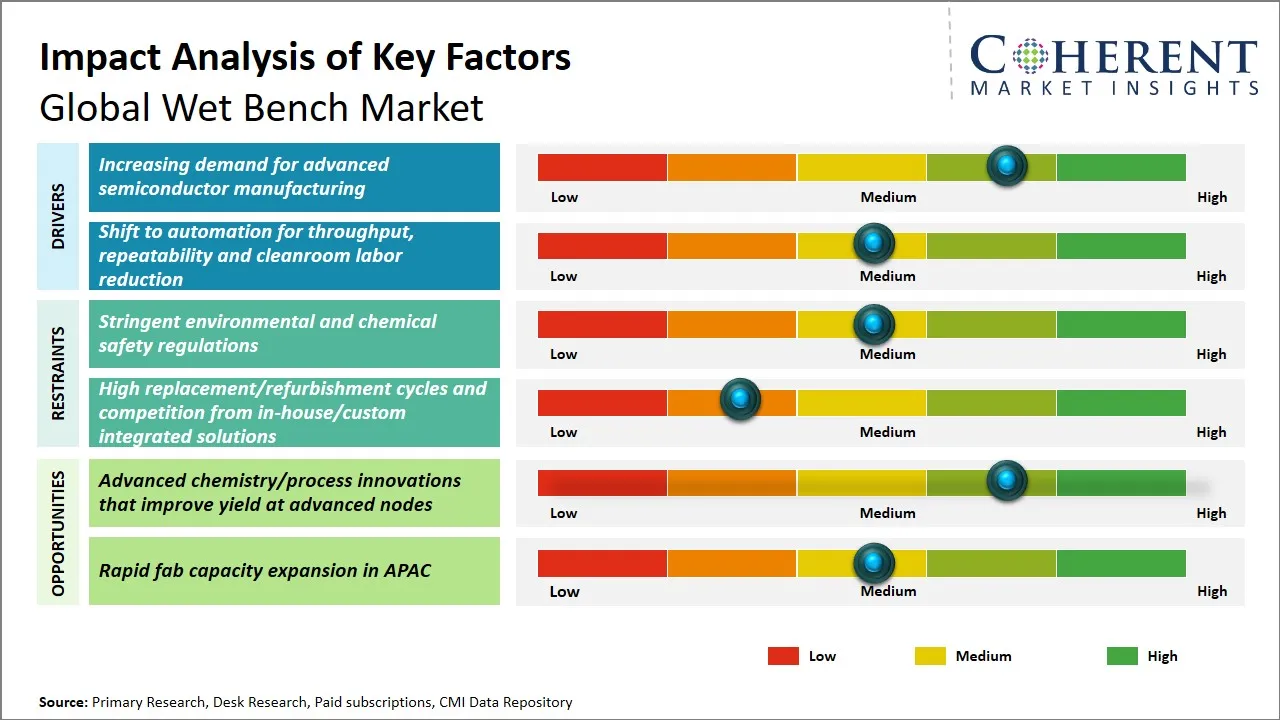
Global Wet Bench Market Driver – Increasing Demand for Advanced Semiconductor Manufacturing
The escalating complexity and miniaturization of semiconductor devices are driving the need for highly precise and reliable wet bench systems in manufacturing facilities. As semiconductor companies push the boundaries of chip performance and functionality, traditional cleaning, etching, and chemical processing methods are no longer sufficient, prompting a shift toward more advanced wet bench technologies capable of meeting stringent quality and contamination control requirements.
This demand is amplified by the rapid adoption of advanced nodes, such as those found in 5G, artificial intelligence, and high-performance computing applications, where even minimal defects can lead to significant yield losses. Consequently, manufacturers are investing heavily in wet bench solutions that offer enhanced process control, automation, and integration with other fab tools to improve throughput and consistency.
Global Wet Bench Market Opportunity – Advanced Chemistry and Process Innovations to Enhance Yield at Advanced Nodes
The global wet bench market stands to benefit significantly from the ongoing advancements in chemistry and process innovations aimed at improving yield at advanced semiconductor nodes. As the semiconductor industry pushes into smaller technology nodes—such as 5nm and beyond—the complexity of wafer fabrication increases exponentially. This complexity demands highly specialized wet bench solutions that can precisely manage critical cleaning, etching, and stripping processes to mitigate defects and enhance overall device performance. Innovations in chemical formulations, including ultra-pure and selective etchants, have enabled better control over surface properties and contamination removal, directly contributing to higher yields.
Additionally, process innovations such as real-time monitoring, automation, and integration with advanced metrology tools are facilitating finer process control and repeatability. These improvements reduce variability and increase throughput in wafer processing, addressing the primary manufacturing challenges faced at advanced nodes. Furthermore, the rising adoption of 3D architectures and heterogeneous integration further underscores the need for advanced wet bench systems that can handle intricate cleaning and preparation steps, positioning these innovations as a critical growth driver in the global wet bench market.
Analyst Opinion (Expert Opinion)
- Advanced semiconductor manufacturing, including wafer fabrication and packaging, is the primary driver of high-value automated wet benches. Analysts note that demand for precision, yield improvement, and automation integration is keeping established players busy with R&D investments.
- Increasing R&D in pharmaceuticals, biotech, and academic laboratories is creating demand for semi-automated and manual wet benches. Analysts expect this segment to grow steadily, driven by new lab setups, process standardization, and the need for ergonomic, cost-effective solutions.
- Photovoltaic (PV), display manufacturing, and MEMS devices are emerging markets for specialized wet benches. Analysts highlight that small-scale and mid-tier OEMs are capitalizing on these niche applications, particularly in APAC, where fab expansions and renewable energy projects are underway.
Speak to the analyst
Want personalized insights?
Take the findings above to one of our principal consultants, or have the report rebuilt around the segments, geographies and competitors you actually track.
Market Segmentation
- Type Insights (Revenue, USD Bn, 2021 - 2033)
- Manual Wet Bench
- Automatic Wet Bench
- Semi-automatic Wet Bench
- Application Insights (Revenue, USD Bn, 2021 - 2033)
- Semiconductor
- Bio-medical
- Solar
- MEMS
- Others
- Regional Insights (Revenue, USD Bn, 2021 - 2033)
- North America
- U.S.
- Canada
- Latin America
- Brazil
- Argentina
- Mexico
- Rest of Latin America
- Europe
- Germany
- U.K.
- Spain
- France
- Italy
- Russia
- Rest of Europe
- Asia Pacific
- China
- India
- Japan
- Australia
- South Korea
- ASEAN
- Rest of Asia Pacific
- Middle East
- GCC Countries
- Israel
- Rest of Middle East
- Africa
- South Africa
- North Africa
- Central Africa
- North America
- Key Players Insights
- AP&S International
- Arias GmbH
- Singulus Technologies AG
- Wafer Process Systems Inc.
- Scientech Corporation
- Teblick
- FutureFab, Inc.
- RENA Technologies GmbH
- Modutek
- JST Manufacturing
Sources
Primary Research Interviews
Stakeholders
- Semiconductor Manufacturing Companies
- Wet Bench and Wet Process Equipment Manufacturers
- R&D and Quality Control Heads at Pharmaceutical and Life Sciences Labs
- Photovoltaic and Display Manufacturing Firms
- Laboratory Equipment Distributors and System Integrators
- Cleanroom and Fab Automation Consultants
Databases
- Global Semiconductor Equipment Database (GSED)
- International Laboratory Equipment Registry (ILER)
- Asia-Pacific Industrial Technology Statistics (APITS)
Magazines
- Semiconductor Manufacturing Today
- Advanced Lab Equipment Magazine
- Electronics Manufacturing Insights
- Cleanroom & Fab Automation Monthly
Journals
- Journal of Semiconductor Manufacturing Processes
- International Journal of Laboratory Automation
- Microelectronics Engineering Journal
- Journal of Photovoltaic Materials & Technology
Newspapers
- Semiconductor Times
- Lab Equipment Daily
- Electronics Weekly
- Manufacturing Today (Asia Edition)
Associations
- International Society for Semiconductor Equipment (ISSE)
- Global Wet Process Equipment Association (GWPEA)
- Semiconductor Equipment and Materials International (SEMI)
- International Laboratory Equipment Association (ILEA)
- American Society for Laboratory Automation (ASLA)
Public Domain Sources
- United Nations Industrial Development Organization (UNIDO)
- World Semiconductor Trade Statistics (WSTS)
- International Energy Agency (IEA) – PV and Display Reports
- ResearchGate – Wet Process and Laboratory Equipment Studies
Proprietary Elements
- CMI Data Analytics Tool
- Proprietary CMI Existing Repository of information for last 8 years
Get access to 250+ pages report
Every segment, forecast, competitor profile and data table behind the analysis above — available for instant download.
- ESOMAR Member
- ISO 9001:2015 Certified
- D-U-N-S Registered
- GDPR & CCPA Compliant
Missing comfort of reading report in your local language? Find your preferred language:
Transform your Strategy with Exclusive Trending Reports
Frequently Asked Questions
The global wet bench market is estimated to be valued at USD 1.59 billion in 2026 and is expected to reach USD 3.64 billion by 2033.
The CAGR of the global wet bench market is projected to be 12.6% from 2026 to 2033.
Increasing demand for advanced semiconductor manufacturing and shift to automation for throughput, repeatability and cleanroom labor reduction are the major factors driving the growth of the global wet bench market.
Stringent environmental and chemical safety regulations and high replacement/refurbishment cycles and competition from in-house/custom integrated solutions are the major factors hampering the growth of the global wet bench market.
A wet bench is a workstation used in semiconductor, pharmaceutical, and lab processes for chemical treatment, cleaning, or etching of wafers and components.
Increased automation, regional fab expansions in APAC, demand for eco-friendly processes, and innovations in wet cleaning and chemical delivery systems are some trends shaping the market.
In terms of type, the manual wet bench segment is estimated to dominate the market revenue share in 2026.