

Global Whiteboard Market Size and Forecast – 2026 To 2033
The global whiteboard market is estimated to be valued at USD 3.83 Bn in 2026 and is expected to reach USD 5.91 Bn by 2033, growing at a compound annual growth rate (CAGR) of 6.4% from 2026 to 2033. Growth is supported by continued whiteboard adoption across educational institutions, corporate offices, training environments, and collaborative workspaces, alongside product innovation that combines writing, presentation, and hybrid communication functions.
In June 2025, SMART Technologies introduced the SMART Board Mini, SMART Board M Pro High Secure Series, and SMART OneLaunch at InfoComm 2025, targeting learning, meeting, and secure workplace environments and illustrating continued investment in interactive visual-collaboration solutions.
Key Takeaways of the Global Whiteboard Market
- Wall mounted Whiteboards are projected at an estimated CAGR of 5.8% during 2026–2033 and are expected to hold 43.8% of the global whiteboard market in 2026. Their fixed installation, classroom-wide visibility, lower space consumption, and suitability for repeated teaching or meeting use support replacement-led purchasing. In July 2025, Ghent detailed Flyte Duo as a frameless, wall-mounted whiteboard with reversible gloss and projection surfaces.
- Melamine is projected to expand at an estimated CAGR of 5.5% during 2026–2033 and account for 34.7% of the global whiteboard market in 2026. Its comparatively accessible cost, light weight, simple fabrication, and adequacy for routine writing make it attractive for budget-sensitive classrooms and offices. In May 2025, MooreCo’s product guide continued to specify melamine dry-erase surfaces for preschool learning-space dividers.
- Educational Institutions are projected to grow at an estimated CAGR of 6.1% during 2026–2033 and represent 39.6% of the global whiteboard market in 2026. Whiteboards remain embedded in teacher-led explanation, group problem-solving, visual instruction, and flexible classroom design, supporting recurring fit-out and replacement demand. In June 2025, Polyvision reported CeramicSteel writable surfaces specified across classrooms and communal areas at Livonia Early Childhood Center.
- North America is projected to register an estimated CAGR of 5.9% during 2026–2033 and command 31.8% of the global whiteboard market in 2026. A large installed base across schools, universities, offices, healthcare facilities, and public buildings sustains replacement purchases and demand for higher-durability surfaces. In August 2025, Pennsylvania’s Loyalsock Township School District recorded a purchase of a porcelain magnetic whiteboard from US Markerboard.
- Europe is projected to post an estimated CAGR of 7.4% during 2026–2033 and hold 28.6% of the global whiteboard market in 2026. Classroom modernization, structured public procurement, workplace refurbishment, and preference for durable, lower-maintenance writing surfaces support above-market expansion. In February 2025, Hampshire County Council launched a four-year framework for individual whiteboards and accessories, with dedicated procurement lots covering dry-erase boards and related supplies.
Segmental Insights
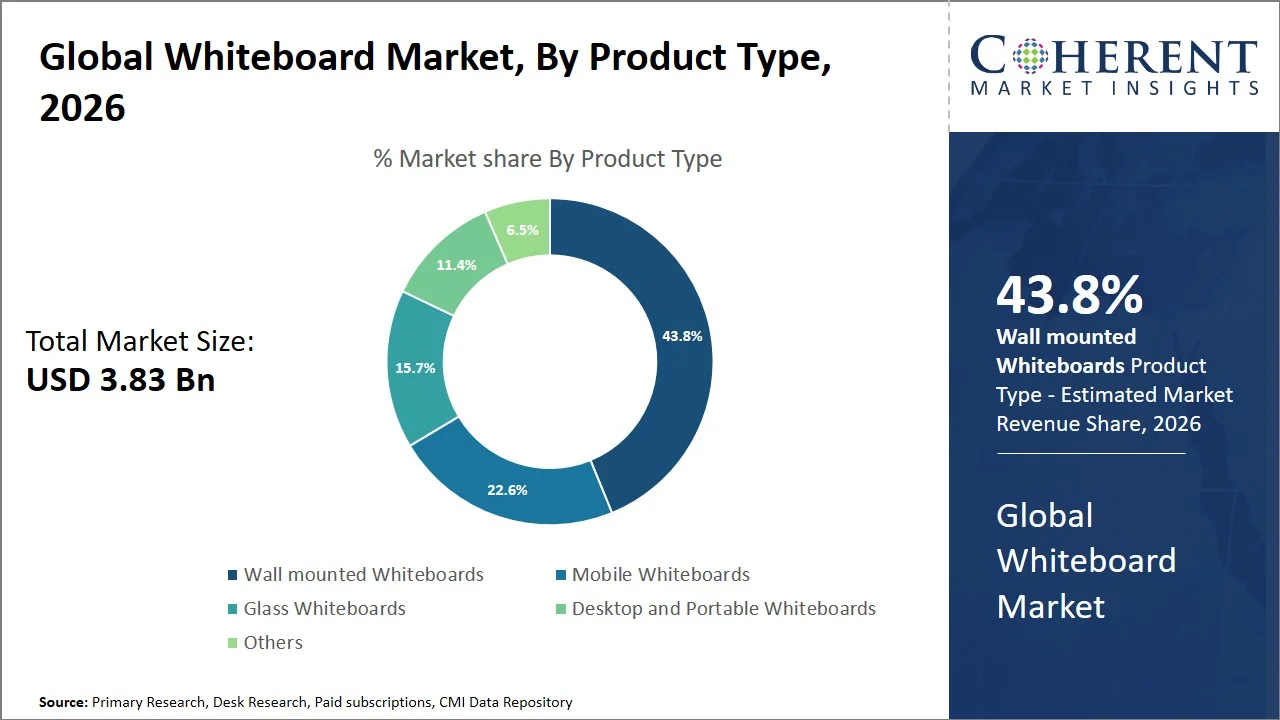
Why Do Wall Mounted Whiteboards Dominate the Global Whiteboard Market?
Wall mounted Whiteboards are expected to hold 43.8% of the global whiteboard market in 2026 because permanent installation suits rooms where writing surfaces are used continuously and floor space must remain available for seating, circulation, and equipment. Their large viewing area, compatibility with magnetic accessories and projection-adjacent layouts, and low need for repositioning support adoption in classrooms, training rooms, conference spaces, and public facilities. Suppliers also benefit from standardized dimensions, repeat installation specifications, and replacement demand tied to room refurbishment rather than individual-user purchases. For buyers, fixed boards reduce handling risk and simplify facility-wide standardization. In August 2025, Pasadena Unified School District approved installation of nine new whiteboards across five modernized classrooms at John Muir High School, directly linking classroom refurbishment with installed writing-surface procurement.
- Current Industry Events of 2026
- Market Size Estimation
- Regional Breakdown
- Competitive Landscape
- Customer Intelligence
- Segmental Analysis
- Pricing Analysis
- Key Market Drivers, Challenges & Future Trends
- Customized Insights Section
Why Does Melamine Represent the Largest Surface Material in the Global Whiteboard Market?
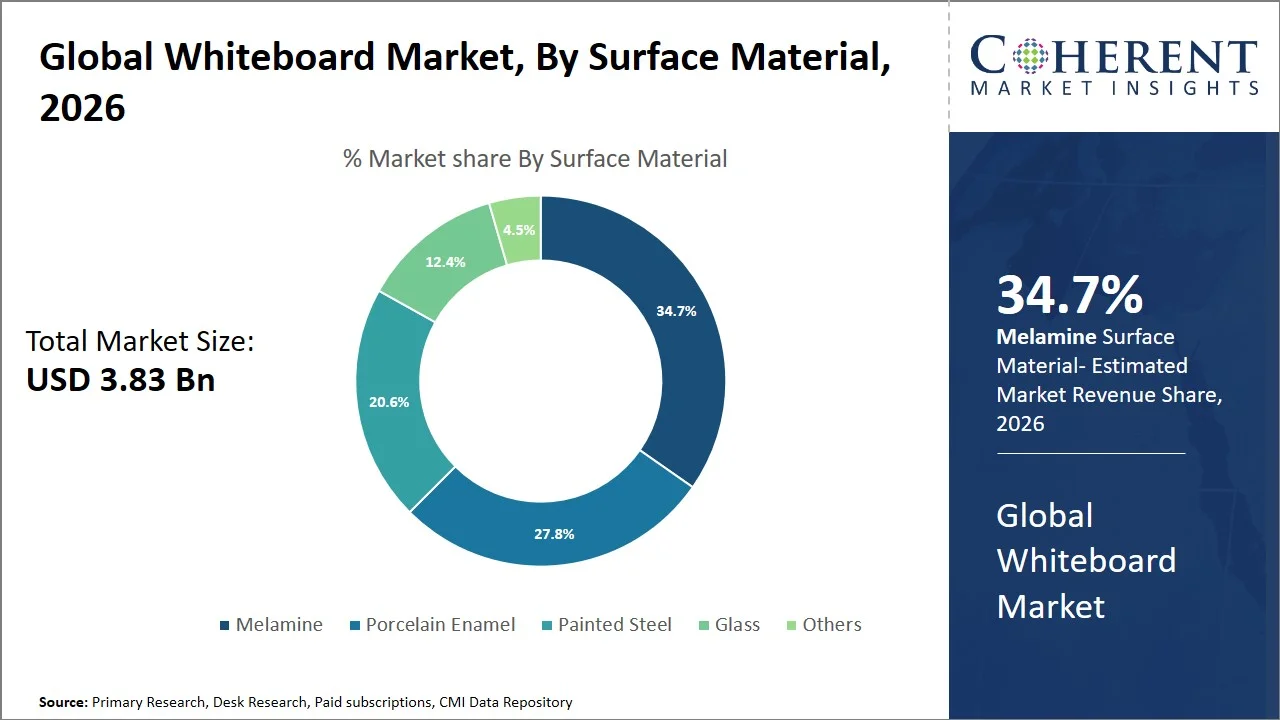
Melamine is expected to represent 34.7% of the global whiteboard market in 2026, leading surface materials because it supports cost-sensitive procurement without requiring the manufacturing complexity or premium pricing associated with porcelain enamel or glass. Melamine-faced boards are relatively lightweight, easy to cut into standard formats, compatible with common framing systems, and suitable for routine dry-erase use where very long service life is not the primary purchasing criterion. These attributes make the material particularly relevant to schools, administrative spaces, small offices, and high-volume tenders where unit economics influence specifications. Manufacturers gain from scalable production and broad channel availability, while distributors can offer multiple sizes at accessible price points. In July 2024, Alamogordo Public Schools purchased eight 8-by-4-foot TRU RED melamine dry-erase boards for high-school CTE classrooms, demonstrating direct institutional use of melamine surfaces in budget-controlled procurement.
Why Do Educational Institutions Dominate the End-User Category of the Global Whiteboard Market?
Educational Institutions are expected to account for 39.6% of the global whiteboard market in 2026 because whiteboards function as shared instructional infrastructure rather than discretionary personal equipment. Schools and colleges require visible writing surfaces across general classrooms, laboratories, training rooms, special-education spaces, and staff areas, creating multi-room purchasing requirements and recurring replacement cycles. Demand is reinforced by teacher-led explanation, worked examples, group problem solving, temporary annotation, and the ability to use a non-powered surface alongside digital classroom technologies. Institutional purchasing also favors suppliers that can support bulk orders, standardized sizes, installation, accessories, and replacement schedules across campuses. In October 2024, Hueneme Elementary School District approved a School Specialty purchase order covering classroom whiteboards for Blackstock, showing how conventional boards remain embedded in funded school-supply procurement even as education technology budgets expand.
Current Events and their Impact
Current Event | Description and Its Impact |
December 2024 – EU General Product Safety Regulation became applicable |
|
February 2025 – UK Procurement Act 2023 entered into force |
|
August 2026 – EU REACH formaldehyde limits began applying to covered articles |
|
Global Whiteboard Market Dynamics
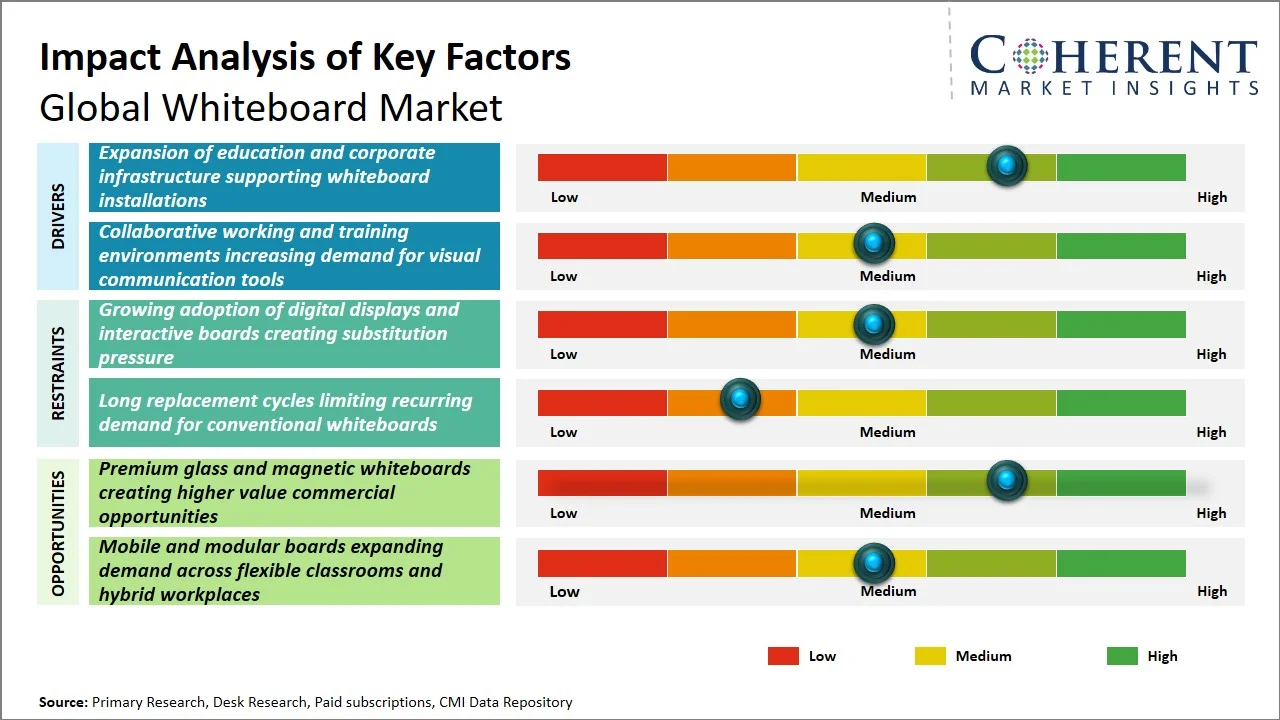
Key Market Drivers
- Expansion of education and corporate infrastructure supporting whiteboard installations: Whiteboard demand benefits from school, office, and public-facility renovation, where boards are incorporated into classroom and meeting-room infrastructure. New and refurbished spaces often replace aging writing surfaces with modern dry-erase formats, generating standardized orders for manufacturers, distributors, installers, and furniture suppliers. In May 2026, Northshore School District reported that interior finishing work at the new Leota Middle School included installation of whiteboards alongside flooring, hallway finishes, and science classrooms, directly demonstrating whiteboard demand within education infrastructure
- Collaborative working and training environments increasing demand for visual communication tools: Flexible classrooms, workshops, and team-based workspaces are increasing demand for mobile and reconfigurable whiteboards. Double-sided boards, magnetic surfaces, portable formats, and locking casters allow users to shift quickly between teaching, breakout sessions, planning, and group review. This benefits manufacturers and institutional distributors offering flexible visual-communication products. In May 2025, DeKalb School District purchase-order records included Title I-funded mobile dry-erase boards and double-sided rolling whiteboards.
Emerging Market Trends
- Writable Surfaces Are Becoming Part of Flexible Spatial Design: Whiteboards are increasingly being treated as part of space planning rather than stand-alone office supplies. Buyers are favoring mobile, modular, frameless, and reconfigurable formats that can divide rooms, support group work, or make better use of walls and furniture surfaces. This shift increases the importance of design flexibility, installation compatibility, and coordinated product systems.
- Circular Design Is Moving into Whiteboard Product Architecture: Sustainability is influencing whiteboard materials, packaging, repairability, and end-of-life design. Manufacturers are exploring recyclable metals, lighter structures, replaceable components, lower-plastic formats, and reduced transport volume. Institutional buyers are also placing greater emphasis on durability, material disclosure, and lifecycle value, favoring suppliers with stronger control over surface, frame, and packaging design.Top of FormBottom of Form
Regional Insights
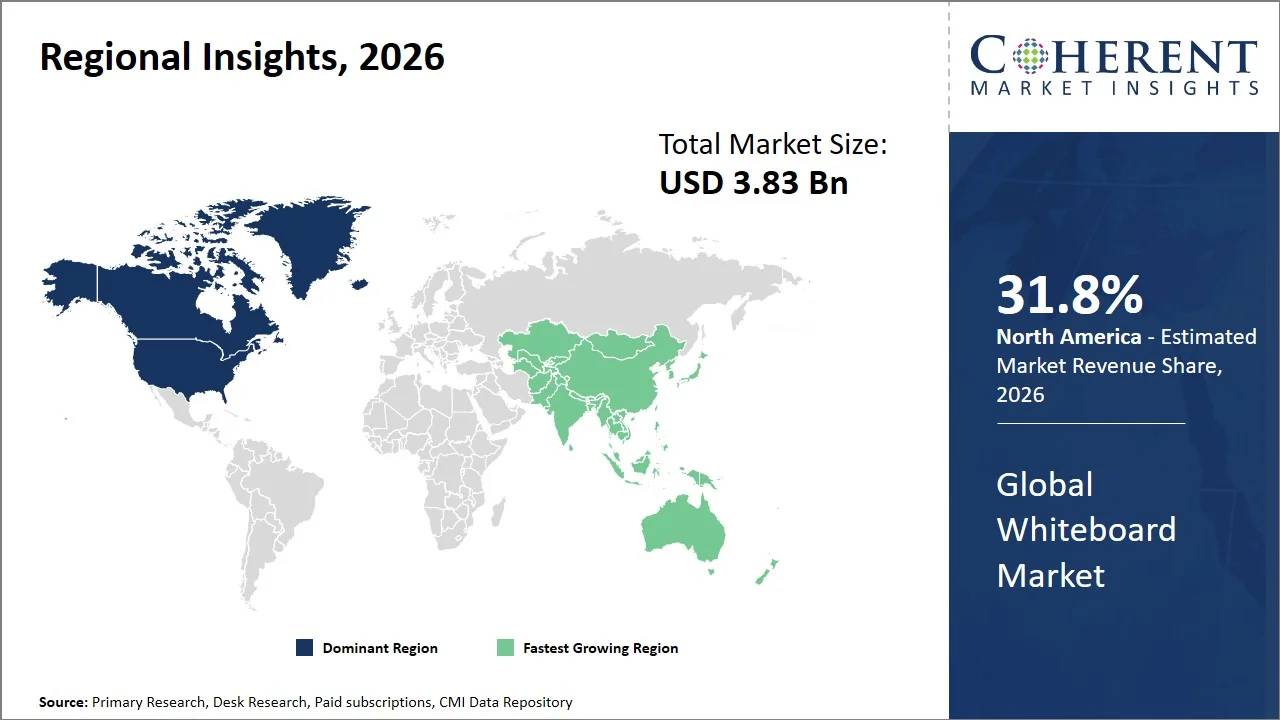
Why Does North America Dominate the Global Whiteboard Market?
North America is expected to retain 31.8% of the global whiteboard market in 2026 because its large installed base of classrooms, universities, offices, healthcare facilities, and public buildings creates recurring replacement and refurbishment demand. Buyers in the region also show strong acceptance of porcelain-enamel, magnetic, glass, and mobile boards where durability and collaborative use justify higher specifications. Established dealer networks and institutional purchasing systems support broad product availability, while renovation projects frequently specify whiteboards as part of room-level infrastructure rather than discretionary stationery. This gives manufacturers access to repeat, multi-site orders and favors suppliers with installation capability and dependable logistics. In July 2026, Ontario’s Upper Grand District School Board issued a five-year tender to supply and deliver whiteboards, corkboards, and related products across all board sites, illustrating the recurring institutional procurement base supporting regional demand.
Why Is Europe Emerging as the Fastest-Growing Region in the Global Whiteboard Market?
Europe is expected to account for 28.6% of the global whiteboard market in 2026 and expand faster as public institutions, education systems, healthcare facilities, and employers refresh collaborative spaces with more durable and design-conscious writing surfaces. Regional purchasing increasingly weighs lifecycle performance, repairability, material documentation, and compatibility with modern interiors, encouraging replacement of lower-grade boards with porcelain, magnetic steel, glass, and specialized formats. Fragmented but well-developed distribution networks also allow regional manufacturers and specialist dealers to address country-specific tenders and custom installations. Sustainability-focused procurement can further favor products with longer service lives and recyclable metal components. In March 2025, As per European Dynamics, Malta’s Central Procurement and Supplies Unit issued a public call for corkboards and whiteboards for Mental Health Services, showing how institutional modernization extends whiteboard demand beyond education and corporate offices.
Global Whiteboard Market Outlook for Key Countries
Why Is the U.S. a Key Market for the Global Whiteboard Market?
The U.S. is estimated to represent 25.4% of the global whiteboard market in 2026, supported by the scale of its K–12 schools, universities, corporate offices, healthcare facilities, training centers, and government buildings. Demand is strengthened by continual classroom refurbishment, modular-space additions, office reconfiguration, and replacement of worn writing surfaces. The country also supports premium product adoption because institutional buyers frequently specify porcelain-enamel steel, magnetic capability, larger wall spans, or glass surfaces where lifecycle performance matters. National distributors and contract dealers give manufacturers access to multi-site customers and standardized purchasing programs. In April 2026, Irvine Unified School District published specifications for relocatable and modular classrooms requiring backing for large 24-gauge porcelain-enamel steel whiteboard surfaces, demonstrating how whiteboards are embedded directly into U.S. classroom infrastructure planning rather than treated only as loose office supplies.
Why Is the U.K. Important in the Global Whiteboard Market?
The U.K. is estimated to hold 5.8% of the global whiteboard market in 2026, with demand anchored in schools, local authorities, universities, offices, training environments, and public-sector facilities. A key commercial feature is the use of procurement frameworks that aggregate recurring requirements for boards, markers, accessories, and related educational supplies, giving approved suppliers predictable access to institutional buyers. This structure supports established distributors and manufacturers able to meet specification, price, delivery, and continuity requirements across multiple locations. Whiteboards also remain practical alongside digital displays because they offer immediate, non-powered writing space for instruction and group work. In February 2026, Yorkshire Purchasing Organisation published an award notice for a framework covering dry-wipe boards and whiteboard markers primarily for the education and local-authority sectors, reinforcing the importance of organized channel procurement in the U.K. market.
Why Is Germany a Strategic Country in the Global Whiteboard Market?
Germany is estimated to account for 6.1% of the global whiteboard market in 2026, reflecting a buyer base that places strong emphasis on durability, technical quality, functional design, and long product life. Porcelain-enamel and magnetic steel boards fit well with schools, vocational institutions, engineering workplaces, manufacturing facilities, and corporate training environments where surfaces receive frequent use. Domestic expertise in office products, metal processing, coatings, and presentation accessories also supports premium specifications and reliable aftermarket supply. Procurement is increasingly linked with broader classroom and workplace modernization, creating opportunities for suppliers that can integrate boards with furniture, projection, and collaborative-space layouts. In October 2025, the City of Bad Salzuflen initiated a hardware procurement for municipal schools that included whiteboards and magnetic boards alongside computer equipment and furniture, illustrating the role of writing surfaces within integrated German education-infrastructure investment.
Why Is India Important in the Global Whiteboard Market?
India is estimated to represent 5.4% of the global whiteboard market in 2026 as school expansion, classroom refurbishment, coaching and training activity, higher-education investment, and office development widen the installed base for writing surfaces. Buyers remain price sensitive, supporting melamine and painted-steel formats, but institutional projects are gradually creating demand for magnetic ceramic-steel boards and more durable wall-mounted systems. India’s broad metalworking, aluminum extrusion, board-processing, furniture, and stationery supply base also enables local assembly and competitive distribution. A distinctive growth route is hybrid classroom design, where conventional white and green boards are retained around digital displays instead of being eliminated. In December 2025, WAPCOS, acting for Jawahar Navodaya Vidyalaya Cooch Behar, specified sliding vitrified magnetic ceramic-steel whiteboards within a teaching-wall system designed to accommodate an interactive flat-panel display, demonstrating this complementary analog-digital procurement model.
Why Does China Support Growth in the Global Whiteboard Market?
China is estimated to hold 10.8% of the global whiteboard market in 2026, supported by both a large domestic education base and extensive manufacturing capacity for steel, glass, aluminum frames, engineered boards, coatings, magnets, and office products. This upstream scale allows Chinese suppliers to compete across entry-level melamine boards, magnetic steel formats, porcelain surfaces, glass boards, and customized institutional products while also serving export markets. Domestic demand is increasingly tied to classroom renovation and hybrid teaching environments, which can preserve physical writing surfaces alongside interactive displays and audiovisual systems. Suppliers with strong coating quality, frame fabrication, and high-volume customization are therefore well positioned. In July 2026, Zhejiang College of Construction Vocational Technology awarded a procurement for its Xiaoshan campus covering porcelain whiteboards and sound-system upgrades, providing direct evidence that durable writing surfaces remain part of contemporary smart-classroom investment in China.
Technology Adoption Landscape in the Global Whiteboard Market
Technology | Adoption Level | Key Application Area | Business Impact |
Melamine Resin Laminate Writing Surfaces | High | High-volume classroom, office and household whiteboards | Enables scalable, cost-efficient board production and broad price positioning, although surface longevity and replacement frequency remain important purchasing considerations. |
Porcelain Enamel-on-Steel Surfaces | High | Heavy-use classrooms, training rooms and institutional installations | Provides high resistance to scratching, staining and ghosting while enabling magnetic functionality, strengthening lifetime-value and warranty positioning. |
Lacquered/Painted Magnetic Steel Surfaces | High | Corporate meeting rooms, classrooms and planning boards | Balances magnetic utility, writing performance and production economics, supporting broad size, frame and mounting configurations. |
Tempered Low-Iron Glass Writing Surfaces | Medium | Premium offices, healthcare environments and design-led interiors | Delivers a non-porous, easy-clean writing surface with strong aesthetic customization, although weight, handling and installation requirements limit mass-market penetration. |
Anti-Glare and Hydrophobic Surface Treatments | Medium | Brightly lit meeting spaces, training areas and intensive-use boards | Improves legibility, cleaning performance and user experience, allowing suppliers to differentiate conventional dry-erase products through functional surface engineering. |
Adhesive Dry-Erase Films and Writable Wall-Covering Systems | Medium | Retrofitting, writable walls and temporary or flexible workspaces | Converts existing walls or fixtures into writing surfaces with lower installation disruption, extending the addressable market beyond conventional framed boards. |
How Are Application-Specific Printed and Configurable Whiteboards Creating New Growth Opportunities in the Global Whiteboard Market?
A high-potential opportunity lies in moving from generic blank boards toward workflow-specific writable surfaces designed around recurring tasks. Healthcare providers can use patient-communication, scheduling, safety, and care-team boards; factories and warehouses can use production, maintenance, quality, and shift-management boards; while training and service environments can adopt standardized planning templates. These applications remain underdeveloped because purchasing often sits between facilities, operations, clinical or production teams, and traditional office-supply channels. Suppliers can capture the opportunity by combining durable substrates with custom graphics, magnetic functionality, cleanable surfaces, rapid design approval, and repeatable multi-site specifications. Commercial success requires digital-print capability, short-run customization, application knowledge, and a sales process that reaches operational decision-makers rather than only stationery buyers. Specialists and vertically integrated manufacturers are likely to benefit most because they can control design, surface performance, printing, and fulfillment. The opportunity also supports premium pricing by tying the board directly to workflow efficiency instead of treating it as a commodity writing surface.
Market Players, Key Development, and Competitive Landscape

Key Developments
- In September 2025, Bi-silque began implementing the ANOD 2 research project with the University of Aveiro and Vidroaplanos to advance pulsed anodization processes for aluminum. This is important for the global whiteboard market because aluminum is widely used in frames and structural components; manufacturing research aimed at improving processing efficiency, durability and functional surface properties can strengthen future product engineering and production economics without depending exclusively on changes to the writing surface.
- In June 2025, ACCO Brands launched its InvisaMount Anti-Glare Magnetic Glass Dry-Erase Board together with a Flip-Top Glass Desktop Dry-Erase computer pad. this is important for the global whiteboard market because the products extend conventional dry-erase functionality into visibility-focused glass boards and compact desktop use cases, allowing established suppliers to compete through application-specific design and user experience rather than relying solely on standard framed-board pricing.
- In May 2025, Rocada implemented a French distribution arrangement with Maul Schneider France for its office-furniture and visual-communication portfolio, including board products. This is important for the global whiteboard market because using an established national distributor can expand reseller coverage, strengthen local account access and improve fulfillment economics without requiring a specialist manufacturer to build an independent commercial network in every target country.
Competitive Landscape
The global whiteboard market is fragmented, with competition spanning multinational office-supply brands, specialist visual-communication manufacturers, architectural writing-surface suppliers, regional fabricators, private-label producers and digital-first sellers. Competitive strength depends less on a single proprietary technology than on matching surface performance, configuration, price, fulfillment and service to specific buyer requirements. Regional specialists remain relevant in custom-sized, printed and project-based installations, while larger suppliers benefit from wider assortments, institutional account relationships, sourcing scale and cross-market availability.
Key focus areas include
- Surface performance: Resistance to ghosting, staining, scratching and premature wear differentiates suppliers in intensive-use institutional environments.
- Price and total ownership economics: Buyers increasingly assess whether lower initial pricing compensates for shorter surface life, more frequent replacement or higher maintenance requirements.
- Manufacturing and supply reliability: Consistent substrate quality, predictable lead times and secure availability of steel, glass, aluminum and board cores influence large-account qualification.
- Customization capability: non-standard dimensions, printed templates, magnetic functionality, frame options and mounting configurations improve access to project-specific specifications.
- Quality and compliance discipline: Product traceability, material documentation, safety information and repeatable quality assurance become increasingly important for institutional and cross-border business.
- Customer-access model: Success depends on reaching facilities managers, educators, architects, workplace planners and procurement teams with appropriate specification and quotation support.
- After-sales execution: Installation guidance, warranty responsiveness, replacement components and problem resolution can materially influence repeat purchasing from multi-site customers.
Market Report Scope
Whiteboard Market Report Coverage
| Report Coverage | Details | ||
|---|---|---|---|
| Base Year: | 2025 | Market Size in 2026: | USD 3.83 Bn |
| Historical Data for: | 2020 To 2024 | Forecast Period: | 2026 To 2033 |
| Forecast Period 2026 to 2033 CAGR: | 6.4% | 2033 Value Projection: | USD 5.91 Bn |
| Geographies covered: |
| ||
| Segments covered: |
| ||
| Companies covered: | ACCO Brands, Bi silque, Claridge Products, GMi Companies, MooreCo, Polyvision, Egan Visual, Legamaster, Luxor, U Brands, Metroplan, Rocada, VIZ PRO, Quartet, Nobo | ||
| Growth Drivers: |
| ||
| Restraints & Challenges: |
| ||
Analyst Opinion (Expert Opinion)
- Competition is likely to shift from one-time board sales toward installed-base management. Suppliers that standardize specifications, manage replacements, and simplify repeat ordering across multiple sites can build stronger institutional relationships and make lifecycle service and account knowledge more valuable.
- Procurement transparency could pressure conventional whiteboard margins. As buyers compare similar products more easily across contract and online channels, standardized boards may become increasingly interchangeable. Suppliers with differentiated surfaces, rapid customization, and stronger technical product information should retain better pricing power.
- Suppliers should prioritize flexible manufacturing, faster customization, durable logistics, regional assembly, and reliable warranty support. Large glass and oversized boards carry freight and breakage risks, while entry-level products remain price-sensitive. Investment should favor supply resilience, application-led selling, and selective partnerships rather than additional commodity capacity.
Speak to the analyst
Want personalized insights?
Take the findings above to one of our principal consultants, or have the report rebuilt around the segments, geographies and competitors you actually track.
Market Segmentation
- Product Type Insights (Revenue, USD Bn, 2021 - 2033)
- Wall mounted Whiteboards
- Mobile Whiteboards
- Glass Whiteboards
- Desktop and Portable Whiteboards
- Others
- Surface Material Insights (Revenue, USD Bn, 2021 - 2033)
- Melamine
- Porcelain Enamel
- Painted Steel
- Glass
- Others
- End User Insights (Revenue, USD Bn, 2021 - 2033)
- Educational Institutions
- Corporate Offices
- Healthcare Facilities
- Government and Public Institutions
- Household
- Others
- Distribution Channel Insights (Revenue, USD Bn, 2021 - 2033)
- Direct Sales
- Indirect Sales
- Regional Insights (Revenue, USD Bn, 2021 - 2033)
- North America
- U.S.
- Canada
- Latin America
- Brazil
- Argentina
- Mexico
- Rest of Latin America
- Europe
- Germany
- U.K.
- Spain
- France
- Italy
- Russia
- Rest of Europe
- Asia Pacific
- China
- India
- Japan
- Australia
- South Korea
- ASEAN
- Rest of Asia Pacific
- Middle East
- GCC Countries
- Israel
- Rest of Middle East
- Africa
- South Africa
- North Africa
- Central Africa
- North America
- Key Players Insights
- ACCO Brands
- Bi silque
- Claridge Products
- GMi Companies
- MooreCo
- Polyvision
- Egan Visual
- Legamaster
- Luxor
- U Brands
- Metroplan
- Rocada
- VIZ PRO
- Quartet
- Nobo
Sources
Primary Research Interviews
- Whiteboard manufacturers, surface-material suppliers, office-furniture companies, education-equipment providers, distributors, installers, and institutional procurement teams
- School administrators, teachers, corporate facility managers, workplace planners, healthcare users, architects, and interior-design professionals
- Product managers, sourcing managers, sales executives, channel partners, specification teams, and workplace-solutions specialists
Stakeholders
- Wall-mounted, mobile, glass, desktop, and portable whiteboard manufacturers
- Melamine, porcelain-enamel, painted-steel, glass, aluminum-frame, coating, and magnetic-component suppliers
- Educational institutions, corporate offices, healthcare facilities, government bodies, households, distributors, dealers, and e-commerce sellers
End-use Segments
- Educational Institutions: classrooms, laboratories, training rooms, libraries, staff rooms, and collaborative learning spaces
- Corporate Offices: meeting rooms, conference spaces, project rooms, training facilities, and hybrid-work environments
- Healthcare & Public Facilities: hospitals, clinics, administrative offices, government buildings, and public institutions
- Household & Small Office Use: home offices, study areas, planning boards, and portable writing applications
Regulatory and Government Bodies
- Public procurement authorities governing school, healthcare, and government-facility purchases
- Consumer-product safety authorities covering product safety, labeling, and traceability
- Environmental and chemical regulators governing coatings, formaldehyde emissions, and material compliance
- Government education departments and local authorities overseeing classroom modernization and infrastructure investment
Databases
- Government procurement portals and public tender databases
- Company annual reports, product catalogs, investor disclosures, and corporate websites
- Import-export and customs databases for whiteboards, office products, glass, steel, and related components
- School district, university, healthcare, and public-sector purchasing records
- Construction, office-fit-out, education-infrastructure, and institutional procurement databases
Magazines and Journals
- Office Products International
- Work Design Magazine
- EdTech Magazine
- Facilities Management Journal
- Education Business
- Workplace design, furniture, education-infrastructure, and visual-communication industry publications
Associations
- Business and Institutional Furniture Manufacturers Association (BIFMA)
- Office Products International industry networks
- Education-furniture and school-equipment associations
- Workplace, facilities-management, interior-design, and architectural-product associations
Public Domain Sources
- Classroom modernization, school renovation, and education-infrastructure projects
- Workplace redesign, hybrid-office, meeting-room, and collaborative-space trends
- Product developments in porcelain-enamel, magnetic steel, glass, melamine, and mobile whiteboards
- Institutional procurement, distribution expansion, sustainability, repairability, and circular-design initiatives
- Public tenders, government purchases, product specifications, and facility refurbishment programs
Key Standards and Regulations
- Product Safety & Traceability: general consumer-product safety and supplier documentation requirements
- Chemical & Material Compliance: REACH, formaldehyde-emission limits, coating and substrate compliance requirements
- Public Procurement Rules: tendering, supplier qualification, transparency, and contract-performance requirements
- Environmental Standards: recyclable materials, low-emission components, responsible sourcing, and lifecycle considerations Bottom of Form
Proprietary Elements
- CMI Data Analytics Tool, Proprietary CMI Existing Repository of information for last 10 years.
Get access to 250+ pages report
Every segment, forecast, competitor profile and data table behind the analysis above — available for instant download.
- ESOMAR Member
- ISO 9001:2015 Certified
- D-U-N-S Registered
- GDPR & CCPA Compliant
Missing comfort of reading report in your local language? Find your preferred language:
Transform your Strategy with Exclusive Trending Reports
Frequently Asked Questions
The CAGR of global whiteboard market is projected to be 6.4% from 2026 to 2033.
The Global Whiteboard Market is estimated to be valued at USD 3.83 billion in 2026 and is expected to reach USD 5.91 billion by 2033
The report helps companies assess market attractiveness, competitive positioning, customer demand patterns, product opportunities, regional expansion potential, distribution strategies, and emerging commercial opportunities across the global whiteboard industry.
Yes. The report evaluates leading whiteboard manufacturers based on product portfolio, market presence, strategic positioning, distribution reach, product innovation, recent developments, and competitive strengths to help clients understand the overall supplier and competitor landscape.
Yes. The study can be customized to include country-level analysis, competitor intelligence, customer profiling, pricing assessment, distribution-channel analysis, procurement intelligence, product benchmarking, opportunity assessment, and other client-specific business requirements.
Expansion of education and corporate infrastructure supporting whiteboard installations and Collaborative working and training environments increasing demand for visual communication tools are the major factor driving the growth of global whiteboard market.
Growing adoption of digital displays and interactive boards creating substitution pressure and Long replacement cycles limiting recurring demand for conventional whiteboards are the major factor hampering the growth of global whiteboard market.