

Global Wireless Bridge Market Size and Forecast – 2026 To 2033
The global wireless bridge market is expected to grow from USD 1.25 Bn in 2026 to USD 2.35 Bn by 2033, registering a compound annual growth rate (CAGR) of 8% from 2026 to 2033. The global wireless bridge market is driven by growing adoption of IoT devices and industrial automation. On April 21, 2026, Siemens announced significant expansions to its Industrial Edge ecosystem, accelerating data and AI integration and releasing enhanced cybersecurity functionalities. (Source: Siemens)
Key Takeaways of the Global Wireless Bridge Market
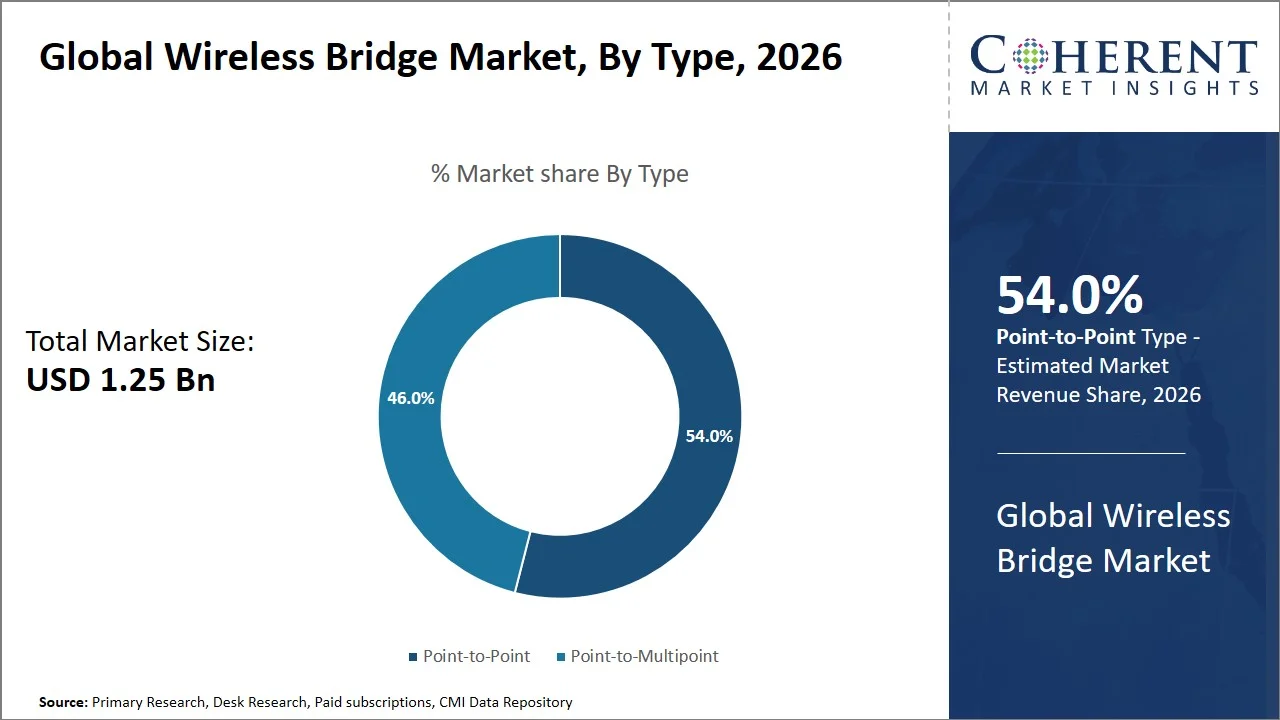
- The point-to-point segment is expected to account for 54.0 % of the global wireless bridge market share in 2026. Steady growth in enterprise campus networking is a key factor boosting the growth of the segment. On June 4, 2025, Hewlett Packard Enterprise (HPE) expanded its Aruba Networking campus portfolio with new CX 6300 series switches and Wi-Fi 7 access points designed for AI-driven enterprise campuses and IoT-heavy environments. (Source: Hewlett Packard Enterprise)
- The hardware segment is estimated to capture 51.0 % of the market share in 2026. Rising demand for surveillance and security tools is driving the growth of the hardware segment. On December 3, 2025, Verkada reached a USD 5.8 billion valuation after a major funding round, reflecting strong enterprise demand for AI-enabled video surveillance systems. (Source: Verkada)
- The Wi-Fi bridges segment is estimated to capture 43.0 % of the market share in 2026. Expansion of rural broadband projects is a primary factor driving the growth of the segment. On April 28, 2026, T-Mobile launched a new internet offering for businesses, combining its 5G network with Starlink's satellite backup to serve companies operating in remote locations.
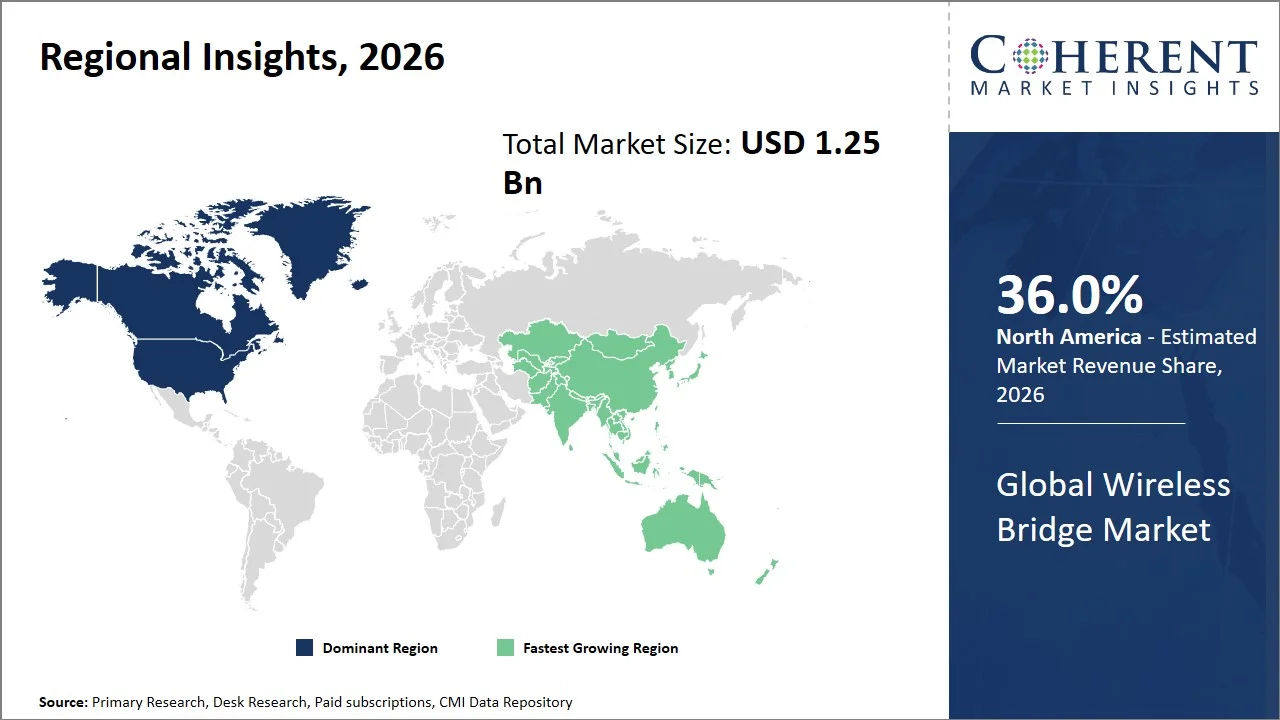
- North America is expected to dominate the wireless bridge market in 2026 with a market share of 36.0 %. Growing integration of industrial IoT and industry 4.0 applications in North America is a major growth factor for the regional market growth. On June 9, 2025, Rockwell Automation advanced its “Connected Enterprise” architecture, integrating IIoT sensors, industrial analytics, and cloud-based control systems across manufacturing plants in the U.S. (Source: Rockwell Automation)
- Asia Pacific is expected to account for 32.0 % share in 2026 and is projected to record the fastest growth over the forecast period. Increasing use of wireless connectivity for mining and oil & gas operations in Asia Pacific is expected to drive the growth of the regional market. On February 3, 2026, PetroChina implemented wireless industrial communication networks in remote Xinjiang oilfields to connect drilling sites, storage facilities, and control centers. (Source: Asia Info)
- Adoption of Wi-Fi 6 and Wi-Fi 7 Technologies: The wireless bridge market is witnessing significant adoption of Wi-Fi 6 and emerging Wi-Fi 7 technologies as organizations seek faster, more reliable, and higher-capacity wireless broadband and connectivity. These advanced standards offer improved throughput, lower latency, better spectrum efficiency, and enhanced support for dense device environments.
- Integration with 5G and Private Wireless Networks: Wireless bridges are increasingly being integrated with 5G infrastructure and private wireless networks to support high-speed data transmission and network backhaul requirements. Enterprises across manufacturing, logistics, healthcare, and transportation sectors are deploying private 5G networks to improve operational efficiency and connectivity.
Segmental Insights
Why Does Point-to-Point Dominate the Global Wireless Bridge Market?
The point-to-point segment is expected to account for 54.0% of the global wireless bridge market share in 2026. Point-to-Point (P2P) wireless bridges dominate the global wireless bridge market primarily because they provide highly reliable, high-bandwidth connectivity over long distances. P2P solutions establish a dedicated wireless link between two locations, enabling stable data transmission with minimal interference and lower latency compared to shared network configurations. This makes them particularly suitable for applications such as telecom backhaul, enterprise campus connectivity, video surveillance networks, and industrial communications, where consistent performance and secure data transfer are critical requirements.
On April 7, 2025, Cambium Networks expanded its Point-to-Point (PTP) backhaul solutions portfolio, focusing on high-capacity millimeter-wave and sub-6 GHz links for telecom operators and enterprises. The company highlighted widespread deployment of PTP links for mission-critical connectivity in government networks, ISP backhaul, and public safety systems (Source: Cambium Networks)
- Current Industry Events of 2026
- Market Size Estimation
- Regional Breakdown
- Competitive Landscape
- Customer Intelligence
- Segmental Analysis
- Pricing Analysis
- Key Market Drivers, Challenges & Future Trends
- Customized Insights Section
Why is Hardware the Most Used Component?
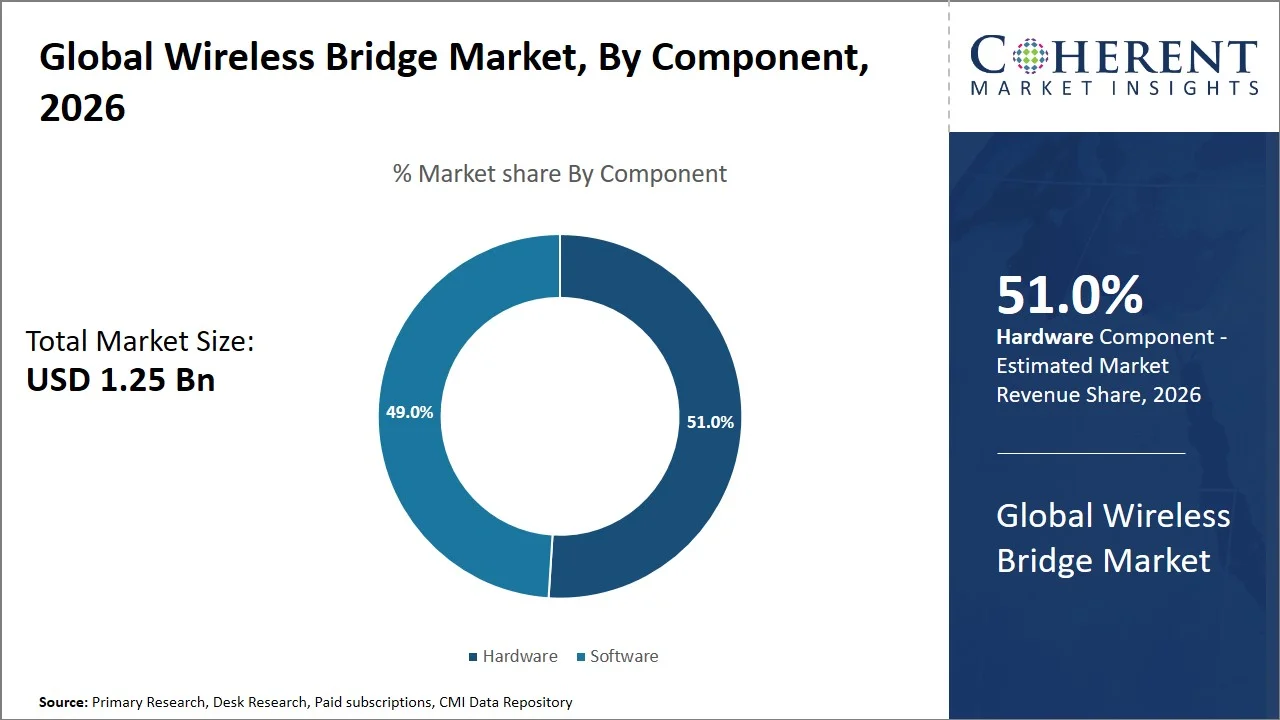
The hardware segment is expected to account for 51.0% of the global wireless bridge market share in 2026. Hardware is the most used component in the global wireless bridge market because it forms the core infrastructure required to establish and maintain wireless connectivity. Essential hardware elements such as antennas, radios, transceivers, and network devices are indispensable for transmitting and receiving data between locations. Since every wireless bridge deployment requires physical networking equipment regardless of the software used, the demand for hardware remains significantly higher than for software components.
On November 18, 2024, Cisco Systems expanded its enterprise wireless portfolio with new Wi-Fi 7 access points, radios, and integrated antenna systems designed for high-density campus and industrial environments. These hardware upgrades were positioned to support AI-driven workloads and large-scale device connectivity across enterprise campuses. (Source: Cisco Systems)
Wi-Fi Bridges Segment Dominates the Global Wireless Bridge Market
The Wi-Fi bridges segment is expected to account for 43.0% of the global wireless bridge market share in 2026. Wi-Fi bridges dominate the global wireless bridge market because they offer a cost-effective and widely compatible solution for extending network connectivity. Their ability to leverage existing Wi-Fi infrastructure, combined with relatively low deployment costs and ease of installation, makes them a preferred choice for enterprises, commercial buildings, educational institutions, and small-to-medium businesses seeking reliable wireless links without investing in expensive wired networks.
On June 4, 2026, H3C globally launched its first enterprise-grade Wi-Fi 8 access point (AP), integrating native Wi-Fi 8 technology with in-house developed Native AI algorithms to address critical pain points in complex industrial and corporate wireless environments. (Source: H3C)
Currents Events and their Impact
Current Events | Description and its Impact |
European Union Gigabit Infrastructure Act (GIA) |
|
Telecommunications Act, 2023 and Telecommunication Right of Way Rules, 2024 |
|
(Source: European Union, Department of Telecommunications)
Wireless Bridge Market Dynamics
Market Drivers
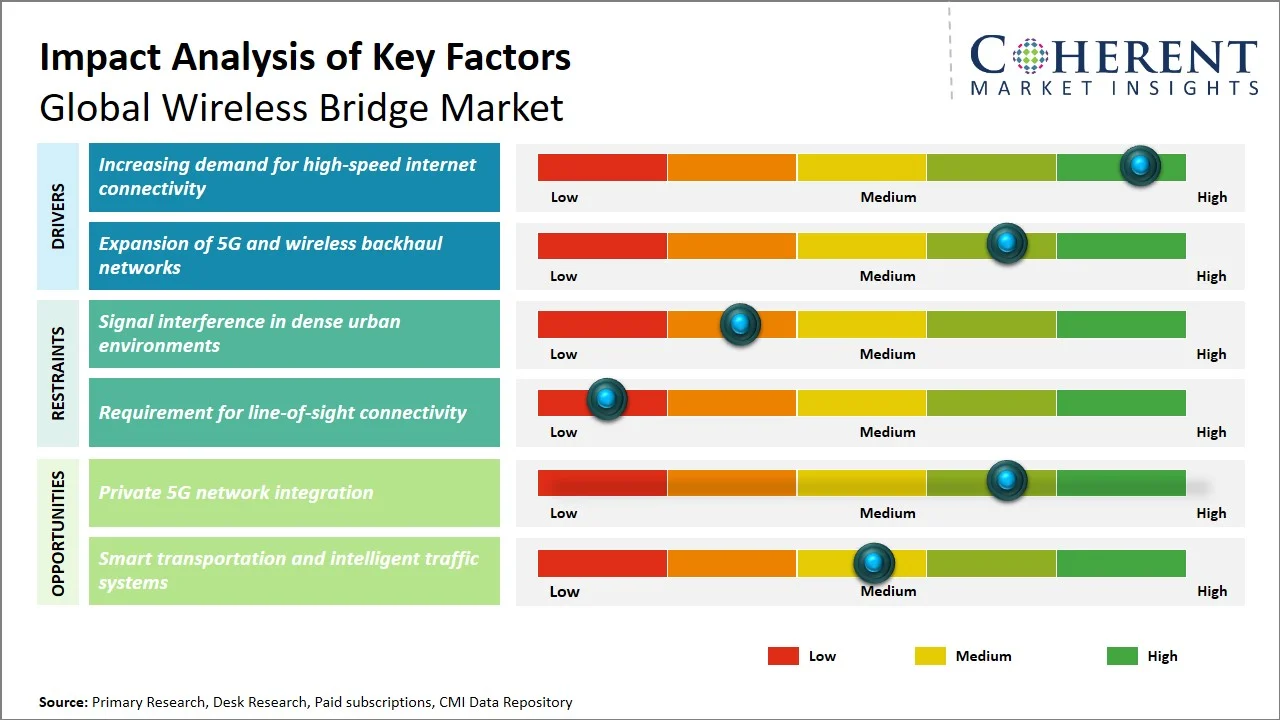
Increasing demand for high-speed internet connectivity
The growing demand for high-speed internet connectivity is a major driver of the global wireless bridge market, fueled by the rapid expansion of cloud computing, video streaming, remote work, online education, and data-intensive business applications. Organizations and service providers are increasingly deploying wireless bridge solutions to deliver reliable, high-bandwidth network connections between buildings, campuses, and remote locations where traditional wired infrastructure may be costly or impractical. As consumers and enterprises continue to require faster and more seamless digital experiences, the adoption of wireless bridges is rising as an efficient means of extending network coverage and enhancing connectivity performance.
On March 10, 2026, AT&T announced an investment and spend of more than USD 250 billion in the future of U.S. advanced connectivity, building the high-speed networks and resilience required for the next era of innovation and economic growth. (Source: AT&T)
Expansion of 5G and wireless backhaul networks
The rapid expansion of 5G networks globally is significantly driving the demand for wireless bridge solutions, particularly for backhaul connectivity between base stations and core networks. As telecom operators roll out dense 5G infrastructure, wireless bridges are increasingly used to provide high-capacity, low-latency links where fiber deployment is expensive, time-consuming, or geographically challenging. This trend is further supported by the growing adoption of small cells in urban and suburban areas, which require flexible and scalable backhaul solutions. As a result, wireless bridges are becoming a critical enabler of 5G network performance and coverage expansion.
On May 21, 2026, Cellnex Group, a leading operator of telecommunications infrastructure, became the lead Ericsson customer worldwide for the introduction of the high-power microwave E-band radio MINI-LINK 6356, delivering high-capacity backhaul with improved range and energy efficiency. (Source: Ericsson)
Emerging Trends
- Growing Demand from Industrial IoT and Smart Infrastructure Projects: The rapid expansion of Industrial Internet of Things (IIoT) applications and smart infrastructure initiatives is creating new opportunities for wireless bridge deployments. Industries are utilizing wireless bridges to connect sensors, surveillance systems, automated machinery, and remote operational facilities across large geographic areas.
- Rise of High-Frequency Millimeter-Wave Wireless Bridges: A growing trend in the market is the adoption of millimeter-wave wireless bridge technologies, particularly in the 60 GHz frequency band. These solutions offer multi-gigabit data transmission speeds that closely resemble fiber-optic performance while reducing installation complexity and deployment time.
Regional Insights
Why is North America a Strong Market for Wireless Bridges?
North America is expected to account for a market share of 36.0% in 2026. North America’s wireless bridge market is strongly driven by large-scale enterprise campus connectivity, defense communications, and telecom backhaul modernization projects. In the U.S., utilities such as remote wind farms in Texas and solar installations in Arizona frequently use millimeter-wave wireless bridges to connect monitoring systems to control centers where fiber is impractical. Canada’s mining sector in provinces like Ontario and British Columbia also relies on long-range point-to-point wireless bridges to maintain connectivity between underground operations and surface command centers. The region also sees heavy deployment in smart city surveillance systems, particularly in cities like New York and Chicago, where wireless bridges support high-definition camera networks. O March 18, 2026, Cisco announced that it has been recognized as the overall leader and top implementer in the ABI Research Enterprise WLAN Infrastructure Vendors Competitive Ranking 2026. (Source: Cisco)
Why Does the Asia Pacific Wireless Bridge Market Exhibit High Growth?
Asia Pacific is projected to account for 32.0% of the global wireless bridge market and is expected to register the fastest growth. Asia Pacific is experiencing rapid adoption of wireless bridges driven by massive telecom expansion, industrial corridors, and smart city projects across developing economies. In India, initiatives like digital railway surveillance systems along Indian Railways routes and connectivity for remote telecom towers in rural states such as Assam and Rajasthan heavily depend on wireless backhaul bridges. In Southeast Asia, countries like Indonesia and the Philippines deploy wireless bridges to connect island-based infrastructure where fiber installation is logistically difficult. China’s large-scale industrial zones and urban surveillance networks also extensively use wireless bridge technology to support high-density data transmission between facilities.
Moreover, the growing need of long-haul networks is also a major factor driving the growth of the regional market. On May 23, 2024, The Baotou Branch of China Unicom Inner Mongolia and Huawei completed the world's first commercial test of the pioneering MAGICS LH long-haul microwave solution in Baotou, Inner Mongolia. Using ultra-wideband technology, this innovative microwave solution enables a single antenna to cover five frequency bands (L6 GHz, U6 GHz, 7 GHz, 8 GHz, and 11 GHz), making it the widest range of microwave frequency bands ever recorded by a commercial product. (Source: Huawei)
Global Wireless Bridge Market Outlook for Key Countries
Why is the U.S. Emerging as a Major Hub in the Wireless Bridge Market?
The wireless bridge market in the U.S. is heavily influenced by enterprise networking, defense installations, and broadband expansion in rural areas. For example, agricultural operations in Midwest states like Nebraska and Iowa use wireless bridges to connect precision farming equipment and irrigation control systems across large farmland areas. Public safety agencies in California deploy wireless bridges for real-time video transmission between wildfire monitoring stations and emergency command centers. Additionally, U.S. telecom providers such as AT&T and Verizon use wireless bridge systems for temporary 5G backhaul during network upgrades and disaster recovery operations.
Is China the Next Growth Engine for the Wireless Bridge Market?
The China wireless bridge market is driven by large-scale industrial automation, smart city surveillance networks, and state-led telecom infrastructure expansion. In manufacturing hubs like Shenzhen and Guangzhou, wireless bridges are widely used to connect multi-building factory complexes for real-time production monitoring and automated logistics systems. Smart city deployments in cities such as Shanghai rely on wireless bridge links for integrated traffic management systems and AI-powered surveillance cameras. Additionally, rural broadband expansion projects in western provinces like Xinjiang and Tibet use wireless bridges to provide connectivity across difficult mountainous terrain.
Germany Wireless Bridge Market Analysis and Trends
The wireless bridge market in Germany is shaped by industrial manufacturing, logistics hubs, and enterprise digitalization under Industry 4.0 initiatives. Automotive plants operated by companies like Volkswagen and BMW use wireless bridges to connect automated production lines and robotic assembly systems across large manufacturing facilities. In logistics centers around Hamburg and Frankfurt, wireless bridges support warehouse automation systems and real-time tracking of goods. Additionally, municipal governments in cities such as Berlin deploy wireless bridges for smart traffic monitoring and public safety surveillance systems.
India Wireless Bridge Market Analysis and Trends
The wireless bridge market in India is expanding rapidly due to rural connectivity projects, telecom tower backhaul requirements, and smart infrastructure development. Indian Railways extensively uses wireless bridges for connecting remote signaling systems and surveillance cameras along railway tracks in states like Uttar Pradesh and Maharashtra. Telecom operators such as Jio and Airtel deploy wireless bridges to connect cell towers in difficult terrain areas like the North-East and Himalayan regions where fiber rollout is challenging. Smart city projects in cities like Pune, Bengaluru, and Hyderabad also rely on wireless bridge networks for integrated traffic management, public Wi-Fi, and surveillance infrastructure.
South Korea Wireless Bridge Market Analysis and Trends
The South Korea wireless bridge market is being shaped by its advanced 5G ecosystem, ultra-fast national broadband infrastructure, and strong telecom leadership from companies like SK Telecom, KT, Samsung Electronics, Nokia, and Ericsson, which are actively deploying microwave point-to-point (P2P) backhaul and enterprise wireless bridging systems to support dense urban connectivity and smart infrastructure. The country’s rapid 5G densification and smart city projects are increasing reliance on high-capacity wireless backhaul links for base station interconnection, enterprise campus networking, and industrial automation sites, especially in areas where fiber expansion is complex or costly.
Global Wireless Bridge Market - Private Wireless Network Deployment Rates
Category | Value |
Global private LTE/5G deployments | 6,500 networks |
Global private cellular engagements | 8,300+ projects |
Annual new deployments | ~1,300 new networks/year |
Private network deployments (earlier baseline) | 4,700 networks |
5G share of private networks | ~30–50% |
How is Private 5G Network Integration Creating New Growth Opportunities in the Wireless Bridge Market?
The integration of private 5G networks is creating strong growth opportunities in the wireless bridge market by increasing the need for flexible, high-capacity backhaul and site-to-site connectivity solutions. Enterprises deploying private 5G in environments such as manufacturing plants, ports, and logistics hubs often require wireless bridges to rapidly connect distributed 5G small cells, edge computing nodes, and control systems without relying on costly fiber infrastructure. For example, automated port operations in places like Rotterdam or smart factories in automotive clusters use wireless bridges to ensure continuous data flow between 5G access points and centralized monitoring systems. This demand is further strengthened by the need for quick deployment, scalable network expansion, and redundancy in mission-critical private networks, where wireless bridges act as an essential supporting layer for reliable and low-latency communication.
On April 1, 2026, Siemens announced that it is bringing its industrial-grade private 5G infrastructure to the U.S. and seven additional countries. The expansion is enabled by two new radio units covering the 3.8–4.2 GHz band and the U.S.-specific CBRS band bringing the solution to a total of 15 countries across Europe and the Americas. (Source: Siemens)
Market Players, Key Development, and Competitive Intelligence
Key Developments
- On April 1, 2026, Cisco announced ultra-reliable wireless backhaul capabilities embedded into enterprise access points, designed to eliminate dependency on wired links in hard-to-cable environments. The solution supports resilient point-to-point wireless connectivity between access nodes and aggregation layers in enterprise deployments.
- On June 25, 2025, Nokia, Verizon Business and Thames Freeport announced a strategic partnership to deploy Verizon Private 5G Networks across multiple key logistics, manufacturing, and innovation sites along the River Thames Estuary in the U. K. The Verizon Private 5G Networks will serve as the technology foundation for a multi-year, multi-billion-dollar operational transformation and economic revival for the region, one of the busiest maritime logistics hubs in the U. K.
Competitive Landscape
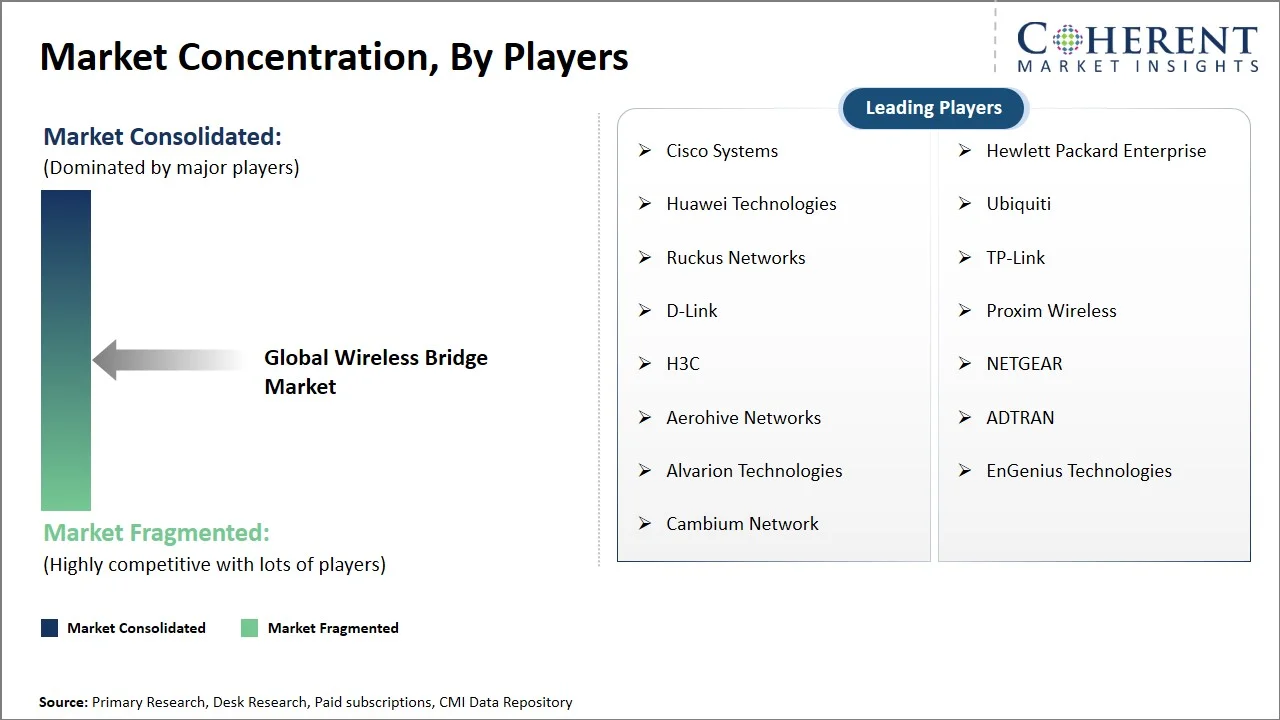
The global wireless bridge market is characterized by a moderately consolidated competitive structure, where a mix of established networking giants and specialized wireless communication vendors are actively operating. The market is led by companies such as Cisco Systems, Huawei Technologies, Ubiquiti, Cambium Networks, and TP-Link, with competition being driven by product innovation, spectrum efficiency, and support for high-capacity point-to-point and point-to-multipoint solutions. Strong emphasis is being placed on millimeter-wave technologies, Wi-Fi 6/7 integration, and enterprise-grade security features. Intense competition is observed in emerging markets, where pricing strategies and scalable deployment capabilities are being used to gain market share.
Market Report Scope
Wireless Bridge Market Report Coverage
| Report Coverage | Details | ||
|---|---|---|---|
| Base Year: | 2025 | Market Size in 2026: | USD 1.25 Bn |
| Historical Data for: | 2020 To 2024 | Forecast Period: | 2026 To 2033 |
| Forecast Period 2026 to 2033 CAGR: | 8% | 2033 Value Projection: | USD 2.35 Bn |
| Geographies covered: |
| ||
| Segments covered: |
| ||
| Companies covered: | Cisco Systems, Hewlett Packard Enterprise, Huawei Technologies, Ubiquiti, Ruckus Networks, TP-Link, D-Link, Proxim Wireless, H3C, NETGEAR, Aerohive Networks, ADTRAN, Alvarion Technologies, EnGenius Technologies, and Cambium Network | ||
| Growth Drivers: |
| ||
| Restraints & Challenges: |
| ||
Analyst Opinion (Expert Opinion)
- The wireless bridge market is being evaluated as a steadily growing segment of the broader wireless networking industry, with demand being primarily influenced by infrastructure modernization, telecom expansion, and enterprise connectivity needs. It is being observed that adoption is being accelerated by the increasing requirement for cost-effective alternatives to fiber deployment, especially in remote and high-density urban environments. Strong growth potential is being identified in developing economies, while technological advancements in high-frequency wireless transmission are being considered critical to future performance improvements. However, challenges related to spectrum regulation and environmental interference are being recognized as limiting factors.
- The future of the wireless bridge market is expected to be shaped by rapid advancements in high-capacity wireless technologies and the expansion of 5G and private network ecosystems. Increased deployment is anticipated in smart cities, industrial automation, and rural broadband projects, where demand for flexible and scalable connectivity solutions is rising. Integration with edge computing and AI-driven network management systems is expected to enhance performance and reduce latency in complex deployments. Additionally, continued innovation in millimeter-wave and next-generation Wi-Fi standards is likely to support higher data rates and more reliable long-distance wireless communication, strengthening the role of wireless bridges in global network infrastructure.
Speak to the analyst
Want personalized insights?
Take the findings above to one of our principal consultants, or have the report rebuilt around the segments, geographies and competitors you actually track.
Market Segmentation
- Type Insights (Revenue, USD Billion, 2021 - 2033)
- Point-to-Point
- Point-to-Multipoint
- Component Insights (Revenue, USD Billion, 2021 - 2033)
- Hardware
- Software
- Technology Insights (Revenue, USD Billion, 2021 - 2033)
- Wi-Fi Bridges
- Microwave Bridges
- Millimeter-Wave Bridges
- Laser Wireless Bridges
- Frequency Insights (Revenue, USD Billion, 2021 - 2033)
- 4 GHz
- 5 GHz
- 60 GHz
- Others
- End User Insights (Revenue, USD Billion, 2021 - 2033)
- Telecom Service Providers
- Enterprise
- Government and Defense
- Industrial
- Retail
- Healthcare
- Education
- Commercial Buildings
- Regional Insights (Revenue, USD Billion, 2021 - 2033)
- North America
- U.S.
- Canada
- Latin America
- Brazil
- Argentina
- Mexico
- Rest of Latin America
- Europe
- Germany
- U.K.
- Spain
- France
- Italy
- Russia
- Rest of Europe
- Asia Pacific
- China
- India
- Japan
- Australia
- South Korea
- ASEAN
- Rest of Asia Pacific
- Middle East
- GCC Countries
- Israel
- Rest of Middle East
- Africa
- South Africa
- North Africa
- Central Africa
- North America
- Key Players Insights
- Cisco Systems
- Hewlett Packard Enterprise
- Huawei Technologies
- Ubiquiti
- Ruckus Networks
- TP-Link
- D-Link
- Proxim Wireless
- H3C
- NETGEAR
- Aerohive Networks
- ADTRAN
- Alvarion Technologies
- EnGenius Technologies
- Cambium Network
Sources
Primary Research Interviews
- Network Infrastructure Equipment Manufacturers
- Telecommunications Service Providers
- System Integrators and Solution Providers
- Enterprise IT Decision Makers
Magazines
- Network World Magazine
- Wireless Week Magazine
- Communications Technology Magazine
- Enterprise Networking Magazine
Journals
- IEEE Communications Magazine
- Journal of Network and Computer Applications
- Wireless Communications and Mobile Computing Journal
Associations
- Wireless Broadband Alliance (WBA)
- IEEE Communications Society
- Telecommunications Industry Association (TIA)
- Wi-Fi Alliance
Public Domain Sources
- Federal Communications Commission (FCC) Reports
- International Telecommunication Union (ITU) Publications
- Government Technology Procurement Data
- Patent and Trademark Office Filings
Proprietary Elements
- CMI Data Analytics Tool
- Proprietary CMI Existing Repository of information for last 10 years
Get access to 250+ pages report
Every segment, forecast, competitor profile and data table behind the analysis above — available for instant download.
- ESOMAR Member
- ISO 9001:2015 Certified
- D-U-N-S Registered
- GDPR & CCPA Compliant
Missing comfort of reading report in your local language? Find your preferred language:
Transform your Strategy with Exclusive Trending Reports
Frequently Asked Questions
The global wireless bridge market is expected to stand at USD 1.25 Bn in 2026 and is expected to reach USD 2.35 Bn by 2033.
The CAGR of the global wireless bridge market is projected to be 8% from 2026 to 2033.
Increasing demand for high-speed internet connectivity and expansion of 5G and wireless backhaul networks are the major factors driving the growth of the global wireless bridge market.
In terms of type, the point-to-point segment is estimated to dominate the market revenue share in 2026.
It enables ultra-high-speed short-range connections with minimal interference.
They are not always better but are more cost-effective and faster to deploy in difficult terrains.
Signal interference in dense urban environments and requirement for line-of-sight connectivity are the major factors hampering the growth of the global wireless bridge market.