

Adaptive Strollers Market Size and Forecast: 2026-203 3
The Adaptive Strollers Market is anticipated to grow at a CAGR of 6.2% with USD 16.6 Bn share in 2026 and is expected to reach USD 18.6 Bn in 2033. Growing rates of mobility impairments and developmental disabilities among children drive demand in the Adaptive Strollers Market. An estimated 1.3 billion people, about 16% of the global population, live with significant disabilities, while up to 19 million adults experience major mobility limitations.
Key Takeaways
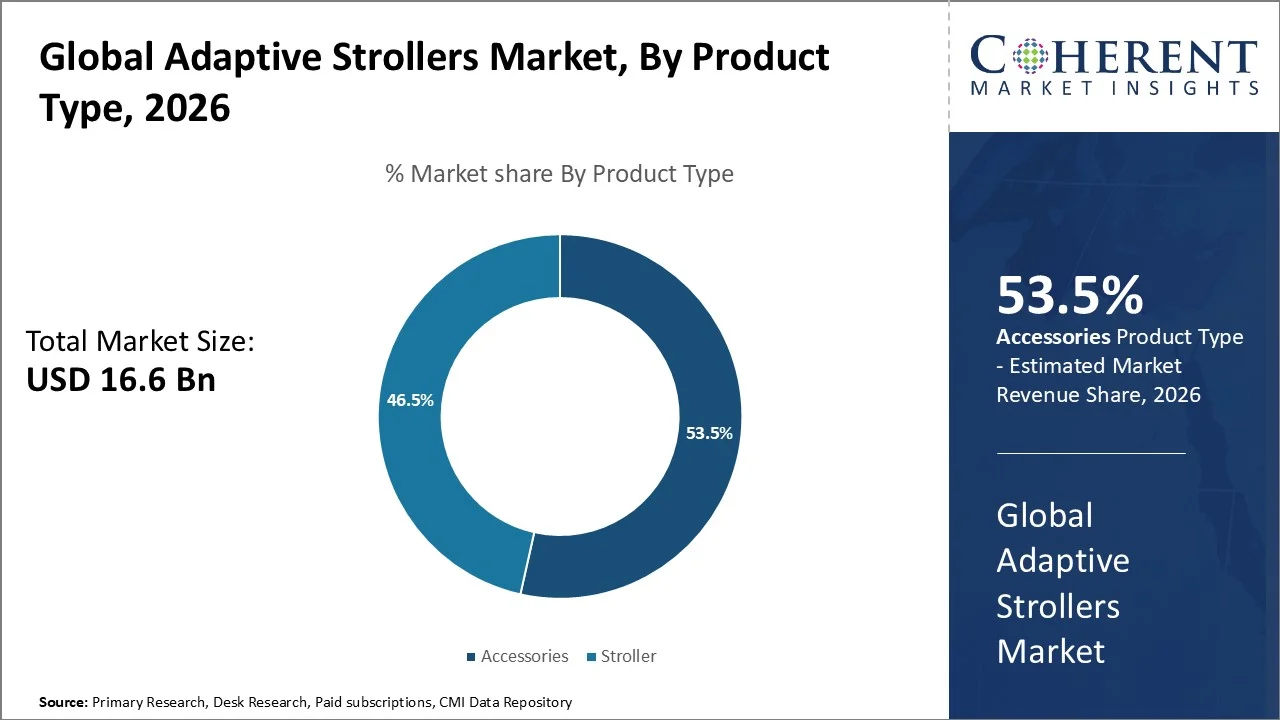
- Accessories hold the largest market share of 53.5% in 2026, driven by rising demand for personalized mobility solutions. Supporting this trend, global demand for adaptive mobility aids is increasing as an estimated 1.3 billion people (about 16% of the population) live with disabilities, creating a strong user base for customizable equipment.
- Developmental delay is expected to account for the largest market share of 34.6% in 2026, supported by its increasing prevalence. For instance, in the U.S. nearly 1 in 6 children are estimated to have a developmental disability, reflecting a growing need for adaptive mobility support products.
- North America is projected to dominate with a 41.10% share in 2026 due to high prevalence of pediatric disabilities and mobility disorders. The region also benefits from advanced healthcare infrastructure and high healthcare spending, with the U.S. alone accounting for nearly 40% of global healthcare expenditure, supporting early diagnosis and assistive device adoption.
Current Events and Their Impact on the Adaptive Strollers Market
Current Event | Description and its Impact |
Strengthening Disability Inclusion Policies (U.S. & Europe) |
|
Government Subsidy Programs for Assistive Devices (India & Emerging Markets) |
|
Segmental Insights
- Current Industry Events of 2026
- Market Size Estimation
- Regional Breakdown
- Competitive Landscape
- Customer Intelligence
- Segmental Analysis
- Pricing Analysis
- Key Market Drivers, Challenges & Future Trends
- Customized Insights Section
Why is Accessories Acquiring the Largest Market Share?
Accessories hold the largest market share of 53.5% in 2026 owing to the shift toward modular and upgradeable designs. The accessories segment drives growth in the adaptive strollers market as caregivers and healthcare professionals increasingly seek customized mobility solutions for children with physical and developmental disabilities. They use accessories such as headrests, positioning supports, harnesses, footrests, cushions, and weather protection systems to improve comfort, safety, and postural support. The growing focus on personalized care, rehabilitation, and social inclusion further boosts demand for these add-ons. Manufacturers also develop modular stroller designs that enable easy upgrades and modifications, encouraging greater adoption of adaptive stroller accessories. For instance, As part of Microsoft’s 12th Ability Summit, the company announced that it will launch a new range of highly customizable adaptive accessories later this year to help people with disabilities who find it difficult to use traditional mouse and keyboard setups on computers or phones.
Which Application segment dominates the market?
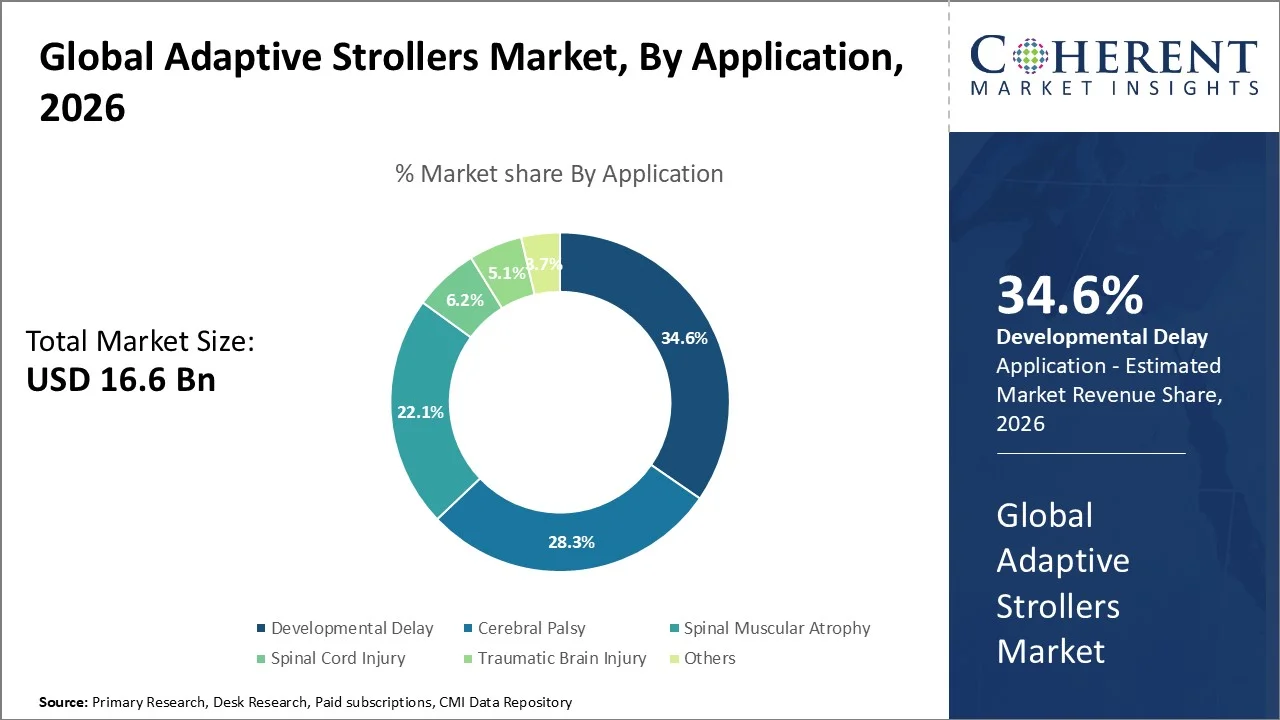 Developmental Delay expected to hold largest market share of 34.6% in 2026. Parents, caregivers, and healthcare professionals are increasingly adopting adaptive strollers to support children diagnosed with developmental delays, driving growth in this segment of the adaptive strollers market. They use these strollers to enhance posture, stability, and comfort, helping children participate more actively in daily routines, therapy sessions, and educational activities. Growing awareness of the benefits of early intervention encourages earlier adoption of mobility aids. Furthermore, healthcare providers are expanding access to pediatric rehabilitation programs and specialized care services, which continues to strengthen demand for adaptive strollers.
Adaptive Strollers Market Trends
- Rising awareness of pediatric mobility disorders and developmental disabilities is increasing demand for adaptive strollers that provide enhanced support, comfort, and mobility for children with special needs.
- Growing emphasis on personalized mobility solutions is driving adoption of adjustable seating systems, positioning supports, tilt-in-space features, and specialized accessories to meet individual patient requirements.
- Increasing prevalence of developmental delays, cerebral palsy, spina bifida, and other mobility-related conditions is supporting market growth. According to the Centers for Disease Control and Prevention (CDC), approximately 1 in 6 children in the United States has a developmental disability, highlighting the need for specialized mobility and support equipment.
- Favorable reimbursement policies and government support programs are improving access to adaptive mobility equipment. Programs such as Medicaid in the United States and various disability assistance initiatives in Europe and other regions help eligible families obtain adaptive strollers and related mobility devices, increasing market adoption.
Regional Insights
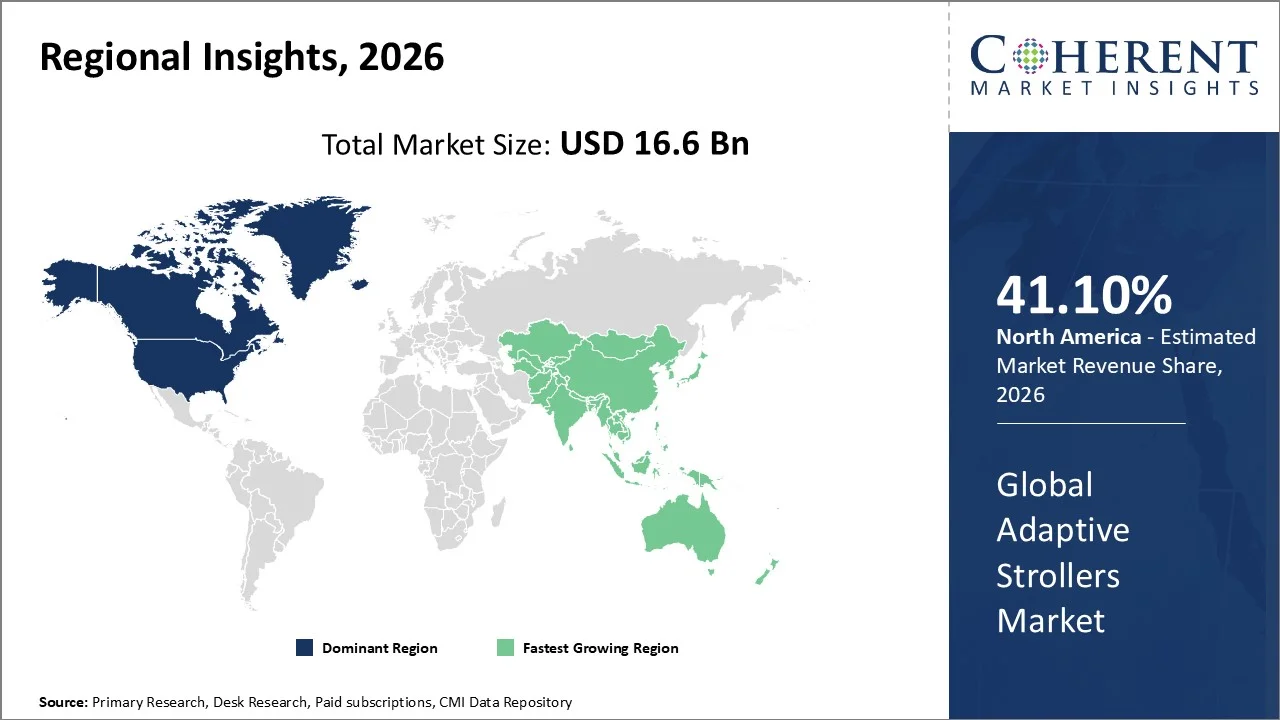
North America dominates owing to High Awareness Among Caregivers and Healthcare Professionals
North America is expected to acquire the dominant share of 41.10% in 2026. North America leads the adaptive strollers market because a high prevalence of pediatric mobility disorders drives strong demand for advanced assistive devices. Well-developed healthcare systems, including specialized rehabilitation centers and pediatric care facilities, support early diagnosis and timely treatment. Insurance providers and reimbursement policies improve families’ access to adaptive strollers. Caregivers and healthcare professionals actively promote customized mobility solutions as awareness increases. Leading manufacturers operate in the region and continuously introduce innovative products, further strengthening market growth across North America. For instance, in December 2025, Aston Martin and the British stroller brand egg have partnered to create a bespoke collection of luxury baby travel systems, combining their shared values of performance, craftsmanship, and understated elegance.
Asia Pacific Adaptive Strollers Market Trends
Rising awareness of pediatric mobility disorders and increasing diagnosis of developmental delays drive the adaptive strollers market in Asia Pacific. Healthcare providers expand infrastructure and improve access to pediatric rehabilitation services, which supports wider adoption of assistive mobility devices. Governments introduce initiatives to strengthen disability care and promote inclusion, further boosting market growth. Rapid urbanization and improving living standards increase demand for advanced mobility solutions. Additionally, a large pediatric population and a strong focus on early intervention actively contribute to the region’s market expansion. India has an estimated 472 million children aged 0–18, accounting for about 39% of the total population.
United States Adaptive Strollers Market Trends
The United States drives the adaptive strollers market due to a high prevalence of pediatric mobility disorders, with nearly 1 in 6 children in the country affected by developmental disabilities. A well-established healthcare system, supported by over 5,000 hospitals and a large network of pediatric rehabilitation centers, enables early diagnosis and treatment. Public programs such as Medicaid, which covers a significant share of children from low-income families, along with private insurance reimbursement, improve affordability and access to adaptive strollers. Growing awareness among caregivers and clinicians is further accelerating adoption. Additionally, the presence of leading medical device manufacturers and strong R&D investment in assistive technologies continues to drive product innovation and market expansion.
China Adaptive Strollers Market Trends
China’s adaptive strollers market is driven by a rapidly aging population and a rising number of people with mobility impairments, which increases demand for assistive mobility solutions. Healthcare systems and rehabilitation services continue to expand, improving access to specialized devices. Government programs actively promote accessibility and disability support, boosting adoption. Urbanization, stronger retail networks, and e-commerce growth enhance product availability. Higher household incomes and growing preference for advanced assistive technologies further support market expansion across urban and semi-urban regions. For instance, the Iconic Brand partnered with Shanghai-based home product development company Fortune to launch a new line of branded water bottles in China, with Medialink, its licensing agent in mainland China, facilitating the collaboration.
Who are the Major Companies in Adaptive Strollers Industry
Some of the major key players in Adaptive Strollers are Adaptive Star, Assistive Technology, Inc., Convaid Products, Inc., Deming Designs Inc., Eurovema Ab, Invacare Corporation, Meyra, Ormesa, Performance Health, Special Tomato, Sunrise Medical LLC, R82 Inc., and Thomashilfen.us.
Key News
- In November 2025, Cornell University built an indoor adaptive high ropes course for people of all abilities. The new course will include features that allow people with limited mobility and wheelchair users to participate, representing a significant upgrade from the previous course in Barton Hall.
Market Report Scope
Adaptive Strollers Market Report Coverage
| Report Coverage | Details | ||
|---|---|---|---|
| Base Year: | 2025 | Market Size in 2026: | USD 16.6 Bn |
| Historical Data for: | 2020 To 2024 | Forecast Period: | 2026 To 2033 |
| Forecast Period 2026 to 2033 CAGR: | 6.2% | 2033 Value Projection: | USD 18.6 Bn |
| Geographies covered: |
| ||
| Segments covered: |
| ||
| Companies covered: | Adaptive Star, Assistive Technology, Inc., Convaid Products, Inc., Deming Designs Inc., Eurovema Ab, Invacare Corporation, Meyra, Ormesa, Performance Health, Special Tomato, Sunrise Medical LLC, R82 Inc., and Thomashilfen.us. | ||
Analyst Opinion
- Adaptive strollers are not driven by discretionary demand but by a measurable rise in pediatric and adult mobility disabilities. WHO estimates that over 1.3 billion people globally experience significant disability, with mobility limitations being one of the most common functional impairments, directly increasing dependence on assistive mobility devices such as adaptive strollers.
- In clinical rehabilitation practice, cerebral palsy remains a major demand driver, affecting about 1 in 345 children in high-income countries, while post-stroke disability continues to rise sharply among aging populations, with nearly 15 million strokes occurring globally each year. These conditions consistently require long-term mobility support, making adaptive strollers a sustained clinical necessity rather than an optional aid.
- Demand is further reinforced by pediatric rehabilitation outcomes, where early mobility support significantly improves posture control and caregiver burden reduction. Clinical studies in rehabilitation centers show that structured mobility assistance can improve functional independence scores in children with severe motor impairments by more than 30%, driving stronger physician preference for prescription-based adaptive stroller adoption in both hospital and home-care settings.
Speak to the analyst
Want personalized insights?
Take the findings above to one of our principal consultants, or have the report rebuilt around the segments, geographies and competitors you actually track.
Market Segmentation
- By Product Type (Revenue, USD Bn, 2021-2033)
- Stroller
- Accessories
- By Application (Revenue, USD Bn, 2021-2033)
- Cerebral Palsy
- Developmental Delay
- Spinal Muscular Atrophy
- Spinal Cord Injury
- Traumatic Brain Injury
- Others
- By Region (Revenue, USD Bn, 2021-2033)
- North America
- U.S.
- Canada
- Latin America
- Brazil
- Mexico
- Argentina
- Rest of Latin America
- Europe
- Germany
- U.K.
- France
- Italy
- Spain
- Russia
- Rest of Europe
- Asia Pacific
- China
- India
- Japan
- Australia
- South Korea
- ASEAN
- Rest of Asia Pacific
- Middle East
- GCC
- Israel
- Rest of Middle East
- Africa
- South Africa
- Central Africa
- North Africa
- North America
- Key Players
- Adaptive Star
- Assistive Technology, Inc.
- Convaid Products, Inc.
- Deming Designs Inc.
- Eurovema Ab
- Invacare Corporation
- Meyra
- Ormesa
- Performance Health
- Special Tomato
- Sunrise Medical LLC
- R82 Inc.
- Thomashilfen.us.
Sources
Primary Research interviews
- Pediatric physiotherapists and occupational therapists specializing in mobility impairments
- Parents and caregivers of children using adaptive/mobility strollers
- Rehabilitation centers and pediatric hospitals staff
- Assistive mobility equipment distributors and retail specialists
- Special education school administrators and support staff
Databases
- World Bank Open Data (disability prevalence, population demographics)
- United Nations Data Repository (child population and disability-related indicators)
- OECD Family Database (child health and support systems data)
- National health and disability statistics portals (country-specific datasets)
- Import–export trade databases for mobility aids and medical devices
Magazines
- Medical and rehabilitation-focused industry magazines
- Pediatric healthcare magazines
- Assistive technology and mobility equipment magazines
- Parenting and childcare magazines featuring special needs care coverage
- Healthcare innovation and device design magazines
Journals
- Pediatric Rehabilitation research journals
- Disability and Rehabilitation journals
- Assistive Technology academic journals
- Journal of Pediatric Orthopaedics and mobility-related studies
- Clinical rehabilitation and physical therapy journals
Newspapers
- Leading national newspapers with healthcare and social welfare coverage
- Business newspapers covering medical device and mobility aid markets
- Regional newspapers reporting on disability inclusion programs
- Financial newspapers reporting on healthcare equipment demand trends
- Policy-focused news publications covering accessibility initiatives
Associations
- World Health Organization (WHO) disability and rehabilitation programs
- International Society for Prosthetics and Orthotics (ISPO)
- Rehabilitation International (RI)
- National disability and accessibility councils (country-specific bodies)
- Pediatric therapy and occupational therapy associations
Public Domain sources
- Government disability census and social welfare reports
- WHO reports on assistive technology and mobility devices
- United Nations Convention on the Rights of Persons with Disabilities (UNCRPD) publications
- Public health ministry reports and policy whitepapers
- Open-access academic repositories (e.g., university thesis databases, PubMed Central open articles)
Proprietary Elements
- CMI Data Analytics Tool
- Proprietary CMI Existing Repository of information for last 10 years
Get access to 250+ pages report
Every segment, forecast, competitor profile and data table behind the analysis above — available for instant download.
- ESOMAR Member
- ISO 9001:2015 Certified
- D-U-N-S Registered
- GDPR & CCPA Compliant
Missing comfort of reading report in your local language? Find your preferred language:
Transform your Strategy with Exclusive Trending Reports
Frequently Asked Questions
The global adaptive strollers market is estimated to surpass USD 18.6 Bn by 2033.
Major players operating in the global adaptive strollers market include Adaptive Star, Assistive Technology, Inc., Convaid Products, Inc., Deming Designs Inc., Eurovema Ab, Invacare Corporation, Meyra, Ormesa, Performance Health, Special Tomato, Sunrise Medical LLC, R82 Inc., and Thomashilfen.us.
High product cost and limited features compared to wheelchair are some of the major factors that are expected to hamper growth of the market over the forecast period.
Increasing prevalence of neurodegenerative diseases is one the major factors that is expected to propel growth of the market over the forecast period.
The global adaptive strollers market is estimated to exhibit a CAGR of 6.2% over the forecast period.
Among regions, North America is expected hold dominant position in the market over the forecast period. Sources: