

Aluminum Deoxidizer Market Size and Forecast – 2026 to 2033
The aluminum deoxidizer market is estimated to be valued at USD 484.4 Mn in 2026 and is expected to reach USD 723.5 Mn by 2033, growing at a compound annual growth rate (CAGR) of 5.9% from 2026 to 2033.
Key Takeaways
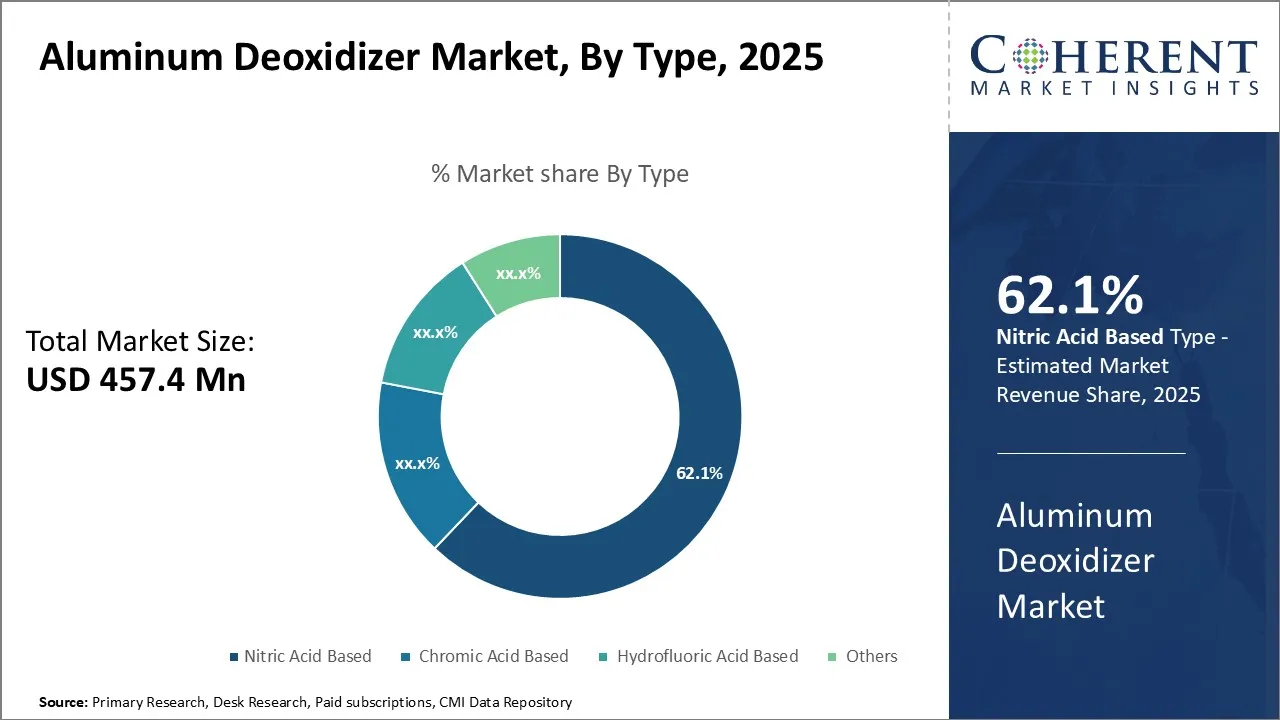
- By Type, Nitric Acid Based acquired the prominent share of 63.1% in 2026 as surging demand across end‑user industries.
- By End-Use Industry, Automotive hold the largest market share of 44.1% in 2026 owing to the lightweighting / fuel efficiency / emissions regulations.
- By Distribution Channel, offline dominates the overall market share of 76.5% in 2026 owing to the technical support, customization, expert consultation.
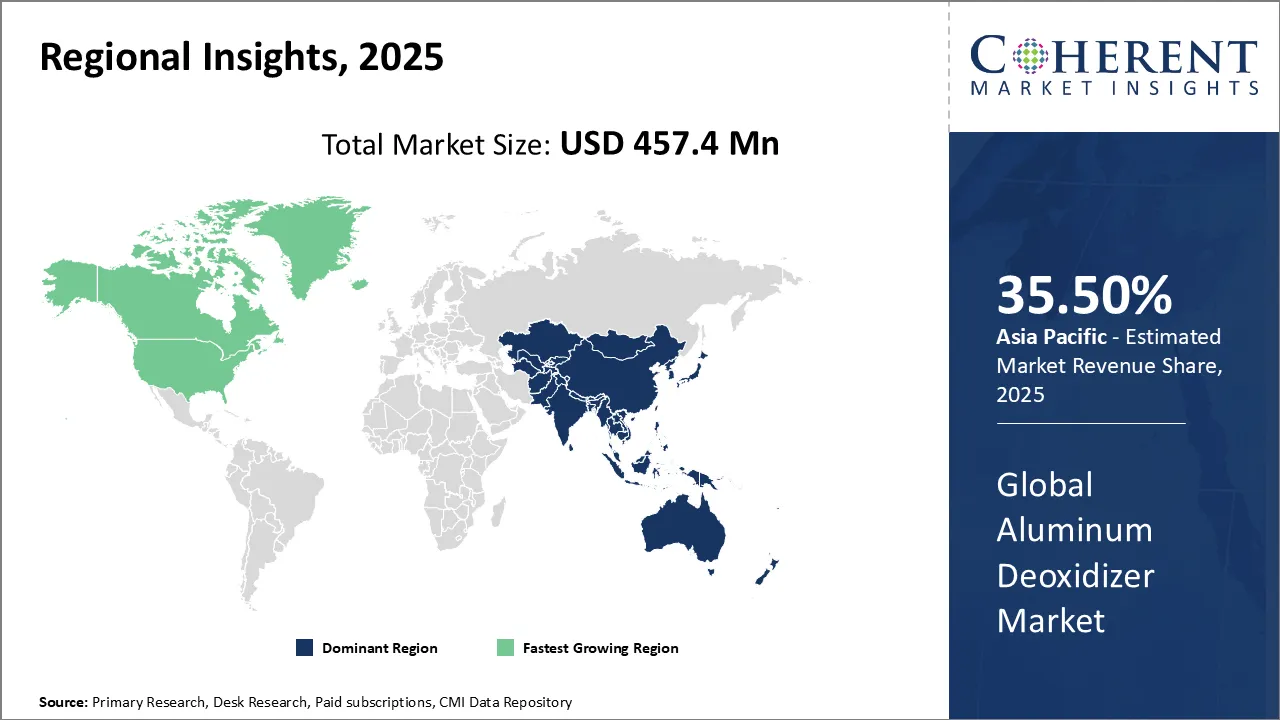
- By Region, Asia Pacific dominates the overall market with an estimated share of 35.5% in 2026 owing to the rapid industrialization & infrastructure growth.
Market Overview
Rising demand for high-purity aluminum in automotive, aerospace, construction, and electronics industries is driving in the Aluminum Deoxidizer Market growth. Manufacturers use deoxidizers to remove oxygen during smelting and casting, which improves metal quality, reduces defects, and enhances overall performance. Expanding aluminum production in emerging economies and ongoing advancements in alloy manufacturing further fuel market growth. In addition, the push for sustainability and increased focus on aluminum recycling are encouraging the adoption of efficient and eco-friendly deoxidizing solutions.
Current Events and their Impact on the Aluminum Deoxidizer Market
Current Events | Description and its impact |
Geopolitical and Trade Dynamics |
|
Economic and Industrial Trends |
|
Supply Chain and Raw Material Availability |
|
Segmental Insights
- Current Industry Events of 2026
- Market Size Estimation
- Regional Breakdown
- Competitive Landscape
- Customer Intelligence
- Segmental Analysis
- Pricing Analysis
- Key Market Drivers, Challenges & Future Trends
- Customized Insights Section
Aluminum Deoxidizer Market Insights, by Type: Nitric Acid Based contribute the highest share of the market owing to its value perception and market share dominance.
Nitric Acid Based acquired the prominent share of 63.1% in 2026. Industries are increasingly adopting nitric acid-based aluminum deoxidizers due to their strong ability to enhance corrosion resistance and maintain metal purity during processing. These deoxidizers create a protective oxide layer that helps produce high-quality aluminum, especially for applications demanding strength and precision. Automotive, aerospace, and electronics sectors prefer these solutions to improve structural performance. Manufacturers also value their compatibility with modern production methods and their effectiveness in treating recycled aluminum, which further accelerates their usage across various aluminum processing operations.
For instance, in June 2025, PSS Intertrade introduced Alfideox 75, a high-performance desmutting additive designed for aluminum anodizing pretreatment. This peroxide-based liquid is formulated to be used with sulfuric acid, effectively removing smut and oxide residues from aluminum surfaces. Alfideox 75 enhances surface activation, ensuring optimal adhesion and uniformity in subsequent anodizing processes. It is recyclable and cost-effective, aligning with sustainable manufacturing practices.
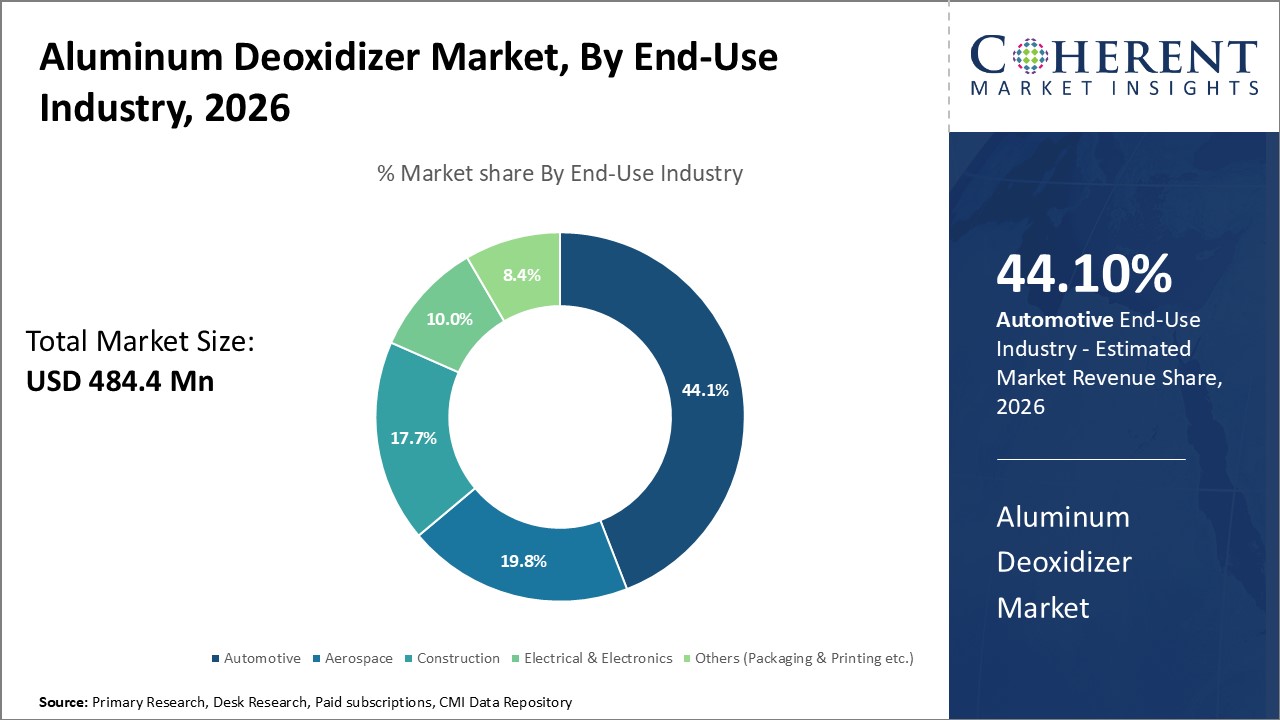
Aluminum Deoxidizer Market Insights, by End-Use Industry: Automotive contribute the highest share of the market owing to its supply chain & material quality.
Automotive hold the largest market share of 44.1% in 2026. Automotive manufacturers are driving demand for aluminum deoxidizers as they increasingly adopt lightweight materials to improve fuel efficiency and comply with emission regulations. By replacing conventional metals with aluminum, they rely on deoxidizers to ensure alloy purity and optimize performance. These agents enhance the strength, durability, and corrosion resistance of critical components like engines, chassis, and body frames. The rising production of electric vehicles, which depend on aluminum for battery housings and structural parts, also accelerates the need for effective deoxidization solutions.
For instance, in October 2023, Henkel introduced Bonderite C-AK 14415, a high-performance, boron-free cleaner designed for aluminum automotive components. This cleaner enhances corrosion resistance and adhesion without the use of boron, addressing sustainability concerns. Ideal for parts like wheels and battery housings, it offers improved process efficiency and aligns with tightening environmental regulations.
Aluminum Deoxidizer Market Insights, by Distribution Channel: Offline contribute the highest share of the market owing to its complex product specifications.
Offline dominates the overall market share of 76.5% in 2026. Industries continue to rely on offline channels to purchase aluminum deoxidizers, favoring direct interactions for acquiring specialized chemical products. Manufacturers and end-users work closely with trusted distributors to secure consistent supply, receive technical guidance, and access customized product solutions. Buyers use offline channels to inspect quality, negotiate terms, and meet regulatory requirements more effectively. In areas with limited digital infrastructure, traditional purchasing methods offer greater reliability. Strong personal relationships and in-person communication further reinforce the importance of offline distribution in this market.
Regional Insights
Asia Pacific Aluminum Deoxidizer Market Trends
Asia Pacific dominates the overall market with an estimated share of 35.5% in 2026. Industries across Asia Pacific are fueling growth in the aluminum deoxidizer market by expanding manufacturing activities and increasing the demand for high-quality aluminum. Countries such as China, India, and Japan are ramping up aluminum production to meet the needs of the automotive, construction, and electronics sectors. Regional manufacturers are adopting modern smelting technologies and efficient deoxidizing methods to boost productivity and minimize material loss. They are also embracing sustainable practices and recycling efforts, which further drive the use of advanced deoxidizers in production processes.
For instance, in July 2026, Chinese tycoons are fueling Indonesia's aluminium industry with multibillion-dollar investments in new smelters and refineries. Companies like Tsingshan Holding, China Hongqiao, and Shandong Nanshan Aluminum are expanding operations in Southeast Asia's largest economy. Goldman Sachs projects a fivefold increase in Indonesian aluminium production by 2030, echoing the nation's earlier nickel boom.
North America Aluminum Deoxidizer Market Trends
Industries across North America are driving growth in the aluminum deoxidizer market by prioritizing high-performance materials and environmentally responsible production methods. Regional manufacturers are improving metal quality to meet the demanding requirements of aerospace, automotive, and industrial applications. They are actively investing in advanced alloy production and recycling infrastructure, which increases the demand for reliable deoxidizing agents. To comply with strict environmental regulations and uphold quality standards, producers are adopting more efficient, low-emission deoxidizer solutions that support both performance and sustainability goals.
For instance, in May 2026, Emirates Global Aluminium (EGA) has announced plans to build a $4 billion aluminium smelter at the Tulsa Port of Inola in Oklahoma, marking the first new primary aluminium production facility in the U.S. The plant will have an annual capacity of 600,000 tonnes, nearly doubling domestic output, and is expected to create up to 1,000 permanent jobs. Construction is slated to begin by the end of 2026, pending finalization of power supply agreements and tax incentives.
United States Aluminum Deoxidizer Market Trends
Manufacturers in the United States are advancing the aluminum deoxidizer market by focusing on precision engineering and maintaining material integrity across major industries. Strong demand from aerospace, defense, and electric vehicle sectors is driving producers to enhance metal processing techniques for better performance and consistency. Companies actively incorporate advanced deoxidizing solutions into their production processes to minimize defects and strengthen alloys. Furthermore, efforts to reshore manufacturing and increase domestic metal production are motivating greater adoption of dependable deoxidizer technologies.
For instance, in August 2024, Cortec® published a white paper detailing methods for cleaning and protecting oxidized aluminum in saltwater environments. The study emphasizes the use of water-based coatings to prevent galvanic corrosion, particularly in marine applications like ferries operating in the Caribbean. Laboratory tests on various coatings subjected to salt fog conditions are included, offering valuable insights for industries dealing with aluminum oxidation.
China Aluminum Deoxidizer Market Trends
China is rapidly expanding its aluminum deoxidizer market as it solidifies its role as a leading global aluminum producer. Automotive, construction, and electronics industries are driving manufacturers to enhance metal quality and boost production efficiency. Chinese companies are implementing innovative deoxidizing technologies to minimize impurities and improve alloy performance. Additionally, government policies promoting sustainable manufacturing and environmental protection encourage the use of eco-friendly deoxidizers. This emphasis on innovation and sustainability is actively shaping the market’s vibrant growth in China.
For instance, in September 2026, Chinese aluminum manufacturers are shifting strategies to escape a severe price war exacerbated by a struggling property sector and oversupply. Faced with declining margins, many are moving up the value chain, focusing on higher-end products like aluminum sheets and automotive parts. This pivot aims to reduce reliance on commodity-grade aluminum and improve profitability.
End-user Feedback and Unmet Needs in the Aluminum Deoxidizer Market
- Demand for Enhanced Purity Control: End-users seek deoxidizers that deliver consistent and superior aluminum purity. Current products sometimes fail to eliminate trace impurities fully, affecting final product quality. This calls for innovations that ensure precise control over oxidation levels during aluminum processing.
- Improved Environmental Compliance: Consumers highlight the need for eco-friendly deoxidizers with reduced emissions and minimal hazardous waste. Sustainable formulations are a priority, as stricter regulations push industries to adopt greener alternatives without compromising performance.
- Cost Efficiency without Quality Trade-offs: Users want affordable deoxidizer solutions that maintain high efficiency and reliability. Existing products can be costly or inefficient at scale, prompting demand for cost-effective options that support large-scale production without sacrificing quality.
Aluminum Deoxidizer Market Trend
Shift Toward Low-Residue Deoxidizer Formulations
A prominent trend in the aluminum deoxidizer market is the growing preference for low-residue formulations. Manufacturers and end-users are prioritizing deoxidizers that leave minimal post-treatment waste, reducing cleaning requirements and improving overall process efficiency. This shift is being driven by the need to streamline downstream processing while maintaining metal quality. New entrants in the market are also differentiating themselves by offering cleaner-burning or minimal-residue products that cater to more advanced and automated aluminum processing systems.
Integration of Smart Monitoring Technologies
The integration of smart monitoring systems in aluminum refining is influencing demand for more predictable deoxidizer behavior. Producers are seeking deoxidizers compatible with real-time sensors and process control technologies that allow better tracking of oxidation levels during production. This trend is shaping the development of intelligent formulations that offer consistent performance under varied conditions. Suppliers responding to this trend are likely to stand out by providing tech-compatible products that fit into the larger movement toward Industry 4.0 in metallurgy.
Aluminum Deoxidizer Market Opportunity
Customized Solutions for High-Performance Alloys
As industries move toward more complex and high-strength aluminum alloys, there is a growing opportunity to offer deoxidizers tailored for specific alloy chemistries. Customized solutions can address challenges like micro-inclusion control and compatibility with trace elements. Companies that invest in R&D to develop alloy-specific deoxidizers will stand out, especially in sectors like aerospace, defense, and electric vehicles where precision metallurgy is non-negotiable and general-purpose products often fall short of desired outcomes.
Market Report Scope
Aluminum Deoxidizer Market Report Coverage
| Report Coverage | Details | ||
|---|---|---|---|
| Base Year: | 2025 | Market Size in 2026: | USD 484.4 Mn |
| Historical Data for: | 2020 To 2024 | Forecast Period: | 2026 To 2033 |
| Forecast Period 2026 to 2033 CAGR: | 5.9% | 2033 Value Projection: | USD 723.5 Mn |
| Geographies covered: |
| ||
| Segments covered: |
| ||
| Companies covered: | BASF SE, Belmont Metals, California Custom Products Inc , Cee-Bee Chemicals, Chemeon Surface Technology, LLC, Henkel Corporation, Sanchem Inc., Socomore, Quaker Houghton | ||
| Growth Drivers: |
| ||
| Restraints & Challenges: |
| ||
Aluminum Deoxidizer Market News
- In June 2024, ANDRITZ successfully commissioned a new continuous surface treatment line at AMAG rolling GmbH in Ranshofen, Austria. The 115-meter-long plant features electric heating powered by green energy and an integrated wastewater treatment system. Advanced digitalization and an autonomous coil transport system enhance productivity and support AMAG’s sustainability objectives. The project underscores AMAG's commitment to high-quality aluminum surfaces and decarbonization efforts.
- In February 2024, BASF’s Surface Treatment unit, Chemetall, inaugurated a new Global Aluminum Competence Center in Giussano, Italy. This advanced facility centralizes R&D efforts to accelerate the development of innovative aluminum surface treatment technologies. The center aims to enhance Chemetall’s position as a global leader in anodizing and pretreatment solutions for aluminum substrates across industries.
Analyst Opinion (Expert Opinion)
- The Aluminum Deoxidizer market is entering a phase of selective consolidation, not expansion—a crucial nuance missed by most mainstream forecasts. While demand continues to track upward in steelmaking geographies, the dynamics have shifted: this is no longer a pure volume game, but one of process optimization and strategic supply positioning.
- Aluminum deoxidation is an entrenched standard in secondary steelmaking. Over 85% of global steel production in 2024 employed aluminum as the primary deoxidizer, driven by its efficacy in producing cleaner steel with low oxygen content. However, the real inflection point is not demanding growth, but cost-performance efficiency.
- Integrated steel plants, particularly in South Korea and Japan, are now optimizing aluminum input ratios via real-time ladle chemistry controls. POSCO, for example, reduced aluminum deoxidizer consumption per ton of steel by 7.2% over the past two years without compromising product quality. This micro-efficiency is shaving margins for bulk aluminum deoxidizer suppliers while creating opportunities for pre-alloyed and high-purity custom blends.
- The industry is also grappling with cost volatility. LME aluminum prices spiked over 20% in 2024 Q2 due to tightened bauxite exports from Guinea and increased Chinese domestic consumption. This forced mid-tier steelmakers in India and Turkey to explore partial substitution using silicon-based deoxidizers or hybrid additions. While these alternatives cannot fully replace aluminum, they threaten low-grade aluminum deoxidizer suppliers with commoditization pressure.
- Let’s not ignore the Chinese factor. China’s top 10 aluminum deoxidizer producers hold an unspoken cartel-like influence over pricing in Southeast Asia, often undercutting regional players by 8–12%. This is not sustainable but is currently distorting market dynamics and accelerating the exit of small-cap manufacturers in Malaysia and Vietnam.
- REACH and similar regulatory frameworks are starting to impact not only raw aluminum input standards but also the downstream recycling process of aluminum dross. Europe is leading a push for closed-loop traceability in steel auxiliary inputs, and aluminum deoxidizers are now under that microscope. In 2025, we anticipate major European buyers to shift procurement toward ISO 14067-certified aluminum deoxidizer sources, forcing non-compliant Asian producers either into retrofit capex or irrelevance.
- A notable case: ArcelorMittal Bremen has already transitioned to a traceable aluminum deoxidizer sourcing model, eliminating three legacy suppliers in 2024 alone. The strategic implication? Compliance is becoming a non-price differentiator in high-value markets, and U.S. producers like AMI Metals and Pyromet are quietly expanding capacity to exploit this regulatory arbitrage.
Speak to the analyst
Want personalized insights?
Take the findings above to one of our principal consultants, or have the report rebuilt around the segments, geographies and competitors you actually track.
Market Segmentation
- Type Insights (Revenue, USD Mn, 2021 - 2033)
- Nitric Acid Based
- Chromic Acid Based
- Hydrofluoric Acid Based
- Others (Sulfuric Acid Based)
- End-use Industry Insights (Revenue, USD Mn, 2021 - 2033)
- Aerospace
- Automotive
- Construction
- Electrical & Electronics
- Others (Packaging & Printing etc.)
- Distribution Channel Insights (Revenue, USD Mn, 2021 - 2033)
- Online
- Third Party E-commerce Websites
- Company / Brand Websites
- Offline
- Industrial Supply Stores
- Others
- Online
- By Regional:
- North America
- U.S.
- Canada
- Latin America
- Brazil
- Argentina
- Mexico
- Rest of Latin America
- Europe
- Germany
- U.K.
- Spain
- France
- Italy
- Russia
- Rest of Europe
- Asia Pacific
- China
- India
- Japan
- Australia
- South Korea
- ASEAN
- Rest of Asia Pacific
- Middle East
- GCC Countries
- Israel
- Rest of Middle East
- Africa
- South Africa
- North Africa
- Central Africa
- North America
- Key Players Insights
- BASF SE
- Belmont Metals
- California Custom Products Inc
- Cee-Bee Chemicals
- Chemeon Surface Technology, LLC
- Henkel Corporation
- Sanchem Inc.
- Socomore
- Quaker Houghton
Sources
Primary Research Interviews
- Senior procurement officers at integrated steel plants in South Korea and Germany
- Production heads at secondary steel mills in India and Turkey
- Technical directors from aluminum-based additive manufacturers in China
- Environmental compliance officers from EU-based specialty steel producers
- Logistics coordinators involved in sourcing aluminum deoxidizer materials in Vietnam and Malaysia
Databases
- LME (London Metal Exchange) Aluminum Pricing Database
- UN Comtrade – International Trade Statistics Database
- World Steel Association (WSA) Steel Production and Capacity Utilization Data
- Eurostat Industrial Input-Output Tables
- India Ministry of Commerce & Industry – Export-Import Data
Magazines
- Steel Times International
- Aluminum Insider
- Metal Bulletin Magazine
- Modern Metals
- Industrial Heating
Journal
- Journal of Materials Processing Technology
- Ironmaking & Steelmaking (IOM3)
- Metallurgical and Materials Transactions B
- Journal of Sustainable Metallurgy
- Journal of Cleaner Production (sections relevant to industrial process optimization)
Newspapers
- The Economic Times (India – Metals & Commodities Section)
- Nikkei Asia (Industrial & Raw Materials Coverage)
- South China Morning Post (Trade & Manufacturing News)
- Handelsblatt (German Industrial and Raw Material Focus)
Associations
- Aluminium Association (USA)
- China Nonferrous Metals Industry Association (CNIA)
- Steel Manufacturers Association (SMA)
- Japan Iron and Steel Federation (JISF)
- European Steel Association (EUROFER)
Public Domain Sources
- REACH Regulations Database – European Chemicals Agency (ECHA)
- U.S. Geological Survey (USGS) – Aluminum Mineral Commodity Summaries
- WTO Trade Policy Reviews – Country-Specific Steel and Aluminum Data
- OECD Steelmaking Capacity Reports
- Ministry of Industry and Information Technology (MIIT), China – Production Guidelines and Export Policies
Proprietary Elements
- CMI Data Analytics Tool, and Proprietary CMI Existing Repository of information for last 8 years
Get access to 250+ pages report
Every segment, forecast, competitor profile and data table behind the analysis above — available for instant download.
- ESOMAR Member
- ISO 9001:2015 Certified
- D-U-N-S Registered
- GDPR & CCPA Compliant
Missing comfort of reading report in your local language? Find your preferred language:
Transform your Strategy with Exclusive Trending Reports
Frequently Asked Questions
The Aluminum Deoxidizer Market is estimated to be valued at USD 484.4 Mn in 2026, and is expected to reach USD 723.5 Mn by 2033.
The CAGR of the Aluminum Deoxidizer Market is projected to be 5.9% from 2026 to 2033.
Augmenting demand of aluminum in automotive industry and Growing Industrialization and Infrastructure Development are the major factor driving the growth of Aluminum Deoxidizer Market.
Volatile prices of raw materials affecting stability in production and Substitution by Alternative Materials are the major factor hampering the growth of Aluminum Deoxidizer Market.
In terms of Type, Nitric Acid Based, estimated to dominate the market revenue share 2026.
BASF SE, Belmont Metals, California Custom Products Inc, Cee-Bee Chemicals, Chemeon Surface Technology, LLC, Henkel Corporation, Sanchem Inc., Socomore, Quaker Houghton are the major players.
Asia Pacific is expected to lead the Aluminum Deoxidizer Market.