

Aluminum Window Profile Market Size and Share Analysis: (2026 - 2033)
The aluminum window profile market is anticipated to grow at a CAGR of 3.94% with USD 120.58 Bn in 2026 and is expected to reach USD 157.70 Bn in 2033. The Aluminum window profile market is driven by driven by architectural trends, energy efficiency demands, along with sustainability initiatives. As urbanization continues to surge (according to WUP25, the total number of cities on the planet more than doubled between 1975 and 2025, reaching 12,000), there is a high preference for lightweight material, which aluminum provides.
Key Takeaways
- L Type is expected to account the largest share of 60% in 2026, L-shaped profiles are commonly used in window frames due to its simplicity, strength along with ease of installation. L-Type extrusions accounted for more than 70% of aluminum profile output in major manufacturing hubs in China as well as India in 2025.
- Sliding windows will dominate with 35% in 2026, sliding windows are prominent known for residential as well as commercial buildings as they are space-efficient, simple to maintain, along with cost-effective. As of the first half of fiscal year 2025 in India, real estate accounted for the largest share of investments among all sectors, with Rs. 75,468 crores out of a total Rs. 4,49,384 crores in AIF investments, representing 17%.
- Residential will dominate with 60% in 2026, majority of the aluminum window profiles are used in homes, especially in city housing, apartment buildings, etc. In March 2026, U.S. privately-owned housing starts reached 1.5 million units, with 69% single-family homes and 30% multi-family apartments. Showing residential construction the largest driver for aluminum window profile demand, supporting an estimated 60% in 2026.
- Asia Pacific is expected to acquire the dominant share of 45% in 2026, high urbanization in countries like China, India, Japan, and Southeast Asia. Among the 33 megacities with 10 million inhabitants or more in 2025, 19 are in Asia. India alone has five megacities, as well as China has four.
Advanced Manufacturing Technologies is transforming the Aluminum Window Profile Industry
Advanced precision extrusion technology utilizes computers, heating systems, as well as real-time monitoring to make very accurate aluminum profiles with complex shapes. Prominent companies adopting this technology include Norsk Hydro (Norway) with smart IoT-enabled extrusion lines, Arconic (USA) with special micro-extrusion for very thin profiles, as well as LIXIL Group (Japan) using multi-cavity extrusion for complex window designs.
These technologies give many benefits. They lower material waste by 30–40%, make measurements very accurate, as well as speed up production by 25%. They also allow more complex designs, better product quality, as well as more design choices.
Automated Surface Treatment Technologies: A major breakthrough in Aluminum Window Profile
Automated surface treatment uses robots as well as precise chemicals for anodizing, powder coating, and wood-grain finishing. Prominent players using these methods include Reynaers Aluminium (Belgium) with AI powder coating, Schüco International (Germany) with robotic anodizing and quality checks, as well as YKK AP (Japan) with automated wood-grain finishing.
Using these systems has cut surface defects by 50%, made color matching very accurate, and improved coating durability by 35%. Better chemical use also reduces environmental impact, making the products higher quality and more sustainable.
- Current Industry Events of 2026
- Market Size Estimation
- Regional Breakdown
- Competitive Landscape
- Customer Intelligence
- Segmental Analysis
- Pricing Analysis
- Key Market Drivers, Challenges & Future Trends
- Customized Insights Section
Current Events and Their Impact on the Aluminum Window Profile Market
Current Event | Description and its Impact |
Europe’s tougher green building rules |
|
U.S. Tariffs on Imported Aluminum |
|
Segmental Insights
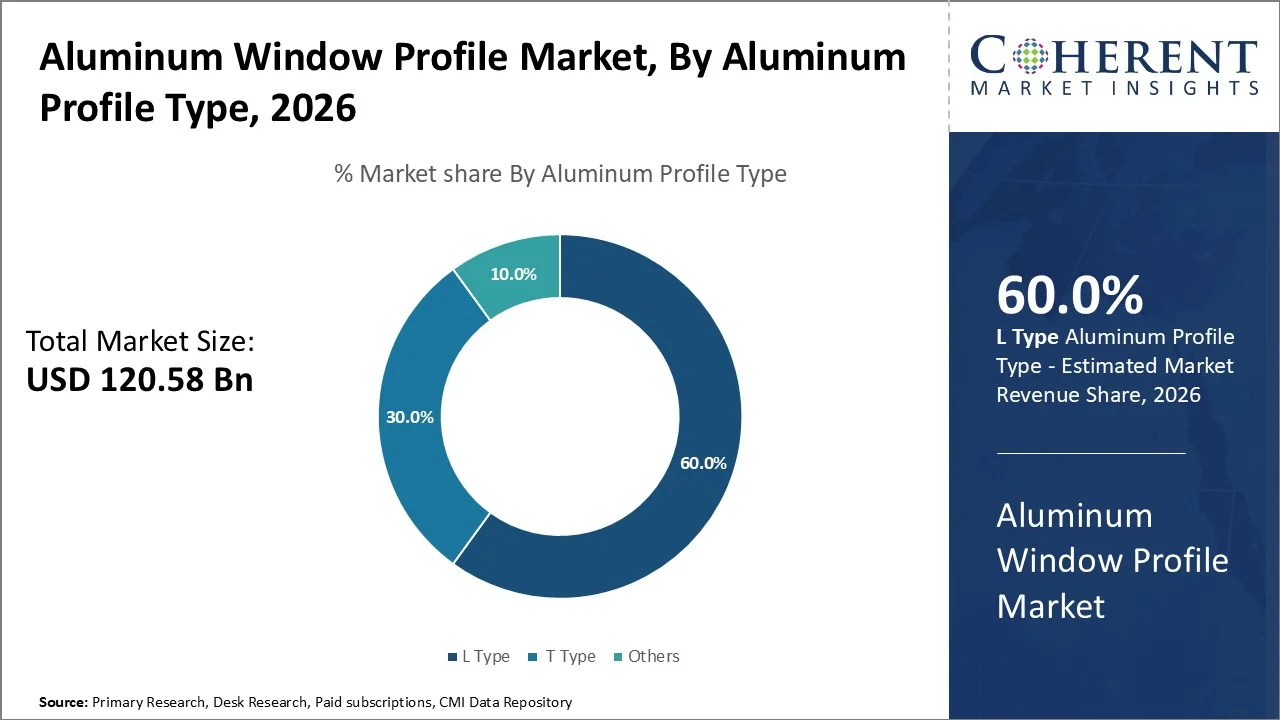
Why is L Type Acquiring the Largest Market Share?
L Type is projected to account for the largest share of aluminum profile type in 2026, representing approximately 60% of the total volume. Exceptional structural versatility along with high adoption across various construction applications is one of the factors responsible for the growth of the segment. The total value of investment in building construction increased USD 442.9 million (+1.9%) to USD 23.7 billion in December 2025.
It has its distinctive angular configuration, which has become the cornerstone of modern fenestration systems due to its optimal balance of strength further stimulating the growth of the market.
Its ability to provide superior structural integrity in line with maintaining relatively straight forward manufacturing processes, makes it a go-to option for both residential as well as commercial construction projects globally.
The inherent design advantages that address multiple construction requirements simultaneously is another growth inducing factor. According to data from the International Code Council (ICC), L Type profiles demonstrate superior load-bearing capabilities compared to optional configurations, particularly in high-rise construction applications where wind load resistance is paramount.
Sliding Windows holds the Largest Market Share
Sliding windows dominates the market, accounting for a significant 35% share in 2026, the exceptional space efficiency, ease of operation, along with unique design characteristics are the factors responsible for the growth of the market.
Their fundamental operational advantage of not requiring exterior space for opening, making them ideal for high-rise residential buildings, commercial offices, urban housing projects, etc., where space optimization is important.
The Union Minister for Housing and Urban Affairs and Power, highlighted the significant increase in urban sector investments during a press briefing in New Delhi. The investments have grown 16 times, from approximately ₹1,78,053 crore between 2004-14 to ₹28,52,527 crore since 2014. This increase underscores the government’s commitment to achieving the goal of Vikshit Bharat by 2047.
According to the U.S. Green Building Council, sliding windows are highly specified in LEED-certified buildings due to their ability to maximize natural light penetration at the same time maintaining structural integrity through aluminum framing systems.
Residential holds the Largest Market Share
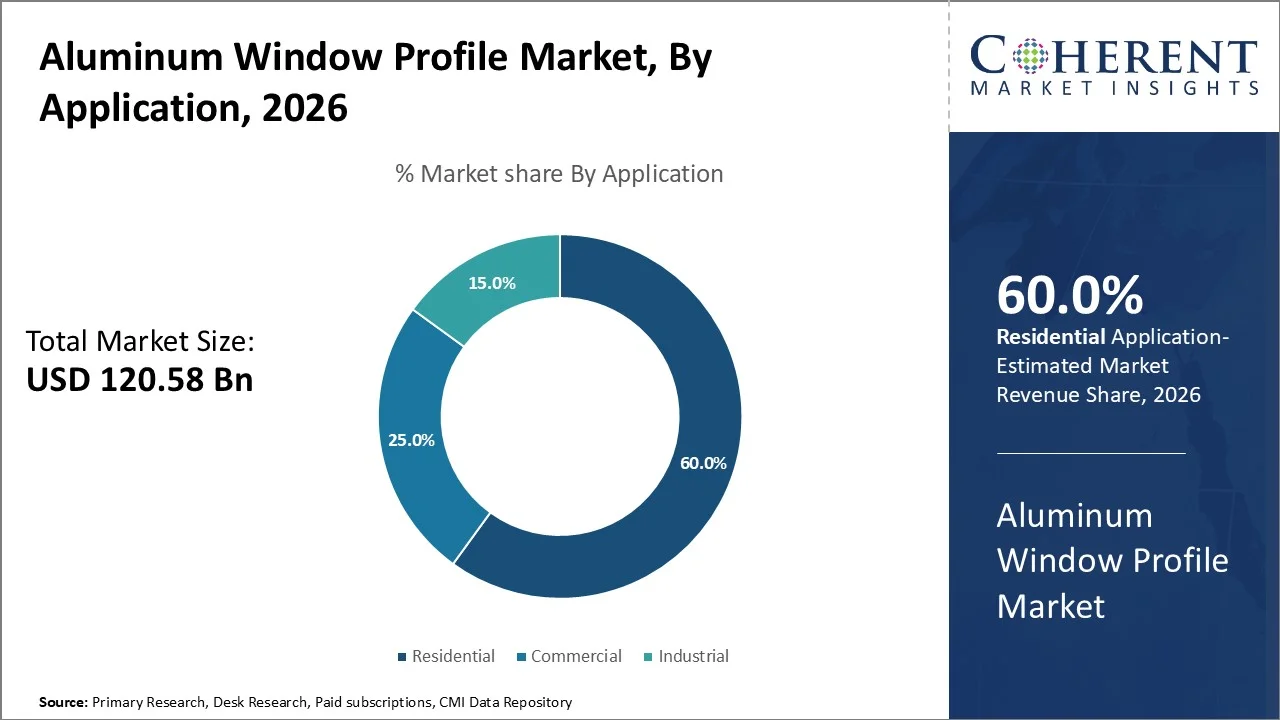
Based on application, residential dominates the market, accounting for a significant 60% share in 2026, the massive scale of global housing demand along with the inherent advantages that aluminum window profiles provide to homeowners as well as residential developers. The number of newly built residential buildings in 2025 was 5 930, similarly the newly built dwellings in them were 37 571 in Bulgaria.
Aluminum window profiles are strong, energy-efficient, as well as aesthetically appealing, making them a perfect choice for contemporary homes. The UN says cities are growing fast, and by 2030, about 3 billion people will need proper homes.
Aluminum Window Profile Market Trends
- Focus towards sustainability with the high emphasis on recyclable as well as eco-friendly building materials, with aluminum's 100% recyclability becoming a key differentiator
- Mandates for energy efficiency is escalating the adoption of thermally broken aluminum profiles to meet stringent building energy codes. October 2025, YKK AP Inc. announced that Bhoruka Extrusions Private Limited, an affiliated company operating YKK AP’s Indian business, has undertaken the restructuring of its main manufacturing site, the Mysuru Factory. A new aluminum profile extrusion line has been installed, and a commissioning ceremony was held locally on October 8.
- Rising integration of IoT-enabled features as well as smart glass technologies in aluminum window systems
- Customization Demand with the shift toward bespoke architectural solutions as well as complex geometrical designs.
- Innovation in powder coating Advanced surface treatment technologies enhancing durability and aesthetic appeal
Regional Insights
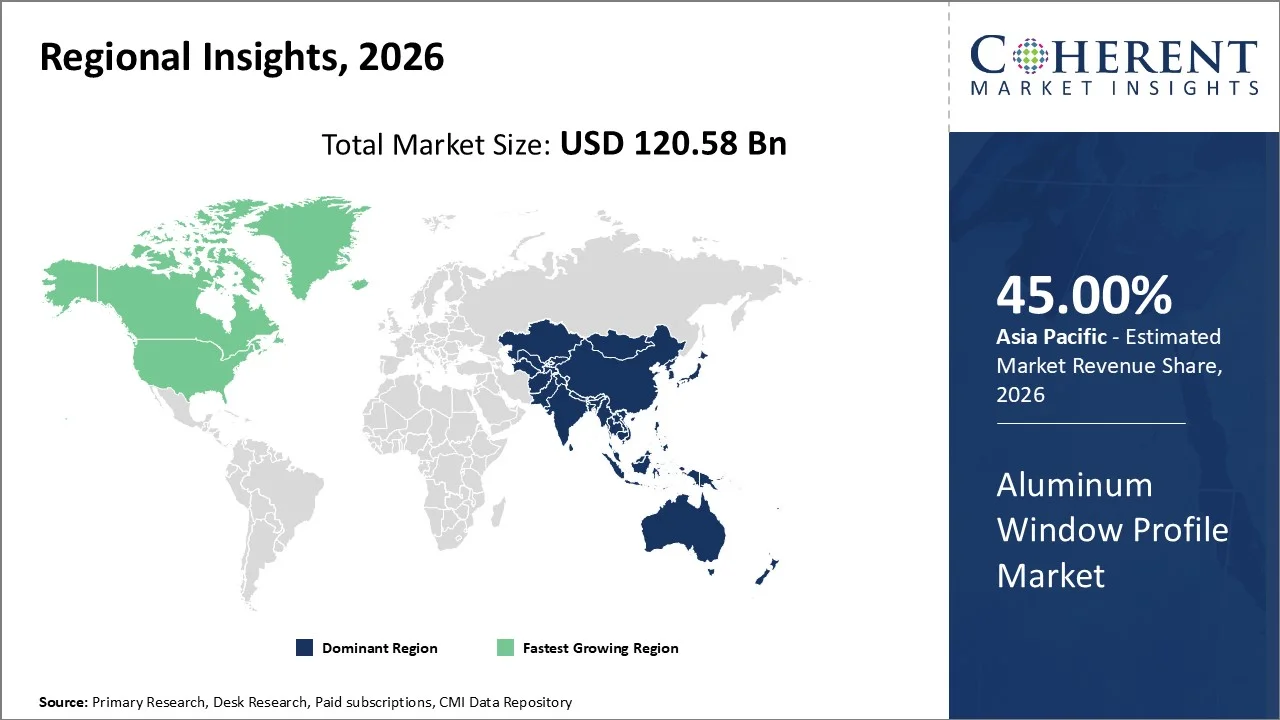
Asia Pacific dominates owing to the infrastructure development
Asia Pacific account 45% market share in 2026, driven by unprecedented urbanization rates and massive infrastructure development projects across emerging economies. By 2030, more than 55% of the population of Asia will be urban, creating demand for advance infrastructure development.
The United Nations Human Settlements Programme (UN-Habitat) indicates that Asia Pacific accounts for over 60% of global urban population growth, creating enormous demand for residential and commercial construction that directly translates to aluminum window profile consumption.
Countries like Vietnam, Indonesia, Philippines, etc., are experiencing construction booms fueled by foreign direct investment as well as government-led infrastructure initiatives which is another growth inducing factor.
North America Aluminum Window Profile Market Trends
The North America region is poised to be the fastest-growing region through 2026-2033, expanding at a CAGR of approximately 6.8%. The robust construction industry infrastructure, stringent energy efficiency regulations, as well as widespread adoption of advanced architectural solutions across residential and commercial sectors. There are 65,658 businesses in the Commercial Building Construction industry in the United States. Similarly, construction is a major contributor to the U.S. economy. There were more than 919,000 construction establishments in the U.S. in the 1st quarter of 2023.
The United States Green Building Council's LEED certification program has majorly influenced construction practices, with over 100,000 certified projects nationwide as of 2023, creating demand for high-performance aluminum window systems that cater to the strict thermal efficiency standards.
Robust Construction Industry is Accelerating the Aluminum Window Profile Market Demand in United States
The U.S. contributes the highest share in the aluminum window profile market in North America owing to its robust construction industry, extensive infrastructure development projects, and stringent energy efficiency regulations that mandate high-performance building materials.
The implementation of Energy Star certification programs by the Environmental Protection Agency (EPA), which has made substantial demand for energy-efficient aluminum window profiles in both residential as well as commercial sectors.
The American Institute of Architects (AIA) reports that sustainable building practices have become standard across major metropolitan areas, with aluminum window profiles being preferred owing to their recyclability and thermal performance capabilities.
China Aluminum Window Profile Market Trends
China contributes the highest share in the aluminum window profile market in Asia Pacific due to its massive construction industry, robust manufacturing capabilities, as well as continuous urbanization initiatives. According to the International Aluminium Institute, China is the world's largest aluminum producer, with the country accounting for approximately 57% of global aluminum production.
The nation's aluminum window profile market benefits majorly from government-backed infrastructure development programs, including the Belt and Road Initiative as well as extensive urban renewal projects across major cities like Beijing, Shanghai, and Shenzhen.
Who are the Major Companies in Aluminum Window Profile Industry
Some of the major key players in aluminum window profile market include, Apogee Enterprises Inc., Fletcher Building, Ply Gem Holdings Inc., YKK AP Inc., LIXIL Group Corporation, Xingfa Aluminium, Sapa Group, PGT Inc., Wacang, and Fenan Group
Key News
- In January 2026, Fletcher Building announced it has entered into a binding agreement to sell its Construction Division to major international construction group VINCI Construction (VINCI) for USD 315.6 million.
- In April 2025, TOKYO/BIELEFELD, LIXIL Corporation ("LIXIL"), maker of pioneering water and housing products, and Schueco International KG ("Schueco"), a provider of aluminum sashes and curtain walls that combine excellent thermal insulation performance and design, announced an agreement to integrate LIXIL's PremiAL series into Schueco's low-carbon profiles, set to launch in Southeast Asia.
Market Report Scope
Aluminum Window Profile Market Report Coverage
| Report Coverage | Details | ||
|---|---|---|---|
| Base Year: | 2025 | Market Size in 2026: | USD 120.58 Bn |
| Historical Data for: | 2020 To 2024 | Forecast Period: | 2026 To 2033 |
| Forecast Period 2026 to 2033 CAGR: | 3.94% | 2033 Value Projection: | USD 157.70 Bn |
| Geographies covered: |
| ||
| Segments covered: |
| ||
| Companies covered: | Apogee Enterprises Inc., Fletcher Building, Ply Gem Holdings Inc., YKK AP Inc., LIXIL Group Corporation, Xingfa Aluminium, Sapa Group, PGT Inc., Wacang, and Fenan Group. | ||
| Growth Drivers: |
| ||
| Restraints & Challenges: |
| ||
Analyst Opinion
- The aluminum window profile market is fueled by urbanization as well as construction demand. In 2025, global construction activity reached USD 13.5 trillion, with residential as well as commercial projects highly favoring energy-efficient aluminum window systems.
- Energy-efficient along with green building trends is reshaping the market. Over 42% of new residential projects in Europe and Asia Pacific in 2025 used thermal break aluminum profiles, showing regulatory mandates as well as adopting sustainability initiatives.
- New technologies like robotic extrusion, automated surface treatments, multi-cavity thermal break profiles, etc., are making production with more precision and efficient. For example, in January 2025, Encore-Alcom started its new factory in Surat, Gujarat. This facility, is the country’s first to feature automated robotic technology.
- Material cost volatility is a key challenge. Aluminum prices surged 15% YoY in early 2025, impacting margins, particularly for small as well as medium manufacturers relying on imports.
- Smart integration and retrofitting are coming as growth drivers. In Europe, approximately 45% of new retrofitting projects in 2025 involved thermal-break aluminum profiles with smart integration to comply with EU energy efficiency directives
- Asia-Pacific leads the market because of the housing boom in China and fast infrastructure growth in India. Europe targets on green building, North America grows through renovations and energy rules, and the Middle East has chances in smart city projects despite political risks.
Speak to the analyst
Want personalized insights?
Take the findings above to one of our principal consultants, or have the report rebuilt around the segments, geographies and competitors you actually track.
Market Segmentation
- By Aluminum Profile Type (Revenue, USD Bn, 2021-2033)
- L Type
- T Type
- Others
- By Window Type (Revenue, USD Bn, 2021-2033)
- Awning Windows
- Hopper Windows
- Sliding Windows
- Fixed Windows
- Single-Hung Windows
- Double Hung Windows
- Casement Windows
- By Application (Revenue, USD Bn, 2021-2033)
- Residential
- Commercial
- Industrial
- By Region (Revenue, USD Bn, 2021-2033)
- North America
- U.S.
- Canada
- Latin America
- Brazil
- Mexico
- Argentina
- Rest of Latin America
- Europe
- Germany
- U.K.
- France
- Italy
- Spain
- Russia
- Rest of Europe
- Asia Pacific
- China
- India
- Japan
- Australia
- South Korea
- ASEAN
- Rest of Asia Pacific
- Middle East
- GCC
- Israel
- Rest of Middle East
- Africa
- South Africa
- Central Africa
- North Africa
- North America
- Key Players
- Apogee Enterprises Inc.
- Fletcher Building
- Ply Gem Holdings Inc.
- YKK AP Inc.
- LIXIL Group Corporation
- Xingfa Aluminium
- Sapa Group
- PGT Inc.
- Wacang
- Fenan Group
Sources
Primary Research Interviews
- Aluminum window profile manufacturers and producers
- Window and door fabricators and installers
- Construction industry professionals and contractors
- Architects and building designers
- Others
Databases
- Global Trade Atlas
- Euromonitor International
- Others
Magazines
- Window & Door Magazine
- Glass Magazine
- Construction Specifier
- Building Design + Construction
- Others
Journals
- Journal of Building Engineering
- Construction and Building Materials
- Materials & Design
- Others
Newspapers
- Construction Dive
- Engineering News-Record (ENR)
- Building Design
- Construction Week
- Others
Associations
- American Architectural Manufacturers Association (AAMA)
- European Aluminium Association
- International Association of Building Envelope Consultants (IABEC)
- National Glass Association (NGA)
- Others
Public Domain Sources
- U.S. Census Bureau Construction Statistics
- European Commission Construction Industry Reports
- International Trade Centre (ITC) Trade Statistics
- National Institute of Standards and Technology (NIST)
- Others
Proprietary Elements
- CMI Data Analytics Tool
- Proprietary CMI Existing Repository of information for last 10 years
Get access to 250+ pages report
Every segment, forecast, competitor profile and data table behind the analysis above — available for instant download.
- ESOMAR Member
- ISO 9001:2015 Certified
- D-U-N-S Registered
- GDPR & CCPA Compliant
Missing comfort of reading report in your local language? Find your preferred language:
Transform your Strategy with Exclusive Trending Reports
Frequently Asked Questions
The aluminum window profile market is expected to reach USD 157.70 Bn in 2033.
Major players operating in the global aluminum window profile market include Apogee Enterprises Inc., Fletcher Building, Ply Gem Holdings Inc., YKK AP Inc., LIXIL Group Corporation, Xingfa Aluminium, Sapa Group, PGT Inc., Wacang, and Fenan Group
Loss of heat and interior condensation associated with aluminum window profile is one of the major factors that is expected to hamper growth of the market over the forecast period.
Initiatives including the creation of car dismantling, shredder, and environmental safety centers are driving growth of the global Aluminum Window Profile market.
The aluminum window profile market is anticipated to grow at a CAGR of 3.94% between 2026 and 2033.
Among regions, Asia Pacific is expected to account for a largest market share in the global aluminum window profile market over the forecast period.