

Asia Pacific Endoscopy Devices Market size and share Analysis (2026-2033)
The Asia Pacific Endoscopy Devices Market is anticipated to grow at a CAGR of 7.3%, with an estimated market value of USD 6.55 Bn in 2026, and is expected to reach USD 10.75 Bn by 2033. UN ESCAP projects that by 2050, one in four people in Asia Pacific will be aged 60 years or above, equivalent to around 1.3 billion people, which is expected to significantly increase demand for endoscopy procedures used in the diagnosis and management of age-related gastrointestinal, oncological, and chronic conditions.
Key Takeaways
- The Visualization Systems segment held the largest share of the market in 2026, accounting for 47.3% of total revenue. The increasing number of gastrointestinal screening and diagnostic endoscopy procedures in major healthcare systems across the Asia-Pacific region is a significant factor driving this segment. This growth is leading to a heightened demand for high-quality imaging, real-time visualization, and efficient management of endoscopy workflows. According to the Endoscopy Database in Japan, approximately 14.3 million gastrointestinal endoscopy procedures are conducted annually under insurance.
- Laparoscopic Surgery accounted for the largest share of the market in 2026 with 38.4% of the overall revenue market share. This dominance is driven by the growing preference for minimally invasive surgery, owing to faster recovery and lower post-operative trauma. Supporting this, a 2025 Japanese study reported 34,429 laparoscopic hysterectomies in 2023, accounting for 53.4% of all hysterectomies for benign diseases, showing strong clinical adoption of laparoscopy.
- Japan held the largest revenue share in the market in 2026, making up approximately 36.0% of the total revenue. This dominance is driven by the country’s ageing population and highly developed endoscopy infrastructure. Supporting this, Japan records around 14.3 million gastrointestinal endoscopy procedures annually under insurance, while the National Cancer Center Hospital in Tokyo operates 15 endoscopy procedure rooms, highlighting strong procedural demand and advanced clinical capacity.
Segmental Insights
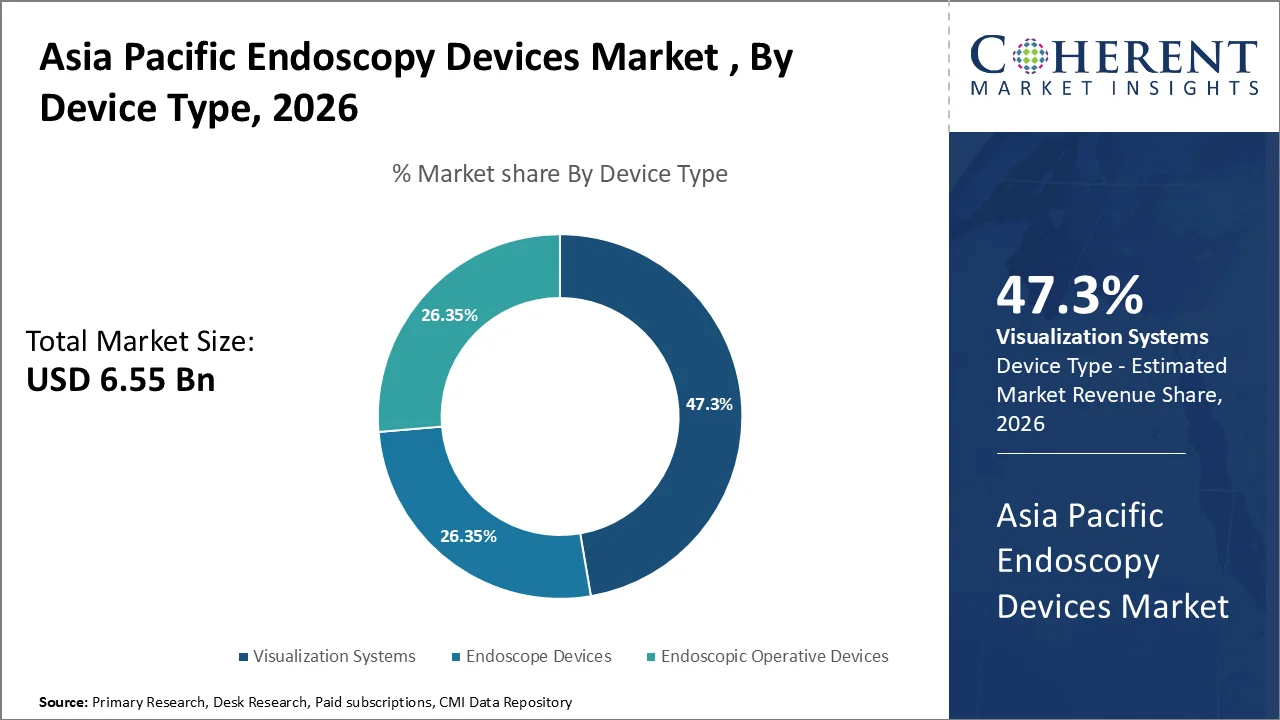
By Device Type, the Visualization Systems dominates with 47.3% of market share in 2026
There is tremendous growth potential for visualization systems because all of the markets for diagnostic and therapeutic endoscopy rely on image processors, light sources, scopes, and monitors to find lesions and guide procedures. Japan alone has recorded 14.3 million gastrointestinal endoscopy cases that are insured, and the National Cancer Center Hospital in Japan has 15 endoscopy rooms; these numbers demonstrate the need for more sophisticated visualization platforms.
There are two key factors driving this segment's growth. The first is the rising number of endoscopic screenings and gastrointestinal cancers, which increases the need for brighter, sharper, and more accurate images used in diagnosis. The second is the replacement of old systems with new 4K capable, image-enhanced systems that help hospitals increase the speed and efficiency of workflows and improve therapeutic decision-making through a broader range of compatible diagnostic and interventional endoscopes used across multiple departments.
On April 23, 2025, FUJIFILM India introduced its ELUXEO 8000 Therapeutic Endoscopy Solution featuring a CMOS sensor and 4K output at the 22nd live endoscopy conference in Mumbai, while on April 23, 2020, Olympus launched its EVIS X1 advanced visualization systems for gastrointestinal disorders (stomach, colon, esophagus, and bronchus).
- Current Industry Events of 2026
- Market Size Estimation
- Regional Breakdown
- Competitive Landscape
- Customer Intelligence
- Segmental Analysis
- Pricing Analysis
- Key Market Drivers, Challenges & Future Trends
- Customized Insights Section
By Application, the Laparoscopy Surgeries dominates with 38.4% of market share in 2026
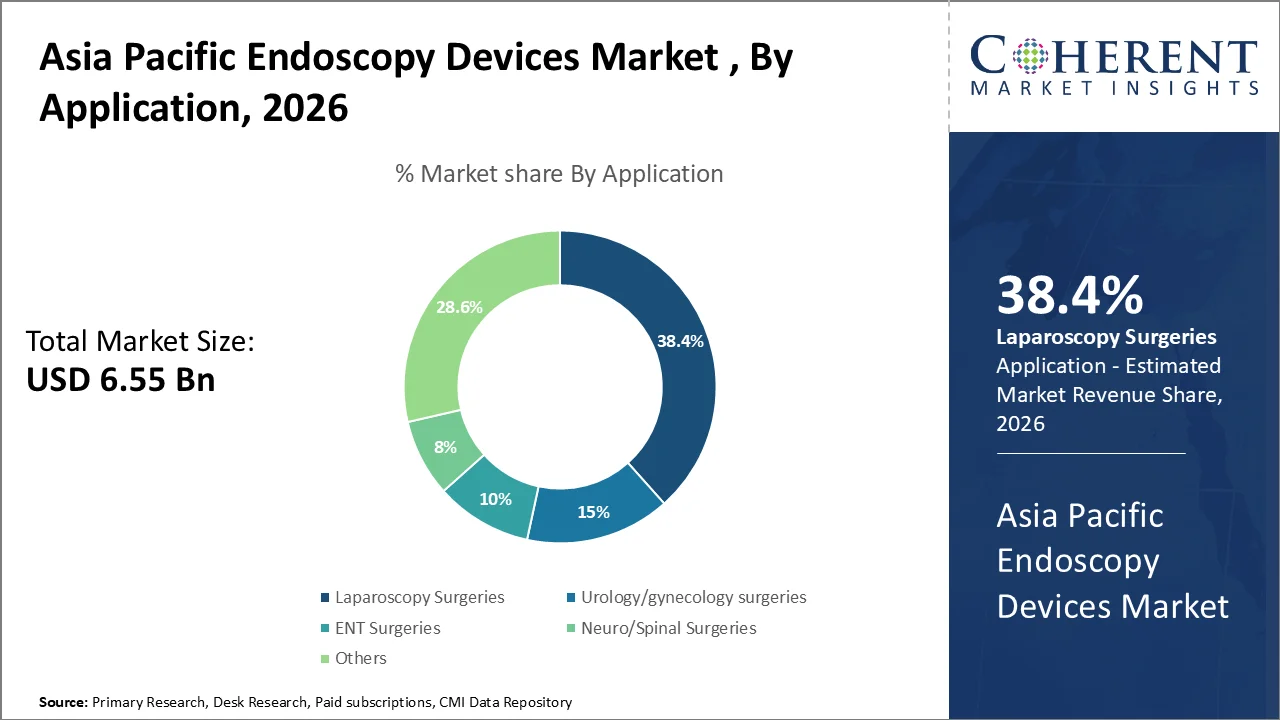
The Laparoscopy Surgeries dominates with 38.4% of market share in 2026, due to the increasing reliance on endoscopes for visualization, accuracy, and quicker recovery across the surgical specialties of minimally invasive abdominal, gynecologic, thoracic and urologic procedures. A 2025 national study from Japan reported 34,429 laparoscopic hysterectomies in 2023, accounting for 53.4% of all hysterectomies for benign diseases, while robot-assisted hysterectomies reached 8,088 cases, reflecting strong adoption of advanced laparoscopic surgery in the region.
Two key drivers for this segment's growth. First, laparoscopic surgery is preferred as it is associated with less pain, fewer wound infections, less blood loss, and shorter length of stay than open surgeries; second, strong registry coverage and structured training for surgeons in Japan is allowing surgeons to achieve standardized outcomes and to adopt minimally invasive surgery across many different specialized areas of practice.
On September 14th 2022 Olympus introduced their VISERA ELITE III surgical video imaging platform covering parts of Asia, Australia, and Japan, which was designed for laparoscopic diagnosis, treatment, and video observation; subsequent updates on March 11th 2026 will emphasize on the capabilities of the platform's 4K white-light/fluorescent-guided surgery features.
Asia Pacific Endoscopy Devices Market Trends
- Due to the growing burden and volume of screened gastrointestinal cancers in Asia Pacific, the overall demand for endoscopy devices in the region has increased and continues to be on an upward trajectory. Asia accounted for 49.2% of global total cancer cases and 56.1% of global total cancer mortality in 2022. In Asia alone, there were 966,399 newly diagnosed colorectal cancer cases. An example of the treatment intensity for procedures requiring endoscopy is the Japan Endoscopy Database, which reported 14.3 million gastrointestinal endoscopy procedures performed annually in Japan under insurance; this supports the continued demand for scopes, processors and imaging systems. (Source: WHO)
- The market is rapidly transitioning to high-definition and software-based visualisation platforms. Olympus launched the VISERA S in September 2024, as well as a new 4K camera head featuring true 4K imaging and narrow band high-definition imaging in 2024; meanwhile, FUJIFILM India launched the ELUXEO 8000 in April 2025. Olympus also announced in October of 2024 that it had received CE mark approval for three cloud-based AI medical devices and intends to launch an AI-enabled endoscopy ecosystem in 2025, thereby demonstrating the shift towards integrated digital imaging systems and AI-assisted workflows.
Rising Innovations in the Asia Pacific Endoscopy Devices Market
The endoscopy devices marketplace throughout the Asia Pacific region will see a significant transformation in 2026 with the advent of cloud-based, AI-assisted endoscopy ecosystems and the diminishing use of stand-alone hardware. Olympus recently confirmed via a press release dated February 2026 that its CADDIE CADe cloud-based solution demonstrated a 7.3% increase in adenoma detection rates, as well as a increase in the detection of sessile serrated lesions when utilized within the framework of the EAGLE randomized clinical trial, which evaluated CADDIE CADe at 8 sites, on 841 patients and over the course of participation by 22 endoscopists. Additionally, the world's first joint demonstration of endoscopy performed in the cloud has been completed between NTT and Olympus, thereby adding credibility to the emerging trend of real-time image processing in endoscopic procedures, rapid upgrade cycles for cloud-based systems and remote collaborative diagnostic capabilities.
Current Events and Their Impact
Current Events | Description and its Impact |
China tightens medical-device manufacturing compliance |
|
India strengthens and digitizes device regulation |
|
Country Insights
Asia Pacific Endoscopy Devices Market Country Analysis: Japan, China, and India Growth Trends
Endoscopy devices have the highest growth potential for the Asia-Pacific Region, because of a large number of diseases, more hospitals, and an increasing number of minimally invasive surgeries. In 2022, almost 49.2% of all new cancer cases occurred in the Asia-Pacific Region; and of the cancer deaths 56.1%. Japan, China and India are each increasing their surgical capacity, screening programs and medical device regulations. As such, the Region can be viewed as favorable for suppliers of visualization systems (endoscope), therapeutic endoscopic devices, and laparoscopic devices.
Japan: Advanced Screening Adoption and Technology Leadership
With its established infrastructures for both surgical procedures and clinical research (the Japan Gastrointestinal Endoscopy Database reports approximately 14.3 million GI endoscopic procedures each year), as well as several other factors, Japan has the highest level of maturity in the Asia Pacific region. Evidence from various studies shows an increase in the percentage of patients that undergo endoscopic resection for malignant gastric tumors, increased from 47% at the start of the study period to 57% by the end of the review period. This indicates that Japan continues to lead the region in terms of adoption of advanced endoscopic technologies.
China: Procedure Volume Growth and Hospital Modernization Trends
On the other hand, China offers significant growth in the future due to the increase in hospital size, new hospitals opening and more generally because of the steep rise in the number of patients being diagnosed with gastrointestinal problems. According to national reviews of digestive endoscopic procedures, the number of procedures performed rose from 28.8 million in 2009 to 44.5 million in 2027, while the number of endoscopists rose from 26,203 to 39,638 in the same period. A more recent review has estimated that there will be 43.3 million procedures performed in China in the year 2023. The economies of scale of this growth make China a high priority market for both visualization systems and therapeutic endoscopy platforms.
Market Report Scope
Report Coverage
| Report Coverage | Details | ||
|---|---|---|---|
| Base Year: | 2025 | Market Size in 2026: | USD 6.55 Bn |
| Historical Data for: | 2020 To 2024 | Forecast Period: | 2026 To 2033 |
| Forecast Period 2026 to 2033 CAGR: | 7.3% | 2033 Value Projection: | USD 10.75 Bn |
| Geographies covered: |
| ||
| Segments covered: |
| ||
| Companies covered: | Accellent Inc., Aesculap Inc., Arthrex Inco, Boston Scientific Corporation, 3NT Medical, AnX Robotica Corporation, C.R. BARD INC, Conmed Corporation, Olympus Corporation, KARL STORZ Endoscopy-America, Inc., Cook Medical Incorporated, and Fujifilm Holding Corporation | ||
Who are the Major Companies in Sexual Health Market?
Major companies: Accellent Inc., Aesculap Inc., Arthrex Inco, Boston Scientific Corporation, 3NT Medical, AnX Robotica Corporation, C.R. BARD INC, Conmed Corporation, Olympus Corporation, KARL STORZ Endoscopy-America, Inc., Cook Medical Incorporated, and Fujifilm Holding Corporation
Key News
- Olympus announced on November 28, 2025, that its CV-1500-C video processor for the EVIS X1 endoscopy system had received a Medical Device Registration Certificate from the Jiangsu Medical Products Administration. This sped up local production in China. Olympus also said that the GIF-EZ1500-C gastroscope had already been approved in August 2025.
Analysts Opinion
The Asia Pacific endoscopy devices market will continue to be driven by demographic pressure. According to the UN Economic and Social Commission for Asia and the Pacific (ESCAP), the projected amount of people aged 60 years or older in APAC will increase to one in four people in 2050, which is about 1.3 billion people, while the International Agency for Research on Cancer (IARC) states that the most common cancers causing people in Asia are lung cancer, liver cancer, and stomach cancer. The expected growth in demand for both upper GI and colorectal endoscopic procedures will lead to recurring orders of visualization systems, therapeutic scopes and service contracts associated with them.
Speak to the analyst
Want personalized insights?
Take the findings above to one of our principal consultants, or have the report rebuilt around the segments, geographies and competitors you actually track.
Market Segmentation
- Asia Pacific Endoscopy Devices Market, By Device Type
- Endoscope Devices
- Rigid Endoscope
- Flexible Endoscope
- Capsule Endoscopy
- Robot Assisted Endoscopy
- Endoscopic Operative Devices
- Visualization Systems
- Endoscope Devices
- Asia Pacific Endoscopy Devices Market, By Application
- Urology/Gynecology Surgeries
- ENT Surgeries
- Neuro/Spinal Surgeries
- Laparoscopy Surgeries
- Others
- Asia Pacific Endoscopy Devices Market, By Regions
- Asia Pacific
- China
- India
- Japan
- New Zealand
- Australia
- South Korea
- Singapore
- Rest of Asia Pacific
- Asia Pacific
- Key Players
- Accellent Inc.
- Aesculap Inc.
- Arthrex Inco
- Boston Scientific Corporation
- 3NT Medical
- AnX Robotica Corporation
- R. BARD INC
- Conmed Corporation
- Olympus Corporation
- KARL STORZ Endoscopy-America, Inc.
- Cook Medical Incorporated
- Fujifilm Holding Corporation
Sources
Primary Research interviews
- Gastroenterologists
- Gastrointestinal endoscopists
- Laparoscopic surgeons
- ENT specialists
- Dental surgeons using endoscopic visualization systems
- Hospital procurement managers
- Heads of endoscopy units
- Ambulatory surgery center administrators
- Sterilization and reprocessing specialists
- Distributors and channel partners
- Product managers and regional sales heads of endoscopy device manufacturers
Databases
- PubMed/MEDLINE
- NCBI
- Global Cancer Observatory (IARC)
- WHO Data
- World Bank Data
- OECD Health Data
- UNESCAP statistical resources
Magazines
- Medical Buyer
- Asian Hospital & Healthcare Management
- Gastroenterology & Endoscopy News
Journals’
- Digestive Endoscopy
- Gastrointestinal Endoscopy
- Journal of Digestive Endoscopy
- Surgical Endoscopy
- World Journal of Gastroenterology
- Clinical Endoscopy
Newspapers
- The Japan Times
- China Daily
- The Hindu BusinessLine
- The Straits Times
- The Economic Times
- The Times of India
Associations
- Asian-Pacific Society for Digestive Endoscopy (APSDE)
- Japan Gastroenterological Endoscopy Society (JGES)
- Society of Gastrointestinal Endoscopy of India (SGEI)
- Chinese Society of Digestive Endoscopy (CSDE)
- Gastroenterological Society of Australia (GESA)
- Indian Society of Gastroenterology (ISG)
- World Endoscopy Organization (WEO)
Public Domain sources
- World Health Organization (WHO)
- International Agency for Research on Cancer (IARC)
- PubMed
- Ministry of Health, Labour and Welfare, Japan
- Pharmaceuticals and Medical Devices Agency, Japan
- National Medical Products Administration, China
- National Health Commission of China
- Central Drugs Standard Control Organization, India
- Ministry of Health and Family Welfare, India
- Therapeutic Goods Administration, Australia
- Health Sciences Authority, Singapore
- Government hospital and public health department websites across Asia Pacific
Proprietary Elements
- CMI Data Analytics Tool
- Proprietary CMI Existing Repository of information for last 8 years
Get access to 250+ pages report
Every segment, forecast, competitor profile and data table behind the analysis above — available for instant download.
- ESOMAR Member
- ISO 9001:2015 Certified
- D-U-N-S Registered
- GDPR & CCPA Compliant
Missing comfort of reading report in your local language? Find your preferred language:
Transform your Strategy with Exclusive Trending Reports
Frequently Asked Questions
In 2026, the Asia Pacific Endoscopy Devices Market is expected to be worth USD 6.55 billion.
The market is expected to grow to USD 10.75 billion by 2033, which shows that people will still want endoscopic diagnosis and minimally invasive surgery.
The market is growing because the population is getting older quickly, more people are getting cancer, more people are focusing on early diagnosis, and more people in the region are using minimally invasive diagnostic and surgical procedures.
The Visualization Systems segment had the biggest share of the market in 2026, bringing in 47.3% of all revenue. This was because it was so important for diagnostic and therapeutic endoscopy.
Endoscopy procedures need high-quality imaging platforms, such as processors, light sources, monitors, and image-enhancement technologies. This is why visualization systems are so popular. The growth of the segment is also being helped by more procedures being done and the shift to 4K and AI-supported imaging systems.