

Wound Closure Market Size and Forecast: 2026 - 2033
The Wound Closure Market is estimated to be valued at USD 15.7 Bn in 2026 and is expected to reach USD 23.65 Bn by 2033, exhibiting a compound annual growth rate (CAGR) of 7.2% from 2026 to 2033.
Key Takeaways
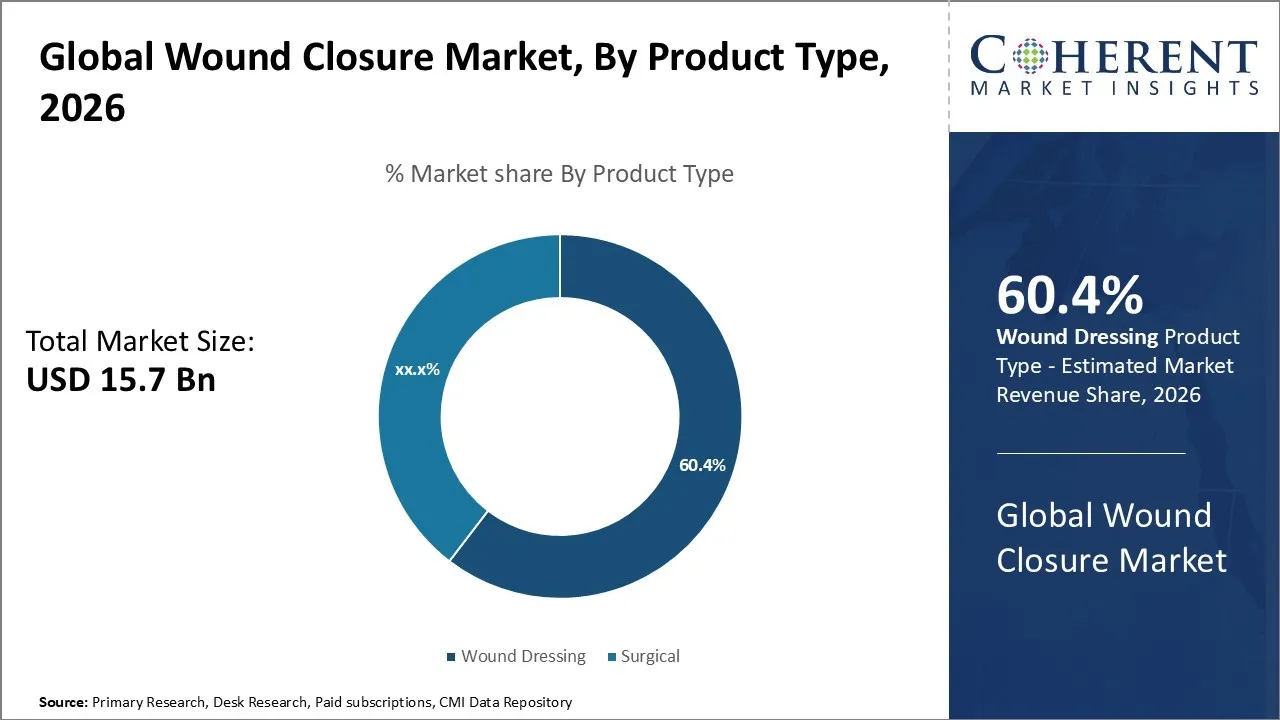
- By Product Type, Wound Dressings hold the largest market share of 60.4% in 2026 owing to the growing prevalence of chronic wounds.
- By Application, Ulcer expected to hold the largest market share of 45.6% in 2026 owing to its rising prevalence of chronic ulcer-forming conditions.
- By End User, Hospitals acquired the prominent market share of 37.6% in 2026 owing to the trauma and emergency care needs.
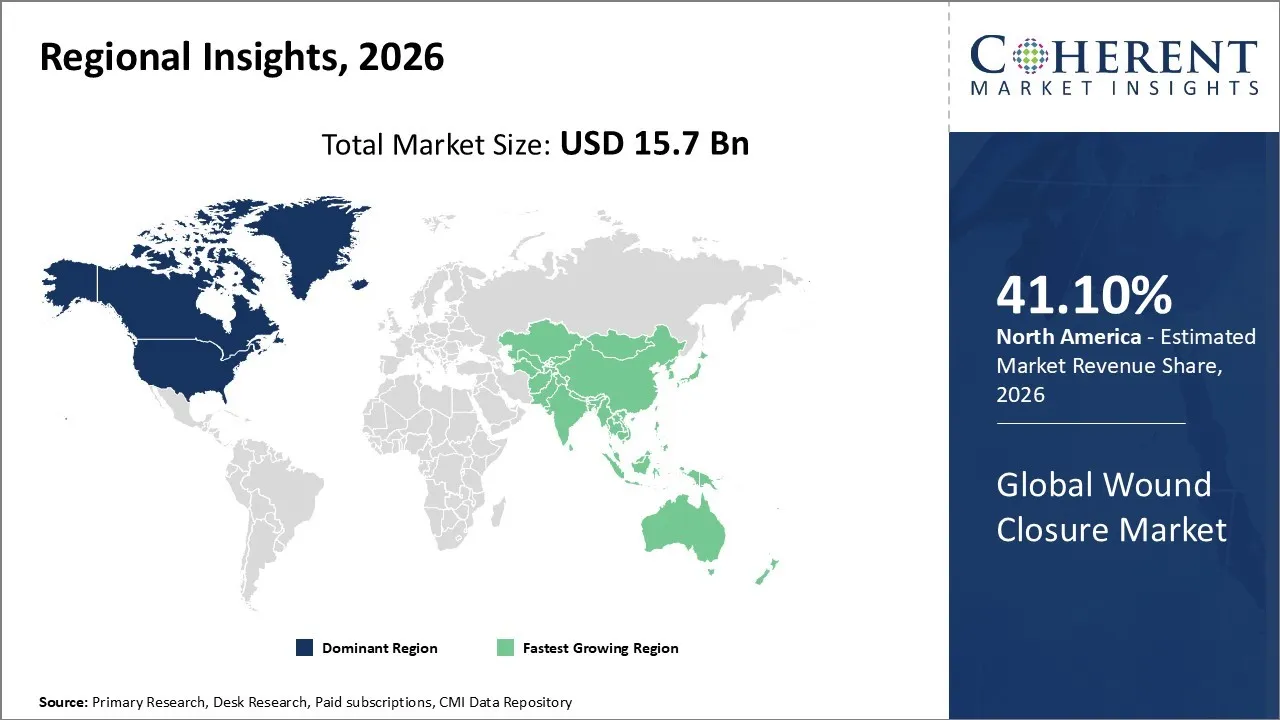
- By Region, North America dominates the overall market with an estimated share of 41.10% in 2026 owing to the high volume of surgical procedures.
Market Overview
The wound closure market delivers products such as sutures, staples, adhesives, and sealants to close surgical and traumatic wounds. Rising surgical procedures, increasing trauma incidents, and the growing prevalence of chronic wounds associated with aging populations and diabetes are driving market demand. Advances in technology, including absorbable materials and tissue adhesives, are enhancing healing outcomes. Hospitals generate strong demand, while expanding healthcare infrastructure and continuous innovation by medical device companies actively influence the global market landscape.
Current Events and Its Impact on the Wound Closure Market
Current Events | Description and its impact |
Geopolitical and Regulatory Developments |
|
Technological Innovations and Advancements |
|
Competitive and Industry-Specific Dynamics |
|
Segmental Insights
- Current Industry Events of 2026
- Market Size Estimation
- Regional Breakdown
- Competitive Landscape
- Customer Intelligence
- Segmental Analysis
- Pricing Analysis
- Key Market Drivers, Challenges & Future Trends
- Customized Insights Section
Wound Closure Market Insights , By Product Type - Wound Dressings contribute the highest share of the market owing to its rising awareness of infection prevention
Wound Dressings hold the largest market share of 60.4% in 2026. Wound dressings support the wound closure market by enabling effective treatment of acute and chronic wounds. The increasing prevalence of diabetic ulcers, pressure injuries, and post-surgical wounds drives demand for continuous and reliable care solutions. Healthcare providers emphasize infection prevention, quicker healing, and improved patient comfort, which encourages the use of advanced dressings. The growing adoption of home healthcare and rising clinical awareness further strengthen demand for modern wound dressing products. For instance, in November 2025, the Department of Atomic Energy (DAE), in collaboration with Cologenesis Pvt. Ltd., announced the commercial launch of ColoNoX, an advanced nitric oxide-releasing wound dressing designed to meet India’s growing need for effective diabetic foot ulcer (DFU) treatment
Wound Closure Market Insights , By Application - Ulcer contribute the highest share of the market owing to its increased adoption of advanced wound care technologies
Ulcer expected to hold the largest market share of 45.6% in 2026. Ulcers contribute significantly to the wound closure market as healthcare providers manage an increasing volume of complex, slow-healing wounds that require specialized care. Diabetes, circulatory disorders, and long periods of immobility raise the incidence of foot, venous, and pressure ulcers. Clinicians rely on advanced wound closure techniques to reduce complications and promote tissue regeneration. Better diagnostic capabilities, earlier treatment approaches, and improved access to advanced wound care products further drive demand for ulcer-specific wound closure solutions. For instance, in January 2025, BioStem Technologies launched the BR-AM-DFU clinical trial to evaluate Vendaje® for treating non-healing diabetic foot ulcers, comparing standard care with and without Vendaje to demonstrate its superiority in advanced wound care.
Wound Closure Market Insights , By End User - Hospitals contribute the highest share of the market owing to its access to advanced infrastructure and skilled professionals
Hospitals acquired the prominent market share of 37.6% in 2026. Hospitals drive the wound closure market by performing most surgical procedures, managing trauma cases, and treating complex wounds. The large patient load and varied clinical needs prompt clinicians to use advanced closure products like sutures, staples, and tissue adhesives. Equipped with modern infrastructure and skilled surgical teams, hospitals actively focus on minimizing post-operative complications, which increases product adoption. Favorable reimbursement policies and streamlined procurement practices further enable hospitals to maintain strong demand for innovative wound closure solutions. For instance, in November 2025, Xtant Medical Holdings, Inc. launched CollagenX™, a bovine collagen particulate product for surgical wound closure designed to promote healing, prevent dehiscence, and reduce the risk of surgical site infections.
Regional Insights
North America Wound Closure Market Trends
North America dominates the overall market with an estimated share of 41.10% in 2026. The North America wound closure market grows as healthcare providers emphasize advanced surgical care and adopt innovative closure technologies. Hospitals and surgical centers actively implement bioresorbable sutures, tissue adhesives, and minimally invasive closure systems to enhance patient outcomes. Increasing chronic wound cases and an aging population drive the need for effective solutions. Strong healthcare infrastructure, ongoing research and development by leading medical device companies, and favorable reimbursement policies further accelerate the widespread use of modern wound closure products across the region. For instance, Krystal Biotech announced FDA approval of VYJUVEK™ for treating patients aged six months and older with dystrophic epidermolysis bullosa, delivering functional COL7A1 genes to promote wound healing and sustained COL7 protein expression.
Asia Pacific Wound Closure Market Trends
The Asia Pacific wound closure market expands as hospitals and clinics actively adopt advanced surgical and trauma care solutions. Increasing awareness of post-surgical wound management, the rising prevalence of chronic diseases, and a large patient population drive demand for effective closure products. Governments enhance medical services through supportive initiatives, while global and local medical device manufacturers invest in introducing innovative sutures, staples, and tissue adhesives. Together, these efforts accelerate the adoption of modern wound closure technologies across the region. For instance, in November 2025, Pantai Hospital Kuala Lumpur launched an integrated diabetic and wound care service using a nursing-led model that delivers structured recovery support, targeted interventions, and patient education to promote healing and prevent complications.
United States Wound Closure Market Trends
The United States wound closure market grows as hospitals and surgical centers actively prioritize efficient, safe, and minimally invasive closure solutions. Healthcare providers increasingly use advanced sutures, tissue adhesives, and hemostatic products to improve surgical outcomes and reduce post-operative complications. Rising chronic wound cases and an aging population drive the need for effective wound management. Robust healthcare infrastructure, extensive clinical research, and supportive reimbursement policies further promote the adoption of innovative wound closure technologies across medical facilities nationwide.
China Wound Closure Market Trends
The China wound closure market grows as hospitals and specialty clinics actively adopt advanced surgical and trauma care solutions to address increasing patient needs. Healthcare providers respond to rising awareness of post-surgical wound management, a growing prevalence of chronic conditions, and a large patient population by using effective closure products. Government efforts to modernize healthcare infrastructure, along with increased investments from domestic and international medical device companies, drive the introduction of innovative sutures, staples, and tissue adhesives, accelerating the nationwide adoption of modern wound closure technologies. For instance, ZipLine Medical received Chinese FDA approval and launched its Zip surgical skin closure device in China, offering a low-cost, non-invasive alternative to sutures and staples that helps reduce surgical site infections.
End-user Feedback and Unmet Needs in the Wound Closure Market
- Demand for Faster Healing Solutions: Clinicians report the need for wound closure products that accelerate healing while minimizing complications. Patients and surgeons seek materials that reduce recovery time and support tissue regeneration, particularly for chronic wounds or post-surgical incisions. Existing products sometimes fall short in combining speed, safety, and patient comfort.
- Enhanced Infection Control: Healthcare providers emphasize stronger infection prevention in closure products. End-users note that while antimicrobial sutures and adhesives exist, there is demand for broader-spectrum, easy-to-use solutions that lower infection risk without increasing treatment complexity or cost, particularly in high-risk surgical or chronic wound cases.
- Improved Patient Comfort and Usability: Patients and caregivers highlight the need for closure solutions that reduce pain, minimize dressing changes, and are easy to apply, especially in home care or outpatient settings. Products that combine effectiveness with user-friendly design remain limited, leaving room for innovations that improve compliance and overall experience.
Wound Closure Market Trend
Shift Toward Advanced Closure Technologies
Healthcare providers increasingly adopt advanced wound closure solutions, including bioresorbable sutures, tissue adhesives, and hemostatic agents. These technologies reduce post-surgical complications, support faster healing, and improve cosmetic outcomes. The trend reflects a focus on minimizing patient recovery time and enhancing clinical efficiency, particularly in complex surgeries. Hospitals and outpatient centers prioritize products that combine safety, durability, and ease of use, encouraging manufacturers to innovate beyond traditional sutures and staples.
Growing Adoption in Minimally Invasive Surgeries
The rise of minimally invasive and laparoscopic surgeries drives demand for specialized closure devices designed for smaller incisions and precise tissue handling. Surgeons require solutions that provide secure closure while maintaining minimal scarring and reducing infection risks. This trend pushes the development of innovative adhesives, micro-sutures, and stapling systems that meet the unique requirements of minimally invasive procedures, increasing overall efficiency and patient satisfaction in modern surgical practices.
Market Report Scope
Wound Closure Market Report Coverage
| Report Coverage | Details | ||
|---|---|---|---|
| Base Year: | 2025 | Market Size in 2026: | USD 15.7 Bn |
| Historical Data for: | 2020 To 2024 | Forecast Period: | 2026 To 2033 |
| Forecast Period 2026 to 2033 CAGR: | 7.2% | 2033 Value Projection: | USD 23.65 Bn |
| Geographies covered: |
| ||
| Segments covered: |
| ||
| Companies covered: | 3M, Smith & Nephew plc, Johnson & Johnson, B. Braun Melsungen AG, Convatec Group PLC, Integra LifeSciences, Medtronic, Mölnlycke Health Care AB, Cardinal Health, and Stryker. | ||
| Growth Drivers: |
| ||
| Restraints & Challenges: |
| ||
Wound Closure Market News
- In November 2025, A research team developed a lignin-based hydrogel that uses lignin’s natural properties to enable controlled drug release and improve wound healing for biomedical applications.
- In April 2025, Joseph’s Health opened an outpatient Center for Wound Healing and Hyperbarics to treat patients with chronic or non-healing wounds, combining traditional and advanced therapies to support the healing process.
Analyst Opinion (Expert Opinion)
- The wound closure market is distinctly shaped by clinical necessity and technological evolution, rather than mere product demand. Adoption patterns make clear that advanced solutions such as bioabsorbable sutures, tissue adhesives, and minimally invasive staples are no longer optional, they are integral to modern surgical protocols. For example, over 80 % of hospitals globally are integrating automated closure systems to reduce healing times and improve outcomes, while adhesive‑based solutions have seen adoption increases of around 60 % due to enhanced patient comfort and reduced scarring compared with traditional sutures.
- However, the transition to these sophisticated technologies exposes a fundamental market tension. Advanced devices often carry premium pricing that can be three to five times higher than traditional methods, constraining uptake in cost‑sensitive regions and smaller healthcare facilities where budget priorities differ. In addition, persistent clinical challenges notably surgical site infections and post‑closure complications continue to demand innovations that not only close wounds but also proactively prevent adverse outcomes, a need underscored by clinical data linking surgical site infections to a significant proportion of hospital readmissions.
- Strategically, this market is driven by evidence‑driven performance and value demonstration. Where tissue adhesives have demonstrably reduced procedure times and improved cosmetic results, their uptake has outpaced that of some longstanding closure methods. Conversely, regulatory complexity and reimbursement inconsistency create a high barrier to entry for truly innovative technologies, often delaying clinician access to promising advances.
Speak to the analyst
Want personalized insights?
Take the findings above to one of our principal consultants, or have the report rebuilt around the segments, geographies and competitors you actually track.
Market Segmentation
- By Product Type
- Wound Dressings
- Foam Dressings
- Hydrocolloid Dressings
- Film Dressings
- Alginate Dressings
- Hydrogel Dressings
- Collagen Dressings
- Other Dressings)
- Surgical
- Sutures
- Absorbable Sutures
- Non-Absorbable Sutures
- Sutures
- Staples
- Tissue Adhesive
- Sealant & Glues
- Hemostats
- Traditional/ Basic Wound Closure Products
- Wound Dressings
- By Application
- Ulcer
- Diabetic Ulcers
- Venous Leg Ulcer
- Pressure Ulcers
- Acute & Sub-acute Ulcers
- Arterial Ulcers
- Surgical Wounds
- General Surgery Wounds
- Oncology Surgery Wounds
- Urology Surgery Wounds
- Cardiovascular Surgery Wounds
- Obstetrics & Gynecology Surgery Wounds
- Neuro & Spine Surgery Wounds
- ENT Surgery Wounds
- Orthopedic Surgery Wounds
- Plastic
- Cosmetics & Reconstruction Surgery Wounds
- Burn Injuries
- Other Applications
- Ulcer
- By End User
- Hospitals
- Long-term Care Settings
- Home Care Settings
- other end users
- By Regional Insights
- North America
- U.S.
- Canada
- Latin America
- Brazil
- Argentina
- Mexico
- Rest of Latin America
- Europe
- Germany
- U.K.
- Spain
- France
- Italy
- Russia
- Rest of Europe
- Asia Pacific
- China
- India
- Japan
- Australia
- South Korea
- ASEAN
- Rest of Asia Pacific
- Middle East
- GCC Countries
- Israel
- Rest of Middle East
- Africa
- South Africa
- North Africa
- Central Africa
- North America
- Key Players Insights
- 3M
- Smith & Nephew plc
- Johnson & Johnson
- Braun Melsungen AG
- Convatec Group PLC
- Integra LifeSciences
- Medtronic
- Mölnlycke Health Care AB
- Cardinal Health
- Stryker
Sources
Primary Research interviews
- Interviews with surgeons, dermatologists, and wound care specialists
- Discussions with hospital procurement managers and nurses
- Conversations with medical device distributors and wholesalers
Databases
- PubMed
- ClinicalTrials.gov
- FDA medical device database
- WHO Global Health Observatory
Magazines
- Modern Healthcare
- MedTech Outlook
- Wound Care Advisor
- Hospital & Health System Administration
Journals
- Journal of Wound Care
- International Wound Journal
- Advances in Skin & Wound Care
- Wound Repair and Regeneration
Newspapers
- The New York Times – Health Section
- The Guardian – Healthcare Section
- The Wall Street Journal – Health & Medicine
- Local health-related newspapers for market trends
Associations
- Wound Healing Society (WHS)
- European Wound Management Association (EWMA)
- American Professional Wound Care Association (APWCA)
- Association for the Advancement of Wound Care (AAWC)
Public Domain sources
- WHO reports and publications
- CDC reports and statistics
- Government healthcare ministry publications
- National health data repositories
Proprietary Elements
- CMI Data Analytics Tool
- Proprietary CMI Existing Repository of information for last 8 years
Get access to 250+ pages report
Every segment, forecast, competitor profile and data table behind the analysis above — available for instant download.
- ESOMAR Member
- ISO 9001:2015 Certified
- D-U-N-S Registered
- GDPR & CCPA Compliant
Missing comfort of reading report in your local language? Find your preferred language:
Transform your Strategy with Exclusive Trending Reports
Frequently Asked Questions
The Wound Closure Market is estimated to be valued at USD 15.7 Bn in 2026 and is expected to reach USD 23.65 Bn by 2033.
Factors such as increasing prevalence of surgeries, increasing prevalence of diabetes and diabetes associated ulcers and introduction of new advanced technology in wound closure treatment are expected to drive the market growth.
Wound Dressings is the leading product type segment in the market
The major factor hampering growth of the market include infections caused due to wound closure devices and product recalls
Major players operating in the market include 3M, Smith & Nephew plc, Johnson & Johnson, B. Braun Melsungen AG, Convatec Group PLC, Integra LifeSciences, Medtronic, Mölnlycke Health Care AB, Cardinal Health, and Stryker