

Australia Lime Market Size and Share Analysis - 2026 to 2033
The Australia lime market was valued at USD 325.6 Bn in 2026 and is forecast to reach a value of USD 371.6 Bn by 2033 at a CAGR of 2.1% between 2026 and 2033.
Key Takeaways
- Based on Product Type, the aglime (agricultural lime) segment is expected to lead the market with 47.3% share in 2026.
- Based on Application Type, the mining & metallurgy segment is expected to hold 41.2% share of the market in 2026.
Market Overview
Lime is an inorganic mineral derived from Limestone. Its chemical name is Calcium Hydroxide (CaOH). Lime is used in building and construction materials abundantly as well as used in various industries such as agriculture, water treatment plants, steel manufacturing industry, metallurgical industry, and others.
Limestone such as quicklime and hydrated lime. Lime finds application in building and engineering materials such as limestone products, concrete, cement, and mortar. Lime is also used in wastewater treatment with ferrous sulfate. Moreover, it is also used across industrial applications such as the food industry, construction, and steel industry. Furthermore, lime also finds application in the agriculture sector and is highly important for the production of sugar.
Current Events and their Impacts on the Australia Lime Market
Current Event | Description and its Impact |
Climate Change and Weather Extremes |
|
Rising Input Costs and Inflation |
|
How is lime production distributed across Australian regions & top companies in 2026?
Region-wise Production
Region | Estimated Quantity (tonnes/year) | Key Notes |
Western Australia (WA) | ~2.5–3.0 million t | Largest producer/consumer; mining-driven demand (gold, nickel, copper). |
South Australia (SA) | ~1.2–1.5 million t | Expanding green lime & cement projects (Hallett Group). |
Victoria (VIC) | ~0.9–1.1 million t | Strong ag-lime demand in cropping regions. |
New South Wales (NSW) | ~0.6–0.8 million t | Agriculture and construction use. |
Queensland (QLD) | ~0.3–0.5 million t | Mining and farming applications. |
Rest of Australia (TAS, NT, ACT) | ~0.2–0.3 million t | Smaller-scale, mostly agricultural lime. |
Company-wise Production
Company / Group | Estimated Quantity (tonnes/year) | Focus Area |
Adbri Limited | ~2.0–2.5 million t | Major supplier for mining & construction. |
Graymont | ~1.0–1.2 million t | Industrial lime, WA & VIC operations. |
Hallett Group | ~1.0 million t (projected) | Green cement & lime in SA. |
Pacific Lime & Cement (PLC) | ~0.5–0.7 million t | Imports via WA (Esperance) + PNG project supply. |
Sibelco Australia | ~0.4–0.6 million t | Agricultural lime for VIC & NSW. |
Regional producers | ~0.3–0.5 million t | Local ag-lime and construction supply. |
- Current Industry Events of 2026
- Market Size Estimation
- Regional Breakdown
- Competitive Landscape
- Customer Intelligence
- Segmental Analysis
- Pricing Analysis
- Key Market Drivers, Challenges & Future Trends
- Customized Insights Section
Segmental Insights
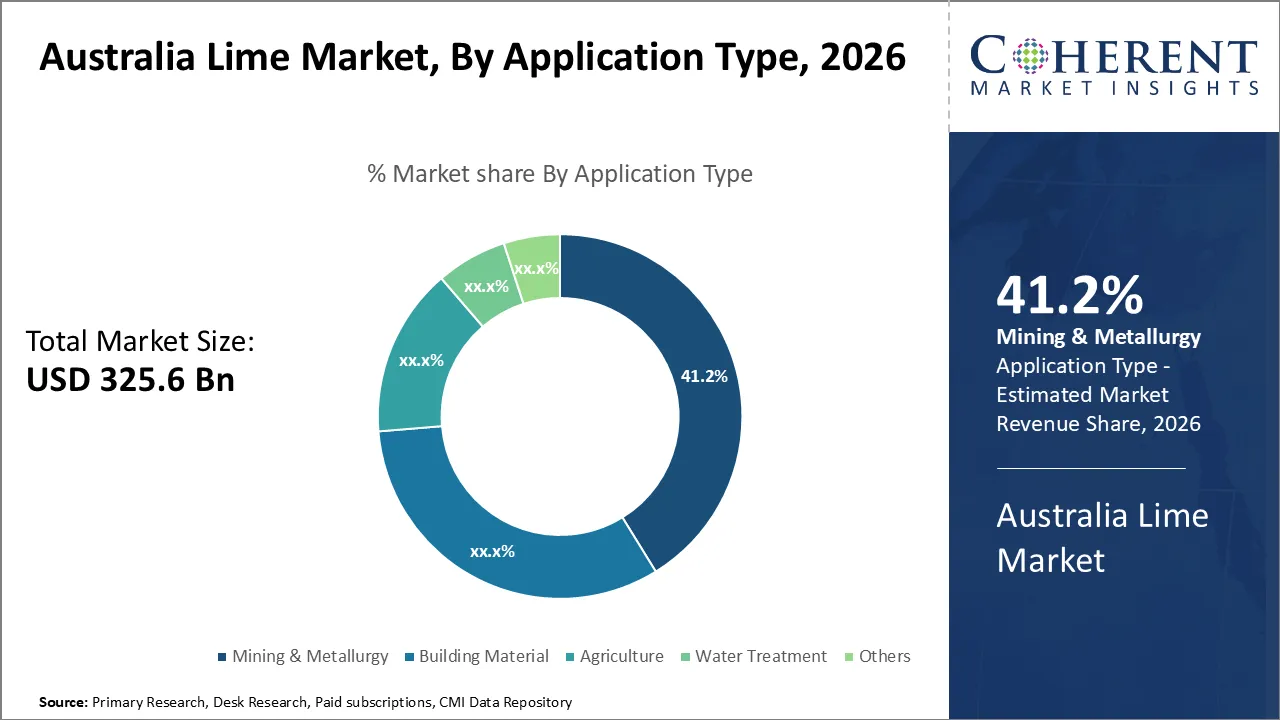
Australia Lime Market Insights, By Application type: Mining and metallurgy lead is fueled by Australia’s extensive mineral processing industry
In terms of application type, the mining & metallurgy segment is expected to hold 41.2% share of the market in 2026. Lime is essential for mineral processing, refining, and smelting, which is in line with Australia's mining industry, that is important around the world. This sector is the most prominent and largest because it depends on lime for efficiency and environmental compliance.
Australia Lime Market Insights, By Product Type: agricultural lime dominance is driven by soil conditioning and farming demand
In terms of product type, the aglime (agricultural lime) segment is expected to lead the market with 47.3% share in 2026. It is the most popular choice as it is widely used to neutralize acidic soils, increase crop yields, and support sustainable farming practices. Strong agricultural activity makes sure that consistent consumption of Aglime, making it the most influential product category.
For instance, in December 2025, in Australia, with low rain regions, surface liming works best for controlling soil acidity. Research shows that it works better than shallow incorporation to increase crop yields. This shows the importance of agricultural lime for sustainable farming and long-term productivity in difficult weather.
Australia Lime Market Outlook Country-Wise
Sydney Lime Market Trends
Sydney's requirement for lime is growing in 2026 because it is crucial for refining alumina, treating water, and industrial manufacturing. Stricter environmental rules, more infrastructure, and updating pulp and paper plants are all reasons for the steady consumption. these factors make Sydney a key center for the growth of the Australia lime market.
For instance, in April 2025, Graymont stated it would make a big investment in lime production in Victoria, Australia. The project increases the amount of goods available to meet rising demand in the mining, construction, agriculture, and environmental sectors. This strategic move strengthens support for the industry in the region, makes it more sustainable, and strengthens Graymont's position as a major lime producer in the Asia-Pacific market.
Western Australia Lime Market Trends
In 2026, Western Australia has a strong demand for lime because it is the main place where alumina is refined, and lime is needed to process bauxite. Consistent demand is driven by the growth of mining operations, infrastructure, and stricter environmental rules. These things make Western Australia a key place for the growth of the Australia lime market.
For instance, in January 2026, new investments at the Port of Esperance in Western Australia have increased trade, such as Pacific Lime and Cement's import of more than 10,400 tons of quicklime. This helps mineral processing in the Goldfields-Esperance area and makes supply chains stronger while the company builds up its lime business in Papua New Guinea.
Market Report Scope
Australia Lime Market Report Coverage
| Report Coverage | Details | ||
|---|---|---|---|
| Base Year: | 2025 | Market Size in 2026: | USD 325.6 Bn |
| Historical Data for: | 2020 To 2024 | Forecast Period: | 2026 To 2033 |
| Forecast Period 2026 to 2033 CAGR: | 2.1% | 2033 Value Projection: | USD 371.6 Bn |
| Geographies covered: |
| ||
| Segments covered: |
| ||
| Companies covered: | Adelaide Brighton Ltd, Boral Ltd., Sibelco Australia, Omya Australia Pty Ltd, Wagners, and Lime Group Australia | ||
| Growth Drivers: |
| ||
| Restraints & Challenges: |
| ||
Australia Lime Market Driver
Alumina Refining Industry
Australia is one of the largest alumina producers globally, and caustic soda plays a vital role in the Bayer process used to refine bauxite into alumina. The continuous expansion of alumina refining facilities ensures strong consumption of NaOH, making this sector the dominant driver of growth. Rising alumina output directly boosts Australia Lime Market demand, as producers require consistent and large-scale supplies of caustic soda to maintain efficiency and meet global export commitments.
Domestic Production & Supply Chain Stability
Australia is investing heavily in local caustic soda production capacity and infrastructure upgrades to reduce reliance on imports. These initiatives strengthen resilience against global supply chain disruptions and energy-linked volatility. By enhancing domestic availability, producers can secure long-term contracts with key industries such as alumina, pulp and paper, and water treatment. This stability improves competitiveness and increases Australia Lime Market share, positioning local suppliers as reliable partners in both domestic and international markets.
Australia Lime Market Opportunity
Water Treatment & Environmental Applications
Australia's municipal and industrial water treatment sectors have noticed a strong growth in the use of caustic soda because of stricter environmental rules and greater investments on clean water infrastructure. NaOH is a common chemical that is used to neutralize acidity, get rid of heavy metals, and make water better overall. It is necessary for sustainable operations.
As Australia focuses on protecting the environment and providing clean water, this industry will continue to grow in demand, even beyond alumina refining. These changes make diversification stronger and fit with the Australia Lime Market forecast, which shows long-term stability and growth.
Analyst Opinion (Expert Opinion)
The Australian lime market has a multi-faceted landscape, with both industrial lime products and fresh lime fruit segments that shows distinct dynamics. There are accumulations of limestone in places like Queensland, which is where majority of the country's industrial lime comes from. Industrial lime has many uses, including in farming, stabilizing soil, treating water, and metallurgy. Recent industry data show that the market is holding steady at about 2 million metric tons, with steady demand coming from construction and mining. Queensland is a big player, but the Northern Territory is also getting more involved because of the needs of the infrastructure and resource sectors.
Trade flows show that Australia is a net importer of fresh limes. Imports from nearby suppliers help make them available all year round. Compared to other fruits, lime fruit exports are still low, which shows that this market is mostly focused on the US.
The Australia lime market is stable overall, with industrial demand staying steady and fresh consumption growing. This is due to a wide range of uses, strong regional production, and connections to other agricultural and infrastructure sectors.
Speak to the analyst
Want personalized insights?
Take the findings above to one of our principal consultants, or have the report rebuilt around the segments, geographies and competitors you actually track.
Recent Developments
- In January 2026, the South Australian Government is offering Hallett Group a USD 12 million loan to help pay for the USD 200 million Green Cement Transformation Project in Port Augusta. The project will turn industrial waste into low-carbon cement, create jobs, and look into ways to make green lime, which will help South Australia's renewable and sustainable industries grow.
- In July 2025, Pacific Lime and Cement Limited started marketing quicklime in Western Australia. The new business will help meet the needs of the construction, mining, and environmental sectors in the region by increasing the supply of goods for industrial use. This strategic move makes the company stronger in the Asia-Pacific lime market and helps the local industry stay strong.
Market Segmentation
- By Product Type
- Aglime (Agricultural Lime)
- Quick Lime
- Hydrated Lime
- By Application Type
- Mining & Metallurgy
- Building Material
- Agriculture
- Water Treatment
- Others
- By Region
- New South Wales
- Victoria
- Western Australia
- Queensland
- Rest of Australia
- Key Players
- Adelaide Brighton Ltd
- Boral Ltd.
- Sibelco Australia
- Omya Australia Pty Ltd
- Wagners
- Lime Group Australia
Sources
Primary Research Interviews
- Lime Manufacturers (Quicklime & Hydrated Lime Producers)
- Cement & Construction Material Companies
- Mining & Metallurgical Processing Companies
- Water & Wastewater Treatment Operators
- Sugar & Chemical Processing Companies
- Environmental & Flue Gas Treatment Engineers
- Lime Kiln Equipment Suppliers
- Distributors & Bulk Material Suppliers
- Others
Databases
- Bloomberg Terminal
- Refinitiv Eikon
- Fitch Solutions
- Others
Magazines
- Australian Mining Magazine
- Global Cement Magazine
- Chemical Engineering Magazine
- Mining Magazine
- World Cement
- Others
Journals
- Cement and Concrete Research
- Construction and Building Materials
- Minerals Engineering
- Hydrometallurgy
- Journal of Environmental Chemical Engineering
- Others
Newspapers
- The Australian
- Australian Financial Review
- Reuters
- Bloomberg News
- The Sydney Morning Herald
- Others
Associations
- Cement Concrete & Aggregates Australia (CCAA)
- Australasian Institute of Mining and Metallurgy (AusIMM)
- Australian Water Association
- Minerals Council of Australia
- Australian Industry Group
- Others
Public Domain Sources
- Australian Bureau of Statistics (ABS)
- Geoscience Australia
- Department of Climate Change, Energy, the Environment and Water
- Australian Government Department of Industry, Science and Resources
- World Bank Open Data
- Others
Proprietary Elements
- CMI Data Analytics Tool
- Proprietary CMI Existing Repository of Information for the Last 8 Years
- CMI Industry Expert Validation Framework
- CMI Supply–Demand Modeling Dashboard
Get access to 250+ pages report
Every segment, forecast, competitor profile and data table behind the analysis above — available for instant download.
- ESOMAR Member
- ISO 9001:2015 Certified
- D-U-N-S Registered
- GDPR & CCPA Compliant
Missing comfort of reading report in your local language? Find your preferred language:
Transform your Strategy with Exclusive Trending Reports
Frequently Asked Questions
The global Australia Lime Market size was valued at USD 325.6 Bn in 2026 and is expected to reach USD 371.6 Bn in 2033.
The alumina refining industry and domestic production & supply chain stability are expected to drive growth of the Market.
Among application type, Mining & Metallurgy segment held the largest market share among the product type.
Key players operating in the market include Adelaide Brighton Ltd, Boral Ltd., Sibelco Australia, Omya Australia Pty Ltd, Wagners, and Lime Group Australia