

Automated Breast Ultrasound Systems Market Analysis & Forecast: 2026-2033
Automated breast ultrasound systems market is estimated to be valued at USD 1.03 Bn in 2026 and is expected to reach USD 2.17 Bn in 2033, exhibiting a compound annual growth rate (CAGR) of 11.1% from 2026 to 2033.
Key Takeaways
- Based on Product Type, the automated breast ultrasound systems segment is expected to hold 62.3% share in 2026.
- Based on Application, the Hospital segment is expected to lead the market with 54.7% share in 2026.
- Based on Region, North America is set to lead the automated breast ultrasound systems market with 38.6% share in 2026. While, Asia Pacific is anticipated to be the fastest growing region.
Market Overview
Ultrasound uses high-frequency sound waves to assess organs and structures inside the body. The approach does not involve exposure to radiation. In automated breast ultrasound, a transducer that scans the whole breast is used to obtain ultrasound images in three dimensions (3D) for cancer detection.
Current Events and Its impacts on the Automated Breast Ultrasound Systems Market
Current Event | Description and its Impact |
Global Healthcare Technology Investment and AI Integration |
|
Aging Demographics and Breast Cancer Screening Policy Changes |
|
Is the high cost of ABUS systems slowing adoption in emerging markets despite rising global demand?
Region | Average ABUS Cost | Adoption Impact | Key Insights |
North America | USD 120K–150K | Moderate – offset by insurance and dense breast mandates | U.S. has reimbursement codes; ABUS adoption is growing in outpatient centers |
Western Europe | USD 110K–140K | Low to Moderate – supported by public screening programs | Germany and France integrate ABUS into national dense breast screening efforts |
Eastern Europe | USD 100K–130K | High – limited funding and infrastructure | Adoption limited to urban hospitals and private clinics |
Asia-Pacific | USD 90K–130K | High – cost-sensitive markets like India, Indonesia, and Vietnam | China and Japan show growth; India faces rural access and training challenges |
Middle East | USD 100K–140K | Moderate – adoption in UAE, Saudi Arabia; limited elsewhere | UAE leads with AI-integrated ABUS in public hospitals |
Latin America | USD 95K–125K | High – constrained by reimbursement and public health budgets | Brazil and Mexico show early adoption in private diagnostic chains |
Africa | USD 90K–120K | Very High – minimal adoption due to cost and lack of trained personnel | ABUS presence mostly limited to pilot programs and donor-funded initiatives |
- Current Industry Events of 2026
- Market Size Estimation
- Regional Breakdown
- Competitive Landscape
- Customer Intelligence
- Segmental Analysis
- Pricing Analysis
- Key Market Drivers, Challenges & Future Trends
- Customized Insights Section
Segmental Insights
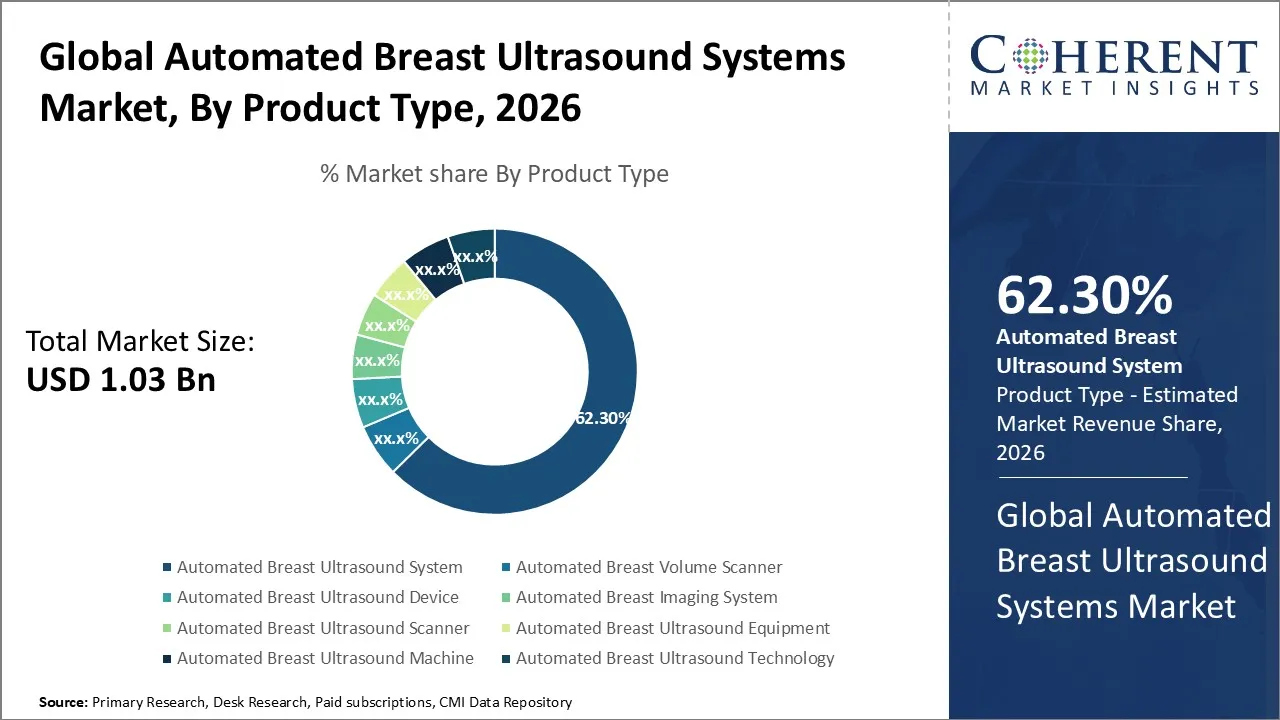
Why Automated Breast Ultrasound Systems (ABUS) lead the product segment in 2026, and what makes them more effective than other imaging types?
In terms of product type, the automated breast ultrasound systems segment is expected to lead the market with 62.3% share in 2026, due to their ability to detect cancer in dense breast tissue without radiation. Their automated, operator-independent imaging ensures consistency and efficiency. Regulatory approvals, especially in the U.S., and integration into routine screening programs have made ABUS the preferred choice for early detection.
For instance, in January 2026, iSono Health’s ATUSA launched as a wearable, automated, and portable breast ultrasound platform with FDA clearance. Designed for early cancer detection, it enables hands-free, operator-independent imaging. This innovation expands access to breast screening, especially in remote settings, and marks a major advancement in the ABUS market landscape.
What advantages position hospitals as the top end-users of ABUS in 2026 over other healthcare settings?
In terms of application, the hospitals segment is expected to hold 54.7% share in 2026, driven by high patient throughput, advanced diagnostic infrastructure, and integration with oncology services. Their ability to support large-scale screening and provide comprehensive care pathways makes them ideal for deploying ABUS technology, especially in regions with established breast cancer awareness and reimbursement frameworks.
For instance, in March 2025, GE HealthCare’s Invenia ABUS™ Premium is an AI-powered, patient-friendly automated breast ultrasound system designed for hospitals. It enhances early breast cancer detection in dense breast tissue by accelerating scan times and improving diagnostic accuracy. The system integrates seamlessly into clinical workflows, supporting radiologists with advanced imaging and interpretation tools.
Regional Insights
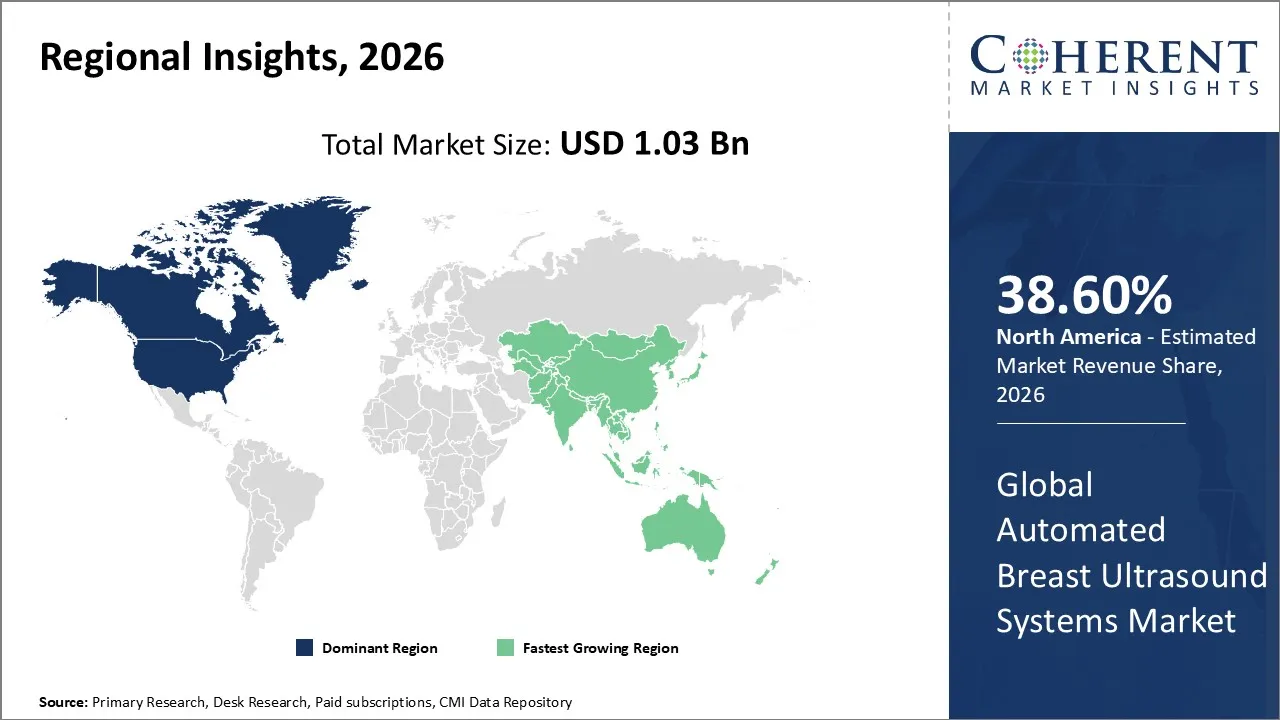
North America Automated Breast Ultrasound Systems Market Analysis & Trends
North America is expected to dominate the automated breast ultrasound market with 38.6% share in 2026, due to high breast cancer prevalence, widespread screening programs, and early FDA approvals of ABUS technologies. Strong healthcare infrastructure, insurance coverage, and awareness campaigns further drive adoption, especially in hospitals and imaging centers focused on dense breast tissue diagnostics and early cancer detection.
For instance, in May 2025, Kootenai Health opened women’s imaging centers in Coeur d’Alene and Post Falls, Idaho, offering 3D mammography, breast ultrasound, biopsies, and MRI. These centers aim to enhance access to comprehensive breast health services, improve early cancer detection, and provide advanced diagnostic care for women across northern Idaho communities.
Asia Pacific Automated Breast Ultrasound Systems Market Analysis & Trends
Asia Pacific is expected to be exhibit the fastest growth, due to rising breast cancer rates, growing awareness, and expanding healthcare infrastructure. Government-led screening initiatives, increasing adoption of advanced diagnostics, and urbanization boost market growth. Portable and cost-effective ABUS solutions also support access in rural areas, accelerating adoption across diverse healthcare settings.
Automated Breast Ultrasound Systems Market Outlook Country-Wise
The U.S. Automated Breast Ultrasound Systems Market Trends
In 2026, the U.S. ABUS market grows due to rising breast cancer rates, dense breast screening mandates, FDA-cleared technologies, and insurance reimbursements. Public awareness, AI integration, and demand for radiation-free, early detection tools drive adoption in hospitals and imaging centers, enhancing diagnostic accuracy and workflow efficiency nationwide.
For instance, in July 2025, Researchers at the University at Buffalo developed OneTouch-PAT, a pain-free, automated breast imaging system combining ultrasound and photoacoustic technology. It delivers fast, high-resolution 3D scans without compression. Enhanced by AI, it detects cancer-related vascular patterns, offering a promising alternative for dense breast screening and early breast cancer detection.
China Automated Breast Ultrasound Systems Market Trends
In 2026, China’s ABUS market grows due to rising breast cancer rates, dense breast prevalence, and expanding healthcare access. Government screening programs, AI integration, and demand for radiation-free diagnostics drive adoption. Urbanization and investments in women’s health further boost ABUS deployment in hospitals and imaging centers across the country.
Market Report Scope
Automated Breast Ultrasound Systems Market Report Coverage
| Report Coverage | Details | ||
|---|---|---|---|
| Base Year: | 2025 | Market Size in 2026: | USD 1.03 Bn |
| Historical Data for: | 2020 To 2024 | Forecast Period: | 2026 To 2033 |
| Forecast Period 2026 to 2033 CAGR: | 11.1% | 2033 Value Projection: | USD 2.17 Bn |
| Geographies covered: |
| ||
| Segments covered: |
| ||
| Companies covered: | General Electric Co., Siemens AG, Hitachi Ltd., QT Ultrasound LLC, Ikonopedia, and SonoCiné Inc. | ||
| Growth Drivers: |
| ||
| Restraints & Challenges: |
| ||
Automated Breast Ultrasound Systems Market Driver
Rising Breast Cancer Incidence
The global rise in breast cancer cases, projected to surpass 3 million annually by 2040, is a major driver of the automated breast ultrasound systems market share. As early detection becomes critical, healthcare providers increasingly adopt ABUS for its ability to detect tumors in dense breast tissue without radiation. This trend is especially strong in countries with aging populations and expanding screening programs, where ABUS supports accurate, non-invasive diagnostics and improves outcomes through earlier intervention.
Dense Breast Tissue Awareness
Growing awareness about the limitations of mammography in women with dense breast tissue is significantly boosting automated breast ultrasound systems market demand. Dense tissue can obscure tumors on X-rays, making ABUS a preferred supplemental screening tool. With public health campaigns and legislation mandating dense breast notifications, more women are seeking alternative imaging options. ABUS offers a safe, radiation-free solution that enhances cancer detection rates, especially in younger women and those at higher risk, driving its global adoption.
Automated Breast Ultrasound Systems Market Opportunity
AI-Enhanced Diagnostic Accuracy
Integrating artificial intelligence with ABUS platforms significantly enhances diagnostic precision by improving lesion detection, minimizing false positives, and reducing radiologist workload. AI algorithms can rapidly analyze 3D breast ultrasound data, flagging suspicious areas for review and enabling faster, more consistent interpretations. This innovation is a key driver in the Automated Breast Ultrasound Systems Market forecast, as healthcare providers increasingly seek intelligent imaging solutions that improve outcomes and efficiency. Vendors offering AI-integrated ABUS are poised to lead the next wave of adoption.
In November 2025, Samsung, India’s leading consumer electronics brand, announced the launch of its super-premium, next-generation R20 ultrasound system for general imaging. The R20 marks a significant advancement in imaging performance, integrating advanced artificial intelligence, enhanced image clarity, and an ergonomic design optimized for clinician comfort and efficiency.
Portable and Cost-Effective ABUS Devices
The emergence of compact, mobile ABUS systems like iSono Health’s ATUSA is transforming breast cancer screening in underserved regions. These portable units eliminate the need for large infrastructure, making them ideal for rural clinics and mobile health programs. By expanding access to early detection, they address disparities in breast health services and fuel Automated Breast Ultrasound Systems Market growth. As affordability and portability improve, these innovations are expected to play a pivotal role in global market expansion.
Analyst Opinion (Expert Opinion)
- The Automated Breast Ultrasound System (ABUS) market value reflects significant momentum as healthcare providers expand advanced imaging capabilities for breast health diagnostics. ABUS technology is increasingly preferred for its ability to deliver standardized, high-resolution 3D breast imaging, providing greater consistency and reduced operator dependency compared with traditional handheld ultrasound methods. This transition toward automated imaging enhances diagnostic accuracy, particularly in women with dense breast tissue, where conventional mammography may have limitations.
- Market segmentation shows that ABUS systems account for the majority of advanced breast imaging deployments, particularly in hospital settings and diagnostic imaging centers where comprehensive screening workflows are critical. Integration of artificial intelligence for lesion detection and image analysis is becoming a defining trend, with a growing proportion of newer models incorporating machine learning capabilities to improve detection sensitivity and workflow efficiency.
- Regional patterns highlight North America as a leading adopter, supported by established screening programs, advanced healthcare infrastructure, and reimbursement frameworks that facilitate technology uptake. Europe and Asia-Pacific are also notable markets, with expanding diagnostic capacity and increasing emphasis on early detection driving ABUS deployment.
- Operational improvements such as reduced scan times and integration with digital image management systems are strengthening the clinical value proposition of ABUS technologies. As healthcare systems prioritize precision diagnostics and patient comfort, ABUS is gaining traction as a complementary imaging tool that enhances overall breast cancer screening strategies.
Speak to the analyst
Want personalized insights?
Take the findings above to one of our principal consultants, or have the report rebuilt around the segments, geographies and competitors you actually track.
Recent Developments
- In January 2026, Emirates Health Services launched the Middle East’s first 3D breast CT scanner in Sharjah, UAE. This advanced system offers fast, compression-free imaging with the lowest radiation dose in its class. Designed for early breast cancer detection, it enhances comfort and accuracy, especially for women with dense breast tissue.
- In August 2025, , QT Imaging secured a $33 million exclusive distribution deal with Gulf Medical to bring its automated breast imaging scanners to Saudi Arabia. The QT Imaging Breast Scanner offers radiation-free, 3D ultrasound imaging for dense breast tissue, enhancing early cancer detection and expanding access to advanced breast diagnostics across the Middle East.
Market Segmentation
- By Product Type
- Automated Breast Ultrasound System
- Automated Breast Volume Scanner
- Automated Breast Ultrasound Device
- Automated Breast Imaging System
- Automated Breast Ultrasound Scanner
- Automated Breast Ultrasound Equipment
- Automated Breast Ultrasound Machine
- Automated Breast Ultrasound Technology
- By Application
- Hospitals
- Radiologists
- Oncologists
- Breast Surgeons
- Gynecologists
- Breast Imaging Technologists
- Healthcare Providers
- Patients
- By Region
- North America
- U.S.
- Canada
- Latin America
- Brazil
- Argentina
- Mexico
- Rest of Latin America
- Europe
- Germany
- U.K.
- Spain
- France
- Italy
- Russia
- Rest of Europe
- Asia Pacific
- China
- India
- Japan
- Australia
- South Korea
- ASEAN
- Rest of Asia Pacific
- Middle East & Africa
- GCC Countries
- Israel
- Rest of Middle East & Africa
- North America
- Global Automated Breast Ultrasound System (ABUS) Market: Competitive Landscape
- General Electric Co.
- Siemens AG
- Hitachi Ltd.
- QT Ultrasound LLC
- Ikonopedia
- SonoCiné Inc
Sources
Primary Research Interviews
- ABUS System Manufacturers
- Medical Imaging Equipment OEMs
- Radiologists & Breast Imaging Specialists
- Hospital Radiology Department Heads
- Diagnostic Imaging Center Operators
- Healthcare Technology Consultants
- Regulatory & Clinical Affairs Experts
- Others
Databases
- Bloomberg Terminal
- Thomson Reuters Eikon
- Others
Magazines
- Radiology Today
- Diagnostic Imaging
- Healthcare Business News
- Medical Imaging International
- Hospital Management Magazine
- Others
Journals
- Radiology
- European Radiology
- American Journal of Roentgenology (AJR)
- Journal of Ultrasound in Medicine
- Breast Cancer Research and Treatment
- Ultrasound in Obstetrics & Gynecology
- Others
Newspapers
- The Wall Street Journal
- Financial Times
- Reuters
- Bloomberg News
- The New York Times – Health Section
- Others
Associations
- Radiological Society of North America (RSNA)
- American College of Radiology (ACR)
- European Society of Breast Imaging (EUSOBI)
- International Society of Ultrasound in Medicine and Biology (ISUOG)
- World Federation for Ultrasound in Medicine and Biology (WFUMB)
- Others
Public Domain Sources
- U.S. Food and Drug Administration (FDA) – Medical Devices Database
- National Institutes of Health (NIH)
- World Health Organization (WHO)
- European Medicines Agency (EMA)
- OECD Health Statistics
- ClinicalTrials.gov
- Others
Proprietary Elements
- CMI Data Analytics Tool
- Proprietary CMI Existing Repository of Information for the Last 8 Years
Get access to 250+ pages report
Every segment, forecast, competitor profile and data table behind the analysis above — available for instant download.
- ESOMAR Member
- ISO 9001:2015 Certified
- D-U-N-S Registered
- GDPR & CCPA Compliant
Missing comfort of reading report in your local language? Find your preferred language:
Transform your Strategy with Exclusive Trending Reports
Frequently Asked Questions
The automated breast ultrasound systems (ABUS) market is estimated to be valued at USD 1.03 Bn in 2026, and is expected to reach USD 2.17 Bn by 2033.
Major players operating in the global automated breast ultrasound systems (ABUS) market include General Electric Co., Siemens AG, Hitachi Ltd., QT Ultrasound LLC, Ikonopedia, and SonoCiné Inc
High equipment and maintenance costs and limited trained personnel are expected to hinder the global automated breast ultrasound systems (ABUS) market over the forecast period.
Rising breast cancer incidence and dense breast tissue awareness are expected to drive the market growth.