Autonomous Vehicle Market Analysis & Forecast: 2025-2032

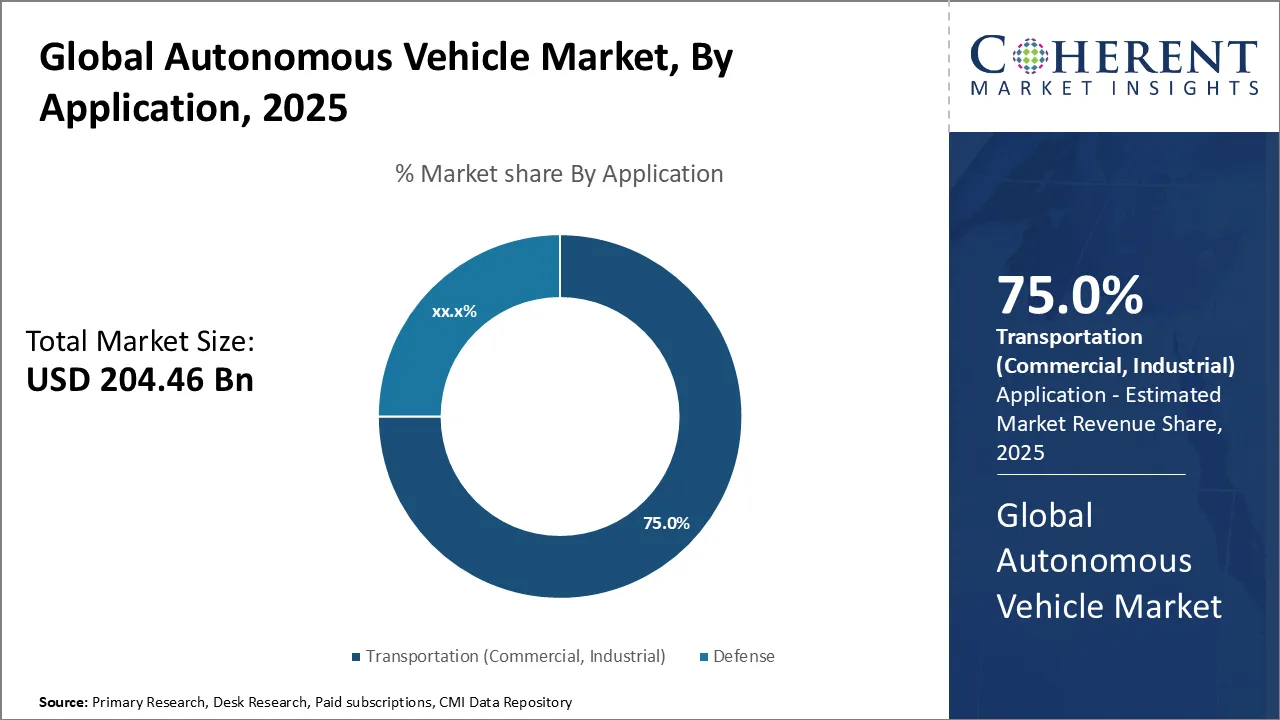
Autonomous Vehicle Market is estimated to be valued at USD 204.46 Bn in 2025 and is expected to reach USD 2,144.53 Bn in 2032, exhibiting a compound annual growth rate (CAGR) of 39.9% from 2025 to 2032.
The autonomous vehicle market is undergoing significant developments due to increased collaboration between automotive and electronics companies. Increasing R&D expenditure on development of autonomous vehicles is also expected to drive growth of the global autonomous vehicle market in the coming future.
|
Current Event |
Description and its Impacts |
|
AI Technology Advancements and Regulatory Frameworks |
|
|
Infrastructure and Energy Transition |
|
Uncover macros and micros vetted on 75+ parameters: Get instant access to report
Artificial intelligence (AI), which is the backbone of self-driving technology, is an important component of the autonomous vehicle market in 2025. AI lets cars see everything around them, make choices, and drive safely without any help from people. The main technologies used are machine learning, computer vision, natural language processing, and generative AI. These systems let self-driving cars read sensor data, guess what is going to occur in traffic, and talk to passengers in a natural way.
In October 2025, General Motors and the University of Michigan worked together to create a single software platform that combined conversational AI with self-driving car systems. The goal of the partnership is to improve driverless mobility, allowing cars to communicate naturally with passengers, which could make transportation safer, more efficient, and more enjoyable in the future.
Based on Application, the Transportation segment is expected to dominate the global market with 75% share in 2025. This is attributed to the increasing adoption of autonomous vehicles in transportation. The transportation segment is commonly driven by logistics, ride-hailing, delivery services, and industrial automation.
For instance, in December 2025, Kazakhstan planned using self-driving freight trucks by 2027 to improve transportation. Sensors will be put on roads for long-term use, which will make it easier to cross borders, lower costs, and keep the roads open 24 hours a day, seven days a week. Through the use of advanced transportation technology, this project hopes to triple delivery speeds and make the environment better.
To learn more about this report, Download Free Sample
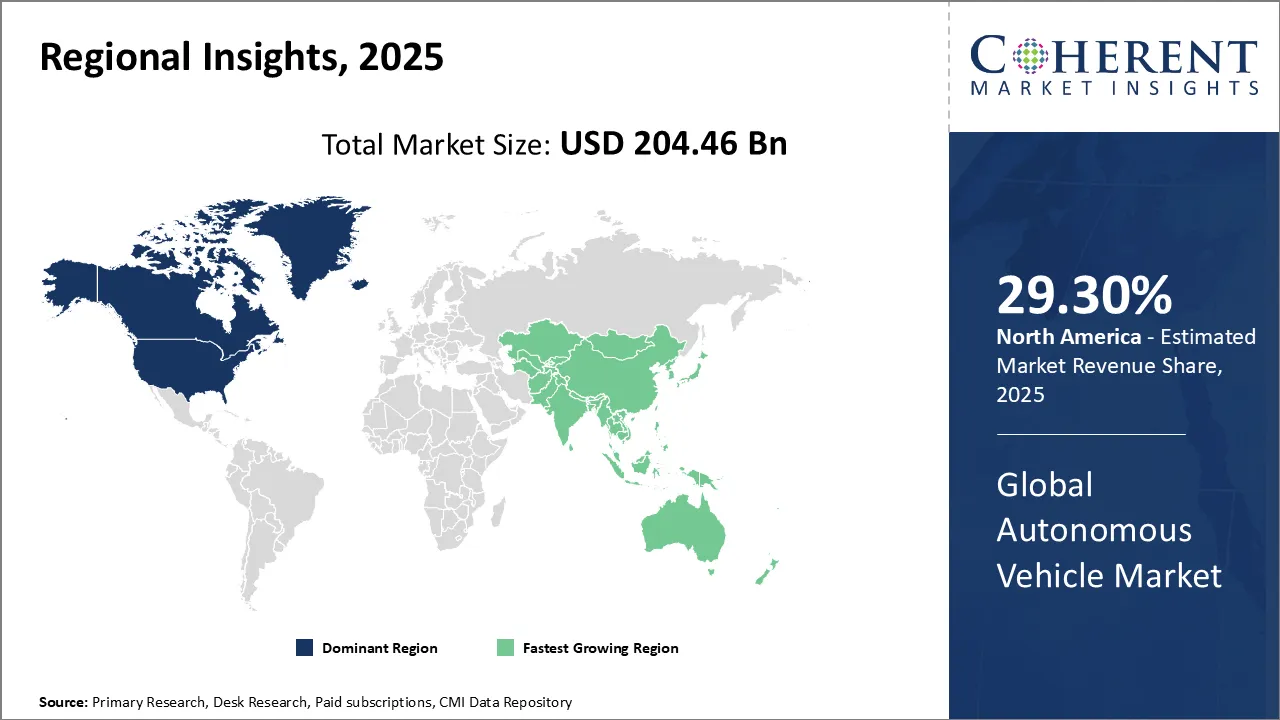
North America is projected to show significant growth in the global autonomous vehicle market with 29.3% share in 2025. This growth can be attributed to increasing growth of mobility as a service sector. Moreover, the region is likely to show strong growth due to amendments in traffic regulations in the U.S. for incorporating autonomous cars on public roads. The adoption of these regulations is increasing all over the country, which will lead to complete autonomous transportation in the country. Such factors are thus expected to fuel growth of the market across the region.
For instance, in December 2025, Uber and AvRide started offering self-driving robot taxis in Dallas, Texas, covering nine square miles in the city center. People can book rides through the Uber app, and there are safety drivers on board right now. The service wants to grow and eventually offer rides without a driver, which should enhance transportation and mobility in cities. It has cameras and sensors.
Asia Pacific is also anticipated to exhibit substantial growth in the global autonomous vehicle market during the forecast period, owing to rise in demand for an efficient, convenient, and safe driving experience, stringent safety regulations, and increasing disposable incomes in developing countries across the region. Moreover, rise in partnerships adopted by market players providing self-driving/autonomous car technology in the region is also driving growth of the market in Asia Pacific.
For instance, by the end of March 2028, Nissan Motor and UK-based AI company Wayve will have a self-driving system ready for use. The partnership is mainly about using advanced AI and machine learning to help cars drive themselves through complicated city settings. This shows Japan's push for self-driving cars and new ways to get around in the future.
The U.S. market for autonomous vehicle market is anticipated to be highly competitive in 2025 because tech companies are making big investments, ride-hailing and logistics companies are using them extensively, regulations are helpful, and people are interested in safety and convenience. Urban mobility projects and industrial automation are also driving demand, making transportation the most popular application area in the country.
For instance, in November 2025, Waymo started running fully self-driving robotaxis in Miami in November 2025. They then added four more U.S. cities. These cars without a driver, which is a big step forward for getting around in cities. The rollout shows that more and more people are using self-driving ride-hailing services.
In 2025, China's market for autonomous vehicle market is expected to be very competitive because the government is very supportive, there are more high-level self-driving zones, and AI-powered mobility solutions are being adopted quickly. China is the fastest-growing market in the world because of smart city projects, the growth of logistics, and companies like Huawei making their products available to everyone.
For instance, in December 2025, Huawei is bringing its self-driving technology to regular cars in China, not just high-end ones. The goal of this project is to make self-driving cars available to as many people as possible by using AI to improve safety and efficiency.
| Report Coverage | Details | ||
|---|---|---|---|
| Base Year: | 2024 | Market Size in 2025: | USD 204.46 Bn |
| Historical Data for: | 2020 To 2024 | Forecast Period: | 2025 To 2032 |
| Forecast Period 2025 to 2032 CAGR: | 39.9% | 2032 Value Projection: | USD 2,144.53 Bn |
| Geographies covered: |
|
||
| Segments covered: |
|
||
| Companies covered: |
Audi AG, BMW AG, Daimler AG (Mercedes Benz), Ford Motor Company, General Motors, Google LLC, Honda Motor Corporation, Nissan Motor Company, Tesla, Inc., Toyota Motor Corporation, Uber Technologies, Inc., and Volvo Car Corporation |
||
| Growth Drivers: |
|
||
| Restraints & Challenges: |
|
||
Uncover macros and micros vetted on 75+ parameters: Get instant access to report
As sensors, compute platforms, and full-stack autonomy software improve, the market for self-driving cars is moving closer to large-scale commercialization. Industry reports for 2024 show that the global market will be very active. This is due to pilot fleets are being deployed quickly, AI perception systems are getting better, and some areas are relaxing their rules. North America continues to remain the busiest place for testing and deployment, thanks to early regulatory frameworks and high-density urban trials. The autonomy compute segment is growing swiftly. This is as high-performance chips and AI accelerators are the most expensive part of higher-level autonomy, which shows how compute-intensive perception and planning workloads are.
Operational data from the top robotaxi companies shows that the number of completed autonomous trips will rise sharply between 2023 and 2024. This means that the service will be more reliable and cover a larger area. Partnerships between ride-hail platforms and autonomy developers show that the ecosystem is moving toward platform integration instead of full verticalization. A greater amount of capital is going into autonomy software, sensor innovation, and fleet management systems. These are all areas where there is a lot of potential for recurring revenue through OTA updates, data-driven improvements, and subscription-based service models.
Some of the main limitations are that market definitions can change, regulations can be confusing, and unit economics can be affected by the manner in which they are used. Even with these problems, the market is moving quickly toward profitable large-scale fleet operations as technology and operational readiness improve.
Definition: An autonomous vehicle (AV) is a motorized vehicle that can perform driving tasks without the need for human control. The driving tasks can include steering, acceleration, and braking. The AV can also detect, classify, and avoid static and moving obstacles in its environment. It can even communicate with other vehicles to determine the safest path.
Share
Share
About Author
Gautam Mahajan is a Research Consultant with 5+ years of experience in market research and consulting. He excels in analyzing market engineering, market trends, competitive landscapes, and technological developments. He specializes in both primary and secondary research, as well as strategic consulting across diverse sectors.
Missing comfort of reading report in your local language? Find your preferred language :
Transform your Strategy with Exclusive Trending Reports :
Frequently Asked Questions
Joining thousands of companies around the world committed to making the Excellent Business Solutions.
View All Our Clients
 Schedule a meeting with report Author