

Ballistic Composites Market Size and Share Analysis- Growth Trends and Forecasts (2026-2033)
The Ballistic Composites Market size is anticipated to grow at a CAGR of 8.6% with USD 2.78 Bn in 2026 and is expected to reach USD 4.96 Bn in 2033. The primary drivers are largely defined by increasing defense modernization programs, growing demand for lightweight body and vehicle armor, rising adoption of advanced protective equipment for military and law-enforcement personnel, and continued advancements in high-performance aramid fibers, UHMWPE, ceramic-reinforced composites, and hybrid composite materials. In November 2025, Teijin Aramid highlighted the use of its Twaron Next para-aramid fiber in ballistic helmets, while its broader ballistic portfolio covers body armor, hard armor, helmets, and vehicle protection.
Key Takeaways
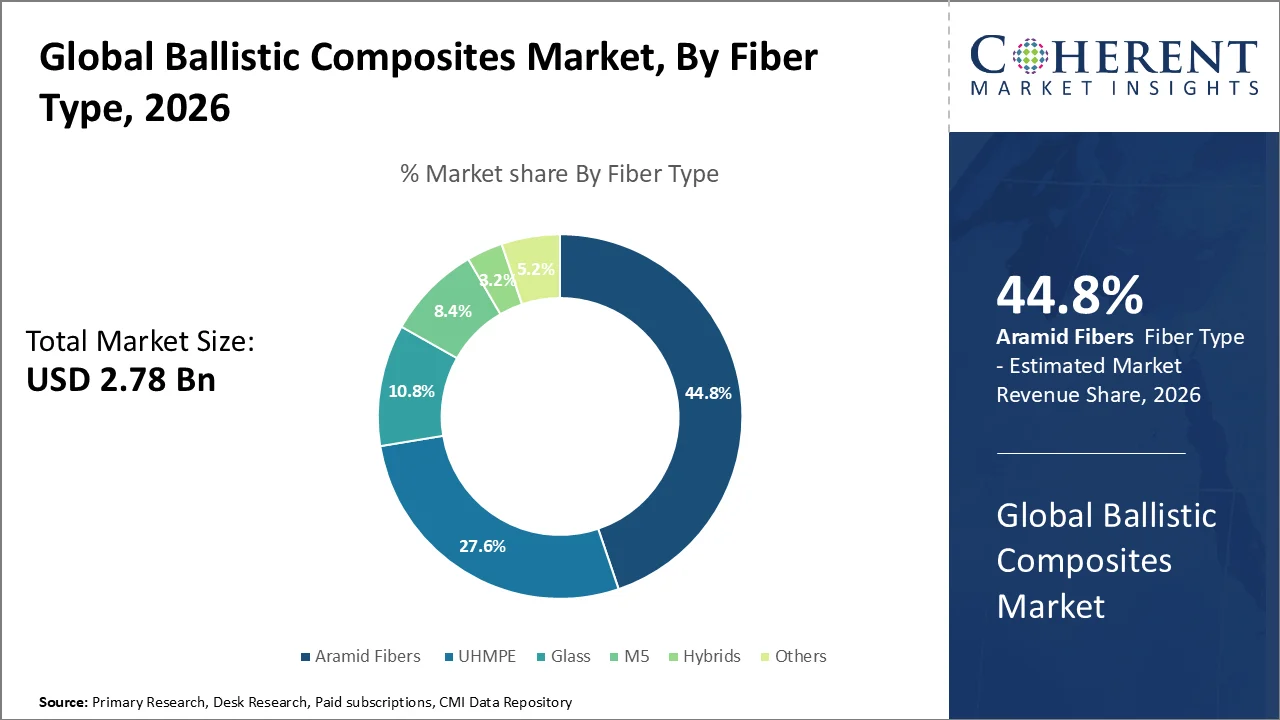
- The aramid fibers segment is likely to dominate the market with 44.8% in 2026. The segment’s growth is owing to the high tensile strength, superior energy absorption, low weight, and extensive use of para-aramid fibers in ballistic vests, helmets, hard armor, and vehicle protection. Teijin Aramid states that its Twaron para-aramid is six times stronger than steel on a weight-for-weight basis and five times lighter than steel, supporting its suitability for lightweight ballistic protection systems.
- The polymer matrix composites (PMC) segment is set to lead with 68.5% in 2026. The segment’s growth is owing to the strong compatibility of polymer resin systems with high-performance fibers, lower structural weight, ease of forming multilayer armor structures, and growing use in hard armor, helmets, and vehicle protection. Honeywell’s Spectra Shield 5241, for example, uses four plies of unidirectional Spectra UHMWPE fiber within a polyurethane resin system and is specified for body armor, facial protection, helmets, and vehicle armor.
- The vehicle armor segment is expected to dominate the application category with 41.7% in 2026. The segment’s growth is owing to rising demand for lightweight armor plates, spall liners, blast-resistant panels, and composite structural protection across land, marine, and air platforms. Teijin Aramid has more than 35 years of experience in high-performance armor across land, sea, and air defense applications, with Twaron being used in vehicle armor, hard armor plates, spall liners, and blast-resistant panels.
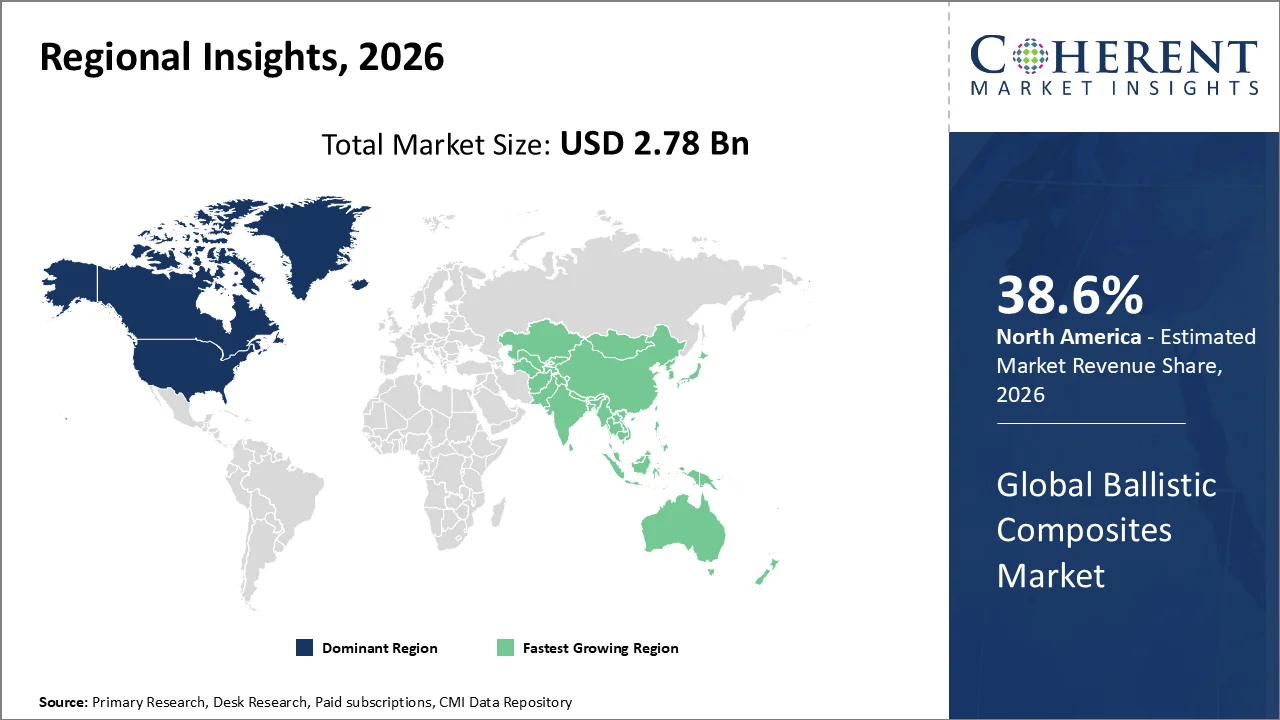
- North America is estimated to account for the largest share of the global ballistic composites market in 2026. Strong defense procurement, continued modernization of land and air armored platforms, high demand for advanced body armor and ballistic helmets and the presence of major aramid, UHMWPE and composite armor manufacturers add strength to the region’s leadership. In the U.S., minimum performance and testing standards for ballistic-resistant body armor used by law-enforcement agencies are still defined by the National Institute of Justice (NIJ) Standard 0101.07, and continued use of advanced armor materials is encouraged.
Market Drivers
Rising Demand for Lightweight Soldier Protection is Accelerating the Ballistic Composites Market
Ballistic composites market is growing on the back of growing demand for lighter body armor, helmets and protective inserts which provide higher ballistic performance and reduce the physical burden on soldiers. The field of personal protection applications is witnessing a continuous replacement of heavy conventional materials by advanced aramid, UHMWPE, ceramic-composite and hybrid armor systems.
In September 2025, the U.S. Army awarded a contract worth USD 65.5 million to Hardwire LLC and Leading Technology Composites for the production of 72,179 Lightweight Small Arms Protective Inserts (LSAPI). The new plates are roughly 30% lighter than the current ESAPI Generation III plates, yet provide the same ballistic protection, demonstrating the direct transition to light weight composite armor solutions.
Increasing Adoption of Advanced Composite Materials in Vehicle and Personnel Armor
Another major driver for the ballistic composites market is the increasing adoption of high-performance composites in military vehicles, helmets and body armor. High impact resistance is provided by UHMWPE, para-aramid fibers, advanced ceramics and polymer matrix composites at significantly lower weight than traditional metallic armor, allowing for better mobility and payload efficiency.
Moreover, the U.S. Army allocated USD 7.153 million for Soldier Protective Equipment development in FY 2026, including the development of lighter, stronger, and more flexible systems of ballistic protection with the use of advanced materials and manufacturing techniques.
Current Events and Their Impact on the Ballistic Composites Market
Current Event | Description and its Impact |
U.S. NIJ Transitions Body Armor Certification to NIJ Standard 0101.07 (2024–2026) |
|
U.S. Army Expands Procurement of Lightweight Ballistic Armor Plates (2025–2026) |
|
- Current Industry Events of 2026
- Market Size Estimation
- Regional Breakdown
- Competitive Landscape
- Customer Intelligence
- Segmental Analysis
- Pricing Analysis
- Key Market Drivers, Challenges & Future Trends
- Customized Insights Section
Segmental Insights
Why are Aramid Fibers Acquiring the Largest Share?
On the basis of fiber type, the aramid fibers segment is projected to account for the largest Ballistic Composites Market share of 44.8% in 2026. The segment’s growth is owing to its high tensile strength, lightweight structure, impact-energy absorption, thermal resistance, and extensive use in ballistic vests, helmets, hard armor panels, and vehicle protection systems.
DuPont’s Kevlar EXO aramid fiber received a Gold Edison Award in the Critical Safety Material Advancements category. DuPont states that the material provides improved ballistic protection with high flexibility, supporting lighter and more mobile body-armor designs.
In April 2026, DuPont completed the divestiture of its Kevlar and Nomex Aramids business in a transaction valued at approximately USD 1.8 billion, highlighting the substantial commercial scale of high-performance aramid materials.
Why are Polymer Matrix Composites (PMC) Acquiring the Largest Share?
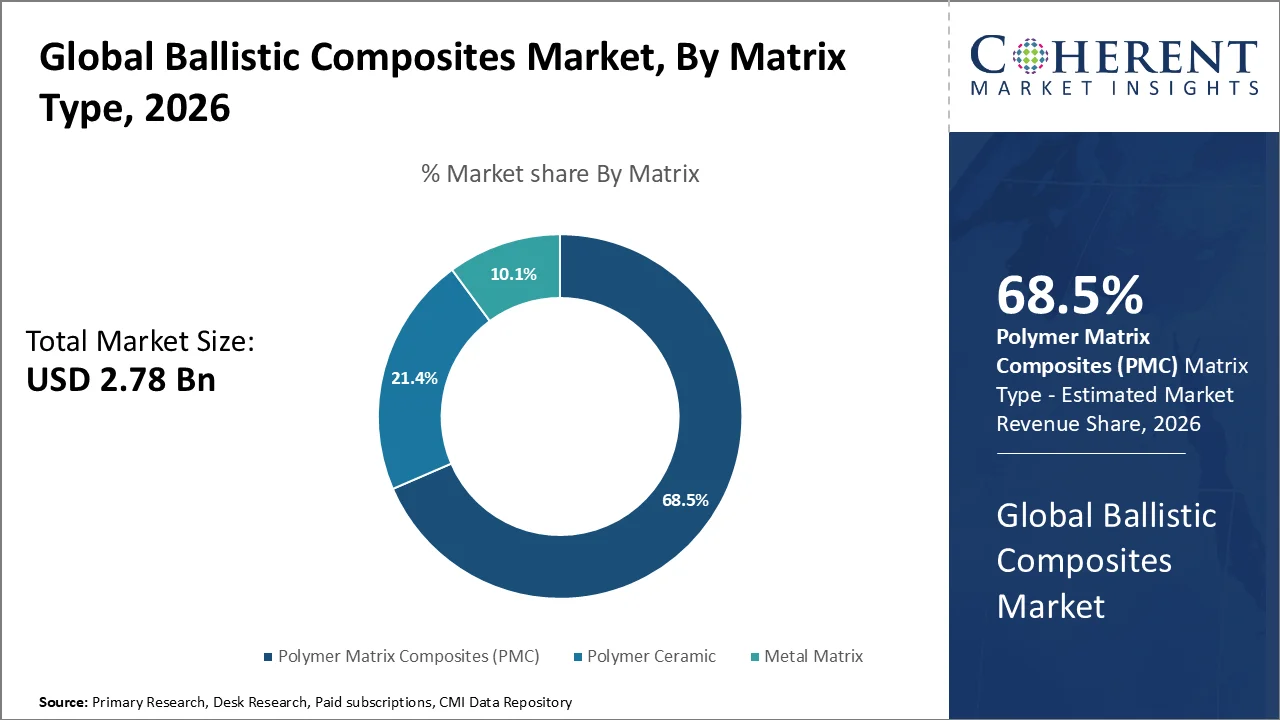
On the basis of matrix type, the polymer matrix composites (PMC) segment is expected to lead the Ballistic Composites Market with 68.5% in 2026. The segment’s growth is owing to the ability of polymer matrices to efficiently bind high-performance fibers such as aramid and UHMWPE, provide high impact resistance at lower structural weight, and enable multilayer ballistic structures for body armor, helmets, and vehicle protection.
Recent technical research also supports continued development of PMC-based protection. A study published on January 31, 2025, evaluated polymer matrix composite panels under high-velocity ballistic impact and considered polyurea coatings as a means of improving their impact-protection performance. This indicates an on-going material engineering for improving the survivability and durability of polymer based composite structures.
In February 2026, Integris Composites announced the creation of its Arctic Armor Development Team to develop a new generation of lightweight ballistic composites for troops, vehicles and equipment operating in extreme Arctic conditions.
Why does Vehicle Armor Hold the Largest Market Share?
On the basis of application, the vehicle armor segment is expected to dominate the Ballistic Composites Market with 41.7% in 2026. The segment’s growth is owing to increasing deployment of lightweight ballistic panels, spall liners, composite armor modules, blast protection, and scalable armor systems across land vehicles, marine platforms, and military aircraft.
The U.S. Department of Defense’s FY2025 acquisition program included procurement of more than 2,609 Joint Light Tactical Vehicles (JLTVs), trailers, and associated vehicle kits. The JLTV platform is specifically designed around scalable armor protection while balancing vehicle protection, payload, agility, and mobility.
In June 2026, Integris Composites and Arquus announced that they were developing and testing a next-generation full-composite armored vehicle door. The design replaces typical metal armor with a more advanced composite architecture in an effort to obtain a significant weight reduction while still providing the necessary ballistic and blast protection.
Ballistic Composites Market Trends
- Increasing usage of ultra-lightweight UHMWPE-based ballistic composites is transforming personal and vehicle protection systems. Avient announced its third generation of unidirectional ballistic materials for inserts, helmets and vehicle armor, Dyneema HB330 and HB332, in January 2025.
- High-performance ballistic composites are in high demand due to the growing use of advanced aramid fibers in next-generation body armor and explosive-ordnance protection. In June 2026, Arclin and BSST announced the introduction of a next generation EOD suit incorporating Kevlar EXO. The suit is designed to provide better fragment protection and reduce the weight of the entire system and improve operator mobility.
- The growing trend toward hybrid and multi-material composite armor architectures is enhancing impact-energy absorption and allowing the development of thinner, lighter protection systems. A study on May 30, 2026 showed that multi-scale hybridization, polymer-resin hybridization and bio-inspired designs can lead to better specific energy absorption in aramid-based ballistic composites, which will help develop next-generation lightweight armor structures.
Regional Insights
North America Dominates Owing to Strong Ballistic-Material Manufacturing and Defense Protection Demand
North America is expected to account for the largest share of the global Ballistic Composites Market at 38.6% in 2026. The region’s dominance is owing to the presence of major ballistic-material manufacturers, large-scale procurement of lightweight protection systems, strong defense manufacturing capabilities, and continued adoption of advanced aramid, UHMWPE, and polymer-based composites across body armor, helmets, naval systems, and armored vehicles.
In January 2026, Solstice Advanced Materials announced an investment of more than USD 220 million to expand its ballistic fiber manufacturing facility in Virginia. The facility produces Spectra fiber and composite materials used in helmets, vests, vehicle armor, and naval applications, and the expansion will add fiber-spinning, composite-coating, and analytical capabilities.
Asia Pacific Ballistic Composites Market Trends
Asia Pacific is expected to be the fastest-growing region in the Ballistic Composites Market over the forecast period. The region’s growth is owing to expanding domestic defense manufacturing, modernization of armored vehicle fleets, increasing procurement of personal protection equipment, and rising development of lightweight composite armor systems across Australia, India, South Korea, Japan, and other regional defense markets.
Regional armored-platform modernization is also expanding. At Eurosatory in June 2026, Thales Australia unveiled the next-generation Bushmaster Mulga 5.6 armored vehicle. Australia already has 290 additional Bushmaster vehicles on order, highlighting the scale of ongoing protected-vehicle procurement and the potential demand base for lightweight ballistic protection and composite armor technologies. In July 2026, Australia-based HighCom Technology was selected for the Australian Government’s Border Protection Technologies Panel for a five-year term beginning July 1, 2026.
Strong Lightweight Armor Procurement and Soldier Protection Modernization are Accelerating the Ballistic Composites Market in the United States
The U.S. Ballistic Composites Market is witnessing strong growth owing to sustained military procurement, development of lightweight soldier protection systems, and increasing use of ceramic-composite, UHMWPE, and other advanced armor materials across body armor, helmets, and vehicle protection.
The U.S. Army’s FY 2026 Soldier Lethality Technology program also includes development of ceramic-composite armor, new armor materials, and improved bonding and integration strategies for composite and ceramic armor packages against emerging threats. In June 2026, the Army further highlighted ongoing R&D in advanced body armor and combat helmets at the DEVCOM Soldier Center.
China Ballistic Composites Market Trends
China is expected to witness strong growth in the Ballistic Composites Market owing to expansion of domestic high-performance fiber production, increasing localization of lightweight armor technologies, and growing use of composite protection in military vehicles, unmanned platforms, body armor, and helmets.
In addition, on May 17, 2025, HANVO New Material showcased its latest UHMWPE yarn, unidirectional composite fabrics, and advanced ballistic plates at the China International Police Equipment Exhibition in Beijing, demonstrating continued domestic commercialization of UHMWPE-based ballistic composite systems.
Who are the Major Companies in Ballistic Composites Industry
Some of the major key players in Ballistic Composites Market are BAE Systems, Barrday Corporation, DSM, Dupont, FY Composites OY, Gaffco Ballistics, Gurit, Honeywell International Inc., M Cubed Technologies, Inc., MKU Limited, Morgan Advanced Materials, PRF Composites, Royal Ten Cate NV, Southern States LLC, and Teiji.
Key News
- In June 2026, Barrday launched BarrFlex UA200, a new advanced unidirectional aramid material for next-generation soft armor. The product is designed for multi-threat ballistic and stab protection and is optimized for both NIJ 0101.06/0101.07 ballistic requirements and NIJ 0115.00 stab requirements.
- In July 2025, MKU secured a multi-year contract to supply more than 200,000 advanced ballistic helmets to an Asian armed force. The selected Kavro ballistic helmets are NIJ Level IIIA certified and were chosen following a competitive evaluation involving international defense suppliers.
Market Report Scope
Ballistic Composites Market Report Coverage
| Report Coverage | Details | ||
|---|---|---|---|
| Base Year: | 2025 | Market Size in 2026: | USD 2.78 Bn |
| Historical Data for: | 2020 To 2024 | Forecast Period: | 2026 To 2033 |
| Forecast Period 2026 to 2033 CAGR: | 8.6% | 2033 Value Projection: | USD 4.96 Bn |
| Geographies covered: |
| ||
| Segments covered: |
| ||
| Companies covered: | BAE Systems, Barrday Corporation, DSM, Dupont, FY Composites OY, Gaffco Ballistics, Gurit, Honeywell International Inc., M Cubed Technologies, Inc., MKU Limited, Morgan Advanced Materials, PRF Composites, Royal Ten Cate NV, Southern States LLC, and Teiji. | ||
| Growth Drivers: |
| ||
| Restraints & Challenges: |
| ||
Analyst Opinion
- The Ballistic Composites Market is increasingly shifting toward application-specific armor systems, particularly protection designed around mobility, ergonomics, and user profile. On June 8, 2026, Dyneema® and NP Aerospace announced delivery of 2,000 body armor systems incorporating 4,000 ballistic plates specifically designed for female military and security personnel. This indicates that future market growth will increasingly come from customized composite protection rather than standardized armor formats.
- Commercial adoption of unidirectional ballistic composites is moving deeper into large-volume police and security programs. In February 2026, FECSA announced the delivery of more than 100,000 protective vests and 100,000 ballistic plates made with Dyneema® to European armed forces and law enforcement agencies. This level of deployment is indicative of advanced UHMWPE composite systems transitioning from premium lightweight solutions to broader institutional procurement.
- The next stage of market development is likely to be driven by hybrid composite architectures, rather than single-material armor systems. In published research on May 30, 2026, multi-scale hybridization, polymer-resin hybridization, and bio-inspired structures have been identified as important pathways to improve the specific energy absorption of aramid-based ballistic composites. This supports growing R&D investment in combinations of aramid, UHMWPE, ceramics, and polymer matrices to achieve higher protection at lower weight.
Speak to the analyst
Want personalized insights?
Take the findings above to one of our principal consultants, or have the report rebuilt around the segments, geographies and competitors you actually track.
Market Segmentation
- By Fiber Type (Revenue, USD Bn, 2021-2033)
- Aramid Fibers
- Para-aramid
- Meta-aramid
- UHMPE
- Glass
- M5
- Hybrids
- Others
- Aramid Fibers
- By Matrix Type (Revenue, USD Bn, 2021-2033)
- Polymer matrix composites (PMC)
- Reinforced Plastics
- Advanced Composites
- Polymer Ceramic
- Metal Matrix
- Polymer matrix composites (PMC)
- By Application (Revenue, USD Bn, 2021-2033)
- Vehicle Armor
- Marine Vehicle
- Land Vehicle
- Air Vehicle
- Body Armor
- Body Vests
- Shields
- Protective Under Garments
- Helmets & Facial Protection
- Others
- Vehicle Armor
- By Region (Revenue, USD Bn, 2021-2033)
- North America
- U.S.
- Canada
- Latin America
- Brazil
- Mexico
- Argentina
- Rest of Latin America
- Europe
- Germany
- U.K.
- France
- Italy
- Spain
- Russia
- Rest of Europe
- Asia Pacific
- China
- India
- Japan
- Australia
- South Korea
- ASEAN
- Rest of Asia Pacific
- Middle East
- GCC
- Israel
- Rest of Middle East
- Africa
- South Africa
- Central Africa
- North Africa
- North America
Sources
Primary Research Interviews
- Ballistic armor and composite material manufacturers
- Aramid fiber and UHMWPE producers
- Body armor, helmet, and protective equipment manufacturers
- Military vehicle armor and survivability system suppliers
- Materials scientists and ballistic testing specialists
- Defense procurement and military modernization officials
- Law-enforcement protective equipment procurement managers
- Key opinion leaders (KOLs) in advanced composites and ballistic protection
Databases
- U.S. Department of Defense (DoD)
- U.S. Army Acquisition Support Center
- National Institute of Justice (NIJ)
- NATO Defence Expenditure Database
- Stockholm International Peace Research Institute (SIPRI)
- European Defence Agency (EDA)
- U.S. International Trade Commission (USITC)
- UN Comtrade Database
Magazines
- CompositesWorld
- JEC Composites Magazine
- European Security & Defence
- Military Technology
- Armada International
- Defence Procurement International
Journals
- Composite Structures
- Composites Part B: Engineering
- International Journal of Impact Engineering
- Defence Technology
- Journal of Composite Materials
- Materials & Design
- Polymer Composites
Newspapers
- Financial Times
- The Wall Street Journal
- Reuters
- The Economic Times
- South China Morning Post
- The Guardian
Associations
- American Composites Manufacturers Association (ACMA)
- SAMPE – Society for the Advancement of Material and Process Engineering
- JEC Group
- ASTM International
- National Defense Industrial Association (NDIA)
- European Composites Industry Association (EuCIA)
- Composites UK
Public Domain Sources
- Company Annual Reports and Investor Presentations
- U.S. Department of Defense and U.S. Army procurement publications
- National Institute of Justice ballistic armor standards and certification documents
- NATO and European defense procurement publications
- Government defense budgets and military modernization documents
- University and defense laboratory research publications
- Patent databases such as WIPO, USPTO, and Google Patents
- Publicly available ballistic testing, armor certification, and material qualification reports
- Company press releases covering new ballistic fibers, armor systems, production expansions, and contracts
Proprietary Elements
- CMI Data Analytics Tool
- Proprietary CMI Existing Repository of Information for the Last 10 Years
Get access to 250+ pages report
Every segment, forecast, competitor profile and data table behind the analysis above — available for instant download.
- ESOMAR Member
- ISO 9001:2015 Certified
- D-U-N-S Registered
- GDPR & CCPA Compliant
Missing comfort of reading report in your local language? Find your preferred language:
Transform your Strategy with Exclusive Trending Reports
Frequently Asked Questions
The Ballistic Composites Market is expected to reach USD 4.96 Bn in 2033, up from USD 2.78 Bn in 2026.
Major players operating in the global Ballistic Composites Market include BAE Systems, Barrday Corporation, DSM, DuPont, FY Composites Oy, Gaffco Ballistics, Gurit, Honeywell International Inc., M Cubed Technologies, Inc., MKU Limited, Morgan Advanced Materials, PRF Composites, Royal Ten Cate NV, Southern States LLC, and Teiji.
The high manufacturing and material costs and complex production and fabrication processes are the key factors hampering growth of the market.
The increasing demand for lightweight body armor and ballistic helmets and the rising adoption of composite armor in military and tactical vehicles are key factors driving market growth.
The Ballistic Composites Market is anticipated to grow at a CAGR of 8.6% between 2026 and 2033.
Among regions, North America is expected to account for the largest market share, with an estimated 38.6% share in 2026.
Asia Pacific is expected to be the fastest-growing region over the forecast period, supported by expanding domestic defense manufacturing, armored vehicle modernization, increasing procurement of personal protective equipment, and development of lightweight composite armor systems.