

Basalt Fiber Market Size and Forecast — 2026-2033
The Global Basalt Fiber Market size is estimated to be valued at USD 3.10 billion in 2026 and is expected to reach USD 6.31 billion by 2033, exhibiting a compound annual growth rate (CAGR) of 10.7% from 2026 to 2033.
Overview
Basalt fibers are high-performance reinforcement materials derived from natural basalt rock through controlled melting and extrusion processes. These fibers exhibit exceptional strength, thermal stability, and chemical resistance, making them ideal for use in construction, automotive, aerospace, and defense industries. Product types include continuous basalt fibers, chopped strands, basalt rebar, and woven fabrics, each tailored for specific applications such as composite reinforcement or insulation. Basalt fiber products are valued for being lightweight, non-corrosive, and environmentally sustainable, providing a superior alternative to glass and carbon fibers in certain conditions.
Key Takeaways
The Continuous Fiber segment dominates the Basalt Fiber Market share with 43%, mainly driven by its versatility and demand in composites manufacturing.
The Construction & Infrastructure application subsegment is expanding rapidly, attributed to energy-efficient building codes adopting basalt fiber-based materials.
Europe leads market revenue generation, accounting for over 30% of the industry share, supported by stringent environmental policies and mature infrastructure sectors.
Asia Pacific demonstrates the fastest CAGR due to robust industrialization and government initiatives favoring sustainable materials uptake, enhancing market scope and opportunities.
Basalt Fiber Market Segmentation Analysis
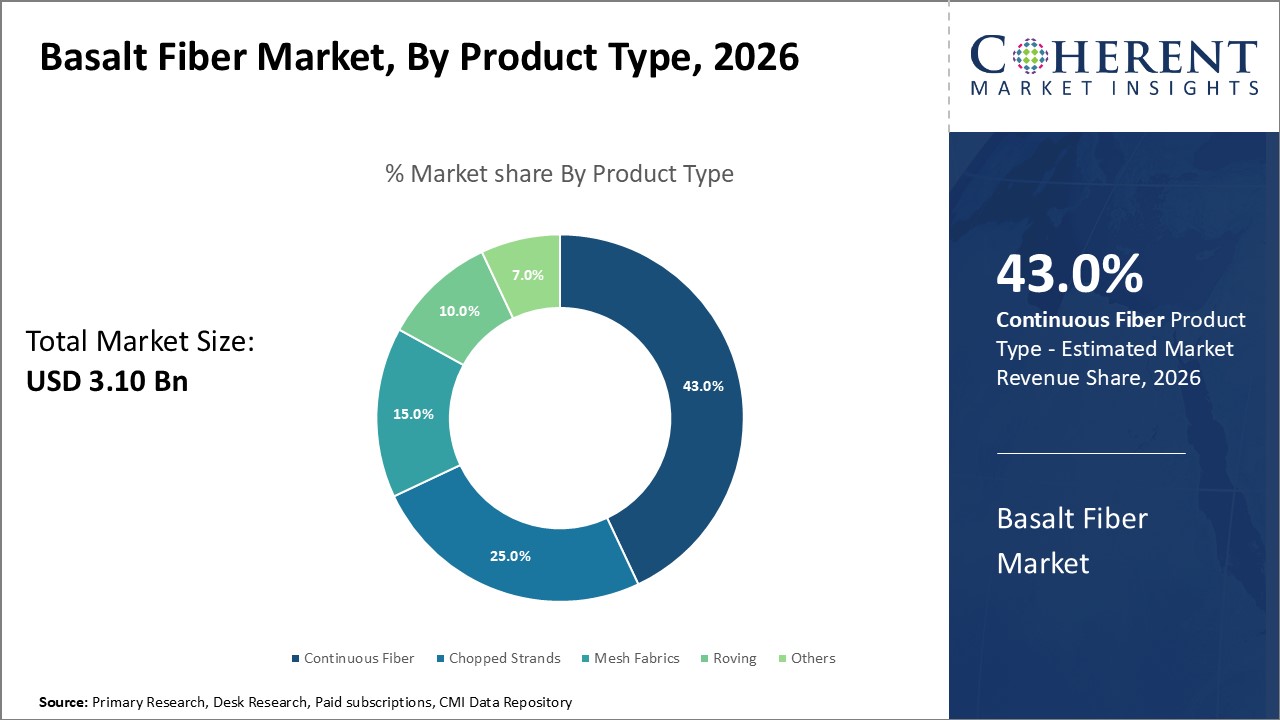
Basalt Fiber Market Insights, By Product Type
Continuous Fiber dominates the market share due to its superior tensile strength and adaptability in composites, enabling use in high-performance applications like aerospace and automotive. Its dominance arises from the growing demand for lightweight and strong material composites, making it the backbone of basalt fiber utilization. The fastest growing subsegment is Mesh Fabrics, which are increasingly adopted in construction for thermal insulation and reinforcement purposes due to their ease of installation and cost-efficiency.
Basalt Fiber Market Insights, By Application
Construction & Infrastructure dominate the market share. This segment’s dominance is driven by escalating regulatory norms for energy-efficient buildings and durability requirements, resulting in widespread use of basalt fiber for insulation, structural reinforcement, and fireproof materials. The fastest-growing application segment is Automotive & Transportation, propelled by global shifts toward electric vehicles and lightweight parts that enhance fuel efficiency and reduce emissions. Aerospace & Defense applications, while niche, show steady growth due to performance advantages in high-stress environments.
Basalt Fiber Market Insights, By Form
Yarns dominate the market share due to their flexibility and extensive use in composite weaving and fabric reinforcement, making them suitable for multiple industrial applications. The rapid growth subsegment is Fabrics, which exhibit rising demand attributed to their application in thermal protection gear and construction materials that benefit from layered composites. Roving is primarily utilized for creating various base materials for further processing, while Mat serves as a base for laminates and specialized fabrication needs. The distinct characteristics of each form address specific requirements in structural integrity and application feasibility.
Basalt Fiber Market Trends
The Basalt Fiber Market is witnessing technology-driven advancements, especially in composite manufacturing processes and sustainable product innovations.
Production facilities are increasingly adopting AI-enabled control systems, improving product quality consistency and reducing waste, as evidenced by German manufacturers' data from 2025.
Ongoing integration with nanotechnology also indicates an industry shift aimed at augmenting material properties, driving new applications in aerospace and renewable energy.
Additionally, the rise of EVs is accelerating demand for lightweight fibers, with North American automotive manufacturers increasing basalt fiber composites usage by 18% in 2026.
Basalt Fiber Market Insights, By Geography
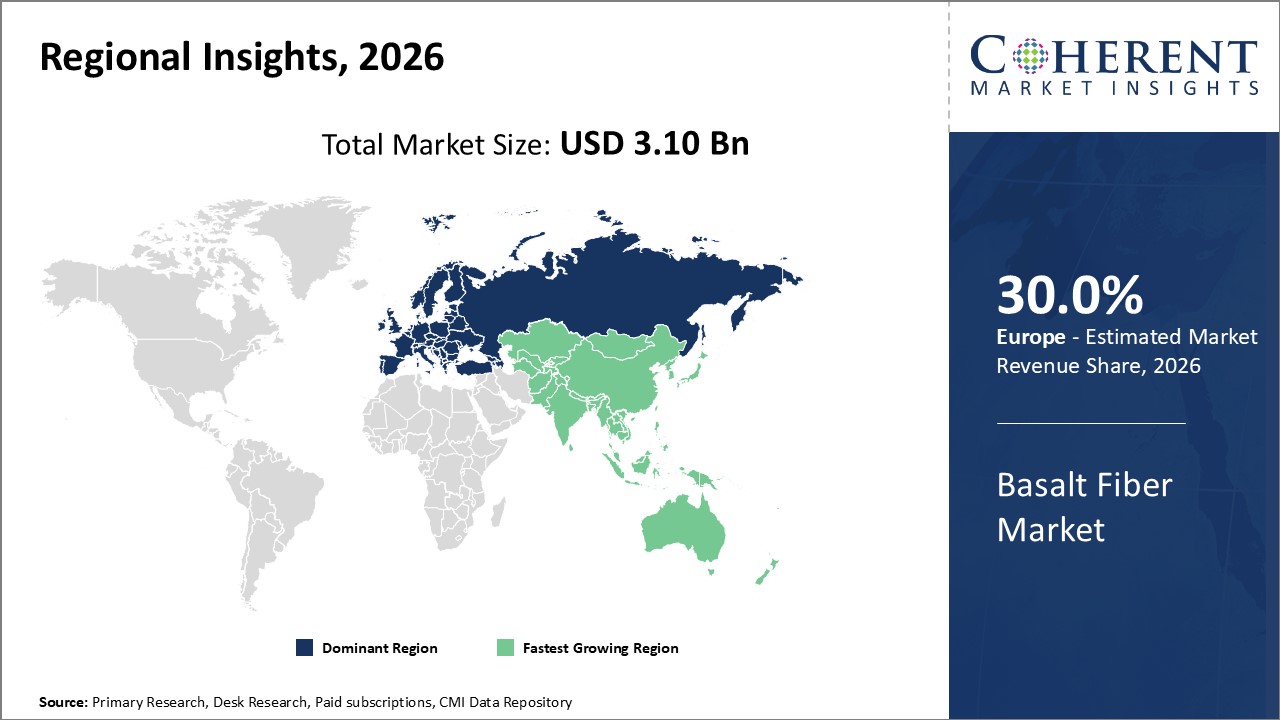
Europe Basalt Fiber Market Analysis and Trends
In Europe, the dominance in the Basalt Fiber Market is upheld by strict environmental regulations and a mature industrial ecosystem. The region holds approximately 30% market share, driven by extensive construction and renewable energy projects that favor basalt fiber composites for their sustainability. Companies such as BASF SE and Saint-Gobain are pivotal players, leveraging ongoing innovation to maintain competitive positioning.
Asia Pacific Basalt Fiber Market Analysis and Trends
Meanwhile, the Asia Pacific exhibits the fastest growth with a CAGR exceeding 12% due to rapid industrialization, urbanization, and supportive infrastructure initiatives. China and India are central markets, with increased government funding toward green construction and automotive lightweighting spurring demand. Firms like Kamenny Vek and Ma Fiber Tech are expanding production capacity here to capitalize on this surge.
Basalt Fiber Market Outlook for Key Countries
USA Basalt Fiber Market Analysis and Trends
The USA's basalt fiber market reflects key growth in construction, automotive, and renewable energy sectors. Increasing adoption in EV manufacturing and infrastructure projects emphasizing thermal efficiency, sustains demand. Imports increased by 15% year-over-year in 2026, buoyed by favorable regulatory environments and investments in lightweight composites. Leading players have established partnerships with automakers and energy firms to optimize supply chains and innovate new basalt fiber grades tailored for stringent U.S. standards.
China Basalt Fiber Market Analysis and Trends
China’s market serves as a manufacturing and consumption hub for basalt fiber, supported by government policies promoting advanced materials for Industry 4.0 applications. With significant infrastructure spending and automotive electrification strategies in place, demand is robust. Production capacity increased by 12% in 2025, helping to meet domestic and export demands. Companies like Kamenny Vek have augmented their R&D efforts in China to develop enhanced quality basalt fibers suited for the aerospace and energy sectors.
Analyst Opinion
The supply-side dynamics of basalt fiber production are highly influential in defining the market revenue trajectory. In 2025, production capacity expansions in China alone accounted for a 13% increase globally, highlighting how manufacturing scalability is pivotal in meeting the rising demand. Pricing trends have stabilized due to increased raw basalt availability and improvements in melting technology, with price fluctuations limited to within 4% year-over-year in 2025.
On the demand side, the rising use of basalt fiber composites in automotive applications, especially in electric vehicles (EVs), has fuelled a notable import surge in regions like North America. Data from 2026 reveals a 15% year-on-year increase in basalt fiber imports to the U.S., driven by vehicle lightweighting initiatives and emission reduction mandates.
Micro-indicators such as adoption in niche industrial segments, including renewable energy infrastructure (wind turbine blades) and fireproof fabrics, are shaping incremental market growth. For instance, manufacturers in Germany integrated basalt fiber into 24% of wind blade production in 2025, up from 17% in 2023, reflecting a growing compliance-driven market shift.
Nano-size indicators focus on end-user feedback on pricing elasticity and performance benchmarks. A survey conducted with European construction firms in 2026 showed a 30% preference increase for basalt fiber composites due to their thermal insulation and lifecycle cost advantages, underlining demand-side momentum.
- Current Industry Events of 2026
- Market Size Estimation
- Regional Breakdown
- Competitive Landscape
- Customer Intelligence
- Segmental Analysis
- Pricing Analysis
- Key Market Drivers, Challenges & Future Trends
- Customized Insights Section
Market Scope
| Report Coverage | Details | ||
|---|---|---|---|
| Base Year: | 2025 | Market Size in 2026: | USD 3.10 billion |
| Historical Data for: | 2020 To 2024 | Forecast Period: | 2026 To 2033 |
| Forecast Period 2026 to 2033 CAGR: | 10.7% | 2033 Value Projection: | USD 6.31 billion |
| Geographies covered: |
| ||
| Segments covered: |
| ||
| Companies covered: | Kamenny Vek, Zhejiang GBF Basalt Fiber Co., Ltd., MAFIC SA, Technobasalt‑Invest LLC, ISOMATEX SA, INCOTELOGY GmbH, Sudaglass Fiber Technology, Basaltex NV, Deutsche Basalt Faser GmbH, Hexcel Corporation, and Owens Corning. | ||
| Growth Drivers: |
| ||
Basalt Fiber Market Growth Factors
The Basalt Fiber Market growth is driven significantly by increasing environmental regulations pushing for sustainable materials replacement. Recent years have seen stricter emissions and recyclability standards encouraging industries to adopt basalt fiber, which is 100% natural and recyclable. Additionally, rising demand from the automotive industry, especially in EV manufacturing, is propelling market revenue due to basalt fiber’s lightweight and strength benefits, enhancing vehicle efficiency. Infrastructure development across emerging economies with a high focus on thermal insulation and durability, offers another growth vector. For instance, India’s infrastructure spending increased by 11% in 2025, with basalt fiber composites used in over 18% of renovation projects.
Basalt Fiber Market Development
In November 2025, Basanite secured a U.S. patent for an innovative basalt fiber rebar production method designed to enhance strength, durability, and corrosion resistance. The patented method supports sustainable construction practices by offering a lighter and longer-lasting alternative to steel rebar.
In July 2026, Fiber Elements announced it raised €2.6 million to scale its automated 3D basalt fiber manufacturing technology aimed at replacing steel in construction. The funding supports commercialization efforts for eco-friendly, high-performance basalt composites with reduced carbon footprint and improved material efficiency.
Key Players
Leading Companies of the Market
Kamenny Vek
Zhejiang GBF Basalt Fiber Co., Ltd.
MAFIC SA
Technobasalt-Invest LLC
ISOMATEX SA
INCOTELOGY GmbH
Sudaglass Fiber Technology
Deutsche Basalt Faser GmbH
Hexcel Corporation
Owens Corning
Competitive strategies observed include vertical integration to control raw material sourcing and R&D investments aimed at high-performance basalt fiber derivatives. For example, Kamenny Vek increased its R&D budget by 19% in 2025 to innovate fire-resistant basalt fibers, resulting in a 8% rise in market share in the European construction segment
Basalt Fiber Market Future Outlook
Basalt fiber’s growth trajectory is underpinned by transportation lightweighting, renewable-energy component demand (wind blades), and infrastructure projects seeking durable, corrosion-resistant materials. Continued R&D on fiber sizings and surface treatments will improve matrix adhesion and composite fatigue life, enabling the replacement of more expensive fibers in structural components.
Scaling melt-and-draw production, process energy efficiency improvements, and supply-chain localization will reduce unit costs and support broader adoption. New hybridization approaches (basalt + glass, basalt + recycled carbon) will yield tailored performance-to-cost solutions. Policy-driven nudges toward sustainable materials, plus rising demand for corrosion-resistant rebar in coastal infrastructure, will provide steady demand. Emerging use cases in thermal management and fire-resistant panels may add specialty high-margin segments.
Basalt Fiber Market Historical Analysis
Basalt fiber production—melting natural basalt rock and drawing continuous fibers—matured in the late 20th century but only scaled meaningfully in the 2010s as process control and fiber-sizing chemistries improved. Early applications were niche (corrosion-resistant rebars, thermal insulation) where basalt’s natural properties—high temperature tolerance, chemical resistance, and favorable stiffness-to-weight ratio—offered clear advantages over glass fibers.
Continuous-fiber processing and textile finishing advances enabled composite-grade rovings and woven fabrics that could compete in automotive and wind-energy components. Geographically, production has expanded beyond initial centers to Asia and Eastern Europe, supporting regional composite supply chains. The material gained appeal as a lower-cost, more sustainable alternative to carbon fiber in applications where cost-performance balance favored basalt. Industrial partnerships and demonstration programs, particularly in infrastructure reinforcement and retrofits, helped validate long-term durability claims and broaden acceptance.
Sources
Primary Research Interviews:
Materials Scientists
Construction Engineers
Fiber Technologists
Industrial Designers
Databases:
ASTM Standards
ScienceDirect
Scopus
USGS Mineral Commodity Data
Magazines:
Composites World
Materials Today
Construction Review
Engineering News-Record
Journals:
Journal of Materials Science
Composites Part B
Construction and Building Materials
Materials Letters
Associations:
American Concrete Institute (ACI)
European Composites Industry Association (EuCIA)
ASTM
Get access to 250+ pages report
Every segment, forecast, competitor profile and data table behind the analysis above — available for instant download.
- ESOMAR Member
- ISO 9001:2015 Certified
- D-U-N-S Registered
- GDPR & CCPA Compliant
Missing comfort of reading report in your local language? Find your preferred language:
Transform your Strategy with Exclusive Trending Reports
Frequently Asked Questions
Dominant market players include Kamenny Vek, JSC, Kamaz Fibers, JSC, Ma Fiber Tech, LLC, BASF SE, and Owens Corning. These companies lead through innovation and extensive production capacities.
The market size is expected to grow from USD 3.10 billion in 2026 to USD 6.31 billion by 2033, driven by sustained demand across multiple industries.
The Construction & Infrastructure sector presents the most significant growth opportunity due to rising energy efficiency standards and infrastructural investments globally.
Market trends will evolve towards enhanced composite technologies integrating nanomaterials and digital production techniques, fostering improved performance and cost-efficiency.
The landscape features high competition based on innovation and scale while facing challenges related to raw material price volatility and technical application constraints.
Market players focus on strategic partnerships, vertical integration, and R&D investments to launch superior products and secure supply chain advantages.