

Bilirubin Colorimeter Assay Market Size and Forecast — 2026-2033
The Global Bilirubin Colorimeter Assay Market size is estimated to be valued at USD 157.8 million in 2026 and is expected to reach USD 265.4 million by 2033, exhibiting a compound annual growth rate (CAGR) of 8.3% from 2026 to 2033.
Overview
Bilirubin colorimeter assays are biochemical diagnostic kits designed to measure bilirubin levels in biological samples, primarily for assessing liver function and detecting jaundice or hemolytic disorders. These assays operate based on the diazo reaction or vanadate oxidation methods, producing color changes proportional to bilirubin concentration, which are then quantified using colorimetric spectrophotometers. The products are available in both manual and automated formats, suitable for clinical laboratories and point-of-care testing. Modern assay kits feature ready-to-use reagents, enhanced stability, and interference-resistant formulations for improved accuracy.
Key Takeaways
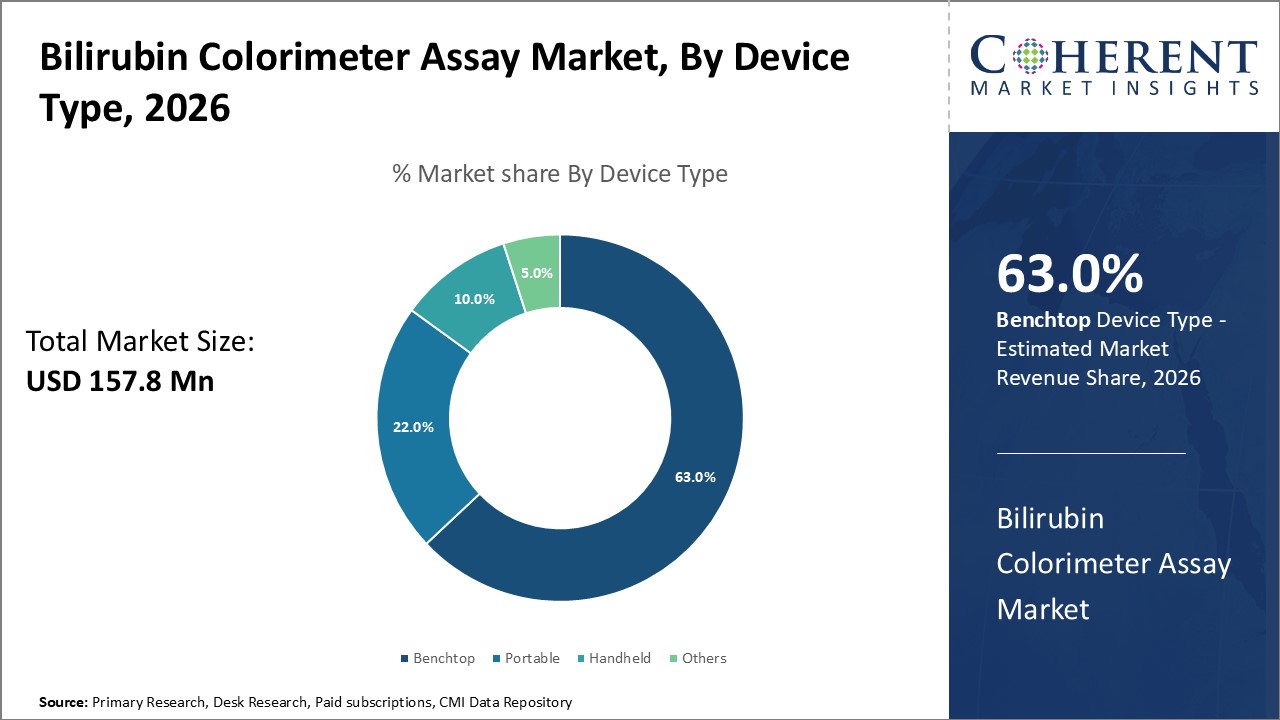
The Benchtop device segment dominates with 63% market share, owing to its accuracy and application in high-throughput laboratories, although portable devices present the fastest growth trajectory due to the trend towards point-of-care testing.
Among applications, Neonatal Jaundice Screening remains the largest contributor, capturing about 56% of total industry revenue due to expanded newborn screening programs.
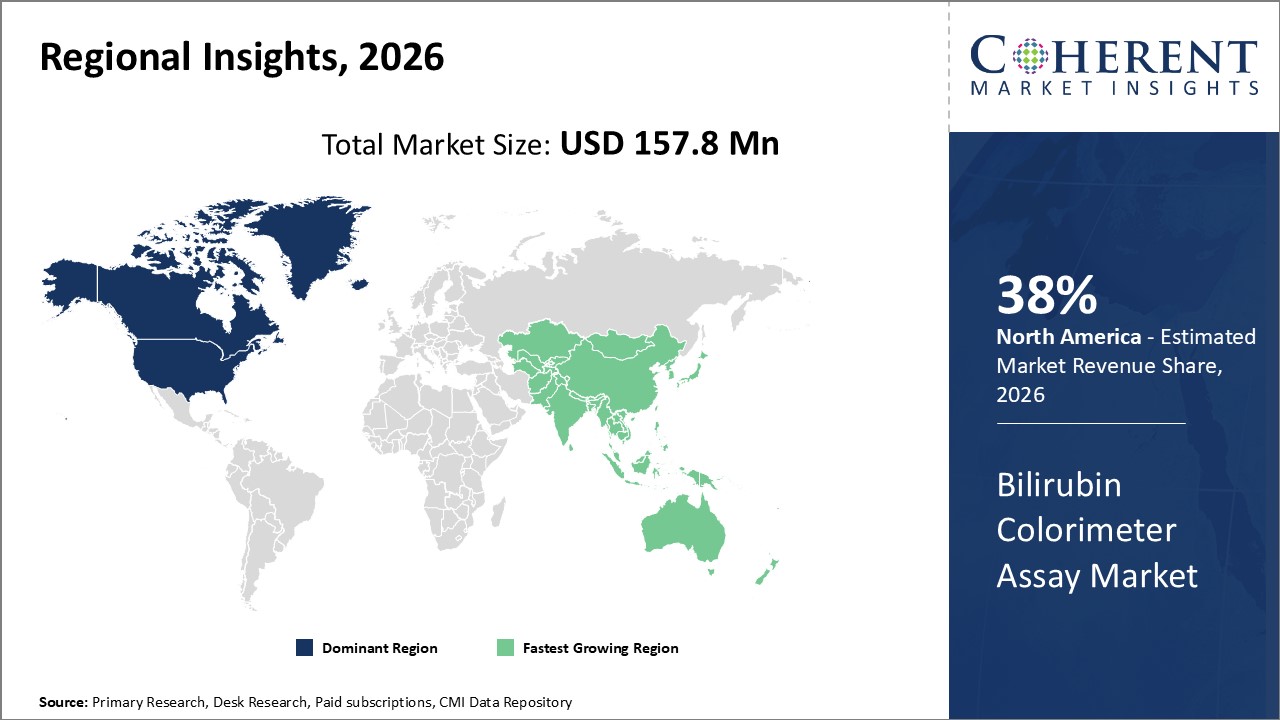
Regionally, North America accounts for the largest industry share at 38%, driven by well-established healthcare infrastructure and government support for diagnostic testing.
In contrast, the Asia Pacific exhibits the highest CAGR due to increasing healthcare spending, rising birth rates, and expanding hospital networks.
Europe maintains steady growth with favorable policies on maternal and child health programs.
Bilirubin Colorimeter Assay Market Segmentation Analysis
Bilirubin Colorimeter Assay Market Insights, By Device Type
Benchtop dominates the market share with 63%. The benchtop segment remains the foundation for clinical laboratories and hospitals due to its superior accuracy, high-throughput capabilities, and integration options with existing lab systems. These devices provide reliable and repeatable bilirubin measurements required for comprehensive neonatal and liver function testing. The Portable segment is the fastest growing, driven by an emphasis on point-of-care diagnostics and telemedicine applications. These devices offer convenience for bedside testing, especially in neonatal units, enabling quick clinical decisions. Handheld bilirubin colorimeters complement this growth by providing mobility and user-friendly interfaces, serving ambulatory and home healthcare sectors.
Bilirubin Colorimeter Assay Market Insights, By End-User
Hospitals dominate the market share with 48%. Hospitals prioritize bilirubin colorimeter assays for neonatal jaundice screening and liver function monitoring, supported by government mandates and clinical guidelines. Hospitals also benefit from high patient throughput and comprehensive diagnostic requirements, driving sustained equipment investments. Diagnostic Centers are witnessing rapid growth due to their expanding role in outpatient diagnostic services and specialized testing. Their flexible adoption of innovative bilirubin colorimeters allows catering to a wider patient base seeking prompt results. Clinical Laboratories serve as critical hubs for large-scale screening and confirmatory testing, balancing accuracy demands with operational efficiency.
Bilirubin Colorimeter Assay Market Insights, By Application
Neonatal Jaundice Screening dominates the market share with 55%. The dominance is attributed to mandatory newborn screening programs across many countries mandating early detection of elevated bilirubin, a leading cause of neonatal morbidity. The specialized bilirubin assays catering to this application emphasize rapid and non-invasive measurement techniques. Liver Function Testing is the fastest-growing application segment, driven by increasing incidences of liver-related diseases due to alcohol consumption, hepatitis prevalence, and metabolic disorders. This segment demands sensitive and precise colorimetric assays to monitor bilirubin levels as part of comprehensive liver panels.
Bilirubin Colorimeter Assay Market Trends
The Bilirubin Colorimeter Assay market trend is prominently characterized by the convergence of technological innovation and shifting healthcare paradigms.
The transition from traditional laboratory-bound assays to portable, bedside bilirubin measurement devices exemplifies this shift.
For example, in 2025, the adoption rate of handheld colorimeters in neonatal wards increased by 21% globally, driven by demands for rapid diagnostics.
Another significant trend is the integration of assay outputs with AI-based clinical decision support systems, enhancing diagnostic accuracy and reducing human error.
Recent trials in leading U.S. hospitals demonstrated a 16% improvement in neonatal jaundice management through AI-enabled bilirubin monitoring platforms.
Regionally, North America dominates the market due to substantial investment in healthcare infrastructure and favorable policy environments encouraging early disease diagnosis.
This region commands approximately 39% of the bilirubin colorimeter assay market share as of 2026.
Bilirubin Colorimeter Assay Market Insights, By Geography
North America Bilirubin Colorimeter Assay Market Analysis and Trends
In North America, the Bilirubin Colorimeter Assay market dominance stems from strong healthcare infrastructure, government neonatal screening mandates, and a mature market with extensive research-based demand. The U.S., as a key market driver, sees ongoing investments in hospital equipment modernization and governmental grants to enhance neonatal care, underpinning market revenue growth. Leading companies have expanded product offerings tailored for hospital and diagnostic laboratory uses, reinforcing their market share with 38%.
Asia Pacific Bilirubin Colorimeter Assay Market Analysis and Trends
Meanwhile, the Asia Pacific exhibits the fastest growth, driven by increasing healthcare access, rising awareness of neonatal jaundice, and government initiatives supporting maternal and child health. The region’s growing birth rates and expanding healthcare facilities during 2025-2026 have catalyzed demand for bilirubin colorimeter assay devices. Local manufacturing hubs in China and India enable cost-effective solutions to penetrate emerging markets, pushing overall market expansion at a CAGR exceeding 10%.
Bilirubin Colorimeter Assay Market Outlook for Key Countries
USA Bilirubin Colorimeter Assay Market Analysis and Trends
The U.S. maintains a prominent position with a technologically advanced healthcare system and stringent newborn screening programs. High prevalence of liver-related diseases drives hospital demand for bilirubin colorimeter systems, supported by reimbursements and increasing government healthcare expenditure. Major players such as Roche Diagnostics and Abbott Laboratories have intensified R&D investments in next-generation bilirubin assay systems for enhanced clinical workflow integration. This focus has resulted in a 15% growth in market revenue within the country during 2025. Strategic collaborations between manufacturers and pediatric healthcare networks further bolster U.S. market penetration.
India Bilirubin Colorimeter Assay Market Analysis and Trends
India’s market growth is fueled by expanding hospital infrastructure and rising healthcare awareness among urban and rural populations alike. Government programs targeting neonatal health have increased demand for bilirubin colorimeter assays in public and private hospitals. Local manufacturers are introducing cost-effective portable devices suited for remote and underserved regions, facilitating broader accessibility. This has contributed to the country's market revenue doubling between 2022 and 2026. The collaborative efforts of key players and healthcare providers in India continue to refine neonatal screening processes, enhancing early detection capabilities and sustaining strong business growth.
Analyst Opinion
The surge in neonatal healthcare infrastructure has driven demand for bilirubin colorimeters, with over 130 million newborns annually requiring jaundice screening. Recent hospital procurement data in the U.S. shows equipment sales increasing by 13% in 2025 compared to the previous year, underscoring the instrument’s critical role.
Adoption of point-of-care testing (POCT) strategies has intensified demand dynamics. Studies published in 2026 reveal a 41% reduction in diagnostic turnaround times where bilirubin colorimeters are used at the bedside, demonstrating efficiency gains that directly support higher market revenue.
Pricing trends show a moderate increase driven by technological enhancements integrating automated calibration and digital readout. For instance, manufacturers introduced next-gen devices in 2025 priced 8% higher on average, reflecting enhanced accuracy and user convenience sought by clinical labs.
Export volumes from Asian manufacturing hubs to Europe and North America grew by approximately 15% year-over-year in 2025, indicating expanding global supply chains and international footprint growth for market players predominantly located in the Asia-Pacific regions.
- Current Industry Events of 2026
- Market Size Estimation
- Regional Breakdown
- Competitive Landscape
- Customer Intelligence
- Segmental Analysis
- Pricing Analysis
- Key Market Drivers, Challenges & Future Trends
- Customized Insights Section
Market Scope
| Report Coverage | Details | ||
|---|---|---|---|
| Base Year: | 2025 | Market Size in 2026: | USD 157.8 million |
| Historical Data for: | 2020 To 2024 | Forecast Period: | 2026 To 2033 |
| Forecast Period 2026 to 2033 CAGR: | 8.3% | 2033 Value Projection: | USD 265.4 million |
| Geographies covered: |
| ||
| Segments covered: |
| ||
| Companies covered: | Sysmex Corporation, PerkinElmer Inc., Roche Diagnostics, Horiba Ltd., Abbott Laboratories, Beckman Coulter Inc., Sekisui Medical Co., Ltd., Nova Biomedical Corporation, Arkray, Inc., Siemens Healthineers, Bio-Rad Laboratories, Inc. | ||
| Growth Drivers: |
| ||
Bilirubin Colorimeter Assay Market Growth Factors
The rise in neonatal mortality reduction programs worldwide has propelled demand for bilirubin colorimeter assays, especially in developing markets. Additionally, increasing liver disorder incidences due to lifestyle diseases have expanded the end-user base in hospitals and clinical laboratories. Technological innovations such as integration with electronic health records (EHRs) and automation are making assays more precise and user-friendly, prompting healthcare providers to upgrade their testing infrastructure. Government initiatives supporting early disease detection and newborn screening programs in countries like the U.S., India, and China have directly contributed to market revenue growth in recent years.
Bilirubin Colorimeter Assay Market Development
In 2020, Abbott Laboratories launched a new automated bilirubin analyzer featuring enhanced throughput and analytical precision for clinical laboratories. The system was designed to streamline bilirubin testing workflows, reduce turnaround times, and deliver highly accurate results for both total and direct bilirubin measurements, supporting improved diagnostics in liver function and neonatal care.
In 2021, Siemens Healthcare Diagnostics received U.S. FDA approval for a novel point-of-care bilirubin testing device, enabling rapid and reliable bilirubin measurement at the patient’s bedside. The portable system enhances clinical decision-making in neonatal and hepatic assessments, particularly in emergency and pediatric settings, by providing lab-quality results within minutes.
In 2022, BioVision introduced a high-sensitivity bilirubin assay kit specifically optimized for neonatal screening applications. The kit delivers precise quantification of low bilirubin levels with superior reproducibility, helping healthcare providers detect and manage neonatal jaundice early, thereby improving outcomes in newborn health diagnostics.
Key Players
Leading Companies of the Market
Sysmex Corporation
PerkinElmer Inc.
Roche Diagnostics
Horiba Ltd.
Abbott Laboratories
Beckman Coulter Inc.
Sekisui Medical Co., Ltd.
Nova Biomedical Corporation
Arkray, Inc.
Bio-Rad Laboratories, Inc.
Leading market companies adopt competitive strategies focusing on product innovation and regional expansion. For example, Sysmex Corporation launched an advanced bilirubin assay module in early 2026, enhancing throughput capacity by 16%, leading to a 11% revenue surge in APAC markets. Roche Diagnostics has strengthened its distribution network across North America, contributing to a 18% growth in market share by optimizing customer reach and after-sales services.
Bilirubin Colorimeter Assay Market Future Outlook
Future growth will focus on integrating bilirubin colorimeter assays into compact, automated, and point-of-care diagnostic systems. Innovation will emphasize reagent stability, faster reaction kinetics, and digital result connectivity for seamless data management. As the prevalence of liver diseases and neonatal jaundice increases globally, demand for rapid and cost-effective testing will remain strong. Integration with smart analyzers and AI-supported diagnostic platforms will enhance result accuracy and interpretation, ensuring bilirubin assays continue to be a key diagnostic tool in clinical biochemistry.
Bilirubin Colorimeter Assay Market Historical Analysis
The bilirubin colorimeter assay market has long been central to clinical chemistry, providing one of the earliest biochemical methods for liver function testing. Since its introduction, the colorimetric diazo reaction has been refined to improve sensitivity and specificity for both direct and total bilirubin measurements. Over decades, laboratories transitioned from manual spectrophotometric assays to fully automated analyzers capable of processing high sample volumes. Technological refinements, such as stable reagent formulations and interference-resistant chemistries, enhanced reliability and reproducibility. The adoption of microplate-based and dry chemistry methods further advanced throughput in modern diagnostic laboratories.
Sources
Primary Research Interviews:
Clinical Biochemists
Pathologists
Laboratory Managers
Diagnostic Device Specialists
Databases:
PubMed Clinical Chemistry Data
NIST Chemical Kinetics Database
FDA IVD Device Listings
WHO Laboratory Data
Magazines:
Clinical Lab Products
Medical Laboratory Observer
Diagnostics World
LabMedica International
Journals:
Clinical Biochemistry
Journal of Clinical Laboratory Analysis
Analytical Biochemistry
Clinical Chemistry and Laboratory Medicine
Newspapers:
The Hindu (Science)
The Guardian (Health)
The New York Times (Medical)
Deccan Chronicle (Health)
Associations:
American Association for Clinical Chemistry (AACC)
International Federation of Clinical Chemistry (IFCC)
World Health Organization (WHO)
CLSI (Clinical and Laboratory Standards Institute)
Get access to 250+ pages report
Every segment, forecast, competitor profile and data table behind the analysis above — available for instant download.
- ESOMAR Member
- ISO 9001:2015 Certified
- D-U-N-S Registered
- GDPR & CCPA Compliant
Missing comfort of reading report in your local language? Find your preferred language:
Transform your Strategy with Exclusive Trending Reports
Frequently Asked Questions
The dominant market players include Sysmex Corporation, Roche Diagnostics, and Horiba Ltd., which are leading in product innovation and global distribution.
The market is projected to grow from USD 157.8 million in 2026 to USD 265.4 million by 2033, reflecting a CAGR of 8.3%.
Hospitals hold the largest growth opportunity due to increasing neonatal screenings and liver function testing requirements.
Trends indicate growing adoption of portable bilirubin devices, AI integration, and sustainable manufacturing methods, accelerating market growth.
Competition revolves around technological innovation, pricing strategies, and expanding regional footprints. Challenges include regulatory compliance and maintaining accuracy standards.
Market players focus on partnerships with healthcare providers,regional expansion, and continuous product development to meet evolvingclinical needs.