

Bio Plasticizers Market Analysis & Forecast: 2026 to 2033
Bio Plasticizers Market is estimated to be valued at USD 3.18 Bn in 2026 and is expected to reach USD 5.10 Bn in 2033, exhibiting a compound annual growth rate (CAGR) of 7.0% from 2026 to 2033.
Key Takeaways
- Based on Product, the Epoxidized Soybean Oil (ESBO) segment is expected to lead the market with 36.6% share in 2026, due to its renewability, compliance, versatility, and cost-effectiveness.
- Based on End Use, the Building & Construction segment is expected to hold the largest share of the market in 2026, due to its heavy reliance on flexible PVC and safer, compliant alternatives like ESBO and castor oil derivatives.
- Based on Region, the Asia Pacific region is set to lead the bio plasticizers market with 39% share in 2026. While, Europe is anticipated to be the fastest growing region.
Market Overview
Increasing demand for bio plasticizers from the global packaging industry is expected to drive the market in the coming years. Moreover, the increasing demand for bio-plasticizers in the production of plastics used in the global textile industry is expected to increase the consumption of bio-plasticizers in the coming years. Furthermore, sustainable plastic manufacturing practices are expected to have a positive impact on the economy while promoting resource efficiency, waste reduction and pollution, creating new opportunities for innovation and growth.
Current Events and Its Impacts on the Bio Plasticizers Market
Current Event | Description and its Impact |
EU Single-Use Plastics Directive and Green Deal Implementation |
|
Technological Breakthroughs in Bio-based Chemical Production |
|
Advancements in Bio Plasticizers Market
Lifecycle Carbon Footprint
- Bio plasticizers reduce CO₂ emissions by 25–40% compared to fossil-based phthalates.
- Example: ESBO (Epoxidized Soybean Oil) production emits ~1.8 kg CO₂/kg vs ~3.2 kg CO₂/kg for DEHP.
- This metric is increasingly used in green building certifications (LEED, BREEAM).
Circular Economy Feedstocks
- By 2030, up to 40% of bio plasticizers are expected to come from waste oils (used cooking oil, palm fatty acid distillates).
- This reduces reliance on virgin soybean/castor oil and stabilizes supply chains.
- Current Industry Events of 2026
- Market Size Estimation
- Regional Breakdown
- Competitive Landscape
- Customer Intelligence
- Segmental Analysis
- Pricing Analysis
- Key Market Drivers, Challenges & Future Trends
- Customized Insights Section
Segmental Insights
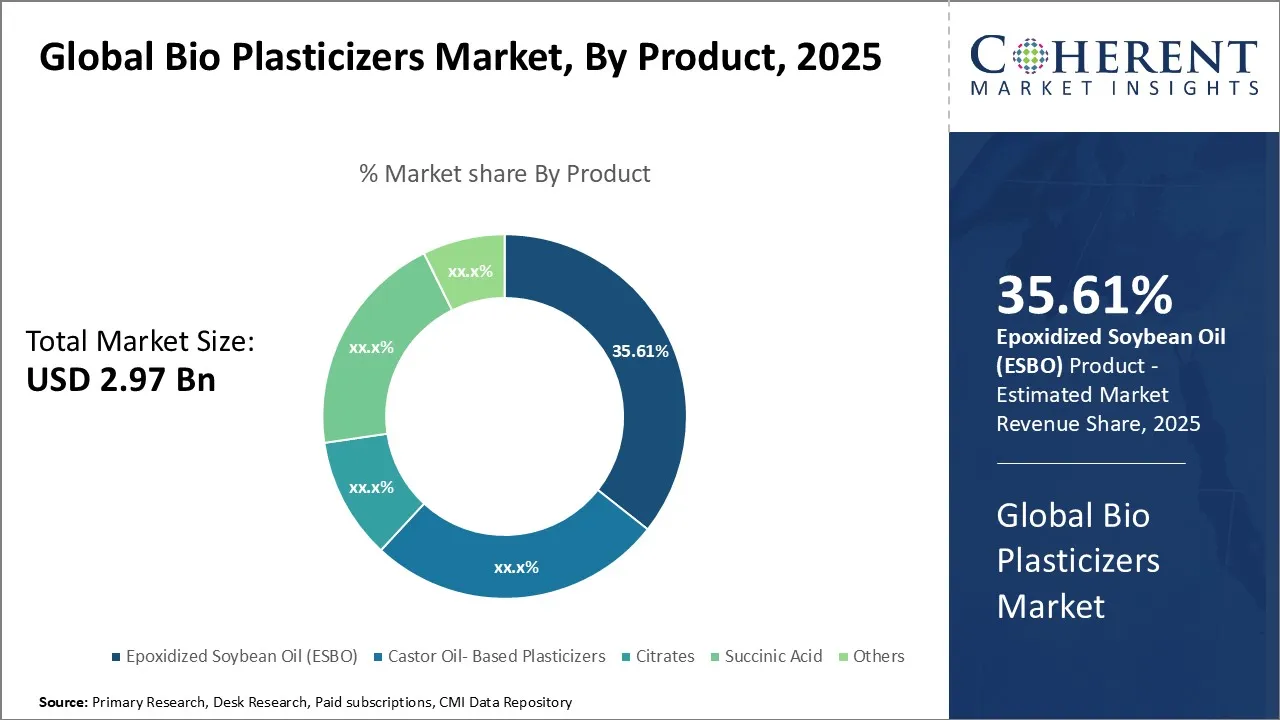
Global Bio Plasticizers Market Insights, By Product - Epoxidized Soybean Oil (ESBO) Dominates Due To Its Renewability, Compliance, Versatility, And Cost-Effectiveness
In terms of product, the Epoxidized Soybean Oil (ESBO) is expected to dominate the global market in 2026 with 36.6% share. This is attributed to their cost-effectives and are efficient for those who are allergic to natural Bio Plasticizers. The Epoxidized Soybean Oil offers factors such as renewability, regulatory-compliant, versatile across PVC applications and cost-effectiveness. It also holds unique combination of sustainability, safety, and affordability making it’s a go-to-choice for industries raging from construction to packaging and medical devices.
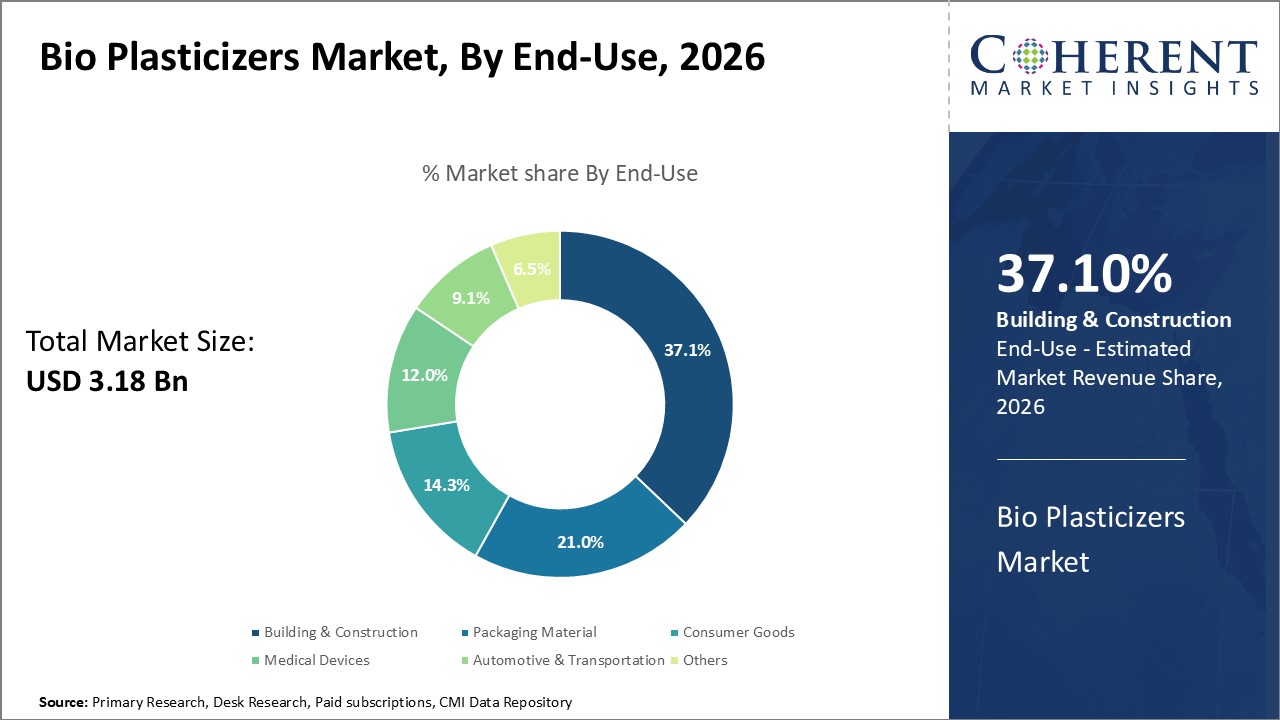
Global Bio Plasticizers Market Insights, By End-Use - Building & Construction Dominance Is Due to Its Heavy Reliance on Flexible PVC And Safer, Compliant Alternatives Like ESBO And Castor Oil Derivatives
Based on End-Use, the Building & Construction segment is expected to dominate the global market with largest share of the market in 2026. This is attributed to their popularity. The building and construction are popular in bio plasticizers market is due to its extensive reliance on flexible OVC across flooring, wall coverings, roofing membranes pipes and cables, this all requires plasticizers to enhance performance. Bio Plasticizers such as ESBO and castor oil derivatives are crucial in improving flexibility and stability. They asl meet the stricter safety standards.
For instance, in September 2025, Researchers at Fraunhofer are making progress on bio-based functional plastic alternatives that develop faster and last longer. These new ideas were first meant for packaging and industrial uses, but they could also be used in building and construction, for example, for sustainable flooring, wall panels, insulation, and composites. The project fits with the goals of the circular economy to cut down on plastics made from fossil fuels.
Regional Insights
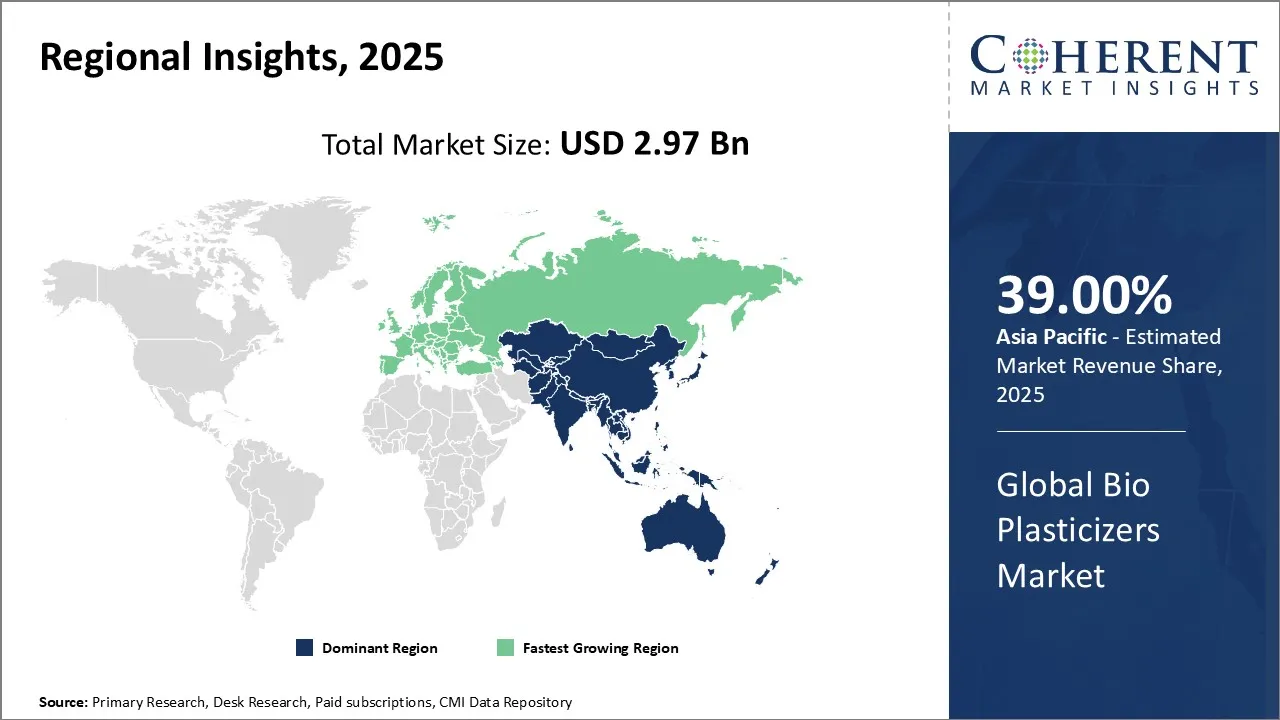
Asia Pacific Bio Plasticizers Market Analysis & Trends
The Asia Pacific is expected to hold leading position in the global Bio Plasticizers market in 39% share in 2026. Asia Pacific bio plasticizers market is expected to grow on account of the high demand for consumer goods products and rising construction activities in the region. Developed countries such as India, China, Japan and South Korea use bio softeners for water treatment, dental care, household bleaching and chemical applications. Countries such as India and China have growing populations, rising income levels and rising purchasing power parities that are driving demand for consumer goods such as toys, personal items and household items. These factors are expected to boost the demand for bio plasticizers in the region during the forecast period.
For instance, in June 2026, Kemira teamed up with Shanghai Bluepha Microbiology Technology to make barrier coatings that are completely bio-based and biodegradable using PHA for paper, paperboard, and molded fiber products. The new product can be heat-sealed and is highly resistant to oil, water, and grease. Its goal is to speed up the packaging industry's move toward low-carbon, environmentally friendly solutions throughout the Asia-Pacific region.
Europe Bio Plasticizers Market Analysis & Trends
Europe is dominated by large developed countries such as the UK, Germany, France, Italy and Spain, increasing the number of personal care and cosmetics manufacturers and various market suppliers. Factors such as changing consumer lifestyles, growing awareness of self-care, and growing preference for consuming organic cosmetics have increased the demand for organic cosmetics. Therefore, rising demand for cosmetics in the market is expected to boost the demand for bio-emollients during the forecast period.
For instance, in October 2026, Europe started building its first industrial-scale plant in France to make a new bio-based molecule. This is a big step toward replacing chemicals made from fossil fuels. Circular Bio-based Europe supports the project, which aims to speed up the switch to eco-friendly materials for plastics, coatings, and adhesives. This will help the EU Green Deal and the circular bioeconomy.
Bio Plasticizers Market Outlook Country-Wise
India Bio Plasticizers Market Trends
India's bio plasticizers market is going to expand quickly in 2026 as more people are moving to cities, construction is booming, and the automotive and packaging sectors are growing. People are becoming more aware of sustainability, the government is limiting harmful phthalates, and there is a demand for eco-friendly PVC alternatives. The fact that soybean and castor oil are available locally also helps growth.
For instance, in November 2026, IG Petrochemicals Ltd. invested ₹100 crore into its biofuel’s subsidiary, which shows that it is serious about using renewable energy. The company also said that the timeline for its upcoming plasticizer plant had been pushed back, which is a sign that the project is being carried out differently. IGPL, India's leading maker of phthalic anhydride, wants to expand its petrochemical base while also getting into renewable energy.
Germany Bio Plasticizers Market Trends
Germany's bio plasticizers market is expected to be driven by strict EU phthalate rules, strong policies for sustainability, and the need for eco-friendly PVC alternatives in construction, cars, and packaging in 2026. Consumer demand for eco-friendly materials and new ideas in renewable feedstocks make Germany a top European market.
For instance, in November 2026, Frankfurt University of Applied Sciences and BIOVOX GmbH are working together on a German research project called "Bio_K_Sub" that is making bio-based plastics for infusion bags, blood bags, and medical tubing. The initiative, which got €500,000 from Hesse's LOEWE program, aims to replace fossil plastics, reduce down on hospital emissions, and make healthcare more environmentally friendly.
Market Report Scope
Bio Plasticizers Market Report Coverage
| Report Coverage | Details | ||
|---|---|---|---|
| Base Year: | 2025 | Market Size in 2026: | USD 3.18 Bn |
| Historical Data for: | 2020 To 2024 | Forecast Period: | 2026 To 2033 |
| Forecast Period 2026 to 2033 CAGR: | 7.0% | 2033 Value Projection: | USD 5.10 Bn |
| Geographies covered: |
| ||
| Segments covered: |
| ||
| Companies covered: | Givaudan SA, International Flavors & Fragrances Inc., Firmenich SA, Symrise AG, Takasago International Corporation, Sensient Technologies Corporation, T. Hasegawa Co., Ltd., Kerry Group, Mane SA, and Huabao International Holdings Limited | ||
| Growth Drivers: |
| ||
| Restraints & Challenges: |
| ||
Global Bio Plasticizers Market Drivers
Growth of end-use industries
The most important raw materials for the production of bio emollients include castor oil, soybean oil and linseed oil. Increased application of bio plasticizers in various end-use industries such as automotive, construction, packaging, textiles, transportation, and agriculture is expected to drive industry growth in the coming years.
Consumer Goods is one of the fastest growing segments of the bio plasticizer market. Reflecting the high growth of the past decade, his per capita income of local residents not only in developed countries but also in some developing countries in Central America and the Asia-Pacific has increased, increasing the demand for consumer goods and fast-moving consumer goods, is also increasing.
Stringent Regulations on Traditional Plasticizers
Favorable government regulations on the use of bio plasticizers in the automotive, textile and consumer goods industries are expected to drive the global market during the forecast period. Organic fabric softeners are made from renewable natural raw materials.
In the Asia-Pacific region, Japan's National Institute of Advanced Industrial Science and Technology (AIST) collaborated to launch a bio-softening product that is biodegradable, environmentally friendly, hypoallergenic and non-toxic domestically. In addition, efforts such as 'Made in India' are expected to improve the domestic bio plasticizer production scenario during the forecast period as well.
Global Bio Plasticizers Market Opportunities
The rapidly increasing use of bio-based plastics as alloys and metal substitutes in the automotive and transportation sectors is one of the key factors behind the global demand for bio plasticizers. Packaging materials are widely used in all fields of bio-plasticizers. The emergence of bio-based plastics is playing an important role in food, pharmaceutical and beverage packaging applications. Composite plastics such as PET and PC are increasingly being replaced by bio plasticizer polymers in the packaging of beverages, consumer goods, consumer electronics, toys and clothing.
Increasing consumption in both developing and developed countries is expected to be a major driver for bio plasticizers in packaging applications. The use of bio plasticizers in packaging is expected to offer significant lucrative opportunities, for example the small amount of bio plastic required for beverage packaging compared to other conventional materials.
Analyst Opinion (Expert Opinion)
- The bio plasticizers market is expanding since stricter rules on phthalates and higher demands for sustainability are speeding up the move toward renewable, low-toxicity additives. Industry reports consistently show that the market is worth billions of dollars, and this is backed up by the fact that more and more PVC applications are using plasticizers, which can make up 20–40% of the weight of the material. Several research groups have published volume-based forecasts that show steady growth over the next ten years. This is because the demand for flexible PVC in construction, cars, medical supplies, and consumer goods is rising as its use grows.
- Epoxidized vegetable oils, especially epoxidized soybean oil, remain the most popular product group on the market. Citrates and other plant-based esters come in second place. These chemistries work well with a wide range of formulations, are accepted by regulators, and have better performance profiles.
- Changes in the prices of agricultural feedstocks and differences in regional regulations can still affect production costs, substitution rates, and investment decisions. Producers are putting more and more effort into making sure that vegetable oil supply chains are stable, improving epoxidation capacity, and building stronger relationships with PVC compounders to speed up the commercialization process. All of these things together make it more likely that bio-based plasticizers will be used more in the long term in major end-use sectors.
Speak to the analyst
Want personalized insights?
Take the findings above to one of our principal consultants, or have the report rebuilt around the segments, geographies and competitors you actually track.
Global Bio Plasticizers Market: Key Developments
- In February 2025, Sika rolled out with ViscoCrete-850 Vegetal, a bio-based superplasticizer for concrete that works really well. The new product is made from some renewable raw materials and makes things easier to work with, stronger, and longer-lasting while using fewer fossil fuels. The product supports sustainable construction, fits in with global green building goals, and helps to build eco-friendly infrastructure.
- In July 2025, The P Zero tire is the first global production model made with more than 70% bio-based and recycled materials. The new product, which is available on some Range Rover 22-inch wheel options, is made with FSC-certified natural rubber, rice husk silica, recycled steel, and bio-resins that act as plasticizers. It is both eco-friendly and high-performing.
- In June 2025, Kuraray announced that it will start making Circular Eval, the world's first 100% bio-based EVOH, in Antwerp in 2025. The new product is made entirely from renewable biomass and provides excellent oxygen-barrier performance for packaging films and coatings. It is a sustainable alternative to fossil-based plastics that does not compromise quality.
Market Segmentation
- Global Bio Plasticizers Market, By Product (Revenue, USD Bn, 2021 - 2033)
- Epoxidized Soybean Oil (ESBO)
- Castor Oil- Based Plasticizers
- Citrates
- Succinic Acid
- Others
- Global Bio Plasticizers Market, By End Use (Revenue, USD Bn, 2021 - 2033)
- Building & Construction
- Packaging Material
- Consumer Goods
- Medical Devices
- Automotive & Transportation
- Others
- Global Bio Plasticizers Market, By Region (Revenue, USD Bn, 2021 - 2033)
- North America
- U.S.
- Canada
- Latin America
- Brazil
- Argentina
- Mexico
- Rest of Latin America
- Europe
- Germany
- U.K.
- Spain
- France
- Italy
- Russia
- Rest of Europe
- Asia Pacific
- China
- India
- Japan
- Australia
- South Korea
- ASEAN
- Rest of Asia Pacific
- Middle East & Africa
- GCC Countries
- Israel
- Rest of Middle East & Africa
- North America
- Global Bio Plasticizers Market: Key Companies Insights (Revenue, USD Bn, 2021 - 2033)
- Evonik Industries Ag
- Solvay
- Avient Corporation
- Lanxess
- Dow
- Emery Oleochemicals
- Basf Se
- Matrica S.P.A.
- Oq Chemicals GMBH
- Dic Corporation
- Hebei Jingu Plasticizer Co., Ltd
- Jiangxi East Huge Dragon Chemical Co., Ltd
Sources
Primary Research Interviews
- Bio-based Plasticizer Manufacturers
- Polymer & PVC Compounders
- Packaging Material Producers
- Industrial Chemical Procurement Managers
- Sustainability & Green Chemistry Consultants
- Others
Databases
- Bloomberg Terminal
- Thomson Reuters Eikon
- IHS Markit
- Euromonitor International
- S&P Global Market Intelligence
- Others
Magazines
- Plasticizers & Additives Magazine
- Plastics Technology Magazine
- Chemical Engineering Magazine
- Sustainable Packaging News
- Polymer Chemistry News
- Others
Journals
- Journal of Applied Polymer Science
- Green Chemistry Journal
- Polymer Degradation and Stability
- Industrial & Engineering Chemistry Research
- ACS Sustainable Chemistry & Engineering
- Others
Newspapers
- Financial Times
- The Wall Street Journal
- Reuters
- Bloomberg News
- Others
Associations
- European Bioplastics Association (EUBP)
- Biodegradable Products Institute (BPI)
- American Chemical Society (ACS) – Green Chemistry Initiative
- Plastics Industry Association – Sustainability Programs
- Others
Public Domain Sources
- U.S. Environmental Protection Agency (EPA)
- European Chemicals Agency (ECHA)
- United Nations Environment Programme (UNEP)
- European Commission – DG Environment
- World Bank Open Data
- Others
Proprietary Elements
- CMI Data Analytics Tool
- Proprietary CMI Existing Repository of Information for the Last 8 Years
*Definition: A plasticizer is a plastic additive that increases the free volume of a polymer when added. Even within the polymer chain. The most commonly used plasticizers are phthalates. Used to improve transparency, flexibility, process ability and compatibility polymer.
Get access to 250+ pages report
Every segment, forecast, competitor profile and data table behind the analysis above — available for instant download.
- ESOMAR Member
- ISO 9001:2015 Certified
- D-U-N-S Registered
- GDPR & CCPA Compliant
Missing comfort of reading report in your local language? Find your preferred language:
Transform your Strategy with Exclusive Trending Reports
Frequently Asked Questions
The Bio Plasticizers Market is estimated to be valued at USD 3.18 Bn in 2026, and is expected to reach USD 5.10 Bn by 2033.
The CAGR of the Bio Plasticizers Market is projected to be 7.0% from 2026 to 2033.
Growth of end-use industries and stringent regulations on traditional plasticizers are fuelling growth of the market.
The epoxidized soybean oil (ESBO) segment is the leading component segment in the market.
High cost of bio plasticizers is the major factors restraining growth of the market.
Evonik Industries Ag, Solvay, Avient Corporation, Lanxess, Dow, Emery Oleochemicals, Basf Se, .Matrica S.P.A., Oq Chemicals GMBH, Dic Corporation, Hebei Jingu Plasticizer Co., Ltd, Jiangxi East Huge Dragon Chemical Co., Ltd.