

Biosimilar Pipeline Analysis Market Size and Share Analysis- 2026 To 2033
The Biosimilar Pipeline Analysis Market size is anticipated to grow at a CAGR of 17%, from USD 40.25 Bn in 2026 to approximately USD 120.79 Bn by 2033. The primary drivers are largely defined by the increasing number of biosimilar candidates entering clinical development, upcoming patent expirations of major biologic therapies, growing regulatory support for biosimilar approvals, rising demand for more affordable biologic treatment options, and increasing investments by pharmaceutical and biotechnology companies in biosimilar development pipelines. According to the U.S. Food and Drug Administration (FDA), biologic medicines represented only around 5% of U.S. prescriptions but accounted for approximately 51% of total U.S. drug spending in 2024, while biosimilars still represented less than 20% market share, highlighting substantial scope for further biosimilar penetration.
Key Takeaways
- The monoclonal antibodies segment is likely to dominate the market with approximately 46.5% in 2026. The segment’s growth is owing to the large number of high-value antibody biologics facing biosimilar competition, expanding development activity around products such as denosumab, ustekinumab, bevacizumab, trastuzumab, rituximab, and pertuzumab, and growing use of biosimilar monoclonal antibodies across oncology and autoimmune diseases. According to the U.S. FDA, 81 biosimilars covering 20 reference products had been approved through 2025, including 10 biosimilars to Humira, 9 to Prolia/Xgeva, 8 to Stelara, 6 to Avastin, and 6 to Herceptin, illustrating the strong concentration of biosimilar activity around antibody-based biologics.
- The clinical trials segment is expected to lead the services category with approximately 61.0% in 2026. The segment’s growth is owing to the need for comparative clinical development, pharmacokinetic and immunogenicity assessment, regulatory evidence generation, and continued advancement of multiple biosimilar candidates toward approval. The FDA reported that 18 biosimilars for 10 reference products were approved in 2025 alone, reflecting substantial ongoing clinical and regulatory activity in the biosimilar development pipeline.
- The chromatography segment is likely to dominate the technology category with approximately 29.5% in 2026. Its leading position is supported by the extensive use of chromatographic techniques for protein purification, physicochemical characterization, impurity profiling, charge-variant assessment, and comparability testing of biosimilar molecules. The FDA continues to require biosimilars to demonstrate that they are highly similar to their reference biologic with no clinically meaningful differences in safety, purity, and potency, supporting demand for advanced analytical characterization technologies throughout biosimilar development.
- The oncology disease segment is set to lead the application category with approximately 41.0% in 2026. The segment’s growth is owing to the large commercial and clinical importance of oncology biologics, multiple reference-product patent opportunities, and increasing development of biosimilars targeting monoclonal antibodies used in breast, colorectal, lung, hematologic, and other cancers. In November 2025, the FDA approved Poherdy (pertuzumab-dpzb) as the first interchangeable biosimilar to Perjeta for HER2-positive breast cancer, further demonstrating expansion of the oncology biosimilar pipeline.
- Europe is likely to dominate the Biosimilar Pipeline Analysis Market with approximately 38.5% in 2026. The region’s leading position is supported by its mature biosimilar regulatory framework, high number of approved biosimilars, strong uptake across major biologic classes, and continued pipeline activity across oncology, immunology, endocrinology, and ophthalmology. According to the European Medicines Agency (EMA), the CHMP approved 41 biosimilars in 2025, the highest annual number on record, while 165 biosimilars had been approved since the establishment of the EU biosimilar framework.
Market Drivers
Expanding Patent Expiries and Pipeline Gaps are Accelerating the Biosimilar Pipeline Analysis Market
The Biosimilar Pipeline Analysis Market is gaining momentum as a large number of biologic medicines approach loss of exclusivity, creating new opportunities for biosimilar developers to identify commercially attractive reference products and prioritize development pipelines. Pipeline analysis is increasingly important for evaluating patent timelines, competitive intensity, clinical-stage assets, geographic development footprints, and future launch opportunities.
According to IQVIA’s analysis for 2026 indicates that approximately 100 biological medicines are expected to go off exclusivity in Europe by 2032, with 79% currently having no biosimilar in development. This significant pipeline gap is opening up opportunities for pharmaceutical and biotech companies to identify underpenetrated biologic targets and grow biosimilar development programs.
Regulatory Streamlining and Growing Biosimilar Approvals are Strengthening Development Activity
Regulatory support continues to be a major driver of the Biosimilar Pipeline Analysis Market with agencies increasingly clarifying development pathways, broadening interchangeability frameworks and fostering competition in the biologic medicines. This is increasing the number of potential development programs requiring pipeline tracking, clinical benchmarking, regulatory intelligence and competitor assessment.
According to the U.S. FDA approved 18 new biosimilars for 10 reference products in 2025, including first biosimilars to Novolog, Xolair, and Perjeta. Several previously approved products also received interchangeable designations, reflecting greater regulatory maturity across several therapeutic categories.
Current Events and Their Impact on the Biosimilar Pipeline Analysis Market
Current Event | Description and its Impact |
U.S. FDA Streamlines Biosimilar Development Requirements (March 2026) |
|
FDA Updates Biosimilar Development Framework Under the BPCI Act (March 2026) |
|
- Current Industry Events of 2026
- Market Size Estimation
- Regional Breakdown
- Competitive Landscape
- Customer Intelligence
- Segmental Analysis
- Pricing Analysis
- Key Market Drivers, Challenges & Future Trends
- Customized Insights Section
Segmental Insights
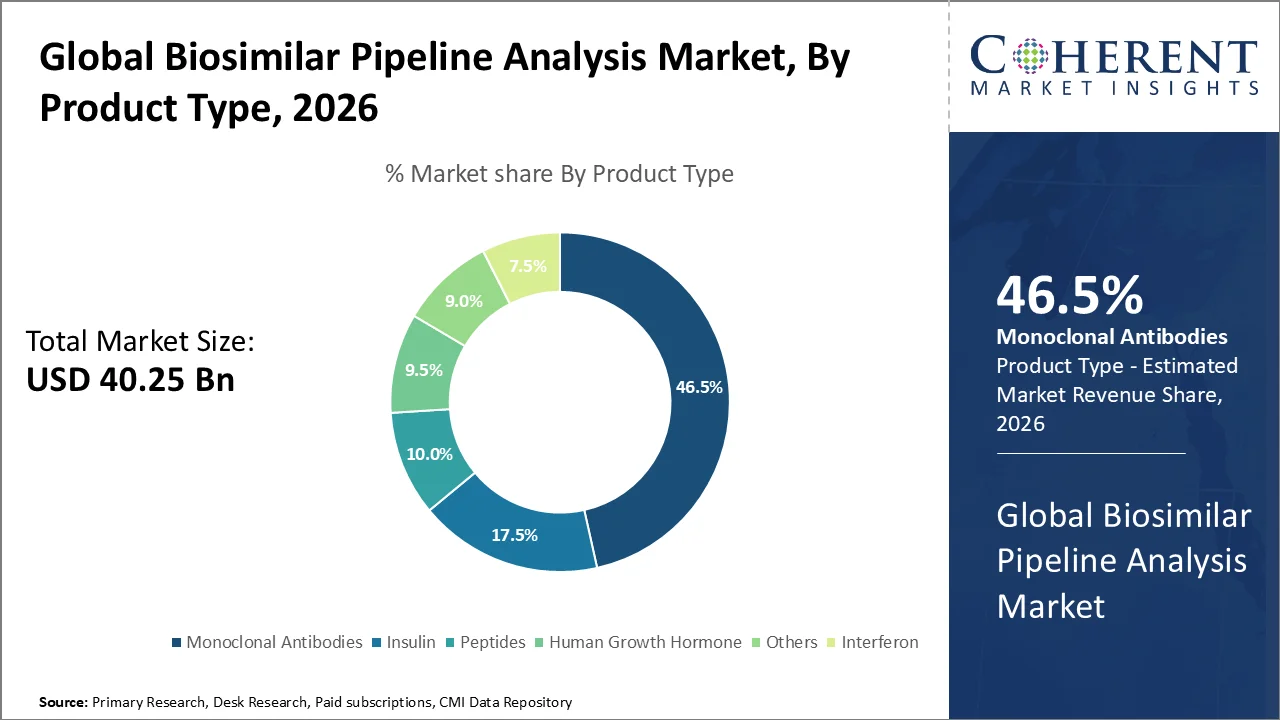
Why are Monoclonal Antibodies Acquiring the Largest Share?
On the basis of product type, the monoclonal antibodies segment is projected to account for the largest Biosimilar Pipeline Analysis Market share of approximately 46.5% in 2026. The segment’s growth is owing to the large number of high-value reference monoclonal antibodies facing biosimilar competition, strong development activity across oncology and autoimmune diseases, and continued expansion of interchangeable biosimilar programs.
The EMA notes that monoclonal antibodies are structurally much larger than simpler biologic proteins, at approximately 150,000 daltons, compared with around 22,000 daltons for human growth hormone and 5,808 daltons for insulin. Their greater structural complexity increases the importance of analytical comparability, clinical development planning, and regulatory assessment during biosimilar development.
In August 2026, Fresenius Kabi announced that the U.S. FDA approved a rituximab biosimilar developed by Dr. Reddy’s Laboratories, referencing Rituxan. Rituximab is a CD20-directed monoclonal antibody used across multiple oncology and immunology indications.
Why are Clinical Trials Holding the Largest Share in Services?
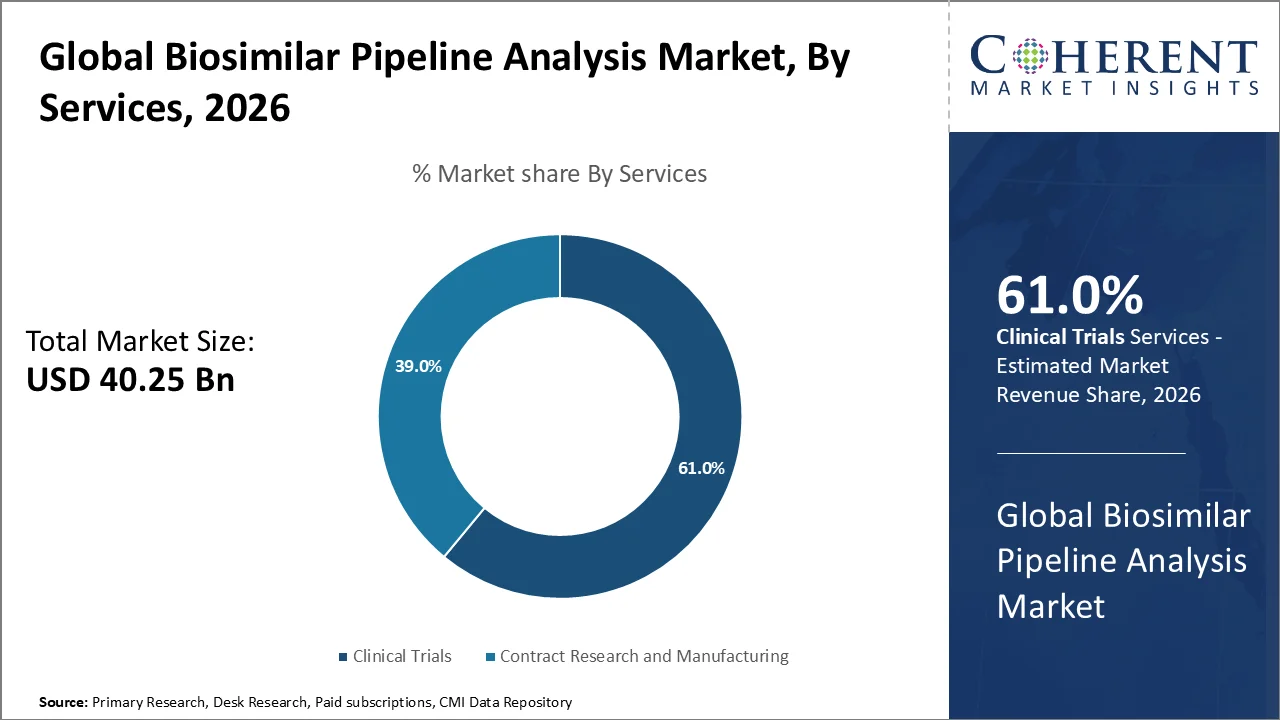
On the basis of services, the clinical trials segment is expected to lead with approximately 61.0% share in 2026. The segment’s growth is owing to the continued requirement for pharmacokinetic, safety, immunogenicity, comparative efficacy, and device-use studies across biosimilar development programs, particularly where analytical evidence alone does not fully resolve residual uncertainty.
A recent example is the Phase I study of the proposed ustekinumab biosimilar Bmab 1200, which compared an autoinjector with a prefilled syringe and enrolled 186 participants. The study began on January 09, 2025 and was completed on July 12, 2025, illustrating continuing clinical-development activity even for mature biosimilar molecules and alternative delivery formats.
In August 2026, Amgen reported that multiple comparative clinical studies for its next-generation biosimilar pipeline remain active. The company is conducting a randomized, double-blind comparative clinical study of ABP 206 versus Opdivo (nivolumab) in treatment-naïve patients with unresectable or metastatic melanoma.
Why is Chromatography Acquiring the Largest Share in Technology?
On the basis of technology, the chromatography segment is likely to dominate with approximately 29.5% share in 2026. The segment’s growth is owing to the extensive use of chromatography for purity assessment, charge-variant profiling, aggregation analysis, glycan characterization, peptide mapping, and comparative analytical assessment between biosimilars and their reference products.
In September 2025, the FDA issued final guidance specifically covering the comparative analytical assessment of therapeutic protein biosimilars, emphasizing detailed physicochemical and functional characterization as a core component of demonstrating biosimilarity.
In July 2026, Agilent Technologies expanded its Altura HPLC column portfolio with the launch of new Altura Size Exclusion Chromatography (SEC) and Altura PLRP-S columns for biotherapeutic analysis.
Why is Oncology Disease Holding the Largest Market Share?
On the basis of application, the oncology disease segment is expected to lead with approximately 41.0% share in 2026. The segment’s growth is owing to the widespread use of biologic monoclonal antibodies in cancer treatment, high treatment costs associated with originator oncology biologics, and the growing number of biosimilar candidates targeting established cancer medicines such as trastuzumab, bevacizumab, rituximab, and pertuzumab.
The oncology biosimilar base is already broad. By the end of 2025, the FDA had approved 6 biosimilars to Avastin (bevacizumab), 6 to Herceptin (trastuzumab), and 3 to Rituxan (rituximab), demonstrating sustained competitive activity around major cancer biologics.
In August 2026, Formycon AG reported the successful completion of clinical development for FYB206, its proposed pembrolizumab biosimilar to Keytruda.
Biosimilar Pipeline Analysis Market Trends
- The rising shift toward streamlined biosimilar development pathways is reducing dependence on large comparative clinical studies and increasing the importance of advanced analytical comparability. In March 2026, the U.S. FDA released draft guidance indicating that unnecessary pharmacokinetic testing may be reduced when scientifically justified, potentially reducing PK study costs by up to 50%, or approximately USD 20 million per development program.
- Growing interest in next-generation oncology biosimilars is driving pipelines toward high-value monoclonal antibodies and checkpoint inhibitors. In January 2026, Biocon Biologics announced three additional oncology biosimilar assets including trastuzumab/hyaluronidase, nivolumab and pembrolizumab. Keytruda contributed approximately USD 29.5 billion while Opdivo contributed approximately USD 9.3 billion in 2024 sales for the reference products, demonstrating the commercial potential for future oncology biosimilar opportunities.
- The growing emphasis on differentiated delivery systems and lifecycle strategies is expanding biosimilar pipeline analysis beyond molecule-level comparability. In August 2026, the FDA added draft guidance addressing container-closure systems and device constituent parts for biosimilar and interchangeable biosimilar products.
Regional Insights
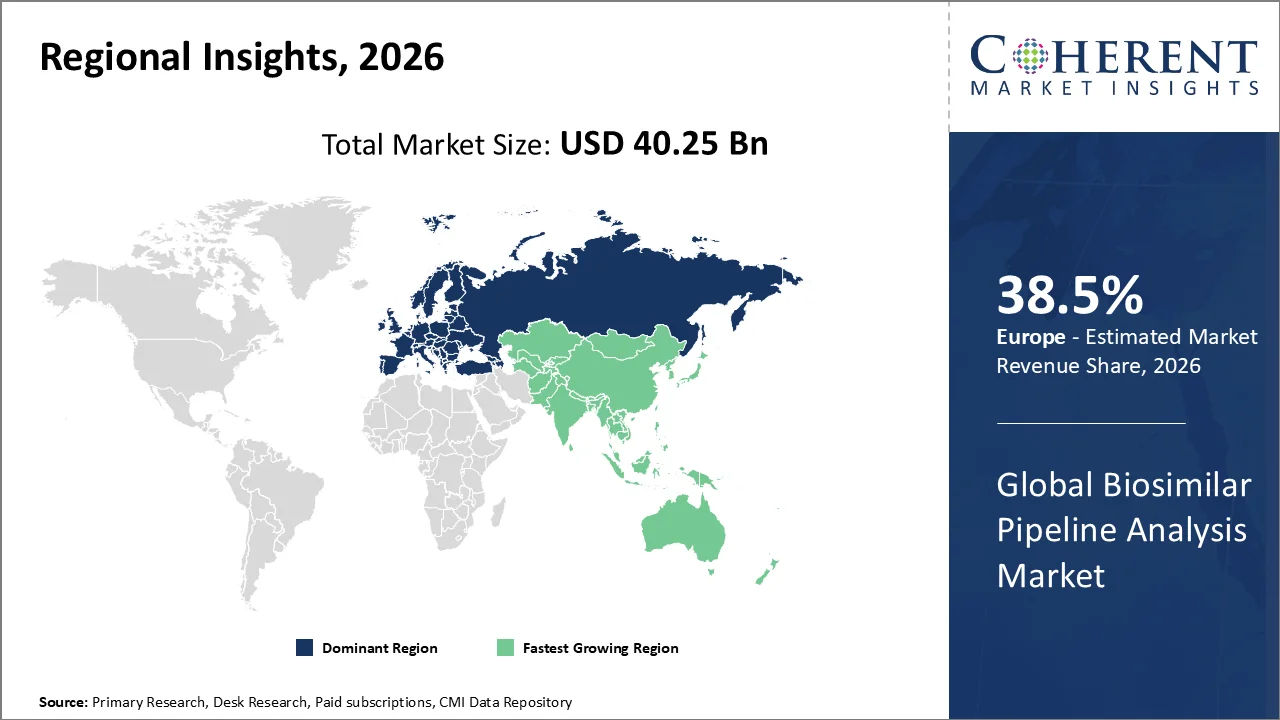
Europe Dominates Owing to the Mature Regulatory Framework and Established Biosimilar Ecosystem
The Europe region accounts for approximately 38.5% of the Biosimilar Pipeline Analysis Market share in 2026. The region’s dominance is owing to its mature biosimilar regulatory framework, large number of approved biosimilars, strong payer-driven adoption, established interchangeability practices, and extensive pipeline activity across oncology, immunology, ophthalmology, and endocrinology.
According to IQVIA’s 2026 analysis, biologic medicines represented approximately 44% of total EU pharmaceutical market value, while biosimilars accounted for around 5%. Biosimilar spending was still growing by approximately 11% annually, indicating continuing commercial expansion despite the region’s already mature adoption levels.
Asia Pacific Biosimilar Pipeline Analysis Market Trends
Asia Pacific is expected to be the fastest-growing region in the Biosimilar Pipeline Analysis Market over the forecast period. The region’s growth is owing to expanding biosimilar manufacturing capacity, regulatory reforms, rising biologic expenditure, and strong development activity from companies in South Korea, India, Japan, and China.
Japan is witnessing greater commercial entry. On May 20, 2026, Samsung Bioepis launched its ustekinumab biosimilar in Japan through NIPRO Corporation, marking Samsung Bioepis’ first product launch in Japan following its inclusion in the National Health Insurance Drug Price Standard. This expansion illustrates the increasing penetration of Asia-based biosimilar developers into major regional pharmaceutical markets.
In August 2026, Celltrion launched the intravenous formulation of STEQEYMA (ustekinumab biosimilar) in Japan, approximately four months after receiving approval from Japan’s Ministry of Health, Labour and Welfare.
Germany Biosimilar Pipeline Analysis Market Trends
The Germany Biosimilar Pipeline Analysis Market is expected to maintain a leading position within Europe owing to rapid biosimilar uptake, favorable reimbursement structures, increasing substitution of biologics, and early commercialization of newly approved products. According to IQVIA, biosimilars accounted for approximately 56% of Germany’s total biologics market revenue during the first half of 2025, demonstrating that biosimilars already represent more than half of biologic sales in the country.
In May 2026, Germany-based Formycon launched its aflibercept biosimilars AHZANTIVE and BAIAMA in Germany, alongside France and Italy, as part of the initial European rollout. The launch expanded Formycon’s commercial portfolio to three internally developed biosimilars and demonstrates Germany’s role as an early European launch market for new biosimilar assets.
China Biosimilar Pipeline Analysis Market Trends
The China Biosimilar Pipeline Analysis Market is expected to witness strong growth owing to expanding domestic biologics development, increasing investment in monoclonal antibody pipelines, improving regulatory infrastructure, and the progression of Chinese companies into global biosimilar development programs.
In March 2026, Shanghai-based Henlius announced that the China NMPA approved the IND application for HLX18, its proposed nivolumab biosimilar, for treatment of certain resected solid tumors. The candidate had previously received U.S. FDA IND clearance and is being developed in accordance with biosimilar requirements in China, the U.S., and Europe, illustrating the increasingly global orientation of Chinese biosimilar pipelines
Who are the Major Companies in Biosimilar Pipeline Analysis Industry
Some of the major key players in Biosimilar Pipeline Analysis Market are Biocon, Pfizer Inc., F. Hoffmann-La Roche Ltd, Amgen Inc., Kyowa Pharmaceutical Industry Co. Ltd, Boehringer Ingelheim GmbH, AstraZeneca, Novartis AG, and Merck & Co.
Key News
- In April 2026, Biocon announced the U.S. commercial launch of BOSAYA and AUKELSO, its denosumab biosimilars. On April 21, 2026, the company also received Health Canada approval for BOSAYA and VEVZUO, biosimilars to Prolia and Xgeva.
- In August 2026, Amgen reported continued clinical advancement of ABP 206, ABP 234, and ABP 692, proposed biosimilars to Opdivo (nivolumab), Keytruda (pembrolizumab), and Ocrevus (ocrelizumab), respectively.
Market Report Scope
Biosimilar Pipeline Analysis Market Report Coverage
| Report Coverage | Details | ||
|---|---|---|---|
| Base Year: | 2025 | Market Size in 2026: | USD 40.25 Bn |
| Historical Data for: | 2020 To 2024 | Forecast Period: | 2026 To 2033 |
| Forecast Period 2026 to 2033 CAGR: | 17% | 2033 Value Projection: | USD 120.79 Bn |
| Geographies covered: |
| ||
| Segments covered: |
| ||
| Companies covered: | Biocon, Pfizer Inc., F. Hoffmann-La Roche Ltd, Amgen Inc., Kyowa Pharmaceutical Industry Co. Ltd, Boehringer Ingelheim GmbH, AstraZeneca, Novartis AG, and Merck & Co. | ||
| Growth Drivers: |
| ||
| Restraints & Challenges: |
| ||
Analyst Opinion
- The Biosimilar Pipeline Analysis Market is gaining strategic importance as regulators simplify development pathways and place greater emphasis on analytical evidence. In March 2026, the U.S. FDA stated that streamlined pharmacokinetic requirements could reduce PK study costs by up to 50%, or approximately USD 20 million per biosimilar program, improving the commercial feasibility of additional pipeline candidates.
- The market is also being shaped by a substantial upcoming loss-of-exclusivity wave. According to IQVIA’s 2026 analysis, approximately 100 biologic medicines are expected to lose exclusivity in Europe by 2032, while 79% currently have no biosimilar in development. This gap creates a strong requirement for pipeline analysis focused on target selection, clinical-stage competition, patent timing, and geographic development activity.
- Regulatory maturity and approval momentum are strengthening the long-term outlook. The European Medicines Agency reported 41 biosimilar approvals in 2025, the highest annual number on record, taking cumulative approvals under the EU biosimilar framework to 165 products. This expanding competitive base increases the need for continuous monitoring of reference molecules, entrants, regulatory milestones, and commercialization strategies.
Speak to the analyst
Want personalized insights?
Take the findings above to one of our principal consultants, or have the report rebuilt around the segments, geographies and competitors you actually track.
Market Segmentation
- By Product Type (Revenue, USD Bn, 2021-2033)
- Human Growth Hormone
- Insulin
- Interferon
- Peptides
- Monoclonal antibodies
- Others
- By Services (Revenue, USD Bn, 2021-2033)
- Clinical Trials
- Contract Research and Manufacturing
- By Technology (Revenue, USD Bn, 2021-2033)
- Electrophoresis
- Recombinant DNA Technology
- Chromatography
- Nuclear Magnetic Resonance Technology
- Bioassay
- Mass Spectrometry
- Western Blotting
- By Application (Revenue, USD Bn, 2021-2033)
- Oncology Disease
- Auto immune Disease
- Blood Disease
- Growth Hormone Deficiencies
- By Region (Revenue, USD Bn, 2021-2033)
- North America
- U.S.
- Canada
- Latin America
- Brazil
- Mexico
- Argentina
- Rest of Latin America
- Europe
- Germany
- U.K.
- France
- Italy
- Spain
- Russia
- Rest of Europe
- Asia Pacific
- China
- India
- Japan
- Australia
- South Korea
- ASEAN
- Rest of Asia Pacific
- Middle East
- GCC
- Israel
- Rest of Middle East
- Africa
- South Africa
- Central Africa
- North Africa
- North America
Sources
Primary Research Interviews
- Biosimilar development scientists
- Biologics and biosimilar R&D heads
- Clinical development and trial management professionals
- Regulatory affairs specialists involved in biosimilar submissions
- Bioprocessing and analytical characterization experts
- Contract research and biomanufacturing professionals
- Oncologists, immunologists, pharmacists, and other clinical KOLs involved in biologic therapy adoption
Databases
- U.S. Food and Drug Administration (FDA) Purple Book
- European Medicines Agency (EMA) Medicines Database
- ClinicalTrials.gov
- EU Clinical Trials Information System (CTIS)
- World Health Organization (WHO)
- U.S. Patent and Trademark Office (USPTO)
- World Intellectual Property Organization (WIPO)
- National Library of Medicine / PubMed
Magazines
- BioPharma Dive
- Pharmaceutical Technology
- BioProcess International
- The Center for Biosimilars
- European Pharmaceutical Review
- Pharmaceutical Executive
Journals
- BioDrugs
- Drugs
- Clinical Pharmacology & Therapeutics
- mAbs
- Journal of Pharmaceutical Sciences
- Expert Opinion on Biological Therapy
- Therapeutic Advances in Drug Safety
Newspapers
- Financial Times
- The Wall Street Journal
- Reuters
- The Economic Times
- Nikkei Asia
Associations
- International Generic and Biosimilar Medicines Association (IGBA)
- Medicines for Europe
- Association for Accessible Medicines (AAM)
- Biosimilars Council
- Biotechnology Innovation Organization (BIO)
- International Federation of Pharmaceutical Manufacturers & Associations (IFPMA)
- International Council for Harmonisation of Technical Requirements for Pharmaceuticals for Human Use (ICH)
Public Domain Sources
- Company annual reports and investor presentations
- Biosimilar pipeline and clinical development disclosures
- FDA, EMA, MHRA, Health Canada, PMDA, and NMPA regulatory publications
- Clinical trial registries and study protocols
- Patent databases such as WIPO, USPTO, EPO, and Google Patents
- Peer-reviewed publications on biosimilarity, analytical comparability, pharmacokinetics, and immunogenicity
- Government reimbursement, pricing, and biosimilar substitution policies
- Company press releases on biosimilar approvals, launches, partnerships, and pipeline developments
Proprietary Elements
- CMI Data Analytics Tool
- Proprietary CMI Existing Repository of Information for the Last 10 Years
Get access to 250+ pages report
Every segment, forecast, competitor profile and data table behind the analysis above — available for instant download.
- ESOMAR Member
- ISO 9001:2015 Certified
- D-U-N-S Registered
- GDPR & CCPA Compliant
Missing comfort of reading report in your local language? Find your preferred language:
Transform your Strategy with Exclusive Trending Reports
Frequently Asked Questions
The Biosimilar Pipeline Analysis Market is expected to reach approximately USD 120.79 Bn by 2033, increasing from USD 40.25 Bn in 2026.
Major players operating in the Biosimilar Pipeline Analysis Market include Biocon, Pfizer Inc., F. Hoffmann-La Roche Ltd, Amgen Inc., Kyowa Pharmaceutical Industry Co. Ltd, Boehringer Ingelheim GmbH, AstraZeneca, Novartis AG, and Merck & Co.
The key factors hampering market growth include high biosimilar development and clinical trial costs and complex regulatory approval requirements.
The market is primarily driven by the increasing number of biosimilar candidates entering clinical development, rising patent expiries of high-value biologic drugs, growing regulatory support for biosimilar approvals, increasing demand for affordable biologic therapies, and rising investments in biosimilar development pipelines.
The Biosimilar Pipeline Analysis Market is anticipated to grow at a CAGR of 17% between 2026 and 2033.
Among regions, Europe is expected to dominate the Biosimilar Pipeline Analysis Market with approximately 38.5% share in 2026, supported by its mature regulatory framework, strong biosimilar adoption, and extensive development activity across major therapeutic areas.
Asia Pacific is expected to be the fastest-growing region over the forecast period, supported by expanding biosimilar manufacturing capacity, regulatory reforms, rising biologic expenditure, and strong development activity in South Korea, India, Japan, and China.