

Bitumen Market Size and Trends
The bitumen market is estimated to be valued at USD 67.32 Bn in 2026 and is expected to reach USD 75.23 Bn by 2033, exhibiting a compound annual growth rate (CAGR) of 1.6% from 2026 to 2033.
Key Takeaways
- Based on Product Type, the Paving Grade Bitumen segment leads the market holding an estimated share of 29.9% in 2026, owing to its wide usage in road construction activities.
- Based on Application, the Roadways segment will hold approximately 28% share in 2026 in the global Bitumen market, due to its excellent binding properties, durability, and cost-effectiveness.
- Based on Region, Asia Pacific is estimated to lead the market with a share of 37. 3% in 2026. While, North America is projected to be the fastest growing region during the forecast period in the bitumen market.
Market Overview
The global bitumen market is primarily driven by infrastructure growth, especially in road construction, which accounts for over 80% of total demand. Expanding urbanization, industrialization, and government investments in transportation—particularly in emerging economies like India and China—are fueling market expansion. In developed countries, the need for road maintenance and upgrades continues to support demand.
Modified bitumen products, including polymer-modified and emulsified types, are gaining popularity due to their durability and performance in extreme conditions. Overall, the market is set for steady growth, supported by infrastructure investments and innovations in sustainable bitumen technologies.
Current Events and their Impact on the Bitumen Market
Current Event | Description and its Impact |
OPEC+ Production Policy Shifts |
|
Global Infrastructure Investment Surges |
|
Export Import Analysis Bitumen
According to data from the World Integrated Trade Solution, India exported a total of 4,294 Bitumen shipments between October 2023 and September 2024. These exports were carried out by 79 Indian exporters and delivered to 295 international buyers. This represents a 13% decline in export volume compared to the previous twelve-month period.
Meanwhile, Coherent Market Insights reports that 170 Bitumen shipments were exported from India in September 2024 alone. This figure reflects no change compared to both September 2023 (YoY) and August 2024 (MoM), indicating stable monthly and annual performance.
India's primary export markets for Bitumen during this period were Nepal, Bhutan, and Bangladesh.
On a global scale, the top three Bitumen-exporting countries are Russia, India, and Iraq. Russia leads with 30,625 shipments, followed by India with 17,716 shipments, and Iraq with 13,906 shipments.
- Current Industry Events of 2026
- Market Size Estimation
- Regional Breakdown
- Competitive Landscape
- Customer Intelligence
- Segmental Analysis
- Pricing Analysis
- Key Market Drivers, Challenges & Future Trends
- Customized Insights Section
Segmental Insights
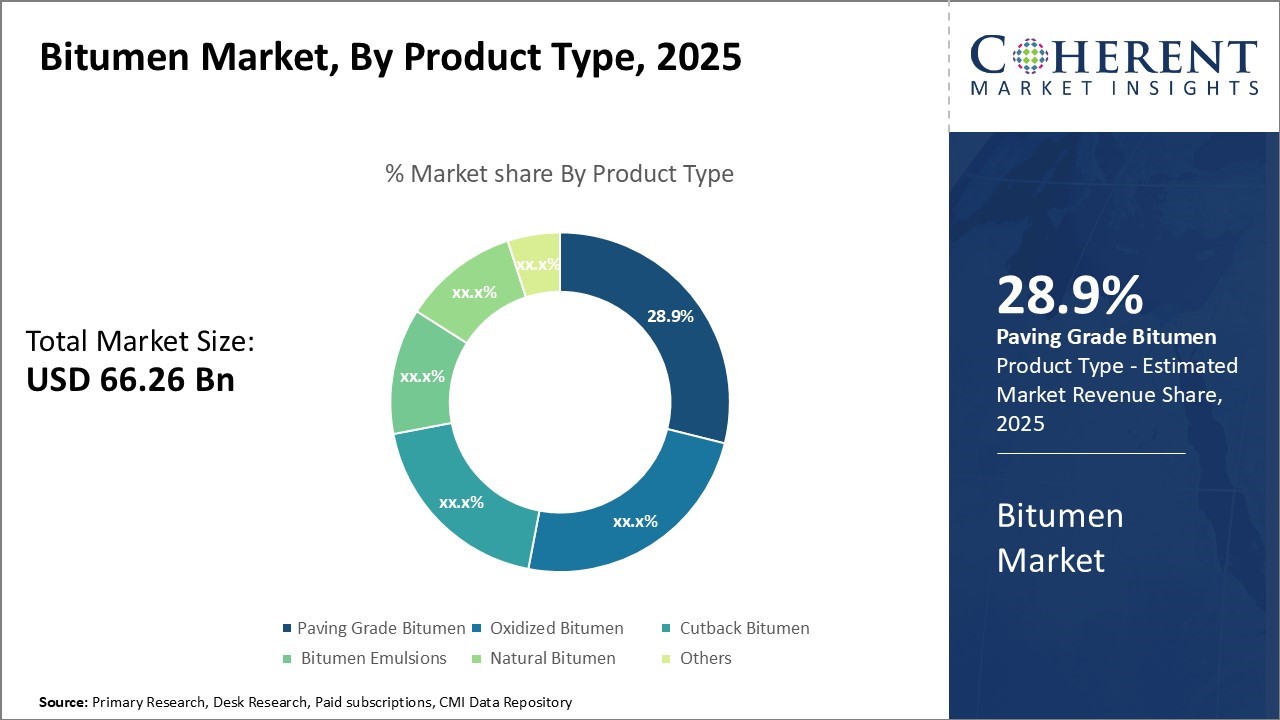
Bitumen Market Insights, By Product Type - Increased Usage in Road Construction Drives Dominance of Paving Grade Bitumen
In terms of product type, paving grade bitumen segment is expected to contribute 29.9% share of the market in 2026, owing to its wide usage in road construction activities. Paving grade bitumen has optimal viscosity and softening point characteristics that make it ideally suited for usage in paving applications such as construction of highways, roads, and driveways. It serves as a primary binder in asphalt concrete, providing the flexibility, durability, and adhesion required for various climatic and traffic conditions. Governments across the globe, especially in fast-growing economies like India, China, Indonesia, and African nations are heavily investing in road networks to support trade, mobility, and urban expansion. Paving grade bitumen is the most widely used material for highways, expressways, and rural road development.
In December 2023, Bitumax, a leading bitumen supplier and exporter, expanded its product portfolio with the introduction of Bitumen 80/100, a versatile penetration-grade aimed at road construction, waterproofing, and industrial applications. The company emphasizes the product's optimal penetration grade, enhanced durability, and suitability for diverse construction projects.
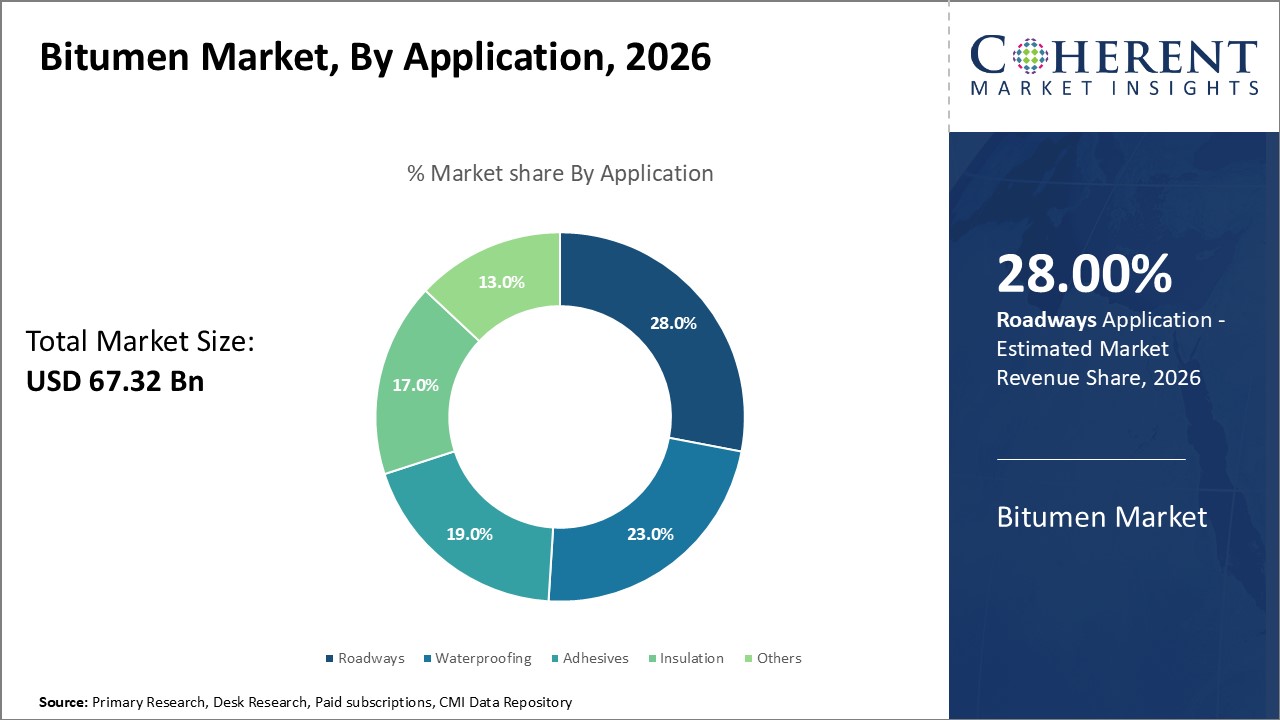
Bitumen Market Insights, By Application - Roadways Segment Drives Due to Excellent Binding Properties and Cost-Effectiveness
In terms of application, roadways segment is expected to contribute 28% share of the market in 2026 due to its excellent binding properties, durability, and cost-effectiveness. Bitumen acts as a strong binder for aggregates, forming a cohesive and durable asphalt mix. Its water-resistant nature helps protect road surfaces from moisture-induced damage, improving longevity. It can withstand repeated traffic loads and thermal expansion without cracking. Its flexibility makes it ideal for both high-traffic highways and low-volume rural roads. The bitumen -based asphalt is relatively easy to produce, lay, and repair. This makes it a preferred choice for both new road construction and road resurfacing projects. Along with that, compared to concrete, bitumen roads are generally cheaper to build and maintain, especially in regions where oil refining (and bitumen as a byproduct) is locally available.
In December 2024, Union Minister Nitin Gadkari inaugurated India’s first national highway stretch constructed using lignin‑based bio‑bitumen on NH‑44 near Mansar, Nagpur. The 1 km test section employs up to 15% bio‑bitumen, developed by Praj Industries in partnership with CSIR‑CRRI, NHAI, and Oriental, using agricultural residue as a sustainable binder. Such innovations are proliferating the bitumen market share.
Regional Insights
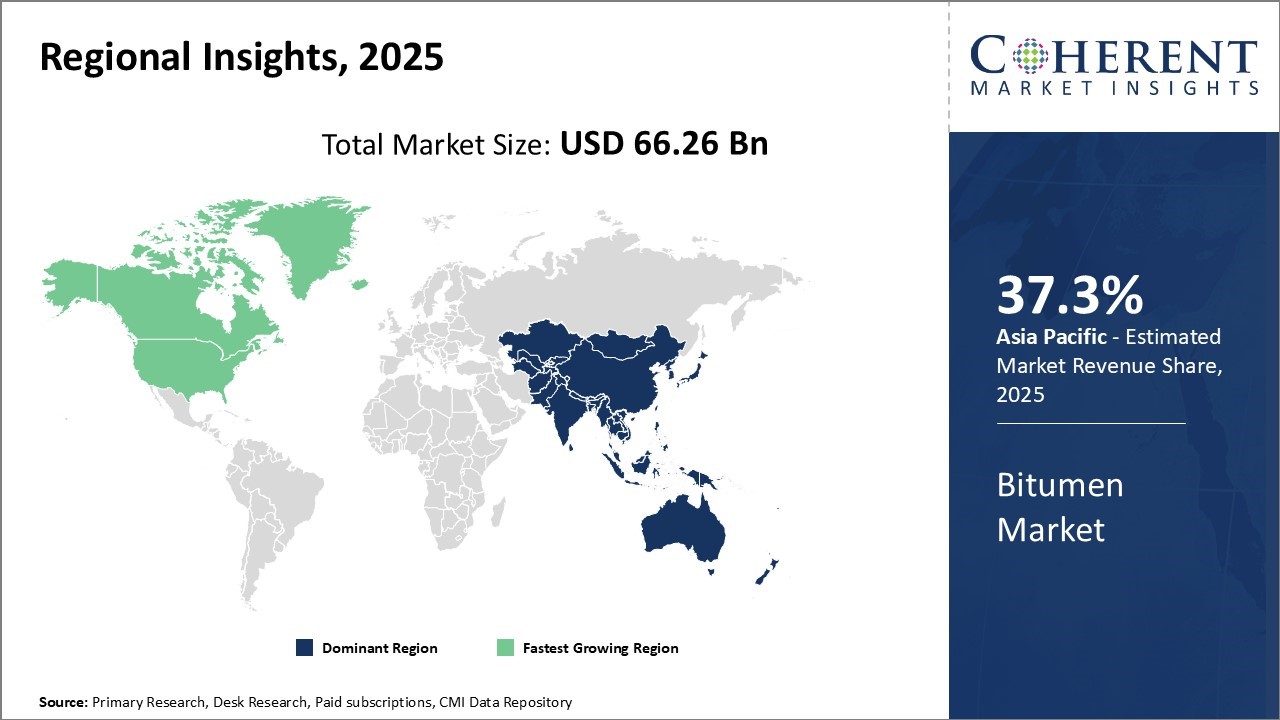
Asia Pacific Bitumen Market Analysis & Trends
Asia Pacific is expected to account for the greatest revenue share of 37.3% in 2026, driven by a combination of economic growth, rapid urbanization, and massive infrastructure investments. Governments in countries like India, China, Indonesia, and Vietnam are investing heavily in national highway expansions, rural road connectivity, and smart cities development. Bitumen is a core material for asphalt roads, rising the demand for road construction. With rapidly growing urban populations, cities across Asia Pacific require extensive development of transportation networks, housing, and commercial infrastructure, all of which involve bitumen-based applications, particularly for paving and waterproofing, further contributing to the bitumen market revenue.
In June 2026, Malaysia launched its largest-ever infrastructure development plan, allocating roughly RM 85 billion toward multi-sector projects—particularly in road networks such as the Pan Borneo Highway, Central Spine Road, and the Greater Kuala Lumpur Transportation Master Plan. This flurry of construction activity is expected to push national bitumen consumption from a previous range of 650,000–700,000 metric tonnes to 800,000–850,000 tonnes in 2026, a sharp increase of around 22% year-over-year.
North America Bitumen Market Analysis & Trends
North America exhibits the fastest growth and is emerging as an important market for bitumen globally. North America is driven by its extensive road network and continuous infrastructure maintenance needs. The U.S. alone has over 4 million miles of public roads, many of which require regular resurfacing, repair, and rehabilitation, creating a consistent demand for paving-grade bitumen. Another key driver is the aging infrastructure. Many highways, bridges, and urban roads built in the mid-20th century are now deteriorating and require substantial investment in restoration. Government programs like the U.S. Infrastructure Investment and Jobs Act (IIJA) are allocating billions toward road upgrades, directly boosting bitumen market share.
In addition to roads, roofing applications also contribute significantly to demand. Bitumen-based roofing products, such as modified bitumen membranes, are widely used in commercial and residential construction due to their waterproofing and thermal insulation properties. Overall, the combination of infrastructure renewal, harsh climate conditions requiring durable materials, and government spending continues to make North America a key market for bitumen.
Global Bitumen Market Outlook for Key Countries
The U.S. Bitumen Market Trends
The U.S. is a major consumer of bitumen due to its extensive 4M+ mile road network and aging infrastructure, much of which requires frequent resurfacing. The Infrastructure Investment and Jobs Act (IIJA) allocates over USD 110 billion for roads and highways, driving significant growth in bitumen market demand. The U.S. has a key focus on road resurfacing for continuous upgrades to deteriorating road, highway expansion by addition of new lanes and expressway projecs and roofing which uses bitumen-based membranes in commercial construction. Additionally, Federal funding and large-scale infrastructure needs ensure strong, sustained demand in the U.S. bitumen market.
India Bitumen Market Trends
India’s bitumen market demand is fueled by large-scale government infrastructure programs such as Bharatmala Pariyojana, Smart Cities Mission, and PMGSY. Bharatmala targets over 83,000 km of highway construction, while PMGSY focuses on rural road connectivity. These initiatives require significant volumes of bitumen for paving and maintenance. India’s sustained infrastructure push and real estate growth make it a key market for bitumen consumption.
Germany Bitumen Market Trends
Germany’s demand for bitumen market is driven by its aging highway network, especially the Autobahn, which requires durable resurfacing solutions. The country relies heavily on polymer-modified bitumen (PMB) for its superior resistance to heavy traffic, temperature extremes, and cracking. Key applications include Autobahn upgrades, airport runway rehabilitation (e.g., Frankfurt, Munich), and energy-efficient roofing systems. Germany’s emphasis on sustainability and infrastructure longevity continues to boost demand for high-performance and specialty bitumen products.
Market Concentration and Competitive Landscape

Bitumen Industry News
- In July 2025, Moglix, Asia’s leading B2B e‑commerce and supply‑chain technology firm, has inaugurated a new greenfield bitumen processing plant under its manufacturing arm, DRG Industries. Located in Kosi Kalan, Mathura, the 3.5‑acre facility will begin commercial operations. It will produce advanced bitumen products, including polymer‑modified bitumen, microsurfacing emulsions, and hard binders aimed at enhancing road durability, reducing maintenance, and lowering carbon emissions
- In February 2025, the Central Road Research Institute (CRRI) introduced Rejubit, India’s first home‑grown rejuvenating agent for recycling old bitumen roads. The agent slashes relaying costs by 66%, reducing reliance on costly imported additives.
- In June 2024, Nynas introduced Nypol RE, a polymer-modified bitumen binder incorporating biogenic components aimed at reducing environmental impact while extending the technical lifespan of asphalt
Analyst Opinion (Expert Opinion)
The global bitumen market value is undergoing a structural recalibration driven by a confluence of technological transformation, environmental scrutiny, and shifting infrastructure priorities.
One of the most significant yet under-discussed shifts is the increasing regulatory pressure from developed economies, especially the EU and North America toward limiting polycyclic aromatic hydrocarbons (PAHs) in paving-grade bitumen. This has led to a quiet yet accelerating pivot toward polymer-modified bitumen (PMB), which offers better performance under thermal stress, extended durability, and reduced lifecycle emissions. For instance, over 80% of roads constructed in Germany today use PMB blends, reflecting both performance standards and environmental compliance requirements. This trend is reshaping supplier portfolios and pushing producers to upgrade their refining capabilities to accommodate higher-grade modified bitumen.
Furthermore, bitumen’s close association with fossil fuel refining places it in a delicate position as global refiners progressively reduce crude runs due to declining fuel demand and rising biofuel quotas. As a result, bitumen is increasingly becoming a byproduct of strategic intent rather than volume optimization. The closure of smaller refineries in Europe and parts of Asia has already led to regional supply imbalances. For example, the shuttering of Shell’s Rheinland refinery bitumen unit in Germany disrupted Central European supply flows, creating opportunities for intra-EU suppliers and imports from Turkey and India.
In emerging economies, particularly in Africa and Southeast Asia, the surge in road development under state-backed infrastructure programs continues to sustain bitumen demand. However, the reliance on imported bitumen in markets such as Kenya and Bangladesh poses risks due to price volatility and logistical bottlenecks. Countries with active upstream assets and integrated refining ecosystems, like India and Saudi Arabia are in a strategically advantageous position to capitalize on this dependency by strengthening export infrastructure.
Speak to the analyst
Want personalized insights?
Take the findings above to one of our principal consultants, or have the report rebuilt around the segments, geographies and competitors you actually track.
Market Report Scope
Bitumen Market Report Coverage
| Report Coverage | Details | ||
|---|---|---|---|
| Base Year: | 2025 | Market Size in 2026: | USD 67.32 Bn |
| Historical Data for: | 2020 To 2024 | Forecast Period: | 2026 To 2033 |
| Forecast Period 2026 to 2033 CAGR: | 1.6% | 2033 Value Projection: | USD 75.23 Bn |
| Geographies covered: |
| ||
| Segments covered: |
| ||
| Companies covered: | Shell Bitumen, NuStar Energy, Exxon Mobil, Marathon Oil Corporation, Valero Energy Corporation, Nynas AB, Petróleos Mexicanos (PEMEX), Indian Oil Corporation, Chevron Texaco Corporation, and Villas Austria GmbH | ||
| Growth Drivers: |
| ||
| Restraints & Challenges: |
| ||
Bitumen Market Driver
- Rapid urbanization and infrastructure development
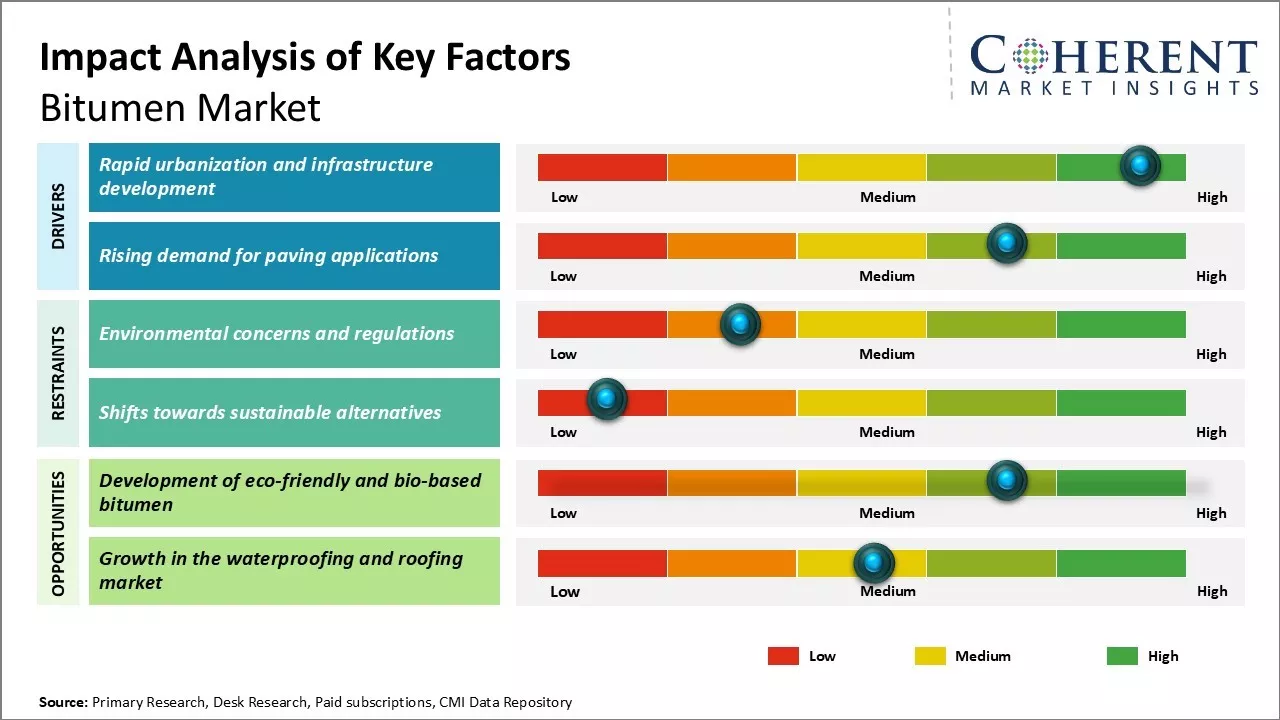
As urbanization accelerates across developing regions, the demand for essential infrastructure, including housing, roads, and commercial spaces is rising sharply. This trend is a core driver in the expansion of the bitumen market, as bitumen is a fundamental material used in road paving, roofing, and waterproofing applications. According to World Bank Group data published in 2023, more than 55% of the global population currently resides in urban areas, and this figure is expected to reach 68% by 2050. This massive demographic shift is placing unprecedented pressure on governments and private sectors to expand and modernize transportation networks, urban housing, and public infrastructure.
From a bitumen market research perspective, this urbanization trend highlights long-term growth opportunities, especially in regions where road density and quality still lag behind economic development. As a result, stakeholders in the bitumen value chain—from refiners and suppliers to construction firms are strategically positioning themselves to capitalize on these evolving market dynamics.
Bitumen Market Opportunity
- Development of eco-friendly and bio-based bitumen for market
One of the most promising opportunities in the bitumen market forecast is the development of eco-friendly and sustainable bitumen alternatives. With growing environmental concerns and pressure to reduce carbon emissions in the construction and infrastructure sectors, the focus has shifted toward creating bio-based bitumen formulations. These sustainable variants are produced using renewable agricultural or plant-based feedstocks, such as lignin, vegetable oils, and agricultural residues, offering a viable substitute for traditional petroleum-derived bitumen. In December 2024, Union Minister Nitin Gadkari inaugurated India’s first National Highway stretch built with bio-bitumen on NH-44 in Mansar, Nagpur. This eco-friendly and durable alternative to traditional bitumen marks a key step toward sustainable road infrastructure. Such incidences are propelling the bitumen market demand.
Market Segmentation
- By Product Type Insights (Revenue, USD Bn, 2026 - 2033)
- Paving Grade Bitumen
- Oxidized Bitumen
- Cutback Bitumen
- Bitumen Emulsions
- Natural Bitumen (Gilsonite)
- Others
- By Application Insights (Revenue, USD Bn, 2026 - 2033)
- Roadways
- Waterproofing
- Adhesives
- Insulation
- Others
- By Regional Insights (Revenue, USD Bn, 2026 - 2033)
- North America
- U.S.
- Canada
- Latin America
- Brazil
- Argentina
- Mexico
- Rest of Latin America
- Europe
- Germany
- U.K.
- Spain
- France
- Italy
- Russia
- Rest of Europe
- Asia Pacific
- China
- India
- Japan
- Australia
- South Korea
- ASEAN
- Rest of Asia Pacific
- Middle East
- GCC Countries
- Israel
- Rest of Middle East
- Africa
- South Africa
- North Africa
- Central Africa
- North America
- Key Players Insights
- Shell Bitumen
- NuStar Energy
- Exxon Mobil
- Marathon Oil Corporation
- Valero Energy Corporation
- Nynas AB
- Petróleos Mexicanos (PEMEX)
- Indian Oil Corporation
- Chevron Texaco Corporation
- Villas Austria GmbH
Sources
Primary Research Interviews from the following stakeholders
Stakeholders
- Interviews with bitumen manufacturers, road construction contractors, petrochemical engineers, refinery operations heads, procurement managers, infrastructure consultants, and regulatory officials from transport and public works departments across major markets.
Specific Stakeholders
- Road and highway project leads at EPC companies
- Procurement managers at national highway authorities
- Operations heads at refineries with bitumen output
- Asphalt mixing plant operators and contractors
- City infrastructure and civil engineers at urban development agencies
- Airport and seaport construction managers
Databases
- UN Comtrade Database
- World Trade Organization (WTO) Trade Statistics
- U.S. Energy Information Administration (EIA)
- Eurostat – Energy and Industrial Outputs
- Indian Ministry of Petroleum & Natural Gas
- China National Bureau of Statistics
- Japan Oil, Gas and Metals National Corporation (JOGMEC)
- Korea National Oil Corporation (KNOC)
- Directorate General of Commercial Intelligence and Statistics (DGCIS), India
Magazines
- World Highways
- AsphaltPro Magazine
- Roads & Bridges
- Bitumen Insider
- Construction Week
- Infrastructure Today
- Civil Engineering & Construction Review
- Oil & Gas Journal
Journals
- Journal of Materials in Civil Engineering
- Construction and Building Materials (Elsevier)
- Fuel (Elsevier)
- Petroleum Science and Technology
- International Journal of Pavement Engineering
- Transportation Research Record
Newspapers
- The Economic Times – Energy & Infrastructure
- Business Standard – Oil & Gas and Construction
- Financial Times – Global Infrastructure & Raw Materials
- The Hindu Business Line – Petroleum and Roads
- Nikkei Asia – Industrial Materials and Transport
- Gulf News – Roads and Energy
- South China Morning Post – Infrastructure and Industry
Associations
- Eurobitume – The European Association of Bitumen Producers
- Asphalt Institute (U.S.)
- Indian Roads Congress (IRC)
- International Bitumen Emulsion Federation (IBEF)
- World Road Association (PIARC)
- Shell Bitumen Technical Network
- Institute of Asphalt Technology (UK)
- Petroleum Federation of India (PetroFed)
Public Domain Sources
- Ministry of Road Transport and Highways (India)
- U.S. Department of Transportation – Federal Highway Administration (FHWA)
- European Commission – Mobility and Transport
- Australian Bureau of Infrastructure and Transport Research Economics (BITRE)
- Japan Ministry of Land, Infrastructure, Transport and Tourism (MLIT)
- Energy Statistics India
- NITI Aayog – Energy and Infrastructure Reports
- World Bank Infrastructure Projects Portal
- African Development Bank – Transport and Logistics Data
Proprietary Elements
- CMI Data Analytics Tool, and Proprietary CMI Existing Repository of information for last 8 years
Get access to 250+ pages report
Every segment, forecast, competitor profile and data table behind the analysis above — available for instant download.
- ESOMAR Member
- ISO 9001:2015 Certified
- D-U-N-S Registered
- GDPR & CCPA Compliant
Missing comfort of reading report in your local language? Find your preferred language:
Transform your Strategy with Exclusive Trending Reports
Frequently Asked Questions
The Bitumen Market is estimated to be valued at USD 67.32 Bn in 2026, and is expected to reach USD 75.23 Bn by 2033.
The CAGR of the Bitumen Market is projected to be 1.6% from 2026 to 2033.
Rapid urbanization and infrastructure development and rising demand for paving applications are the major factors driving the market growth.
Environmental concerns and regulations and shift towards sustainable alternatives are the major factors hampering the market growth.
In terms of product type, paving grade bitumen segment is estimated to dominate the market in 2026.
Shell Bitumen, NuStar Energy, Exxon Mobil, Marathon Oil Corporation, Valero Energy Corporation, Nynas AB, Petróleos Mexicanos (PEMEX), Indian Oil Corporation, Chevron Texaco Corporation, and Villas Austria GmbH are the major players.
Asia Pacific is expected to lead the global bitumen market in 2026.