

Bone Graft Substitutes Market Size and Forecast – 2026 to 2033
The Bone Graft Substitutes Market is anticipated to grow at a CAGR of 6.5% with USD 4.7 Bn in 2026 and is expected to reach USD 6.9 Bn in 2033. Increasing orthopedic surgeries, the rising prevalence of bone-related disorders, and growing demand for minimally invasive procedures drive the Bone Graft Substitutes Market. In 2024–2025, 35.8% of hip replacements and 31.1% of knee replacements for osteoarthritis were performed as day surgeries.
Key Takeaways
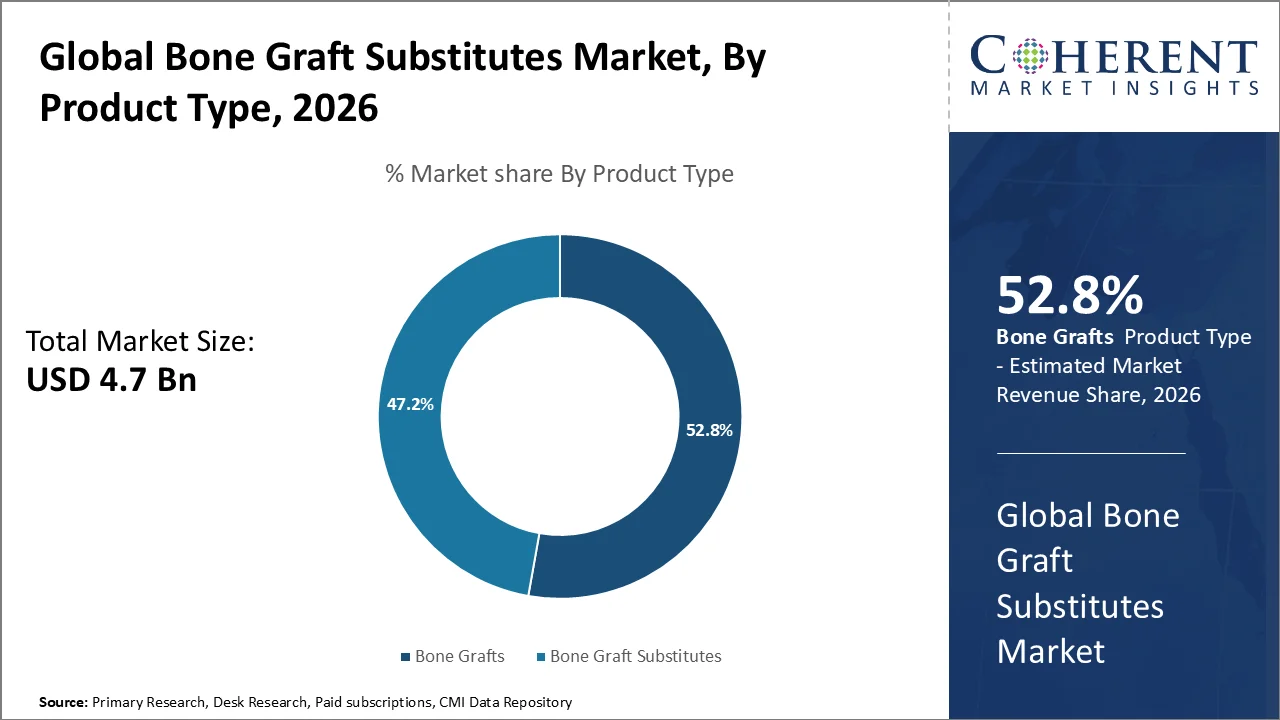
- Bone Grafts hold the largest market share of 52.8% in 2026 owing to its rising orthopedic and spinal surgeries. The annual number of spinal fusion procedures has increased substantially in recent decades, rising from fewer than 40,000 to nearly 1 million procedures per year.
- Dental Bone Grafts expected to hold largest market share of 38.7% in 2026 owing to the rising dental implant procedures. Dental implants have a high long-term success rate, with studies reporting success rates of approximately 90%–98%.
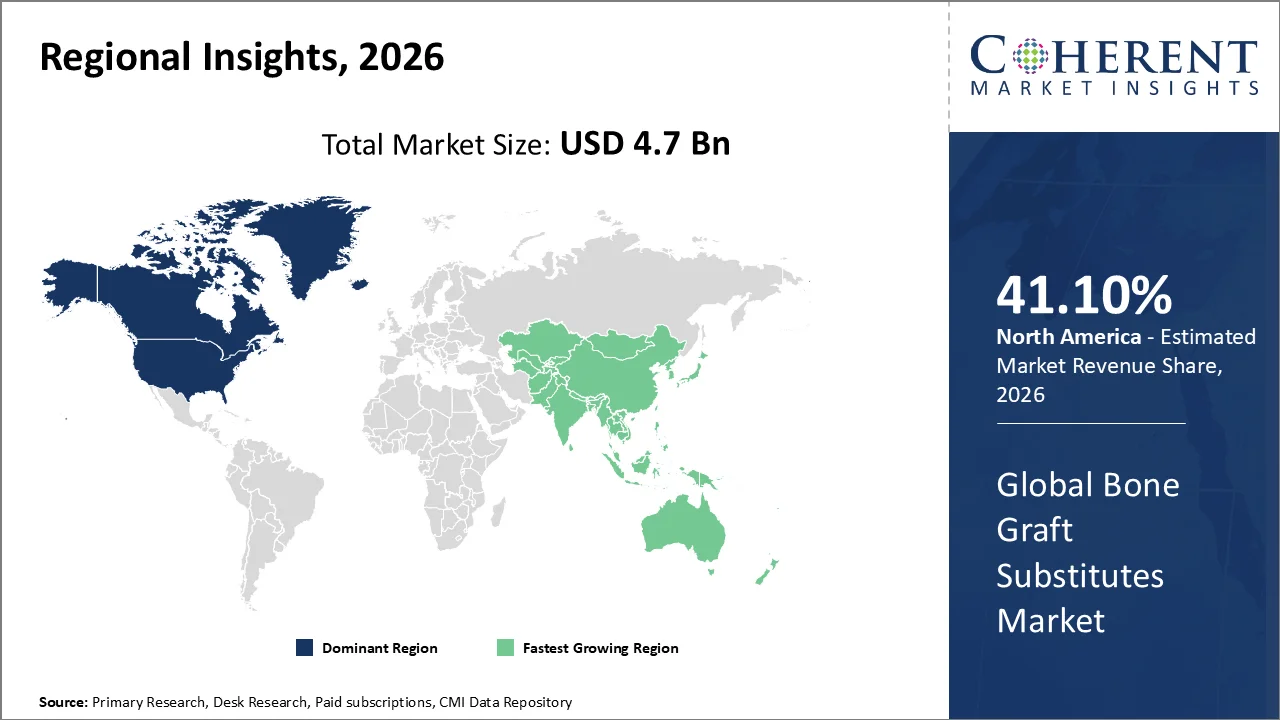
- North America is expected to acquire the dominant share of 41.1% in 2026 owing to its high volume of orthopedic and spinal procedures. More than 312,000 lumbar spine procedures were recorded in the American Spine Registry between 2015 and 2024, with posterior or transforaminal lumbar interbody fusion (PLIF/TLIF) being the most frequently performed procedures.
Current Events and Their Impact on the Bone Graft Substitutes Market
Current Event | Description and its Impact |
FDA Breakthrough Device Designation and PMA Approval of Infuse Bone Graft for TLIF – 2024–2026 |
|
FDA 510(k) Clearances for New Bone Void Filler Products – 2024–2026 |
|
Segmental Insights
- Current Industry Events of 2026
- Market Size Estimation
- Regional Breakdown
- Competitive Landscape
- Customer Intelligence
- Segmental Analysis
- Pricing Analysis
- Key Market Drivers, Challenges & Future Trends
- Customized Insights Section
Why is Bone Grafts Acquiring the Largest Market Share?
Bone Grafts hold the largest market share of 52.8% in 2026. The Bone Graft Substitutes Market is expanding as orthopedic disorders, fractures, osteoporosis, and degenerative bone conditions become more prevalent, while healthcare providers perform more spinal fusion, joint reconstruction, trauma, and dental procedures. In 2024, 17.9% of people aged 16 years and over reported having a long-term musculoskeletal (MSK) condition. An aging population also increases the need for effective bone regeneration solutions. Manufacturers are developing advanced synthetic biomaterials, calcium-based ceramics, bioactive grafts, and biologically active substitutes to improve clinical outcomes and encourage adoption. Moreover, clinicians increasingly favor minimally invasive procedures and off-the-shelf alternatives to autografts, which can simplify surgery and minimize donor-site complications. For instance, Apollo Hospitals introduced Cerament G, an injectable bone graft solution designed to treat bone infections and support bone healing. The technology helps clinicians address trauma-related injuries and diabetic foot complications while aiming to reduce the risk of amputation, accelerate recovery, and improve patients’ mobility.
Dental Bone Grafts expected to hold largest market share
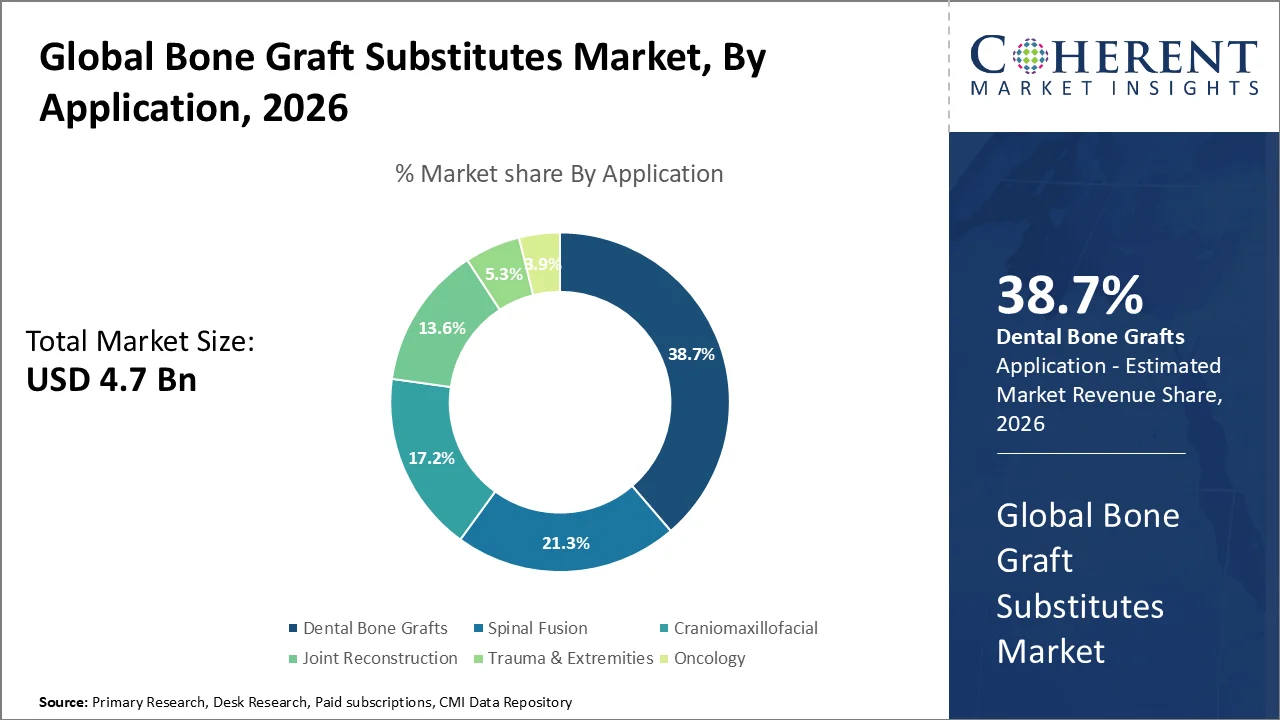
Dental Bone Grafts expected to hold largest market share of 38.7% in 2026 owing to the expansion of socket preservation and ridge augmentation. The dental bone grafts segment of the Bone Graft Substitutes Market is expanding as tooth loss, periodontal disease, and dental trauma increase the need for bone regeneration and oral reconstruction. Dentists are increasingly using dental implants, which drives demand for grafting procedures such as socket preservation, ridge augmentation, and sinus lifts. Meanwhile, manufacturers continue to develop synthetic, bioactive, and regenerative biomaterials that improve treatment outcomes and encourage wider clinical adoption. For instance, in February 2026, Stratasys launched a new dental anatomical model preset, a 3D-printing solution developed for simulation-based training. The company designed the solution to help dental schools, training centers, and medical device manufacturers provide more realistic, consistent, and effective hands-on education.
Bone Graft Substitutes Market Trends
- Increasing use of 3D-printed and patient-specific grafts: Advances in 3D printing and medical imaging are enabling the development of patient-matched devices designed around individual anatomical characteristics. The FDA confirms that 3D printing can be used to manufacture patient-specific devices based on medical-imaging data and that such devices are evaluated for safety and effectiveness through established regulatory pathways. The FDA has also cleared a patient-specific, 3D-printed bone-segment device for orthopedic applications, demonstrating the clinical translation of this technology.
- Aging populations increase demand for bone-regeneration procedures: Population ageing is creating a larger patient pool susceptible to fractures and other orthopedic conditions requiring bone repair. According to the World Health Organization (WHO), the global population aged 60 years and older is projected to increase from 1.0 billion in 2020 to 1.4 billion by 2030 and 2.1 billion by 2050. In addition, WHO reported 178 million new fractures globally in 2019, representing a 33.4% increase from 1990, with ageing and population growth identified as important drivers. These demographic and epidemiological trends are expected to support demand for bone-regeneration products, including bone graft substitutes.
Regional Insights
North America dominates owing to increasing incidence of sports injuries and trauma
North America is expected to acquire the dominant share of 41.10% in 2026. North America’s Bone Graft Substitutes Market is expanding as healthcare providers perform a high volume of orthopedic, spinal, trauma, and dental procedures. The region’s aging population is increasing cases of osteoporosis, fractures, and degenerative bone disorders, driving demand for bone regeneration solutions. By 2040, approximately 20% of the U.S. population is projected to be aged 65 years or older, compared with about 12.5% in 2000. Advanced healthcare infrastructure and rapid adoption of innovative medical technologies further accelerate market growth. Rising dental implant procedures are also increasing the use of grafting materials. Moreover, investments in regenerative medicine, advanced biomaterials, and minimally invasive surgical techniques are encouraging clinicians to adopt bone graft substitutes more widely. For instance, CGBIO has signed a global clinical development and exclusive commercialization agreement with DePuy Synthes for its NOVOSIS bone graft substitute portfolio in the U.S., Canada, and Australia.
Asia Pacific Bone Graft Substitutes Market Trends
The Asia Pacific bone graft substitutes market is growing as healthcare providers address the increasing prevalence of orthopedic disorders, spinal conditions, bone injuries, and age-related diseases. An expanding geriatric population is driving demand for spinal fusion, joint reconstruction, and dental procedures. Rising adoption of dental implants, medical tourism, improved healthcare infrastructure, and government investments are strengthening market growth. Furthermore, manufacturers are advancing synthetic and biocompatible graft materials, while surgeons increasingly adopt minimally invasive techniques and healthcare professionals promote awareness of innovative bone regeneration solutions.
United States Bone Graft Substitutes Market Trends
The U.S. bone graft substitutes market gains momentum from the growing number of orthopedic, spinal, trauma, and dental procedures that require bone regeneration. An aging population and the rising incidence of fractures, degenerative bone disorders, and spinal conditions continue to increase clinical demand. Healthcare providers are also adopting dental implants and reconstructive procedures more widely, supporting market growth. Advances in synthetic biomaterials, bioactive ceramics, and engineered grafts enhance biocompatibility and treatment outcomes. Clinicians increasingly prefer off-the-shelf substitutes because they minimize donor-site complications and simplify surgical procedures. In October 2025, Aurora Spine launched Aurora Biologics, a new division focused on improving spinal fusion outcomes through advanced biologic solutions.
Japan Bone Graft Substitutes Market Trends
Japan’s Bone Graft Substitutes Market benefits from its rapidly aging population, which drives demand for treatments for osteoporosis, fractures, degenerative bone disorders, and spinal conditions. Increasing dental implant procedures and periodontal treatments further boost the use of bone grafting materials. Healthcare providers are also adopting minimally invasive surgical techniques and advanced synthetic and composite biomaterials. The growing preference for solutions that minimize donor-site complications supports market development, while Japan’s advanced healthcare infrastructure, clinical expertise, and progress in regenerative medicine technologies encourage broader product adoption.
Who are the Major Companies in Bone Graft Substitutes Industry
Some of the major key players in Bone Graft Substitutes are Ace Surgical Supply Co., Inc., NovaBone Product, LLC., Exactech, Inc., Medtronic Plc., LifeNet Health, Zimmer Biomet Holdings, Inc., Stryker Corporation., ORTHOFIX INTERNATIONAL N.V., Johnson & Johnson, Bone Therapeutics SA, K2M Group Holdings, Inc., and OsteoNovus.
Key News
- In June 2025, Cerapedics has received FDA premarket approval for PearlMatrix™ P-15 Peptide Enhanced Bone Graft, a Class III combination product for single-level TLIF procedures in adults with degenerative disc disease.
Market Report Scope
Bone Graft Substitutes Market Report Coverage
| Report Coverage | Details | ||
|---|---|---|---|
| Base Year: | 2025 | Market Size in 2026: | USD 4.7 Bn |
| Historical Data for: | 2020 To 2024 | Forecast Period: | 2026 To 2033 |
| Forecast Period 2026 to 2033 CAGR: | 6.5% | 2033 Value Projection: | USD 6.9 Bn |
| Geographies covered: |
| ||
| Segments covered: |
| ||
| Companies covered: | Ace Surgical Supply Co., Inc., NovaBone Product, LLC., Exactech, Inc., Medtronic Plc., LifeNet Health, Zimmer Biomet Holdings, Inc., Stryker Corporation., ORTHOFIX INTERNATIONAL N.V., Johnson & Johnson, Bone Therapeutics SA, K2M Group Holdings, Inc., and OsteoNovus. | ||
Analyst Opinion
- Japan’s aging spine population is creating a clinically compelling case for bone graft substitutes. In a Japanese study of 22,932 spine-surgery patients, 5,288 patients, or roughly 23%, had osteoporosis, while the incidence of osteoporosis among spine-surgery patients increased by 67% between 2010 and 2016. In our view, this makes bone quality a more important surgical consideration and strengthens the case for osteobiologics that can support fusion where compromised bone may increase procedural complexity.
- The strongest opportunity lies in products that can reduce dependence on iliac-crest autograft without sacrificing fusion performance. Autograft remains the clinical benchmark, but its harvesting requires an additional surgical procedure and can cause donor-site morbidity. A recent randomized trial reported posterior fusion rates of 98% with iliac bone graft and 94% with BMP, compared with 85% for bone-marrow aspirate and 50% for conventional allograft. We believe these results reinforce a clear product-development hierarchy: substitutes must demonstrate measurable fusion performance rather than simply offer biological novelty.
- BMP-based technologies currently have the strongest evidence-backed differentiation, but cost and safety will determine their practical adoption. A network meta-analysis covering 43 randomized controlled trials and 3,823 patients found that rhBMP-2 significantly improved fusion outcomes versus iliac-crest bone graft, with an odds ratio of 3.71, while also reducing complications. Earlier systematic evidence similarly found a substantially lower risk of radiographic nonunion with rhBMP-2. In our assessment, this clinical evidence gives BMP a meaningful advantage, but manufacturers still need to address cost, indication-specific risks, and surgeon concerns to achieve broader utilization.
Speak to the analyst
Want personalized insights?
Take the findings above to one of our principal consultants, or have the report rebuilt around the segments, geographies and competitors you actually track.
Market Segmentation
- By Product Type (Revenue, USD Bn, 2021-2033)
- Bone Grafts
- Allografts
- Xenografts
- Bone Graft Substitutes
- Ceramics
- Composites
- Polymers
- Demineralized Bone Matrix
- Bone Morphogenetic Proteins
- Others
- Bone Grafts
- By Application (Revenue, USD Bn, 2021-2033)
- Spinal Fusion
- Dental Bone Grafts
- Craniomaxillofacial
- Joint Reconstruction
- Trauma & Extremities
- Oncology
- By Region (Revenue, USD Bn, 2021-2033)
- North America
- U.S.
- Canada
- Latin America
- Brazil
- Mexico
- Argentina
- Rest of Latin America
- Europe
- Germany
- U.K.
- France
- Italy
- Spain
- Russia
- Rest of Europe
- Asia Pacific
- China
- India
- Japan
- Australia
- South Korea
- ASEAN
- Rest of Asia Pacific
- Middle East
- GCC
- Israel
- Rest of Middle East
- Africa
- South Africa
- Central Africa
- North Africa
- North America
Sources
Primary Research interviews
- Orthopedic surgeons and spine surgeons
- Oral and maxillofacial surgeons
- Dental implantologists and periodontists
- Hospital procurement and orthopedic department heads
- Bone graft substitute manufacturers and product specialists
- Regulatory and clinical affairs professionals
- Tissue-engineering and regenerative-medicine researchers
Databases
- U.S. Food and Drug Administration (FDA) 510(k) and medical-device databases
- PubMed / MEDLINE
- ClinicalTrials.gov
- Cochrane Library
- Embase
- Scopus
- Web of Science
- WHO Global Index Medicus
- U.S. National Library of Medicine databases
Magazines
- Orthopedics Today
- AAOS Now
- Dental Economics
- Modern Healthcare
- Becker’s Healthcare
- Orthopedic Product News
Journals
- Bone & Joint Journal
- Journal of Orthopaedic Research
- Journal of Orthopaedic Trauma
- Spine
- Journal of Neurosurgery: Spine
- Clinical Orthopaedics and Related Research
- Journal of Cranio-Maxillofacial Surgery
- International Journal of Oral & Maxillofacial Surgery
- Biomaterials
- Acta Biomaterialia
- Materials Science and Engineering: C
- Journal of Biomedical Materials Research
Newspapers
- The New York Times
- The Wall Street Journal
- Financial Times
- Reuters
- The Guardian
- Nikkei Asia
Associations
- American Academy of Orthopaedic Surgeons (AAOS)
- Orthopaedic Research Society (ORS)
- American Association of Oral and Maxillofacial Surgeons (AAOMS)
- American Dental Association (ADA)
- AO Foundation
- North American Spine Society (NASS)
- International Society for Technology in Arthroplasty (ISTA)
- International Association for Dental Research (IADR)
Public Domain sources
- U.S. Food and Drug Administration (FDA)
- U.S. National Library of Medicine (NLM)
- National Institutes of Health (NIH)
- Centers for Disease Control and Prevention (CDC)
- World Health Organization (WHO)
- U.S. Census Bureau
- Eurostat
- OECD
- Japan Ministry of Health, Labour and Welfare (MHLW)
- Japan Orthopaedic Association
- Japan Dental Association
- ClinicalTrials.gov
- PubMed
- Cochrane Library
Proprietary Elements
- CMI Data Analytics Tool
- Proprietary CMI Existing Repository of information for last 10 years
Get access to 250+ pages report
Every segment, forecast, competitor profile and data table behind the analysis above — available for instant download.
- ESOMAR Member
- ISO 9001:2015 Certified
- D-U-N-S Registered
- GDPR & CCPA Compliant
Missing comfort of reading report in your local language? Find your preferred language:
Transform your Strategy with Exclusive Trending Reports
Frequently Asked Questions
The Bone Graft Substitutes Market is anticipated to grow at a CAGR of 6.5% with USD 4.7 Bn in 2026 and is expected to reach USD 6.9 Bn in 2033.
The market is primarily supported by increasing orthopedic and spinal procedures, dental implant and maxillofacial surgeries, and continued development of synthetic and biologically enhanced graft materials.
Synthetic materials, particularly calcium phosphate ceramics, and composite materials, are receiving significant attention because manufacturers can control their composition, porosity, degradation behavior, and form.
Autograft remains the clinical benchmark because it provides osteogenic cells along with osteoinductive and osteoconductive properties.
Spinal fusion, trauma and fracture repair, dental implantology, , and oral and maxillofacial reconstruction represent important application areas.
The principal challenge is achieving the biological performance of autologous bone.