

Medical Ceramics Market Analysis & Forecast 2026-2033
The global medical ceramics market was valued at USD 6,050.70 Mn in 2026 and is forecast to reach a value of USD 9,180.0 Mn by 2033 at a CAGR of 6.05% between 2026 and 2033.
Key Takeaways
- Based on Material, the Bio-Inert segment is expected to hold 57.8% share in 2026.
- Based on Application, the Surgical Implants segment is expected to lead the market with 67.2% share in 2026.
- Based on Region, North America is expected to lead the medical ceramics market with 37% share in 2026. While, Asia Pacific is anticipated to be the fastest growing region.
Market Overview
Ceramic materials are the combination of thermal and physical qualities which are used for various medical applications for the repair and reconstruction of human body parts. These are employed majorly in dental and orthopedic applications, mainly as implants or replacements. The inherent brittleness of traditional ceramics has limited their ability to compete with ductile metals and polymers for technical applications like oil-free bearings in food processing equipment, aerospace turbine blades, nuclear fuel rods, lightweight armour, cutting tools. However, over the last 100 years innovative techniques in the fabrication of ceramics have led to their use as high-tech materials. Inert bioceramic, such as ZrO2 and Al2O3, have inherently low levels of reactivity compared to other materials such as polymers and metals as well as surface reactive or bio-inert ceramics and they are expected to be non-toxic, non-allergenic, and non-carcinogenic for a life-time in a human body. This led to the early adoption of the most recent generation of instruments using an established technology in the hospitals.
Current Events and Its Impacts on the Medical Ceramics Market
Current Event | Description and its Impact |
Technological Advancements in Additive Manufacturing and 3D Printing |
|
Aging Global Population and Healthcare Infrastructure Expansion |
|
Are ceramic implants outperforming metals in longevity and success rates?
Ceramic-on-Ceramic Hip Implants
Ceramic-on-ceramic hip implants are exceptionally long-lasting, with a 95% survival rate after 20 years. This means that only 5% of patients needed to have their surgery redone within 20 years. Ceramics wear down much less than metal-on-polyethylene implants, which means there is less particle debris that can cause inflammation or osteolysis. In the clinic, this means fewer problems, longer implant lifespans, and better patient mobility over time.
Zirconia Dental Implants
Zirconia dental implants have osseointegration success rates of more than 97%, which is similar to those of titanium implants. Osseointegration is the direct structural and functional link between bone and implant. Zirconia is a great choice for visible parts of the mouth because it is biocompatible, resistant to corrosion, and looks good (it appears to be teeth). Patients have a lower risk of peri-implantitis with this type of implant than with metal implants. Clinicians like its stability and long-term performance.
- Current Industry Events of 2026
- Market Size Estimation
- Regional Breakdown
- Competitive Landscape
- Customer Intelligence
- Segmental Analysis
- Pricing Analysis
- Key Market Drivers, Challenges & Future Trends
- Customized Insights Section
Segmental Insights
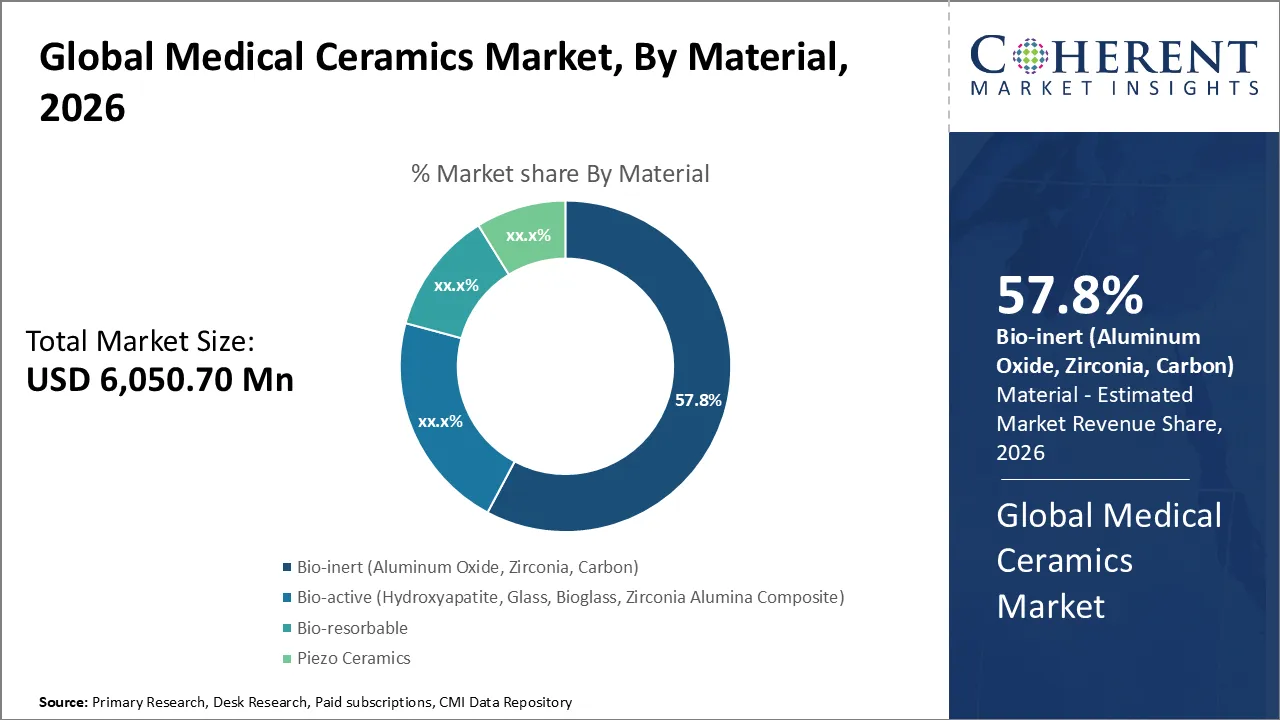
Medical Ceramics Market Insights, By Material: Bio-inert ceramics dominate due to unmatched strength, durability, and biocompatibility in implants
In terms of material, the bio-inert segment is expected to hold 57.8% share in 2026. The bio-inert ceramics like alumina and zirconia will be the most popular types of medical ceramics. They are suitable for orthopedic and dental implants because they are exceptionally resilient, resistant to wear, and compatible with living tissue. These materials do not interact with body tissues, which makes them stable, reliable, and widely used in surgical procedures all over the world.
Medical Ceramics Market Insights, By Application: Surgical implants lead is driven by rising dental and orthopedic implant demand worldwide
In terms of application, the surgical implants segment is expected to lead the market with 67.2% share in 2026. surgical implants, especially dental and orthopedic ones, will be the most popular type of application. Growth is driven by increasing numbers of individuals needing hip and knee replacements and more people getting dental implants. Implants are the primary source of income for medical ceramics around the world, driven by an aging population, bone disorders caused by lifestyle choices, and trends in cosmetic dentistry.
For instance, in September 2025, Enovis Surgical and Mathys Orthopädie GmbH started a project to make hip joint heads from ZTA ceramics using raw materials from Europe. It is funded by Thuringia and the EU and works on making ceramic implants that can withstand damage, digitizing process chains, and investigating into chips as possible raw material bases for new ideas.
Regional Insights
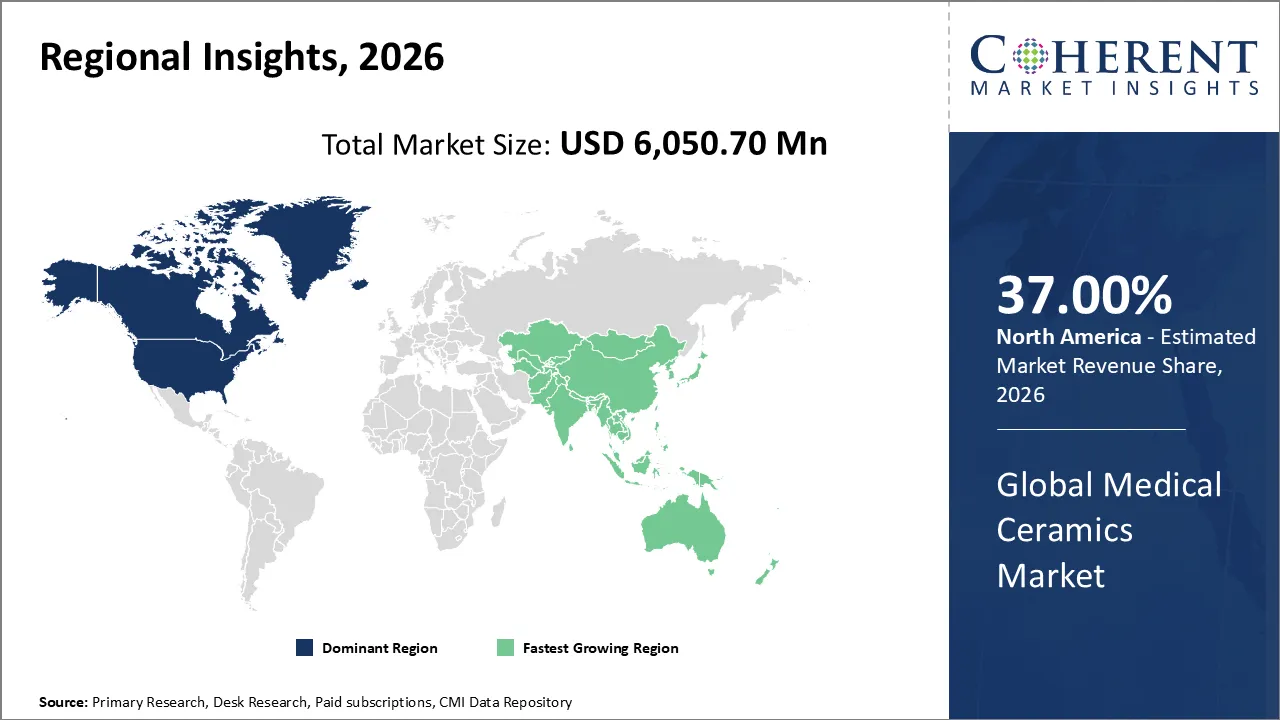
North America Medical Ceramics Market Analysis & Trends
North America is expected to dominate the medical ceramics market with 37% share in 2026, owing to better healthcare infrastructure, more chronic diseases, and more people using minimally invasive procedures. Biocompatible ceramics are necessary for dental restorations, orthopedic implants, and cardiovascular devices. This is driving strong market growth across the region.
For instance, in May 2025, Himed and Lithoz launched a Bioceramics Center of Excellence at Himed's headquarters in New York. Lithoz's technology helps medical device makers make prototypes quickly, improve designs, analyze materials, and make 3D prints. Its goal is to speed up the development of bioceramic innovations, regenerative therapies, and affordable implants.
Asia Pacific Medical Ceramics Market Analysis & Trends
Asia Pacific is expected to exhibit the fastest growth, due to healthcare infrastructure is getting better, medical tourism is on the rise, and China and India are using more advanced biomaterials. Rapid market growth across the region is also being driven by an aging population, rising healthcare costs, and more cases of dental and orthopedic concerns.
For instance, in September 2025, Kyocera Asia Pacific showcased cutting-edge technologies at Electronica India 2025 in Bangalore. Kyocera's slogan is "Build a Better Future with Kyocera." The company focuses on fine ceramics, semiconductor components, and electronic solutions for AI, 5G, automotive, aerospace, and green energy. It stresses innovation across industries and reliable performance.
Medical Ceramics Market Outlook Country-Wise
The U.S. Medical Ceramics Market Trends
In 2026, the demand for medical ceramics in the U.S. is driven by a well-developed healthcare system, a high number of chronic and age-related diseases, and a strong use of dental and orthopedic implants. Strong research and development, new biocompatible materials, and the presence of top medical device makers all help the market grow across the country.
For instance, in December 2025, SINTX Technologies and Evonik signed a deal for SINTX to make a silicon nitride–PEEK compound. This material will be used in 3D printing of implants that are made just for each patient with the help of AI. The partnership brings together advanced biomaterials and additive manufacturing in order to improve the performance, customization, and innovation of medical devices.
Thailand Medical Ceramics Market Trends
In Thailand (2026), the demand for medical ceramics is growing since the country has a strong medical tourism industry, more ceramics are being used in orthopedic implants like hip and knee replacements, and the population is getting older and needs greater dental restorations. Trends in cosmetic dentistry and the use of bioactive ceramics are also speeding up market growth.
For instance, in May 2025, The BDMS Wellness Clinic and Straumann Group Thailand worked together to open Asia-Pacific's first certified Ceramic Dental Implant Center. This project combines advanced zirconia-based implant technology with cosmetic dentistry. Its goal is to make Thailand a global center for dental wellness while also promoting overall health, confidence, and wellness tourism.
Market Report Scope
Medical Ceramics Market Report Coverage
| Report Coverage | Details | ||
|---|---|---|---|
| Base Year: | 2025 | Market Size in 2026: | USD 6,050.70 Mn |
| Historical Data for: | 2020 To 2024 | Forecast Period: | 2026 To 2033 |
| Forecast Period 2026 to 2033 CAGR: | 6.05% | 2033 Value Projection: | USD 9,180.0 Mn |
| Geographies covered: |
| ||
| Segments covered: |
| ||
| Companies covered: | CoorsTek Medical, H.C. Starck GmbH, Tosoh Corporation, Noritake Co., Ltd., 3M ESPE, Morgan Advanced Materials plc, Ceramtec, Pl Ceramic GmbH, Lithoz, Kyocera Corporation | ||
| Growth Drivers: |
| ||
| Restraints & Challenges: |
| ||
Medical Ceramics Market Driver
Rising demand for implantable devices
As more people around the world get older and more chronic diseases become prevalent, the need for implantable medical devices has grown a lot. Medical ceramics are used in dental implants, orthopedic prosthetics, and cardiovascular devices considering they are biocompatible, resistant to corrosion, and long-lasting. They are essential to modern medicine because they can easily blend in with human tissue. As patients demand longer-lasting solutions, the Medical Ceramics Market is growing because of new ideas and more uses for implantable technologies.
Increase in hip and knee replacement procedures
The rise in hip and knee replacement surgeries around the world is a big reason why advanced ceramics like zirconia and alumina are growing more popular. Compared to regular metals, these materials are better at resisting wear, have less friction, and last longer as implants. More and more people with musculoskeletal disorders and arthritis are choosing ceramic-based solutions for joint replacements. This trend is driving up the Medical Ceramics Market demand due to hospitals and clinics want materials that improve patient outcomes and reduce the need for revision surgeries.
Medical Ceramics Market Opportunity
Advancements in bioactive and bioresorbable ceramics
Innovations in bioactive ceramics such as hydroxyapatite and bioglass are revolutionizing regenerative medicine and tissue engineering. These materials not only integrate seamlessly with biological tissues but also actively stimulate bone regeneration and healing. Bioresorbable ceramics add further value by safely dissolving after fulfilling their purpose, reducing the need for secondary surgeries. This dual functionality enhances patient outcomes and broadens clinical applications. As research accelerates, the Medical Ceramics Market forecast anticipates strong growth driven by next-generation therapies and personalized healthcare solutions.
Analyst Opinion (Expert Opinion)
Strong demand for orthopedic and dental uses keeps the medical ceramics market booming. Bioinert ceramics like zirconia and alumina are commonly used for joint implants and dental restorations as they are strong, biocompatible, and resistant to wear. Ceramic materials that are bioresorbable and bioactive are also becoming more popular. They help with regenerative procedures and can be used in more ways than just traditional implants. Ceramic parts are now an important part of prosthetics, surgical tools, and diagnostic equipment in many major markets. This shows the benefit the material is in clinical settings.
Implantable devices are a major type of application because a growing number of people are getting joint replacements and dental work. For instance, several million dental ceramic crowns are put in each year in the biggest healthcare markets, which shows how important the material is in restorative dentistry. Diagnostic segments also show that increasing numbers of imaging systems are using ceramic piezoelectric components, which means that they are being used for more than just structural implants.
North America is a leading market for unit consumption and technology adoption, thanks to its advanced healthcare infrastructure and high volumes of procedures. The Asia-Pacific region is growing quickly. For example, more implants are being used in China and India, and more advanced ceramics are being used as part of larger healthcare investments. Bioactive and additive-manufactured ceramics are growing the fastest in this area, driven by new ideas in personalized and complex shapes.
Technological improvements, such as 3D printing, surface engineering, and custom bioceramic formulations, are making designs more accurate and clinical results better. These new ideas are making it possible to make implants that fit better and osseointegration that works better. This makes medical ceramics an important material class for making modern healthcare devices.
Speak to the analyst
Want personalized insights?
Take the findings above to one of our principal consultants, or have the report rebuilt around the segments, geographies and competitors you actually track.
Global Medical Ceramics Market: Key Developments
- In January 2026, Nivalon Medical has made the first spinal implant in the world that is completely tailored to the patient, keeps their motion, and is free of metal. The new technology uses AI and advanced ceramic 3D printing to make custom implants that fit each person's body. Its goal is to improve outcomes, lower complications, and move spinal care forward with materials that are eco-friendly and safe for the body.
- In October 2025, G Surgiwear worked with 3DCeram to improve the manufacturing of medical ceramic additives. They want to make complicated, custom implants with better accuracy and biocompatibility using 3D printing. This partnership boosts healthcare innovation by providing scalable solutions for individual patient needs and increasing the use of ceramics in medical technology.
Market Segmentation
- By Material
- Bio-inert
- Aluminum Oxide
- Zirconia
- Carbon
- Bio-active
- Hydroxyapatite (HAP)
- Glass and Bioglass
- zirconia alumina composite
- Bio-resorbable
- Piezo Ceramics
- Bio-inert
- By Application
- Surgical Implants
- Dental Implants
- Orthopedic Implants
- Other Implants
- Medical Tools and Devices
- Prosthetics
- Surgical Implants
- By Region
- North America
- U.S.
- Canada
- Latin America
- Brazil
- Argentina
- Mexico
- Rest of Latin America
- Europe
- Germany
- U.K.
- Spain
- France
- Italy
- Russia
- Rest of Europe
- Asia Pacific
- China
- India
- Japan
- Australia
- South Korea
- ASEAN
- Rest of Asia Pacific
- Middle East & Africa
- GCC Countries
- Israel
- Rest of Middle East & Africa
- North America
- Key Players
- CoorsTek Medical
- H.C. Starck GmbH
- Tosoh Corporation
- Noritake Co., Ltd.
- 3M ESPE
- Morgan Advanced Materials plc
- Ceramtec
- Pl Ceramic GmbH
- Lithoz
- Kyocera Corporation
Sources
Primary Research Interviews
- Medical Ceramics Manufacturers
- Orthopedic & Dental Implant Manufacturers
- Bioceramic Material Suppliers
- Medical Device OEMs & Contract Manufacturers
- Biomedical Engineers & Clinical Specialists
- Others
Databases
- Bloomberg Terminal
- Thomson Reuters Eikon
- Others
Magazines
- Medical Device and Diagnostic Industry (MDDI)
- Medical Design & Outsourcing
- Dental Products Report
- BioMaterials Magazine
- Others
Journals
- Journal of Biomedical Materials Research
- Biomaterials
- Acta Biomaterialia
- Journal of the European Ceramic Society
- Others
Newspapers
- Financial Times
- The Wall Street Journal
- Reuters
- Bloomberg News
- Others
Associations
- American Ceramic Society (ACerS)
- European Society for Biomaterials (ESB)
- International Society for Ceramics in Medicine (ISCM)
- Medical Device Manufacturers Association (MDMA)
- Others
Public Domain Sources
- U.S. Food and Drug Administration (FDA) – Medical Devices
- National Institutes of Health (NIH)
- World Health Organization (WHO)
- European Medicines Agency (EMA)
- U.S. National Library of Medicine (PubMed)
- Others
Proprietary Elements
- CMI Data Analytics Tool
- Proprietary CMI Existing Repository of Information for the Last 8 Years
Get access to 250+ pages report
Every segment, forecast, competitor profile and data table behind the analysis above — available for instant download.
- ESOMAR Member
- ISO 9001:2015 Certified
- D-U-N-S Registered
- GDPR & CCPA Compliant
Missing comfort of reading report in your local language? Find your preferred language:
Transform your Strategy with Exclusive Trending Reports
Frequently Asked Questions
The global Medical Ceramics Market size was valued at USD 6,050.7 Mn in 2026 and is expected to reach USD 9,180.0 Mn in 2033.
Factors such as rising demand for implantable devices and increase in hip and knee replacement procedures are expected to drive the market growth.
Surgical implants segment is the leading Application type segment in the market.
The major factors hampering growth of the market include high production and processing costs.
Major players operating in the market include CoorsTek Medical, H.C. Starck GmbH, Tosoh Corporation, Noritake Co., Ltd., 3M ESPE, Morgan Advanced Materials plc, Ceramtec, Pl Ceramic GmbH, Lithoz, and Kyocera Corporation.