

Cardiovascular Ultrasound Market Size and Share Analysis- Growth Trends and Forecasts (2026-2033)
The Cardiovascular Ultrasound Market size is estimated to expand at a CAGR of 5.5% with USD 1.91 Bn in 2026 and is likely to reach USD 2.78 Bn by 2033. The market growth is mainly attributed to the increasing prevalence of cardiovascular illnesses, expanding geriatric population, increasing desire for non-invasive diagnostic imaging techniques and continuing technological advancements in echocardiography systems. According to the American Heart Association’s 2025 heart disease and Stroke Statistics Report, high blood pressure is among the most common risk factors for heart disease, affecting almost 122.4 million individuals in the United States (46.7%), and increasing the need for cardiac imaging and monitoring.
Key Takeaways
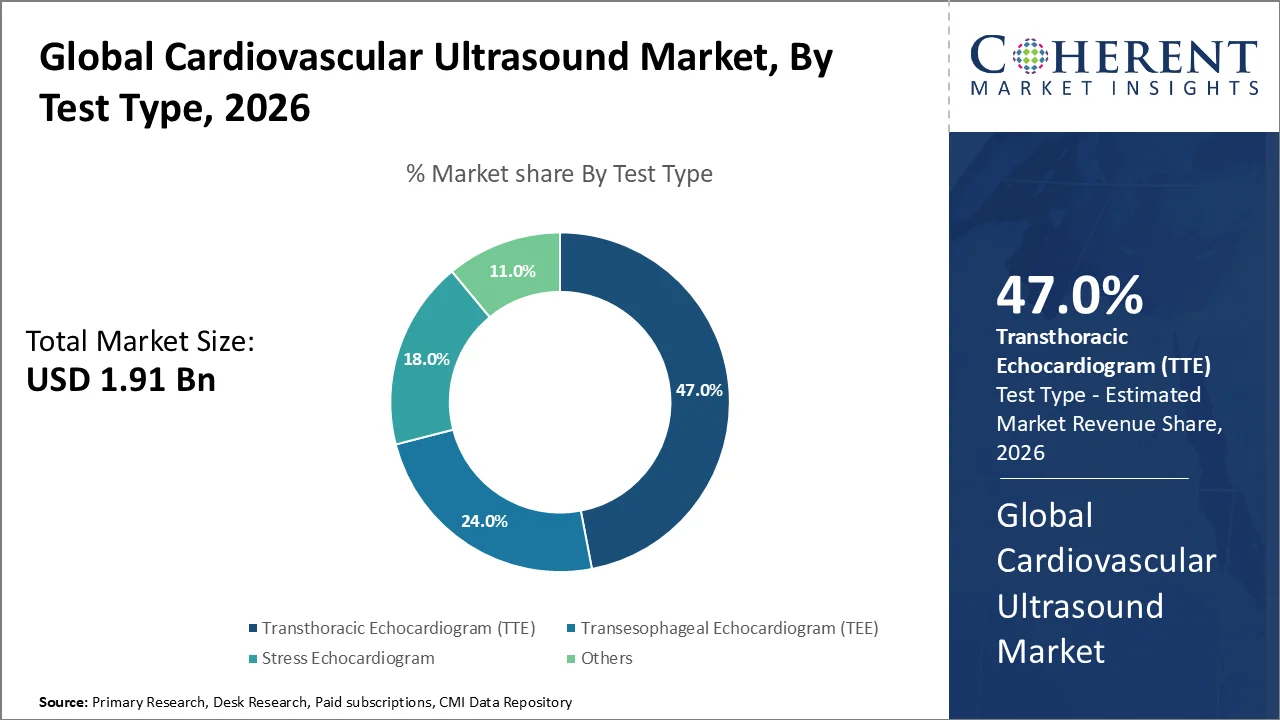
- Transthoracic Echocardiogram (TTE) category is expected to hold the largest market share of 47.0% in 2026. The category is expected to grow due to its non-invasive nature, cheap cost, real-time imaging capabilities and its use as the first-line diagnostic technique for assessing cardiac structure and function. As to the latest edition of the World Health Organization (WHO) Fact Sheet in July 2025, cardiovascular illnesses resulted in 19.8 million deaths, and WHO highlights the significance of early identification and diagnosis to reduce mortality, hence endorsing the need for echocardiographic procedures.
- The 2D segment is set to lead with 52.0% in 2026. The expansion of this category is attributed to the wide clinical acceptance, convenience of operation and capacity to give real time assessment of cardiac anatomy and function. According to the American College of Cardiology (JACC) reported that the number of global cardiovascular disease (CVD) deaths has increased from 13.1 million in 1990 to 19.2 million in 2023, emphasizing the growing importance of routine cardiovascular imaging technologies such as 2D echocardiography.
- Portable sector to lead with 58.0% in 2026. The segment growth is driven by increased demand for point-of-care diagnostics, emergency cardiovascular assessment, and technological advancements in small ultrasound technologies. According to the World Health Organization’s Cardiovascular Diseases, more than four out of five cardiovascular deaths are due to heart attacks and strokes, underscoring the need of the rapid identification and portable imaging capabilities in different healthcare settings.
- The hospitals segment is expected to dominate the market with a share of 59.0% by 2026. The segment is driven by the high patient volume, availability of modern imaging infrastructure and increasing cardiovascular admissions. The WHO European Region Fact Sheet published in July 2024 highlighted the necessity of hospital-based diagnosis and cardiac imaging services as around 24% of deaths from cardiovascular disease in Europe were due to excessive blood pressure.
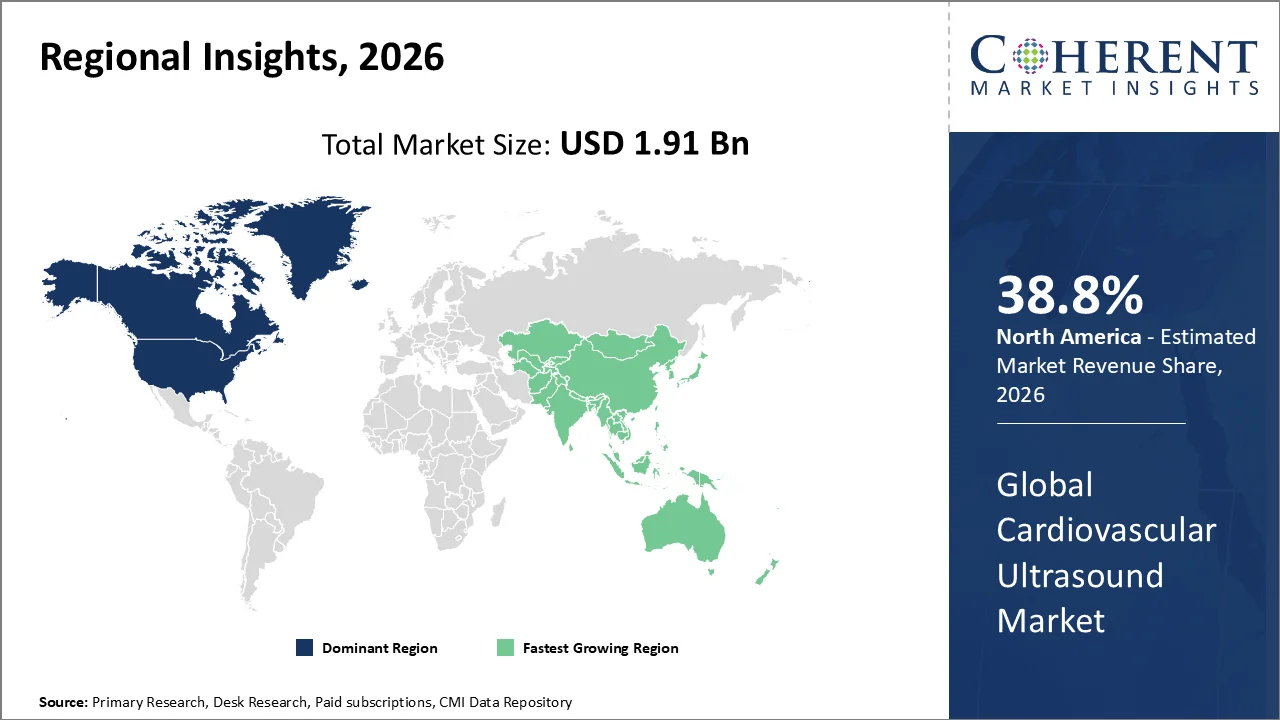
- North America is predicted to have the maximum share of 38.8% by 2026. The high prevalence of cardiovascular disorders, developed healthcare infrastructure, advantageous reimbursement policies, rising acceptance of modern echocardiography systems, and presence of top ultrasound manufacturers are some factors driving the growth of the market. According to the U.S. Centers for Disease Control and Prevention (CDC), 919,032 people died from cardiovascular disease in the U.S. in 2023, which is about one in every three deaths, highlighting the increasing burden of cardiovascular diseases and the importance of early diagnosis and monitoring with echocardiography and ultrasound systems.
Segmental Insights
Why is Transthoracic Echocardiogram (TTE) Acquiring the Largest Share?
Based on test type, the Transthoracic Echocardiogram (TTE) segment is expected to hold the biggest Cardiovascular Ultrasound Market share of 47.0% by 2026. The segment’s rise is attributed to its non-invasive nature, cost-effectiveness, mobility, and widespread use as the first-line imaging modality for evaluating cardiac anatomy and function.
The American Society of Echocardiography (ASE) states that echocardiography continues to be one of the most widely performed cardiovascular imaging modalities in the world and is regarded the cornerstone of cardiac diagnosis due to its safety and availability. In July 2025, ASE amended its recommendations for the assessment of left ventricular diastolic function and HFpEF, highlighting the use of transthoracic echocardiography in the routine evaluation of cardiac function.
- Current Industry Events of 2026
- Market Size Estimation
- Regional Breakdown
- Competitive Landscape
- Customer Intelligence
- Segmental Analysis
- Pricing Analysis
- Key Market Drivers, Challenges & Future Trends
- Customized Insights Section
Why does 2D Technology Hold the Largest Market Share?
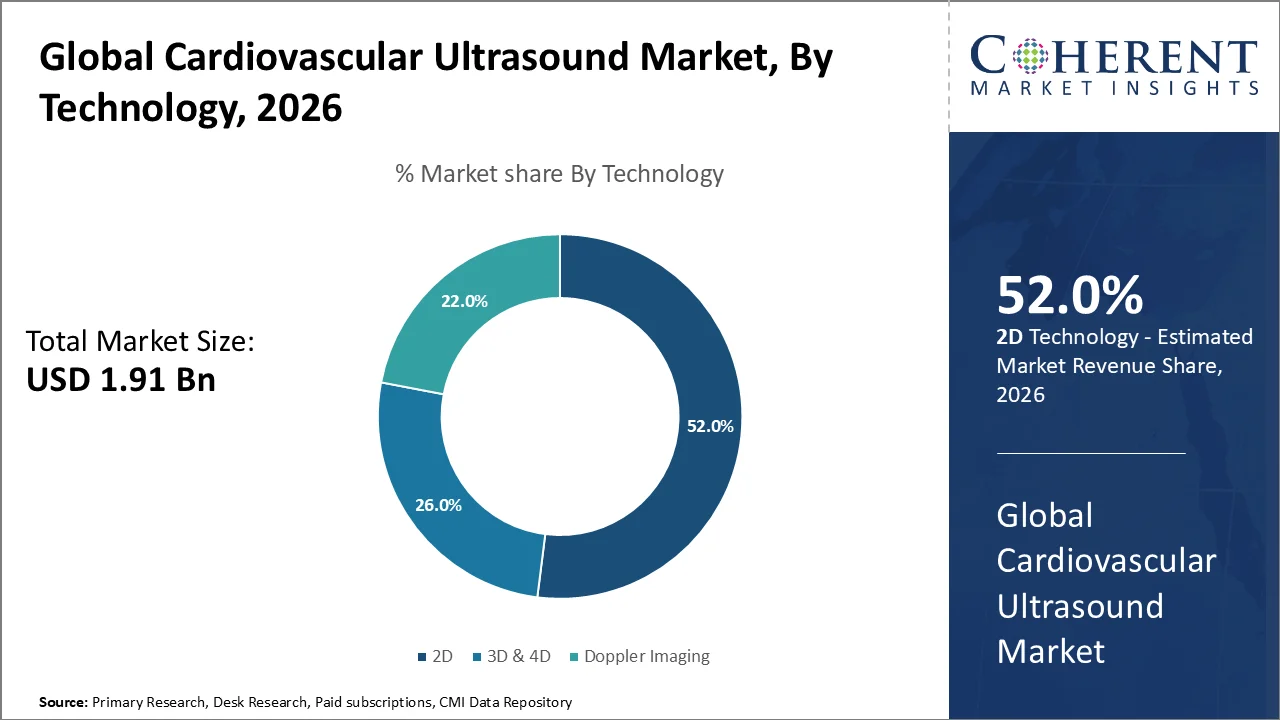
Based on technology, the 2D segment is estimated to hold the highest share of the Cardiovascular Ultrasound Market in 2026. The segment is estimated to develop owing to ease of operations, wide clinical acceptance, and capacity to provide real-time image of cardiac anatomy and function.
According to the American Heart Association (AHA) 2025 heart disease and Stroke Statistics Update, about 127.9 million adults in the U.S. live with cardiovascular disease, which includes the increasing demand for routine and accessible cardiac imaging. 2D echocardiography is still the standard imaging modality for first cardiac assessment and the sector continues to benefit from increasing illness prevalence.
In August 2025, GE HealthCare has announced the launch of their next-generation, AI-driven cardiovascular ultrasound device, the Vivid Pioneer. It includes increased 2D imaging, superior cSound™ Pioneer architecture, and AI-powered automation tools to improve image quality, workflow productivity, and diagnostic confidence.
Why are Portable Systems and Hospitals Acquiring the Largest Share?
Based on modality, the portable segment is expected to hold the highest share of the Cardiovascular Ultrasound Market at 58.0% in 2026. The rise of the category is attributed to the rising usage of point-of-care diagnostics, emergency cardiovascular evaluation, and compact ultrasound technologies.
According to the U.S. Food and Drug Administration (FDA), more than 1,000 AI-enabled medical devices have been cleared through the premarket procedures already in place, showing that AI is being incorporated more and more into diagnostic imaging and portable ultrasound systems. In January 2025, the FDA announced draft guidance for Artificial Intelligence-Enabled Device Software Functions, which provides a regulatory framework for AI-enabled imaging technology.
Hospitals hold the Largest Market Share
Based on end user, the Cardiovascular Ultrasound Market is expected to have the largest market share of 59.0% in 2026 for hospitals sector. The rise of the category can be attributed to high patient volume, availability of improved imaging infrastructure, presence of specialized cardiology departments, and rising hospital admissions for cardiovascular disorders.
In October 2025, the Centers for Medicare & Medicaid Services (CMS) issued the CY 2026 Physician Fee Schedule Final Rule, which promotes payment for cardiovascular care and supports continuing investment in advanced imaging technology in hospitals and outpatient settings.
Market Drivers
Rising Burden of Cardiovascular Diseases is Driving Demand in the Cardiovascular Ultrasound Market
The increasing prevalence of cardiovascular diseases (CVDs) is a major factor that is driving the growth of cardiovascular ultrasound market due to the increased demand for early diagnosis, disease monitoring and non-invasive imaging procedures. Echocardiography remains one of the main diagnostic procedures used to assess the anatomy and function of the heart. It allows clinicians to identify heart valve diseases, cardiomyopathies, heart failure and congenital anomalies. The use of cardiovascular ultrasound systems is also driven by the aging population together with the rising incidence of hypertension, obesity and diabetes.
According to the American Heart Association (AHA) reported in 2025, 72% of U.S. adults have unhealthy weight, and 42% are living with obesity, both of which are substantial risk factors for cardiovascular illnesses and are increasing the need for routine echocardiographic examination.
Current Events and Their Impact
Current Event | Description and its Impact |
ASE Releases New Standardized Adult Echocardiography Reporting Guidelines (September 2025) |
|
CMS 2026 Physician Fee Schedule Final Rule (Effective January 2026) |
|
Cardiovascular Ultrasound Market Trends
- Growing use of strain echocardiography is helping in early detection of illness and risk stratification. In November 2025, a clinical consensus statement was published by the American Society of Echocardiography (ASE) and the European Association of Cardiovascular Imaging (EACVI) to promote increased use and reimbursement of strain imaging applications.
- Right heart and pulmonary hypertension are of increasing importance and are driving the increasing use of sophisticated ultrasound technologies. In March 2025, the ASE issued new recommendations for echocardiographic examination of the right heart with an emphasis on pulmonary hypertension, including updated severity grading and imaging considerations.
- Advances in AI-based image processing are enabling automated assessment of heart function. Research in 2025 showed that AI-based echocardiographic parameters can obtain an AUC of 0.89 for heart disease risk classification, providing evidence for expanded utilization of AI-enabled cardiovascular ultrasound devices.
Regional Insights
North America Dominates Owing to Advanced Cardiac Care Infrastructure and Favorable Reimbursement Policies
North America Cardiovascular Ultrasound Market is projected to be 38.8% in 2026. The region’s growth is driven by widespread acceptance of modern echocardiography equipment, strong reimbursement support, increasing frequency of cardiovascular illnesses, and the existence of key ultrasound producers and dedicated cardiac facilities. Hospitals and outpatient facilities are rapidly investing in AI-enabled and point-of-care ultrasound technologies to increase diagnostic efficiency and patient outcomes.
According to the Centers for Medicare and Medicaid Services (CMS), U.S. healthcare spending surged by 7.2% to reach USD 5.3 trillion in 2024, representing 18.0% of the GDP, whereas, spending on physicians and clinical services witnessed an increase of 8.1% to reach USD 1.11 trillion.
In August 2025, Royal Philips announced the growth of their AI-driven range of cardiac care, including next-generation cardiovascular ultrasound technologies that incorporate intelligent automation and enhanced workflow capabilities.
Asia Pacific Cardiovascular Ultrasound Market Trends
Asia Pacific is predicted to expand at the fastest growth rate in the Cardiovascular Ultrasound Market during the forecast period. The region’s rise is attributed to the developing healthcare infrastructure, rising cardiovascular disease burden, increasing healthcare expenditure, and increased acceptance of portable and AI-assisted ultrasound equipment in China, India, Japan, and Southeast Asia.
According to the WHO Western Pacific Regional Office estimates that there are over 265 million persons of 65 years and above living in the Western Pacific Region, which accounts for about one-third of the world’s older population. The wider Asia-Pacific region is predicted to see its population aged 65 and older almost double to about one billion by 2050, boosting demand for cardiovascular diagnostics and imaging services.
In March 2025, Shenzhen Mindray Bio-Medical Electronics Co., Ltd. (China) introduced the Resona A20 premium ultrasound system at ECR 2025. The platform leverages Acoustic Intelligence Technology and superior image processing capabilities to enhance confidence in diagnosis and workflow efficiency in cardiology and general imaging applications.
Increasing Healthcare Expenditure and Expansion of AI-Enabled Imaging are Accelerating the Cardiovascular Ultrasound Market in the United States
The U.S. Cardiovascular Ultrasound Market is experiencing considerable expansion owing to improving healthcare infrastructure, growing acceptance of AI-enabled imaging technologies and favorable reimbursement policies. Hospitals and outpatient facilities are investing heavily in next-generation echocardiography technology to enhance cardiac diagnosis and workflow efficiency.
According to the American Hospital Association (AHA) Fast Facts on U.S. Hospitals 2026, there were 6,100 hospitals in the U.S. for FY 2024, of which 5,121 were community hospitals, giving abundant facility for cardiovascular imaging and echocardiography services.
Who are the Major Companies in Cardiovascular Ultrasound Industry
Some of the major key players in Cardiovascular Ultrasound Market are GE Healthcare (General Electric Company), Koninklijke Philips N.V., FUJIFILM Holdings Corporation, Siemens Healthineers AG, Samsung Medison Co., Ltd., Shenzhen Mindray Bio-Medical Electronics Co., Ltd., ESAOTE SPA, and Canon Medical Systems, USA.
Key News
- In July 2025, FUJIFILM Sonosite launched the UHF46-20, the world's first 46 MHz ultra-high-frequency ultrasound transducer, expanding advanced ultrasound imaging capabilities for multiple applications including cardiology.
- In May 2025, Samsung Medison announced a collaboration with Exo Imaging to accelerate development of AI-powered and portable ultrasound technologies.
Market Report Scope
Cardiovascular Ultrasound Market Report Coverage
| Report Coverage | Details | ||
|---|---|---|---|
| Base Year: | 2025 | Market Size in 2026: | USD 1.91 Bn |
| Historical Data for: | 2020 To 2024 | Forecast Period: | 2026 To 2033 |
| Forecast Period 2026 to 2033 CAGR: | 5.5% | 2033 Value Projection: | USD 2.78 Bn |
| Geographies covered: |
| ||
| Segments covered: |
| ||
| Companies covered: | GE Healthcare (General Electric Company), Koninklijke Philips N.V., FUJIFILM Holdings Corporation, Siemens Healthineers AG, Samsung Medison Co., Ltd., Shenzhen Mindray Bio-Medical Electronics Co., Ltd., ESAOTE SPA, and Canon Medical Systems, USA | ||
| Growth Drivers: |
| ||
| Restraints & Challenges: |
| ||
Analyst Opinion
- AI and automation advances are improving efficiency and repeatability in echocardiography. EchoNet-Measurements, trained using 877,983 echocardiographic measurements from 155,215 studies, can automatically quantify 18 echocardiographic parameters accurately, minimizing operator dependence and enhancing workflow efficiency, according to research presented at ASE 2025.
- Echocardiography practice is becoming standardized, leading to uniformity in diagnosis and the use of sophisticated ultrasound instruments. New adult echocardiography reporting standards for transthoracic, transesophageal, and stress echocardiography were released in September 2025 by the American Society of Echocardiography (ASE). These guidelines are intended to help ensure consistency of reporting in clinical practice.
- AI-enabled cardiac risk stratification is broadening the clinical usage of cardiovascular ultrasound. For example, a study of 736 patients in 2025 found that a new AI-derived Acoustic Index had an AUC of 0.89 with a sensitivity and specificity of 0.8, demonstrating the promise of AI-enabled echocardiography for early illness detection and continuous surveillance.
Speak to the analyst
Want personalized insights?
Take the findings above to one of our principal consultants, or have the report rebuilt around the segments, geographies and competitors you actually track.
Market Segmentation
- By Test Type (Revenue, USD Bn, 2021-2033)
- Transthoracic Echocardiogram
- Transesophageal Echocardiogram
- Stress Echocardiogram
- Others
- By Technology (Revenue, USD Bn, 2021-2033)
- 2D
- 3D & 4D
- Doppler Imaging
- By Modality (Revenue, USD Bn, 2021-2033)
- Portable
- Standalone
- By End User (Revenue, USD Bn, 2021-2033)
- Hospitals
- Ambulatory Care Centers
- Others
- Global Cardiovascular Ultrasound Market , By Region (Revenue, USD Bn, 2021-2033)
- North America
- U.S.
- Canada
- Latin America
- Brazil
- Mexico
- Argentina
- Rest of Latin America
- Europe
- Germany
- U.K.
- France
- Italy
- Spain
- Russia
- Rest of Europe
- Asia Pacific
- China
- India
- Japan
- Australia
- South Korea
- ASEAN
- Rest of Asia Pacific
- Middle East
- GCC
- Israel
- Rest of Middle East
- Africa
- South Africa
- Central Africa
- North Africa
- North America
- Key Players
- GE Healthcare (General Electric Company)
- Koninklijke Philips N.V.
- FUJIFILM Holdings Corporation
- Siemens Healthineers AG
- Samsung Medison Co., Ltd.
- Shenzhen Mindray Bio-Medical Electronics Co., Ltd.
- ESAOTE SPA
- Canon Medical Systems, USA
Sources
Primary Research Interviews
- Cardiologists and Echocardiography Specialists
- Radiologists and Diagnostic Imaging Experts
- Ultrasound Equipment Manufacturers
- Hospital Procurement Managers
- Ambulatory Care Center Administrators
- Healthcare IT and Imaging Informatics Specialists
- Medical Device Distributors and Service Providers
- Others
Databases
- Bloomberg Terminal
- S&P Global Market Intelligence
- FactSet
- D&B Hoovers
- GlobalData
- PitchBook
- Frost & Sullivan
- Others
Magazines
- Diagnostic Imaging
- Imaging Technology News (ITN)
- AuntMinnie
- Healthcare Radiology Magazine
- Medical Device Network
- MedTech Dive
- Others
Journals
- Journal of the American College of Cardiology (JACC)
- Circulation
- European Heart Journal
- Journal of the American Society of Echocardiography (JASE)
- JACC: Cardiovascular Imaging
- Ultrasound in Medicine & Biology
- Others
Newspapers
- Reuters
- Bloomberg News
- Financial Times
- The Wall Street Journal
- The Economic Times
- Business Standard
- Others
Associations
- American Heart Association (AHA)
- American Society of Echocardiography (ASE)
- European Society of Cardiology (ESC)
- European Association of Cardiovascular Imaging (EACVI)
- World Heart Federation (WHF)
- Radiological Society of North America (RSNA)
- Others
Public Domain Sources
- World Health Organization (WHO)
- U.S. Food and Drug Administration (FDA)
- Centers for Medicare & Medicaid Services (CMS)
- Centers for Disease Control and Prevention (CDC)
- American Hospital Association (AHA)
- National Bureau of Statistics of China
- International Diabetes Federation (IDF)
- National Institutes of Health (NIH)
- PubMed
- World Bank Open Data
- Others
Proprietary Elements
- CMI Data Analytics Tool, Proprietary CMI Existing Repository of Information for the Last 10 Years
Get access to 250+ pages report
Every segment, forecast, competitor profile and data table behind the analysis above — available for instant download.
- ESOMAR Member
- ISO 9001:2015 Certified
- D-U-N-S Registered
- GDPR & CCPA Compliant
Missing comfort of reading report in your local language? Find your preferred language:
Transform your Strategy with Exclusive Trending Reports
Frequently Asked Questions
The Cardiovascular Ultrasound Market is expected to reach USD 2.78 Billion by 2033, growing from USD 1.91 Billion in 2026 at a CAGR of 5.5% during the forecast period.
The rising prevalence of cardiovascular diseases, increasing geriatric population, growing demand for non-invasive diagnostic imaging, advancements in AI-enabled echocardiography technologies, and expanding adoption of portable and point-of-care ultrasound systems are driving market growth.
The Cardiovascular Ultrasound Market is anticipated to grow at a CAGR of 5.5% during the forecast period from 2026 to 2033.
The market outlook remains positive due to continued advancements in AI-assisted imaging, portable ultrasound technologies, 3D and 4D echocardiography, workflow automation, and increasing investments in cardiovascular diagnostics and early disease detection.
The Cardiovascular Ultrasound Market refers to the industry involved in the development, manufacturing, and commercialization of ultrasound systems and related technologies used to assess cardiac structure, function, blood flow, and vascular conditions through non-invasive imaging techniques, including transthoracic, transesophageal, stress echocardiography, and Doppler imaging.
Among test types, the Transthoracic Echocardiogram (TTE) segment is expected to hold the largest share, accounting for 47.0% in 2026, owing to its non-invasive nature, lower cost, and widespread use as the first-line diagnostic modality for evaluating cardiac structure and function.
Portable cardiovascular ultrasound systems are gaining popularity owing to their ability to provide rapid point-of-care diagnosis, improved accessibility, lower operational complexity, and suitability for emergency departments, intensive care units, and outpatient settings.