

Cellular Rubber Market Size and Forecast — 2026 - 2033
The Global Cellular Rubber Market size is estimated to be valued at USD 7.8 billion in 2026 and is expected to reach USD 13.2 billion by 2033, exhibiting a compound annual growth rate (CAGR) of 8.2% from 2026 to 2033.
Overview
The Cellular Rubber Market comprises a range of products designed for cushioning, insulation, sealing, and vibration dampening across various industries. Key product types include closed-cell foams, offering superior resistance to moisture and chemicals, and open-cell foams, providing excellent sound absorption and flexibility. Silicone-based cellular rubbers are popular for high-temperature and medical applications, while neoprene and EPDM variants are widely used in automotive, construction, and industrial settings due to their durability and weather resistance. Polyurethane foams deliver lightweight structural support, and specialty blends cater to niche requirements such as acoustic insulation, thermal barriers, and impact absorption, reflecting broad applicability and technological innovation.
Key Takeaways
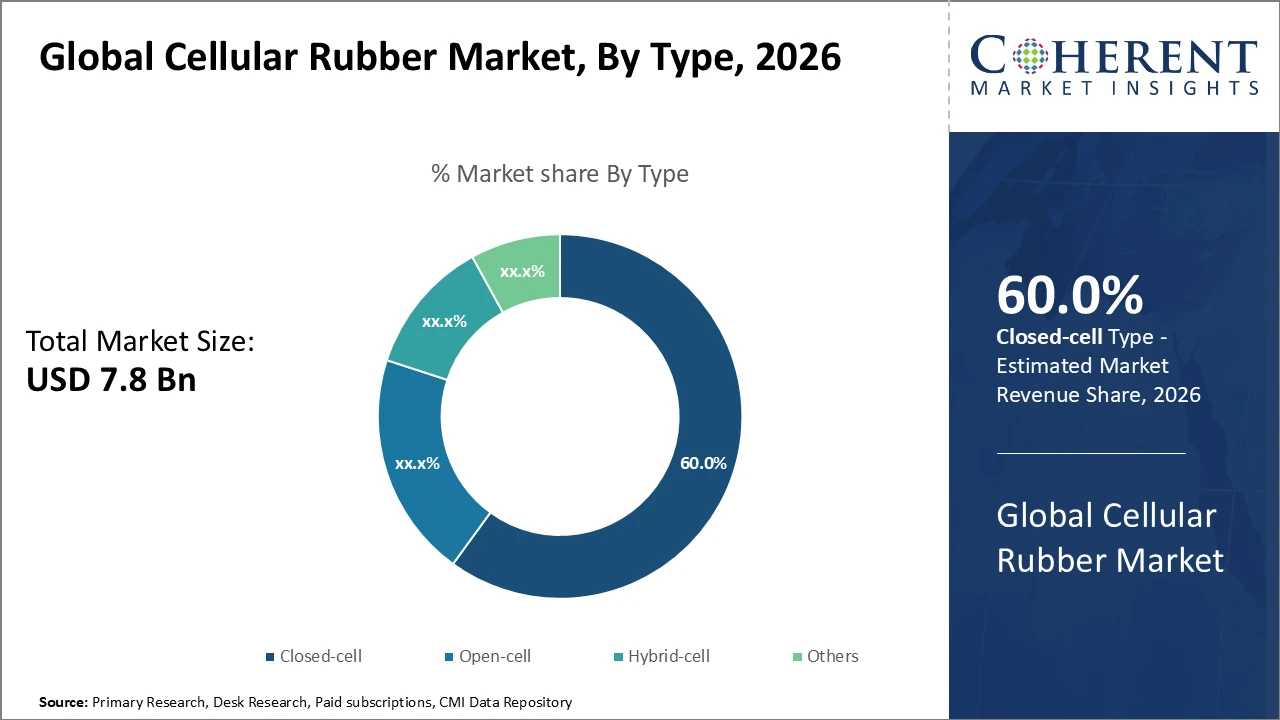
The closed-cell type segment dominates the market with a 60% share, attributed to its excellent insulation, waterproofing, and chemical resistance properties, making it a preferred choice across industries.
Automotive applications drive significant revenue growth, supported by stricter emission standards, NVH (noise, vibration, and harshness) reduction requirements, and increased use of lightweight, durable materials.
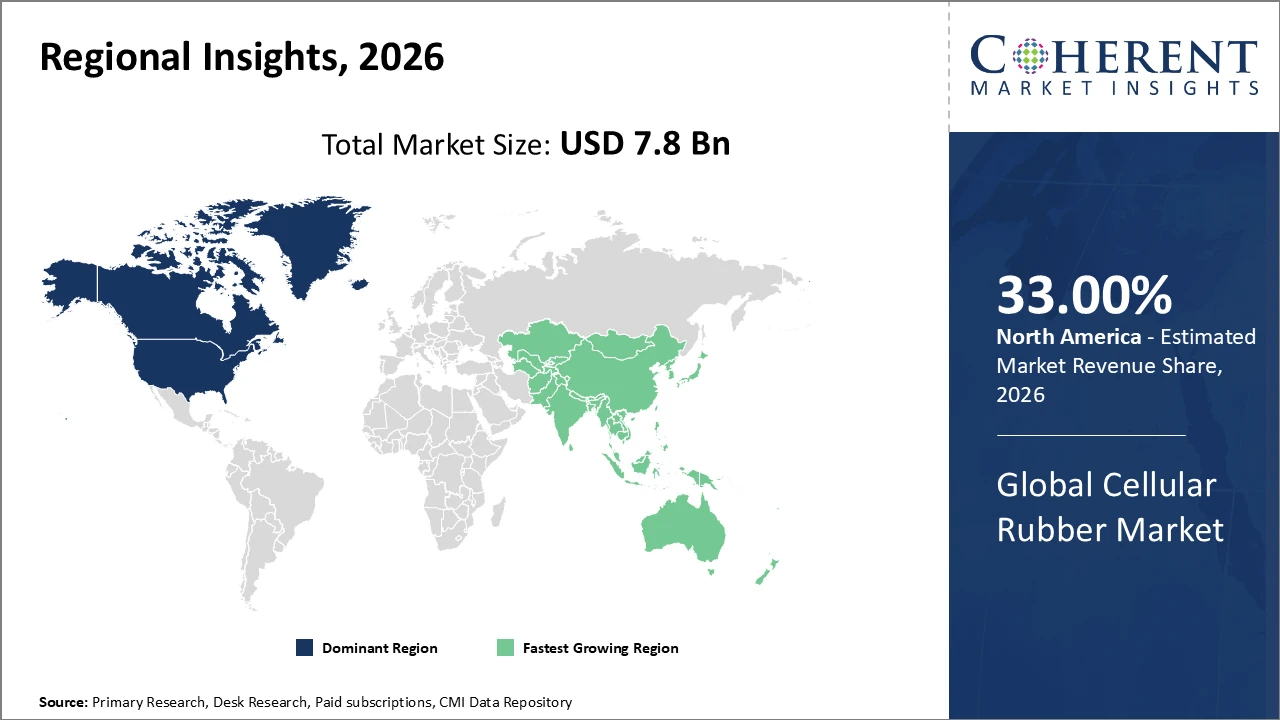
North America leads the market with approximately 33% share, underpinned by a strong industrial base, advanced manufacturing capabilities, and regulatory frameworks promoting material innovation.
Asia Pacific shows the fastest growth, fueled by extensive infrastructure projects, expanding automotive and industrial production, and rising disposable incomes in China and India.
Cellular Rubber Market Segmentation Analysis
Cellular Rubber Market Insights, By Type
Closed-cell cellular rubber leads the market with a 60% share, valued for its excellent insulation, water resistance, and mechanical stability, widely used in automotive seals, construction gaskets, and EV battery enclosures. Its dense microstructure limits moisture penetration while enhancing thermal performance, meeting stringent industry standards. Open-cell cellular rubber is the fastest-growing segment, favored for lightweight cushioning, breathability, and comfort applications in consumer goods and furniture. Hybrid-cell types offer a combination of closed- and open-cell benefits, serving specialized industrial needs. The Others segment comprises niche foam variants designed for specific technical applications, representing a minimal portion of the overall market.
Cellular Rubber Market Insights, By Application
Automotive dominates the cellular rubber market, driven by regulatory mandates to reduce vehicle weight and noise, leading to widespread use in NVH components, gaskets, and thermal insulation, particularly in electric vehicles. The Construction segment shows the fastest growth, fueled by stricter energy codes and demand for high-performance insulation in window seals, expansion joints, and roofing applications. Consumer Goods applications leverage cellular rubber’s cushioning, durability, and comfort properties in footwear, sporting goods, and furniture. Electronics adopt it for protective casings and shock absorption, benefiting from the rise in wearable devices. The Others category includes industrial sealing and marine applications, providing stable incremental demand.
Cellular Rubber Market Trends
Technological advances in polymer chemistry and extrusion processes have expanded the use of cellular rubber in high-performance applications globally.
In 2025, fire-retardant cellular rubber incorporating bio-based additives gained traction due to eco-conscious regulations in Europe and North America.
Adoption of digital manufacturing tools, including CAD and 3D printing, allows rapid customization of cellular rubber products, boosting applications in electronics and wearable devices.
Circular economy initiatives are driving recycling in cellular rubber production, with over 10% of raw materials projected to be sourced from recycled feedstock by 2026.
Cellular Rubber Market Insights, By Geography
North America Cellular Rubber Market Analysis and Trends
North America leads the Cellular Rubber market, holding about 33% of the global share in 2026, driven by a mature industrial base and advanced research capabilities. The region’s strong automotive and construction sectors fuel demand for lightweight, insulating, and noise-dampening materials. Stringent regulatory frameworks emphasizing energy efficiency, emissions reduction, and sustainable building practices further bolster adoption. Additionally, government incentives for green construction and environmentally friendly materials encourage manufacturers to deploy high-performance cellular rubber solutions. The combination of innovation, regulatory support, and industrial demand positions North America as a pivotal market for cellular rubber growth and technological advancement.
Asia Pacific Cellular Rubber Market Analysis and Trends
Asia Pacific registers the fastest growth in the Cellular Rubber market, with a CAGR exceeding 10%, driven by rapid urbanization, rising industrialization, and expanding automotive manufacturing hubs in China and India. Significant infrastructure investments, including transportation and energy projects, further stimulate demand for high-performance insulation and sealing solutions. Favorable trade policies and government incentives for local manufacturing enhance regional production capabilities and market penetration. Leading companies like Sekisui Chemical and JSP Corporation have strategically expanded capacities in the region, enabling them to meet growing demand and unlock substantial market potential across automotive, construction, and industrial applications.
Cellular Rubber Market Outlook for Key Countries
USA Cellular Rubber Market Analysis and Trends
The U.S. Cellular Rubber market is propelled by advanced automotive R&D, early adoption of high-performance materials, and strict environmental regulations promoting energy efficiency. In 2025, automotive applications accounted for over 40% of national consumption, reflecting the material’s critical role in noise, vibration, and thermal management for vehicles. Leading manufacturers such as Armacell and Rogers Corporation have invested heavily in domestic innovation hubs to enhance product performance and customization. Additionally, infrastructure rehabilitation initiatives, including bridges, roads, and commercial buildings, have increased demand for cellular rubber-based insulation and sealing solutions, supporting steady market growth and reinforcing the U.S. as a key regional leader.
Germany Cellular Rubber Market Analysis and Trends
Germany’s Cellular Rubber market is characterized by advanced manufacturing capabilities, stringent environmental standards, and high demand from automotive and construction sectors. In 2025, the country’s automotive industry drove significant consumption of closed-cell cellular rubber for NVH components, thermal insulation, and lightweight applications. Regulatory emphasis on energy efficiency and low-emission building materials further supported adoption in construction and industrial sectors. Technological innovations, including bio-based additives and fire-retardant formulations, have gained traction to meet sustainability targets. Additionally, domestic manufacturers like Armacell and JSP Corporation continue to invest in R&D and production expansion, reinforcing Germany’s position as a mature and technologically advanced market in Europe.
Analyst Opinion
In 2024, global cellular rubber production capacity increased by 12%, driven by extrusion and molding advancements, reducing manufacturing costs by 7% and supporting stable pricing despite raw material volatility.
Automotive accounted for approximately 38% of market revenue in 2025 due to lightweighting and NVH solutions.
Construction sealing applications grew 14% year-over-year from stricter building codes, while wearable electronics adoption rose 10% in 2026.
Synthetic rubber price fluctuations led to an 8% rise in Asia Pacific imports in early 2026.
Central Europe exports contributed 5% of revenue, and Latin America shifted toward lower-cost grades.
Over 22 patents were filed in 2025 for improved fire-retardant and eco-friendly formulations, boosting aerospace and marine applications with around 6% incremental revenue.
- Current Industry Events of 2026
- Market Size Estimation
- Regional Breakdown
- Competitive Landscape
- Customer Intelligence
- Segmental Analysis
- Pricing Analysis
- Key Market Drivers, Challenges & Future Trends
- Customized Insights Section
Market Scope
| Report Coverage | Details | ||
|---|---|---|---|
| Base Year: | 2025 | Market Size in 2026: | USD 7.8 billion |
| Historical Data for: | 2020 To 2024 | Forecast Period: | 2026 To 2033 |
| Forecast Period 2026 to 2033 CAGR: | 8.2% | 2033 Value Projection: | USD 13.2 billion |
| Geographies covered: |
| ||
| Segments covered: |
| ||
| Companies covered: | KCC Corporation, BASF SE, JSP Corporation, Rogers Corporation, Evonik Industries AG, Dow Chemical Company, 3M Company, Wacker Chemie AG, Recticel NV, Huntsman Corporation | ||
| Growth Drivers: |
| ||
Cellular Rubber Market Growth Factors
Stringent global regulations mandating energy-efficient building materials have significantly boosted demand for cellular rubber insulation, with the construction segment growing by 11% in 2025. In parallel, the automotive industry’s focus on lightweight components to improve fuel efficiency and reduce emissions accelerated the adoption of cellular rubber, contributing to a 9% overall market revenue increase in 2026. Innovations in polymer formulations enhancing durability, fire resistance, and environmental sustainability have expanded applications into high-performance sectors such as aerospace and electronics. Rapid urbanization and infrastructure development in Asia Pacific and Latin America, supported by government incentives, have further fueled market growth.
Cellular Rubber Market Development
In February 2024, Rubberlite, Inc. expanded its Huntington, West Virginia campus with a new multi-purpose facility, bringing its total footprint in the state to nearly 500,000 square feet. The addition increases capacity for cellular rubber and plastic conversion, as well as the production of custom-engineered polyurethane foams.
Key Players
Leading Companies of the Market
KCC Corporation
BASF SE
JSP Corporation
Huntsman Corporation
Evonik Industries AG
Dow Chemical Company
3M Company
Wacker Chemie AG
Recticel NV
Rogers Corporation
Several market companies have pursued aggressive growth strategies, including mergers and acquisitions, strategic partnerships, and technological collaborations. For instance, Armacell’s acquisition of a thermoformed foam manufacturer in 2025 expanded its manufacturing footprint by 15%, enabling greater market penetration across North America. Similarly, Zotefoams introduced cost-reduction innovations in cellular rubber extrusion, reducing production cycle times by 20%, which allowed more competitive pricing and facilitated market share gains in Asia Pacific. These strategic moves underscore the emphasis on operational efficiency and regional expansion as key drivers for strengthening presence in the global cellular rubber market.
Cellular Rubber Market Future Outlook
The Cellular Rubber market is poised for robust growth, driven by rising demand for energy-efficient insulation, lightweight automotive components, and durable industrial sealing solutions. Advancements in polymer technology, including eco-friendly and fire-retardant formulations, are expanding applications across construction, automotive, aerospace, and electronics sectors. Increasing urbanization and infrastructure investments in Asia Pacific and Latin America will continue to fuel regional market expansion. Moreover, the shift toward electric vehicles and stringent environmental regulations globally will further boost adoption. Innovation in manufacturing processes, such as automated extrusion and 3D molding, will enhance product customization, efficiency, and overall market competitiveness, supporting sustained growth through 2033.
Cellular Rubber Market Historical Analysis
The Cellular Rubber market has witnessed steady expansion over the past decade, driven by industrialization, urbanization, and increasing demand for insulation and lightweight materials. Historically, the automotive sector was the primary growth driver, with noise, vibration, and harshness (NVH) reduction requirements boosting adoption in vehicle components. Construction and building applications gradually gained prominence due to stricter energy-efficiency standards and thermal insulation needs. Technological improvements in polymer formulations enhanced durability, water resistance, and fire retardancy, further supporting market uptake. Europe and North America historically dominated due to mature automotive and construction sectors, while Asia Pacific emerged as a rapidly growing region by the mid-2010s.
Sources
Primary Research Interviews:
Product managers, R&D specialists, and material engineers involved in cellular rubber formulation, extrusion processes, and high-performance applications.
Procurement managers, operations heads, and engineers from automotive, construction, and electronics companies using cellular rubber for insulation, sealing, and cushioning.
Industry experts from foam manufacturers and polymer additive suppliers focusing on customization, sustainability, and cost optimization in cellular rubber products.
Magazines:
Rubber & Plastics News – Innovations in cellular rubber manufacturing, extrusion technology, and market applications.
Coatings World – Trends in rubber-based insulation and sealing solutions for automotive and construction industries.
Polymer Engineering & Science – Technological developments in polymer foams and rubber composites.
Journals:
Journal of Cellular Plastics – Research on cellular rubber formulations, mechanical properties, and performance optimization.
Polymer Testing – Studies on durability, thermal insulation, and fire resistance of rubber foams.
Journal of Applied Polymer Science – Innovations in synthetic rubbers and foaming technologies.
Newspapers:
The Wall Street Journal – Market trends, mergers, and investments in the rubber and polymer industries
Financial Times – Global manufacturing developments, regulatory updates, and trade news affecting cellular rubber.
Reuters – Product launches, technology adoption, and market performance in industrial foam sectors.
Bloomberg – Company performance and market adoption trends for cellular rubber applications.
Associations:
Rubber Manufacturers Association (RMA) – Guidelines, standards, and best practices for rubber product manufacturing
International Institute of Synthetic Rubber Producers (IISRP) – Research, standards, and industry data for synthetic rubbers and foams.
European Rubber & Plastics Machinery Association (ERPMA) – Insights on machinery, extrusion processes, and polymer innovations.
Get access to 250+ pages report
Every segment, forecast, competitor profile and data table behind the analysis above — available for instant download.
- ESOMAR Member
- ISO 9001:2015 Certified
- D-U-N-S Registered
- GDPR & CCPA Compliant
Missing comfort of reading report in your local language? Find your preferred language:
Transform your Strategy with Exclusive Trending Reports
Frequently Asked Questions
Leading companies include Rogers Corporation, KCC Corporation, and Huntsman Corporation, recognized for their advanced innovations, diverse product portfolios, and global manufacturing presence.
The Cellular Rubber market is expected to grow from USD 7.8 billion in 2026 to USD 13.2 billion by 2033, reflecting a compound annual growth rate (CAGR) of 8.2%, driven by rising demand in automotive, construction, and electronics sectors.
The automotive sector represents the largest growth opportunity due to increasing requirements for lightweight, energy-efficient, and noise-reducing materials that support emission reduction and electric vehicle development.
Key trends include the adoption of sustainable and recycled materials, integration of smart cellular composites with multifunctional properties, and growing use of advanced manufacturing technologies such as extrusion optimization and 3D printing for product customization.
The market is highly competitive with a strong focus on R&D-driven innovation. Challenges include fluctuating raw material costs, compliance with environmental regulations, and balancing high-performance requirements with cost-efficiency.
Companies frequently employ strategic partnerships, mergers and acquisitions, technology licensing, and regional manufacturing expansions to enhance market penetration, product portfolios, and geographic reach.