

Chlor-Alkali Market Analysis & Forecast
The global chlor-alkali market is estimated to be valued at USD 78.08 Bn in 2026 and is expected to reach USD 106.98 Bn by 2033, growing at a compound annual growth rate (CAGR) of 4.6% from 2026 to 2033.
Key Takeaways
- On the basis of Product, Soda Ash is expected to account for approximately 54.8% share in the global chlor-alkali market in 2026.
- Based on Production Process, the Membrane Cell segment is projected to hold around 44.8% share in the global market during the same period.
- By Application, the Pulp and Paper segment is anticipated to contribute about 38.2% share of the chlor-alkali market in 2026.
- Based on Region, North America is expected to maintain its leading position in the global chlor-alkali market with 38.3% shares in 2026.
Market Overview
The Global Chlor-Alkali Market is expected witness steady demand driven by growth in end-use industries such as chemical processing, water treatment, pharmaceutical, paper & pulp and others. Within the chemicals industry, chlor-alkali is a critical building block material that serves as a key raw material for the production of numerous essential chemicals including polyvinyl chloride (PVC), ethylene dichloride (EDC), caustic soda, alumina, and titanium dioxide among others. Rapid industrialization and infrastructural development activities across emerging economies are expected to drive the demand for such derivatives, supplementing revenue generation in the global chlor-alkali market over the coming years.
Current Events and Its Impact on the Chlor-Alkali Market
Event | Description and Impact |
China's Economic Slowdown and Industrial Policy Shifts |
|
Global Energy Crisis and Natural Gas Price Volatility |
|
Rising Environmental Regulations and Sustainability Mandates |
|
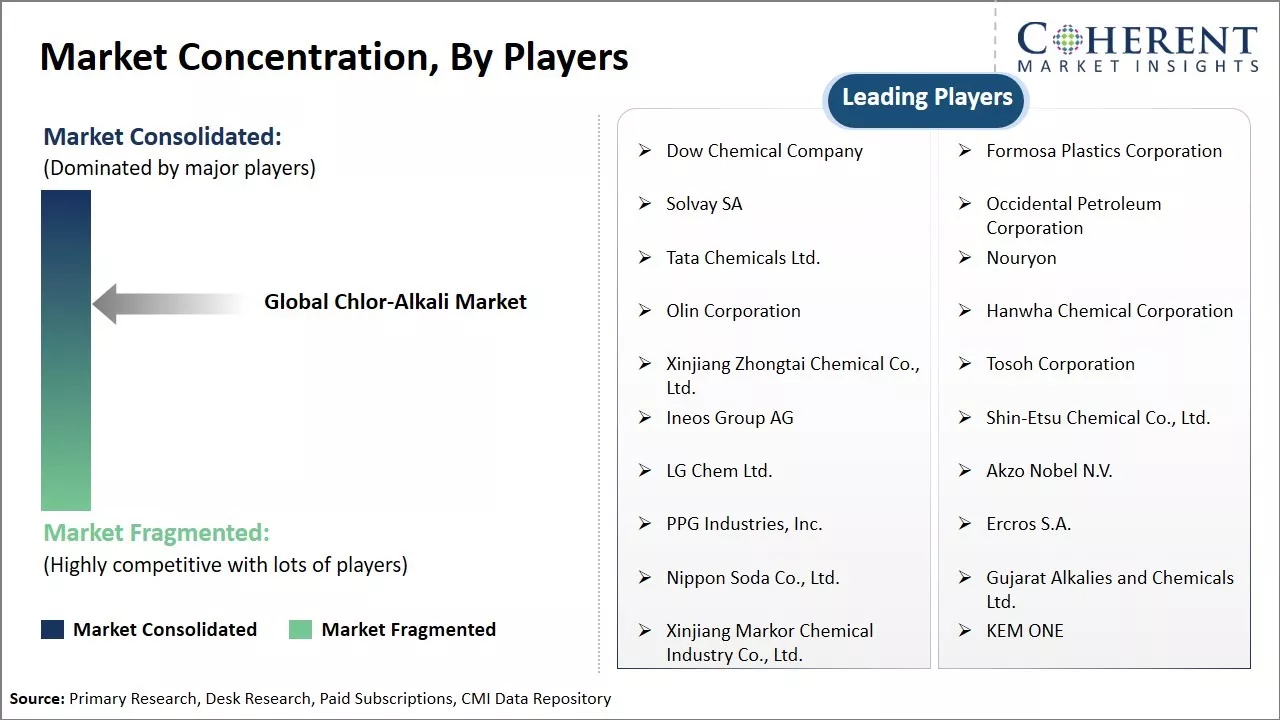
Market Concentration and Competitive Landscape
Growing demand from water treatment industry
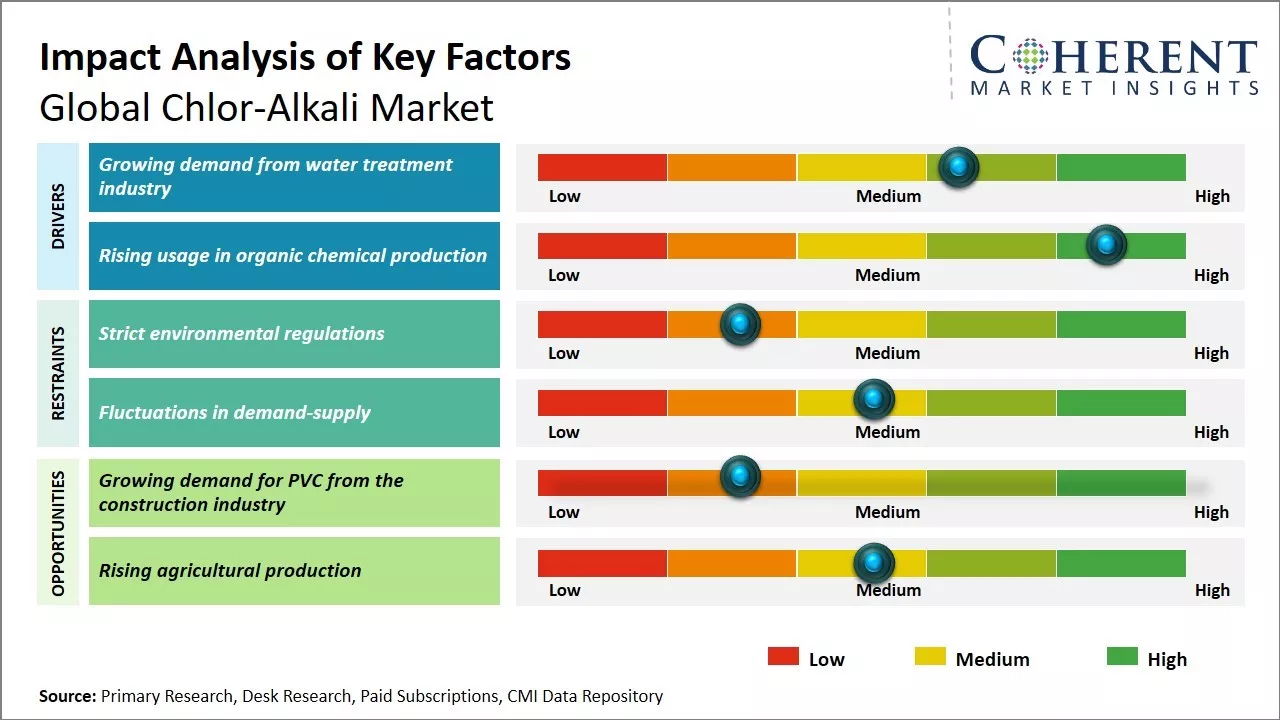
The growing global population and urbanization are positively impacting the water treatment industry. People’s access to clean drinking water directly affects their health, making it a vital issue. The chlor-alkali industry is benefitting from this as chlorine and sodium hydroxide are extensively used in water treatment systems. Chlorine serves as a disinfectant to eliminate bacteria and other microorganisms that may contaminate water. It is a strong water sterilizing agent and helps purify water that is delivered to homes and industries.
Globally, both developed and developing countries have been increasing the use medicinal chlorine for water treatment. For instance, as UNICEF reported in 2020, more than 800 million people lacked basic drinking water services, and water disinfection systems require further strengthening.
As more communities are to be provided access to safe water in coming years, the consumption of chlorine is projected to rise further. In addition to chlorine, the increasing complexity of water generated from various sources like surface water, seawater, and industrial wastewater has necessitated advanced treatment methods that employ caustic soda (sodium hydroxide) on a large scale.
Sodium hydroxide serves the purpose of pH balancing and eliminating heavy metals through coagulation and precipitation processes. It is important in the secondary and tertiary stages of water treatment. With sodium hydroxide being extensively used in water treatment, there is expected to be great change in the usage of sodium hydroxide for water treatment industrially over the next ten years. This is expected to support the growth of the chlor-alkali industry.
According to UN Water reports, the world is running out of freshwater. Industrialization, pollution, and climate change are responsible for water scarcity in various regions of the world. The sodium hydroxide market in the water treatment industry is anticipated to boost considerably in the next decade. This is good news for the chlor-alkali industry as whole.
Rising usage in organic chemical production
Production of a variety of organic chemicals is another significant end-use sector where chlor-alkali chemicals are applied. Chlorine serves as a precursor or a raw material for several commodity chemicals, including vinyl chloride monomer (VCM), ethylene dichloride (EDC), polyvinyl chloride (PVC) resins, ethylene, propylene oxide, and others. These chemical intermediates are further processed into components for a multitude of industrial and consumer goods.
In supported regions, the global production of organic chemicals surged recently as a result of expanding markets like consumer durables, automotive industry, packaging, construction, and agrochemicals. There is also growing manufacturing activity in Asia Pacific and Latin America, which further stimulates domestic demand for organic chemicals alongside the international demand.
To expand access to domestic and foreign clients, chemical companies are investing heavily in facilities that produce organic chemicals. As this increase in production happens, the worldwide demand for chlorine and chlor-alkali products will continue to experience vigorous growth.
- Current Industry Events of 2026
- Market Size Estimation
- Regional Breakdown
- Competitive Landscape
- Customer Intelligence
- Segmental Analysis
- Pricing Analysis
- Key Market Drivers, Challenges & Future Trends
- Customized Insights Section
Opportunities: Growing demand for PVC from the construction industry
The construction industry’s increasing need for PVC creates a significant opportunity for expansion within the chlor-alkali market at a global scale. Due to its diverse characteristics and cost effectiveness, PVC or polyvinyl chloride is one of the most popular plastics in the construction industry. It is simple to cast into different shapes such as pipes, window frames, siding, flooring, and even as insulation boards.
Some numbers illustrate the sheer magnitude of construction projects taking place globally and the surge in demand for PVC. As reported by the United Nations, the global spending on infrastructure is projected to reach USD 94 trillion by 2040 for the building of roads, bridges, utilities, among other construction requisites. This will be due to accelerated urbanization where people move to cities for better living standards and job opportunities.
Asia and Africa are expected to account for roughly two thirds of all infrastructure spending in the next 20 years. China alone has plans for over USD 12 trillion in new projects by 2030. As development-stage economies focus on more housing, transport, and energy facilities, the availability of PVC materials will have to meet demand.
Segmental Insights
Chlor-Alkali Market Insights, By Product
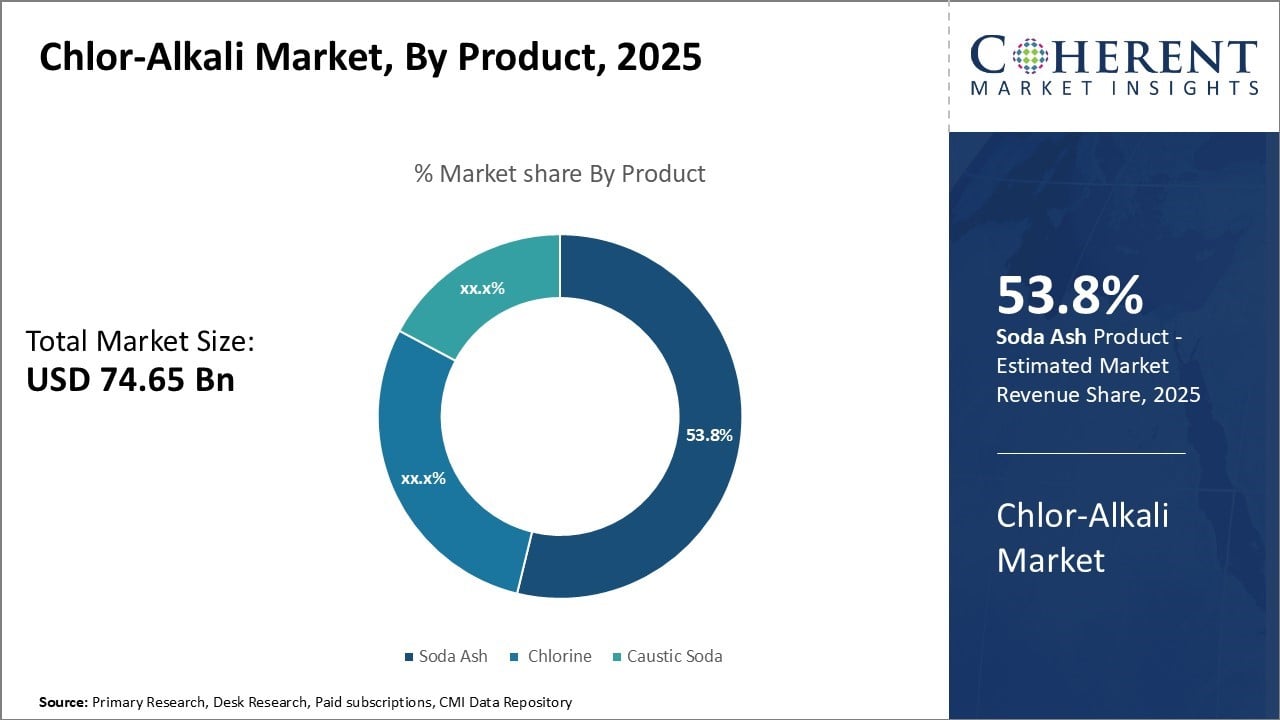
In terms of product, soda ash is expected to contribute 54.8% share of the market in 2026 owing to its increasing use in the flourishing pulp and paper industry. Soda ash, also known as sodium carbonate, acts as an important raw material in the manufacturing of paper. It has alkalinity properties that help remove lignin from wood fibers to extract cellulose needed for paper production. With more nations pushing initiatives to reduce reliance on plastics and increase paper product usage, pulp and paper companies are ramping up capacities. This bodes well for soda ash demand.
Additionally, growing e-commerce is propelling corrugated packaging board demand, another major end-use for soda ash. Further, favorable government policies in developing nations supporting local paper industries also aids the soda ash market. Its cost-effectiveness relative to substitute products cements soda ash's dominant position
Chlor-Alkali Market, Insights By Production Process
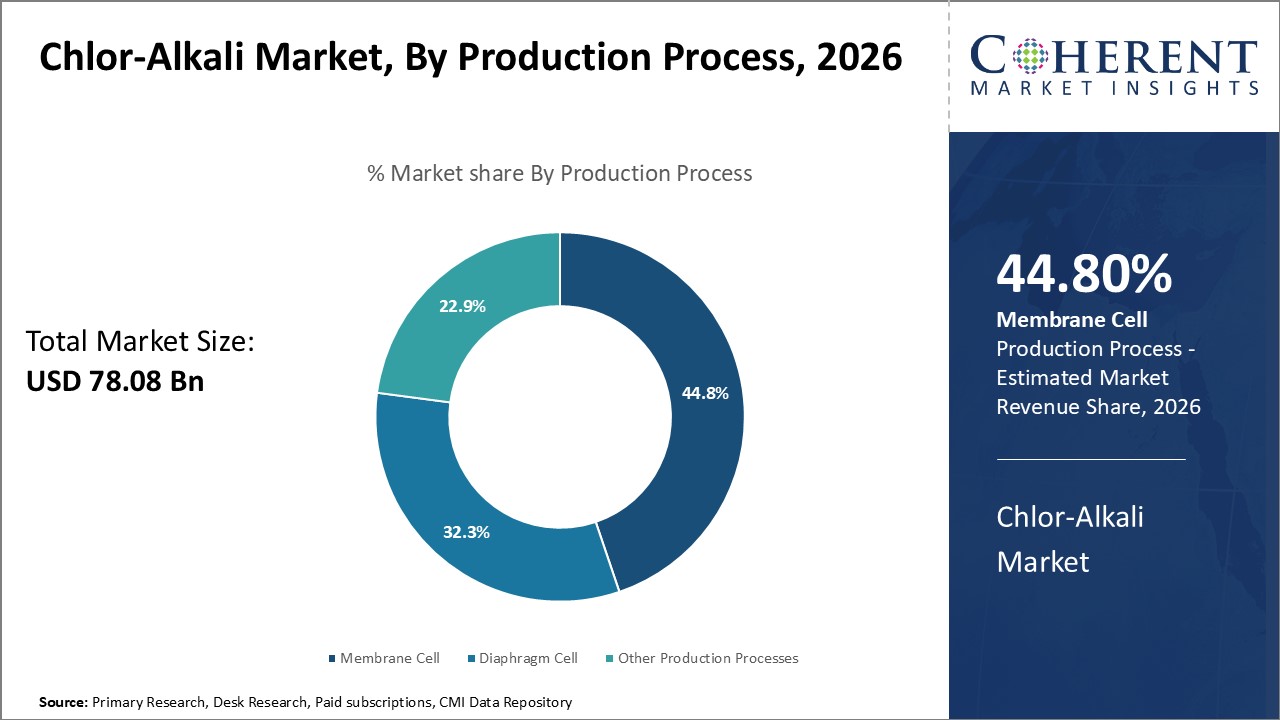
In terms of production process, membrane cell is expected to contribute 44.8% of the market share in 2026 owing to its technology advantages over traditional processes. Membrane cell technology provides higher energy efficiency and yields compared to diaphragm cell methods. It allows producers to reduce operating costs and lower carbon footprint.
Additionally, membrane cells offer improved safety with reduced risk of gas leaks. Their modular design also enables easy capacity expansions. With sustainability and cost savings in sharp focus, many chlor-alkali companies are retrofitting plants or constructing new production facilities based on advanced membrane cell systems.
Government incentives for green technologies further accelerate widespread adoption. R&D continues to enhance membrane cell performance, helping cement its position as the preferred production process.
Regional Insights
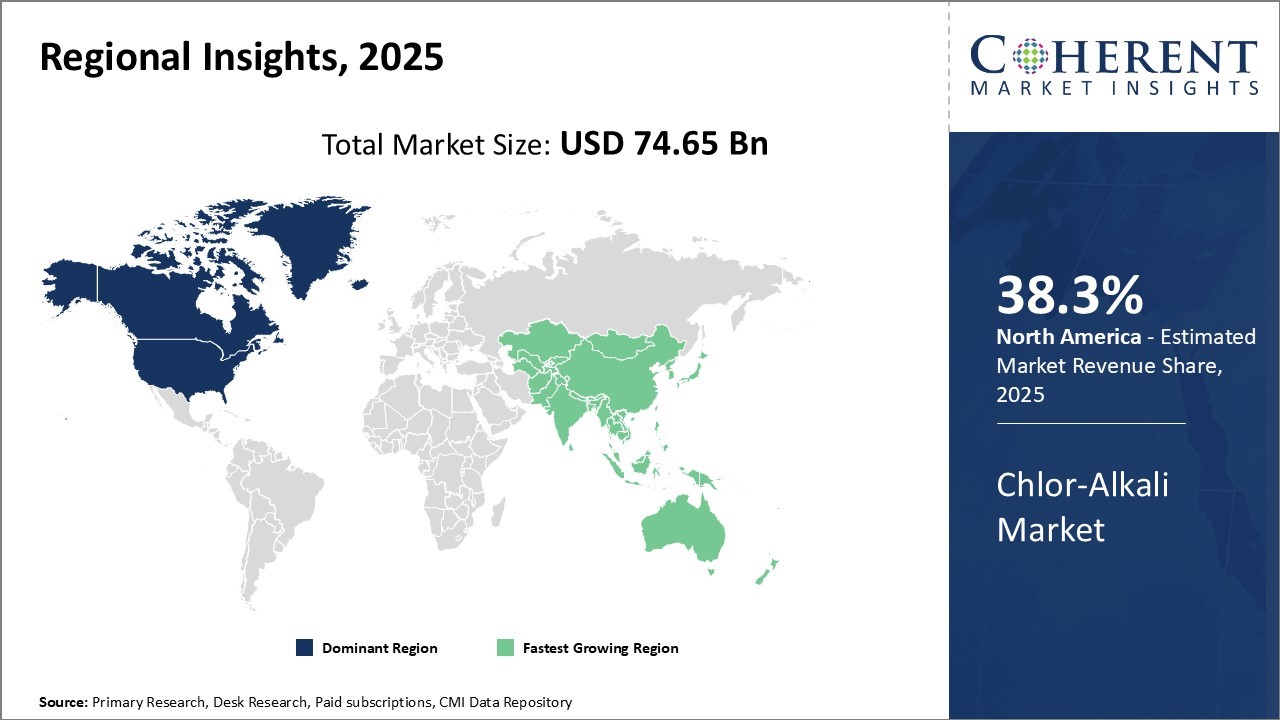
North America Chlor-Alkali Market Analysis and Trends
North America is projected to maintain a leading position in the global chlor-alkali market through 2026, with the region expected to account for 38.3% of total market share. This dominance is underpinned by North America’s mature industrial infrastructure and the strong presence of end-use sectors such as chemicals, pulp & paper, pharmaceuticals, and municipal water treatment.
Major chlor-alkali producers operate extensive manufacturing networks across the U.S. and Canada, ensuring a steady supply to domestic industries and facilitating exports to nearby markets such as Latin America.
The region benefits from abundant access to raw materials and reliable energy sources, allowing manufacturers to maintain competitive production costs. However, the enforcement of stricter environmental regulations—particularly around mercury cell technology—has led to increased compliance costs for producers. Despite these regulatory challenges, the demand for caustic soda, chlorine, and related derivatives remains stable, driven by continued industrial consumption and the region’s strong export orientation.
Asia Pacific Chlor-Alkali Market Analysis and Trends
Asia Pacific is expected to emerge as the fastest-growing chlor-alkali market globally, driven by robust industrialization, infrastructure expansion, and growing demand from downstream sectors. Countries such as China, India, Indonesia, and Vietnam are witnessing a rapid rise in chemical, construction, textile, and water treatment activities—boosting the consumption of chlorine, caustic soda, and potassium hydroxide across the board.
This surge in demand is prompting chlor-alkali manufacturers to expand existing facilities and establish new production units to serve regional needs. While China currently dominates chlor-alkali exports within Asia Pacific, other ASEAN economies are quickly gaining attention as emerging hubs for both production and consumption. Moreover, regional markets increasingly import chlor-alkali products from Persian Gulf nations to meet short-term demand surges, further diversifying their sourcing strategies.
With growing urbanization, a rising middle-class population, and favorable economic policies, Asia Pacific’s chlor-alkali market is poised for continued growth over the forecast period, outpacing more mature markets in volume and capacity additions.
Dominating Countries in the Chlor-Alkali Market
United States Chlor-Alkali Market Analysis and Trends
The United States leads the North American chlor-alkali market, supported by well-established production infrastructure, access to shale gas-based energy sources, and strong demand from a wide range of downstream industries. Major players operate fully integrated facilities and benefit from scale efficiencies, making the U.S. a cost-effective supplier of chlor-alkali products both domestically and internationally. Regulatory developments are prompting a shift toward more sustainable technologies, with companies gradually phasing out older mercury-based processes.
China Chlor-Alkali Market Analysis and Trends
China is the largest contributor to Asia Pacific’s chlor-alkali growth, fueled by its vast manufacturing base and expanding demand in sectors such as plastics, textiles, construction, and electronics. The country continues to invest in modernizing production technologies and increasing output to support both domestic consumption and exports. Despite challenges such as tightening environmental standards, China's strategic position as a global supplier and regional demand center makes it a critical driver of market dynamics across Asia Pacific.
Market Report Scope
Chlor-Alkali Market Report Coverage
| Report Coverage | Details | ||
|---|---|---|---|
| Base Year: | 2025 | Market Size in 2026: | USD 78.08 Bn |
| Historical Data for: | 2020 To 2024 | Forecast Period: | 2026 To 2033 |
| Forecast Period 2026 to 2033 CAGR: | 4.6% | 2033 Value Projection: | USD 106.98 Bn |
| Geographies covered: |
| ||
| Segments covered: |
| ||
| Companies covered: | Dow Chemical Company, Formosa Plastics Corporation, Solvay SA, Occidental Petroleum Corporation, Tata Chemicals Ltd., Nouryon, Olin Corporation, Hanwha Chemical Corporation, Xinjiang Zhongtai Chemical Co., Ltd., Tosoh Corporation, Ineos Group AG, Shin-Etsu Chemical Co., Ltd., LG Chem Ltd., Akzo Nobel N.V., PPG Industries, Inc., Ercros S.A., Nippon Soda Co., Ltd., Gujarat Alkalies and Chemicals Ltd., Xinjiang Markor Chemical Industry Co., Ltd., and KEM ONE | ||
| Growth Drivers: |
| ||
| Restraints & Challenges: |
| ||
Analyst Opinion ( Expert Opinion)
- The global chlor-alkali market is characterized by solid growth prospects, propelled by broadening applications across multiple key industries. Demand from the pulp and paper sector remains a primary driver, with chlorine’s role as a vital bleaching agent sustaining consumption levels.
- The textile industry’s increasing use of sodium hydroxide in fabric processing continues to fuel market expansion. The post-pandemic rebound in the construction sector has notably boosted PVC production, which directly elevates chlorine demand as a crucial raw material.
- The market faces notable challenges, including stringent environmental regulations aimed at phasing out mercury-based production processes due to their ecological impact. Additionally, rising energy costs weigh heavily on production economics since chlor-alkali manufacturing is energy-intensive, especially for plants operating older, less efficient technologies. The complexities involved in safely transporting and storing hazardous chemicals further limit market scalability.
- Opportunities are emerging with the adoption of advanced membrane cell technology, which offers enhanced energy efficiency and a reduced environmental footprint. Growing investments in global water treatment infrastructure are increasing demand for chlorine-based disinfectants. Furthermore, expanding pharmaceutical industries, particularly in developing regions, create promising prospects for high-purity caustic soda applications.
- Regionally, Asia-Pacific leads the market, driven by China’s expansive industrial base and India’s rapidly growing manufacturing landscape. The region benefits from ample raw material supply, cost-effective production, and supportive government policies fostering industrial development. Meanwhile, North America and Europe continue to hold significant shares but are compelled to modernize aging facilities and comply with strict environmental standards, thereby accelerating shifts toward cleaner, sustainable production technologies
Speak to the analyst
Want personalized insights?
Take the findings above to one of our principal consultants, or have the report rebuilt around the segments, geographies and competitors you actually track.
Chlor-Alkali Market Key Developments
- In February 2024, INEOS Inovyn launches Ultra Low Carbon Chlor-Alkali range – significantly reducing CO2 footprint by up to 70% New Ultra Low Carbon (ULC) range of Chlor-Alkali products, including Caustic Soda, Caustic potash and Chlorine get a major carbon footprint reduction.
- In July 2021, Ciner Group planned to invest EUR 100 million to increase soda ash capacity by 600 thousand tons because of increased demand after the pandemic.
- In April 2020, Covestro AG innovated a new technology for chlorine production called the Oxygen Depolarized Cathode (ODC). It is based on the conventional membrane method, which uses rock salt, water, and electricity to form chlorine, caustic soda, and hydrogen.
- In June 2022, OxyVinyls, the chemical division of Occidental Petroleum, is planning a USD 1.1 billion expansion and modernization project at its chlor-alkali plant in La Porte, Texas.
Market Segmentation
- Product Insights (Revenue, USD Bn & KT, 2021 - 2033)
- Caustic Soda
- Chlorine
- Soda Ash
- Production Process Insights (Revenue, USD Bn & KT, 2021 - 2033)
- Membrane Cell
- Diaphragm Cell
- Other Production Processes
- Application Insights (Revenue, USD Bn & KT, 2021 - 2033)
- Pulp and Paper
- Organic Chemical
- Inorganic Chemical
- Soap and Detergent
- Alumina
- Textile
- Other Applications
- Regional Insights (Revenue, USD Bn & KT, 2021 - 2033)
- North America
- U.S.
- Canada
- Latin America
- Brazil
- Argentina
- Mexico
- Rest of Latin America
- Europe
- Germany
- U.K.
- Spain
- France
- Italy
- Russia
- Rest of Europe
- Asia Pacific
- China
- India
- Japan
- Australia
- South Korea
- ASEAN
- Rest of Asia Pacific
- Middle East & Africa
- GCC Countries
- Israel
- Rest of Middle East & Africa
- Key Players Insights
- Dow Chemical Company
- Formosa Plastics Corporation
- Solvay SA
- Occidental Petroleum Corporation
- Tata Chemicals Ltd.
- Nouryon
- Olin Corporation
- Hanwha Chemical Corporation
- Xinjiang Zhongtai Chemical Co., Ltd.
- Tosoh Corporation
- Ineos Group AG
- Shin-Etsu Chemical Co., Ltd.
- LG Chem Ltd.
- Akzo Nobel N.V.
- PPG Industries, Inc.
- Ercros S.A.
- Nippon Soda Co., Ltd.
- Gujarat Alkalies and Chemicals Ltd.
- Xinjiang Markor Chemical Industry Co., Ltd.
- KEM ONE
Sources
Primary Research Interviews
- Chief Executive Officers of leading chlor-alkali manufacturers
- Production managers and plant operators in chemical facilities
- Supply chain directors and procurement specialists
- Regional sales managers and distributors
- Others
Databases
- Global Trade Information Services (GTIS)
- Others
Magazines
- Chemical Engineering Magazine
- Chemical Processing Magazine
- ICIS Chemical Business Magazine
- Chemical Week Magazine
- Others
Journals
- Journal of Cleaner Production
- Industrial & Engineering Chemistry Research
- Chemical Engineering Journal
- Others
Newspapers
- Financial Times (Chemical Industry Section)
- The Wall Street Journal (Industrial Sector Coverage)
- Chemical & Engineering News
- Asian Chemical News
- Others
Associations
- World Chlorine Council (WCC)
- American Chemistry Council (ACC)
- European Chemical Industry Council (CEFIC)
- Japan Soda Industry Association (JSIA)
- Others
Public Domain Sources
- U.S. Environmental Protection Agency (EPA) reports
- International Energy Agency (IEA) industrial data
- United Nations Industrial Development Organization (UNIDO)
- National statistical offices and trade ministries
- Others
Proprietary Elements
- CMI Data Analytics Tool
- Proprietary CMI Existing Repository of information for last 8 years
Get access to 250+ pages report
Every segment, forecast, competitor profile and data table behind the analysis above — available for instant download.
- ESOMAR Member
- ISO 9001:2015 Certified
- D-U-N-S Registered
- GDPR & CCPA Compliant
Missing comfort of reading report in your local language? Find your preferred language:
Transform your Strategy with Exclusive Trending Reports
Frequently Asked Questions
The Chlor-Alkali Market size is estimated to be valued at USD 78.08 Bn in 2026, and is expected to reach USD 106.98 Bn by 2033.
The CAGR of the global Market is projected to be 4.6% from 2026 to 2033.
Growing demand from water treatment industry and rising usage in organic chemical production are the major factors driving the growth of the global market.
Strict environmental regulations and fluctuations in demand-supply are the major factors hampering the growth of the global market.
In terms of product, soda ash is estimated to dominate the market revenue share in 2026.
Dow Chemical Company, Formosa Plastics Corporation, Solvay SA, Occidental Petroleum Corporation, Tata Chemicals Ltd., Nouryon, Olin Corporation, Hanwha Chemical Corporation, Xinjiang Zhongtai Chemical Co., Ltd., Tosoh Corporation, Ineos Group AG, Shin-Etsu Chemical Co., Ltd., LG Chem Ltd., Akzo Nobel N.V., PPG Industries, Inc., Ercros S.A., Nippon Soda Co., Ltd., Gujarat Alkalies and Chemicals Ltd., Xinjiang Markor Chemical Industry Co., Ltd., and KEM ONE are the major players.
North America is expected to lead the global chlor-alkali industry.