

Chromatographic Silica Resin Market Size and Share Analysis - 2026 To 2033
The chromatographic silica resin market is anticipated to grow at a CAGR of 7.9% with USD 2.25 Bn share in 2026 and is expected to reach USD 3.2 Bn in 2033. High demand from the pharmaceutical and biotech industries for high-purity separation materials, driven by drug development, quality testing, as well as ingredient purification, is boosting growth, especially with wider use of HPLC and advanced separation methods.
Key Takeaways
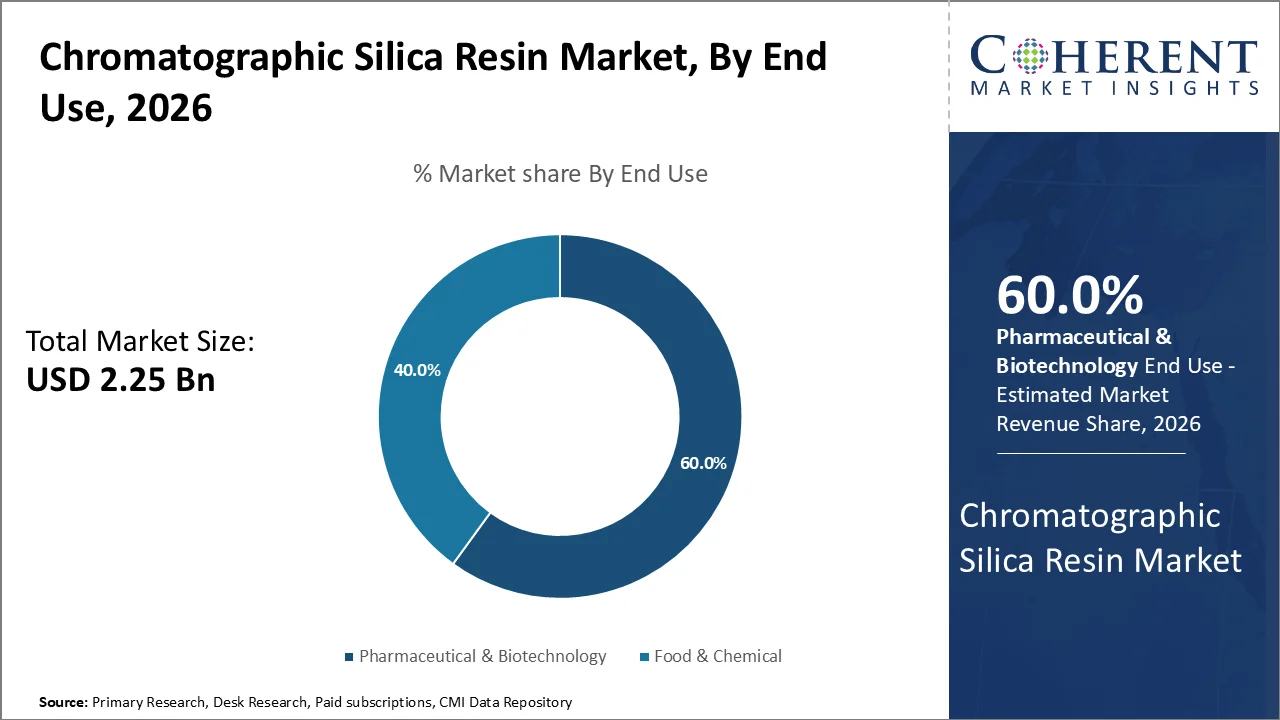
- Pharmaceutical & Biotechnology is expected to account the largest share of 60% in 2026, driven by strong demand for high-purity separation media in drug development, quality control, and API purification. Growth in the Indian pharmaceutical industry, projected to reach USD 130 Bn by 2030, further supports the rising demand in this segment.
- Analytical chromatography will dominate with 55% in 2026, widely used in quality control, drug development, and regulatory testing. The number of product samples tested across BIS-recognized labs has risen fivefold, from 48,121 in 2019–20 to over 2.5 lakh in 2024–25.
- Pure silica holds the dominant share of 58% in 2026, pure silica (up to 97%) is more common in less critical applications like basic chemical separations or some food/industrial uses. Amorphous silica (such as fumed silica) is incorporated in a variety of food products as anti-caking agents at levels up to 2% by weight.
- 30-60 hold the dominant share of 40% in 2026, commonly used in preparative and process chromatography, which accounts for the largest volumes of silica resin consumption in pharmaceutical and chemical production. Commonly used in preparative and process chromatography, which accounts for the largest volumes of silica resin consumption in pharmaceutical and chemical production.
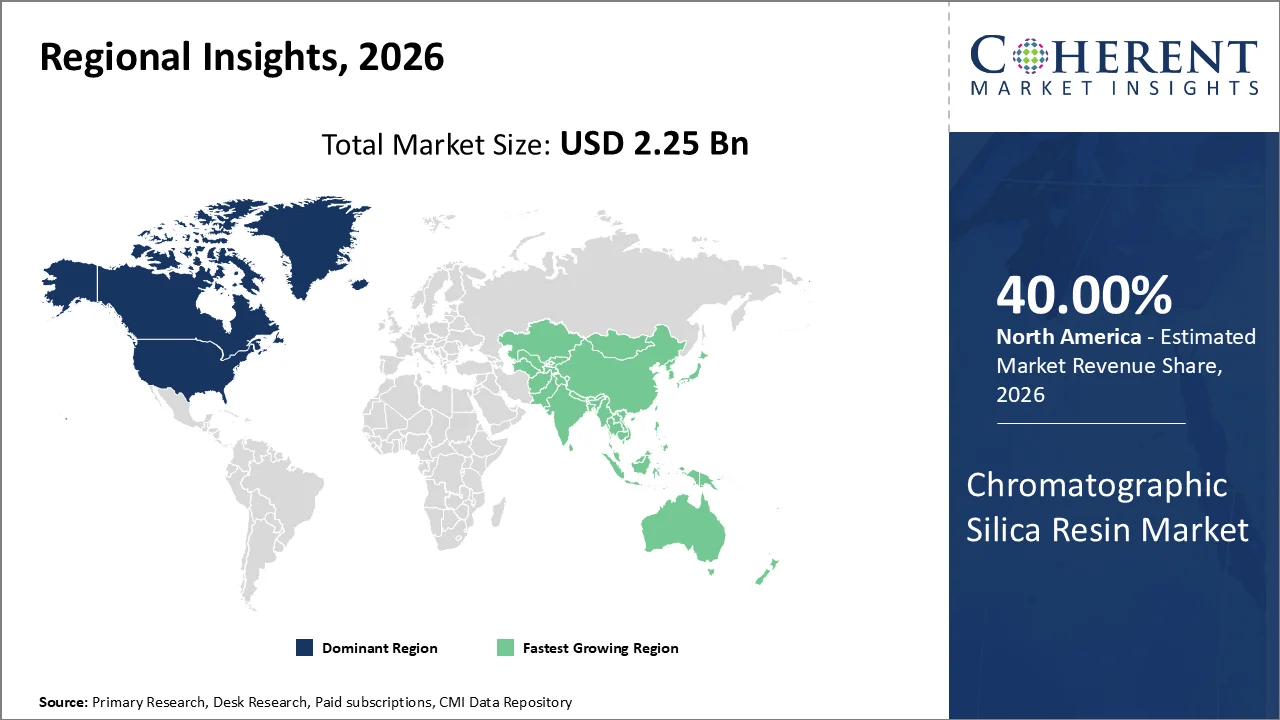
- North America is expected to acquire the dominant share of 40% in 2026, driven by high pharmaceutical and biotech activity, as well as high adoption of analytical and preparative chromatography in drug development and quality control. The region has the largest installed base of HPLC systems, accounting for nearly 40–45% of the global analytical chromatography.
Green and Sustainable Technologies: A major breakthrough in Chromatographic Silica Resin Procedure
Development of eco-friendly silica resins that reduce solvent waste and energy use. Companies like Mitsubishi Chemical are highly investing in resins optimized for supercritical fluid chromatography (SFC), which uses CO2 as a green solvent, enhancing sustainability in large-scale separations.
In February 2023, AGC Inc., a world-leading manufacturer of glass, chemicals and high-tech materials, announced that its wholly owned subsidiary, AGC Si-Tech Co., Ltd., which manufactures as well as sells fine silica products, has launched a new integrated brand RESIFA for all silica gel offerings. AGC Chemicals Americas, Inc. (AGCCA), a global subsidiary of AGC Inc., is AGC Si-Tech’s North American distributor of fine silica products.
Current Events and Their Impact on the Chromatographic Silica Resin Market (regulatory shifts, government policies)
Current Event | Description and its Impact |
Regulatory Push for Eco-Friendly and Sustainable Resins (U.S. & EU, 2025) |
|
High Adoption of Sol-Gel Silica in Pharmaceutical R&D (2025) |
|
- Current Industry Events of 2026
- Market Size Estimation
- Regional Breakdown
- Competitive Landscape
- Customer Intelligence
- Segmental Analysis
- Pricing Analysis
- Key Market Drivers, Challenges & Future Trends
- Customized Insights Section
Segmental Insights
Why is Pharmaceutical & Biotechnology Acquiring the Largest Market Share?
Pharmaceutical & biotechnology is projected to account for the largest share of end user in 2026, representing approximately 60% of the total volume. Primarily due to the sector's dependence on high-purity separation and purification processes essential for drug development as well as bioproduct manufacturing. Chromatographic silica resins play a crucial role in efficiently isolating active pharmaceutical ingredients (APIs), proteins, and other biological molecules with precision and consistency, which is a fundamental necessity within these industries. In August 2024, a single month, logged 32 export shipments, showing 113% growth over August 2023. While flat month-on-month, the long-term spike is undeniable.
The rigorous quality and regulatory standards imposed by agencies such as the U.S. Food and Drug Administration (FDA) and the European Medicines Agency (EMA) mandate the use of reliable as well as reproducible purification techniques to ensure drug safety and efficacy. This regulatory pressure has entrenched chromatography as a core purification method, driving demand for advanced silica resins that enable higher resolution as well as throughput.
Analytical Chromatography holds the Largest Market Share
Based on application, analytical chromatography dominates the market, accounting for a significant 55% share in 2026, this is mainly because it is increasingly used in quality checks, medicine testing, crime investigations, and environmental monitoring, where accuracy is very important.
Pure silica holds the Largest Market Share
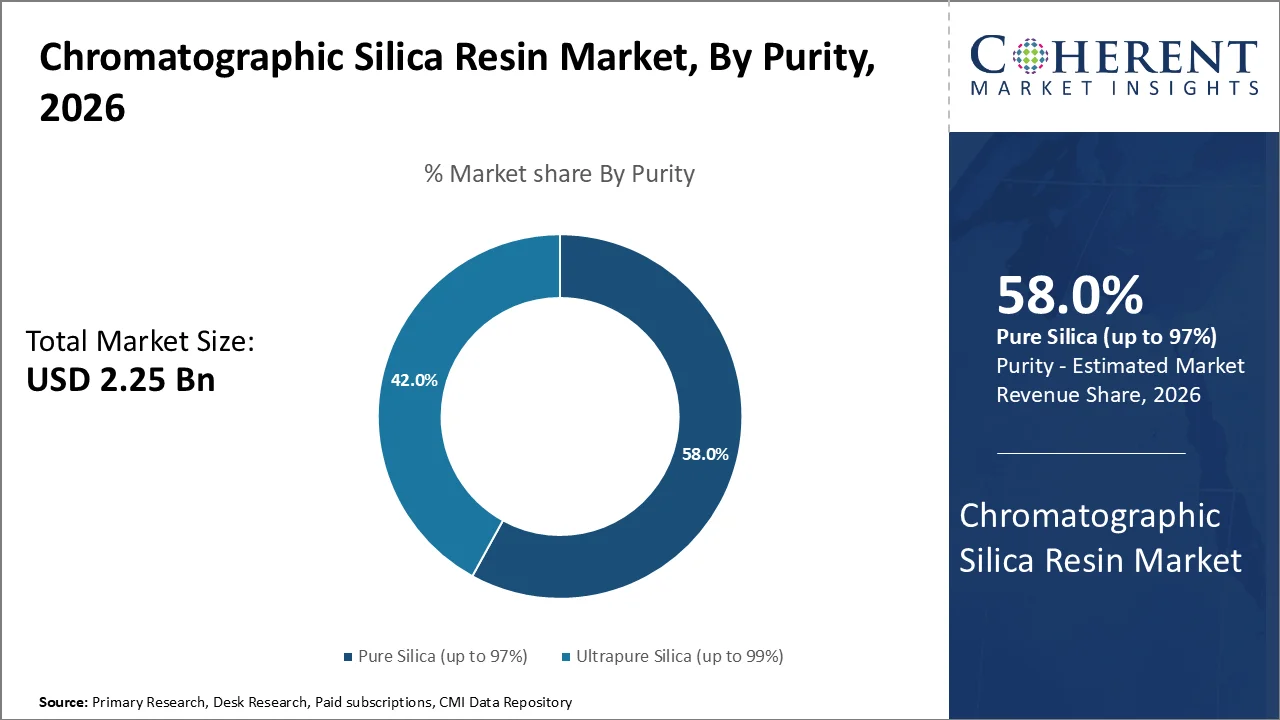
Based on purity, pure silica dominates the market, accounting for a significant 58% share in 2026, this dominance is supported by the ability to meet the requirements of most standard chromatographic separations while maintaining an optimal balance between performance as well as economic viability. Pure silica resins with up to 97% purity have established themselves as the workhorse of the chromatographic industry, particularly in pharmaceutical quality control, environmental monitoring, and food safety testing applications where consistent performance as well as reliability are paramount.
According to the World Health Organization's guidelines for pharmaceutical analysis, the majority of analytical methods for drug substances and products can be effectively performed utilizing silica resins with purity levels around 95-97%, making this segment highly relevant for global pharmaceutical manufacturing.
30-60 mesh size holds the Largest Market Share
Based on mesh size, 30-60 mesh size dominates the market, accounting for a significant 40% share in 2026, owing to its optimal balance of separation efficiency as well as practical operability across diverse chromatographic applications. This mesh size range shows the sweet spot for most industrial as well as pharmaceutical purification processes, delivering superior performance in terms of resolution while maintaining manageable pressure drops and flow rates.
Chromatographic Silica Resin Market Trends
- More people are using advanced chromatography methods like High-Performance Liquid Chromatography (HPLC) in making and testing medicines and biological drugs.
- Growing emphasis on precision medicine and development of novel biologics fueling demand for high-quality separation media. A wave of over 4,000 new precision therapies can fundamentally reshape how we approach as well as manage life-threatening diseases.
- Innovations in surface functionalization of silica resins advancing selectivity as well as performance.
- Rising regulatory standards demanding higher purity and betterquality control in drug manufacturing.
- Expansion of chromatography applications beyond pharmaceuticals, notably in food testing, environmental analysis, as well as petrochemicals.
Regional Insights
North America dominates owing to Growing Pharmaceutical and Biotechnology
North America account 40% market share in 2026, the United States, in particular, plays a crucial role given its established pharmaceutical and biotechnology sectors, which demand high-quality chromatographic materials for drug development as well as quality control processes. According to Drug Discovery World, the United States dominates the biotech sector in North America and globally, with an estimated value share of nearly 59%. Further, according to Key Biotechnology Indicators collated by the Organisation for Economic Co-operation and Development (OECD), the country had the largest number of biotechnology firms in 2021 with 2,8402, though some sources say that number is now as high as 6,6533.
The surged focus on biopharmaceuticals and personalized medicines in leading U.S. research institutions such as the National Institutes of Health (NIH) encourages ongoing innovations in chromatographic materials, driving demand for premium silica resins capable of supporting complex analytical workflows.
Asia Pacific Chromatographic Silica Resin Market Trends
The Asia-Pacific region is poised to be as the fastest-growing region through 2026-2033, expanding at a CAGR of approximately 5.74%. Escalating industrialization as well as expanding pharmaceutical and biotechnology sectors in countries like China, India, Japan, South Korea, etc., are major drivers for this growth. China, in particular, has experienced remarkable advancements in bio-pharmaceutical manufacturing capabilities as evidenced by the recent expansion of the Suzhou Industrial Park, which houses numerous biotech firms investing heavily in chromatographic purification processes using silica resins.
On August 21, 2025, the State Council gave further momentum to this trajectory by approving the Plan for Open and Innovative Development of the Entire Biopharmaceutical Industry Chain in the China (Jiangsu) Pilot Free Trade Zone. The initiative, submitted by the Jiangsu Provincial Government and the Ministry of Commerce (MOFCOM), targeted to establish a globally influential industrial cluster by advancing integrated innovation across the full biopharma value chain.
By 2024, China accounted for nearly one-quarter of next-generation therapeutic candidates worldwide, as well as out-licensing deals, where Chinese companies export their innovations for global commercialization, surged from just USD8 billion in 2020 to over USD50 billion in 2024.
The Deeply Rooted Chemical Industries is accelerating the Chromatographic Silica Resin Market Demand in United States
The U.S. is home to a large number of leading pharmaceutical companies, chemical manufacturers, as well as research institutions that are heavily invested in advanced chromatographic techniques for drug discovery, development, and quality control. In 2025, researchers across all 50 U.S. states and Washington, D.C. received USD 36.58 billion. This money helped fund 390,863 jobs and paid for new equipment, research supplies, maintenance, and other services.
Additionally, the high adoption rate of cutting-edge analytical technologies in academic as well as industrial R&D labs further cements the U.S. as the dominant subsegment within North America’s chromatographic silica resin market.
China Chromatographic Silica Resin Market Trends
The China contributes the highest share in the chromatographic silica resin market in the region owing to its robust pharmaceutical manufacturing ecosystem and extensive chemical processing infrastructure. China is a leader in this field because it is the biggest center for making medicines in the world. According to the National Medical Products Administration (NMPA), more than 4,000 pharmaceutical companies work there.
The nation's commitment to advancing biotechnology as well as pharmaceutical research has made substantial demand for high-quality chromatographic silica resins used in drug purification and analysis processes. For example, the Chinese government's "Made in China 2025" initiative has prioritized biopharmaceuticals as a key strategic sector, leading to significant investments in pharmaceutical manufacturing capabilities.
Furthermore, China's thriving fine chemicals industry, which generates annual revenue exceeding USD200 billion according to the China Petroleum and Chemical Industry Federation, heavily depends on chromatographic separation techniques for product purification.
Who are the Major Companies in Chromatographic Silica Resin Industry
Some of the major key players in chromatographic silica resin are W.R. Grace and Company, Osaka Soda Co. Limited, Alfa Aesar, Merck KGaA, AGC Group, SiliCycle Inc., Sorbead India, and Sepax Technologies Inc.
Key News
- In May 2025, DuPont added a new product, AmberChrom TQ1 chromatography resin, to its bioprocessing range. This resin is made to purify oligonucleotides and peptides more efficiently.
Market Report Scope
Chromatographic Silica Resin Market Report Coverage
| Report Coverage | Details | ||
|---|---|---|---|
| Base Year: | 2025 | Market Size in 2026: | USD 2.25 Bn |
| Historical Data for: | 2020 To 2024 | Forecast Period: | 2026 To 2033 |
| Forecast Period 2026 to 2033 CAGR: | 7.9% | 2033 Value Projection: | USD 3.2 Bn |
| Geographies covered: |
| ||
| Segments covered: |
| ||
| Companies covered: | W.R. Grace and Company, Osaka Soda Co. Limited, Alfa Aesar, Merck KGaA, AGC Group, SiliCycle Inc., Sorbead India, and Sepax Technologies Inc. | ||
| Growth Drivers: |
| ||
| Restraints & Challenges: |
| ||
Analyst Opinion
- Precision medicine and biologics are driving demand for the market. The surge in chromatographic silica resin use is tied directly to the growing number of high-value biologics as well as oligonucleotide therapies. According to BioPharma Dive (2025), over 1,200 new biologics entered clinical trials globally in 2025 alone, highlighting that the market isn’t “trending up”, it’s scaling because these therapies require high-purity, reproducible separation media for development and QC.
- Custom and functionalized silica resins are no longer niche. According to a 2025 Chemical & Engineering News (C&EN) feature, specialized resins such as cation/anion-exchange as well as hydrophilic-ligand bonded silica are being adopted at scale in commercial oligonucleotide manufacturing.
- Inclination from generic to application-specific resins is reshaping competitive dynamics, forcing manufacturers to innovate rapidly or risk losing high-value clients in pharma and biotech.
- Sustainability and regulatory compliance are shaping purchasing decisions. A 2025 Environmental Protection Agency (EPA) update tightened limits on organic solvent emissions in lab-scale chromatography operations. Companies choosing eco-friendly, water-based silica resins gain a competitive advantage, as regulatory pressures as well as corporate ESG commitments make these products essential, not optional, for compliance and market access.
Speak to the analyst
Want personalized insights?
Take the findings above to one of our principal consultants, or have the report rebuilt around the segments, geographies and competitors you actually track.
Market Segmentation
- By End Use
- Pharmaceutical & Biotechnology
- Food & Chemical
- By Application
- Analytical Chromatography
- Process Chromatography
- Preparative Chromatography
- Gravity Chromatography
- By Purity
- Pure Silica (up to 97%)
- Ultrapure Silica (up to 99%)
- By Mesh Size
- 30-60
- 60-100
- 100-200
- Above 200
- By Region
- North America
- U.S.
- Canada
- Latin America
- Brazil
- Mexico
- Argentina
- Rest of Latin America
- Europe
- Germany
- U.K.
- France
- Italy
- Spain
- Russia
- Rest of Europe
- Asia Pacific
- China
- India
- Japan
- Australia
- South Korea
- ASEAN
- Rest of Asia Pacific
- Middle East
- GCC
- Israel
- Rest of Middle East
- Africa
- South Africa
- Central Africa
- North Africa
- North America
Sources
Primary Research Interviews
- Chromatographic silica resin manufacturers and suppliers
- Laboratory equipment distributors and vendors
- Pharmaceutical and biotechnology company procurement managers
- Research laboratory directors and analytical chemists
- Others
Databases
- Chemical Market Analytics International (CMAI)
- IHS Markit Chemical Economics Handbook
- Others
Magazines
- Chemical & Engineering News (C&EN)
- Laboratory Equipment Magazine
- Chromatography Today
- Chemical Processing Magazine
- Others
Journals
- Journal of Chromatography A
- Analytical Chemistry Journal
- Journal of Separation Science
- Others
Newspapers
- Chemical Week
- The Chemical Engineer
- Chemical Industry Digest
- Laboratory News
- Others
Associations
- American Chemical Society (ACS)
- International Association of Analytical Chemistry (IAAC)
- Society for Chromatography and Allied Techniques
- European Chromatography Society
- Others
Public Domain Sources
- U.S. Environmental Protection Agency (EPA) databases
- European Chemicals Agency (ECHA) regulatory filings
- FDA drug approval databases
- National Institute of Standards and Technology (NIST)
- Others
Proprietary Elements
- CMI Data Analytics Tool, Proprietary
- CMI Existing Repository of information for last 10 years
Get access to 250+ pages report
Every segment, forecast, competitor profile and data table behind the analysis above — available for instant download.
- ESOMAR Member
- ISO 9001:2015 Certified
- D-U-N-S Registered
- GDPR & CCPA Compliant
Missing comfort of reading report in your local language? Find your preferred language:
Transform your Strategy with Exclusive Trending Reports
Frequently Asked Questions
The chromatographic silica resin market is expected to reach USD 3.2 Bn in 2033.
Major players operating in the global chromatographic silica resin market include W.R. Grace and Company, Osaka Soda Co. Limited, Alfa Aesar, Merck KGaA, AGC Group, SiliCycle Inc., Sorbead India, and Sepax Technologies Inc.
Limited scope of chromatographic silica resin across the end-use application is one of the major factor that is expected to hamper growth of the market over the forecast period.
The growing pharmaceutical industry around the globe is one of the major factors that is expected to propel growth of the market over the forecast period.
The chromatographic silica resin market is anticipated to grow at a CAGR of 7.9% between 2026 and 2033.
Among regions, North America is expected to account for a largest market share in the global chromatographic silica resin market over the forecast period.
Silica gel has a strong physical strength and is the most widely used as a column packing agent for analysis and purification in chromatography such as HPLC, medium and low-pressure chromatography, and open column chromatography.