

Clinical Alarm Management Market Size and Forecast – 2026 to 2033
Clinical Alarm Management Market is estimated to be valued at USD 5,280.4 Mn in 2026 and is expected to reach USD 29,515.6 Mn in 2033, exhibiting a compound annual growth rate (CAGR) of 27.9% from 2026 to 2033.
Key Takeaways
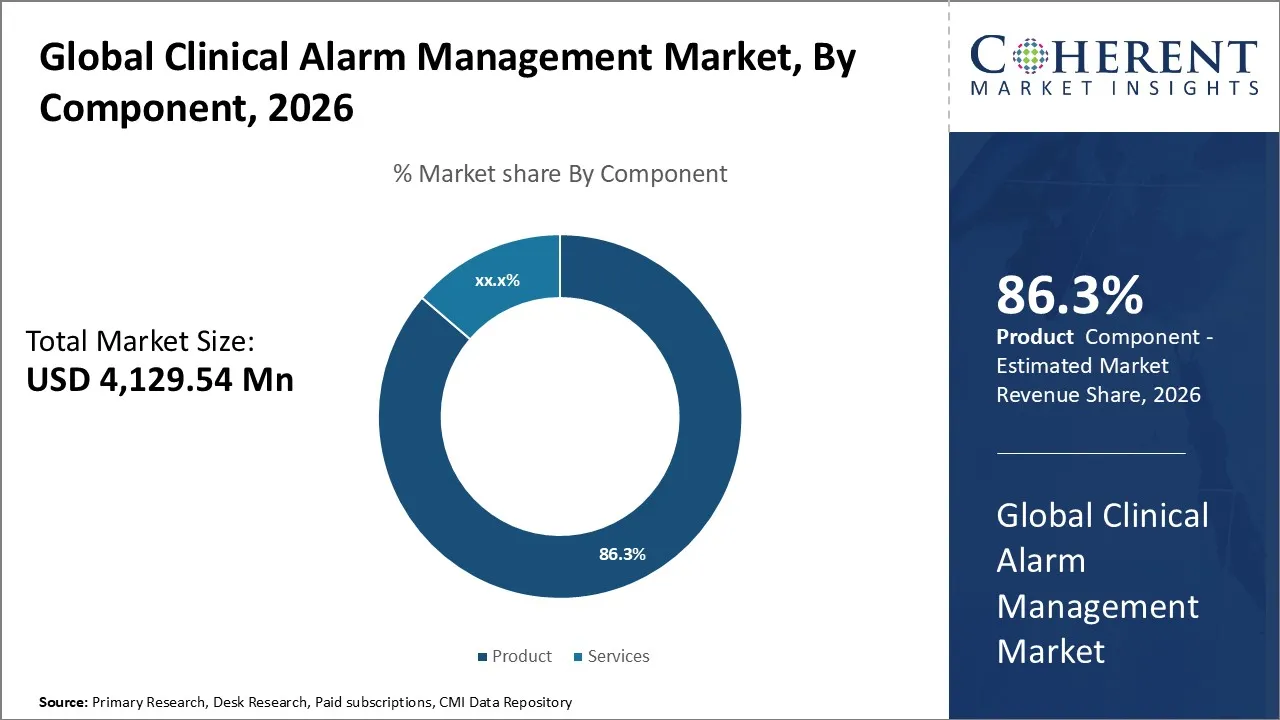
- By Component, Product hold the largest market share of 87.3% in 2026 owing to its increased focus on patient safety.
- By End Users, Hospital acquired the prominent market share of 75.3% in 2026 owing to the improving patient safety & reducing alarm‑related adverse events.
- By Region, North America dominates the overall market with an estimated share of 45.5% in 2026 owing to the advanced healthcare infrastructure & technology adoption.
Market Overview
The Clinical Alarm Management Market is driving the adoption of solutions that optimize and streamline medical alarm systems in healthcare settings. Hospitals and clinics are increasingly implementing intelligent alarm management technologies to address patient safety concerns, reduce alarm fatigue, and meet regulatory requirements. These systems connect with monitoring devices, electronic health records, and workflow platforms to prioritize critical alerts, improve clinician response, and boost operational efficiency. Advances in technology, along with growing use in acute care, telehealth, and home monitoring, are fueling market expansion in North America and worldwide.
Current Events and Its Impact on the Clinical Alarm Management Market
Current Events | Description and its impact |
Technological Advances in Healthcare IoT Integration |
|
Regulatory Changes and Patient Safety Initiatives |
|
Cybersecurity Threats and Data Privacy Regulations |
|
Segmental Insights
- Current Industry Events of 2026
- Market Size Estimation
- Regional Breakdown
- Competitive Landscape
- Customer Intelligence
- Segmental Analysis
- Pricing Analysis
- Key Market Drivers, Challenges & Future Trends
- Customized Insights Section
Clinical Alarm Management Market Insights, By Component - Product contribute the highest share of the market owing to its rising adoption of nurse call & monitoring systems
Product hold the largest market share of 87.3% in 2026. Products in the Clinical Alarm Management Market are expanding as healthcare facilities actively seek to enhance patient safety and minimize alarm fatigue. Hospitals and clinics are adopting advanced alarm management solutions that connect with monitoring devices, electronic health records, and clinical workflows to deliver timely and precise alerts. Innovations such as AI-powered analytics and predictive algorithms help prioritize alarms and support faster decision-making. Growing use of these solutions in acute care, home healthcare, and telehealth is further boosting global product demand. For instance, in May 2025, AirStrip has launched AirStrip Alarm Management, an integrated platform that modernizes clinical alarm management in hospitals.
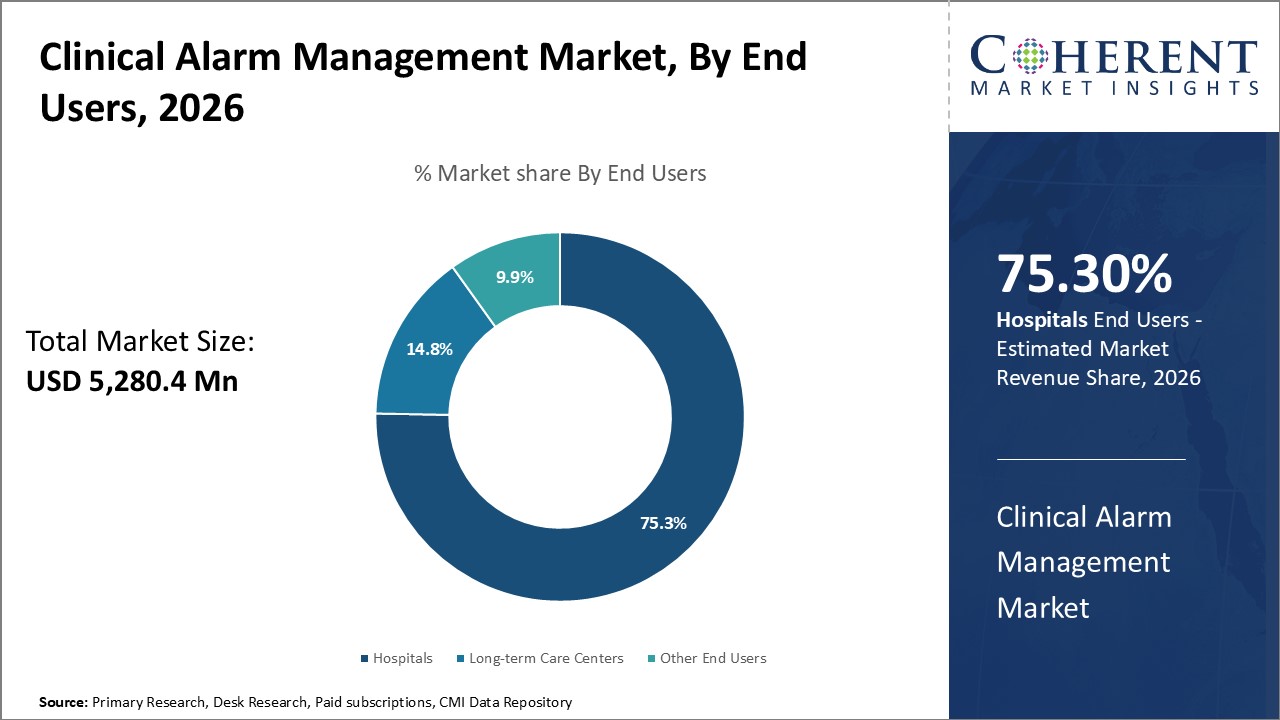
Clinical Alarm Management Market Insights, By End Users - Hospital contributes the highest share of the market owing to its technology advancements and operational efficiency
Hospital acquired the prominent market share of 75.3% in 2026. Hospitals are actively implementing Clinical Alarm Management solutions to enhance patient safety and streamline clinical workflows. These systems filter and prioritize critical alerts, helping staff respond faster and more accurately while reducing alarm fatigue. Compliance with regulatory requirements and accreditation standards further drives hospital adoption. By linking with electronic health records and monitoring devices, these solutions boost operational efficiency, support quality-of-care objectives, and improve staff performance, making them vital tools in intensive care units, emergency departments, and general hospital settings. For instance, in October 2025, Nihon Kohden launched AlarmSense, an analytics platform that helps hospitals reduce alarm fatigue by streamlining responses and converting alerts into actionable insights.
Regional Insights
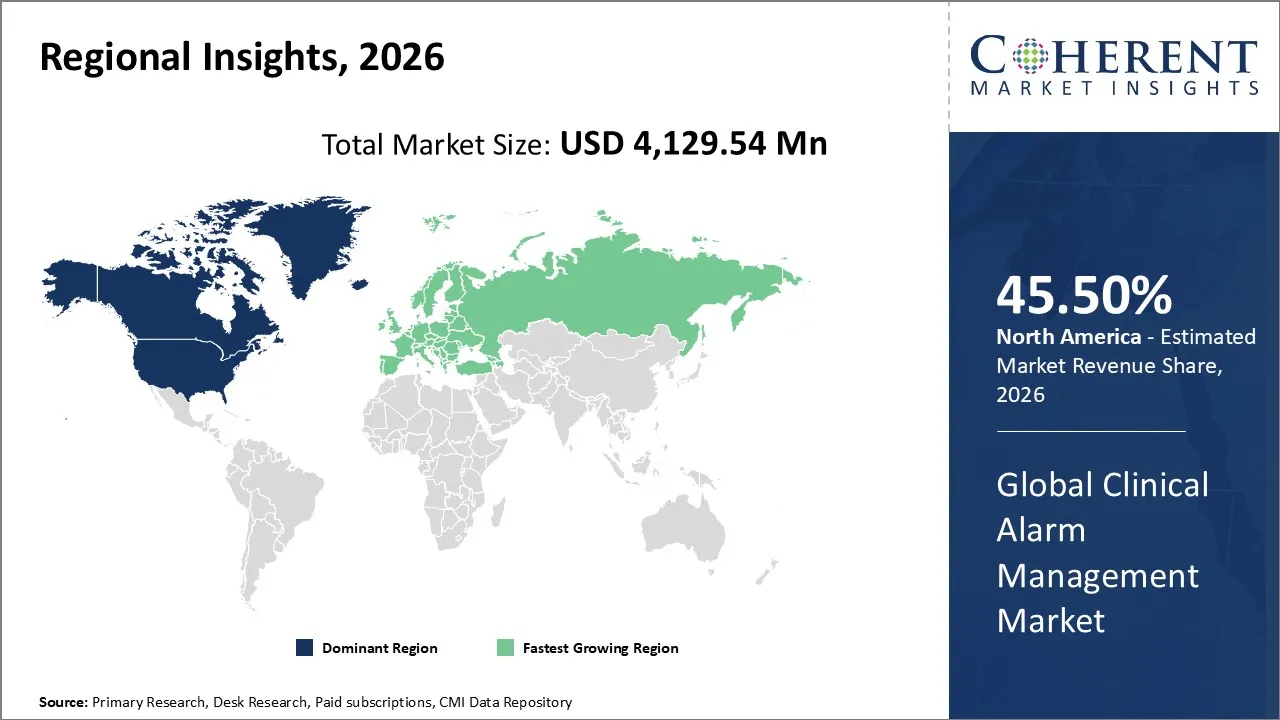
North America Clinical Alarm Management Market Trends
North America dominates the overall market with an estimated share of 45.50% in 2026. In North America, hospitals and healthcare providers are actively advancing the Clinical Alarm Management Market by focusing on patient safety and operational efficiency. They are increasingly integrating alarm systems with electronic health records, monitoring devices, and streamlined clinical workflows. AI-powered analytics and predictive monitoring are improving alarm accuracy and minimizing false alerts. The growth of telehealth and home healthcare is driving demand for remote alarm management solutions, while healthcare regulations targeting alarm fatigue continue to influence adoption and implementation across medical facilities. For instance, the Province unveiled BC Heat Alert and Response System (BC HARS) to provide people, First Nations communities, and local governments with tools to stay safe during heat events.
Europe Clinical Alarm Management Market Trends
In Europe, hospitals and healthcare providers are actively driving the growth of the Clinical Alarm Management Market by prioritizing patient safety and workflow efficiency. They are integrating alarm systems with electronic health records, monitoring devices, and centralized clinical networks to enhance care coordination. AI-powered analytics and smart alert prioritization are helping staff respond faster and reduce unnecessary alarms. Increased investment in telemedicine and home care, combined with stringent regional regulations on alarm management, is accelerating adoption across hospitals, intensive care units, and emergency departments. For instance, in October 2026, Ascom, in partnership with Dräger and B. Braun, launched the Silent ICU solution at ESICM LIVES 2026, enhancing ICU workflow, patient safety, and healing environments by delegating all medical device alarms to a distributed system.
United States Clinical Alarm Management Market Trends
In the United States, healthcare providers are actively expanding the Clinical Alarm Management Market by prioritizing patient safety and minimizing alarm fatigue. Hospitals are implementing alarm systems that connect with electronic health records, monitoring devices, and optimized clinical workflows. AI-powered analytics and predictive alert systems are enhancing alarm accuracy and enabling clinicians to respond more effectively. The growth of telehealth services, home monitoring solutions, and stringent regulatory requirements is further accelerating adoption across hospitals, emergency departments, and intensive care units throughout the country. For instance, in October 2026, Nihon Kohden launched AlarmSense™, a data-driven analytics solution that streamlines hospital response management and reduces alarm fatigue.
United Kingdom Clinical Alarm Management Market Trends
In the United Kingdom, healthcare providers are actively expanding the Clinical Alarm Management Market by prioritizing patient safety and streamlining clinical workflows. Hospitals and care facilities are implementing alarm systems that link with electronic health records, monitoring devices, and centralized clinical networks. AI-based analytics and smart alert prioritization are improving response times and reducing false alarms. Government initiatives, along with the growth of telehealth and home care services, are further driving adoption across hospitals, intensive care units, and emergency departments throughout the UK.
End-user Feedback and Unmet Needs in the Clinical Alarm Management Market
- Alarm Fatigue and Overload: End-users report that frequent non-critical alarms cause desensitization, delayed responses, and increased stress among clinical staff. Hospitals need systems that can intelligently filter and prioritize alerts, reducing unnecessary interruptions while ensuring critical alarms are addressed promptly to improve patient safety and staff efficiency.
- Integration with Existing Systems: Many healthcare providers face challenges integrating alarm management solutions with electronic health records, monitoring devices, and clinical workflows. End-users seek seamless interoperability to avoid workflow disruptions, ensure accurate data capture, and support real-time decision-making, enabling more efficient and coordinated care delivery across departments.
- Customization and Flexibility: Clinicians often highlight a lack of customizable alert settings for different departments or patient needs. End-users want solutions that allow adjustable thresholds, personalized notification preferences, and context-aware alarms to better match patient conditions and departmental priorities, enhancing usability and reducing unnecessary disruptions.
Clinical Alarm Management Market Trend
AI-Driven and Predictive Alarm Systems
Advanced Clinical Alarm Management solutions are incorporating artificial intelligence and predictive analytics to improve alarm accuracy. These systems filter false alerts, prioritize critical notifications, and anticipate potential patient deterioration. End-users benefit from actionable insights that support faster decision-making, reduce alarm fatigue, and enhance clinical workflow efficiency. The focus on intelligent, data-driven alarm solutions is a major trend, as hospitals strive to optimize staff performance while maintaining high standards of patient safety and care quality.
Market Report Scope
Clinical Alarm Management Market Report Coverage
| Report Coverage | Details | ||
|---|---|---|---|
| Base Year: | 2025 | Market Size in 2026: | USD 4,129.54 Mn |
| Historical Data for: | 2020 To 2024 | Forecast Period: | 2026 To 2033 |
| Forecast Period 2026 to 2033 CAGR: | 27.9% | 2033 Value Projection: | USD 29,515.6 Mn |
| Geographies covered: |
| ||
| Segments covered: |
| ||
| Companies covered: | Connexall USA, Inc., Spok Inc., Masimo, GE Healthcare, Medtronic PLC, Ascom Holding AG, Koninklijke Philips N.V., Baxter International Inc., Nihon Kohden Corporation, TigerConnect (Critical Alert System), West Com Nurse Call Systems, Inc., Stryker (Vocera Communications), and Amplion Clinical Communications, Inc., among others. | ||
| Growth Drivers: |
| ||
| Restraints & Challenges: |
| ||
Clinical Alarm Management Market News
- In September 2025, Philips has introduced a new telemetry platform, featuring the Telemetry Monitor 5500, to tackle staffing shortages and improve alarm management with a data-driven approach to cardiac monitoring and operational performance.
- In February 2025, TigerConnect has released its Pre-Hospital solution and provided early access to its Transfer solution, offering a unified platform for clinical communication, scheduling, alarm management, nurse call, and patient engagement.
Analyst Opinion (Expert Opinion)
- In the Clinical Alarm Management domain, alarm fatigue is not an abstract challenge but a documented clinical safety crisis with measurable impacts. Studies have repeatedly shown that the vast majority of monitoring alarms do not lead to meaningful clinical action, with one observational ED study noting that only 0.8 % of over 1,000 recorded alarms resulted in observable changes to patient care—highlighting a dangerous disconnect between alarm frequency and clinical relevance.
- Healthcare practitioners commonly encounter hundreds of alarms per patient per day, many of which are false or clinically irrelevant, creating a desensitization effect that increases the risk of missed critical events. Reports indicate clinicians may be exposed to an alarm burden in the range of several hundred sounds per day per bed, with upwards of 88 % of arrhythmia alarms in ICU settings being false. This cacophony of non‑actionable alerts not only degrades response accuracy but also contributes to cognitive overload and stress among nurses, who often report reduced attention, increased burnout, and compromised situational awareness in high‑alarm environments.
- While intelligent alarm management interventions—especially those leveraging machine learning and AI‑driven filtering—show promise in significantly reducing false alarms, practical implementation remains inconsistent across institutions. Evidence from integrative reviews demonstrates that system‑level alarm management tools can meaningfully decrease false alarm counts, shorten alarm durations, and improve clinician response times when effectively deployed. However, these improvements are contingent upon robust integration with clinical workflows, rigorous staff training, and organizational culture shifts that prioritize alarm relevance over sheer volume.
Speak to the analyst
Want personalized insights?
Take the findings above to one of our principal consultants, or have the report rebuilt around the segments, geographies and competitors you actually track.
Market Segmentation
- Global Clinical Alarm Management Market, By Component (Revenue, USD Mn, 2021 - 2033)
- Product
- Services
- Global Clinical Alarm Management Market, By End User (Revenue, USD Mn, 2021 - 2033)
- Hospitals
- Long-term Care Centers
- Other End Users
Regional Insights (Revenue, USD Mn, 2021 - 2033)
- North America
- U.S.
- Canada
- Latin America
- Brazil
- Argentina
- Mexico
- Rest of Latin America
- Europe
- Germany
- U.K.
- Spain
- France
- Italy
- Russia
- Rest of Europe
- Asia Pacific
- China
- India
- Japan
- Australia
- South Korea
- ASEAN
- Rest of Asia Pacific
- Middle East
- GCC Countries
- Israel
- Rest of Middle East
- Africa
- South Africa
- North Africa
- Central Africa
- North America
- Key Players Insights
- Connexall USA, Inc.
- Spok Inc.
- Masimo
- GE Healthcare
- Medtronic PLC
- Ascom Holding AG
- Koninklijke Philips N.V.
- Baxter International Inc.
- Nihon Kohden Corporation
- TigerConnect (Critical Alert System)
- West Com Nurse Call Systems, Inc.
- Stryker (Vocera Communications)
- Amplion Clinical Communications, Inc.
Sources
Primary Research interviews
- Hospital clinical engineering teams
- Biomedical technicians
- Nurses and ICU staff
- Medical device manufacturers’ R&D teams
- Hospital administrators responsible for alarm management policies
Databases
- PubMed
- ClinicalTrials.gov
- WHO Global Health Observatory
- FDA Medical Device Database
- CDC National Healthcare Safety Network (NHSN)
Magazines
- Healthcare Technology Magazine
- Medical Device & Diagnostic Industry (MD+DI)
- Health Management Technology
- Biomedical Instrumentation & Technology
Journals
- Journal of Clinical Monitoring and Computing
- Journal of Biomedical Informatics
- Critical Care Medicine
- American Journal of Infection Control
- Healthcare Technology Letters
Newspapers
- The New York Times – Health Section
- The Guardian – Health
- The Washington Post – Health & Science
Associations
- Association for the Advancement of Medical Instrumentation (AAMI)
- American Hospital Association (AHA)
- American Nurses Association (ANA)
- International Electrotechnical Commission (IEC)
Public Domain sources
- U.S. FDA Safety Communications
- WHO Guidelines and Reports
- CDC Guidelines on Patient Safety and Alarms
- National Health Service (NHS) Publications
Proprietary Elements
- CMI Data Analytics Tool
- Proprietary CMI Existing Repository of information for last 8 years
Get access to 250+ pages report
Every segment, forecast, competitor profile and data table behind the analysis above — available for instant download.
- ESOMAR Member
- ISO 9001:2015 Certified
- D-U-N-S Registered
- GDPR & CCPA Compliant
Missing comfort of reading report in your local language? Find your preferred language:
Transform your Strategy with Exclusive Trending Reports
Frequently Asked Questions
The Clinical Alarm Management Market is estimated to be valued at USD 5,280.4 Mn in 2026, and is expected to reach USD 29,515.6 Mn by 2033.
The CAGR of the Clinical Alarm Management Market is projected to be 27.9% from 2026 to 2033.
Rise in prevalence of chronic diseases and rise in geriatric (aging) population around the world is fueling the market.
The product segment is the leading component segment in the market.
High investment for clinical alarm management systems and lack of product standardization and false alarms are major factors restraining market.
Major players operating in the market are Connexall USA, Inc., Spok Inc., Masimo, GE Healthcare, Medtronic PLC, Ascom Holding AG, Koninklijke Philips N.V., Baxter International Inc., Nihon Kohden Corporation, TigerConnect (Critical Alert System), West Com Nurse Call Systems, Inc., Stryker (Vocera Communications), and Amplion Clinical Communications, Inc., among others.