

Clinical Trials Support Services Market Size and Forecast – 2026 to 2033
Clinical Trials Support Services Market is estimated to be valued at USD 27.85 Bn in 2026 and is expected to reach USD 46.81 Bn in 2033, exhibiting a compound annual growth rate (CAGR) of 7.7% from 2026 to 2033.
Key Takeaways
- By Phase, Phase III acquired the prominent share of 55.2% in 2026 as prevalence of chronic and complex diseases.
- By Service, Clinical Trial Site Management hold the largest market share in 2026 owing to its increasing r&d investments & drug discovery activities.
- By Sponsor, Pharmaceutical & Biopharmaceutical Companies dominates the overall market share in 2026 owing to the Rising R&D Investments & New Drug Development.
- By Region, North America dominates the overall market with an estimated share of 49.8% in 2026 owing to the robust healthcare and research infrastructure.
Market Overview
The global clinical trials support services market is experiencing strong growth owing to the increasing demand for clinical trials support services and rise in burden of chronic and infectious disease. Furthermore, increasing number of clinical trials and increase in drug discovery and drug development is expected to boost the clinical trials support services market growth.
Current Events and their Impact on the Clinical Trials Support Services Market
Current Events | Description and its impact |
Geopolitical and Regulatory Shifts |
|
Technological Innovations and Digital Transformation |
|
Economic Fluctuations and Funding Dynamics |
|
End-user Feedback and Unmet Needs in the Clinical Trials Support Services Market
End-user Feedback and Unmet Needs
- Demand for Faster Patient Recruitment: End-users frequently report delays in patient enrollment as a critical challenge. They seek support services that offer faster, targeted recruitment strategies using digital outreach, real-world data, and community engagement to improve enrollment speed and diversity across trial sites.
- Need for Integrated Digital Solutions: Stakeholders emphasize the need for unified platforms that connect data capture, remote monitoring, and site management. Fragmented tools slow down operations and create inefficiencies, prompting demand for seamless, tech-enabled systems that improve trial oversight and data accuracy.
- Improved Site Communication and Oversight: Trial sponsors and CROs often face challenges in maintaining consistent communication with clinical trial sites. They require better site engagement models, frequent updates, and centralized communication platforms to ensure alignment and smooth execution throughout all trial phases.
- Current Industry Events of 2026
- Market Size Estimation
- Regional Breakdown
- Competitive Landscape
- Customer Intelligence
- Segmental Analysis
- Pricing Analysis
- Key Market Drivers, Challenges & Future Trends
- Customized Insights Section
Segmental Insights
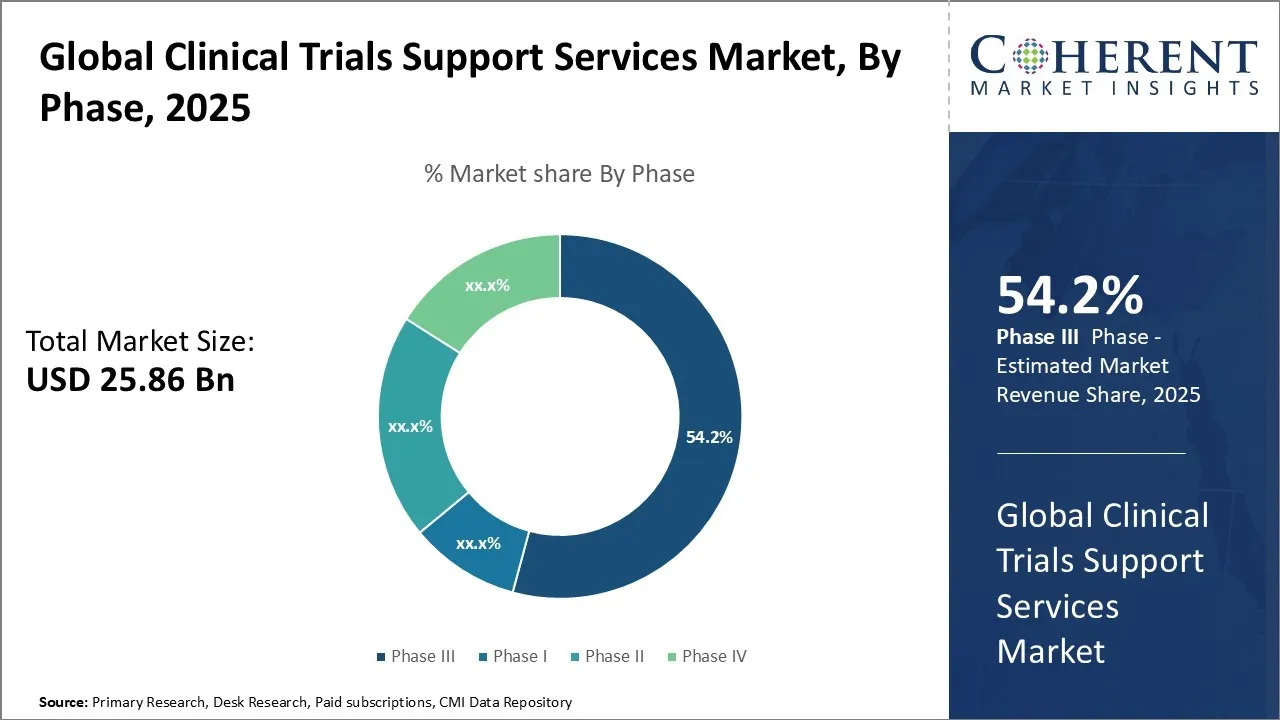
Clinical Trials Support Services Market Insights, By Phase - Phase III contribute the highest share of the market owing to its regulatory complexity & need for compliance support
Phase III acquired the prominent share of 55.2% in 2026. Growing rates of chronic diseases, rising drug development activity, and increasing trial complexity drive the Phase 3 Clinical Trials Support Services market. Pharmaceutical and biotech companies actively outsource services to improve efficiency, meet regulatory requirements, and cut operational costs. They also adopt technologies like electronic data capture and remote monitoring to streamline trial processes. As the demand for large, diverse patient populations grows, these companies expand trials globally, further increasing their reliance on comprehensive support services during this pivotal phase. For instance, in December 2024, EyePoint Pharmaceuticals, Inc., focused on developing innovative treatments for serious retinal diseases, has announced that it has dosed the first patient in the LUCIA trial—its second global Phase 3 clinical trial of DURAVYU (formerly EYP-1901) for treating wet AMD.
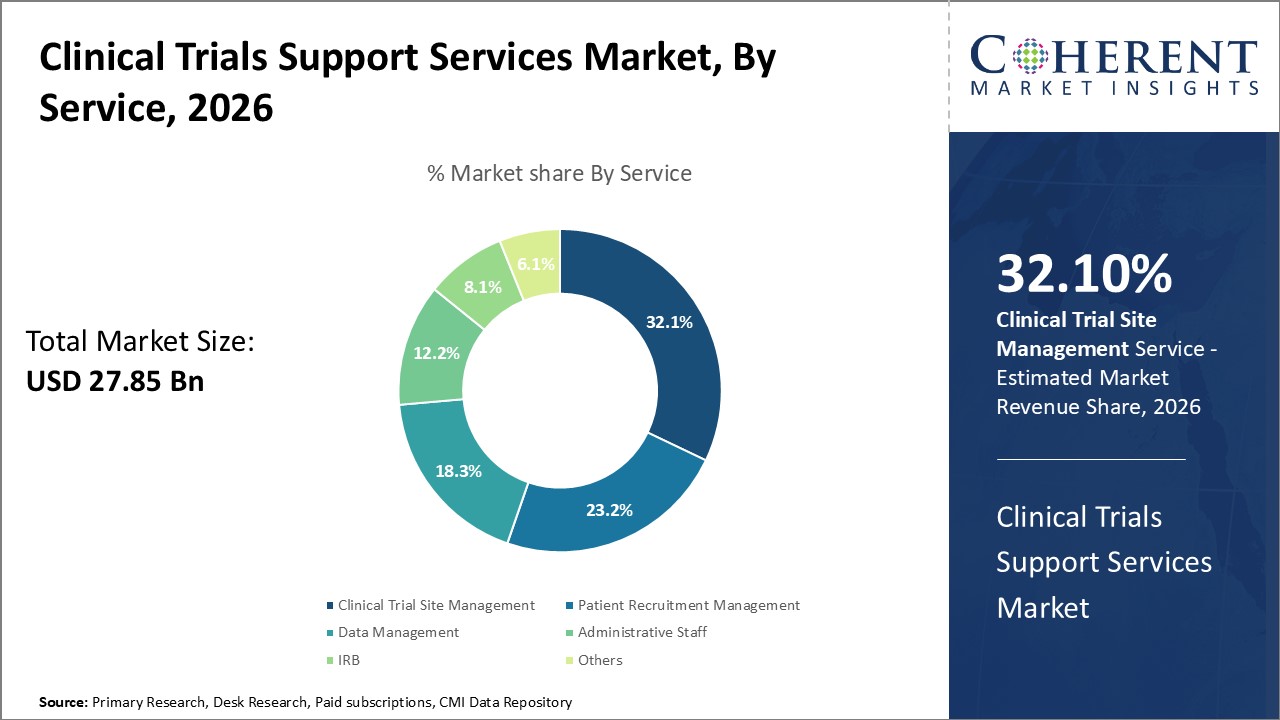
Clinical Trials Support Services Market Insights, By Service - Clinical Trial Site Management contribute the highest share of the market owing to its trend toward outsourcing
Increasing trial complexity, rising pressure to recruit patients efficiently, and the need to meet regulatory standards drive growth in the Clinical Trial Site Management segment. Pharmaceutical and biotech companies actively outsource site management to improve operational efficiency, lower costs, and maintain quality control. They adopt digital tools like clinical trial management systems and remote monitoring to optimize site performance. As they expand trials into emerging markets, they rely more on skilled site management teams to coordinate and support studies across multiple regions. For instance, in March 2025, Neutra Corp entered the Life Sciences clinical research sector through its pilot program and announced the launch of its advanced Site Management Organization (SMO), Neutra Life Sciences.
Clinical Trials Support Services Market Insights, By Sponsor - Pharmaceutical & Biopharmaceutical Companies contribute the highest share of the market owing to its cost efficiency through outsourcing
Pharmaceutical and biopharmaceutical companies actively fuel the Clinical Trials Support Services market by boosting research and development efforts and speeding up drug discovery. They increasingly outsource support services to cut costs, enhance efficiency, and leverage specialized expertise. As they shift toward personalized medicine and manage more complex trial designs, they seek tailored solutions. These companies also embrace digital innovations and expand their trials globally, driving the need for comprehensive support services to ensure smooth and successful trial execution across diverse regions.
In February 2025, Selkirk Pharma, Inc., a privately held U.S. pharmaceutical manufacturer focused on fill and finish services for injectable drugs, launched ClinFAST™—a groundbreaking service aimed at helping clinical-stage biotech and pharma companies quickly complete the fill/finish process for their clinical trial supplies.
Regional Insights
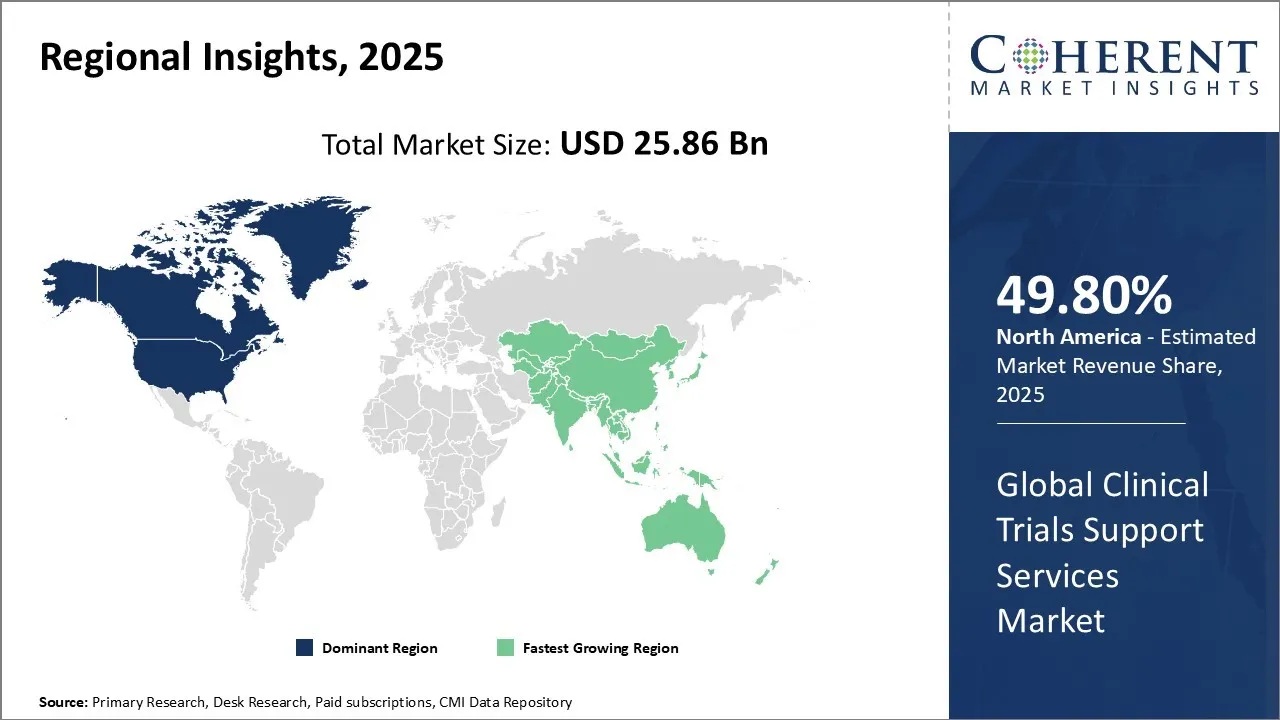
North America Clinical Trials Support Services Market Trends
North America dominates the overall market with an estimated share of 49.80% in 2026. Advanced healthcare infrastructure, strong R&D activity, and the presence of major pharmaceutical and biotech companies are driving growth in the North America Clinical Trials Support Services market. Industry players in the region actively adopt innovative technologies like electronic data capture, remote monitoring, and decentralized trial models to enhance trial efficiency. Regulatory agencies provide clear guidance and streamlined approvals, encouraging market expansion. Companies also prioritize patient-centric strategies and increasingly outsource trial operations, which continues to shape evolving market trends across the United States and Canada. For instance, in December 2024, USF Health unveiled a state-funded hyperbaric oxygen therapy trial, enrolling its first patient. National experts recognize this ambitious project as one of the most rigorous studies of its kind, with long-term results that could transform the understanding of hyperbaric oxygen therapy as a treatment for neurological diseases.
Asia Pacific Clinical Trials Support Services Market Trends
Clinical trial activity is rapidly increasing in Asia Pacific as countries like China, India, and South Korea attract attention with their large, diverse patient populations and growing disease burden. Global pharmaceutical companies are choosing these locations for their cost-efficiency and expanding healthcare systems. Governments and private investors across the region are actively building healthcare infrastructure and upgrading clinical research facilities. These advancements enable the region to offer modern trial sites and skilled professionals, making it an increasingly attractive hub for international clinical research. For instance, in July 2026, Intrinseque Health innaugrated its new entity, Intrinseque Health (Malaysia) Sdn. Bhd. This entity will strengthen operations across Southeast Asia, supporting drug development, clinical trials, and clinical supply chain activities throughout the region.
United States Clinical Trials Support Services Market Trends
Sponsors and research organizations in the U.S. are actively implementing decentralized clinical trial models to enhance patient participation and minimize the need for site visits. By using remote monitoring, telehealth, and digital platforms, they improve recruitment and retention across diverse regions. U.S. pharmaceutical and biotech companies increasingly outsource trial operations to Contract Research Organizations (CROs) and Site Management Organizations (SMOs). This strategy helps them reduce costs, accelerate timelines, and access expert support for managing complex, multi-site, and multi-phase clinical trials.
For instance, in May 2026, U.S. based company, OptymEdge, a part of the Emmes Group, expanded its ophthalmology services by launching the clinical research industry’s first technology platform specifically designed for ophthalmology trials.
India Clinical Trials Support Services Market Trends
Global pharmaceutical and biotech companies are increasingly choosing India as a key destination for clinical trials, drawn by its large patient pool, diverse disease patterns, and growing involvement in international research. Sponsors are conducting more studies in India to achieve faster patient enrollment and reduce costs. They are actively outsourcing trial support services to Indian Contract Research Organizations (CROs) and Site Management Organizations (SMOs), which provide experienced personnel, flexible operations, and affordable solutions, positioning India as a strategic hub for clinical trial outsourcing. For instance, in April 2024, the Indian Council of Medical Research (ICMR) announced tp expand its Indian Clinical Trial and Education Network (INTENT) to conduct large, regulation-compliant clinical trials aimed at delivering evidence-based, scientifically robust, and culturally appropriate solutions to health challenges of national importance.
Market Report Scope
Clinical Trials Support Services Market Report Coverage
| Report Coverage | Details | ||
|---|---|---|---|
| Base Year: | 2025 | Market Size in 2026: | USD 27.85 Bn |
| Historical Data for: | 2020 To 2024 | Forecast Period: | 2026 To 2033 |
| Forecast Period 2026 to 2033 CAGR: | 7.7% | 2033 Value Projection: | USD 46.81 Bn |
| Geographies covered: |
| ||
| Segments covered: |
| ||
| Companies covered: | Wuxi AppTec, Inc., IQVIA Holdings, Inc., Syneos Health, Inc., Eurofins Scientific, Laboratory Corporation of America Holdings (Labcorp), Icon PLC, ALCURA, Parexel International Corporation, PPD, Inc. (Pharmaceutical Product Development), and Charles River Laboratories International, Inc. | ||
| Growth Drivers: |
| ||
| Restraints & Challenges: |
| ||
Clinical Trials Support Services Market Trend
- Rising Demand for Decentralized Clinical Trials (DCTs)
The market is witnessing a strong shift toward decentralized clinical trials, driven by the need for improved patient accessibility and operational flexibility. DCTs use technologies like telemedicine, remote monitoring, and wearable devices to conduct trials outside traditional sites. This approach reduces patient burden, increases engagement, and expands geographic reach. Sponsors are investing in service providers that can support hybrid and remote models, making decentralized trial capabilities a major competitive differentiator in the clinical trials support services landscape.
- Increased Outsourcing to CROs and SMOs
Pharmaceutical and biotech companies are increasingly outsourcing clinical trial activities to Contract Research Organizations (CROs) and Site Management Organizations (SMOs). This trend is driven by the need to reduce costs, improve trial efficiency, and access specialized expertise. CROs offer end-to-end support, while SMOs focus on site-level coordination and recruitment. Outsourcing allows sponsors to focus on core R&D while delegating operations, compliance, and monitoring tasks to experienced partners, fueling the demand for outsourced support services across all trial phases.
Clinical Trials Support Services Market Opportunity
- Expanding Role of Artificial Intelligence and Automation
AI and automation present significant opportunities to streamline clinical trial processes. Service providers can leverage AI for patient matching, protocol design, risk-based monitoring, and predictive analytics. Automation reduces manual errors and accelerates data processing. Companies that invest in AI-driven platforms can offer faster, more accurate services and gain a competitive edge. As trials become more complex, the demand for intelligent, data-driven decision-making tools creates a vast opportunity for innovation in support services.
Clinical Trials Support Services Market News
- In May 2025, Queen’s Health Sciences (QHS) in Canada introduced a centralized Clinical Trial Support Unit (CTSU) to strengthen clinical trial research capacity. Currently in its pilot phase, the unit provides a variety of shared services, including support for trial start-up, ongoing management, and full-scope coordination.
- In May 2025, Bayer launched Centafore Imaging Core Lab to enhance imaging support for clinical trials and Software as a Medical Device (SaMD) development. With this launch, Bayer positions Centafore as a dedicated imaging solutions provider, delivering customized services to external clients across various therapeutic areas and development stages.
- In November 2024, Authorities from Hong Kong and Shenzhen jointly launched a clinical trial institute and a clinical trials center on Thursday at the twin science park in the Lok Ma Chau Loop. With this initiative, they aim to accelerate clinical trials for innovative drugs and attract leading innovative companies and research institutions to establish a presence in the city.
Analyst Opinion (Expert Opinion)
- Clinical trials today are no longer defined by geography or site-based management but by speed, scalability, and digital fluency.
- Patient recruitment and retention continue to be the costliest and most error-prone aspects of trials. Over 85% of trials fail to retain enough participants, and nearly one-third of Phase III trials are delayed due to recruitment bottlenecks. Service providers that rely solely on site-based recruitment models are ignoring a massive opportunity. Companies like Antidote Technologies and Trialbee have set the standard by using AI-driven, pre-screened, real-world data to match patients, reducing recruitment times by up to 50% in certain oncology trials.
- From an operational standpoint, the trend toward hybrid and outsourced trial models isn’t just tactical—it’s now strategic. In 2024, Amgen and Novartis both reported that over 60% of their global clinical trials involved third-party coordination at the site level, reflecting a growing dependence on support providers for not just execution, but also protocol feasibility, risk mitigation, and regulatory navigation.
Speak to the analyst
Want personalized insights?
Take the findings above to one of our principal consultants, or have the report rebuilt around the segments, geographies and competitors you actually track.
Market Segmentation
- Global Clinical Trials Support Services Market, By Phase (Revenue, USD Bn, 2021 - 2033)
- Phase I
- Phase II
- Phase III
- Phase IV
- Global Clinical Trials Support Services Market, By Service (Revenue, USD Bn, 2021 - 2033)
- Clinical Trial Site Management
- Patient Recruitment Management
- Data Management
- Administrative Staff
- IRB
- Others
- Global Clinical Trials Support Services Market, By Sponsor (Revenue, USD Bn, 2021 - 2033)
- Pharmaceutical & Biopharmaceutical Companies
- Medical Device Companies
- Others
- Global Clinical Trials Support Services Market, By Geography (Revenue, USD Bn, 2021 - 2033)
- North America
- U.S.
- Canada
- Latin America
- Brazil
- Argentina
- Mexico
- Rest of Latin America
- Europe
- Germany
- U.K.
- Spain
- France
- Italy
- Russia
- Rest of Europe
- Asia Pacific
- China
- India
- Japan
- Australia
- South Korea
- ASEAN
- Rest of Asia Pacific
- Middle East
- GCC Countries
- Israel
- Rest of Middle East
- Africa
- South Africa
- North Africa
- Central Africa
- North America
- Key Players Insights
- Wuxi AppTec, Inc.
- IQVIA Holdings, Inc.
- Syneos Health, Inc.
- Eurofins Scientific
- Laboratory Corporation of America Holdings (Labcorp)
- Icon PLC
- ALCURA
- Parexel International Corporation
- PPD, Inc. (Pharmaceutical Product Development)
- Charles River Laboratories International, Inc.
Sources
Primary Research Interviews
- Senior executives from CROs and SMOs
- Clinical operations heads at pharmaceutical and biopharmaceutical companies
- Site coordinators and investigators from academic research centers
- Regulatory affairs professionals from sponsor organizations
- Digital health and DCT platform providers
Databases
- ClinicalTrials.gov
- WHO International Clinical Trials Registry Platform (ICTRP)
- U.S. FDA Clinical Investigator Inspection List
- PubMed and MEDLINE
- European Medicines Agency (EMA) Clinical Trials Register
Magazines
- Applied Clinical Trials
- PharmaVOICE
- The Pharma Letter
- Clinical Leader
- Drug Development & Delivery
Journals
- The Lancet Oncology
- Journal of Clinical Pharmacology
- Therapeutic Innovation & Regulatory Science
- Contemporary Clinical Trials Communications
- Journal of Clinical Trials
Newspapers
- The Wall Street Journal (Health Section)
- Financial Times (Life Sciences Segment)
- The Economic Times (Pharma & Healthcare Section)
- The Guardian (Global Health)
- Business Standard (Healthcare & Pharma)
Associations
- Association of Clinical Research Professionals (ACRP)
- Society for Clinical Research Sites (SCRS)
- International Society for Pharmacoeconomics and Outcomes Research (ISPOR)
- DIA (Drug Information Association)
- TransCelerate BioPharma Inc.
Public Domain Sources
- U.S. Food and Drug Administration (FDA)
- European Medicines Agency (EMA)
- Indian Council of Medical Research (ICMR)
- Centers for Disease Control and Prevention (CDC)
- National Institutes of Health (NIH)
Proprietary Elements
- CMI Data Analytics Tool, and Proprietary CMI Existing Repository of information for last 8 years
Get access to 250+ pages report
Every segment, forecast, competitor profile and data table behind the analysis above — available for instant download.
- ESOMAR Member
- ISO 9001:2015 Certified
- D-U-N-S Registered
- GDPR & CCPA Compliant
Missing comfort of reading report in your local language? Find your preferred language:
Transform your Strategy with Exclusive Trending Reports
Frequently Asked Questions
The Clinical Trials Support Services Market is estimated to be valued at USD 27.85 Bn in 2026, and is expected to reach USD 46.81 Bn by 2033.
The CAGR of the Clinical Trials Support Services Market is projected to be 7.7% from 2026 to 2033.
High demand for clinical trials support services and increasing prevalence of chronic or infectious diseases is fueling the growth of the global clinical trials support services market.
The Phase III segment is the leading phase segment in the market.
Stringent regulatory framework and poor healthcare infrastructure are major factors restraining growth of the market.
Major players operating in the market are Wuxi AppTec, Inc., IQVIA Holdings, Inc., Syneos Health, Inc., Eurofins Scientific, Laboratory Corporation of America Holdings (Labcorp), Icon PLC, ALCURA, Parexel International Corporation, PPD, Inc. (Pharmaceutical Product Development), and Charles River Laboratories International, Inc.