

Compression Garments And Stockings Market Analysis & Forecast
Compression Garments and Stockings Market is estimated to be valued at USD 3,330.1 Mn in 2026 and is expected to reach USD 4,780.3 Mn in 2033, exhibiting a compound annual growth rate (CAGR) of 5.3% from 2026 to 2033.
Key Takeaways
- Based on the Product Type, the Compression garments segment dominates the market due to improving athletic performance and speeding up muscle recovery.
- Based on the Application, the Varicose Veins segment dominates the market due to the treatment and management of varicose veins.
- On the basis of Distribution Channel, the hospitals segment dominates the market due to the increased use of compression garments in post-operative care.
- Based on the region, North America is dominant in the global compression garments and stockings market and is estimated to hold 46.90% of the market share.
Market Overview
Several important factors are supporting the growth of the global compression garments and stockings market. A growing number of people are experiencing vein problems like varicose veins and deep vein clots, especially among older adults and those with inactive lifestyles, which is increasing medical use. Improvements in materials, such as breathable fabrics, step-by-step pressure designs, and smart clothing, are making these products more comfortable and effective. Athletes and fitness lovers use them for better performance and faster recovery. Attractive designs and customization also appeal to health-focused customers, encouraging wider use.
Current Events and Their Impact on the Compression Garments And Stockings Market
Current Events | Description and its impact |
Technological Advancements |
|
Emerging Market Expansion |
|
Material Science Developments |
|
Major US Regulatory Changes |
|
Reimbursement Scenario in Compression Garments and Stockings
As of June 15, 2024, EmblemHealth and ConnectiCare have introduced a new reimbursement policy for compression garments. Under this policy, both plans will follow CMS reimbursement guidelines for compression garments and stockings when they are prescribed by a physician and supplied by a durable medical equipment (DME) provider.
Moreover, Medicare covers lymphedema compression treatment items as outlined in section 1861(s)(2)(JJ) of the Social Security Act and detailed in 42 CFR 410.36(a)(4). Coverage includes both standard and custom-fitted gradient compression garments. Custom garments are tailored to the individual's specific measurements to ensure proper gradient compression.
- Current Industry Events of 2026
- Market Size Estimation
- Regional Breakdown
- Competitive Landscape
- Customer Intelligence
- Segmental Analysis
- Pricing Analysis
- Key Market Drivers, Challenges & Future Trends
- Customized Insights Section
Pricing Analysis of Compression Stockings
Compression stockings are generally divided into three categories based on quality and target users:
Budget or Entry-Level Options typically cost between $10 and $20. These are aimed at casual users or those looking for mild compression. They’re commonly available at pharmacies and big-box retailers.
Mid-Range Products are priced between $20 and $50. These stockings often offer better materials, more consistent graduated compression, and are suitable for people who use them regularly for travel, standing jobs, or minor swelling issues.
Premium or Medical-Grade Stockings range from $50 to over $100. These are designed for athletes, people with medical conditions like varicose veins or lymphedema, and often require prescriptions. They typically provide stronger compression (20–30 mmHg or higher) and may be covered by insurance.
Segmental Insights
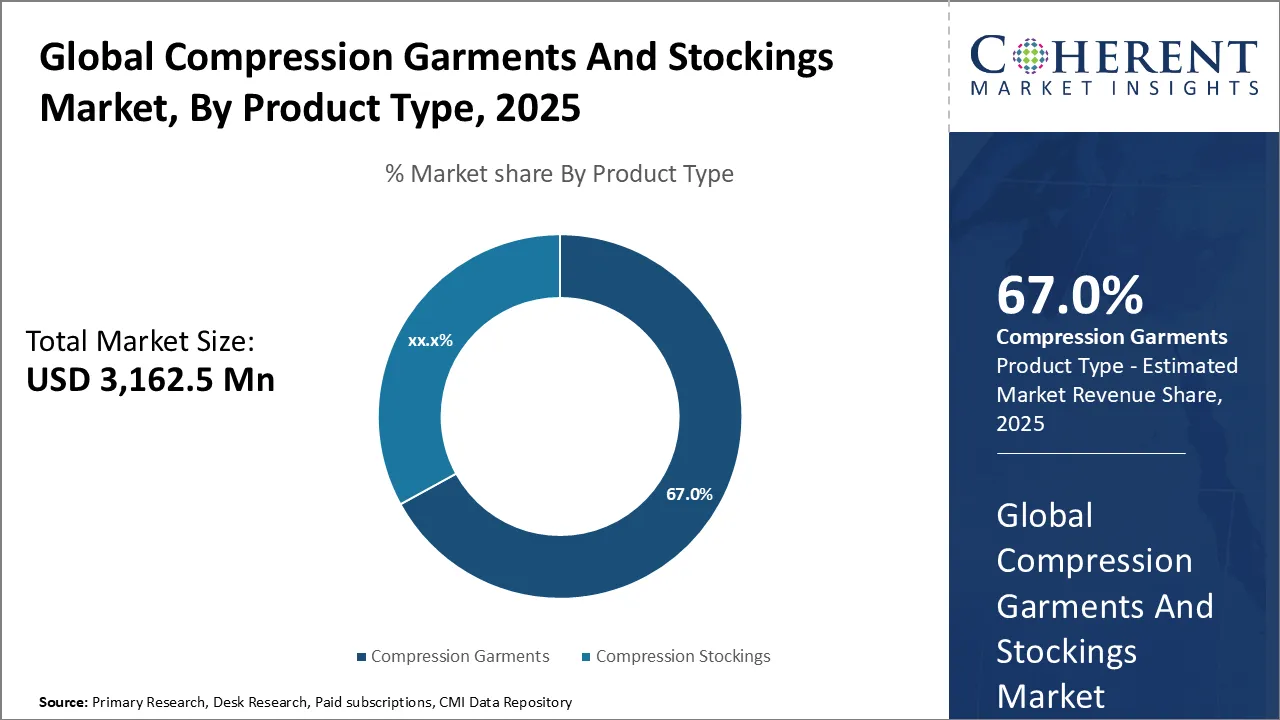
Compression Garments And Stockings Market Insights, By Product Type
The Compression garments segment dominates the market due to improving athletic performance and speeding up muscle recovery
By Product Type, the market is segmented into compression garments and compression stockings. Compression garments are preferred because they improve athletic performance and speed up muscle recovery. Wearing compression clothing can increase blood flow, lessen muscular weariness, and stop injuries. Demand for these products is driven by the increased use of sports compression garments among amateur and professional athletes. E-commerce has furthermore made it simpler for customers to buy compression apparel and stockings online, fueling industry expansion. For instance, Therabody launched RecoveryPulse, a wearable sleeve with graduated compression and vibration therapy, designed for various applications, including pain relief and circulatory issues.
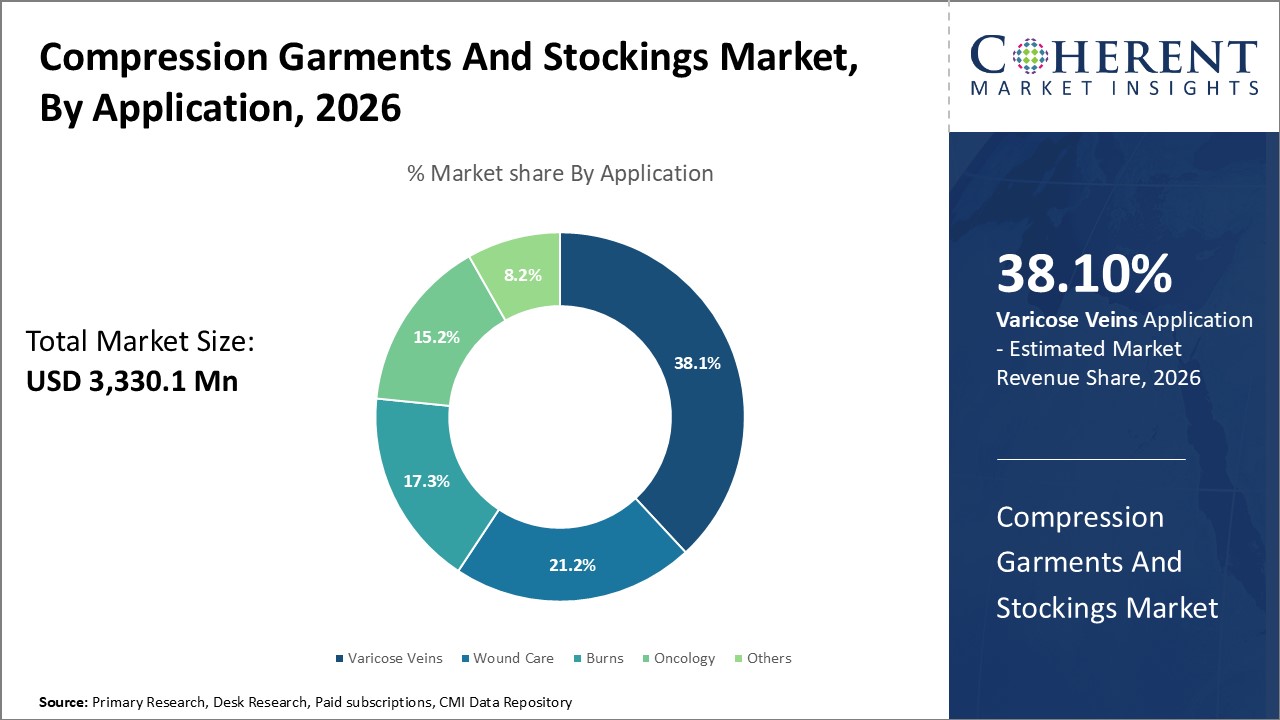
Compression Garments And Stockings Market Insights, By Application
The Varicose Veins segment dominates the market due to the treatment and management of varicose veins
By Application, the market is segmented into Varicose Veins, Wound Care, Burns, and Oncology. Out of which, Varicose Veins are getting more importance in terms of compression therapy. A significant rise in the global aging population, which is more prone to venous disorders such as varicose veins, has led to increased demand for compression therapy. Additionally, sedentary lifestyles, obesity, and prolonged standing or sitting—common in modern work environments—are contributing to a higher incidence of venous insufficiency. The growing awareness about early treatment and non-invasive management of varicose veins has also boosted the adoption of compression stockings. For instance, Sorgen offers a variety of medical compression stockings for varicose veins, with different compression levels and lengths (knee-high, thigh-high).
Compression Garments And Stockings Market Insights, By Distribution Channel
The hospitals segment dominates the market due to the increased use of compression garments in post-operative care
By Distribution Channel, the market is segmented into hospitals, ambulatory surgical centers, clinics, online channels, and other healthcare facilities. Out of these, hospitals are expected to hold the largest share of the market as a result of the increased use of compression therapy and rising hospitalization rates. For instance, Hospitals like Kauvery Hospital in Tiruchirappalli have opened lymphedema clinics that offer compression therapy and other advanced procedures for patients with lymphedema.
Regional Insights
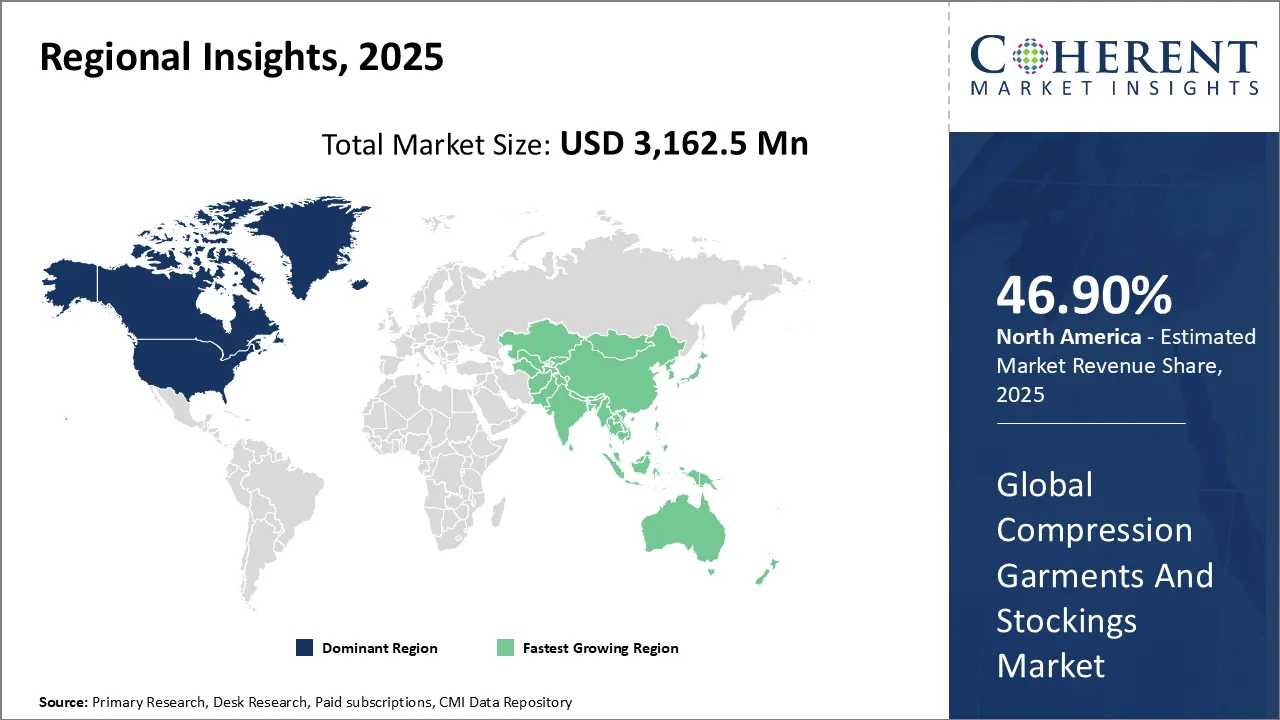
North America Compression Garments And Stockings Market Trends
Among regions, North America is estimated to hold a dominant position in the global compression garments and stockings market with a share of 46.90% in 2026. The growth of the market is mainly due to more cases of vein problems, diabetes, and obesity, along with a rising number of older people. More people now understand the health benefits of compression wear, such as better blood flow and less swelling, which increases demand. New technology has made these garments more comfortable and easier to wear. Also, more people playing sports and easier access through online shopping are helping the market grow. For instance, the U.S. company Marena Group launched a lipedema compression garment featuring the FlexFit Comfort Ankle and TriFlex. This is further propelling the compression garments and stocking market share.
Europe Compression Garments And Stockings Market Trends
The growth of Europe’s compression garments and stockings market is primarily driven by a rising aging population, which is more susceptible to chronic venous disorders such as varicose veins and deep vein thrombosis. Increased awareness of preventive healthcare and early treatment options has led to higher adoption of compression therapy. Favorable reimbursement policies and strong healthcare infrastructure further support market expansion. Technological advancements in garment materials and design, offering improved comfort and efficacy, are also propelling demand across both medical and athletic applications in Europe. In August 2024, Orthoservice AG, a Switzerland-based manufacturer of orthoses, insoles, and medical compression products, established its new UK headquarters at the North East BIC.
United States Compression Garments And Stockings Market Trends
The United States compression garment and stocking market is growing due to better health awareness. Better healthcare services, more insurance support, and higher earnings are supporting the industry growth. A rise in sports and physical activity is also pushing demand. New designs that are more comfortable and better-looking are attracting more users. These garments are now used more for recovery after surgery, long-term health issues, and daily health care. In the U.S. today, women make up more than one-third of all high school athletes, and their representation in collegiate sports has tripled. Therefore, the use of compression garments increases as participation increases. For instance, in March 2024, the U.S. company 3M launched advanced compression stockings with moisture-wicking fabrics. This is further adding to the compression garments market revenue.
Germany Compression Garments And Stockings Market Trends
The growth of Germany’s compression garments and stockings market is supported by factors such as increased post-surgical use, growing demand for minimally invasive treatment alternatives, and a surge in outpatient care services. As hospitals aim to reduce inpatient stays, compression therapy is increasingly used for home-based recovery. Rising participation in fitness and wellness activities also drives demand for compression wear for muscle support and injury prevention. Moreover, heightened public health campaigns and improved retail access—both online and offline—are making these products more accessible. The shift toward customizable and stylish medical garments further boosts consumer interest and adoption across varied age groups. For instance, the German company Juzo introduced the Juzo Move compression stockings with patented Slide Knit technology.
Market Report Scope
Compression Garments And Stockings Market Report Coverage
| Report Coverage | Details | ||
|---|---|---|---|
| Base Year: | 2025 | Market Size in 2026: | USD 3,330.1 Mn |
| Historical Data for: | 2020 To 2024 | Forecast Period: | 2026 To 2033 |
| Forecast Period 2026 to 2033 CAGR: | 5.3% | 2033 Value Projection: | USD 4,780.3 Mn |
| Geographies covered: |
| ||
| Segments covered: |
| ||
| Companies covered: | 3M, BSN Medical, Covidien Ltd. (a Medtronic Plc. company), Medi GmBH & Co KG, SIGVARIS, Therafirm, 2XU Pty. Ltd., Santemol Group Medikal, Leonisa, Inc., Nouvelle, Inc., Medical Z, Pressio, Hyperice, Marena Group, LLC, AIROS Medical, Therabody, SYM ITO, Hohenstein, Koya Medical, Mueller Sports Medicine, and CRX Compression. | ||
| Growth Drivers: |
| ||
| Restraints & Challenges: |
| ||
Global Compression Garments And Stockings Market – Driver
Launch of new products by key market players to expand product portfolio
To meet the needs for compression Garments And Stockings by conducting both prenatal and postnatal research, key market players are focused on launching new products to expand their product portfolio. For instance, in January 2023, Marena Group, LLC, a manufacturer of medical-grade compression garments, shapewear, and activewear, released its new female curves bodysuit for women with naturally curvy body types who are seeking body sculpting procedures, such as liposuction, to further enhance their curves.
Global Compression Garments And Stockings Market: Key Trends
Road accidents and an increase in the older population may be factors in the market's expansion
Elderly people who have arthritis as a result of other chronic conditions like heart disease, diabetes, and obesity are becoming more and more likely to wear compression clothing and stockings daily to improve their quality of life.
One of the leading causes of mortality and disability around the world is traffic accidents, followed by sports-related injuries. For instance, more than 800,000 sports injuries occur among athletes between the ages of 5 and 14, while athletes aged 14 to 24 account for over 600,000 reported injuries. Accident situations are frequently accompanied by moderate or severe skeletal system injuries. Compression treatment devices are frequently utilized in these situations to help the healing process and hasten patient recovery.
Global Compression Garments And Stockings Market: Key Developments
- In June 2025, ZenToes, a prominent provider of affordable and holistic foot care solutions, introduced next-generation Compression Socks.
- In March 2025, DRYWORLD Brands Inc., a top performance athletic brand, launched its “Innovation that Elevates” campaign, unveiling a groundbreaking line of graduated compression apparel aimed at boosting elite athlete performance.
- In June 2024, Singapore’s TriVantage Holdings acquired Australian compression-wear brand 2XU for global expansion in North America, Europe, and Asia Pacific.
- In June 2024, British Cycling signed a three-year deal with ISOBAR, integrating compression tech into sportswear to enhance athlete performance and recovery.
- On April 4, 2023, AIROS Medical Inc., a medical technology manufacturer, designer, and specification developer specializing in compression therapy, received U.S. Food and Drug Administration (FDA) 510(k) clearance for its AIROS 8P sequential therapy device and garment system. The clearance also lets AIROS offer larger compression therapy garments, including lower truncal garments for abdominal swelling.
Analyst Opinion (Expert Opinion)
- Clinical Integration is No Longer Optional — It’s the Key Advantage. Even with more public awareness, most compression brands still focus on looks rather than medical results. Research shows that graduated compression between 20-30 mmHg can improve blood flow by over 40% in people with vein problems (Journal of Vascular Surgery, 2023). Yet, only a few companies — like Sigvaris and Medi — design their products to match medical needs. This lack of medical focus has led to lower trust from long-term users. Brands that build strong ties with doctors and hospitals, especially in post-surgery care, will see steady demand, unlike those only targeting occasional buyers.
- Product Innovation is Falling Behind Real-World Needs. A big problem in fast-growing markets like India and Southeast Asia is heat and discomfort. Many users find compression wear too hot or itchy. A 2024 survey by Indegene Health found that 61% of users in hot regions stopped using compression stockings within 3 months because they were uncomfortable. Still, most companies have made little progress. In contrast, CEP (Germany) launched a product line with temperature-control technology and saw repeat purchases go up by 35% in one year. Companies that don’t use breathable materials or improve ease of wearing are losing out on customers in hot climates, which make up more than half of the global population.
- Insurance Reimbursement is a Hidden Driver — But Not Fully Used. Compression therapy is often covered by insurance for surgery recovery and long-term care, especially in richer countries. However, less than 30% of brands inform doctors or patients about how to claim these benefits (2025 data from CMS and NHS Digital). For example, in the U.S., Medicare Part B pays for stockings used in treating venous ulcers, but few people know this. Companies like Juzo that work with insurance providers and clinics have created an easy path for prescription sales, which perform three times better than direct online selling. Most brands still focus only on digital marketing and miss this major growth channel.
Speak to the analyst
Want personalized insights?
Take the findings above to one of our principal consultants, or have the report rebuilt around the segments, geographies and competitors you actually track.
Market Segmentation
- Global Compression Garments And Stockings Market, By Product Type (Revenue, USD Mn, 2021 - 2033)
- Compression Garments
- Upper Compression Garments
- Lower Compression Garments
- Compression Stockings
- Anti-Embolism Compression Stockings
- Gradient Compression Stockings
- Compression Garments
- Global Compression Garments And Stockings Market, By Application (Revenue, USD Mn, 2021 - 2033)
- Varicose Veins
- Wound Care
- Burns
- Oncology
- Others
- Global Compression Garments And Stockings Market, By Distribution Channel (Revenue, USD Mn, 2021 - 2033)
- Hospitals
- Ambulatory Surgical Centers
- Clinics
- Online Channels
- Other Healthcare Facilities
- Global Compression Garments And Stockings Market, By Region (Revenue, USD Mn, 2021 - 2033)
- North America
- U.S.
- Canada
- Latin America
- Brazil
- Mexico
- Argentina
- Rest of Latin America
- Europe
- Germany
- U.K.
- France
- Italy
- Spain
- Russia
- Rest of Europe
- Asia Pacific
- China
- India
- Japan
- Australia
- South Korea
- ASEAN
- Rest of Asia Pacific
- Middle East
- GCC
- Israel
- Rest of Middle East
- Africa
- South Africa
- Central Africa
- North Africa
- North America
- Global Compression Garments And Stockings Market - Key Players
- 3M
- BSN Medical
- Covidien Ltd. (a Medtronic Plc. company)
- Medi GmbH & Co KG
- SIGVARIS
- Therafirm
- 2XU Pty. Ltd.
- Santemol Group Medikal
- Leonisa, Inc.
- Nouvelle, Inc.
- Medical Z
- Pressio
- Hyperice
- Marena Group LLC
- AIROS Medical
- Therabody
- SYM ITO
- Hohenstein
- Koya Medical
- Mueller Sports Medicine
- CRX Compression
Sources
Interviews from the Following Stakeholders
Stakeholders
Interviews were conducted with vascular surgeons, physiotherapists, wound care specialists, orthotists, hospital procurement leads, rehabilitation experts, dermatologists, medical garment designers, post-operative care consultants, regulatory affairs personnel, product development heads at medical device firms, category managers in retail pharmacy chains, and digital health platform operators. These stakeholders provided insights into the design, prescription, distribution, and usage patterns of compression garments and stockings across therapeutic, preventive, and post-operative settings.
Specific Stakeholders
- Medical garment manufacturers (global and regional)
- Hospital procurement and supply chain managers
- Rehabilitation and sports medicine experts
- Post-surgical care specialists and wound care nurses
- Retail and e-commerce distributors of medical textiles
- Compression therapy product engineers and R&D teams
- Healthtech firms focused on wearable therapeutics
- Telehealth platforms with remote physiotherapy services
- Regulatory affairs experts for Class I & II medical devices
- Dermatology and vascular clinics prescribing compression therapy
- Physiotherapy chains and mobility wellness centers
- Patient advocacy groups for venous and lymphatic disorders
Databases
- WHO Global Health Observatory – Chronic disease prevalence and treatment protocols
- Frost & Sullivan – Therapeutic medical textiles adoption and regional demand patterns
- Statista – Market size, growth rate, and patient awareness of compression therapy
- IQVIA – Prescription trends for compression garments in post-surgical recovery
- GlobalData – Product pipeline, clinical trial data, and competitive landscape
- Indian Council of Medical Research (ICMR) – Compression therapy in vascular disease management
- National Health Service (NHS UK) – Guidelines for compression stockings in chronic venous insufficiency
- US FDA MAUDE Database – Post-market surveillance and device-related feedback
- Health Ministry of India – Medical textile regulations and subsidies
- Eurostat – Medical device import/export and usage across the EU
- National Health Accounts (India) – Medical devices expenditure patterns in hospitals
Magazines
- Medical Device Network
- MedTech Insight
- Modern Healthcare
- PharmaBiz (India)
- Healthcare Business International
- Textile Today – Medical Textiles Section
- Hospimedica International
- Business Today – Healthcare and Medical Innovation Section
- Express Healthcare
- Clinician Reviews – Vascular and Rehabilitation Editions
Journals
- Journal of Vascular Surgery
- Phlebology – The Journal of Venous Disease
- Lymphatic Research and Biology
- International Wound Journal
- Journal of Rehabilitation Medicine
- Textile Research Journal – Medical Applications
- Journal of Medical Devices (ASME)
- International Journal of Angiology
- Indian Journal of Dermatology
- Journal of Compression Therapy and Venous Health
Newspapers
- The Economic Times – Healthcare and MedTech Section
- Business Standard – Medical Devices Coverage
- Mint – Healthtech and Wellness Features
- The Hindu BusinessLine – Medical and Surgical Products
- The Times of India – Healthcare Innovation Reports
- Reuters Health
- Financial Times – Global Health Markets and Medical Device Focus
Associations
- Association of Indian Medical Device Industry (AiMeD)
- Compression Therapy Education Committee (CTEC)
- Indian Association of Dermatologists, Venereologists and Leprologists (IADVL)
- American Venous Forum (AVF)
- Indian Association of Physiotherapists (IAP)
- Textile Association (India) – Medical Textile Chapter
- World Confederation for Physical Therapy (WCPT)
- Lymphoedema Support Network (UK)
- Medical Textile and Biomaterials Society
- National Accreditation Board for Hospitals & Healthcare Providers (NABH)
Public Domain Sources
- Ministry of Health & Family Welfare (India) – Medical device regulation and reimbursement policies
- U.S. Food and Drug Administration (FDA) – Compression garment classification and compliance
- European Medicines Agency (EMA) – Device certification and post-market safety
- National Medical Products Administration (China) – Regulatory framework for therapeutic textiles
- Indian Technical Textile Mission – Schemes and support for health-related textile innovation
- OECD – Health expenditure data and medical technology adoption
- World Health Organization (WHO) – Guidelines on chronic venous insufficiency and lymphedema care
- Bureau of Indian Standards (BIS) – Medical textile quality norms and certification
- U.S. Centers for Medicare & Medicaid Services (CMS) – Coverage criteria for compression therapy
- Digital Public Goods Alliance (DPGA) – Open-access medical tools and health tech frameworks
Proprietary Elements
- CMI Data Analytics Tool, and the Proprietary CMI Existing Repository of information for the last 8 years.
Get access to 250+ pages report
Every segment, forecast, competitor profile and data table behind the analysis above — available for instant download.
- ESOMAR Member
- ISO 9001:2015 Certified
- D-U-N-S Registered
- GDPR & CCPA Compliant
Missing comfort of reading report in your local language? Find your preferred language:
Transform your Strategy with Exclusive Trending Reports
Frequently Asked Questions
The Compression Garments And Stockings Market is estimated to be valued at USD 3,330.1 Mn in 2026 and is expected to reach USD 4,780.3 Mn by 2033.
The CAGR of the Compression Garments And Stockings Market is projected to be 5.3% from 2026 to 2033.
The launch of new products by market key players to expand their product portfolio is expected to drive market growth.
Compression garment is the leading segment in the market.
The market expansion is anticipated to be constrained in the targeted period by the availability of different medicines and other factors that can compete with the Compression Garments And Stockings.
Major players operating in the market include 3M, BSN Medical, Covidien Ltd. (a Medtronic Plc. company), Medi GmBH & Co KG, SIGVARIS, Therafirm, 2XU Pty. Ltd., Santemol Group Medikal, Leonisa, Inc., Nouvelle, Inc., Medical Z, Pressio, Hyperice, Marena Group, LLC, AIROS Medical, Therabody, SYM ITO, Hohenstein, Koya Medical, Mueller Sports Medicine, and CRX Compression.