

Cordyceps Sinensis Extract Market Size and Share Analysis- 2026 To 2033
The Cordyceps Sinensis Extract Market size is anticipated to grow at a CAGR of 10.9%, with USD 612.4 Mn in 2026, and is expected to reach USD 1,263.3 Mn by 2033. The primary drivers are largely defined by the rising demand for natural and functional health supplements, increasing adoption of Cordyceps-based nutraceuticals, growing consumer interest in traditional medicinal ingredients, and wider use of Cordyceps sinensis extracts in dietary supplements, functional foods, and pharmaceutical formulations. According to a 2025 systematic review published in Frontiers in Medicine reviewed 15 clinical studies with 1,310 patients on the therapeutic use of Cordyceps sinensis in renal dysfunction, and the analysis found improvements in several renal-function-related outcomes.
Key Takeaways
- The powder segment is likely to dominate the Cordyceps Sinensis Extract Market with 46.5% in 2026. The segment’s growth is owing to the ease of incorporation into dietary supplements and functional formulations, flexible dosing, longer shelf stability, and increasing use of standardized mushroom extracts. In a 2024 retrospective cohort study of 631 patients with stage 4 chronic kidney disease, 339 patients were treated with fermented Cordyceps sinensis powder.
- The dietary supplement segment is expected to lead with 54.0% in 2026. The segment’s growth is being driven by an increase in demand for natural wellness products, increased use of medicinal mushrooms in nutraceutical formulations, rising consumer demand for adaptogenic ingredients and increased commercialization of cultured Cordyceps sinensis products. In 2024, the Elsevier review stated that O. sinensis culture-based products are widely used in dietary supplements and therapeutic products, showing a growing commercial significance in the nutraceutical industry.
- The retail pharmacy segment is expected to account for the prominent share of 57.0% in 2026. The segment’s growth is owing to established consumer access to branded health supplements, greater availability of standardized capsule, tablet, and powder formulations, and demand for trusted channels for products where authenticity and bioactive-content verification remain important.
- North America is expected to acquire the prominent share of 34.5% in 2026. The region’s growth is owing to the established dietary supplement industry, high consumer adoption of functional and natural health products, widespread online and retail availability of mushroom-based supplements, and continued scientific interest in the therapeutic properties of Cordyceps sinensis.
Market Drivers
Rising Adoption of Dietary Supplements and Natural Wellness Products is Driving the Cordyceps Sinensis Extract Market
The Cordyceps Sinensis Extract Market is gaining momentum owing to the rising consumption of dietary supplements, increasing consumer preference for naturally derived functional ingredients, and growing incorporation of medicinal mushrooms into wellness and nutraceutical formulations. Cordyceps sinensis is rich in bioactive compounds such as polysaccharides, nucleosides, sterols and cordycepin, and used in various dietary supplement and functional health products.
The study found total nucleoside and nucleobase levels of 388.43–8,593.1 µg/g in wild samples and 214–629,660 µg/g in cultured samples, supporting the increasing use of standardized cultivated Cordyceps ingredients in dietary supplements, functional foods and nutraceutical formulations.
Advancements in Fermentation and Cultivation Technologies are Supporting Commercial-Scale Cordyceps Sinensis Extract Production
Advances in fermentation and controlled cultivation are becoming important supply-side drivers of the Cordyceps Sinensis Extract Market. Natural Ophiocordyceps sinensis is rare and dependent on finite wild populations, such that conventional harvesting is not scalable. Thus, the production of cultured mycelia by fermentation is increasingly being investigated as a more sustainable and commercially scalable source of bioactive compounds derived from Cordyceps.
In 2024 Biochemical Engineering Journal reported that the fermentation of C. sinensis with 150 g/L Glucose and 10 g/L talc increased the production of exopolysaccharide (EPS) 1.8-fold, reaching 4.21 g/L. This highlights the potential of fermentation optimization to significantly increase the yield of commercially relevant bioactive compounds from Cordyceps and to render extract production more scalable.
Current Events and Their Impact on the Cordyceps Sinensis Extract Market
Current Event | Description and its Impact |
China Strengthens Registration Oversight for Health Foods Containing Ophiocordyceps sinensis (2025) |
|
U.S. FDA Strengthens New Dietary Ingredient Notification Framework for Dietary Supplements (2024–2025) |
|
- Current Industry Events of 2026
- Market Size Estimation
- Regional Breakdown
- Competitive Landscape
- Customer Intelligence
- Segmental Analysis
- Pricing Analysis
- Key Market Drivers, Challenges & Future Trends
- Customized Insights Section
Segmental Insights
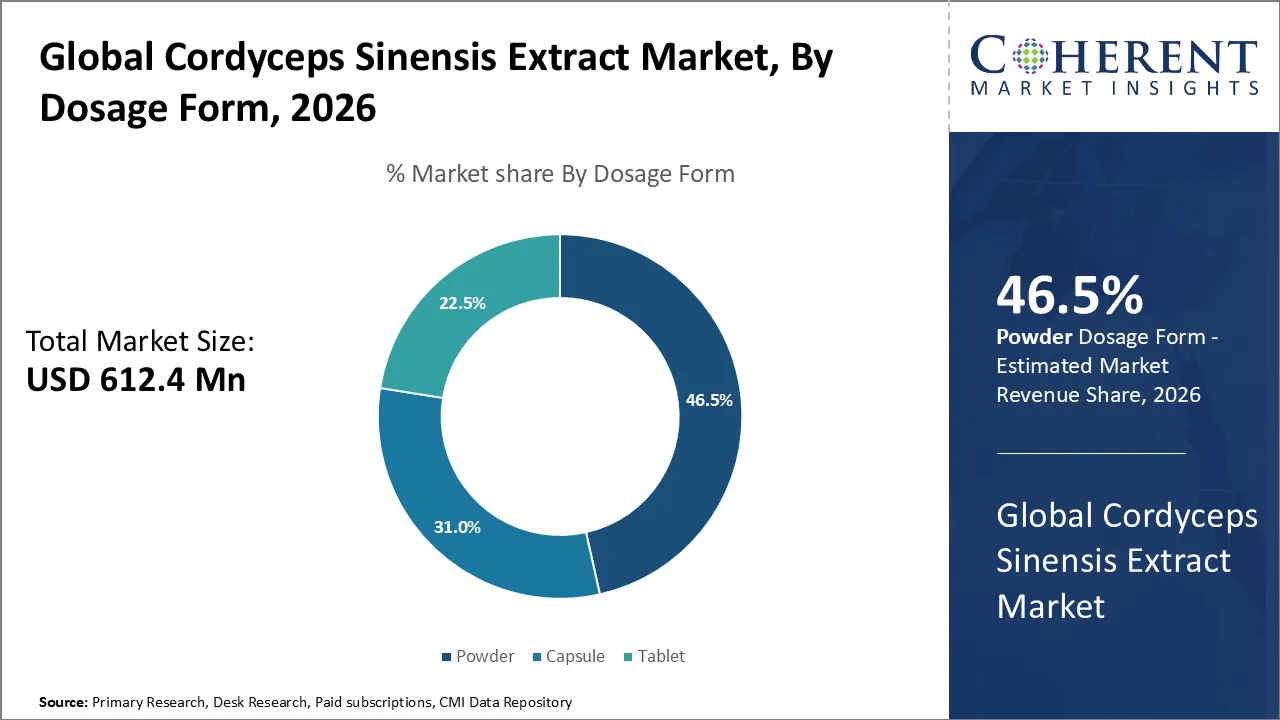
Why is Powder Acquiring the Largest Share?
On the basis of dosage form, the powder segment is projected to account for the largest Cordyceps Sinensis Extract Market share of 46.5% in 2026. The segment’s growth is owing to the ease of incorporating Cordyceps powder into dietary supplements and functional formulations, flexible dosing, compatibility with encapsulation, and the growing commercial use of cultivated and fermented Cordyceps as an alternative to scarce wild Ophiocordyceps sinensis.
A 2025 study published in the Journal of Ethnopharmacology specifically evaluated fermented Cordyceps powder (FCP) from Cordyceps sinensis mycelium and reported that the fermented powder has a composition and biological activity similar to natural C. sinensis. This means the standardized fermented Cordyceps in powder form are still under development and used.
In March 2026, Rohto Pharmaceutical launched “Eu Yan Sang Cordyceps” in Japan, following a limited release beginning in January 2026. The product is classified as a Cordyceps sinensis powder processed food and contains 100% Cordyceps sinensis powder, with a recommended intake of one capsule per day.
Why are Dietary Supplements Acquiring the Largest Share?
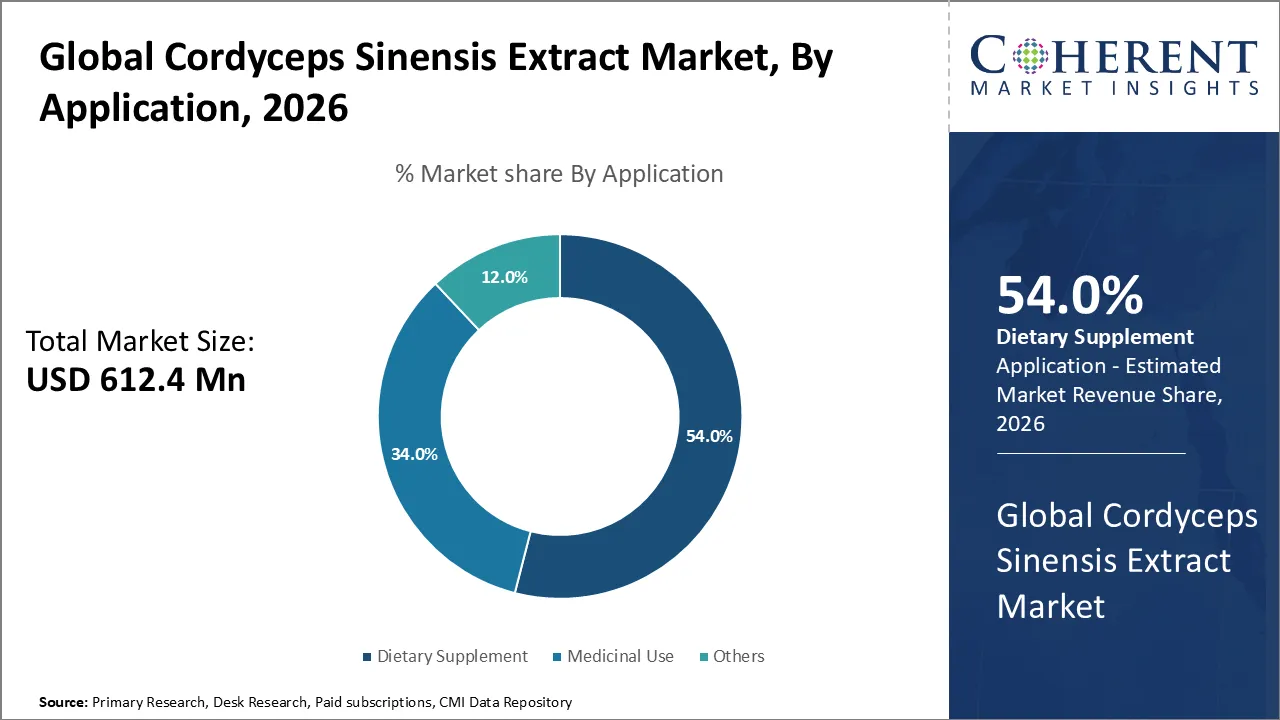
On the basis of application, the dietary supplement segment is expected to lead the Cordyceps Sinensis Extract Market with a prominent 54.0% share in 2026. The segment’s growth is owing to increasing consumer adoption of natural wellness products, growing interest in medicinal mushrooms and adaptogenic ingredients, and expanding use of Cordyceps-derived ingredients in daily health and nutritional formulations.
A 2026 peer-reviewed review identified five human intervention studies involving 321 participants examining Cordyceps supplementation for exercise performance and recovery. Supplementation periods ranged from 1 to 16 weeks, with daily doses of 1–12 g, demonstrating active clinical investigation of Cordyceps as a dietary supplement ingredient.
In January 2026, GOBA announced the development of GOBA Cordyvit K PRO, a standardized Cordyceps dietary supplement with a precisely defined cordycepin content of 10 mg/g.
Why are Retail Pharmacies Acquiring the Largest Share?
On the basis of distribution channel, the retail pharmacy segment is projected to account for the largest Cordyceps Sinensis Extract Market share of 57.0% in 2026. The segment’s growth is owing to strong consumer accessibility, established distribution networks for dietary supplements and natural health products, availability of pharmacist guidance, and greater consumer preference for recognized channels when purchasing health-related formulations.
According to the National Association of Chain Drug Stores (NACDS), 91% of Americans live within five miles of a retail pharmacy, illustrating the wide physical reach of this distribution channel.
Cordyceps Sinensis Extract Market Trends
- The growing popularity of Cordyceps is extending beyond traditional herbal applications as it increasingly becomes part of mainstream wellness and self-care products. In March 2026, Rohto Pharmaceutical launched Eu Yan Sang Cordyceps in Japan, a daily health supplement made from Cordyceps sinensis powder for consumers suffering from fatigue, stress and sleep deprivation.
- Growing commercial opportunity for the ingredient as Cordyceps extracts are used more in adjacent consumer-health spaces such as skincare and functional beauty. Rohto Pharmaceutical launched a new skincare product containing Cordyceps extract in July 2026, under the Dermacept RX Stem Advance brand for medical institutions only, extending the use of Cordyceps-derived ingredients beyond conventional dietary supplements.
- Focus on quality, authenticity and traceability is affecting the development in product development and purchasing decisions in the Cordyceps Sinensis Extract Market. A 2024 review in the South African Journal of Botany pointed to the inconsistent labeling of bioactive constituents in commercial O. sinensis products, and identified authentication and standardized bioactive markers as key priorities for both manufacturers and consumers.
Regional Insights
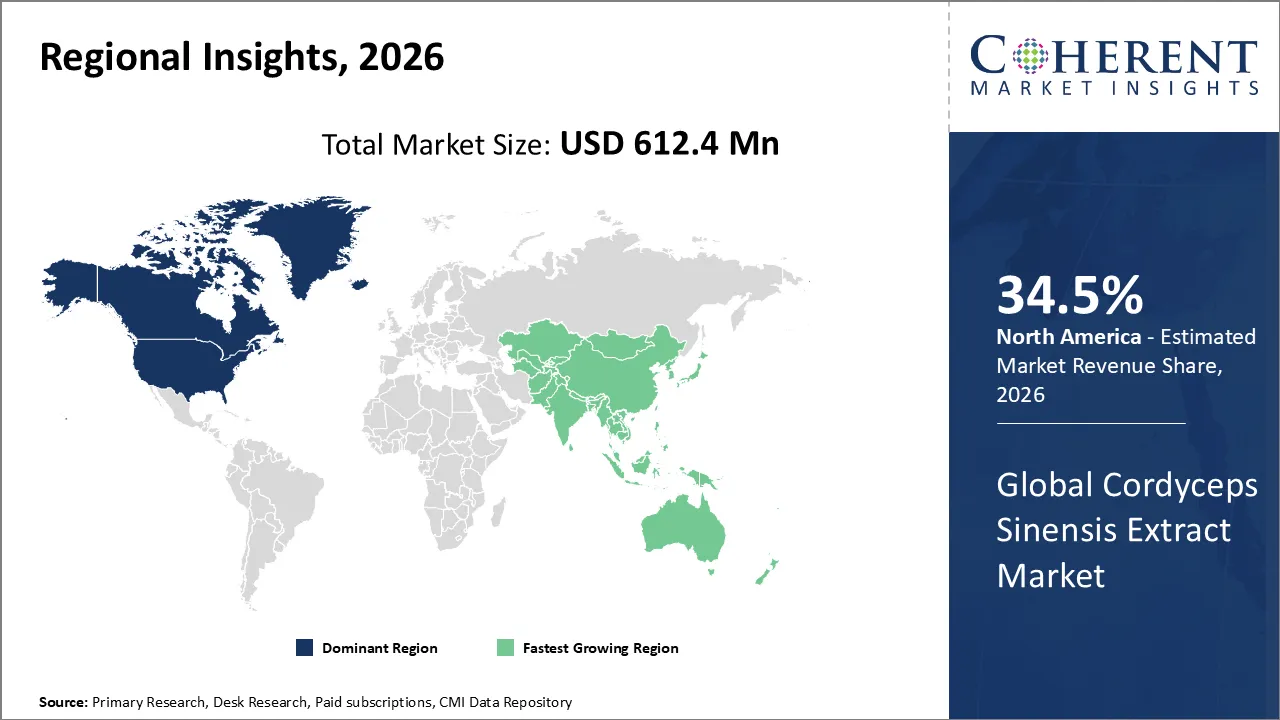
North America Dominates Owing to the Strong Dietary Supplement Base and High Consumer Adoption of Natural Wellness Products
The North America region accounts for 34.5% of the Cordyceps Sinensis Extract Market share in 2026. The region’s growth is owing to the high penetration of dietary supplements, established nutraceutical distribution channels, strong consumer interest in functional mushrooms, and growing demand for standardized natural health products.
In April 2026, Colorado-based Extract Labs launched a new certified-organic functional mushroom extract powder range in the U.S., including a highly concentrated Cordyceps extract powder alongside Lion’s Mane and Reishi.
Asia Pacific Cordyceps Sinensis Extract Market Trends
Asia Pacific is expected to be the fastest-growing region over the forecast period. The region’s growth is owing to the historical use of Cordyceps sinensis in traditional medicine, expanding cultivation and fermentation capabilities, increasing commercialization of standardized supplements, and rising consumer adoption of functional health products across China, Japan, South Korea, and Southeast Asia.
In March 2026, Rohto Pharmaceutical launched Eu Yan Sang Cordyceps in Japan, marking the Japanese debut of one of Southeast Asia’s established wellness brands. Before broader commercialization, approximately 6,500 Japanese consumers participated in a one-month early-adopter trial. The product uses cultivated mycelium described by Rohto as having 99% genetic similarity to Cordyceps material from the Tibetan highlands and is positioned as a daily health supplement.
Japan’s broader health-products ecosystem also provides a supportive regional backdrop. Japan’s Ministry of Economy, Trade and Industry estimated the country’s food-related health-promotion market, including supplements, health foods, OTC products, and designated quasi-drugs, at approximately JPY 3.4 trillion, with potential expansion to JPY 8.7 trillion.
Strong Functional-Mushroom Commercialization and Expanding Supplement Offerings are Supporting the Cordyceps Sinensis Extract Market in the United States
The U.S. Cordyceps Sinensis Extract market is growing at a steady pace, with the expansion of the functional-mushroom supplement category, growing consumer interest in adaptogens and natural wellness products, and greater availability of Cordyceps extracts in powder, capsule, gummy and beverage formats.
In February 2026, Hifas da Terra entered the U.S. market, bringing more than 25 years of European medicinal-mushroom expertise and a portfolio of traceable, science-backed mushroom supplements to American consumers. The company’s U.S. expansion reflects the growing commercial attractiveness of medicinal mushroom products in the country and supports wider adoption of Cordyceps-based supplements.
China Cordyceps Sinensis Extract Market Trends
China is expected to remain a strategically important market for Cordyceps Sinensis Extract owing to its long-established use of Ophiocordyceps sinensis in traditional health products, domestic raw-material availability, expanding cultivation and fermentation capabilities, and strong regulatory focus on the protection and controlled commercialization of wild Cordyceps resources.
In 2025, China’s State Administration for Market Regulation clarified that Ophiocordyceps sinensis remains classified as a national second-class protected wild plant. Health foods containing Cordyceps must undergo registration and approval under China’s health-food framework, and products cannot be manufactured or sold without approval. The regulator is also reviewing previously approved Cordyceps-containing products and raw-material management requirements.
The supply-side importance of China is also substantial. China’s Ministry of Agriculture and Rural Affairs has historically estimated Cordyceps resources at about 200,000 kg, with approximately 120,000 kg harvested, while more than 20,000 kg was exported annually to markets including the U.S., Japan, Korea, Europe, and Southeast Asia.
Who are the Major Companies in Cordyceps Sinensis Extract Industry
Some of the major key players in Cordyceps Sinensis Extract Market are Naturalin, Active Organics, Quyuan sunnycare Inc., Kangzhou, HERBSINO, SOST, Health Choice Limited, Zhongke Group, Nutra Green.
Key News
- In June 2026, Naturalin published an updated Cordyceps Extract product feature highlighting its Cordyceps extract portfolio for supplement applications. Naturalin’s current Cordyceps extract specification includes 10%–30% polysaccharides, and the company states that its organic Cordyceps extract/powder is USDA Organic and EU Organic certified.
- In November 2025, Xi’an SOST Biotech announced an upgraded organic mushroom extract series at the Western International Sourcing Fair. The range included Cordyceps extract among 10 functional mushroom extract raw materials and was reported as carrying USDA and EU dual-organic certification, along with export quality-inspection documentation.
Market Report Scope
Cordyceps Sinensis Extract Market Report Coverage
Report Coverage | Details | ||
Base Year: | 2025 | Market Size in 2026: | USD 612.4 Mn |
Historical Data for: | 2020 to 2024 | Forecast Period: | 2026 to 2033 |
CAGR: | 10.9% | 2033 Value Projection: | USD 1,263.3 Mn |
Geographies covered: |
| ||
Segments covered: |
| ||
Companies covered: | Naturalin, Active Organics, Quyuan sunnycare Inc., Kangzhou, HERBSINO, SOST, Health Choice Limited, Zhongke Group, Nutra Green. | ||
Growth Drivers: |
| ||
Restraints & Challenges: |
| ||
Analyst Opinion
- The Cordyceps Sinensis Extract Market is increasingly supported by the shift from wild harvesting toward controlled cultivation and fermentation-based production, which improves scalability, consistency, and sustainability. A 2025 Journal of Fungi review notes that wild Ophiocordyceps sinensis is under pressure from overharvesting and climate-related factors, while in-vitro mycelial fermentation offers a more standardized and scalable production route.
- As manufacturers seek to commercialize Cordyceps extracts across dietary supplements and functional-health products, product quality and standardization are emerging as competitive factors. A systematic review in 2024 found 34 polysaccharides from fermented C. sinensis. Of these 5 were glucans and 7 hetero-polysaccharides. This reflects the growing scientific interest in the characterization of bioactive compounds and the development of standardized extracts.
- Commercialization is also broadening across major consumer-health markets as companies introduce more standardized Cordyceps products. In 2026, Rohto Pharmaceutical launched Eu Yan Sang Cordyceps in Japan after an early-adopter program involving approximately 6,500 consumers, reflecting growing corporate investment in bringing cultivated Cordyceps products into mainstream daily wellness channels.
Speak to the analyst
Want personalized insights?
Take the findings above to one of our principal consultants, or have the report rebuilt around the segments, geographies and competitors you actually track.
Market Segmentation
- By Dosage Form (Revenue, USD Mn, 2021-2033)
- Powder
- Tablet
- Capsule
- By Application (Revenue, USD Mn, 2021-2033)
- Dietary Supplement
- Medicinal Use
- Others
- By Distribution Channel (Revenue, USD Mn, 2021-2033)
- Retail Pharmacy
- Online Pharmacy
- By Region (Revenue, USD Mn, 2021-2033)
- North America
- U.S.
- Canada
- Latin America
- Brazil
- Mexico
- Argentina
- Rest of Latin America
- Europe
- Germany
- U.K.
- France
- Italy
- Spain
- Russia
- Rest of Europe
- Asia Pacific
- China
- India
- Japan
- Australia
- South Korea
- ASEAN
- Rest of Asia Pacific
- Middle East
- GCC
- Israel
- Rest of Middle East
- Africa
- South Africa
- Central Africa
- North Africa
- North America
Sources
Primary Research Interviews
- Cordyceps extract manufacturers and processors
- Nutraceutical and dietary supplement manufacturers
- Medicinal mushroom cultivators and fermentation specialists
- Herbal ingredient suppliers and distributors
- R&D heads from functional food and nutraceutical companies
- Retail pharmacy and online supplement channel professionals
- Key opinion leaders (KOLs) in medicinal mushrooms, herbal medicine, and nutraceuticals
Databases
- U.S. Food and Drug Administration (FDA)
- National Institutes of Health (NIH) – Office of Dietary Supplements
- PubMed
- National Center for Biotechnology Information (NCBI)
- China State Administration for Market Regulation (SAMR)
- National Medical Products Administration (NMPA), China
- Ministry of Agriculture and Rural Affairs, China
- Japan Ministry of Economy, Trade and Industry (METI)
Magazines
- Nutraceuticals World
- Nutrition Insight
- Natural Products Insider
- Nutritional Outlook
- FoodNavigator
- WholeFoods Magazine
Journals
- Journal of Ethnopharmacology
- Journal of Fungi
- International Journal of Biological Macromolecules
- South African Journal of Botany
- Chinese Herbal Medicines
- Frontiers in Medicine
- Biochemical Engineering Journal
Newspapers
- The Wall Street Journal
- Financial Times
- South China Morning Post
- The Economic Times
- The Japan Times
Associations
- American Herbal Products Association (AHPA)
- Council for Responsible Nutrition (CRN)
- Consumer Healthcare Products Association (CHPA)
- United Natural Products Alliance (UNPA)
- International Alliance of Dietary/Food Supplement Associations (IADSA)
- American Botanical Council (ABC)
- National Association of Chain Drug Stores (NACDS)
Public Domain Sources
- Company Annual Reports, Product Portfolios, and Corporate Announcements
- Government Dietary Supplement and Health Food Regulations
- Peer-reviewed Clinical and Preclinical Research Publications
- University and Research Institute Publications on Ophiocordyceps sinensis
- Patent Databases such as WIPO, USPTO, and Google Patents
- Publicly Available Product Registrations and Dietary Supplement Label Databases
- Government Publications Related to Wild Cordyceps Protection, Cultivation, and Trade
Proprietary Elements
- CMI Data Analytics Tool
- Proprietary CMI Existing Repository of Information for the Last 10 Years
Get access to 250+ pages report
Every segment, forecast, competitor profile and data table behind the analysis above — available for instant download.
- ESOMAR Member
- ISO 9001:2015 Certified
- D-U-N-S Registered
- GDPR & CCPA Compliant
Missing comfort of reading report in your local language? Find your preferred language:
Transform your Strategy with Exclusive Trending Reports
Frequently Asked Questions
The Cordyceps Sinensis Extract Market is expected to reach USD 1,263.3 Mn in 2033, from USD 612.4 Mn in 2026.
Major players operating in the global Cordyceps Sinensis Extract Market include Naturalin, Active Organics, Quyuan sunnycare Inc., Kangzhou, HERBSINO, SOST, Health Choice Limited, Zhongke Group, and Nutra Green.
The high cost of authentic Cordyceps sinensis raw material and limited availability of wild Cordyceps sinensis are among the key factors hampering market growth. Additional challenges include standardization, authentication, and quality-control requirements.
The increasing adoption of Cordyceps sinensis in dietary supplements and nutraceuticals, rising consumer preference for natural and functional health products, and advances in fermentation and cultivation technologies are supporting market growth.
The Cordyceps Sinensis Extract Market is anticipated to grow at a CAGR of 10.9% between 2026 and 2033.
North America is expected to account for the largest market share, with approximately 34.5% in 2026, supported by the established dietary supplement industry, strong nutraceutical distribution, and high adoption of functional health products.
Asia Pacific is expected to be the fastest-growing region over the forecast period, supported by the historical use of Cordyceps in traditional medicine, expanding cultivation and fermentation capabilities, and increasing commercialization of standardized supplements.