

Coronavirus Vaccine Market Analysis & Forecast: 2026-2033
Coronavirus Vaccine Market is estimated to be valued at USD 54.49 Bn in 2026 and is expected to reach USD 90.99 Bn in 2033, exhibiting a compound annual growth rate (CAGR) of 7.6% from 2026 to 2033.
Key Takeaways
- Based on Vaccine Type, the RNA Vaccines segment is projected to account for 41.1% share of the market in 2026, due to their adaptability, high efficacy, and global R&D investment.
- Based on Distribution Channel, the Government Channel segment is expected to lead with the largest share in 2026, with its mass immunization programs and strong public-private partnerships.
- Based on Region, North America is set to lead the market with 33.5% share in 2026. While, Asia Pacific is anticipated to be the fastest growing region.
Market Overview
The coronavirus vaccine market demand remains robust in 2026, driven by ongoing immunization efforts, emerging variants, and innovations in vaccine technology. Governments continue to invest in mRNA platforms and expand healthcare access, especially in Tier 2 and 3 cities. The market benefits from global vaccine diplomacy, public-private partnerships, and improved cold chain logistics. Despite challenges like vaccine hesitancy and misinformation, sustained R&D and diversified distribution channels support long-term growth. The evolving landscape reflects a shift toward booster programs, combination vaccines, and personalized immunization strategies to meet dynamic public health needs.
Current Events and their Impact on the Coronavirus Vaccine Market
Current Event | Description and its Impact |
Regulatory Framework Evolution and Approval Processes |
|
Technological Advancements and Next-Generation Vaccines |
|
COVID-19 Vaccine Production Highlights
- Global output remains robust, with major producers including Pfizer, Moderna, Novavax, and CanSino updating formulas to target the JN.1 Omicron variant.
- Seasonal vaccines for 2025–2026 have received FDA approvals in the U.S., ensuring timely rollout for fall immunization campaigns.
- Technological innovation continues, with increased focus on oral and nasal delivery platforms to improve accessibility and compliance.
- Public-private investment supports expanded manufacturing capacity and rapid response to emerging variants.
- Regulatory agencies worldwide are streamlining approval pathways to accelerate deployment of updated vaccines.
- Current Industry Events of 2026
- Market Size Estimation
- Regional Breakdown
- Competitive Landscape
- Customer Intelligence
- Segmental Analysis
- Pricing Analysis
- Key Market Drivers, Challenges & Future Trends
- Customized Insights Section
Segmental Insights
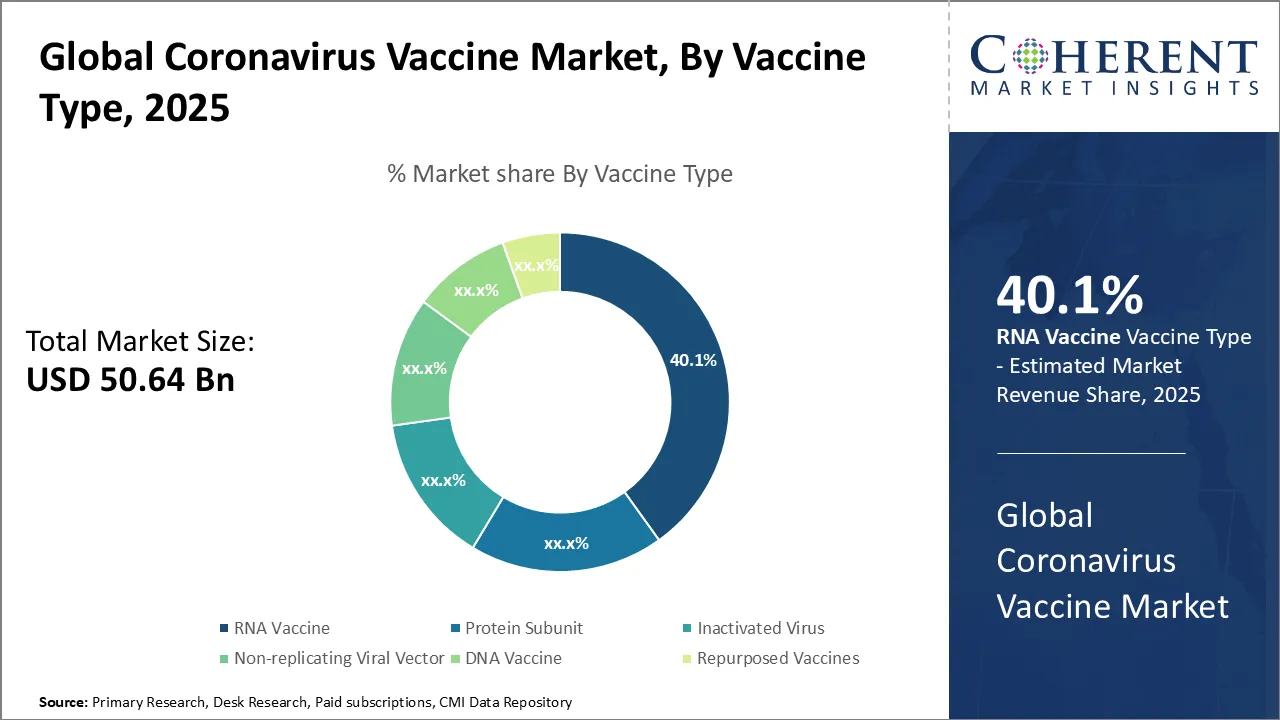
Coronavirus Vaccine Market Insights, By Vaccine Type: RNA vaccines lead Due To Their Adaptability, High Efficacy, And Global R&D Investment
In terms of vaccine type, the RNA vaccines segment is expected to hold 41.1% share of the market in 2026. These vaccines, exemplified by Pfizer-BioNTech and Moderna, are favored for their high efficacy and ability to be rapidly modified in response to emerging variants. The mRNA platform allows for swift development cycles, making it ideal for addressing the evolving nature of the virus. Public confidence in RNA vaccines remains strong, bolstered by their widespread use during earlier phases of the pandemic. Additionally, countries like India are investing heavily in mRNA research and manufacturing infrastructure, further expanding the reach and innovation of RNA-based solutions. This combination of scientific agility, proven effectiveness, and global investment has made RNA vaccines the cornerstone of COVID-19 immunization strategies in 2025.
For instance, in October 2025, a study by UF Health reveals that COVID-19 mRNA vaccines may trigger immune responses capable of targeting cancer cells. Researchers found that the vaccine’s activation of T cells, crucial for fighting infections, could also enhance the body’s ability to detect and destroy cancerous growths, opening new avenues for immunotherapy research.
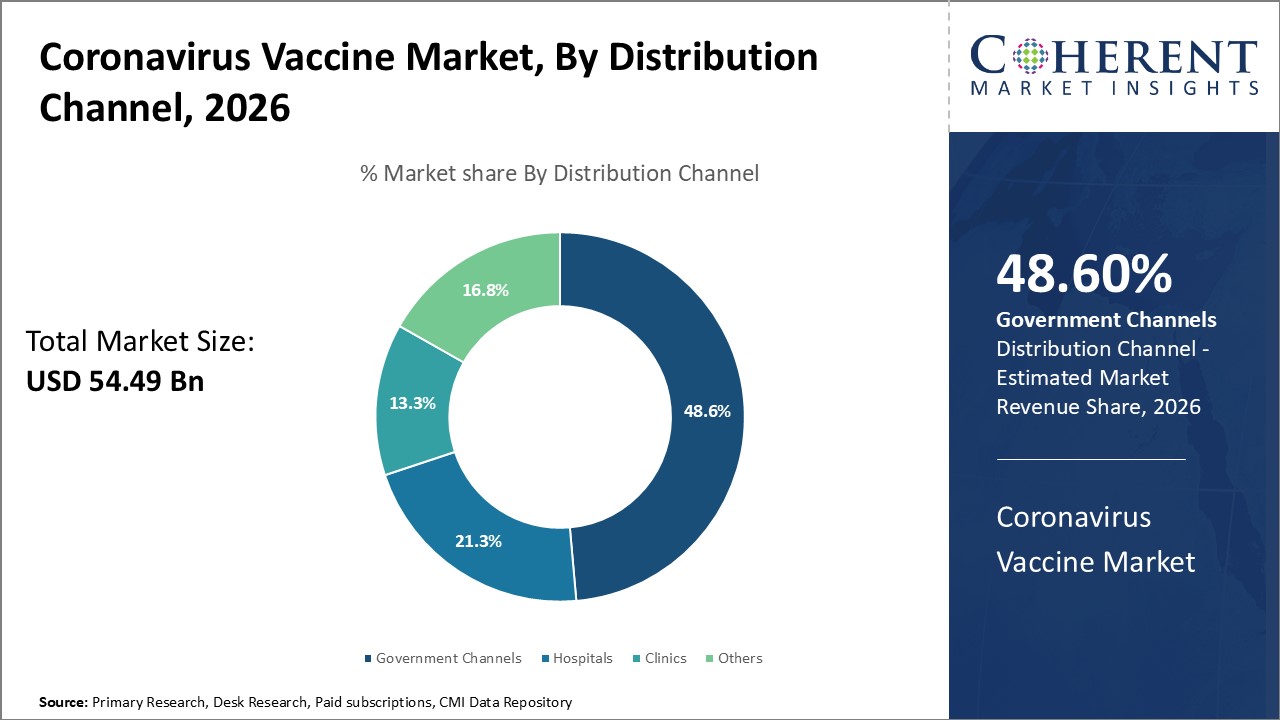
Coronavirus Vaccine Market Insights, By Distribution Channel: Government Channels Dominate Through Mass Immunization Programs and Strong Public-Private Partnerships
In terms of distribution channel, the government channels segment is expected to lead the market with the largest share in 2026. National health authorities have maintained large-scale immunization programs, ensuring that vaccines reach broad populations efficiently and equitably. These efforts are supported by public-private partnerships that streamline logistics and reduce costs, making vaccines more accessible to all socioeconomic groups. International health organizations and vaccine diplomacy initiatives have also played a crucial role in reinforcing government-led distribution, particularly in low- and middle-income countries. By leveraging centralized systems, governments can coordinate booster campaigns, manage variant-specific rollouts, and maintain public trust. As a result, government channels remain the backbone of global vaccine dissemination, reflecting a strategic emphasis on public health infrastructure and coordinated response.
For instance, in May 2025, the U.S. Department of Health and Human Services and NIH unveiled a next-generation universal vaccine platform targeting pandemic-prone viruses, including COVID-19. The initiative aims to develop broad-spectrum vaccines that offer durable protection against evolving threats, marking a major step in government-led efforts to strengthen global health security and preparedness.
Regional Insights
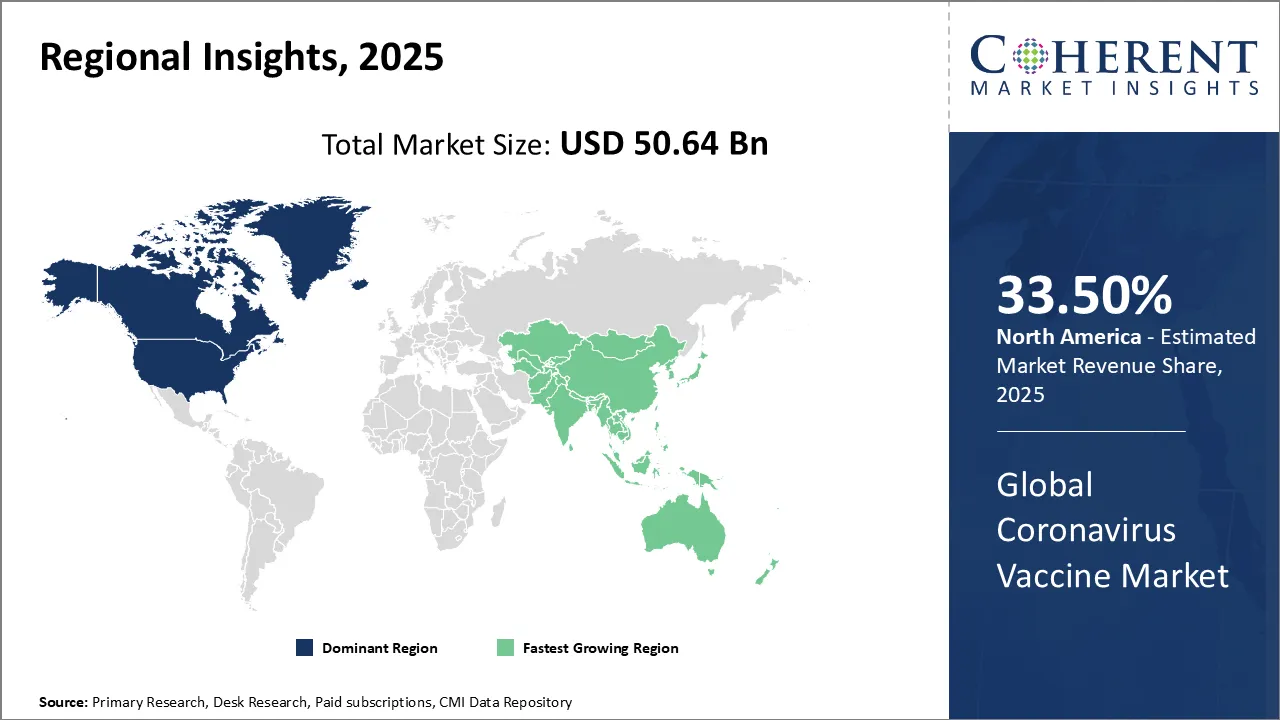
North America Coronavirus Vaccine Market Analysis & Trends
North America, holding 33.5% share in 2026, is projected to dominate the coronavirus vaccine market, due to ongoing booster campaigns, emergence of new variants, and strong public health infrastructure. Government initiatives, advanced biotech capabilities, and widespread awareness drive consistent uptake. Additionally, regulatory support and investment in mRNA technology fuel innovation and ensure sustained market growth across the region.
For instance, in May 2026, the U.S. FDA recommended a monovalent COVID-19 vaccine targeting the JN.1 Omicron variant for the 2026–2026 season. Set for rollout in Fall 2026, this update aims to enhance protection against evolving strains. Manufacturers are advised to align production with the new formula to ensure nationwide coverage.
Asia Pacific Coronavirus Vaccine Market Analysis Trends
Asia Pacific is projected be the fastest growing region, due to large population centers, ongoing booster campaigns, and rising awareness of variant threats. Government-led immunization programs, expanding healthcare infrastructure, and increased production of advanced vaccines like mRNA and DNA types further fuel market growth, making the region a key driver of global vaccine uptake.
Coronavirus Vaccine Market Outlook Country-Wise
The U.S. Coronavirus Vaccine Market Trends
High demand for COVID-19 vaccines in the U.S. stems from evolving variants, annual immunization strategies, and strong public health infrastructure. The market is driven by government programs, widespread pharmacy access, and updated vaccine formulations like the JN.1-targeted shots for 2026. Despite declining growth, the U.S. remains a top revenue generator globally.
For instance, in November 2026, Dynavax Technologies has secured exclusive rights to Vaxart’s novel oral COVID-19 vaccine, aiming to revolutionize immunization with a tablet-based format. The agreement positions Dynavax to lead development and commercialization, enhancing accessibility and pandemic preparedness. This U.S.-focused partnership reflects growing interest in next-generation vaccine delivery platforms.
China Coronavirus Vaccine Market Trends
China’s COVID-19 vaccine market remains in demand due to ongoing public health initiatives, variant surveillance, and strategic investments. Despite slowing growth, the country continues to expand production and innovate delivery methods. Domestic competition and regulatory reforms also drive development, positioning China as a key player in global vaccine technology and distribution.
For instance, in Septmber 2026, CanSino Biologics announced progress in its COVID-19 vaccine development, highlighting updates to its Convidecia platform. The Chinese biotech firm continues to innovate in vaccine delivery and production, reinforcing its role in national and global pandemic response efforts. The announcement reflects China’s ongoing commitment to vaccine advancement and public health preparedness.
Market Report Scope
Coronavirus Vaccine Market Report Coverage
| Report Coverage | Details | ||
|---|---|---|---|
| Base Year: | 2025 | Market Size in 2026: | USD 54.49 Bn |
| Historical Data for: | 2020 To 2024 | Forecast Period: | 2026 To 2033 |
| Forecast Period 2026 to 2033 CAGR: | 7.6% | 2033 Value Projection: | USD 90.99 Bn |
| Geographies covered: |
| ||
| Segments covered: |
| ||
| Companies covered: | Pfizer-BioNtech, AstraZeneca, Bharat Biotech., Johnson & Johnson Services, Inc, Moderna, Inc., Sinovac Biotech Ltd., Serum Institute of India Pvt. Ltd., Sanofi S.A., Novavax, Inc., Symvivo, CanSinoBIO, CureVac AG, Zydus Cadila, Arcturus Therapeutics Holdings Inc., Entos Pharmaceuticals, GlaxoSmithKline, EyeGene Inc., Arcturus Therapeutics, Takara Bio. | ||
| Growth Drivers: |
| ||
| Restraints & Challenges: |
| ||
Global Coronavirus Vaccine Market Drivers
- Increasing number of R&D activities and clinical trials: Increasing number of research and development activities by the market players for improving the effectiveness of coronavirus vaccine to prevent against new variants of corona virus and omicron virus is expected to drive growth of the market over the forecast period.
- Increasing investment in research and development by government bodies: Increasing investment in research and development by government bodies is expected to boost demand for coronavirus vaccine, and thus, is expected to drive the global coronavirus vaccine market growth.
Analyst Opinion (Expert Opinion)
The coronavirus vaccine market value has transitioned from emergency-driven demand to a mature, innovation-centric landscape. Messenger RNA (mRNA) platforms now dominate, accounting for over 50% of the global share, due to their proven adaptability and superior efficacy, up to 94% in reducing symptomatic illness, according to large-scale population studies. This dominance, however, creates structural barriers for manufacturers dependent on older technologies. Public procurement continues to drive nearly 70% of vaccine distribution, leaving producers vulnerable to policy shifts and budget fluctuations. Meanwhile, market maturity in developed regions contrasts sharply with rising opportunities in emerging economies, where vaccine acceptance averages around 65%.
Innovation is becoming the key differentiator, next-generation, self-amplifying, and multivalent mRNA vaccines are essential for sustained relevance. Yet, overcapacity risks have surfaced, exemplified by Chinese manufacturers scaling back production amid weak domestic demand. Going forward, consolidation, pricing pressure, and the evolution toward multi-disease mRNA platforms are expected. Manufacturers must adopt flexible production strategies, diversify across demographics, and localize manufacturing to address logistics and affordability.
Ultimately, the market’s trajectory hinges on sustained innovation, policy alignment, and regional adaptability. Firms capable of evolving from one-time immunization providers to agile, platform-based biotech leaders will define the next competitive phase of this global vaccine ecosystem.
Speak to the analyst
Want personalized insights?
Take the findings above to one of our principal consultants, or have the report rebuilt around the segments, geographies and competitors you actually track.
Global Coronavirus Vaccine Market: Key Trend
Rising investment from private and public players for development and distribution of vaccines
Rising investment from both private firms and government bodies is fueling innovation in vaccine technology, logistics, and global access. This surge supports rapid development of next-generation COVID-19 vaccines, including oral and variant-specific formulations. As a result, the coronavirus vaccine market size continues to expand, driven by sustained demand, evolving variants, and strategic public health initiatives.
Global Coronavirus Vaccine Market: Key Developments
- In September 2025, Moderna secured FDA approval for its updated COVID-19 vaccines targeting the JN.1 Omicron variant for the 2025–2026 season. Designed to align with evolving virus strains, the vaccines will be available starting Fall 2025. This approval supports continued public health efforts and reinforces Moderna’s role in seasonal immunization strategies.
- In October 2025, the Center for Infectious Disease Research and Policy (CIDRAP) at the University of Minnesota launched an updated Coronavirus Vaccine Roadmap Initiative website. Aimed at advancing global vaccine development and equitable access, the platform offers strategic guidance to researchers, policymakers, and manufacturers preparing for future COVID-19 variants and pandemic threats.
- In August 2025, Pfizer and BioNTech’s COVID-19 vaccine, Comirnaty, received full approval from the U.S. FDA, affirming its safety and efficacy. The mRNA-based vaccine, initially authorized for emergency use, now holds full regulatory status, reinforcing its role in ongoing public health efforts and pandemic preparedness across the United States.
- In August 2025, Novavax received U.S. FDA approval for its updated Nuvaxovid™ COVID-19 vaccine, formulated for the 2025–2026 season. Targeting the JN.1 Omicron variant, the protein-based vaccine aligns with national immunization strategies. The approval reinforces Novavax’s role in offering diverse vaccine options amid evolving public health needs.
- In August 2023, CureVac SE, a global biopharmaceutical company, announced first dosing of participant in phase 2 study of modified COVID-19 mRNA vaccine developed in collaboration with GSK, a global biopharmaceutical company. The Phase 2 study will evaluate safety, reactogenicity and immune responses of single booster doses of two modified mRNA COVID-19 vaccine candidates. The CV0601, encodes the spike protein of the omicron BA.4-5 variant.
Market Segmentation
- Global Coronavirus Vaccine Market, By Vaccine Type (Revenue, USD Bn, 2021 - 2033)
- Inactivated Virus
- Protein Subunit
- Non-replicating Viral Vector
- Repurposed Vaccines
- RNA Vaccine
- DNA Vaccine
- By Distribution Channel (Revenue, USD Bn, 2021 - 2033)
- Government Channels
- Hospitals
- Clinics
- Others
- Global Coronavirus Vaccine Market, By Region (Revenue, USD Bn, 2021 - 2033)
- North America
- U.S.
- Canada
- Latin America
- Brazil
- Argentina
- Mexico
- Rest of Latin America
- Europe
- Germany
- U.K.
- Spain
- France
- Italy
- Russia
- Rest of Europe
- Asia Pacific
- China
- India
- Japan
- Australia
- South Korea
- ASEAN
- Rest of Asia Pacific
- Middle East
- GCC Countries
- Israel
- Rest of Middle East
- Africa
- South Africa
- North Africa
- Central Africa
- North America
- Company Profiles
- Pfizer-BioNtech
- AstraZeneca
- Bharat Biotech.
- Johnson & Johnson Services, Inc
- Moderna, Inc.
- Sinovac Biotech Ltd.
- Serum Institute of India Pvt. Ltd.
- Sanofi S.A.
- Novavax, Inc.
- Symvivo
- CanSinoBIO
- CureVac AG
- Zydus Cadila
- Arcturus Therapeutics Holdings Inc.
- Entos Pharmaceuticals
- GlaxoSmithKline
- EyeGene Inc.
- Arcturus Therapeutics
- Takara Bio
Sources
Primary Research Interviews from the following stakeholders
Stakeholders
- Interviews with national immunization programme managers, vaccine procurement officers, public-health laboratory directors, hospital pharmacy directors, cold-chain and logistics managers, clinical trial investigators, regulatory affairs heads, vaccine safety/pharmacovigilance leads, and procurement heads across leading global markets.
Specific stakeholders
- Heads of Immunization Programmes / EPI managers at Ministries of Health (e.g., India MoHFW / ICMR EPI leads, UK Department of Health immunisation leads, Brazil’s Ministério da Saúde immunisation division)
- Regulatory affairs and vaccine approval leads at national regulatory agencies (e.g., US FDA vaccine reviewers, EMA vaccine assessors, Japan PMDA, China NMPA, India CDSCO)
- Chief Medical Officers / Infectious disease leads at major hospital networks and health systems (e.g., NHS Trusts, Cleveland Clinic, AIIMS)
- Procurement and supply-chain heads at international procurers and partners (e.g., UNICEF Supply Division procurement leads, Gavi procurement officers, PAHO procurement teams)
- Supply-chain and cold-chain managers at vaccine distributors and logisticians (national cold-chain equipment manufacturers, cold-chain logistics operators in Asia, Africa, and Latin America)
- Clinical trials leads / principal investigators running Phase I–IV COVID-19 vaccine studies at academic medical centres and CROs
- Heads of vaccination programmes at large occupational and corporate health providers (e.g., airlines, multinational corporations running employee vaccination drives)
- Immunization monitoring and data leads at public-health surveillance agencies (e.g., CDC, ECDC, state public-health departments)
- Vaccine manufacturing plant heads and quality assurance / GMP leads (fill–finish and bulk antigen producers)
- Product managers and R&D leads at vaccine developers and biotech firms (examples: Pfizer/BioNTech, Moderna, AstraZeneca, Johnson & Johnson, Sinovac, Sinopharm, Bharat Biotech, Serum Institute)
- Pharmacovigilance and safety managers at national AEFI committees and independent safety boards
- Representatives from donor and funding bodies involved in vaccine procurement decisions (e.g., World Bank immunisation financing teams)
Databases
- ClinicalTrials.gov (U.S. National Library of Medicine) — clinical study registry and results
- WHO International Clinical Trials Registry Platform (ICTRP)
- WHO Vaccine Market and Procurement databases (including MI4A / vaccine price & procurement datasets)
- UNICEF Supply Division procurement & shipment data (vaccine procurement dashboard)
- Gavi, the Vaccine Alliance — procurement, allocations, COVAX delivery data
- CEPI (Coalition for Epidemic Preparedness Innovations) project and funding data
- Our World in Data — global vaccination rollout and administration datasets
- Johns Hopkins Coronavirus Resource Center (vaccine and epidemiological datasets)
- European Centre for Disease Prevention and Control (ECDC) vaccine and uptake datasets
- US Centers for Disease Control and Prevention (CDC) vaccination statistics and surveillance databases
- National regulatory agency databases: U.S. FDA Biologics License Applications / authorizations; EMA vaccine approvals and EPARs; Japan PMDA approvals; China NMPA records; India CDSCO vaccine approvals
- WHO/UNICEF Joint Reporting Form (JRF) on immunization coverage
- UN Comtrade / WTO trade statistics (vaccine and related inputs trade data)
- World Bank & OECD Health Statistics (health expenditure, immunization financing)
- National health ministry open data portals (e.g., data.gov.in immunisation datasets, NHS England vaccination data)
Magazines & Trade Publications
- Nature News & Views (Vaccine coverage)
- STAT News (health & biotech reporting)
- New Scientist (vaccine development features)
- The Lancet (news and commentary sections)
- Pharmaceutical Technology
- BioPharma Dive
- FiercePharma / FierceBiotech
- VaccineIndustryDaily-type trade newsletters (industry coverage)
- WHO Bulletin and WHO press briefings (not a magazine but trade-relevant releases)
Peer-Reviewed Journals
- Vaccine (Elsevier)
- The Lancet / The Lancet Infectious Diseases
- New England Journal of Medicine (NEJM)
- Nature Medicine
- BMJ / BMJ Global Health
- Clinical Infectious Diseases (CID)
- Journal of Infectious Diseases
- Human Vaccines & Immunotherapeutics
- Vaccine: X and related vaccine science journals
- Journal of Pharmaceutical Policy and Practice (for access and pricing analyses)
- pharmacoepidemiology and drug safety journals (for safety / pharmacovigilance studies)
Newspapers & General Press
- The Wall Street Journal — Health & Biotech coverage
- Financial Times — Life Sciences & Health policy reporting
- The New York Times — Health and Science sections
- The Guardian — Health/Science reporting
- Nikkei Asia — pharma manufacturing and supply-chain coverage
- South China Morning Post — China vaccine industry reporting
- The Hindu / The Economic Times — India vaccine manufacturing and policy coverage
- Reuters Health / Bloomberg Health — breaking industry and supply-chain news
Associations, Multilateral Agencies & NGOs
- World Health Organization (WHO) — vaccine policy, prequalification, MI4A
- Gavi, the Vaccine Alliance — procurement, financing and access
- Coalition for Epidemic Preparedness Innovations (CEPI)
- UNICEF Supply Division — vaccine procurement & logistics
- PATH — vaccine introduction, cold-chain and implementation programs
- International Federation of Pharmaceutical Manufacturers & Associations (IFPMA)
- International Vaccine Institute (IVI)
- International Society for Vaccines (ISV)
- Global Health Security Agenda (GHSA) partner bodies
- Public health associations (e.g., American Public Health Association, Indian Public Health Association)
- Cold Chain & Logistics associations (regional cold-chain forums)
Public Domain / Government Sources
- World Health Organization — vaccine technical documents, prequalification lists, SAGE reports
- U.S. Centers for Disease Control and Prevention (CDC) — guidance, ACIP meeting minutes, vaccine safety reports
- U.S. Food & Drug Administration (FDA) — Emergency Use Authorizations (EUAs), Biologics approvals, CBER reports
- European Medicines Agency (EMA) — assessment reports and summaries (EPAR)
- Ministry of Health portals (example countries: India MoHFW / ICMR / NCDC; UK DHSC / UKHSA; Brazil Ministério da Saúde)
- National regulatory authorities: CDSCO (India), PMDA (Japan), NMPA (China), MFDS (Korea)
- National public-health surveillance reports and vaccine adverse event reporting systems (e.g., VAERS in the U.S., Yellow Card in the UK)
- Government budget / treasury documents on vaccine financing and procurement contracts
- National immunization technical advisory group (NITAG) publications and recommendations
- WHO Global Health Observatory data
Proprietary / Internal Elements
- CMI Data Analytics Tool
- Proprietary CMI Existing Repository of information for last 8 years
Definition: Coronavirus disease (COVID-19) is an infectious disease caused by the SARS-CoV-2 virus. It is contagious and spreads quickly, and causes mild to moderate respiratory illness. The vaccine is developed to prevent the infection of COVID-19, and there are 6 types of COVID vaccine: inactivated vaccine, live-attenuated vaccine, viral vector vaccine, sub-unit vaccine, DNA vaccine, and RNA Vaccine.
Get access to 250+ pages report
Every segment, forecast, competitor profile and data table behind the analysis above — available for instant download.
- ESOMAR Member
- ISO 9001:2015 Certified
- D-U-N-S Registered
- GDPR & CCPA Compliant
Missing comfort of reading report in your local language? Find your preferred language:
Transform your Strategy with Exclusive Trending Reports
Frequently Asked Questions
The Coronavirus Vaccine Market is estimated to be valued at USD 54.49 Bn in 2026, and is expected to reach USD 90.99 Bn by 2033.
The CAGR of the Coronavirus Vaccine Market is projected to be 7.6% from 2026 to 2033.
Increasing investment in research and development activities by government bodies and increasing number of R&D activities and clinical trials are expected to drive the market growth.
RNA vaccine is the leading Vaccine type segment in the market.
Stringent regulatory conditions for approval is expected to hinder the market growthover the forecast period.
Major players operating in the market are Pfizer-BioNtech, AstraZeneca, Bharat Biotech., Johnson & Johnson Services, Inc, Moderna, Inc., Sinovac Biotech Ltd., Serum Institute of India Pvt. Ltd., Sanofi S.A., Novavax, Inc., Symvivo, CanSinoBIO, CureVac AG, Zydus Cadila, Arcturus Therapeutics Holdings Inc., Entos Pharmaceuticals, GlaxoSmithKline, EyeGene Inc., Arcturus Therapeutics, Takara Bio.