

Measles, Mumps and Rubella (MMR) Vaccines Market Size and Forecast – 2026 to 2033
The Measles, Mumps and Rubella (MMR) Vaccines Market is anticipated to grow at a CAGR of 6.1% with USD 4.2 Bn share in 2026 and is expected to reach USD 5.8 Bn in 2033. Governments, healthcare organizations, and public health agencies drive the Measles, strengthening vaccination initiatives, and increasing public awareness of preventable diseases. In April 2025, the Government of India launched the National Zero Measles-Rubella Elimination Campaign 2025–26 during World Immunisation Week, reinforcing its commitment to eliminating measles and rubella by 2026. The campaign aims to achieve 100% immunisation coverage by ensuring every child receives two doses of the Measles-Rubella (MR) vaccine.
Key Takeaways
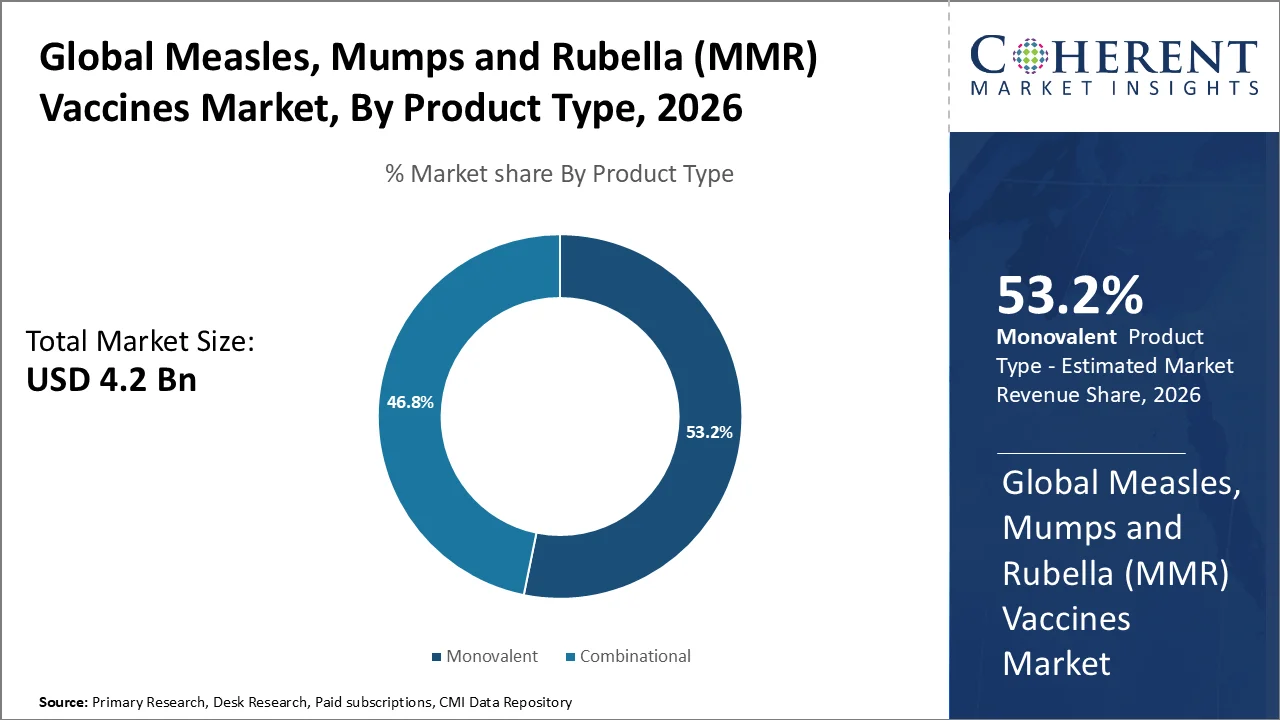
- Monovalent hold the largest market share of 53.2% in 2026 owing to the targeted outbreak response. On June 18, 2022, the Advisory Committee on Immunization Practices (ACIP) recommended the use of the monovalent Moderna COVID-19 vaccine as a 2-dose primary series for children aged 6 months–5 years and the monovalent Pfizer-BioNTech vaccine as a 3-dose primary series for children aged 6 months–4 years.
- Hospitals acquired the largest market share of 42.7% in 2026 owing to its high volume of routine childhood immunizations. In March 2026, SPARSH Group of Hospitals launched a Life-Course Vaccination (LCV) programme to promote preventive healthcare by supporting immunisation across all stages of life, from childhood to older adulthood.
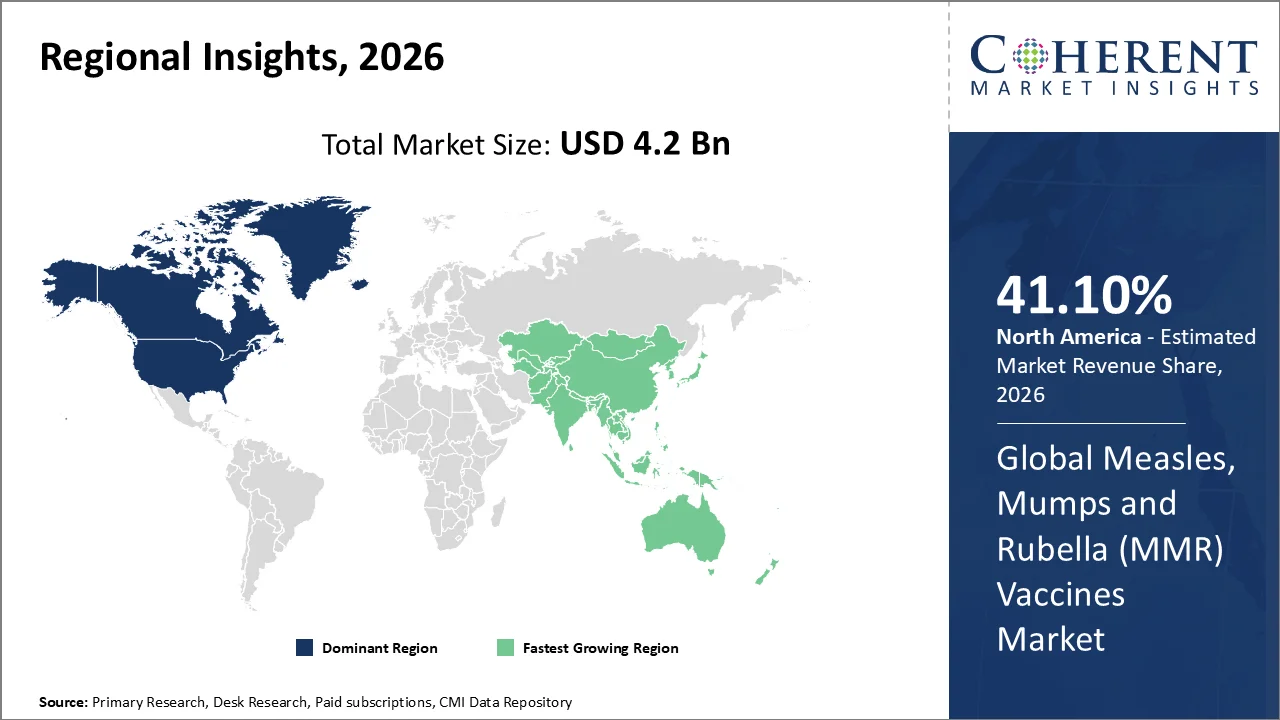
- North America is expected to acquire the dominant share of 41.1% in 2026 owing to the strong government support and funding.
Current Events and Their Impact on the Measles, Mumps and Rubella (MMR) Vaccines Market
Current Event | Description and its Impact |
India's National Zero Measles-Rubella Elimination Campaign (2025–26) |
|
Introduction of Routine MMRV Vaccination in England |
|
Segmental Insights
- Current Industry Events of 2026
- Market Size Estimation
- Regional Breakdown
- Competitive Landscape
- Customer Intelligence
- Segmental Analysis
- Pricing Analysis
- Key Market Drivers, Challenges & Future Trends
- Customized Insights Section
Why is Monovalent Acquiring the Largest Market Share?
Monovalent hold the largest market share of 53.2% in 2026. Healthcare providers and public health authorities drive the monovalent segment of the Measles, Mumps, and Rubella (MMR) vaccines market by increasing the use of targeted immunization during disease-specific outbreaks, especially measles. They deploy monovalent vaccines for outbreak control, catch-up vaccination campaigns, and disease elimination programs when protection against a single infection is required. Governments further stimulate demand by investing in immunization programs, strengthening healthcare infrastructure, expanding vaccine access, and enhancing disease surveillance. Growing public awareness of vaccine-preventable diseases and the need for adaptable vaccination strategies across different epidemiological settings also accelerate the adoption of monovalent vaccines. For instance, in March 2025, NIH has initiated a Phase 1 first-in-human trial for a Lassa fever vaccine, addressing a disease with no approved vaccine or treatment. Lassarab, a rabies virus-based vaccine, may potentially complement existing rabies vaccines if it generates similar protective immune responses.
Which End Users segment dominates the market?
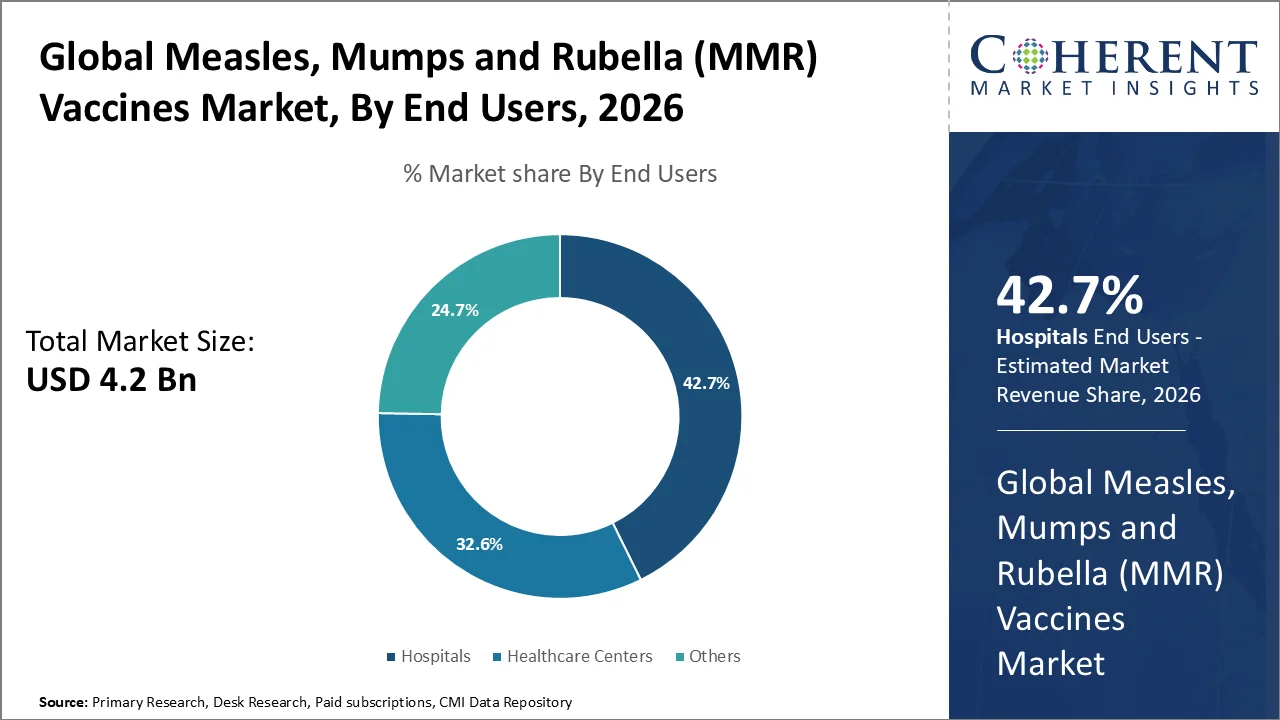
Hospitals acquired the largest market share of 42.7% in 2026. Hospitals strengthen the Measles, Mumps, and Rubella (MMR) vaccines market by delivering routine childhood immunizations and implementing government-supported vaccination programs. Healthcare professionals administer MMR vaccines through pediatric, maternal, and preventive care services to achieve broad immunization coverage. Hospitals also enhance vaccine delivery by expanding healthcare infrastructure, maintaining reliable cold-chain storage, and employing trained medical staff. They further boost vaccine demand by promoting preventive healthcare, conducting catch-up immunization initiatives, managing disease outbreaks, and maintaining comprehensive immunization records.
Measles, Mumps and Rubella (MMR) Vaccines Market Trends
- Rising measles outbreaks and recurring mumps cases are accelerating demand for routine MMR vaccination, catch-up immunization campaigns, and strengthened public health preparedness across developed and emerging economies. In 2024, 60 countries experienced large or disruptive measles outbreaks, nearly double the 33 countries in 2022, highlighting the need for stronger immunization efforts.
- Governments and international health organizations are expanding national immunization programs and school-entry vaccination requirements to improve vaccine coverage and prevent the resurgence of measles, mumps, and rubella. WHO reports that 191 Member States had incorporated a second dose of a measles-containing vaccine into their national immunization schedules by the end of 2024, supporting broader protection against outbreaks.
- Investments in vaccine manufacturing capacity, cold-chain infrastructure, and outbreak preparedness are strengthening vaccine availability and distribution. Governments and public health agencies continue to support catch-up vaccination initiatives, emergency stockpiles, and equitable vaccine access through national immunization programs and international partnerships. WHO and UNICEF also reported that 14.3 million children remained "zero-dose" (received no routine vaccines) in 2024, emphasizing the continued need for investments in vaccine delivery infrastructure and access.
Regional Insights
North America dominates owing to advanced vaccine storage and distribution networks
North America is expected to acquire the dominant share of 41.10% in 2026. North America strengthens the Measles, Mumps, and Rubella (MMR) vaccines market by implementing robust immunization programs, developing advanced healthcare infrastructure, and supporting government-led vaccination initiatives. Healthcare organizations and public health agencies promote vaccine adoption through increased awareness of vaccine-preventable diseases, school vaccination policies, and efficient disease surveillance systems. Rising measles outbreaks encourage authorities to expand catch-up immunization campaigns and improve vaccination coverage. The region’s established vaccine manufacturers, reliable cold-chain systems, and growing adult immunization efforts further contribute to market expansion. For instance, in July 2026, Pennsylvania’s health department launched an online dashboard to track reported measles cases and provide updates on the disease’s status across the state.
Asia Pacific Measles, Mumps and Rubella (MMR) Vaccines Market Trends
The Asia Pacific Measles, Mumps and Rubella (MMR) Vaccines Market grows as governments expand immunization programs, increase awareness of vaccine-preventable diseases, and strengthen healthcare infrastructure. Rising birth rates in several countries and proactive public health initiatives boost vaccination demand across the region. Healthcare providers and authorities improve vaccine distribution networks, enhance access to medical services, and collaborate with vaccine manufacturers to support market expansion. Disease elimination campaigns and routine childhood immunization programs further drive the adoption and growth of MMR vaccines throughout Asia Pacific.
United States Measles, Mumps and Rubella (MMR) Vaccines Market Trends
The United States MMR vaccines market expands due to rising immunization awareness, government vaccination programs, and public health initiatives. Increasing measles cases, school vaccination requirements, improved pediatric healthcare access, and ongoing vaccine research drive demand and support market growth. For instance, in May 2026, Virginia Department of Health launched a measles dashboard to track rising cases, monitor trends, and help residents understand exposure risks during the outbreak in Buckingham County and statewide.
Japan Measles, Mumps and Rubella (MMR) Vaccines Market Trends
Japan’s Measles, Mumps and Rubella (MMR) vaccines market is driven by rising awareness of preventive healthcare, strong government immunization initiatives, and continuous efforts to maintain high vaccination coverage among children. Growing concerns over measles outbreaks, international travel-related disease transmission, and the need for reliable pediatric healthcare solutions are encouraging vaccine adoption. As of 22 March 2026, Japan had reported 152 cumulative measles cases, representing a 3.5-fold increase compared with the same period in 2025. Improvements in healthcare infrastructure, public health campaigns, and advancements in vaccine development are further supporting market growth, while increasing focus on disease prevention strengthens demand across Japan.
Who are the Major Companies in Measles, Mumps and Rubella (MMR) Vaccines Industry
Some of the major key players in Measles, Mumps and Rubella (MMR) Vaccines are GlaxoSmithKline (Belgium), Merck & Co. Inc. (USA) and Serum Institute of India Ltd.
Key News
- In April 2026, Bangladesh launched an emergency measles vaccination campaign for over one million children after reporting its highest measles death toll in two decades, with 17 confirmed deaths and 98 suspected child deaths.
Market Report Scope
Measles, Mumps and Rubella (MMR) Vaccines Market Report Coverage
| Report Coverage | Details | ||
|---|---|---|---|
| Base Year: | 2025 | Market Size in 2026: | USD 4.2 Bn |
| Historical Data for: | 2020 To 2024 | Forecast Period: | 2026 To 2033 |
| Forecast Period 2026 to 2033 CAGR: | 6.1% | 2033 Value Projection: | USD 5.8 Bn |
| Geographies covered: |
| ||
| Segments covered: |
| ||
| Companies covered: | GlaxoSmithKline (Belgium), Merck & Co. Inc. (USA) and Serum Institute of India Ltd. | ||
Analyst Opinion
- MMR vaccination demand is being shaped less by routine immunization and more by Japan’s vulnerability to disease resurgence. Despite strong healthcare systems, Japan continues to experience measles importation risks due to international travel, with the country reporting hundreds of measles cases during recent outbreak periods after years of elimination status. In my view, this highlights that sustained MMR vaccine demand is not optional but a public health requirement, particularly as global mobility increases and immunity gaps become more visible.
- Japan’s focus on maintaining childhood immunization coverage remains the strongest structural driver for the MMR vaccines market. The country’s national immunization framework has helped achieve high vaccine uptake, but challenges such as missed vaccinations, regional disparities, and pandemic-related disruptions have created pockets of susceptible populations. For example, measles requires very high population immunity levels to prevent transmission, making consistent vaccine availability and catch-up programs critical rather than temporary healthcare initiatives.
- The next phase of market growth will be influenced by improved vaccine confidence and targeted immunization strategies. Japan’s experience with vaccine hesitancy following past public concerns, particularly around combined vaccines, shows that adoption depends heavily on public trust and physician engagement. Expertly managed awareness programs, stronger communication from healthcare providers, and surveillance-driven vaccination campaigns will be key factors supporting long-term MMR vaccine utilization, especially among younger populations and international travelers.
Speak to the analyst
Want personalized insights?
Take the findings above to one of our principal consultants, or have the report rebuilt around the segments, geographies and competitors you actually track.
Market Segmentation
- By Product Type (Revenue, USD Bn, 2021-2033)
- Monovalent
- Combinational
- Divalent
- Trivalent
- Others
- By End Users (Revenue, USD Bn, 2021-2033)
- Hospitals
- Healthcare Centers
- Others
- By Region (Revenue, USD Bn, 2021-2033)
- North America
- U.S.
- Canada
- Latin America
- Brazil
- Mexico
- Argentina
- Rest of Latin America
- Europe
- Germany
- U.K.
- France
- Italy
- Spain
- Russia
- Rest of Europe
- Asia Pacific
- China
- India
- Japan
- Australia
- South Korea
- ASEAN
- Rest of Asia Pacific
- Middle East
- GCC
- Israel
- Rest of Middle East
- Africa
- South Africa
- Central Africa
- North Africa
- North America
Sources
Primary Research interviews
- Healthcare professionals and immunization experts
- Pediatricians and infectious disease specialists
- Vaccine researchers and epidemiologists
- Public health officials and immunization program coordinators
- Hospital and clinic administrators
- Vaccine manufacturers’ representatives and distribution stakeholders
- Government health agencies and regulatory authorities
Databases
- World Health Organization (WHO) immunization and vaccine databases
- Centers for Disease Control and Prevention (CDC) vaccine surveillance databases
- UNICEF immunization data resources
- National immunization program databases
- Government health statistics databases
- Clinical trial registries and vaccine development databases
- Epidemiological surveillance databases
Magazines
- Vaccine industry and healthcare publications
- Public health and biotechnology magazines
- Pharmaceutical and life sciences magazines
- Medical news publications
- Immunization-focused newsletters and healthcare bulletins
Journals
- Peer-reviewed journals covering vaccinology and immunology
- Public health and epidemiology journals
- Infectious disease research journals
- Pediatric medicine journals
- Clinical research and vaccine development journals
- Healthcare policy and global health journals
Newspapers
- National and international healthcare news publications
- Science and technology newspapers
- Government health policy news sources
- Pharmaceutical and biotechnology news platforms
- Public health and disease outbreak reporting sources
Associations
- World Health Organization
- Centers for Disease Control and Prevention
- American Academy of Pediatrics
- International Vaccine Institute
- National pediatric, immunology, and public health associations
- Immunization advocacy and healthcare professional organizations
Public Domain sources
- Government health department publications
- Vaccine safety monitoring reports
- Immunization coverage reports
- Public health surveillance reports
- Regulatory authority publications
- Clinical trial information available through public registries
- Open-access scientific research publications
- Global disease monitoring and outbreak reports
Proprietary Elements
- CMI Data Analytics Tool
- Proprietary CMI Existing Repository of information for last 10 years
Get access to 250+ pages report
Every segment, forecast, competitor profile and data table behind the analysis above — available for instant download.
- ESOMAR Member
- ISO 9001:2015 Certified
- D-U-N-S Registered
- GDPR & CCPA Compliant
Missing comfort of reading report in your local language? Find your preferred language:
Transform your Strategy with Exclusive Trending Reports
Frequently Asked Questions
The MMR vaccines market is primarily driven by increasing government immunization programs, continued efforts to eliminate measles outbreaks, and the need to maintain high vaccination coverage among children and vulnerable populations.
Measles is one of the most contagious infectious diseases, requiring very high community immunity levels to prevent outbreaks.
Government-led immunization schedules, school-entry vaccination requirements, and public health campaigns play a significant role in driving vaccine adoption.
Public awareness campaigns help address vaccine hesitancy and improve acceptance of MMR vaccination.
Children represent the largest demand group due to routine childhood immunization schedules.