

Dermatomyositis Market Size and Share Analysis: 2026 - 2033
The global dermatomyositis market size is expected to reach approximately USD 637.7 Mn in 2026 and USD 931.6 Mn by 2033, growing at a CAGR of 5.5% throughout the forecast period (2026-2033)
Key Takeaways from the Dermatomyositis Market Report
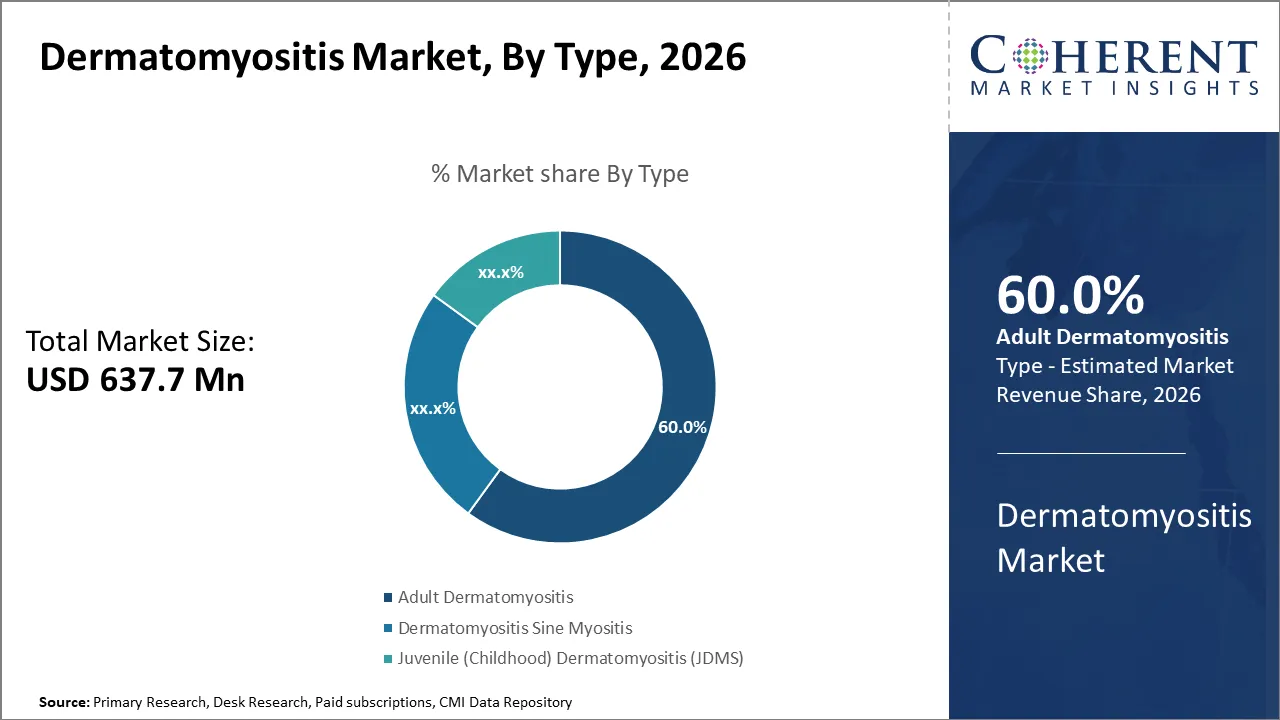
- Adult Dermatomyositis main a highly sought-after type, accounting for about 60% of the market share in 2026 due to greater diagnosis rate ad often associated with malignancies and requires long-term therapy.
- Anti-inflammatory medication is expected to remain leading treatment type segment accounting for 50% in the dermatomyositis market revenue in 2026, as it is first-line therapy and provides rapid symptom relief and high usage volume globally.
- The hospital pharmacies segment registered its dominance over the global dermatomyositis market with share of 50% in 2026 because need for continuous monitoring and complex care.
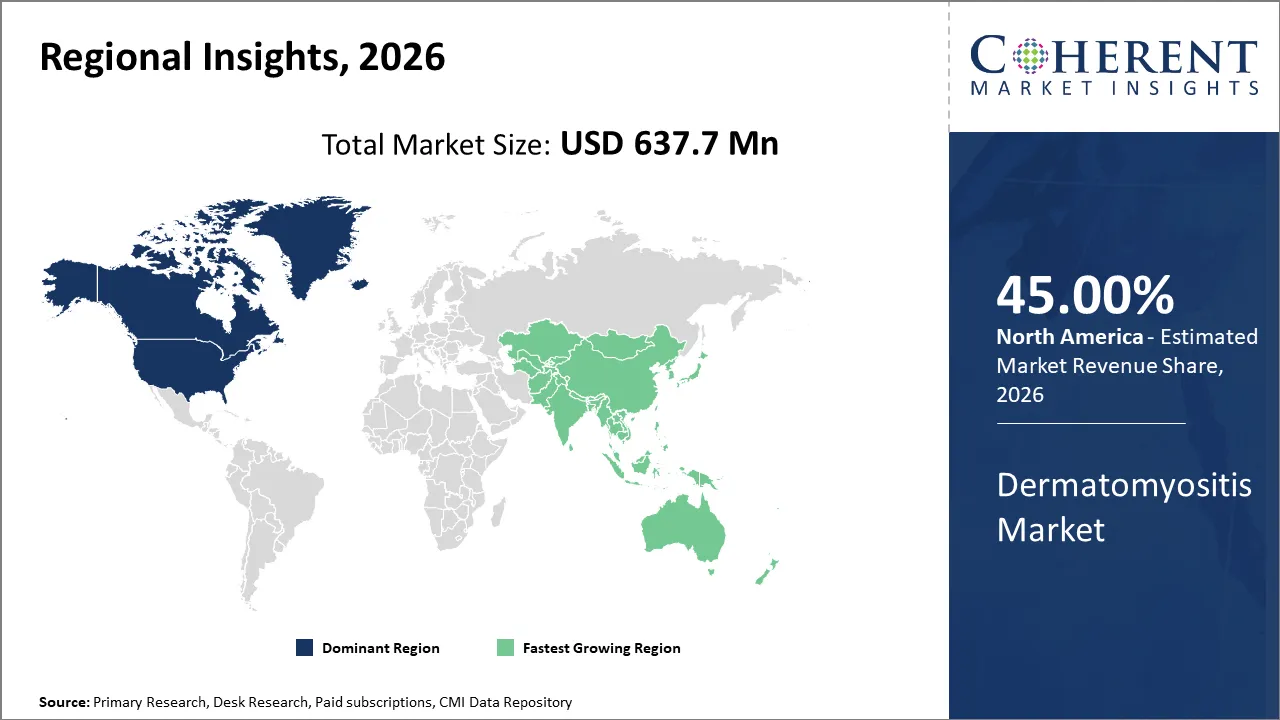
- North America is projected to dominate the global dermatomyositis market in 2026, with a share of over 45% due to strong presence of key pharmaceutical companies and advanced healthcare infrastructure.
Dermatomyositis Market Overview
An inflammatory autoimmune disorder characterized by muscle weakness and skin rash is called dermatomyositis. Dermatomyositis attacks muscle and skin, causing muscle weakness, fatigue, and a characteristic skin rash; in some patients, it can also affect the lungs, swallowing, and overall physical function. The dermatomyositis market is mainly driven by rising recognition of the disease’s high unmet need, because patients often require long-term treatment and may also develop serious complications such as interstitial lung disease, dysphagia, and malignancy-associated disease. The dermatomyositis market is gaining strategic importance because it has high unmet clinical need, complex diagnosis, and long-term management requirements, which are driving demand for earlier detection, specialist care, biomarker-led testing, and targeted therapies. Its orphan-disease status, growing clinical research activity, and increasing focus on precision immunology are also encouraging innovation of new drug, partnerships, and premium treatment positioning.
Current Events and Their Impact on the Dermatomyositis Market
Current Event | Description and its Impact |
Increasing drug approval by the regulatory bodies |
|
Launch of Advanced Therapy for Treatment |
|
Segmental Insights
- Current Industry Events of 2026
- Market Size Estimation
- Regional Breakdown
- Competitive Landscape
- Customer Intelligence
- Segmental Analysis
- Pricing Analysis
- Key Market Drivers, Challenges & Future Trends
- Customized Insights Section
Dermatomyositis Market Insights, By Type - Adult Dermatomyositis Holds Dominant Type in the Market
Based on type, adult dermatomyositis is expected to lead the market, accounting for a revenue share of 60% in 2026. The adult dermatomyositis segment dominates because the adult patient pool is larger than the pediatric pool, and adults more often present with complications that require broader, longer, and more intensive medical management. The increased clinical complexity of adult illness is another important factor. While juvenile dermatomyositis is relatively infrequently linked to malignancy, adult dermatomyositis is much more strongly associated with cancer, and reviews point out that cancer-associated dermatomyositis is a well-established problem in adults. Since more regular screenings, imaging, specialist consultations, and longer follow-ups are required, this increases the market demand for adult care.
Dermatomyositis Market Insights, By Treatment Type - Anti-Inflammatory Medication to Remain Leading Treatment Type of Adult Bovine Serum
By treatment type, the anti-inflammatory medication segment is slated to account for a prominent market share of 50% in 2026. The anti-inflammatory medications are extensively used for dermatomyositis treatment owing to their first-line role in disease management and rapid action on suppression of muscle and skin inflammation. Another important factor is that most patients get anti-inflammatory drugs early and often, no matter how bad their disease is. High-dose glucocorticoids are frequently used in conjunction with methotrexate or other immunosuppressants for treating dermatomyositis in both adults and children, according to guidelines by the regulatory bodies. Because inflammation control is the cornerstone of treatment, particularly at diagnosis and during flare-ups, the anti-inflammatory medicine segment dominates the dermatomyositis market. Systemic glucocorticoids continue to be the first-line treatment for dermatomyositis, according to current reviews and clinical references. This is because systemic glucocorticoids operate fast to reduce muscle inflammation, relieve weakness, and control active illness before longer-term, steroid-sparing therapies fully take effect.
Dermatomyositis Market Insights, By Distribution Channel
Based on distribution channel, hospital pharmacies segment led the global dermatomyositis market with share of 50% in 2026. The hospital pharmacies segment dominates as the dermatomyositis treatment often involves specialist-managed therapies such as immunosuppressants, corticosteroids, biologics, and especially intravenous immunoglobulin (IVIg), which commonly require hospital-based prescribing, monitoring, infusion administration, and reimbursement control. Because dermatomyositis is a rare autoimmune disease that usually requires specialist-led treatment, including IVIg infusions and other advanced immunomodulatory therapies, which are primarily dispensed and monitored through hospital settings rather than retail pharmacies, the hospital pharmacies segment dominates the dermatomyositis market distribution landscape.
Regional Insights
North America Remains the Market Leader in 2026
North America is expected to dominate the global dermatomyositis market, accounting for a share of 45% in 2026. The region benefits from a well-developed network of specialized myositis centers and referral hospitals in the U.S. This network supports earlier diagnoses, collaborative care involving multiple medical specialties, and greater use of advanced treatments. Due to availability of advanced infrastructure and presence of leading key players, there is greater use of advanced infusion-based therapy supports higher market value. The growth of the North America dermatomyositis market is driven by strong specialist care availability, robust hospital and infusion infrastructure, higher awareness of rare autoimmune diseases, and the presence of U.S.FDA-approved treatment options, all of which improve diagnosis rates, treatment uptake, and long-term disease management in the region.
Asia Pacific Dermatomyositis Market Trends
Asia Pacific region is expected to be the fastest growing region in the dermatomyositis market in the near future due to rising research and development activity and increasing adoption of advanced therapeutic treatment. For instance, in August 2025, Pfizer, a pharmaceutical company, announced the positive response of the dazukibart drug for the treatment of dermatomyositis and polymyositis and its enrollment in the phase 3 clinical trial. This trial has multiple recruiting sites in Asia‑Pacific, including China (e.g., Anhui Provincial Hospital, Peking Union Medical College Hospital, Renji Hospital Shanghai Jiao Tong University), India (Ernakulam, Kerala), and Japan (Tokyo) reflecting Asia‑Pacific participation. According to evaluation published by the National Center for Biotechnology Information evaluations in 2024, biologics, JAK inhibitors, and other more recent therapy modalities for dermatomyositis and juvenile dermatomyositis are gaining popularity. Regional market expansion quickens as Asia Pacific's tertiary-care facilities increase access to these more expensive treatments. Access to immunology testing, the expansion of tertiary hospitals, and rheumatology/dermatology referral routes are all contributing to the diagnosis and treatment of previously overlooked or postponed cases. This is not evidence of present market domination, but rather a market-growth element. This trend of change is supported by the research on diagnostic delay and current advancements in classification.
Dermatomyositis Market Outlook – Country-wise
U.S. Dermatomyositis Market Forecast
The U.S. country dominates within the North America dermatomyositis market due to large patient pool increase the burden for the treatment. According to the research data published in 2024 by the National Center for Biotechnology Information, the U.S. has one of the highest reported rates of adult dermatomyositis incidence and prevalence worldwide, with an adult incidence of 15.2 per million person-years and a prevalence of 21.4 per 100,000, indicating a higher demand for treatment than other nations in the region. Coordinated care from rheumatology, dermatology, neurology, pulmonology, and infusion-based treatment is frequently necessary for dermatomyositis. Due to the presence of advanced infrastructure and an advanced specialized environment for treating myositis problems is shown in U.S.-based facilities like the Johns Hopkins Myositis Center and The Myositis Association's physician network, clinical research is more active in the U.S. In the U.S., ClinicalTrials.gov lists numerous dermatomyositis studies and extension trials, demonstrating increased ongoing research activity, early acceptance of innovative medicines, and improved access to experimental treatment alternatives.
China Dermatomyositis Market Trends
China dermatomyositis market is driven by the growing epidemiology and launched of advanced therapy in the country. China's policy framework has progressively supported rare-disease medications through insurance inclusion, price negotiations, VAT reductions, quicker review/approval support, and hospital formulary requirements for collaborative-network institutions. This facilitates the conversion of clinical need into real commercial demand. Anti-MDA5 dermatomyositis is comparatively more common in Asian populations, which is a clinically significant factor. According to a 2025 review, it is responsible for more than 20% of occurrences of dermatomyositis in Asians, and 50% to 100% of Asian MDA5-DM patients develop fast progressive interstitial lung disease. This raises the need for specialized diagnosis, hospitalization, immunosuppressive treatment, and follow-up. The Asia-Pacific dermatomyositis market is dominated by China because of its large addressable patient pool, extensive network of tertiary hospitals, improved infrastructure for diagnosing and referring rare diseases, improved access to treatment through policy support, and increased clinical demand for specialized management of severe dermatomyositis subtypes.
Dermatomyositis Market News
- In March 2026, the U.S. Food Drug and Administration announced the approval of the Brepocitinib's New Drug Application (NDA) for the treatment of dermatomyositis, a chronic inflammatory illness affecting the muscles and skin. Data from the phase 3 VALOR trial (ClinicalTrials.gov Identifier: NCT05437263), which assessed brepocitinib, an oral dual inhibitor of tyrosine kinase 2 and Janus kinase 1, in a wide range of dermatomyositis patients, including those with multiple cardiovascular risk factors and a history of benign or malignant neoplasm, support the NDA.
- In January 2026, Cartesian Therapeutics, Inc., biotechnology company, revealed plan to start its Phase 2 TRITON trial of Descartes-08 for myositis, including dermatomyositis and antisynthetase syndrome. Up to 50 patients will participate in this experiment to evaluate the safety and effectiveness of autologous cell treatment given in outpatient settings without preconditioning chemotherapy.
Market Report Scope
Dermatomyositis Market Report Coverage
| Report Coverage | Details | ||
|---|---|---|---|
| Base Year: | 2025 | Market Size in 2026: | USD 637.7 Mn |
| Historical Data for: | 2020 To 2024 | Forecast Period: | 2026 To 2033 |
| Forecast Period 2026 to 2033 CAGR: | 5.5% | 2033 Value Projection: | USD 931.6 Mn |
| Geographies covered: |
| ||
| Segments covered: |
| ||
| Companies covered: | AstraZeneca Plc., Bristol-Myers Squibb Company, Octapharma AG, Corbus Pharmaceuticals Holdings, Inc., CSL Limited, Ermium Therapeutics, Kezar Life Sciences Inc., Mallinckrodt Plc., Néovacs, Horizon Therapeutics plc., and Pfizer Inc. | ||
| Growth Drivers: |
| ||
| Restraints & Challenges: |
| ||
Dermatomyositis Market Drivers
Increasing funding by non-profit organizations for dermatomyositis or inflammatory myopathies treatment
Expansion of funding activities and inflammatory myopathies has estimated to drive the growth of the dermatomyositis market by improving awareness, stimulating research, enabling infrastructure, and ultimately expanding both treatment development and patient access. The funding aids in the discovery of new patient subgroups, biomarkers, and treatment targets. It can aid in the initiation of clinical studies, increasing the possibility that novel treatments will be approved by regulators. Early funding lowers the cost of entry for new biotech firms looking to create therapies tailored to diabetes mellitus. In combination, non‑profit funding drives growth in the dermatomyositis market by increasing diagnosis rates and patient identification, enhancing reimbursement and policy support, and attracting broader investment and commercial interest.
For instance, in December 2025, according to the data published by The Myositis Association, has funded 68 international research projects with close to USD10 million. From basic science to clinical applications, these initiatives cover a wide range of myositis-related illnesses and specialties. Our average grant award is over USD120,000, which is a significant investment that has helped patients find fresh hope, develop research programs, and establish careers. 43% of TMA-funded initiatives have benefited non-U.S. investigators, demonstrating our dedication to international cooperation. Early-career researchers have benefited from 32% of funds, fostering the development of the next generation of myositis specialists. Many of the 22 Fellowship Grants that have been given out have resulted in long-term leadership in the industry.
Product approvals and launches for the treatment of dermatomyositis
Increasing approval and launch of new drug product has estimated to drive the growth of the market over the forecast period. By enhancing treatment credibility, reimbursement access, physician adoption, patient identification, and pipeline investment, product launches and regulatory approvals hasten the growth of the dermatomyositis market and transform an underpenetrated rare-disease segment into a more organized commercial market. Additionally, approvals benefit the market by increasing diagnosis and awareness, motivating specialists to find qualified patients sooner, and driving treatment facilities to develop regimens tailored to individual diseases. Successful launches can draw increased interest from investors and R&D.
For instance, in March 2026, Priovant Therapeutics, a clinical-stage biotechnology company, unveiled that the U.S. Food and Drug Administration (FDA) has approved New Drug Application (NDA) for brepocitinib to treat dermatomyositis (DM) and has given the application Priority Review. The third quarter of 2026 has been designated by the FDA as the Prescription Drug User Fee Act (PDUFA) target action date. By the end of September 2026, the business plans to introduce the medication in the US.
Dermatomyositis Market Trends
Expansion of Targeted and Novel Therapies
Due to the rising prevalence of dermatomyositis, there is increase in the demand for the biologic therapies. Growth in immunosuppressants and precision immunology treatment is major structural driver of the dermatomyositis market because both expand the patient pool, improve treatment outcomes, and attract pharmaceutical investment. As the precision immunology medicines target specific immune pathways instead of broad suppression it has higher demand in the market. Expansion of combination treatment strategies enables better disease management and driving market adoption.
Dermatomyositis Market Opportunities
Expansion in Emerging Markets
Growing emergence in regions like Asia Pacific, Latin America, and the Middle East are experiencing rapid growth in healthcare access, driven by significant investments in specialized care centers and rheumatology departments. The increasing demand for diagnostic tools and targeted therapies will stimulate growth in the market. The ability to detect and manage dermatomyositis early will increase the adoption of both existing and novel treatments. Healthcare infrastructure development will allow wider access to treatments, enabling the use of innovative drugs, expanding patient access, and accelerating market penetration. Therefore, expansion in emerging markets has created significant opportunity for the growth of the dermatomyositis market in the near future.
Earlier Diagnosis and Growing Awareness
Increasing prevalence and launch of advanced technology for the diagnosis of the dermatomyositis has created significant opportunity for the growth of the in the near future. For instance, in January 2026, according to the data published by the National Center for Biotechnology Information and Fortune journals, it has been estimated that a rare inflammatory myopathy, dermatomyositis is expected to have an annual incidence rate of 1 to 15 cases per million people and a prevalence of 2 to 20 cases per 100,000 people. Early diagnosis makes therapy possible, which is essential for slowing the progression of the disease and averting consequences. Patients may have better long-term results if treatment is started early in the illness. The precision and promptness of diagnoses are being greatly enhanced by technological developments in diagnostic instruments including MRI, skin biopsy methods, and autoantibody tests. More early-stage diagnoses will result from this increased awareness, enabling earlier therapies and improved patient outcomes.
Analyst Opinion (Expert Opinion)
- The market is expected to benefit from investments in rare disease research and biopharmaceuticals in emerging economies. Increased healthcare investments and the establishment of specialized care centers in emerging regions like Asia Pacific and Latin America will significantly accelerate market penetration. The development of clinical infrastructure and better access to healthcare in these regions provides the necessary support for diagnosis, treatment, and long-term management of dermatomyositis, strengthening market demand.
- The market for dermatomyositis is expected to rise significantly due to growing support for research and development as well as increased attention to uncommon autoimmune illnesses. Initiatives to accelerate the release of innovative therapies onto the market are being funded in large part by governments and nonprofits. The future is extremely bright as awareness and diagnostic rates rise worldwide along with the development of immunotherapies.
- According to experts’ opinion baseline demand is being strengthened by increased awareness and early diagnosis. Dermatomyositis has been diagnosed earlier and more accurately thanks to improvements in diagnostic methods (such as MRI, biomarker tests, and autoantibody screens) and growing awareness of autoimmune illnesses. This boosts demand for novel treatments and enhances treatment results, both of which support faster market expansion.
- Hence, increasing dermatomyositis prevalence and biopharmaceutical and immunotherapy advancements remain the primary growth catalyst. The increasing drug approval and adoption of targeted biologics and immunotherapies for dermatomyositis treatment are major drivers in market growth.
Speak to the analyst
Want personalized insights?
Take the findings above to one of our principal consultants, or have the report rebuilt around the segments, geographies and competitors you actually track.
Dermatomyositis Market Segmentation
- By Type ( Revenue, USD Mn, 2020 - 2033)
- Adult Dermatomyositis
- Dermatomyositis Sine Myositis
- Juvenile (Childhood) Dermatomyositis (JDMS)
- By Treatment Type Insights (Revenue, USD Mn, 2020 - 2033)
- Anti-inflammatory Medication
- Immunosuppressive Drugs
- Immunoglobulin
- Others (Plasma Exchange, Monoclonal antibody among others)
- By Distribution Channel Insights ( Revenue, USD Mn, 2020 - 2033)
- Hospital Pharmacies
- Retail Pharmacies
- Online Pharmacies
- By Region Insights (Revenue, USD Mn, 2020 - 2033)
- North America
- U.S.
- Canada
- Latin America
- Brazil
- Argentina
- Mexico
- Rest of Latin America
- Europe
- Germany
- U.K.
- Spain
- France
- Italy
- Russia
- Rest of Europe
- Asia Pacific
- China
- India
- Japan
- Australia
- South Korea
- ASEAN
- Rest of Asia Pacific
- Middle East & Africa
- GCC Countries
- Israel
- Rest of Middle East & Africa
- North America
- Key Players
- AstraZeneca Plc.
- Bristol-Myers Squibb Company
- Octapharma AG
- Corbus Pharmaceuticals Holdings, Inc.
- CSL Limited
- Ermium Therapeutics
- Kezar Life Sciences Inc.
- Mallinckrodt Plc.
- Néovacs, Horizon Therapeutics plc.
- Pfizer Inc.
Sources
Primary Research Interviews
- Interviews with rheumatologists, dermatologists, and immunologists to understand diagnosis challenges, treatment preferences, and the effectiveness of biologics and immunosuppressants in managing dermatomyositis.
- Insights from pharmaceutical executives, product managers, and clinical development professionals on the progress of drug pipelines, market adoption, and regulatory considerations for dermatomyositis therapies.
- Discussions with hospital pharmacists, procurement managers, and specialty pharmacy providers to assess prescription trends, treatment accessibility, pricing dynamics, and factors influencing the adoption of dermatomyositis treatments.
- Conversations with diagnostic lab professionals and clinical researchers to understand advancements in diagnostic tools, biomarker development, and ongoing research trends for better disease diagnosis and treatment.
Databases
- PubMed — Biomedical and life sciences research studies related to dermatomyositis and its treatment options.
- Scopus — Multidisciplinary literature on autoimmune diseases, including dermatomyositis, and related immunotherapies.
- ClinicalTrials.gov — Clinical trial registry for ongoing studies in dermatomyositis treatments and immunomodulatory drugs.
- Web of Science — Research publications on immunosuppressive therapies, biologics, and autoimmune conditions.
Magazines
- Genetic Engineering & Biotechnology News (GEN)
- BioProcess International
- Biopharma Dive
- The Medicine Maker
- BioPharm International
- Pharmaceutical Technology Magazine
Journals
- Cytotechnology Journal
- Journal of Clinical Immunology
- Journal of Autoimmunity
- Journal of Tissue Engineering and Regenerative Medicine
- Biotechnology and Bioengineering Journal
- Journal of Dermatology
Newspapers
- The New York Times — Health & Science Section
- The Guardian — Science & Biotechnology
- The Hindu — Science and Health
- The Economic Times — Healthcare & Pharmaceuticals
- Reuters — Biotechnology & Pharmaceutical News
Associations
- American College of Rheumatology (ACR)
- International Federation of Pharmaceutical Manufacturers & Associations (IFPMA)
- International Society for Autoimmunity (ISA)
- Biotechnology Innovation Organization (BIO)
- American Society for Clinical Immunology (ACRI)
Public Domain Sources
- World Health Organization (WHO) — Global health reports and autoimmune disease treatment strategies.
- European Medicines Agency (EMA) — Guidelines for biologics and autoimmune disease treatments.
- U.S. Food and Drug Administration (FDA) — Regulations for biologics and immunotherapies in autoimmune disease treatments.
- National Institute of Arthritis and Musculoskeletal and Skin Diseases (NIAMS) — Research and guidelines on dermatomyositis.
Proprietary Elements
- CMI Data Analytics Tool
- Proprietary CMI Existing Repository of Information for the Last 8 Years
Get access to 250+ pages report
Every segment, forecast, competitor profile and data table behind the analysis above — available for instant download.
- ESOMAR Member
- ISO 9001:2015 Certified
- D-U-N-S Registered
- GDPR & CCPA Compliant
Missing comfort of reading report in your local language? Find your preferred language:
Transform your Strategy with Exclusive Trending Reports
Frequently Asked Questions
The global market is estimated to be valued at USD 637.7 Mn in 2026.
The global Dermatomyositis Market value is expected to reach USD 931.6 Mn by 2033
The global market is poised to exhibit a CAGR of 5.5% from 2026 to 2033.
Major growth factors include increasing funding by non-profit organizations for dermatomyositis or inflammatory myopathies treatment and product approvals and launches for the treatment of dermatomyositis.
Limitations associated with bovine serum in cell culture
Some major companies in the AstraZeneca Plc., Bristol-Myers Squibb Company, Octapharma AG, Corbus Pharmaceuticals Holdings, Inc., CSL Limited, Ermium Therapeutics, Kezar Life Sciences Inc., Mallinckrodt Plc., Néovacs, Horizon Therapeutics plc., and Pfizer Inc.
North America, with 45% share in 2026, is expected to lead the market during the forecast period.