

Digital Pathology Market Size and Trends - 2026 to 2033
Digital Pathology Market is estimated to be valued at USD 1,250.8 Mn in 2026 and is expected to reach USD 2,835.0 Mn in 2033, exhibiting a compound annual growth rate (CAGR) of 12.4% from 2026 to 2033.
Key Takeaways
- Based on Product Type, the scanners segment is expected to lead the global market due to increase in product launches.
- Based on Therapeutic Area, Oncology is poised to be the dominant segment owing to rising usage for cancer or tumor.
- Based on Technology, the Immunohistochemistry segment is projected to be at the forefront in the market driven by rising R&D initiatives.
- Based on End User, the Pharmaceutical and Biotechnology Companies segment is expected to lead the market due to increasing product launches.
- Based on Region, North America is set to lead the Digital Pathology Market with 41.7% share in 2026. While, Europe is anticipated to be the fastest growing region.
Market Overview
The Digital Pathology Market is growing rapidly due to several important factors that are changing how medical laboratories and hospitals operate today. The rising number of chronic diseases, especially cancer cases, requires faster and more accurate testing methods to help patients get better treatment options. There is a serious shortage of trained pathologists worldwide which automated digital systems are needed to handle the growing workload more effectively.
The new technology improvements in artificial intelligence and medical imaging are making it easier to analyze tissue samples and diagnose diseases much faster. Companies are also launching innovative digital pathology projects that help doctors make better diagnostic decisions and work efficiently in their daily practice. Several government programs are also supporting digital healthcare are helping hospitals and clinics adopt these diagnostics tool and upgrade their existing laboratory infrastructure systems.
Current Events and Its Impacts on the Digital Pathology Market
Current Event | Description and the Impact |
Technological Advancements in AI and Machine Learning |
|
Regulatory and Compliance Changes |
|
Healthcare Infrastructure and Policy Developments |
|
Role Of Artificial Intelligence (AI) In Digital Pathology Market
AI is shifting the Digital Pathology Market by making it possible to automate image analysis, use predictive analytics, and detect anomalies. AI-powered tools make it easier to analyze sample tissues, identify patterns, and reach diagnostic conclusions, which cuts down on the need for pathologists to do things by hand and lowers operational costs. Real-time information makes it easier to manage patient care and make clinical decisions. Healthcare facilities can process high-volume pathology cases more efficiently, accurately, and safely by using AI. This is going to enhance diagnostic quality and encourage adoption by large and small healthcare institutions around the world.
For instance, in September 2024, Roche revealed that it was broadening its digital pathology open ecosystem by incorporating over 20 sophisticated artificial intelligence (AI) algorithms from eight new partners. This initiative is deigned to assist pathologists and researchers in cancer research and diagnosis through the application of advanced AI technology.
- Current Industry Events of 2026
- Market Size Estimation
- Regional Breakdown
- Competitive Landscape
- Customer Intelligence
- Segmental Analysis
- Pricing Analysis
- Key Market Drivers, Challenges & Future Trends
- Customized Insights Section
Segmental Insights
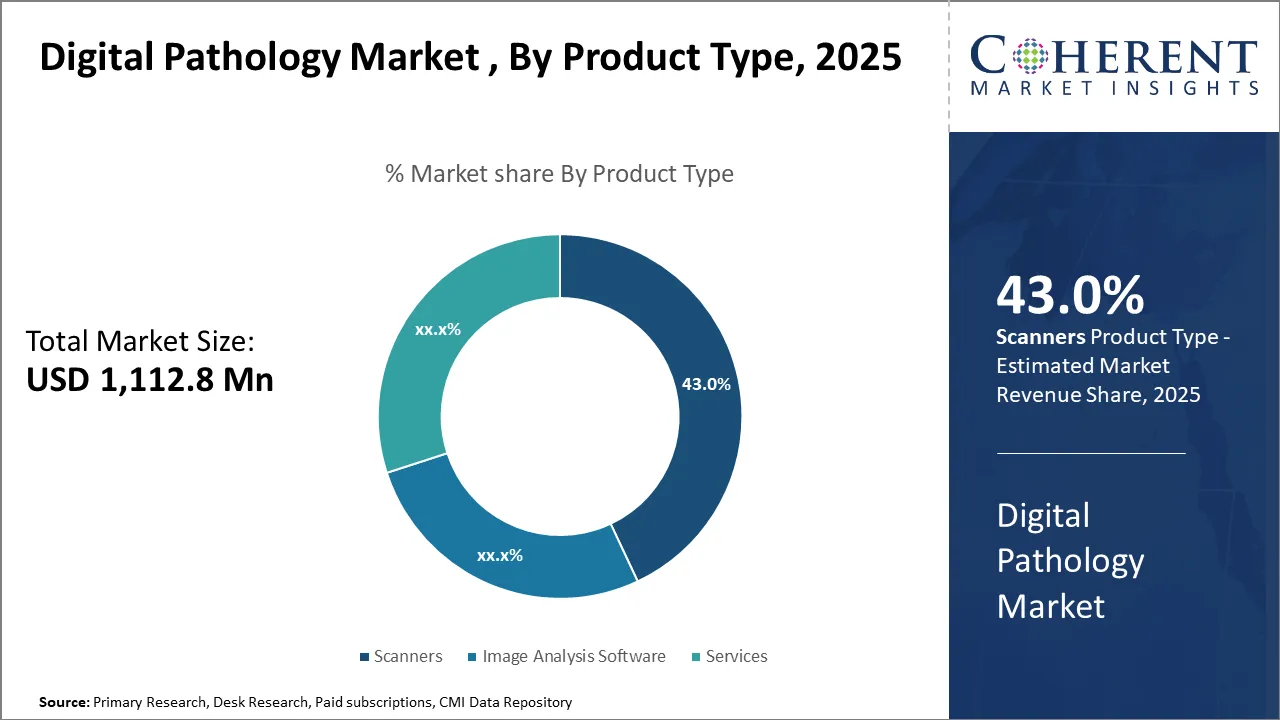
Digital Pathology Market Insights By, Product Type - Technological Upgrades Boosts the Scanner Usage
Based on Product Type, scanner segment contributes the highest share of 44% in 2026 of the market owing to the technological upgrades and surge in automation needs. These scanners deliver high image resolution capabilities that capture minute cellular details essential for accurate diagnosis. They also provide faster scanning speeds and greater throughout allowing the laboratories to handle growing case in an efficient manner.
For instance, in December 2026, Leica Biosystems, a Danaher subsidiary and a provider of anatomic pathology solutions took a major step in modernizing diagnostics. At the Digital Pathology and AI Congress in London, the company introduced three new products named Aperio GT 180 DX scanner, Aperio CS5 DX scanner, and Aperio iQC DX software.
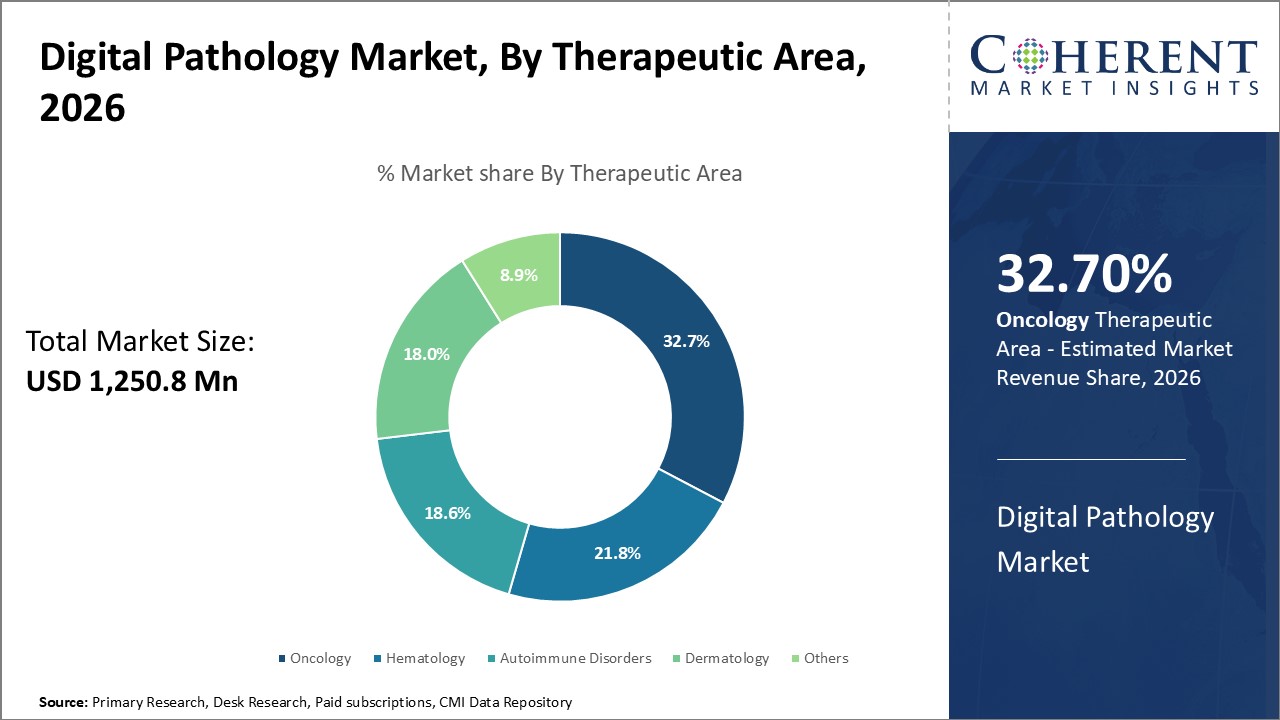
Digital Pathology Market Insights By, Therapeutic Area - Oncology Segment Lead with Need for Accurate Tumor Diagnosis
Based on Therapeutic Area, the oncology contributes the highest share in 2026 of the market owing to increasing global cancer burden and critical need for accurate tumor diagnosis. Cancer cases are rising globally which is creating unprecedented demand for accurate and timely pathological assessments. Digital pathology allows the oncologists to obtain faster diagnoses which is crucial for initiating cancer therapies.
For instance, in January 2023, Paige teamed up with Microsoft to use artificial intelligence on digital pathology. Their goal was to create new tools and biomarkers that would improve cancer diagnosis and patient care. This partnership aims to bring better diagnostics and more personalized treatment to patients.
Digital Pathology Market Insights By, Technology - Growing Research Activities Drives Priority for Immunohistochemistry
Based on Technology, the Immunohistochemistry contribute the highest share in 2026 owing to growing research activities and its important role in disease diagnosis. This technique uses special antibodies to find specific proteins in tissue samples, helping doctors identify cancer types and choose correct treatments. Drug companies are investing heavily in this technology to develop tests that identify which patients will respond well to specific medicines. The technique works for many diseases like cancer, immune disorders, and infections making it widely useful.
Digital Pathology Market Insights, By End User - Pharmaceutical and Biotechnology Companies Leads Owing to New Product Launches
Based on End User, Pharmaceutical and Biotechnology Companies segment expected to lead the market with largest share in 2026. It is because these companies are launching new products and conducting extensive drug research. They need to analyze large numbers tissue samples quickly when testing new medicines for safety and effectiveness. Regulatory authorities are also accepting digital pathology results for drug approvals which is encouraging more companies to invest in this technology. Biotech companies are using AI-enabled digital tools to discover new disease markers and create innovative diagnostic tests.
For instance, in April 2025, Roche a biotechnology firm, received the U.S. FDA Breakthrough Device Designation for its VENTANA® TROP2 (EPR20043) RxDx Device. This was the first computational pathology companion diagnostic to receive this recognition. The designation highlighted Roche’s focus on developing innovation that help doctors diagnose cancer more accurately.
Regional Insights
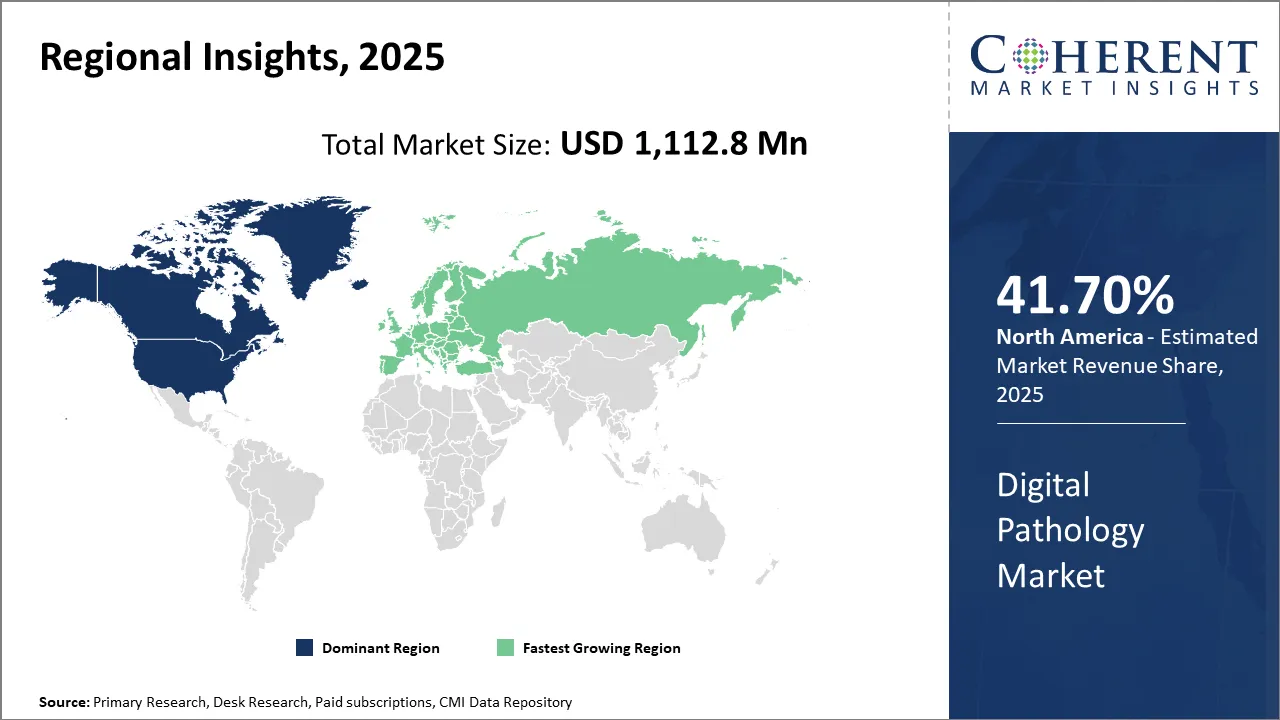
North America Digital Pathology Market Analysis & Trends
North America has remained the dominant region with a share of 41.7% in 2026 in the market due to the rising approval for new products by health regulators. The region has strong healthcare systems with modern labs and hospitals that are quickly adopting new diagnostic tools and digital technologies. Several top digital pathology companies operate here, thus creating competition that pushes innovation forward and helps the market grow faster. The rising need for remote diagnoses services and online consultation makes hospitals invest more money in digital pathology systems for better efficiency. Also, the support from government through clear rules and standards is encouraging healthcare facilities to switch from traditional methods to digital solutions more confidently.
For instance, in May 2024, Quest Diagnostics, a top provider of diagnostic services, partnered with PathAI, a global leader in AI-powered pathology technology. This multi-year collaboration aims to speed up digital and AI innovations in pathology while enhancing cancer and disease diagnoses through better quality, faster results, and greater efficiency. This deal marks a key advancement for anatomic pathology adoption in the U.S.
Europe Digital Pathology Market Analysis & Trends
The Europe region has emerged as the fastest growing market over the forecast period. The region was among the first regions to adopt digital systems. Digital pathology helps research work together easily by letting pathologist view large image collections and patient data from anywhere in the world. This feature has encouraged many hospitals and research centers across Europe to join forces and use common digital platforms for better results. The growing partnerships between medical facilities in different European countries is increasing the demand for digital pathology tools that allow smooth data sharing and testing.
For instance, in November 2023, Dedalus Group, Europe’s leading provider of anatomic pathology systems teamed up with Ibex Medical Analytics, a frontrunner in AI-driven cancer diagnostics. Together they launched a complete end-to-end AI Digital Pathology Solution for cancer diagnosis. The solutions feature algorithms that boost diagnostic quality and efficiency for expanding customer bases.
Digital Pathology Market Outlook Country-Wise
The U.S. Digital Pathology Market Trends
The U.S. has been the frontrunner in the digital pathology market with a major share in due to the rising cancer incidence, strong healthcare infrastructure, and increasing use of AI-powered diagnostic tools. The country’s strong healthcare system and heavy investment in research make it a global leader in this field. Pharmaceutical and biotech firms are leveraging digital pathology to speed up clinical trials and biomarker identification in precision medicine.
For instance, in November 2026, U.S.-based Hyland, creator of the Content Innovation Cloud™ partnered with Tribun Health, a digital pathology expert. The integration combines Tribun’s platform with Hyland’s imaging tools to embed AI in diagnostics, helping pathologists deliver faster and more efficient results.
Germany Digital Pathology Market Trends
The digital pathology market in Germany is growing quickly due to its excellent healthcare system, focus on innovation and commitment to personalized medicine. The region leads in the adoption of digital diagnostic tools, with hospital and research centers increasingly using digital imaging and AI analysis. Germany laboratories are moving away from traditional microscopes to digital systems allowing for faster diagnoses, better quality checks, and easier collaboration between doctors.
For instance, in November 2024, Mindpeak, GmbH, a pioneer in digital pathology, teamed up with Sagis DX for a landmark study. It tests the new Onychomycosis AI algorithm on PAS-stained slides, aiming to transform detection of fungal nail infections.
Market Report Scope
Digital Pathology Market Report Coverage
| Report Coverage | Details | ||
|---|---|---|---|
| Base Year: | 2025 | Market Size in 2026: | USD 1,250.8 Mn |
| Historical Data for: | 2020 To 2024 | Forecast Period: | 2026 To 2033 |
| Forecast Period 2026 to 2033 CAGR: | 12.4% | 2033 Value Projection: | USD 2,835.0 Mn |
| Geographies covered: |
| ||
| Segments covered: |
| ||
| Companies covered: | Leica Biosystems Nussloch GmbH, Olympus Corporation, F. Hoffmann-La Roche Ltd., Merck KGaA, GE Healthcare, Mikroscan Technologies, Inc., Koninklijke Philips N.V., Sectra AB, Propath UK Limited, Inspirata, Inc., Hamamatsu Photonics, Inc., OracleBio Limited, MD Biosciences, Aiforia, Xybion Digital Inc., Nucleai, Inc | ||
| Growth Drivers: |
| ||
| Restraints & Challenges: |
| ||
Digital Pathology Market Drivers
Technological innovations help market expand
Digital pathology market grows rapidly because new imaging systems help doctors to diagnose diseases more accurately while making fewer mistakes in healthcare facilities. Artificial intelligence technology analyzes tissue sample automatically and spots patterns quickly which convinces more hospitals and laboratories to purchase this digital equipment. Cloud storage lets pathologist view old patient cases anytime and predict future health trends. Such benefits make these tools very useful for medical businesses.
Advanced scanners equipped with strong computers create clear detailed images that improve diagnosis while reducing costs for hospitals and laboratories using them. Barcode labels stop sample confusion and solve problems with broken glass slides helping pathology labs work faster and save money. New features like label-free imaging and smart learning tools make digital pathology a necessary investment in healthcare companies wanting better results.
For instance, in August 2025, Tempus AI, Inc., a leader in using artificial intelligence to advance precision medicine, completed the purchase of Paige, a specialized digital pathology firm. This move expands Tempus’s data resources, strengthen its expert team, and solidifies its position in digital pathology top-tier technology.
Analyst Opinion (Expert Opinion)
The digital pathology market is experiencing sustained expansion, driven by the increasing adoption of digital imaging systems, artificial intelligence–enabled analysis, and integrated laboratory workflows. Industry data indicate that the market has crossed the billion-dollar threshold in recent years and is expected to multiply in size over the next decade, supported by rising installation of whole-slide imaging scanners and growing software penetration across pathology labs.
North America represents the largest contributor to overall market revenue, supported by advanced healthcare infrastructure, strong regulatory frameworks for digital diagnostics, and early adoption of AI-based pathology solutions. Europe follows closely, benefiting from large-scale digitization initiatives across public healthcare systems. Asia Pacific is emerging as a high-growth region, with expanding hospital networks, rising cancer diagnostic volumes, and increased investment in digital healthcare technologies.
From a component perspective, scanners and imaging hardware account for a significant portion of current deployments, reflecting the foundational need to digitize glass slides. Software platforms, particularly those incorporating machine learning algorithms for image analysis, are witnessing accelerated adoption due to their ability to improve diagnostic efficiency, reproducibility, and workflow automation. Hospitals and diagnostic laboratories remain the primary end users, while pharmaceutical and biotechnology companies increasingly rely on digital pathology for drug development, biomarker discovery, and clinical research.
Speak to the analyst
Want personalized insights?
Take the findings above to one of our principal consultants, or have the report rebuilt around the segments, geographies and competitors you actually track.
Digital Pathology Industry News
- In November 2025, Pictor Labs, a top innovator in AI-driven virtual staining and digital pathology, release the ClearStain™. This next-generation tool aims to transform molecular diagnostic processes.
- In August 2025, OptraSCAN, a worldwide leader in digital pathology and AI cytology solutions, introduced its CytoSiA platform across Asia at the Asia Pacific Imaging Summit. This launch aims to cater to the key challenges diagnostics, especially in the low- and middle-income areas with limited traditional cytology resources.
- In July 2025, PathAI, a global pioneer in Ai and digital pathology, released the Precision Pathology Network (PPN). The PPN network connects digital anatomic pathology laboratories using PathAI’s AISight®1 Image Management System. This advances precise diagnostics, boosts AI adoption in pathology, and supports better patient results worldwide.
- In January 2025, Mayo Clinic established Mayo Clinic Digital Pathology. It is built on a robust platform and taps into a vast archive of digital slides to transform pathology workflows and speed up medical innovations. This initiative promises quicker, and more accurate, diagnoses, enhanced treatments and faster access to new therapies for patients.
Market Segmentation
- Product Type Insights (Revenue, USD Mn, 2026 - 2033)
- Image Analysis Software
- Scanner
- Services
- Therapeutic Area Insights (Revenue, USD Mn, 2026 - 2033)
- Oncology
- Hematology
- Autoimmune Disorders
- Dermatology
- Others
- Technology Type Insights (Revenue, USD Mn, 2026 - 2033)
- Immunohistochemistry
- ISH & FISH
- Immunofluorescence
- Others
- Industry Insights (Revenue, USD Mn, 2026 - 2033)
- Pharmaceutical and Biotechnology Companies
- Diagnostic Labs
- Hospital Laboratories
- Others
- Regional Insights (Revenue, USD Mn, 2026 - 2033)
- North America
- U.S.
- Canada
- Latin America
- Brazil
- Argentina
- Mexico
- Rest of Latin America
- Europe
- Germany
- U.K.
- France
- Italy
- Russia
- Rest of Europe
- Asia Pacific
- China
- India
- Japan
- Australia
- South Korea
- ASEAN
- Rest of Asia Pacific
- Middle East
- GCC Countries
- Israel
- Rest of Middle East
- Africa
- South Africa
- North Africa
- Central Africa
- North America
- Key Players Insights (Revenue, USD Mn, 2021 - 2033)
- Leica Biosystems Nussloch GmbH
- Olympus Corporation
- F. Hoffmann-La Roche Ltd.
- Merck KGaA
- GE Healthcare
- Mikroscan Technologies, Inc.
- Koninklijke Philips N.V.
- Sectra AB
- Propath UK Limited
- Inspirata, Inc.
- Hamamatsu Photonics, Inc.
- OracleBio Limited
- MD Biosciences
- Aiforia
- Xybion Digital Inc.
- Nucleai, Inc.
Sources
Primary Research Interviews
- Digital Pathology Solution Providers
- Whole Slide Imaging (WSI) Scanner Manufacturers
- Pathology Software & AI Algorithm Developers
- Hospital Pathologists and Laboratory Directors
- Diagnostic Laboratory Service Providers
- Healthcare IT Integration Specialists
- Academic and Research Institute Professionals
- Others
Databases
- Bloomberg Terminal
- Thomson Reuters Eikon
- IHS Markit
- IQVIA Healthcare Databases
- S&P Global Market Intelligence
- PitchBook
- Others
Magazines
- CAP Today
- The Pathologist
- Diagnostic Pathology Europe
- Healthcare IT News
- Medical Device Network
- Others
Journals
- Journal of Pathology Informatics
- Modern Pathology
- American Journal of Clinical Pathology
- Journal of Digital Imaging
- Nature Medicine
- Others
Newspapers
- Financial Times
- The Wall Street Journal
- Reuters
- Bloomberg News
- The Guardian – Health Section
- Others
Associations
- Digital Pathology Association (DPA)
- College of American Pathologists (CAP)
- European Society of Pathology (ESP)
- American Society for Clinical Pathology (ASCP)
- International Academy of Digital Pathology (IADP)
- Others
Public Domain Sources
- U.S. Food and Drug Administration (FDA) – Medical Devices
- National Institutes of Health (NIH)
- World Health Organization (WHO)
- European Medicines Agency (EMA)
- National Cancer Institute (NCI)
- Others
Proprietary Elements
- CMI Data Analytics Tool
- Proprietary CMI Existing Repository of Information for the Last 8 Years
Definition: The Digital Pathology Market facilitates the digitization and management of pathological specimen data. It provides virtual microscopy solutions that allow pathologists and healthcare institutions to analyze, store, and share digitized slides in in a fast, secure and convenient way. Healthcare providers can use this market to conduct remote diagnoses, collaborate on complex cases with specialists worldwide. They can also integrate AI-powered diagnostics tools and streamline workflow between laboratories and clinicians using computer-based technology for specimen analysis.
Get access to 250+ pages report
Every segment, forecast, competitor profile and data table behind the analysis above — available for instant download.
- ESOMAR Member
- ISO 9001:2015 Certified
- D-U-N-S Registered
- GDPR & CCPA Compliant
Missing comfort of reading report in your local language? Find your preferred language:
Transform your Strategy with Exclusive Trending Reports
Frequently Asked Questions
The Digital Pathology Market is estimated to be valued at USD 1,250.8 Mn in 2026, and is expected to reach USD 2,835.0 Mn by 2033.
The CAGR of the Digital Pathology Market is projected to be 12.4% from 2026 to 2033.
Increasing product launches by market players, increasing government initiatives, and product approval by regulatory authorities in the market are expected to drive the Market growth
Image analysis software is the leading imaging technology segment in the market
The major factor that can hamper growth of the market include the high cost of digital pathology equipment
Major players operating in the market include Leica Biosystems Nussloch GmbH, Olympus Corporation, F. Hoffmann-La Roche Ltd., Merck KGaA, GE Healthcare, Mikroscan Technologies, Inc., Koninklijke Philips N.V., Sectra AB, Propath UK Limited, Inspirata, Inc., Hamamatsu Photonics, Inc., OracleBio Limited, MD Biosciences, Aiforia, Xybion Digital Inc., Nucleai, Inc.