

Electronics Adhesives Market Analysis & Forecast 2026-2033
Electronics Adhesives Market is estimated to be valued at USD 11.53 Bn in 2026 and is expected to reach USD 24.70 Bn in 2033, exhibiting a compound annual growth rate (CAGR) of 11.5% from 2026 to 2033.
Key Takeaways
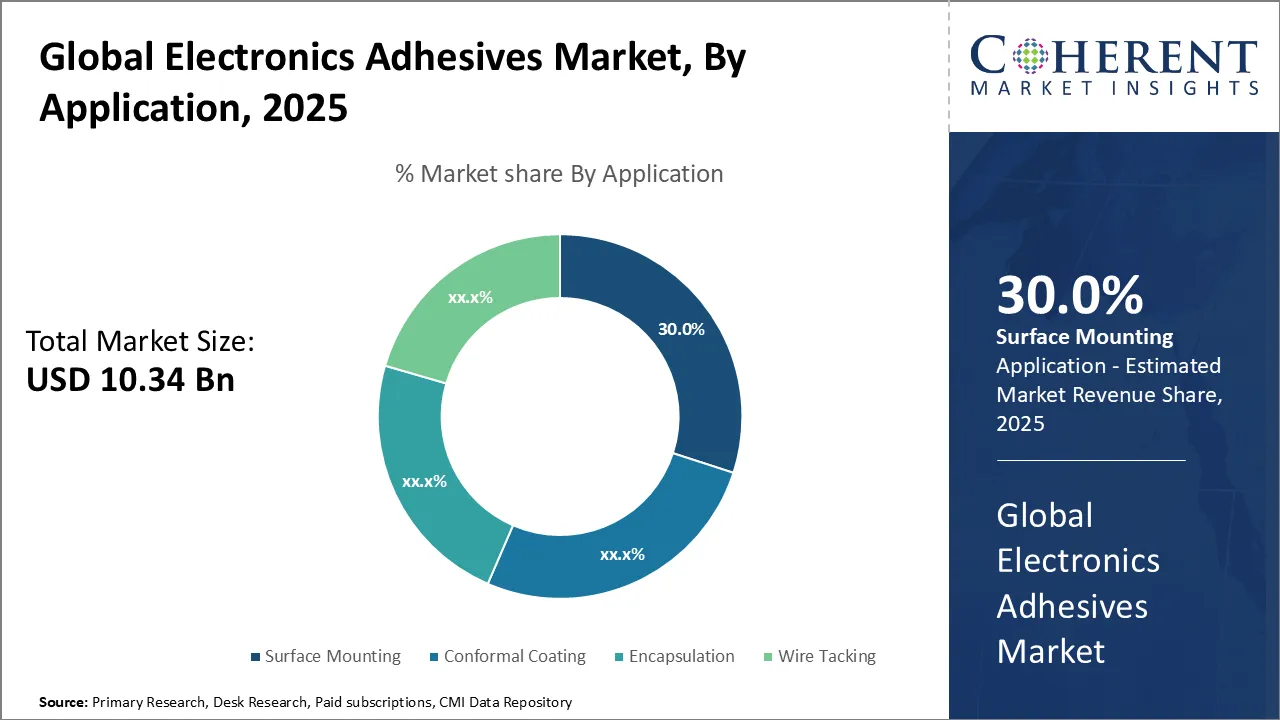
- By Application, the Surface Mounting segment is expected to dominate the global electronics adhesives market by 2026, accounting for 31% of the total revenue.
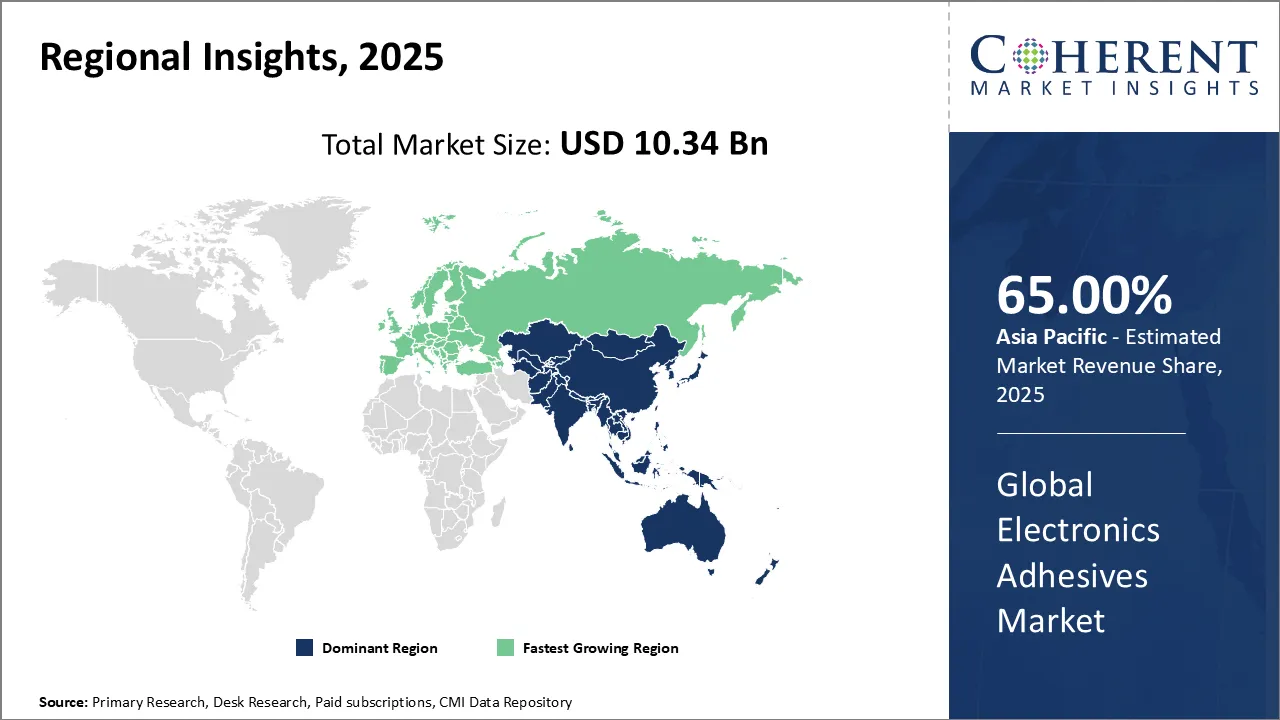
- By Region, Asia Pacific is projected to lead the global electronics adhesives market in 2026, capturing a commanding 65% share of the total market revenue.
Market Overview
The electronics adhesives market is rising rapidly. The growth is due to the growing need for small and easy to carry lightweight electronic devices. Factors fueling growth include the adoption of flexible electronics, advancements in semiconductor technologies, and the need for reliable thermal management and electrical insulation.
For example, a sharp increase in the production of smartphones, especially foldable ones, has widely increased the need for flexible and durable adhesives. Moreover, broadening needs in automotive electronics and IoT devices are additional reasons driving the expansion. The market is expected to grow steadily in the coming years as manufacturers look for high-performance adhesives to increase the longevity and performance of the devices.
Current Events and Its Impact on the Electronics Adhesives Market
Event | Description and Impact |
US-China Trade Relations and Technology Restrictions |
|
Global Semiconductor Shortage and Supply Chain Restructuring |
|
5G Infrastructure Deployment and Advanced Electronics Evolution |
|
Segmental Insights
- Current Industry Events of 2026
- Market Size Estimation
- Regional Breakdown
- Competitive Landscape
- Customer Intelligence
- Segmental Analysis
- Pricing Analysis
- Key Market Drivers, Challenges & Future Trends
- Customized Insights Section
Electronic Adhesives Market Insights, By Application
The Surface Mounting segment is expected to dominate the global electronic adhesives market in 2026, accounting for 31% of the total revenue. This leading position is driven by the widespread use of surface mounting technology in the manufacturing of compact and high-performance electronic devices.
The demand for miniaturized components in consumer electronics, automotive, and telecommunications sectors has accelerated the adoption of surface mounting adhesives, which provide strong bonding and thermal stability.
Meanwhile, the Conformal Coating and Encapsulation segments, which follow surface mounting in market share, are also experiencing steady growth. These applications are critical for protecting electronic components against environmental factors such as moisture, dust, and vibration, ensuring device reliability and longevity.
As electronics continue to advance and find new applications, the demand for conformal coatings and encapsulation materials is expected to rise steadily, complementing the dominant surface mounting segment.
Regional Insights
Asia Pacific Electronic Adhesives Market Analysis and Trends
Asia Pacific is set to dominate the global electronic adhesives market in 2026, capturing a commanding 65.00% share of the total market revenue. The region’s strong leadership position is driven by rapid industrialization, expanding electronics manufacturing hubs, and growing demand from key sectors such as consumer electronics, automotive, and telecommunications. Countries like China, Japan, South Korea, and India are at the forefront, supported by large-scale investments in electronics production and infrastructure development.
The availability of cost-effective raw materials, skilled labor, and government incentives aimed at boosting manufacturing capabilities further fuel the market’s growth in Asia Pacific. Additionally, increasing adoption of advanced electronic adhesives in high-performance applications such as flexible electronics and wearable devices is propelling the region’s market expansion.
Following Asia Pacific, Europe and North America hold smaller yet significant shares of the market. Both regions benefit from advanced technological innovation, stringent quality standards, and strong demand in automotive and aerospace sectors, which support steady growth in electronic adhesives consumption. However, Asia Pacific’s scale and growth momentum firmly establish it as the global leader in this market segment.
Dominating Countries in the Electronic Adhesives Market
China Electronic Adhesives Market Analysis and Trends
China leads the Asia Pacific electronic adhesives market, driven by its vast electronics manufacturing ecosystem and deep-rooted investments in high-tech industries. As the world’s largest producer of consumer electronics and semiconductors, China’s demand for electronic adhesives spans applications from smartphones and wearables to electric vehicles and 5G infrastructure.
Government policies supporting domestic innovation, coupled with the presence of major global OEMs and ODMs, solidify China’s dominance. Additionally, the country’s cost-effective supply chain, abundant raw materials, and rapidly advancing R&D capabilities make it a central hub for electronic adhesive production and consumption.
Japan Electronic Adhesives Market Analysis and Trends
Japan maintains a critical role in the Asia Pacific electronic adhesives market due to its longstanding expertise in precision manufacturing and high-performance materials. The country’s electronics industry—renowned for reliability and innovation—drives strong demand for specialty adhesives used in semiconductors, automotive electronics, and advanced consumer devices.
With continuous investment in R&D, Japanese manufacturers are at the forefront of developing next-generation adhesives with superior thermal conductivity, flexibility, and environmental resistance. Regulatory emphasis on quality and sustainability further enhances Japan’s position as a premium market player.
South Korea Electronic Adhesives Market Analysis and Trends
South Korea’s electronic adhesives sector is bolstered by its global leadership in memory chips, display technologies, and consumer electronics. Major conglomerates like Samsung and LG drive robust domestic demand, particularly in applications requiring miniaturized, high-precision adhesive solutions.
Strategic government support for innovation and supply chain resilience—especially in semiconductor materials—ensures continued market growth. South Korea’s strong focus on advanced packaging technologies and flexible electronics fuels the adoption of high-performance adhesives, solidifying its stature in the Asia Pacific market.
India Electronic Adhesives Market Analysis and Trends
India is emerging as a dynamic growth market for electronic adhesives in Asia Pacific, backed by the government’s “Make in India” initiative and increasing localization of electronics manufacturing. Rising domestic production of smartphones, consumer gadgets, and EV components is driving demand for adhesives tailored to high-speed, high-temperature, and high-reliability applications.
India’s competitive labor costs, expanding industrial parks, and growing ecosystem of contract manufacturers are attracting global players and investments. These factors position India as a rising contributor to regional market momentum and innovation.
Market Report Scope
Electronic Adhesives Market Report Coverage
| Report Coverage | Details | ||
|---|---|---|---|
| Base Year: | 2025 | Market Size in 2026: | USD 11.53 Bn |
| Historical Data for: | 2020 To 2024 | Forecast Period: | 2026 To 2033 |
| Forecast Period 2026 to 2033 CAGR: | 11.5%2033 Value Projection: | USD 24.70 Bn | |
| Geographies covered: |
| ||
| Segments covered: |
| ||
| Companies covered: | Henkel AG & Co. KGaA, H.B. Fuller Company, 3M Company, Evonik Industries AG, Dymax Corporation, and Dow Corning | ||
| Growth Drivers: |
| ||
| Restraints & Challenges: |
| ||
Electronic Adhesives Market Drivers
Electronic Adhesives Market Opportunities
Growing focus of key end user industries to develop compact miniature components for miniaturization of the final product is expected to offer potential growth opportunities to the market of electrical adhesives. Miniaturization of electrical devices such as mobiles and laptops has raised the usage of adhesives in encapsulation and conformal coating types of applications are further projected to augment the market growth of electronic adhesives over the forecast period.
The growing focus of adhesives manufacturers to develop sustainable and eco-friendly products such as halogen-free, solvent-free, lead-free, and low VOC content is expected to stimulate market growth over the forecast period. Moreover, shifting the focus of the manufacturer is trying to limit the usage of polyurethane that are petroleum-based due to strict government rules and regulations is further anticipated to accelerate the market growth of electronic adhesive.
Electronic Adhesives Market Trends
Many manufacturers are following the trend of introducing novel electrical solutions in order to meet the rising demand around the globe is propelling the market growth. For instance, in August 2022, Techsil announced an agreement to supply Canada-based M.G. Chemicals’ popular, high-performance range of adhesives, sealants, coatings, and cleaners to the U.K.’s electronics manufacturing sector. This adhesive is high quality and high-performance ideal solution for the electronics industry. Therefore, innovation in the electrical adhesive is augmenting the market growth over the forecast period.
The rising trend of adopting smart strategies such as mergers and acquisitions among major players in the electrical adhesive market to gain a competitive edge is propelling market growth over the forecast period. For instance, in March 2022, Chemence, Inc., a producer of specialized adhesives, sealants, and resins, acquired the electronics adhesive business and technology of Georgia-based manufacturer Supreme Recourses, Inc.
Analyst Viewpoint
- The market shows strong growth driven by miniaturization of electronic devices and increased complexity in semiconductor packaging.
- Expansion of 5G and IoT technologies is boosting demand for high-performance adhesives capable of enduring harsh operating conditions while maintaining electrical insulation.
- Adoption of electric vehicles and growth in renewable energy sectors are creating new opportunities for adhesives used in batteries, power electronics, and solar panels.
- Environmental regulations targeting VOCs and hazardous substances challenge manufacturers to develop eco-friendly adhesive formulations.
- Supply chain disruptions and volatile raw material prices, especially for specialty chemicals and silicones, impact market stability and profit margins.
- Asia-Pacific leads the market due to China’s large electronics manufacturing base and India’s growing semiconductor capabilities, supported by favorable policies and proximity to end users.
- North America is the fastest-growing region, driven by reshoring efforts and investments in electric vehicle infrastructure.
- Key growth areas include thermally conductive adhesives for advanced chip packaging, flexible adhesives for wearables, and sustainable bio-based adhesives.
- AI and edge computing applications are increasing demand for specialized adhesives in high-frequency electronics and thermal management solutions.
Recent Developments
- In July 2022, Henkelis to invest USD 45 million in its Salisbury facility in Rowan County. The German chemical and consumer goods company will install updated equipment, which will include a new production line for UV acrylic adhesives used in tapes and labels within the packaging and other industries. The 825 Cedar Springs Road facility produces adhesive products that are suitable for various industries such as packaging, electronics, and consumer goods.
- In March 2022, B. Fuller Company, one of the world’s leading adhesives suppliers, showcased several innovations that address growing trends in sustainable consumer goods and e-commerce packaging at PRINTPACK INDIA 2022.
- In August 2022, B. Fuller announced the schedule for the REVEAL of the new GorillaPro Ultimate Service Truck built by Richard Rawlings and Gas Monkey Garage. The REVEAL is the culmination of a six-episode run of Gas Monkey Garage YouTube videos highlighting the step-by-step building of a new promotional vehicle for H.B. Fuller with GorillaPro products.
Market Segmentation
- Global Electronics Adhesives Market, By Material Type (Revenue, USD Bn, 2021 - 2033)
- Silicones
- Polyurethanes
- Epoxies
- Acrylics
- Others
- Global Electronics Adhesives Market, By Product Type (Revenue, USD Bn, 2021 - 2033)
- Electrically Conductive
- Thermally Conductive
- Ultraviolet Curing
- Others
- Global Electronics Adhesives Market, By Application (Revenue, USD Bn, 2021 - 2033)
- Conformal Coating
- Encapsulation
- Surface Mounting
- Wire Tacking
- Global Electronics Adhesives Market, By Region (Revenue, USD Bn, 2021 - 2033)
- North America
- U.S.
- Canada
- Latin America
- Brazil
- Mexico
- Rest of Latin America
- Europe
- Norway
- Nordic
- U.K.
- Italy
- Poland
- Russia
- Ukraine
- Rest of Europe
- Asia Pacific
- China
- India
- Japan
- Rest of Asia Pacific
- Middle East & Africa
- GCC
- Israel
- Africa
- Rest of Middle East & Africa
- Company Profiles
- Henkel AG & Co. KGaA
- H.B. Fuller Company
- 3M Company
- Evonik Industries AG
- Dymax Corporation
- Dow Corning
Sources
Primary Research Interviews
- Electronics adhesive manufacturers and suppliers
- Electronic component manufacturers
- Automotive electronics engineers
- Consumer electronics design engineers
- Others
Databases
- IBISWorld Industry Reports
- Others
Magazines
- Electronic Design Magazine
- Adhesives & Sealants Industry Magazine
- Electronics Manufacturing Magazine
- Circuit Assembly Magazine
- Others
Journals
- International Journal of Adhesion and Adhesives
- IEEE Transactions on Electronics Packaging Manufacturing
- Journal of Electronic Materials
- Others
Newspapers
- Electronics Weekly
- Electronic Engineering Times
- Electronics360 News
- Electronic Products & Technology
- Others
Associations
- Adhesive and Sealant Council (ASC)
- IPC - Association Connecting Electronics Industries
- Electronic Components Industry Association (ECIA)
- International Electronics Manufacturing Initiative (iNEMI)
- Others
Public Domain Sources
- U.S. Patent and Trademark Office (USPTO)
- European Patent Office (EPO)
- Government electronics industry reports
- Trade statistics databases
- Others
Proprietary Elements
- CMI Data Analytics Tool
- Proprietary CMI Existing Repository of information for last 8 years
Get access to 250+ pages report
Every segment, forecast, competitor profile and data table behind the analysis above — available for instant download.
- ESOMAR Member
- ISO 9001:2015 Certified
- D-U-N-S Registered
- GDPR & CCPA Compliant
Missing comfort of reading report in your local language? Find your preferred language:
Transform your Strategy with Exclusive Trending Reports
Frequently Asked Questions
The Electronics Adhesives Market size is estimated to be valued at USD 11.53 Bn in 2026, and is expected to reach USD 24.70 Bn by 2033.
Key players active in the global electronic adhesives market are Henkel AG & Co. KGaA, H.B. Fuller Company, 3M Company, Evonik Industries AG, Dymax Corporation, and Dow Corning.
The high cost associated with the market penetration can hamper the market growth.
Growing IT infrastructure and connected devices are the key factors driving the growth of the market.
The CAGR of the global Market is projected to be 11.5% from 2026 to 2033.
Asia Pacific region held the largest market share in the market.
Outgassing is the release of volatile compounds from adhesives, which can cause contamination, corrosion, or malfunction in sensitive electronic components.