

Europe Needle-free IV Connectors Market Size and Share Analysis - 2026 To 2033
The Europe Needle-free IV connectors market is anticipated to grow at a CAGR of 8.7% with USD 406.1 Mn in 2026 and is expected to reach USD 728.2 Mn in 2033. The rising adoption of infection-control devices (The EU average healthcare spending was 18% on pharmaceuticals and medical devices, while 4% was allocated to preventive healthcare in 2023). Needle-free IV connectors are increasingly used across hospitals, ambulatory surgical centers, and home healthcare settings as they help minimize needlestick injuries, support aseptic drug administration, and improve patient and healthcare worker safety across Europe.
Key Takeaways
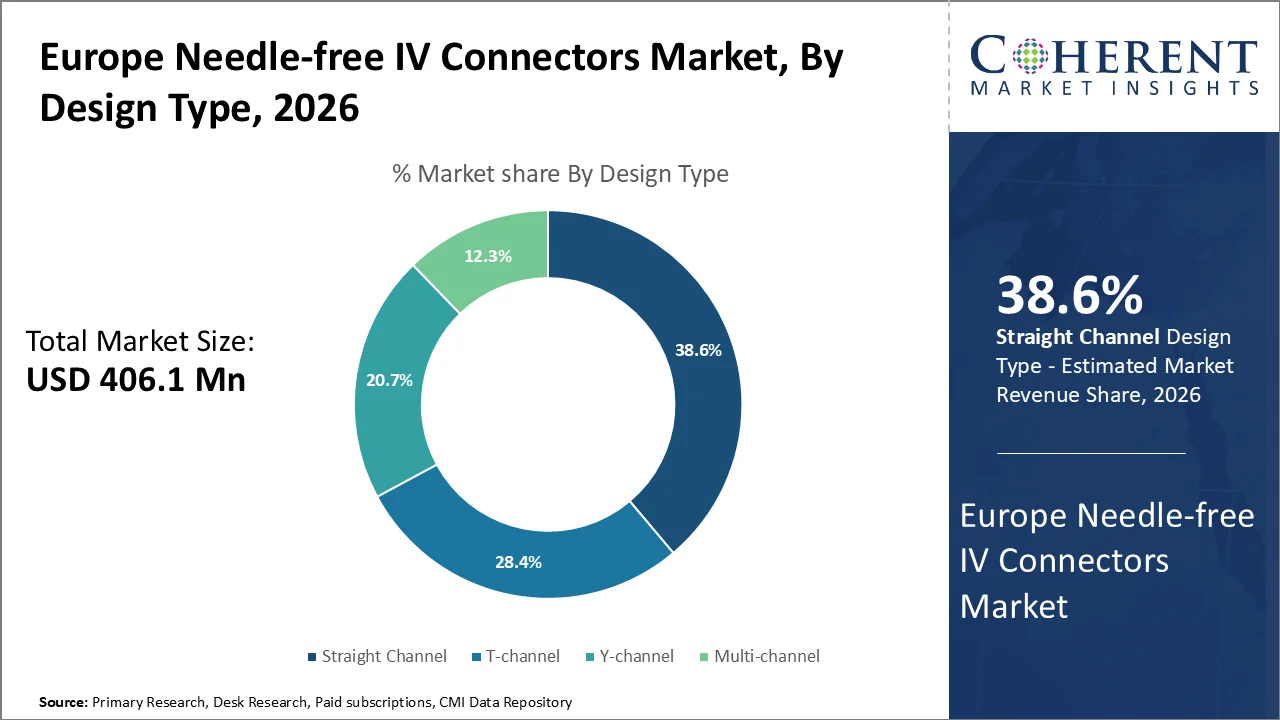
- The straight channel segment is expected to account the largest share of 38.6% in 2026, the growth of the segment is owing to its wide adoption across hospitals, ambulatory surgical centers, and routine infusion therapy settings. The share of tonsil removal surgeries done as same-day (ambulatory) procedures in the UK increased from 47% in 2013 to 77% in 2023.
- The neutral fluid displacement segment will dominate with 46.4% in 2026, needle-free connectors are increasingly used because they help reduce blood reflux, lower the risk of catheter blockage, improve infection control, and support safer intravenous therapy. This is important as an estimated 834,000 healthcare-associated infections occur in the NHS each year.
- The seven day segment will dominate with 65% in 2026, owing to its alignment with standard IV therapy protocols, reduced need for frequent connector replacement, as well as growing use in long-duration hospital and home healthcare infusion care. As of May 2026, 86.1% of care home beds in England were occupied, with around 359,215 people living in care homes.
- Germany is expected to acquire the dominant share of 50% in 2026, attributed to the existence of advanced hospitals, high patient admission, good expenditure in healthcare services, and the prevalence of IV therapy in Germany. There are nearly 216,000 hospitals worldwide in 2026, and German hospitals continue to be recognized for maintaining high quality standards.
Segmental Insights
Why is Straight Channel Acquiring the Largest Market Share?
Straight channel is projected to account for the largest share of design type in 2026, representing approximately 38.6% of the total volume. The growth of the segment is due to its simple connector structure, easy handling during routine IV administration, as well as high usage across inpatient care, day-care procedures, medication delivery, and infusion therapy.
The European Centre for Disease Prevention and Control (ECDC) has consistently highlighted bloodstream infections associated with intravascular devices as a major patient safety challenge, as well as the straight channel design directly addresses this concern by reducing internal dead space where blood or fluid residue may accumulate and subsequently serve as a breeding ground for microbial colonization.
In Germany, infections caused by antibiotic-resistant bacteria in the bloodstream increased between 2015 and 2020. The rate rose from 1.4 to 2.9 cases per 100,000 people, causing an estimated 2,499 deaths during this period.
The reduced internal volume of straight channel connectors translates directly into fewer flush requirements between medication administrations, which not only lowers the risk of catheter occlusion but also reduces the consumption of saline flush solutions an important consideration in resource management across European healthcare institutions operating under nationalized healthcare frameworks such as the UK's National Health Service (NHS) or Germany's statutory health insurance system (Gesetzliche Krankenversicherung).
- Current Industry Events of 2026
- Market Size Estimation
- Regional Breakdown
- Competitive Landscape
- Customer Intelligence
- Segmental Analysis
- Pricing Analysis
- Key Market Drivers, Challenges & Future Trends
- Customized Insights Section
Neutral Fluid Displacement holds the Largest Market Share
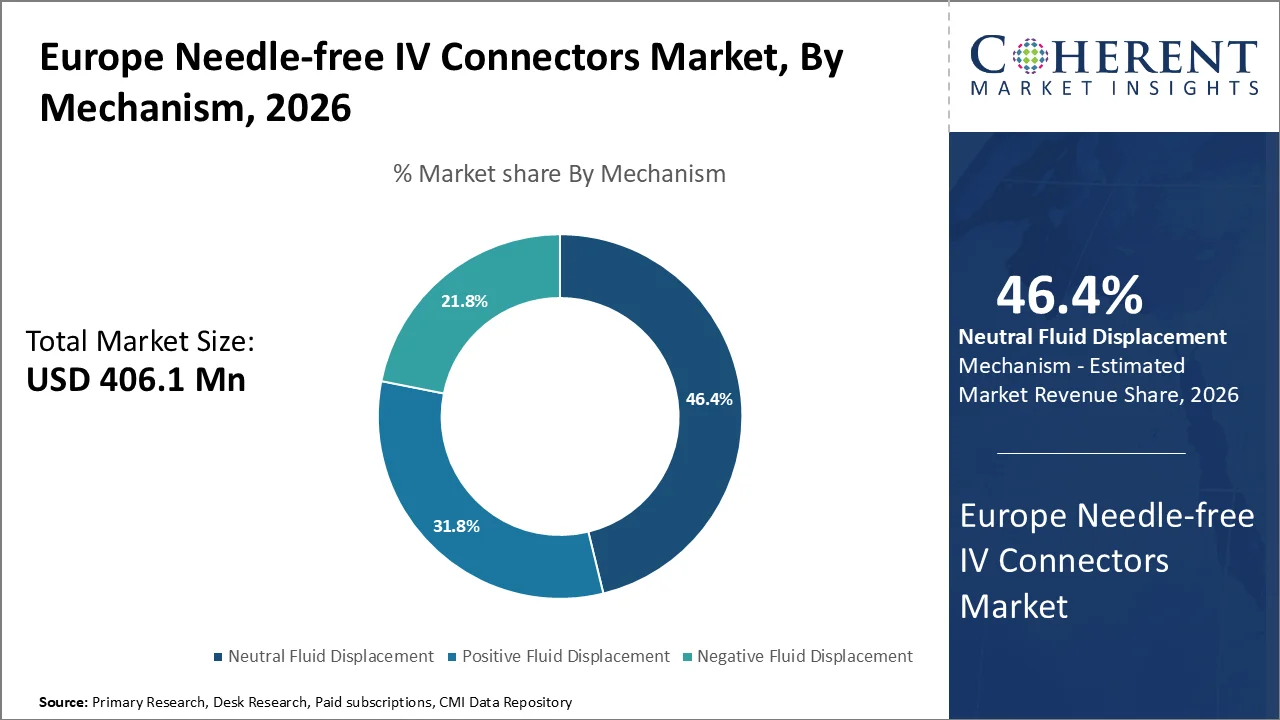
Based on mechanism, neutral fluid displacement dominates the market, accounting for a significant 46.4% share in 2026. The growth of the segment is owing to its ability to reduce fluid displacement, limit blood reflux, support catheter patency, and improve safety during connection and disconnection of IV lines.
Their well-established clinical safety profile, high adoption across intensive care units (ICUs), oncology wards, and long-term care facilities, as well as strong alignment with infection prevention guidelines promoted by leading health organizations across the continent.
Seven Day holds the Largest Market Share
Based on dwell time, seven day dominates the market, accounting for a significant 65% share in 2026, the increase in the segment's market share will be attributed to its conformity to hospital protocols regarding connector change, low replacement rate, ease in nursing process, and suitability for venous access and oncology treatment. In Germany, around 517,800 new cancer cases were diagnosed in 2023. About 276,400 cases were in men and 241,400 cases were in women.
The Gen2Zero needle free connector was introduced by Chi Feng at MEDICA 2024. It has 7-day durability, antireflux neutral design and double closed construction which is beneficial to the 7-day dwell-time segment.
In December 2025, Vygon Belgium highlighted its Bionector needle-free connector, which supports 7 days or 360 connections and offers a straight fluid pathway with neutral fluid displacement.
Split-Septum Technology is transforming the Europe Needle-free IV Connectors Industry
Split-septum connectors are needle-free IV connectors that use a soft silicone or rubber membrane. When a syringe or blunt cannula is connected, the membrane opens to allow fluid flow. When disconnected, it closes automatically to help prevent blood backflow as well as contamination. These connectors are built to support safer IV therapy and reduce infection risks.
These connectors usually require 1–3 Newtons of activation force, can support around 500–2,000 uses, as well as have a low internal fluid space of 0.05–0.3 mL. They are widely used in hospitals in Europe, including products from companies such as B. Braun and Vygon. Their adoption helps reduce needle-stick injuries, lower infection risks, improve catheter safety, and reduce the need for frequent line changes.
Market Drivers
Mechanical Valve Technology (Positive, Negative, and Neutral Displacement): A major breakthrough in Europe Needle-free IV Connectors
Mechanical valve connectors use internal parts like springs, pistons, or disks to control fluid movement during IV therapy. There are three types: positive displacement pushes fluid forward to prevent blood backflow, negative displacement allows backward movement that may increase blockage risk, and neutral displacement allows very little fluid movement.
Positive displacement valves are widely used because they help keep catheters open and reduce reflux after syringe removal. Products such as BD MaxPlus Clear use positive displacement technology to push fluid into the catheter tip and help reduce occlusions and catheter-related bloodstream infection risks when used with proper care practices. These connectors are used in hospitals across Europe to improve IV safety and infection control.
Current Events and Their Impact on the Europe Needle-free IV Connectors Market
Current Event | Description and its Impact |
WHO Releases New Central Venous Catheter Infection-prevention Guidelines (May 2026) |
|
NHS England Expands OPAT Service Guidance for Outpatient IV Therapy (April 2025) |
|
Europe Needle-free IV Connectors Market Trends
- European Union health authorities, alongside national regulatory agencies such as the UK's NICE (National Institute for Health and Care Excellence), Germany's AWMF (Association of the Scientific Medical Societies), and France's HAS (Haute Autorité de Santé), have intensified guidelines around catheter-related bloodstream infection (CRBSI) prevention.
- A marked industry convergence between needle-free IV connectors and closed system drug transfer device (CSTD) technologies is reshaping procurement strategies across European hospitals and oncology centers.
- The increasing standardization of needle-free connection systems has been seen to be emerging as an important trend in Europe, as hospitals are increasingly procuring IV access devices, extension sets, and related consumables under a framework-based approach. The NHS Supply Chain introduced a new framework of Needlefree Connection Systems and Associated Products in January 2026 for a period of 24 months, involving 16 suppliers with 5 new suppliers, and 277 new products have been included.
- The growing need for more secure training in vascular access has been aiding the use of standard IV access products, which include needle free connectors. In May 2025, CÚRAM of University of Galway in collaboration with B. Braun started SIMETRIC vascular access research project through simulation, imaging, eye tracking, high-definition video, and motion capture technology to enhance IV catheter insertion and long peripheral catheter insertion techniques.
- The rising trend towards administration of IV antibiotics at home is driving the need for needle-free connectors which are easy to handle and fit decentralization requirements. In October 2025, the University of East Anglia noted that administering patients at home with IV antibiotics would cost the National Health Service half and ease pressure on hospital beds.
Regional Insights
Germany Dominates Owing to Large Inpatient Treatment Base and Highest Healthcare Spending
Germany account 50% market share in 2026, attributed to the existence of advanced hospitals, high patient admission, good expenditure in healthcare services, and the prevalence of IV therapy in Germany. Germany spends a high amount on healthcare per person compared with many countries. Its healthcare system provides almost full insurance coverage, with 99.9% of people covered by public insurance and 27.9% having private insurance coverage.
Germany contributes the highest share in the market in Europe owing to its exceptionally robust healthcare infrastructure, well-established hospital networks, and stringent infection prevention protocols that collectively drive the widespread adoption of needle-free IV connectors across the country. Germany operates one of the most advanced healthcare systems globally, with approximately 1,893 hospitals and over 497,000 hospital beds as reported by the German Hospital Federation (Deutsche Krankenhausgesellschaft), creating an enormous demand base for advanced intravenous access technologies.
Who are the Major Companies in Europe Needle-free IV Connectors Industry
Some of the major key players in Europe Needle-free IV Connectors market include, Cardinal Health, Inc, Amsino International, Inc, ICU Medical, Inc, Vygon S.A, Baxter International Inc, Becton, Dickinson and Company, B. Braun Melsungen AG, NP Medical Inc, Poly Medicure Limited, CODAN Medizinische Geräte GmbH & Co KG, and Integrity Devices Ltd.
Key News
- In April 2026, PuraCath Medical received FDA clearance for its needleless IV connector used in vascular access. The device helps healthcare workers give medicines and fluids through IV lines while supporting safer treatment and reducing infection risks.
- In December 2025, BD launched the BD Nexiva Closed IV Catheter System in Jakarta on 16 December 2025. The launch took place during a national webinar on vascular access management, attended by around 1,100 healthcare professionals through in-person, satellite, and online sessions.
Market Report Scope
Europe Needle-free IV Connectors Market Report Coverage
| Report Coverage | Details | ||
|---|---|---|---|
| Base Year: | 2025 | Market Size in 2026: | USD 406.1 Mn |
| Historical Data for: | 2020 To 2024 | Forecast Period: | 2026 To 2033 |
| Forecast Period 2026 to 2033 CAGR: | 8.7% | 2033 Value Projection: | USD 728.2 Mn |
| Geographies covered: |
| ||
| Segments covered: |
| ||
| Companies covered: | Cardinal Health, Inc, Amsino International, Inc, ICU Medical, Inc, Vygon S.A, Baxter International Inc, Becton, Dickinson and Company, B. Braun Melsungen AG, NP Medical Inc, Poly Medicure Limited, CODAN Medizinische Geräte GmbH & Co KG, and Integrity Devices Ltd. | ||
| Growth Drivers: |
| ||
| Restraints & Challenges: |
| ||
Analyst Opinion
- The Europe Needle-free IV Connectors Market is expected to grow steadily as hospitals prioritize catheter-related infection prevention and safer vascular access practices. According to ECDC's report in February 2026, 4% of ICU patients who stayed at the hospital for more than two days had bloodstream infections, whereas 43 percent of those bloodstream infections cases were associated with the use of catheters.
- The market potential is greatly bolstered by the updated guidelines on infection control. The WHO issued 2026 guidelines for preventing bloodstream infection and other infections related to central venous catheters in various health care facilities, which mention that infections due to catheter raise morbidity, mortality, stay in hospitals, and health care costs.
- Seven-day and closed-system connector designs are likely to remain attractive for hospitals seeking workflow efficiency and reduced manipulation of IV lines. Vygon describes Bionector as a multi-purpose closed needle-free connection device that allows infusion, injection, sampling, and IV tubing changes without opening the IV circuit to the atmosphere, supporting adoption in routine hospital infusion workflows.
Speak to the analyst
Want personalized insights?
Take the findings above to one of our principal consultants, or have the report rebuilt around the segments, geographies and competitors you actually track.
Market Segmentation
- By Design Type (Revenue, USD Mn, 2021-2033)
- Straight Channel
- T-channel
- Y-channel
- Multi-channel
- By Mechanism (Revenue, USD Mn, 2021-2033)
- Positive Fluid Displacement
- Negative Fluid Displacement
- Neutral Fluid Displacement
- By Dwell Time (Revenue, USD Mn, 2021-2033)
- Seven Day
- Other than Seven Day
- By Region
- Europe
- Germany
- U.K.
- France
- Italy
- Spain
- Russia
- Rest of Europe
- Europe
Sources
Primary Research Interviews
- Needle-free IV connector manufacturers
- IV access device and infusion therapy product suppliers
- Hospital procurement managers and tendering specialists
- Infection prevention and control specialists
- Intensive care unit and oncology nursing professionals
- Vascular access specialists and clinical educators
- Ambulatory surgical center and outpatient infusion managers
- Home healthcare and OPAT service providers
- Distributors of infusion therapy and vascular access consumables
- Key opinion leaders in catheter-related infection prevention
Databases
- Eurostat
- European Centre for Disease Prevention and Control (ECDC)
- World Health Organization (WHO)
- European Commission Public Health Database
- NHS England
- NHS Supply Chain
- European Medicines Agency (EMA)
- U.S. Food and Drug Administration (FDA)
- Centers for Disease Control and Prevention (CDC)
- Organisation for Economic Co-operation and Development (OECD)
Magazines
- Medical Device Network
- MedTech Dive
- MassDevice
- Healthcare Purchasing News
- European Medical Journal
- Hospital Healthcare Europe
- Medical Plastics News
Journals
- Journal of Hospital Infection
- Journal of Vascular Access
- Infection Control & Hospital Epidemiology
- Antimicrobial Resistance & Infection Control
- BMC Infectious Diseases
- Clinical Microbiology and Infection
- American Journal of Infection Control
- British Journal of Nursing
Newspapers
- Financial Times
- The Guardian
- Reuters
- Bloomberg
- The Economic Time
- Healthcare Europa
- European Pharmaceutical Review
Associations
- European Vascular Access Network (EVAN)
- Infusion Nurses Society (INS)
- Association for Professionals in Infection Control and Epidemiology (APIC)
- European Society of Clinical Microbiology and Infectious Diseases (ESCMID)
- European Hospital and Healthcare Federation (HOPE)
- Association of British HealthTech Industries (ABHI)
- MedTech Europe
Public Domain Sources
- Company Annual Reports and Investor Presentations
- Company Product Catalogues and Technical Brochures
- FDA 510(k) and De Novo Clearance Documents
- EU MDR and Medical Device Regulatory Publications
- NHS Procurement Frameworks and Tender Documents
- Hospital Infection Prevention Guidelines
- Central Venous Access Device Guidelines
- WHO and ECDC Healthcare-associated Infection Reports
- Publicly Available Clinical Performance Studies
- Product Launch Announcements and Press Releases
Proprietary Elements
- CMI Data Analytics Tool
- Proprietary CMI Existing Repository of information for last 10 years
Get access to 250+ pages report
Every segment, forecast, competitor profile and data table behind the analysis above — available for instant download.
- ESOMAR Member
- ISO 9001:2015 Certified
- D-U-N-S Registered
- GDPR & CCPA Compliant
Missing comfort of reading report in your local language? Find your preferred language:
Transform your Strategy with Exclusive Trending Reports
Frequently Asked Questions
The Europe needle-free IV connectors market is expected to reach USD 728.2 Mn in 2033.
Major players operating in the Europe needle-free IV connectors market include Cardinal Health, Inc, Amsino International, Inc, ICU Medical, Inc, Vygon S.A, Baxter International Inc, Becton, Dickinson and Company, B. Braun Melsungen AG, NP Medical Inc, Poly Medicure Limited, CODAN Medizinische Geräte GmbH & Co KG, and Integrity Devices Ltd.
High product and procurement cost, risk of connector contamination due to improper handling, staff training requirements, and pricing pressure in hospital procurement is expected to restrain the Europe needle-free IV connectors market growth over the forecast period.
Rising adoption of infection-control devices, increasing demand for safer intravenous access systems, growing use of closed IV connector technologies, higher hospitalization rates, and rising need to reduce catheter-related bloodstream infections are driving growth of the Europe needle-free IV connectors market.
The Europe needle-free IV connectors market is anticipated to grow at a CAGR of 8.7% between 2026 and 2033.
Among regions, Germany is expected to account for a largest market share in the Europe needle-free IV connectors market over the forecast period.
A healthcare organisation uses one type of needleless connector (negative, positive, neutral or anti-reflux) that requires the same clamp-disconnection technique, ensure all personnel involved with CVAD and PIVC management are educated and is detailed in organisational policy (4,9).