Flexible Electronics Market Analysis & Forecast: 2025-2032

The global flexible electronics market is estimated to be valued at USD 38.53 Bn in 2025 and is expected to reach USD 85.18 Bn in 2032, exhibiting a compound annual growth rate (CAGR) of 12% from 2025 to 2032.
The global flexible electronics market is expected to grow significantly during the forecast period due to technological advancements and rising consumer demand for compact electronic devices. Additionally, the use of flexible display technologies in wearable’s is propelling the growth of this market. In addition, the development of stretchable and foldable electronic components offers significant opportunities for manufacturers to develop innovative products in the market.
|
Current Events |
Description and its impact |
|
U.S.-China Technology Trade Tensions and Export Controls |
|
|
European Union's Green Deal and Circular Economy Initiatives |
|
Uncover macros and micros vetted on 75+ parameters: Get instant access to report
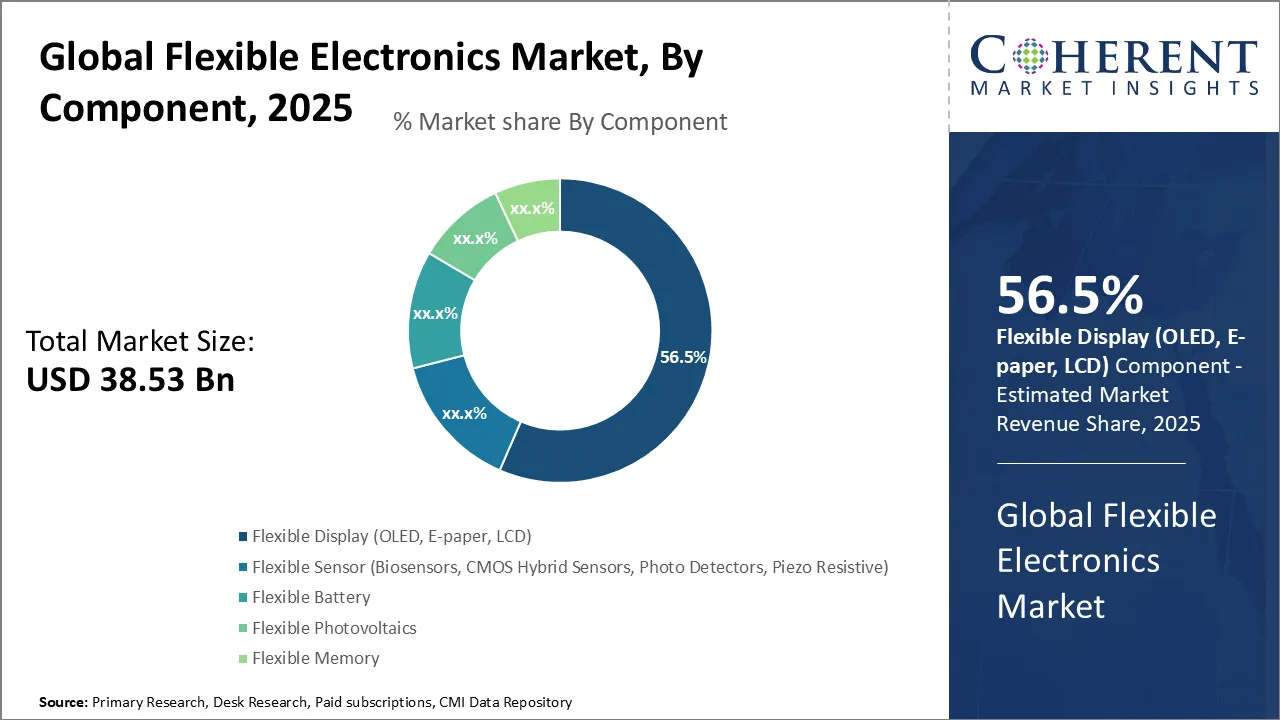
In terms of component, the flexible display segment contributes 56.5% of the market share in 2025, driven by growing adoption in foldable smartphones, tablets, and wearable devices. Flexible displays are dominated by OLED technology due to its superior flexibility, brightness, and energy efficiency. Other flexible displays provide light, easy-to-handle, and adaptable platforms for manufacturers to design foldable, rollable, and wearable electronics without sacrificing durability or performance.
Applications ranging from consumer electronics to medical monitoring devices effectively utilize flexible displays. Because of higher resolution, low power consumption, and an improved user experience that OLED panels offer, they are preferred over traditional LCD and e-paper displays. The flexibility of the displays will keep allowing device designers the license to explore new form factors with innovative product designs.
For instance, in September 2025, Samsung unveiled the Galaxy FlexTab, a foldable tablet featuring a flexible OLED display capable of 360-degree folding. This innovation demonstrates the convergence of portability, interactivity, and user convenience, marking a major step forward in flexible electronics.
In terms of application, the consumer electronics segment contributes 67% of the market share in 2025, driven by increasing demand for foldable smartphones, wearables, and other flexible consumer devices. Consumer electronics leverage flexible displays, sensors, and batteries to offer new experiences and enhanced functionality.
Foldable smartphones and tablets enable users to expand the screen for productivity activities while retaining compact portability, while flexible sensors, OLED displays, and stretchable batteries are integrated into wearable devices for health monitoring, fitness tracking, and interactive experiences. As a matter of fact, these devices address emerging consumer preferences for more multi-functionality, personalization, and comfort.
The adoption of flexible electronics in consumer electronics has accelerated with growth in the use of e-commerce, connected devices, and lifestyle-focused innovations. Manufacturers are focusing on energy efficiency, durability, and seamless integration with software ecosystems to enhance device utility and user engagement.
For instance, in July 2025, Vivo X-Fold 5, launched foldable smartphone from Vivo features a flexible display and represents the brand’s push into foldable/flexible‑screen consumer devices.
To learn more about this report, Download Free Sample
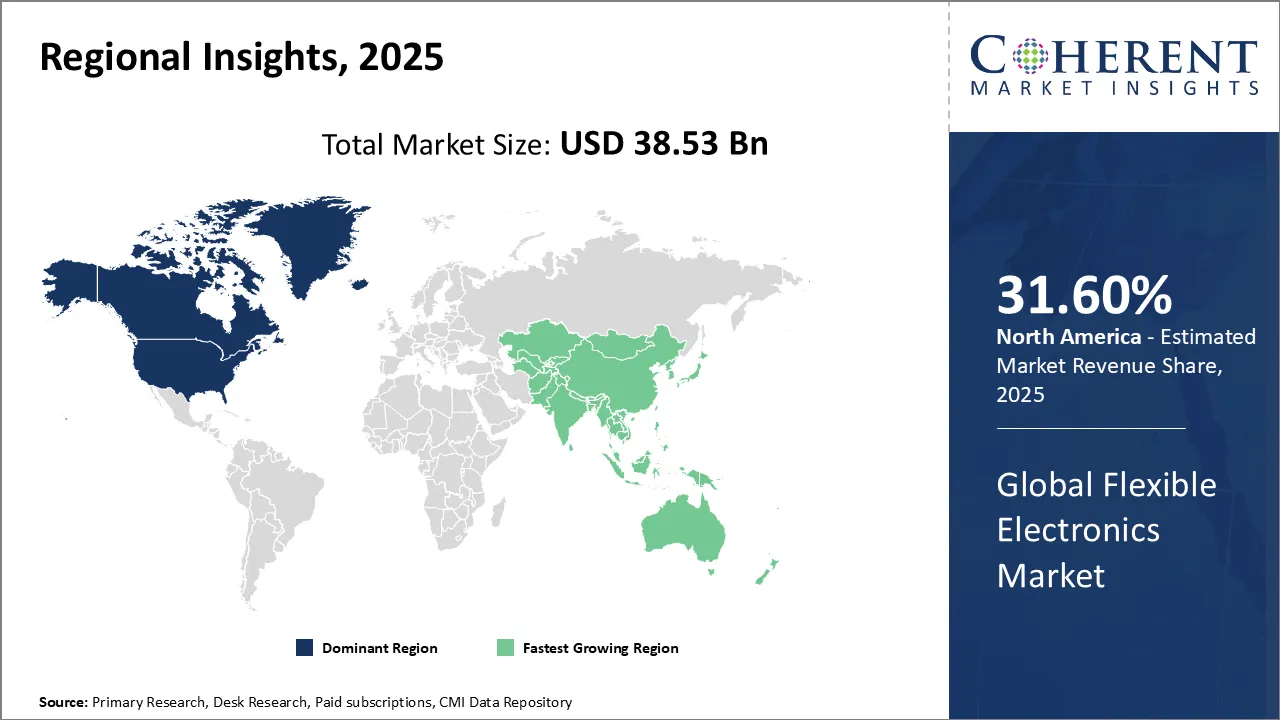
North America is set to lead the global flexible electronics market with 31.6% share in 2025, driven by strong demand from consumer electronics, healthcare devices, and automotive applications. The U.S. has a significant presence in flexible electronics owing to well-established R&D facilities, advanced manufacturing capabilities, and early adoption of cutting-edge technologies such as flexible OLED displays, sensors, and wearable devices. The growing consumer interest in foldable smartphones, wearable health monitors, and electronic textiles accelerated the adoption of flexible components across the region. North America remains an investment hotspot for next-generation flexible electronics start-ups, driving innovation and commercialization forward.
For instance, in October 2025, Corning Inc. introduced a new ultra-thin flexible glass substrate for foldable smartphones and wearable devices, enhancing durability while maintaining flexibility. This innovation supports the development of advanced consumer and healthcare devices, reinforcing North America’s leadership in flexible electronics.
By 2025, the Asia Pacific will see the highest growth rate for flexible electronics due to rapid industrialization; an increase in disposable incomes; and an increase in demand for consumer electronics in developing nations such as China, Japan, South Korea, and India. Increased adoption has been seen for flexible smartphones, wearable devices, and display panels amongst the growing middle-class population. Major manufacturers in the region continue to develop production capabilities associated with flexible batteries, sensors, and displays to handle regional and global demand.
For instance, in September 2025, BOE Technology Group launched a large-scale flexible AMOLED display production line in China, enabling mass production of foldable smartphones and tablets. This development highlights Asia Pacific’s rapid technological adoption and investment in flexible electronics, supporting its position as the fastest-growing regional market.
The US flexible electronics market is growing steadily, driven by demand for flexible displays, printed circuits, and flexible components across consumer electronics, automotive, healthcare, and industrial sectors. Innovation in wearable devices, foldable smartphones, and flexible sensors boosts further adoption. Strong R&D capabilities, established manufacturing infrastructure, and early adoption of advanced technologies contribute to market expansion in the country.
For instance, in August 2025, researchers in the U.S. announced a new flexible, environmentally friendly electronic “plastic” (polymer) for wearable‑tech sensors and flexible electronics, offering potential for lighter, flexible, and more sustainable wearables and flexible devices.
China is emerging as one of the fastest-growing markets for flexible electronics, fueled by strong manufacturing capabilities, integrated supply chains, and strategic investments in next-generation display and flexible device production. The market is witnessing significant adoption of wearable devices, and flexible display panels, supported by both consumer demand and government policies promoting technology innovation. Local manufacturers also continue to build production capacity in flexible displays, printed circuits, and sensors to serve both domestic and global markets.
For instance, in May 2025, BOE announced the early start of equipment installation for a new 8.6‑Gen flexible AMOLED production line at its Chengdu facility.
| Report Coverage | Details | ||
|---|---|---|---|
| Base Year: | 2024 | Market Size in 2025: | USD 38.53 Bn |
| Historical Data for: | 2020 To 2024 | Forecast Period: | 2025 To 2032 |
| Forecast Period 2025 to 2032 CAGR: | 12% | 2032 Value Projection: | USD 85.18 Bn |
| Geographies covered: |
|
||
| Segments covered: |
|
||
| Companies covered: |
Au Optronics Corp., Blue Spark Technologies, Cymbet Corporation, E Ink Holdings Inc., Enfucell Softbattery, Imprint Energy Inc., LG Electronics, and Palo Alto Research Center Incorporated |
||
| Growth Drivers: |
|
||
| Restraints & Challenges: |
|
||
Uncover macros and micros vetted on 75+ parameters: Get instant access to report
Due to the increase in adoption of IoT, factors such as technical, economic, and social stature of all the things as well as application dynamics are majorly being influenced in current times. There are various components of IoT, including implementation of technologies, use of sensors, and compatible power sources to run the new applications. With the rise in need for sensors for operating IoT-connected devices and the source to provide power supply, the demand for flexible electronics is increasing. Thus, this factor is expected to aid in growth of the global flexible electronics market over the forecast period.
Several governments around the world are focused on investments and initiatives in flexible electronics for establishing a connected world for harnessing the complete potential of applications such as safety & security, mobile health, wearable technology, and transportation among others. For instance, the U.S. Department of Defense (DoD) in 2017 made an investment of US$75 million in a public-private partnership for development of flexible electronics. Such initiatives from governments around the world are anticipated to boost growth of the global flexible electronics market over the forecast period.
Increasing growth of printed electronics to generate lucrative opportunities in the global flexible electronics market over the forecast period. The printing technology can be utilized for separately producing components of printed electronics; however, to harness the full potential of these printed electronic components they have to be integrated with other printed devices. For instance the production of printed flexible batteries in different applications including RFID. The applications associated with flexible electronics are significantly increasing, and this in turn is expected to create growth opportunities in the market.
Constant technological advancements to bring growth opportunities to the global flexible electronics market over the forecast period. Several companies are making heavy investments in research and development activities for the development of their products. For instance, in 2020, Apple Inc. received a patent for a foldable device with a hinge mechanism, which uses movable flaps that can help in preventing the display from being damaged or creased when folded.
The flexible electronics market is undergoing a structural shift driven by technological integration and supply-chain consolidation. Increased adoption of flexible OLED displays, stretchable sensors, and thin-film substrates is transforming device designs from rigid to conformable, ergonomic form factors. Take, for instance, the prototype of a 12-inch stretchable display from LG Display, which exhibits how flexibility, color fidelity, and durability can successfully coexist, signaling a move toward truly bendable, wearable, and foldable consumer and industrial electronics.
Joint ventures, OTFT materials, and large-scale flexible display production are being invested in by leading firms like AUO Display Plus, E Ink Holdings, and FlexEnable, creating a pull-effect up and down the supply chain. A large amount of market share is now dominated by flexible displays and components, which suggests that mastering end-to-end integration and efficiency in manufacturing is an urgent need for companies. Enterprises that focus on the vertical integration of flexible substrates, sensors, displays, and flexible batteries will more than likely win long-term advantage, while those firms that rely on innovation at the device level will continue falling behind.
Apart from this, demonstrating performance and reliability at scale will be the determining factors in commercial success for flexible electronics. Those companies integrating the development of advanced materials, supply-chain mastery, and multi-application product pipelines will cement stronger brand partnerships, enable next-generation device form factors, and define the next competitive frontier of the global flexible electronics market.
*Definition: Flexible electronics are designed to bend or conform to a variety of non-traditional substrates. These include plastics, paper, metal foil and flex glass. This means they can fit into places that traditional circuit boards simply cannot. These devices can be made much thinner, lighter and more durable. Many of them also offer new ways to interact with the products we use.
Share
Share
About Author
As an accomplished Senior Consultant with 7+ years of experience, Pooja Tayade has a proven track record in devising and implementing data and strategy consulting across various industries. She specializes in market research, competitive analysis, primary insights, and market estimation. She excels in strategic advisory, delivering data-driven insights to help clients navigate market complexities, optimize entry strategies, and achieve sustainable growth.
Missing comfort of reading report in your local language? Find your preferred language :
Transform your Strategy with Exclusive Trending Reports :
Frequently Asked Questions
Joining thousands of companies around the world committed to making the Excellent Business Solutions.
View All Our Clients
 Schedule a meeting with report Author