
Global Preservatives Market Analysis & Forecast: 2026-2033

Global Preservatives Market Size and Forecast – 2026 – 2033
The Global Preservatives Market size is estimated to be valued at USD 7.8 billion in 2026 and is expected to reach USD 12.1 billion by 2033, exhibiting a compound annual growth rate (CAGR) of 6.8% from 2026 to 2033.
Global Global Preservatives Market Overview
The global preservatives market products include chemical, natural, and bio-based solutions used to extend shelf life, maintain quality, and prevent microbial growth across food and beverages, pharmaceuticals, cosmetics, and industrial applications. Common chemical preservatives include benzoates, sorbates, nitrates, and sulfites, valued for effectiveness and cost efficiency. Natural preservatives such as salt, sugar, vinegar, rosemary extract, and cultured dextrose are gaining popularity due to clean-label trends. Bio-based and fermentation-derived preservatives are emerging for sustainable formulations. Products are offered in powder, liquid, and blended formats, enabling manufacturers to meet regulatory requirements, safety standards, and diverse application needs globally across multiple end-use sectors.
Key Takeaways
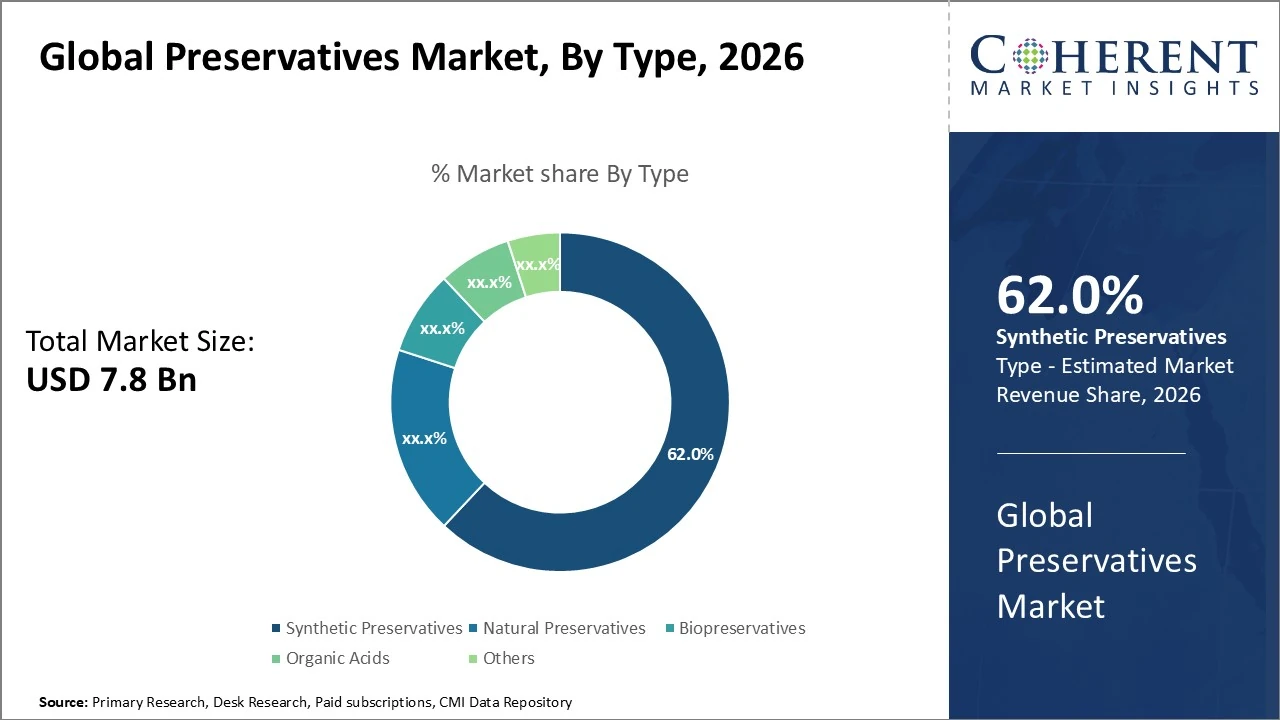
The synthetic preservatives segment commands a dominant position, accounting for over half the market share, driven by cost-effectiveness and broad-spectrum antimicrobial activity, while natural preservatives represent the fastest-growing sub-segment due to rising consumer preference for clean-label ingredients.
Among application segments, Food & Beverage leads in market revenue because of increasing demand for shelf life extension, whereas Pharmaceuticals exhibit the highest growth rate, supported by expanding biopharmaceutical pipelines that require effective preservation systems.
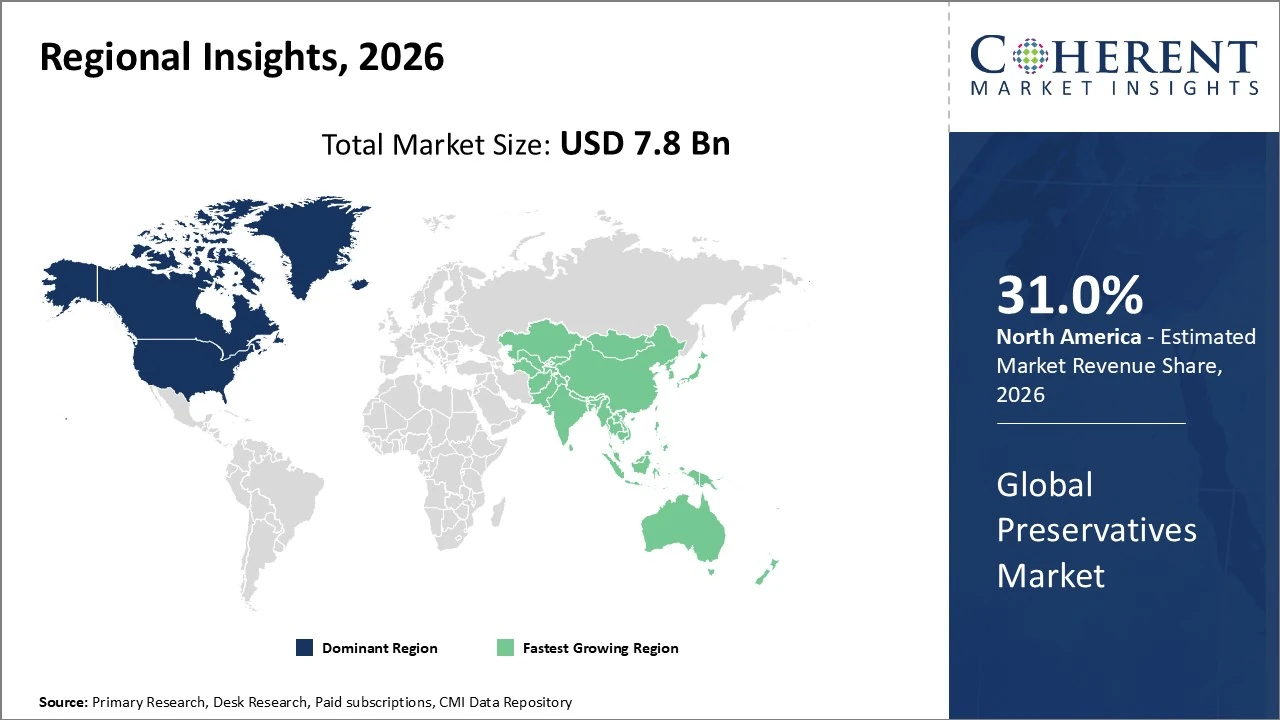
North America holds a dominant industry share of approximately 31%, supported by advanced healthcare infrastructure and strict regulatory standards that encourage preservative innovation, while Asia Pacific is the fastest-growing region with a CAGR exceeding 8%, driven by rapid growth in processed food production and cosmetics markets in China and India.
Europe’s strong regulatory emphasis on preservative safety and sustainability is shaping market dynamics, accelerating the adoption of natural and biopreservatives and supporting a regional transition toward greener preservative solutions.
Global Preservatives Market Segmentation Analysis
To learn more about this report, Download Free Sample
Global Preservatives Market Insights, By Type
Synthetic preservatives dominate market share due to cost efficiency, broad antimicrobial activity, and high stability, making them essential across food and industrial applications. Widely used options such as parabens and sorbates maintain strong adoption because of established supply chains and long-standing regulatory acceptance. In contrast, natural preservatives are the fastest-growing subsegment, driven by clean-label demand and regulations promoting natural ingredients. These include botanical extracts, essential oils, and fermentation-derived compounds. Biopreservatives show rising potential through sustainable innovations like bacteriocins and enzymes. Organic acids remain widely used for antifungal and antibacterial protection, while other emerging chemistries address specialized niche preservation needs globally.
Global Preservatives Market Insights, By Application
Food & Beverage dominates market share due to rising demand for shelf life extension and safety in packaged foods. Preservatives used range from synthetic antimicrobials to natural alternatives, supporting diverse food matrices and formulations. Growth is reinforced by increasing consumption of processed and ready-to-eat foods, particularly in urban areas driven by convenience trends. Pharmaceuticals represent the fastest-growing application segment, fueled by complex biologics requiring specialized preservatives to ensure stability and microbial protection. Expanding use of injectables, vaccines, and topical drugs accelerates demand. Cosmetics & Personal Care benefits from safety regulations and clean-label trends, while industrial applications focus on material protection across paints, adhesives, and lubricants.
Global Preservatives Market Insights, By Form Type
Liquid preservatives dominate market share due to easy incorporation, uniform distribution, and broad compatibility across food, pharmaceutical, and cosmetic formulations where consistency and regulatory compliance are critical. Their rapid efficacy makes them a preferred choice for large-scale manufacturing. Powder forms represent the fastest-growing subsegment, driven by superior storage stability, precise dosing, and suitability for dry food and industrial applications. In pharmaceuticals, powders are increasingly favored for extended shelf life and formulation flexibility. Pellet preservatives serve niche needs requiring controlled release and long-term protection, particularly in specialized industrial uses. Overall, form-based market dynamics reflect demand for performance efficiency, adaptability, and compliance-driven innovation.
Global Preservatives Market Trends
The preservatives market is increasingly shifting toward eco-conscious and health-compatible solutions, marked by rising adoption of natural and biopreservatives and declining reliance on traditional synthetic variants.
Between 2024 and 2026, consumer products containing natural preservatives recorded a 15% compounded global increase, signaling a strong and accelerating market transition.
Growing demand for multi-functional preservative technologies is improving formulation efficiency while reducing overall additive load, aligning with both regulatory expectations and consumer preferences.
Circular economy principles are boosting interest in biodegradable preservatives that lower environmental impact, fostering the emergence of new market segments and reshaping competitive dynamics across the industry.
Global Preservatives Market Insights, By Geography
To learn more about this report, Download Free Sample
North America Global Preservatives Market Analysis and Trends
In North America, the preservatives market maintains a dominant position with an estimated 31.0% share, supported by a mature industrial ecosystem and stringent regulatory frameworks, including the FDA’s rigorous preservation and safety standards. Strong institutional backing for research and development encourages continuous innovation in preservative formulations. The region benefits from the presence of leading market players and well-established end-use industries such as pharmaceuticals, processed foods, and personal care products, which generate consistent demand. Additionally, rising consumption of packaged foods and advanced drug formulations sustains market revenue growth. Companies in North America proactively adapt to evolving regulations, influencing global preservative technologies and best practices.
Asia Pacific Global Preservatives Market Analysis and Trends
Asia Pacific represents the fastest-growing preservatives market, registering a CAGR exceeding 8%, driven by rapid urbanization, expanding processed food industries, and rising demand for cosmetics and personal care products. Major economies such as China and India are witnessing accelerated industrial growth, supported by government initiatives focused on food safety regulations and pharmaceutical manufacturing expansion. Increasing disposable incomes and changing consumer lifestyles further stimulate demand for packaged and convenience foods. Additionally, heightened consumer awareness regarding health and product safety is encouraging the adoption of natural and multifunctional preservatives. The region’s flexible regulatory environment and cost-efficient manufacturing base enable companies to innovate, scale production, and capture emerging opportunities across diverse end-use industries.
Global Preservatives Market Outlook for Key Countries
USA Global Preservatives Market Analysis and Trends
The USA’s preservatives market is strongly shaped by advanced healthcare infrastructure and robust food safety regulations. Oversight by the FDA ensures strict standards for preservative safety and efficacy, encouraging continuous innovation and supporting market expansion. The pharmaceutical industry is a major demand driver, with high-grade preservatives essential for drug stability and safety; antimicrobial preservatives used in injectable formulations recorded an estimated 20% annual growth rate in 2025. Additionally, ongoing innovation in processed foods and stringent labeling transparency requirements are accelerating adoption of natural preservative technologies. Together, these factors reinforce the USA’s significant contribution to global market size, revenue generation, and technological leadership.
Germany Global Preservatives Market Analysis and Trends
Germany’s preservatives market is shaped by strict regulatory frameworks emphasizing safety, sustainability, and consumer protection, driving adoption of natural and biopreservatives. The country’s strong food processing, pharmaceutical, and cosmetics industries create consistent demand for effective preservation solutions. Regulatory initiatives promoting clean-label products and environmentally friendly formulations are accelerating the shift from synthetic to natural and multifunctional preservatives. Innovation in preservative technologies focuses on antimicrobial efficacy, shelf-life extension, and compatibility with complex formulations. Additionally, Germany’s emphasis on research and development fosters the introduction of biodegradable and eco-friendly preservatives, positioning the country as a trendsetter in sustainable preservative solutions within the European and global markets.
Analyst Opinion
Evolving demand for clean-label preservatives is a key driver of market growth, with consumers favoring natural ingredients. The clean-label segment captured around 34% of the market share in 2025, prompting manufacturers to develop biopreservatives and reduce reliance on synthetic compounds, in line with stricter safety regulations in North America and Europe.
Supply chain dynamics, particularly raw material availability, significantly affected market revenue in 2024. Limited natural preservative supplies led to nearly 5% price increases in Asia-Pacific, while imports of preservative raw materials to established hubs grew over 8% in 2026, reflecting rising demand in pharmaceuticals.
The healthcare sector’s growing use of preservatives in injectables and topicals drove market expansion. Antimicrobial preservatives in injectables contributed to an 18% revenue increase in 2025, fueled by increased vaccine production and biologics manufacturing, supporting pharmaceutical-grade preservative demand.
Technological advancements addressing antimicrobial resistance influenced market trends in 2026. Innovations like encapsulation for controlled-release preservatives saw 12% higher adoption in food and cosmetics, improving efficacy, reducing toxicity, and expanding market opportunities in premium product lines while tackling safety and performance challenges.
Market Scope
| Report Coverage | Details | ||
|---|---|---|---|
| Base Year: | 2025 | Market Size in 2026: | USD 7.8 billion |
| Historical Data for: | 2020 To 2024 | Forecast Period: | 2026 To 2033 |
| Forecast Period 2026 to 2033 CAGR: | 6.8% | 2033 Value Projection: | USD 12.1 billion |
| Geographies covered: |
|
||
| Segments covered: |
|
||
| Companies covered: | Lonza Group Ltd., BASF SE, Clariant AG, Lanxess AG, Kerry Group plc, Eastman Chemical Company, Evonik Industries AG, Akzo Nobel N.V., Celanese Corporation, Sensient Technologies Corporation | ||
| Growth Drivers: |
|
||
Uncover macros and micros vetted on 75+ parameters: Get instant access to report
Global Preservatives Market Growth Factors
The preservatives market is expanding primarily due to rising demand for processed foods and ready-to-eat meals, which require effective shelf-life extension. Urbanization and changing lifestyles further accelerate this trend. In pharmaceuticals, increased use of preservatives ensures drug stability and safety in complex formulations, supported by growing global healthcare infrastructure. Advances in biotechnology have enabled the development of natural and multifunctional preservatives, meeting consumer preferences and regulatory requirements. Additionally, stringent government regulations on food safety and cosmetic product preservation compel manufacturers to innovate, enhancing preservative efficacy and creating growth opportunities driven by compliance, sustainability, and evolving market demands across multiple industries.
Global Preservatives Market Development
In 2025, Kerry Group Plc launched a new line of clean-label preservatives tailored for plant-based dairy alternatives, using botanical extracts and natural antimicrobials to reduce artificial additives and meet clean-label consumer demand. Additionally, Cargill, Incorporated expanded its natural preservative range with a citrus-based antimicrobial blend that improved shelf life for bakery products, demonstrating innovation in food preservation solutions.
Key Players
Leading Companies of the Market
Lonza Group Ltd.
BASF SE
Clariant AG
Lenxess AG
Kerry Group plc
Eastman Chemical Company
Evonik Industries AG
Akzo Nobel N.V.
Celanese Corporation
Sensient Technologies Corporation
In 2025, Lonza’s aggressive R&D investment in novel antimicrobial preservatives led to a 14% increase in their market share, underscoring the company’s focus on innovation-driven growth. BASF strengthened its position in clean-label markets across Europe and North America through strategic acquisitions of smaller biopreservative startups in 2024, expanding its product portfolio and market reach. At the same time, DuPont utilized contract manufacturing partnerships to optimize production capacity, achieving a 10% reduction in lead times and enhancing supply chain resilience amid volatile raw material prices. Collectively, these strategies highlight how innovation, acquisitions, and operational efficiency are shaping the global preservatives market.
Global Preservatives Market Future Outlook
The global preservatives market is expected to experience steady growth driven by rising demand for processed foods, pharmaceuticals, and personal care products requiring extended shelf life and microbial safety. Consumer preference for clean-label, natural, and multifunctional preservatives will continue to shape product innovation, while regulatory frameworks across North America, Europe, and Asia Pacific will enforce safety and sustainability standards. Advances in biotechnology and controlled-release technologies are likely to expand preservative efficacy and reduce additive load. Additionally, growing awareness of environmental impact will drive adoption of biodegradable and eco-friendly preservatives, presenting opportunities for market expansion, premium product development, and sustainable industry practices.
Global Preservatives Historical Analysis
The global preservatives market has historically experienced steady growth, driven by increasing demand for processed foods, beverages, pharmaceuticals, and personal care products requiring extended shelf life and safety. Synthetic preservatives dominated early market development due to their cost-effectiveness, stability, and broad antimicrobial spectrum. Over time, rising consumer awareness of health and safety, coupled with regulatory scrutiny, spurred growth in natural and biopreservative segments. Regional markets in North America and Europe led adoption, supported by established food processing and pharmaceutical industries. Historical trends also reflect technological advancements in preservation methods, formulation efficiency, and the gradual shift toward clean-label and environmentally sustainable preservative solutions.
Sources
Primary Research Interviews:
Food & Beverage Manufacturers
Pharmaceutical Companies
Cosmetic & Personal Care Manufacturers
Industrial Product Manufacturers
Databases:
Food and Agriculture Organization (FAO) Statistics
OECD Health and Food Data
UN Food Systems and Agriculture Reports
Eurostat Food and Chemical Industry Data
Magazines:
Food Business News
Food Navigator
Cosmetic Business
Global Food Review
Ingredients Network
Journals:
Journal of Food Protection
Food Chemistry
LWT – Food Science and Technology
International Journal of Cosmetic Science
Trends in Food Science & Technology
Archives of Physical Medicine
Newspapers:
The New York Times (Food & Health)
The Guardian (Environment & Health)
Financial Times (Food & Beverage Industry)
The Hindu (Business & Health)
Reuters (FOOD & Pharma News)
Associations:
International Food Additives Council (IFAC)
European Food Safety Authority (EFSA)
Institute of Food Technologists (IFT)
American Chemical Society (ACS) – Food Chemistry Division
Share
Share
About Author
Shivam Bhutani has 6 years of experience in market research and strategy consulting. He is a Market Research Consultant with strong analytical background. He is currently an MBA candidate specializing in Business Analytics from BITS Pilani.
He is adept at navigating diverse roles from sales and marketing to research and strategy consulting. He excels in market estimation, competitive intelligence, pricing strategy, and primary research. He is skilled at analysing large datasets to provide precise insights, helping clients in achieving strategic transformation across various industries. He is skilled in leveraging data visualization techniques to drive innovation and enhance business processes.
Missing comfort of reading report in your local language? Find your preferred language :
Transform your Strategy with Exclusive Trending Reports :
Frequently Asked Questions

Credibility and Certifications

860519526

9001:2015

27001:2022


Need a Custom Report?
We can customize every report - free of charge - including purchasing stand-alone sections or country-level reports
Customize NowSelect a License Type
Joining thousands of companies around the world committed to making the Excellent Business Solutions.
View All Our Clients
 Schedule a meeting with report Author