

Herbal Nutraceuticals Market Analysis & Forecast: 2026-2033
Herbal Nutraceuticals Market is estimated to be valued at USD 45.16 Bn in 2026 and is expected to reach USD 75.90 Bn in 2033, exhibiting a compound annual growth rate (CAGR) of 7.7% from 2026 to 2033.
Key Takeaways
- Based on Product type, the Ginger segment dominates the market due to its Anti-inflammatory & antioxidant benefits.
- Based on Nature, the Organic-based segment is forecasted to dominate the market in the future.
- Based on Form, the Capsule & Tablets-based segment is dominant in the market due to mass production and cost efficiency.
- Based on Sales Channels, the Pharmacy-based segment acquires the largest Herbal Nutraceuticals market share due to high consumer trust.
- On the basis of Region, North America is expected to dominate the market share for the Market owing to the growing geriatric population in the United States.
Market Overview
The Herbal Nutraceuticals Market is driven by rising health awareness, lifestyle-related diseases, and demand for natural products. Technological advancements and supportive policies also boost growth. Regulatory support and government initiatives promoting Ayurveda medicines have also contributed to herbal nutraceuticals market growth.
Current Events and Its Impact
Current Events | Description and its Impacts |
Growing demand for natural and organic products |
|
Advancements in research and development |
|
Role of AI (Artificial Intelligence) in the Herbal Nutraceuticals Market
Artificial Intelligence (AI) in the Herbal Nutraceutical Market has been enhanced by research, development, and personalized healthcare solutions. For instance, a recent study introduced an AI-refined prescription system that analyzed 1,872 natural compounds from traditional medicines databases. This system identified 17 high-efficiency herbs, like Gastrodia elata and Withania somnifera, showing significant seizure reduction in epilepsy treatment. Therefore, the industry holds a significant promise for advancing personalized healthcare, improving product quality, and effective natural remedies with the help of Artificial intelligence (AI).
- Current Industry Events of 2026
- Market Size Estimation
- Regional Breakdown
- Competitive Landscape
- Customer Intelligence
- Segmental Analysis
- Pricing Analysis
- Key Market Drivers, Challenges & Future Trends
- Customized Insights Section
End-user Feedback and Unmet Needs in the Herbal Nutraceuticals Market
End-user Feedback
- Efficacy Concerns: Users often report uncertainty about whether the products are working and there's a demand for faster or more noticeable results, especially for chronic conditions like joint pain, stress, or sleep.
- Lack of Transparency: Customers frequently want more information on ingredient sourcing, manufacturing processes, and clinical evidence.
- Taste and Format: Complaints about the bitter or unpleasant taste of herbal supplements. The preference should be shifting towards user-friendly formats like gummies, powder, and teas over traditional capsules or tablets.
Unmet Needs
- Personalization: A significant lack of customized herbal solutions tailored to individual health conditions, lifestyle, or genetics. Growing demand for AI or Quiz-based product recommendations.
- Scientific Validation: There must be a need for more clinical studies or lab-tested claims to back product efficacy where consumers are more willing to trust brands that provide transparent research data.
- Regulatory Trust: There is confusion around the certification and what they actually guarantee and there must be a desire for third-party verification or QR-code-based traceability.
Segmental Insights
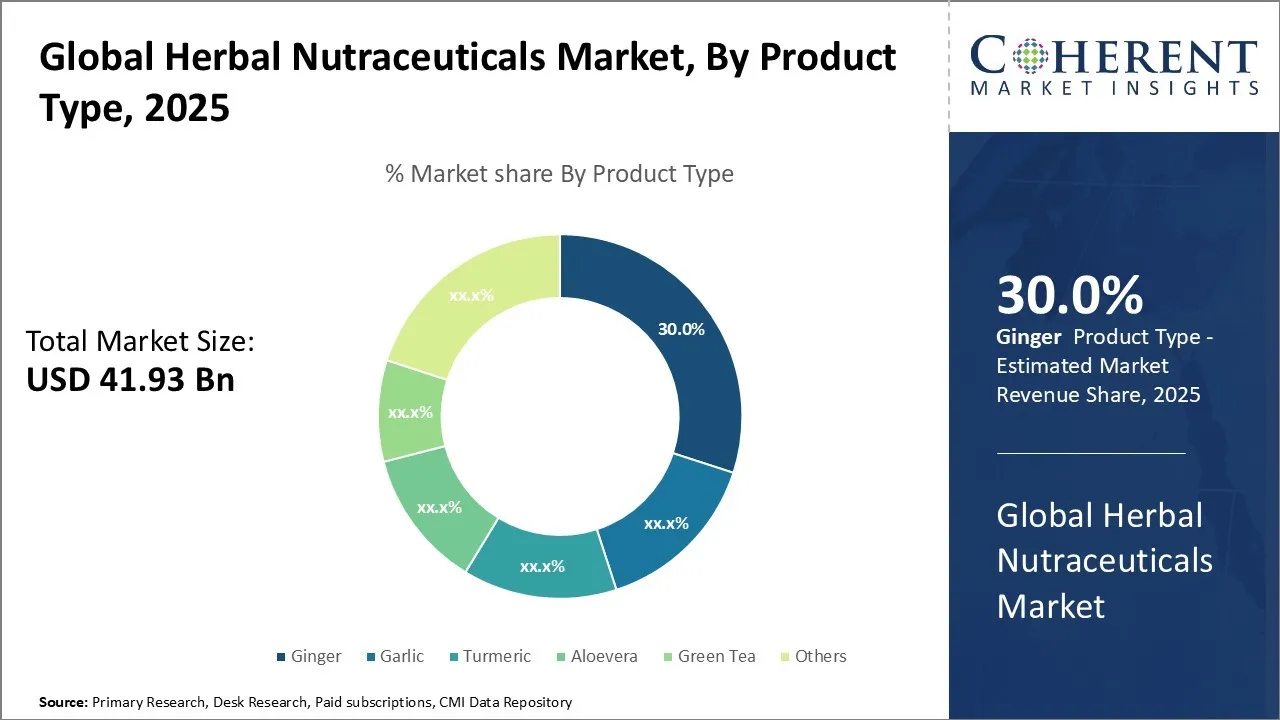
Herbal Nutraceuticals Market Insights, by Product Type: Ginger Based segment dominates the market due to Anti-inflammatory & antioxidant benefits
Based on product type, the market is segmented into Ginger, Garlic, Turmeric, Aloe Vera, Green Tea, and Others. Out of which, Ginger is expected to dominate the global market over the forecast period and this is attributed to its medicinal value and is widely used as a traditional medicine. It is extensively used for various health conditions and hence manufacturers are introducing it in making nutraceuticals. For instance, the ginger extract market itself was estimated to be worth $1.29 billion in 2024, with projections for further growth. The garlic segment is also expected to witness significant growth shortly. It is a widely used herb for medical conditions related to the blood and heart system. Also, Patients with coronary heart disease, atherosclerosis, and hypertension benefit from using garlic pure extract capsules.
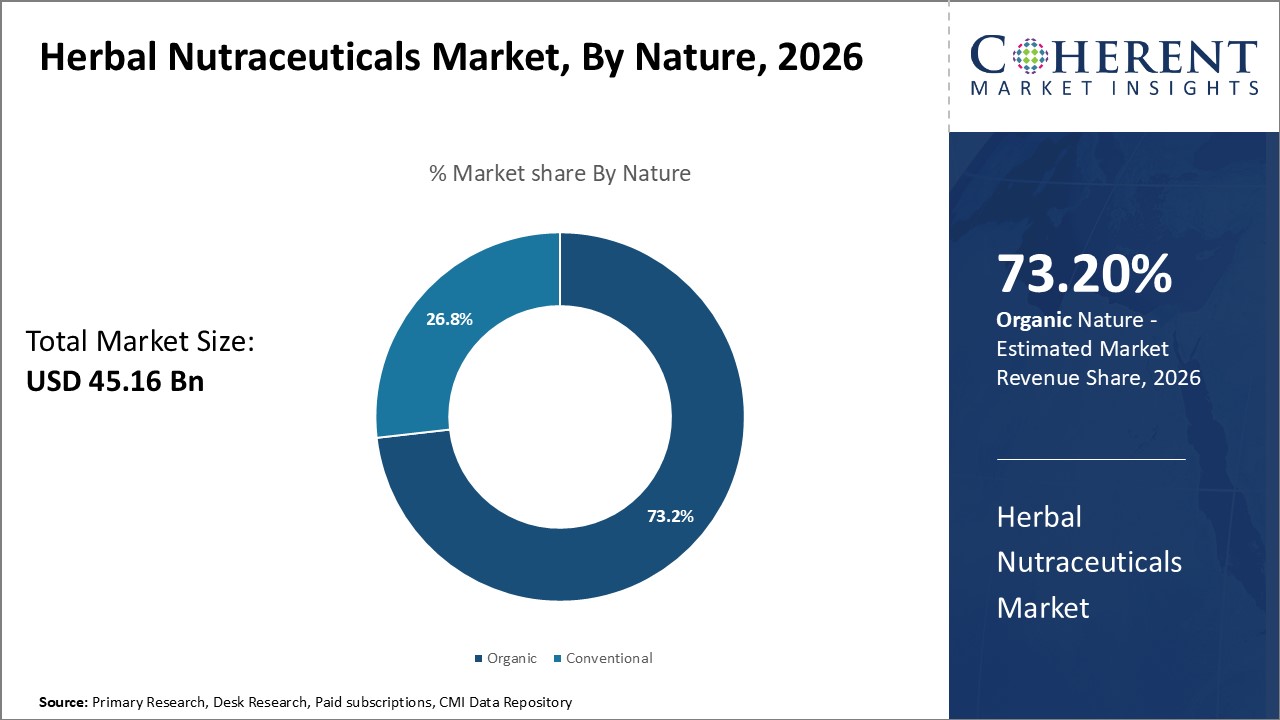
Herbal Nutraceuticals Market Insights, by Nature: Organic Based segment dominates the market due to perceived health benefits
Based on nature, the market is segmented into Conventional and Organic. Out of which, Organic is expected to dominate the global market over the forecast period and this is attributed to the growing trend of consuming herbal and organic products. For instance, Organic Herbal Nutraceuticals account for approximately 36% of the market share and it is experiencing the fastest growth rate and the industry where conventional products hold around 65% of the share. The conventional segment is also expected to witness significant growth shortly and this is owing to its low cost and easy availability of raw materials used in the preparation.
Herbal Nutraceuticals Market Insights, by Form: Capsules & Tablets Based segment dominates the market due to mass production and cost efficiency
Based on form, the market is segmented into Capsules & Tablets, Powder, Liquid, and Others. Out of which, Capsules & Tablets is expected to dominate the global market over the forecast period and this is attributed to the ease of consumption and the convenience associated with this form. These products do not require any measurement for specific doses, thus facilitating easy consumption. Additionally, they make it easier to encapsulate essential oils and herbal extracts.
Powder segment is also expected to witness significant growth in the near future and this is owing to their convenient packaging such as sachets, jars, packets, and bottles. The powder herbal nutraceuticals market was valued at $6,589.1 million in 2019, and is projected to reach $12,220.9 million by 2027, growing at a CAGR of 8.6% from 2021 to 2027.
Herbal Nutraceuticals Market Insights, by Sales: the Pharmacy-Based segment dominates the market due to high consumer trust.
Based on sales channels, the market is segmented into Pharmacies, Online stores, supermarkets/hypermarkets, and Others. Out of which, Pharmacy is expected to dominate the global market over the forecast period. The large share of this distribution channel is primarily attributed to the improvement in healthcare infrastructure and the surge in several consumers visiting pharmacies and drug stores. For instance, Patanjali Ayurveda in India has reported a total income of Rs 9,35.2 crore in the fiscal year 2023-24, marking a 24.15% increase from the previous year. The online store segment is also expected to witness significant growth shortly and this is owing to the emergence of digital platforms opening up opportunities for herbal nutraceuticals, as consumers are increasingly using mobile apps and telemedicine services to access their preferred brands and track their orders online.
Regional Insights
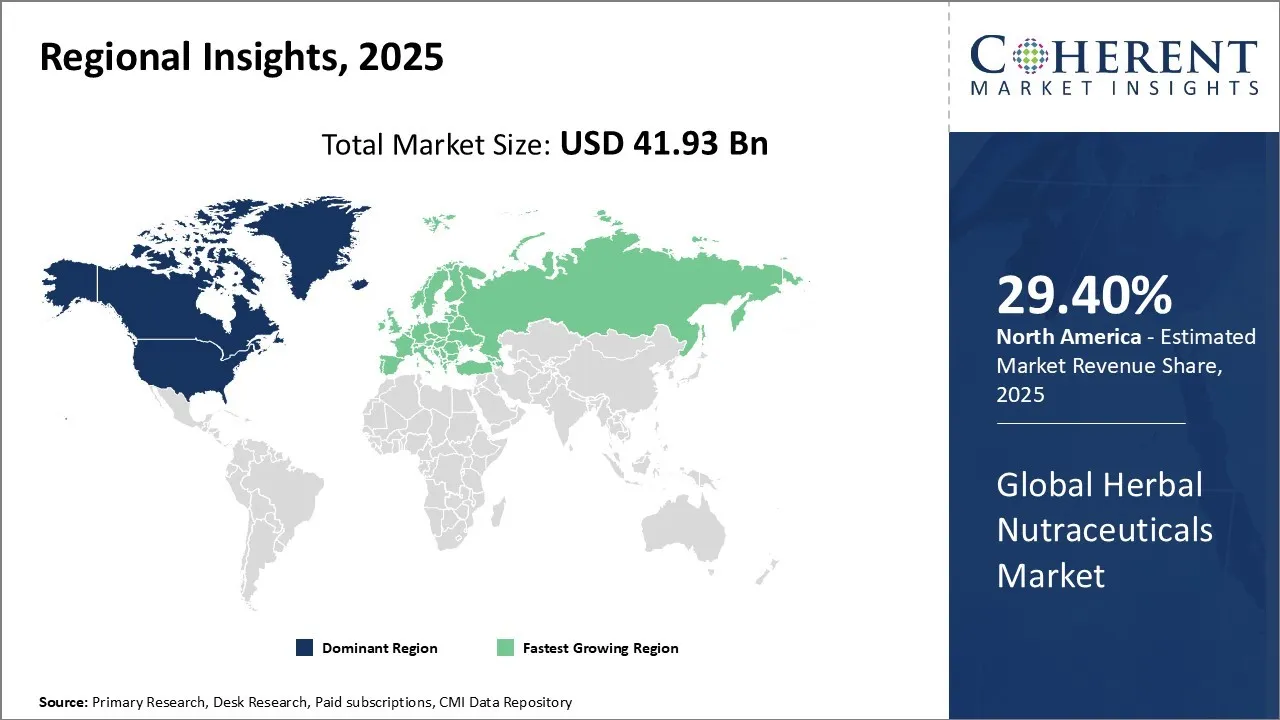
North America Herbal Nutraceuticals Market Trends
North America is expected to dominate the global herbal nutraceuticals market over the forecast period owing to the rising prevalence of chronic disease with an increasing geriatric population. Moreover, growing awareness regarding the health benefits of herbal products is also expected to propel regional market growth. Ginger was the highest contributor with USD 1,206.6 million in 2019 and is estimated to reach USD 1,765.8 million by 2027, registering a CAGR of 5.5%. For example, new product innovation and functional formulations like Bayer have introduced Iberogast in the U.S., a digestive relief product formulated with a blend of six herbs to aid occasional digestive systems. This product aligns with U.S. consumer habits by being available in convenient soft gel form. This is further escalating the herbal nutraceuticals market share.
Europe Herbal Nutraceuticals Market Trends
The herbal nutraceuticals market is growing at a significant rate in Europe, due to the increasing focus of the European population toward a healthy lifestyle. The Europe herbal nutraceuticals market was valued at USD 8,697.2 million in 2019 and is projected to reach USD 13,613.5 million by 2027, growing at a CAGR of 6.4% from 2021 to 2027. Consumers are increasingly seeking natural and plant-based supplements as part of a proactive approach to health. About 61% of supplement users say that the natural origin of the product matters to them, while approximately 46% prefer their supplements to be free from animal ingredients. This shift is particularly evident among the aging population, who are turning to herbal nutraceuticals to manage chronic conditions and maintain overall well-being. For instance, products containing turmeric, ginseng, and ashwagandha are gaining popularity for their purported benefits in joint health and cognitive function. This is further propelling the herbal nutraceuticals industry growth.
United States Herbal Nutraceuticals Market
The United States Herbal Nutraceutical Market has experienced notable expansion and significant growth, fueled by increasing consumer interest in natural health remedies and preventive wellness practices. For example, around 30% of americans report using herbal supplements annually. The U.S. Herbal Nutraceutical market has shown continuous growth driven by consumer trends favoring natural and holistic health approaches, with the increase in research and product innovation, the market is expected to expand further and grow the health and wellness industry.
Germany Herbal Nutraceuticals Market
The Herbal Nutraceutical Market in Germany is experiencing growth, due to increasing consumer demand and preference for more natural health solutions, an aging population, and a strong tradition of herbal medicine. For instance, the consumer preference and demand for natural remedies remains high where stats suggest that 62% favor herbal treatments that aren't available and the increase in the use of food supplements including herbal ones is also likely to continue to grow since 42% as in 2023. The overall market direction points towards consistent growth and strong consumer adoption of Herbal Nutraceutical in Germany.
Growing number of people suffering from chronic disease to augment market growth
Herbal or botanical extracts are more easily absorbed by the body and are more effective in treating various disease. They are also cheaper and easier to produce than whole herbs. Herbal extracts are used in a wide variety of health and wellness products such as supplements, drinks, and cosmetics ingredients. They are more popular in the United States, where consumers are highly health-conscious and actively seek organic ingredients in their products, which is further propelling the herbal nutraceuticals market growth.
Ongoing product innovation in the market to propel market growth
Key players are introducing new products in the market to gain a competitive edge. For instance, in September 2022, Pharmagreen Biotech, Inc., announced that it had developed its first formulated nutraceutical product and is in the process of organizing the retail sales distribution channels for its new product.
Global Herbal Nutraceuticals Market Opportunities
The growing importance of herbal products across developing countries is expected to provide significant growth opportunities. Herbs are used in herbal nutraceuticals to enhance the quality of life by providing several health benefits such as weight loss, boosting the immune system, and combating stress. The herbs used in herbal supplements are also known to have anti-inflammatory, antioxidant, and anti-viral properties. They are also used to treat various ailments including gastrointestinal disorders cardiovascular diseases, and respiratory problems. Besides, herbs are also effective in lowering cholesterol levels and preventing heart disease.
Increased millennial population is projected to provide additional market opportunities. The shifting inclination of consumers towards herbal products and the increase in discretionary spending are fueling the growth of the market. Millennials have shown a greater preference for products that facilitate the preventive healthcare approach. In addition, the growing number of aging adults and the declining fertility rates in developed countries have led to an increased demand for herbal products.
Market Report Scope
Herbal Nutraceuticals Market Report Coverage
| Report Coverage | Details | ||
|---|---|---|---|
| Base Year: | 2025 | Market Size in 2026: | USD 45.16 Bn |
| Historical Data for: | 2020 To 2024 | Forecast Period: | 2026 To 2033 |
| Forecast Period 2026 to 2033 CAGR: | 7.7% | 2033 Value Projection: | USD 75.90 Bn |
| Geographies covered: |
| ||
| Segments covered: |
| ||
| Companies covered: | Bio Botanica, Inc, Herbochem, Nature’s Bounty, NUTRAMARKS, INC., Now foods, OREGON'S WILD HARVEST, Pharmaca, Pure Encapsulations, LLC, and Sydler India Pvt | ||
| Growth Drivers: |
| ||
| Restraints & Challenges: |
| ||
Key Developments
In May 2025, the Ayush Nirmata Sangh urged the Madhya Pradesh state government to establish a dedicated cluster for herbal and ayurvedic medicines manufacturers to meet increasing domestic and international demand. Where approximately 100 units, including 20 focused on exports, are prepared to invest over Rs150 crore.
In February 2025, Vitafoods Mumbai announced an event to showcase innovations in nutraceutical sector, featuring over 150 exhibitors and sessions on topics like sustainability and women’s health.
In February 2025, ACI Ltd. expanded its presence in the pharmaceutical industry by announcing the launch of a new subsidiary aimed at tapping into the rising demand for high-quality herbal medicine in Bangladesh.
In August 2024, Denzour Nutrition Launches Herbal Nutraceuticals for comprehensive wellness as it includes products for energy, stress relief, hormonal balance, and detoxification. These formulations use organic, ethically sourced ingredients and comply with FSSAI safety standards.
Market Segmentation
- Global Herbal Nutraceuticals Market, By Product Type (Revenue, USD Bn, 2021 - 2033)
- Ginger
- Garlic
- Turmeric
- Aloe Vera
- Green Tea
- Others
- By Nature
- Conventional
- Organic
- Global Herbal Nutraceuticals Market, By Form (Revenue, USD Bn, 2021 - 2033)
- Capsules & Tablets
- Powder
- Liquid
- Others
- Global Herbal Nutraceuticals Market, By Sales Channel (Revenue, USD Bn, 2021 - 2033)
- Pharmacy
- Online store
- Supermarket/Hypermarket
- Others
Regional Insights (Revenue, USD Bn, 2021 - 2033)
- North America
- U.S.
- Canada
- Latin America
- Brazil
- Argentina
- Mexico
- Rest of Latin America
- Europe
- Germany
- U.K.
- Spain
- France
- Italy
- Russia
- Rest of Europe
- Asia Pacific
- China
- India
- Japan
- Australia
- South Korea
- ASEAN
- Rest of Asia Pacific
- Middle East
- GCC Countries
- Israel
- Rest of Middle East
- Africa
- South Africa
- North Africa
- Central Africa
- North America
- Company Profiles
- Bio Botanica, Inc
- Herbochem
- Nature’s Bounty
- NUTRAMARKS, INC.
- Now Foods
- OREGON'S WILD HARVEST
- Pharmaca
- Pure Encapsulations, LLC
- Sydler India Pvt
Sources
Primary Research Interviews from the Following Stakeholders
Stakeholders
- Interviews with medical professionals, herbal product manufacturers, healthcare providers, and industry experts specializing in herbal nutraceuticals and related technologies.
- Specific stakeholders: Ayurvedic practitioners, phytotherapists, herbal product formulators, and healthcare managers involved in nutraceutical product development and distribution.
Databases
- PubMed
- gov
- gov
Magazines
- Nutraceuticals World
- Natural Products Insider
- HerbalGram
- HealthTech Magazine
Journals
- Journal of Herbal Medicine
- Phytotherapy Research
- Journal of Ethnopharmacology
- Journal of Dietary Supplements
Newspapers
- The New York Times
- The Guardian
- The Wall Street Journal
- Financial Times
- The Washington Post
Associations
- American Herbal Products Association (AHPA)
- Natural Products Association (NPA)
- Council for Responsible Nutrition (CRN)
- United Natural Products Alliance (UNPA)
- American Botanical Council (ABC)
Public Domain Sources
- World Health Organization (WHO)
- Centers for Disease Control and Prevention (CDC)
- Food and Drug Administration (FDA)
- National Institutes of Health (NIH)
Proprietary Elements
- CMI Data Analytics Tool and Proprietary CMI Existing Repository of information for the last 8 years
*Definition: Herbal nutraceuticals are a combination of nutritional and medicinal substances. They are derived from natural plant resources and have slight or no side effects. The rising focus on health and wellness among customers across the world has driven the demand for herbal supplements.
Get access to 250+ pages report
Every segment, forecast, competitor profile and data table behind the analysis above — available for instant download.
- ESOMAR Member
- ISO 9001:2015 Certified
- D-U-N-S Registered
- GDPR & CCPA Compliant
Missing comfort of reading report in your local language? Find your preferred language:
Transform your Strategy with Exclusive Trending Reports
Frequently Asked Questions
The Herbal Nutraceuticals Market is estimated to be valued at USD 45.16 Bn in 2026, and is expected to reach USD 75.90 Bn by 2033.
The CAGR of the Herbal Nutraceuticals Market is projected to be 7.7% from 2026 to 2033.
The growing number of people suffering from chronic disease and ongoing product innovation are fuelling the Herbal Nutraceuticals market share.
The ginger segment is the leading Product Type segment in the market.
High cost of herbal products and Lack of standard regulations is the major factors restraining growth of the market.
Bio Botanica, Inc, Herbochem, Nature’s Bounty, NUTRAMARKS, INC., Now foods, OREGON'S WILD HARVEST, Pharmaca, Pure Encapsulations, LLC, and Sydler India Pvt