

Immunoassay Instruments Market Size and Forecast — 2026 - 2033
The global immunoassay instruments market size is estimated to be valued at USD 3.5 billion in 2026 and is expected to reach USD 6.8 billion by 2033, exhibiting a compound annual growth rate (CAGR) of 9.3% from 2026 to 2033.
Overview
The immunoassay instruments market is driven by the rising prevalence of infectious and chronic diseases, including cancer, cardiovascular disorders, and Diabetes Mellitus. Growing demand for early and accurate disease diagnosis is accelerating the adoption of advanced immunoassay technologies in clinical laboratories. Technological innovations such as automation, high-throughput systems, and enhanced sensitivity are improving testing efficiency and reliability. Expanding healthcare infrastructure, increasing laboratory testing volumes, and rising investments in diagnostic research further support market growth. Additionally, heightened awareness of preventive healthcare and the need for rapid point-of-care testing are contributing to sustained demand globally.
Key Takeaways
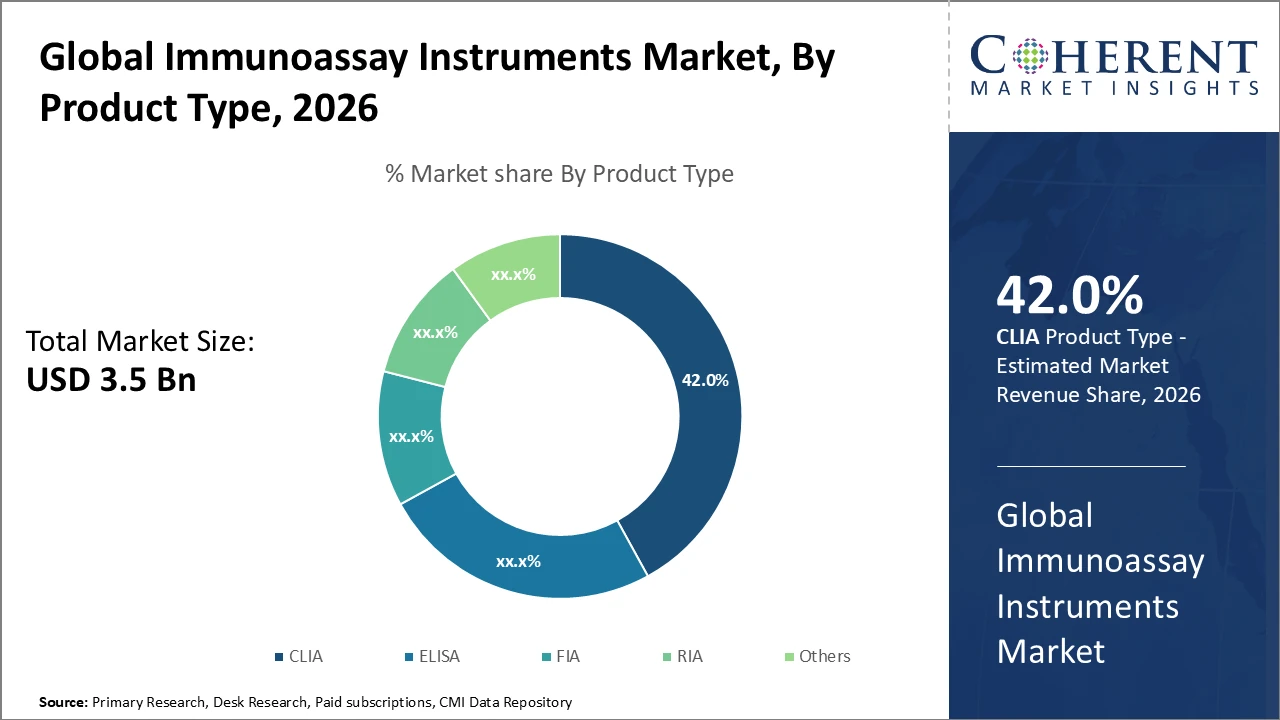
The Chemiluminescence Immunoassay (CLIA) segment leads the product type category with a 42% market share, supported by high sensitivity and automation advantages.
Automated immunoassay instruments outperform semi-automated solutions, reflecting the growing demand for efficiency and scalability in clinical diagnostics.
Hospitals and diagnostic laboratories represent the largest end-user segment, generating the majority of market revenue due to increasing patient testing volumes.
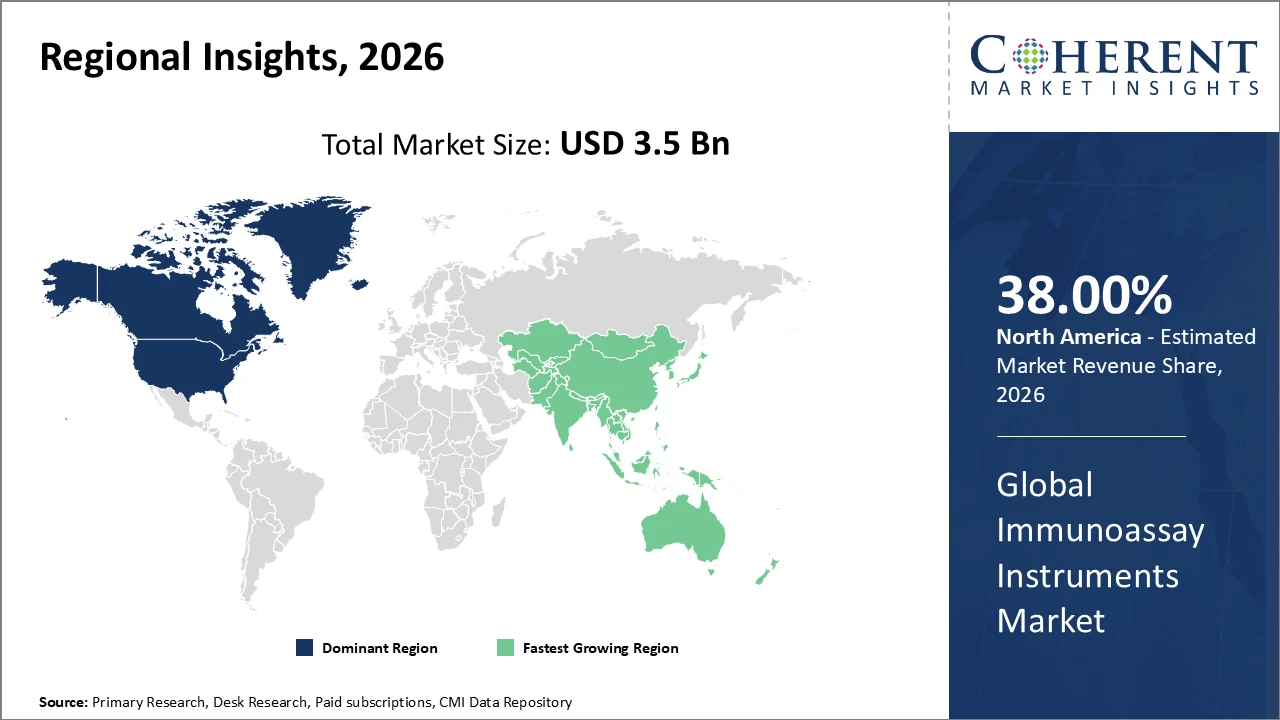
North America holds around 38% of the regional market share, driven by advanced healthcare infrastructure and widespread adoption of modern immunoassay instruments.
Asia Pacific is the fastest-growing region, with a high CAGR fueled by rising healthcare investments and increasing disease prevalence.
These trends highlight key drivers shaping industry growth and market dynamics.
Immunoassay Instruments Market Segmentation Analysis
Immunoassay Instruments Market Insights, By Product Type
CLIA leads the immunoassay instruments market due to its superior sensitivity, automation compatibility, and wide clinical applicability across diagnostics. The fastest-growing subsegment is Enzyme-Linked Immunosorbent Assay (ELISA), driven by its cost-effectiveness, simplicity, and versatility in both research and clinical testing. Fluorescence Immunoassays provide high specificity and accuracy but face limited adoption due to higher costs and specialized equipment requirements. Radioimmunoassays are constrained by strict regulatory guidelines and safety concerns, limiting their use. The Others category encompasses emerging assay types, including chemifluorescent and bead-based assays, which are primarily applied in niche research and specialized diagnostic applications.
Immunoassay Instruments Market Insights, By Technology
Automated immunoassay instruments dominate the market, driven by high throughput, consistent and standardized results, and reduced labor requirements. These systems are increasingly preferred in large clinical laboratories and hospitals to handle growing testing volumes efficiently. Semi-automated instruments continue to maintain demand in mid-sized laboratories, offering a balance between automation benefits and cost-effectiveness, particularly in emerging economies. Manual instruments, while gradually declining, remain relevant in resource-limited settings due to their affordability and simplicity. The rapid adoption of automation is fueled by laboratories’ need to improve workflow efficiency, ensure precision, and support expanding diagnostic and research testing requirements.
Immunoassay Instruments Market Insights, By End User
Hospitals and diagnostic laboratories hold the largest market share in the immunoassay instruments market, supported by increasing patient testing volumes and continuous technological upgrades in clinical settings. Pharmaceutical and biotechnology companies represent the fastest-growing segment, leveraging immunoassay instruments for drug discovery, biomarker validation, and high-throughput screening. Academic and research institutions contribute steadily, aided by rising funding for translational medicine and biomedical research. Veterinary diagnostics, although smaller in market size, are expanding as global pet healthcare and livestock monitoring gain importance. Overall, demand across clinical, research, and veterinary applications is driving market growth and encouraging technological advancements in immunoassay instruments.
Immunoassay Instruments Market Trends
Technological advancements, including automation and artificial intelligence integration, are driving market trends by improving throughput and diagnostic accuracy. For instance, AI-enabled immunoassay platforms launched in 2025 increased processing speed by 25% in clinical laboratories.
The growing adoption of multiplex assays is providing comprehensive testing solutions, reducing test times, and enhancing efficiency, as reflected by a 14% rise in multiplex test usage across Europe in 2026.
The expansion of point-of-care immunoassay instruments is decentralizing healthcare diagnostics, particularly in Southeast Asia, supported by government initiatives promoting accessible and efficient healthcare infrastructure.
Immunoassay Instruments Market Insights, By Geography
North America Immunoassay Instruments Market Analysis and Trends
In North America, the immunoassay instruments market holds a dominant 38% share, driven by advanced healthcare infrastructure, substantial research and development investments, and the presence of leading companies such as Abbott Laboratories and Roche Diagnostics. High adoption of automated and AI-enabled diagnostic systems in hospitals and laboratories enhances testing efficiency and accuracy, further strengthening market growth. Government initiatives supporting rapid diagnostics development, coupled with significant healthcare expenditure, promote innovation and adoption of advanced immunoassay technologies. The combination of technological leadership, strong regulatory frameworks, and well-established clinical networks ensures North America remains a key market for immunoassay instruments globally.
Asia Pacific Immunoassay Instruments Market Analysis and Trends
Asia Pacific is experiencing the fastest growth in the immunoassay instruments market, with a CAGR exceeding 11%, driven by expanding healthcare access, rising prevalence of chronic diseases, and the growth of diagnostic laboratories. Government initiatives in countries like China and India to promote medical device adoption and improve healthcare infrastructure have further accelerated market expansion. Major players, including Bio-Rad and Danaher, have strengthened their regional presence through localized manufacturing, strategic partnerships, and distribution networks. Additionally, increasing investments in laboratory automation and diagnostic technologies support rapid adoption, making Asia Pacific a key growth region for immunoassay instruments in both clinical and research applications.
Immunoassay Instruments Market Outlook for Key Countries
USA Immunoassay Instruments Market Analysis and Trends
The USA continues to be a major contributor to the immunoassay instruments market, driven by high healthcare spending and rapid adoption of advanced technologies. In 2025, the introduction of AI-integrated immunoassay platforms resulted in a 20% increase in instrument installations across clinical and research laboratories. Leading domestic and multinational companies launched cutting-edge systems targeting oncology, infectious diseases, and biomarker testing, reinforcing the country’s market leadership. Supportive regulatory frameworks, quick approvals, and favorable reimbursement policies have accelerated innovation and commercialization. Combined with strong laboratory infrastructure and skilled workforce, these factors sustain the United States’ prominent position in the global immunoassay instruments market.
Germany Immunoassay Instruments Market Analysis and Trends
The immunoassay instruments market in Germany is experiencing steady growth, driven by advanced healthcare infrastructure, strong research initiatives, and increasing demand for precise diagnostics. Hospitals and clinical laboratories are adopting automated and high-throughput systems to improve efficiency and accuracy in patient testing. The pharmaceutical and biotechnology sectors are expanding the use of immunoassay instruments for drug discovery, biomarker validation, and translational research. Technological innovations, including AI integration, multiplex assays, and point-of-care platforms, are shaping market trends. Additionally, government support for medical technology adoption and sustainability initiatives encourages the use of efficient and environmentally friendly immunoassay solutions, reinforcing Germany’s role as a key market in Europe.
Analyst Opinion
The increasing demand for high-throughput and automated immunoassay instruments is a key supply-side driver, with production capacities in leading manufacturing hubs expanding over 15% in 2025 to meet a 12% rise in demand from clinical laboratories worldwide, enhancing market share.
On the demand side, growing adoption in oncology and infectious disease testing has significantly influenced market growth. A surge in antibody testing during 2024, linked to emerging viral outbreaks, led to a 9% increase in import volumes of immunoassay instruments, particularly in North America and Europe.
Multiplexing capabilities in immunoassay platforms are expanding, allowing simultaneous detection of multiple analytes. Shipments of such instruments increased 18% globally in 2026, reflecting trends toward comprehensive diagnostic solutions.
Niche applications in veterinary diagnostics and food safety monitoring also contributed, with deployment of specialized instruments growing 11% in 2025, highlighting diversified market use cases.
- Current Industry Events of 2026
- Market Size Estimation
- Regional Breakdown
- Competitive Landscape
- Customer Intelligence
- Segmental Analysis
- Pricing Analysis
- Key Market Drivers, Challenges & Future Trends
- Customized Insights Section
Market Scope
| Report Coverage | Details | ||
|---|---|---|---|
| Base Year: | 2025 | Market Size in 2026: | USD 3.5 billion |
| Historical Data for: | 2020 To 2024 | Forecast Period: | 2026 To 2033 |
| Forecast Period 2026 to 2033 CAGR: | 9.3% | 2033 Value Projection: | USD 6.8 billion |
| Geographies covered: |
| ||
| Segments covered: |
| ||
| Companies covered: | Abbott Laboratories, Bio-Rad Laboratories, Siemens Healthineers, Roche Diagnostics, Danaher Corporation, Hologic Inc., Medica Corporation, Nova Biomedical, Luminex Corporation, PerkinElmer Inc. | ||
| Growth Drivers: |
| ||
Immunoassay Instruments Market Growth Factors
The immunoassay instruments market is primarily driven by the increasing prevalence of chronic and infectious diseases, which necessitate accurate and rapid diagnostic tools. Advances in automation enhance testing throughput, minimize human error, and improve laboratory efficiency. Growing investments in biotechnology research further support the adoption of these instruments in R&D laboratories. The rising demand for multiplex assays, enabling simultaneous detection of multiple analytes, also fuels market growth. In 2026, cardiovascular disease testing led to a 10% increase in hospital instrument utilization. Additionally, government initiatives to strengthen healthcare infrastructure in emerging economies contributed approximately 8% year-on-year revenue growth.
Immunoassay Instruments Market Development
In September 2025, Beckman Coulter Diagnostics, part of Danaher Corporation, launched the first fully automated Brain-derived Tau (BD-Tau) research-use-only immunoassay. The test, available on the DxI 9000 Immunoassay Analyzer and Access 2 Analyzer, expands the company’s portfolio of neurodegenerative disease assays.
Key Players
Leading Companies of the Market
Abbott Laboratories
Siemens Healthineers
Bio-Rad Laboratories
Roche Diagnostics
Hologic Inc.
Danaher Corporation
Medica Corporation
Nova Biomedical
Luminex Corporation
PerkinElmer Inc.
Market players in the immunoassay instruments industry employ a range of growth strategies, including strategic acquisitions, innovative product launches, and geographic expansion. For instance, Roche Diagnostics expanded its automated immunoassay platforms in 2025, resulting in a 20% increase in market share in North America. Similarly, Abbott’s collaborations with biotechnology firms focused on multiplex immunoassay development led to a 15% revenue growth in the Asia Pacific region. These initiatives highlight how companies leverage technological innovation, strategic partnerships, and regional market penetration to strengthen their competitive positions and drive overall growth in the global immunoassay instruments market.
Immunoassay Instruments Market Future Outlook
The immunoassay instruments market is expected to experience strong growth driven by rising demand for early disease detection, personalized medicine, and high-throughput screening in clinical and research laboratories. Technological advancements, including automation, multiplexing, and integration with AI and data analytics, will enhance accuracy, speed, and workflow efficiency. The growing prevalence of chronic diseases, infectious outbreaks, and biomarker-driven diagnostics will further propel market adoption. Emerging regions, particularly Asia-Pacific and Latin America, are likely to witness rapid expansion due to increasing healthcare investments, laboratory infrastructure development, and rising awareness of advanced diagnostic solutions. Sustainability and cost-effective innovations will shape future market trends.
Immunoassay Instruments Market Historical Analysis
The immunoassay instruments market has experienced steady growth over the past two decades, driven by increasing demand for accurate and rapid diagnostic testing. Early adoption focused on enzyme-linked immunosorbent assay (ELISA) readers and basic chemiluminescence analyzers in clinical laboratories. Technological advancements, such as automated analyzers, multiplex platforms, and high-throughput systems, improved efficiency and reduced human error. Growth was further supported by rising prevalence of chronic and infectious diseases, expansion of healthcare infrastructure, and increasing research activities in biotechnology and pharmaceuticals. Historical trends also reflect a gradual shift from manual, labor-intensive assays to fully automated, integrated systems that enhance reliability and scalability.
Sources
Primary Research Interviews:
R&D managers, scientists, and project leaders from companies developing immunoassay instruments, including ELISA, CLIA, and multiplex platforms.
Technical specialists from manufacturing firms, focusing on production, quality control, automation, and assay accuracy.
Industry experts from clinical laboratories, hospitals, and research institutions involved in diagnostics, regulatory compliance, and instrument deployment.
Magazines:
Clinical Laboratory News – Market trends, technological updates, and diagnostic innovations.
Lab Manager – Advances in laboratory automation, workflow efficiency, and instrument management.
Diagnostics World – News on immunoassay platforms, research applications, and clinical adoption.
Journals:
Journal of Immunological Methods – Research on assay performance, biomarker detection, and clinical applications.
Clinical Chemistry – Studies on diagnostic accuracy, immunoassay instrumentation, and workflow optimization.
Analytical and Bioanalytical Chemistry – Insights into assay development, high-throughput screening, and instrument validation.
Newspapers:
The Wall Street Journal – Corporate developments, mergers, and investments in diagnostic companies.
Financial Times – Market trends, regulatory policies, and global diagnostics industry analysis.
Reuters – Updates on instrument approvals, laboratory expansions, and healthcare initiatives.
Bloomberg – Company strategies, revenue trends, and market forecasts for immunoassay instruments.
Associations:
International Federation of Clinical Chemistry and Laboratory Medicine (IFCC) – Guidelines, best practices, and global laboratory standards.
World Health Organization (WHO) – Recommendations for diagnostic testing, laboratory infrastructure, and global disease monitoring.
Clinical & Laboratory Standards Institute (CLSI) – Protocols, standards, and regulatory guidance for immunoassay instruments.
Get access to 250+ pages report
Every segment, forecast, competitor profile and data table behind the analysis above — available for instant download.
- ESOMAR Member
- ISO 9001:2015 Certified
- D-U-N-S Registered
- GDPR & CCPA Compliant
Missing comfort of reading report in your local language? Find your preferred language:
Transform your Strategy with Exclusive Trending Reports
Frequently Asked Questions
Dominance is held by companies such as Abbott Laboratories, Roche Diagnostics, Siemens Healthineers, and Bio-Rad Laboratories, known for their technological innovations and extensive product portfolios.
The market size is forecast to reach USD 6.8 billion by 2033, growing at a CAGR of 9.3% from 2026 to 2033.
Hospitals and diagnostic laboratories continue to present the largest growth opportunity due to increasing diagnostic testing demand globally.
Trends point to notable growth in automation, AI integration, multiplexing technologies, and expansion of point-of-care testing instruments.
Competitive dynamics involve innovation race and strategic partnerships with challenges such as high regulatory standards and high capital expenditures.
Companies focus on strategic acquisitions, product line extensions, regional expansions, and collaborations within biotech and healthcare sectors.