

Industrial Starches Market Analysis & Forecast: 2026-2033
Industrial Starches Market is estimated to be valued at USD 18.00 Bn in 2026 and is expected to reach USD 28.16 Bn in 2033, exhibiting a compound annual growth rate (CAGR) of 6.6% from 2026 to 2033.
Key Takeaways
- By Type, the Starch Derivatives and Sweeteners segment is projected to dominate the global industrial starches market in 2026, accounting for approximately 74.0% of the total share. This dominance is attributed to their extensive application in food processing, pharmaceuticals, and industrial manufacturing.
- By Region, North America is expected to lead the global industrial starches market with a 36.00% share in 2026, driven by advanced manufacturing infrastructure, consistent demand from the food and paper sectors, and increased adoption of modified starches in pharmaceutical applications.
Market Overview
The industrial starches market is being fueled by the food processing sector's global growth. Industrial starches serve as the primary ingredients for the fabrication of plastic items. Furthermore, the rise in the demand for “clean label” food items is also contributing to growth in the market. For example, in March 2020 Tate and Lyle increased the range of Claria clean-label starches with the launch of Claria Everlast. This particular starch addresses formulation challenges pertaining to refrigerated and freeze-thaw stability for frozen meals, sauces, and yogurts. The ingredient is non-GMO, has a clean taste, and is neutral in color.
Current Events and Its Impact on the Industrial Starches Market
Event | Description and Impact |
Global Supply Chain Disruptions and Raw Material Shortages |
|
Regulatory Changes and Environmental Policies |
|
Technological Advancements and Innovation Trends |
|
Pricing Analysis: Industrial Starches Market
The Industrial Starches Market exhibits varied pricing influenced by raw material sources, extraction methods, and specialized applications. Prices differ significantly across categories like native starches, modified starches, and specialty grades.
Industrial Starches as Thickening Agents typically command prices between $0.45 to $1.50 per kg, depending on starch type—corn, wheat, potato, or cassava—and regional supply dynamics. For example, potato starch used in oil drilling often commands premium pricing ($0.85–$1.50/kg) due to limited availability and high performance in drilling fluids.
Industrial Starches as Binders in paper and construction industries usually involve modified starches such as oxidized or cationic types, priced higher ($0.80 to $2.50 per kg) because of enhanced functional properties. Brands like Ingredion THERMPEL and Cargill COxyPure exemplify premium offerings.
In detergent formulations, starch derivatives improve product consistency and biodegradability, influencing demand and pricing within the $1.00–$2.50 per kg range.
Industrial Starches application in nonwoven fabrics involves cross-linked starches with price points of $1.50–$3.00 per kg, supporting durability and moisture resistance.
Extraction methods and regional factors heavily impact pricing, with Asia-Pacific often offering competitive rates due to abundant cassava and tapioca starch supplies.
- Current Industry Events of 2026
- Market Size Estimation
- Regional Breakdown
- Competitive Landscape
- Customer Intelligence
- Segmental Analysis
- Pricing Analysis
- Key Market Drivers, Challenges & Future Trends
- Customized Insights Section
Role of Technological Advancement
Developments in production, functionality, and sustainability of industrial starches are driven by the application of new technologies. Precision modern enzymatic modifications result in starches with enhanced solubility, stability, and performance for a wide range of applications. Cross-linking and substitution chemical modifications create starches with greater resistance to heat, pH, and mechanical stress which is crucial for industrial applications like oil drilling and detergents. The invention of nano-modified starches has increased their usefulness in biodegradable packaging and nonwoven fabrics due to their enhanced barrier and mechanical properties.
Processors benefit from Industry 4.0 technologies such as IoT, real-time tracking, digital twins, and other automation tools which streamline manufacturing while maintaining quality and minimizing waste. Sustainable advances in biotechnology and fermentation are changing how starches are produced and engineered, enabling new properties to be added while increasing yield and functionality. The implementation of green chemistry theories into technological processes creates solvent-less and closed systems which significantly lowers the impact on the environment. Stranych is able to expand further into agriculture and the industrial world with the creation of smart materials controlled by degradation time and responsiveness. High-performance precision starch solutions that substitute synthetic materials molded under sustainable ideals unlocks market potential harnessed by technological breakthroughs.
Segmental Insights
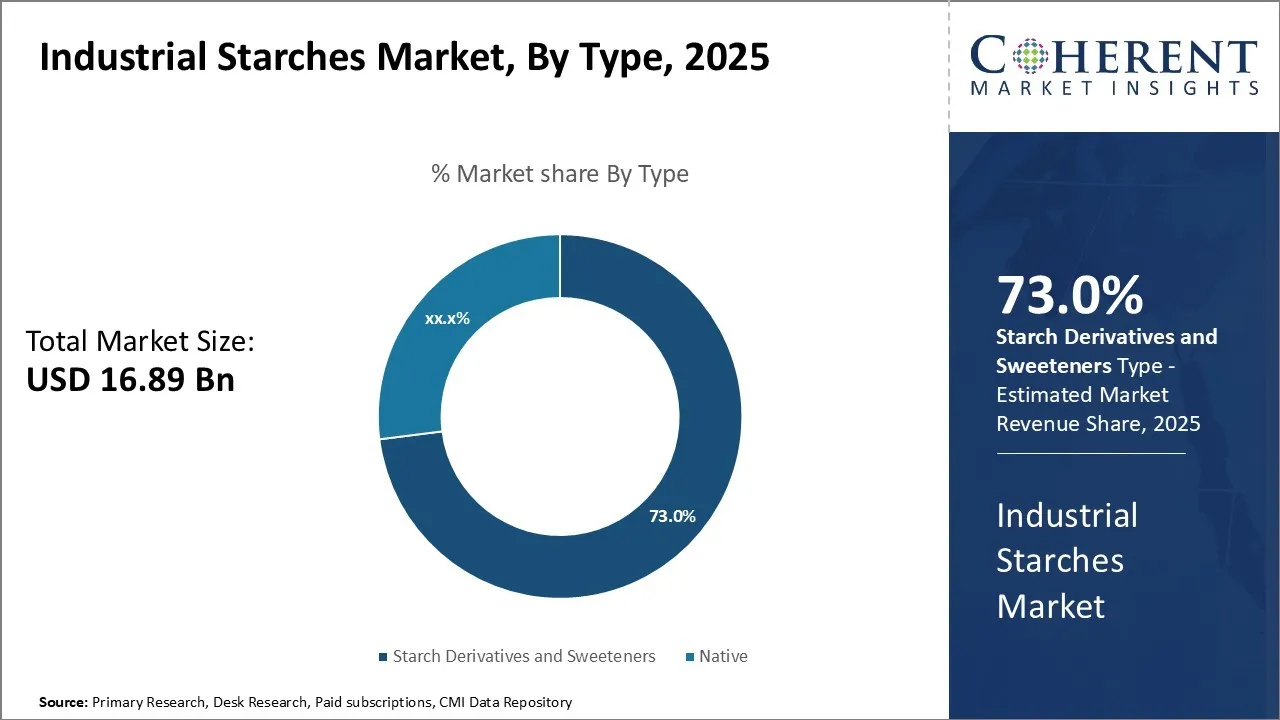
Global Industrial Starches Market Insights, By Type
In terms of product type, starch derivatives and sweeteners are forecast to command a 74.0% share of the Global Industrial Starches Market in 2026. This dominance traces back to the increasing interest in functional food products and clean-label ingredients. Their multifunctional properties, like improved texture and enhanced stability or shelf life, are particularly useful in modern food formulations such as low sugar beverages, fortified confectioneries, and health-focused nutraceuticals.
At present, the confectionery and beverage industries mark the largest application segments. Within these sectors, sweeteners and starch derivatives are crucial as they serve multiple functions, including thickening and stabilizing the systems. At the same time, functional food uses are growing the most rapidly, as manufacturers are more interested in clean-label botanically sourced or plant-based ingredients. While it has a smaller share, the native starch segment is expected to advance significantly in the short term. Native starches are clean and unmodified which makes them appealing to consumers seeking simplicity and purity, thus, ideal for "free from" or minimally processed products. It is used in bakery and dairy, as well as meat alternatives, where it provides natural thickening and binding sans modification. The Global Industrial Starches Market showcases a blend of innovative multifunctional products (starch derivatives and sweeteners) and clean label simplicity (native starch)—both driven by shifting consumer and industry focus on health.
Global Industrial Starches Market – Regional Insights
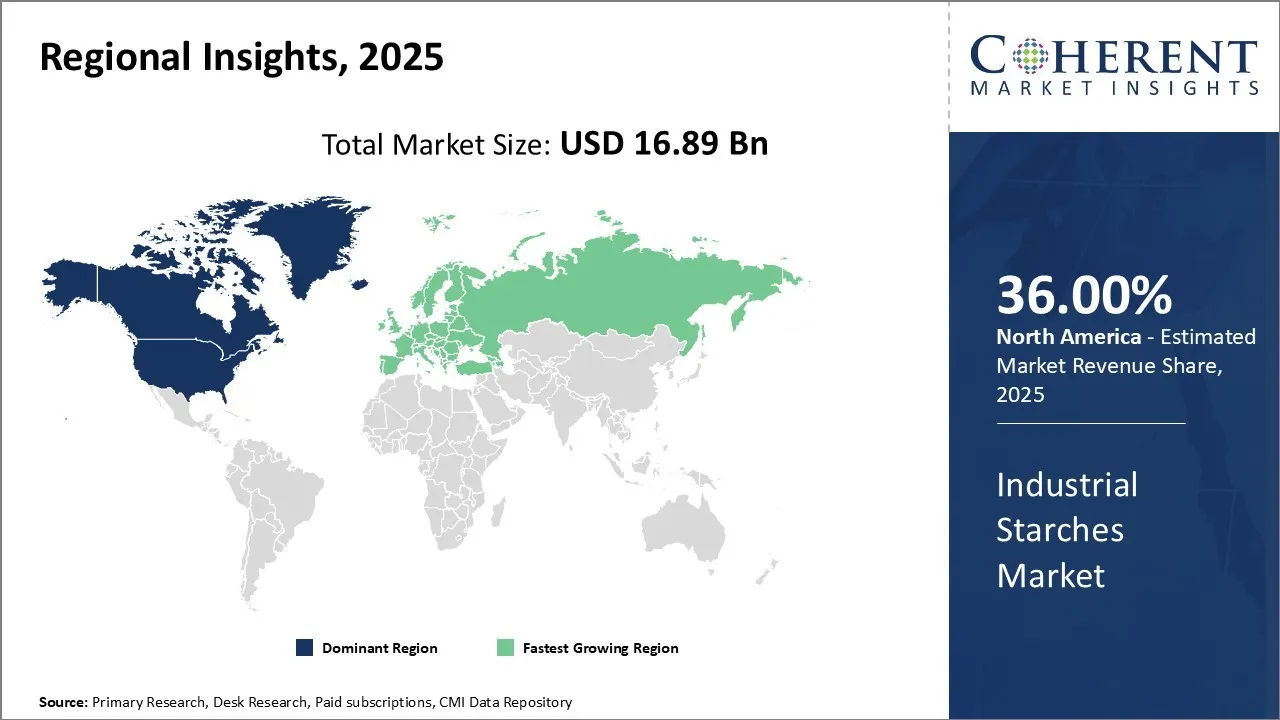
North America Industrial Starches Market Analysis and Trends
North America is poised to dominate the Global Industrial Starches Market with an estimated 36.00% market share in 2026, supported by the region's high-volume starch production and expansive agricultural output. The United States, in particular, stands out as the world’s largest corn producer, with production projected to reach 383.94 million metric tons during 2021–2026. Corn is a key raw material for industrial starch production, making the U.S. a strategic hub for starch manufacturing.
The region benefits from a well-developed agro-industrial infrastructure and a mature food and beverage sector that extensively utilizes starches and starch derivatives in various applications, including sweeteners, thickeners, and binders. Additionally, North America’s established network of starch producers contributes to innovation and product development tailored to evolving market needs such as clean label, plant-based, and functional food trends.
Europe Industrial Starches Market Analysis and Trends
Europe remains a significant player in the global industrial starches landscape, driven by high regional starch production and supportive trade associations such as the European Starch Industry Association. In 2020, Europe produced approximately 11.5 million metric tons of starch—an increase from 10.7 million metric tons in 2018—from sources including wheat, maize, and potatoes. This production volume reflects Europe’s robust processing infrastructure and its commitment to food sustainability and traceability standards.
European starch producers are highly focused on innovation in native and modified starches, meeting the growing demand for sustainable, traceable, and clean-label ingredients. The region's stringent regulatory framework encourages the use of starches in functional food, bioplastics, pharmaceuticals, and textile sectors, helping to diversify applications beyond traditional food and beverage uses.
United States Industrial Starches Market Analysis and Trends
As the anchor of North America's industrial starches market, the United States leverages its strong agricultural output—particularly corn—to meet rising domestic and global demand. This growth is fueled by rising domestic demand as well as the region’s strong export capabilities, particularly to Europe and Asia.
The country's starch industry is deeply integrated with sectors such as processed food, paper manufacturing, and bio-based chemicals, contributing to its dynamic market position. The U.S. is also a hub for technological innovation in starch modification and sustainable starch-based product development, allowing it to address the needs of a shifting consumer landscape focused on health and environmental consciousness.
Canada Industrial Starches Market Analysis and Trends
Canada contributes significantly to the North American starch ecosystem through its agricultural strength and advanced food processing sector. Canadian starch manufacturers benefit from proximity to the U.S. market, shared regulatory frameworks under trade agreements like USMCA, and growing domestic interest in sustainable, locally sourced specialty food ingredients. Canadian processors are increasingly exploring alternative starch sources such as peas and pulses, reflecting consumer demand for allergy-friendly and non-GMO starch alternatives.
Market Report Scope
Industrial Starches Market Report Coverage
| Report Coverage | Details | ||
|---|---|---|---|
| Base Year: | 2025 | Market Size in 2026: | USD 18.00 Bn |
| Historical Data for: | 2020 To 2024 | Forecast Period: | 2026 To 2033 |
| Forecast Period 2026 to 2033 CAGR: | 6.6% | 2033 Value Projection: | USD 28.16 Bn |
| Geographies covered: |
| ||
| Segments covered: |
| ||
| Companies covered: | Cargill Incorporated, Archer Daniels Midland Company, Ingredion Inc., Tate & Lyle PLC, Agrana Beteiligungs AG, Kent Nutrition Group Inc. (Grain Processing Corp.), Roquette Frères, Tereos Group, Coöperatie Koninklijke Cosun U.A, Altia PLC, Angel Starch and Food Pvt. Ltd, Manildra Group, and Japan Corn Starch Co. Ltd. | ||
| Growth Drivers: |
| ||
| Restraints & Challenges: |
| ||
Global Industrial Starches Market Growth Drivers
- Increasing investment by key players in starch production
Increasing investment by key players in starch production to meet the growing demand is driving growth of the industrial starches market. For instance, in April 2021, Cargill Inc., a global food corporation, announced its plans to expand its specialty tapioca starch offerings for the Asia Pacific region.
Cargill partnered with Starpro, the food-grade tapioca starch producer in Thailand. With this, it plans to expand in the Asia Pacific region in order to support the product processing requirements of food manufacturers and the expectations of consumers.
- Growing demand from bio-plastic industry
Growing demand from the bio-plastic industry is again propelling growth of the market. Starch-based films, when used in conjunction with PLA films as an outer layer, are used in different food packaging applications. For instance, in 2022 Mars Incorporated replaces BOPP (biaxially oriented polypropylene) in its candy packaging by incorporating a new compound made of the starch derived from potato cutting waste.
Market Trends
- Rise in application of cold-water swelling starches in food industries
The growing trend of cold-water swelling starches in food industries is projected to boost the market growth. Cold-water swelling starches offer better viscosity in a short time, saving time and costs. This is beneficial for convenience food. Moreover, it also gives unique textures to end products such as sauces and dressings, snacks, bakery goods, and prepared dairy products.
- Reduction in the usage of plastic
There has been a big push observed in the market to reduce the use of plastic globally. Due to this, a large number of food manufacturers are looking for plastic-free packaging options. For instance, Nestlé Japan announced it will swap the plastic wrapping on its KitKat candy bars with paper in a bid to become one step closer to its commitment to 100% recyclable or reusable packaging by 2025.
Analyst Viewpoint
- The market continues to gain momentum, fueled by rising demand across food processing, pharmaceuticals, textiles, and paper industries.
- Increasing consumer preference for natural and biodegradable materials is driving the shift from synthetic polymers to starch-based alternatives.
- Modified starches are seeing heightened adoption in pharmaceuticals, especially in tablet binding and controlled-release drug delivery systems.
- Volatile prices of key raw materials like corn and wheat remain a critical restraint, impacting production stability and margins.
- Regulatory challenges, particularly in food-grade starch applications, create entry barriers in several regions due to stringent compliance standards.
- Asia-Pacific stands out as the fastest-growing region, led by industrial growth and pharmaceutical expansion in China and India.
- North America maintains market leadership, supported by advanced infrastructure and strong demand from mature end-use sectors.
- Opportunities are expanding in eco-friendly packaging and bioplastics, driven by tightening global environmental regulations.
- The clean-label trend in food products is encouraging greater use of native starches with minimal processing.
- Ongoing technological advancements in starch modification are unlocking new industrial applications and reinforcing long-term growth.
Global Industrial Starches Market: Key Developments
- In April 2025, Cargill introduced a new line of cold-water swelling starches designed to enhance texture and stability in processed foods. The launch supports the company's focus on clean-label ingredients for North American and European markets.
- In February 2025, Tate & Lyle announced the expansion of its modified starch production facility in Thailand. This move aims to strengthen the company’s supply chain capabilities across the Asia-Pacific region and meet growing demand in the food and paper industries.
- In January 2025, Ingredion Incorporated invested in a bioplastics startup to accelerate the development of starch-based alternatives for conventional plastics. The initiative reflects Ingredion’s commitment to sustainability and innovation in non-food applications.
- In August 2024, Al Ghurair Foods initiated the construction of an advanced corn starch manufacturing plant within the Khalifa Economic Zones Abu Dhabi. This state-of-the-art facility marks a regional milestone and plays a crucial role in enhancing local food production capacities.
Market Segmentation
- Global Industrial Starches Market By Type (Revenue, USD Bn, 2021 - 2033)
- Native Starch
- Starch Derivatives and Sweeteners
- Global Industrial Starches Market By Source (Revenue, USD Bn, 2021 - 2033)
- Corn
- Wheat
- Cassava
- Potato
- Other Sources
- Global Industrial Starches Market By Application (Revenue, USD Bn, 2021 - 2033)
- Food
- Feed
- Paper Industry
- Pharmaceutical Industry
- Other Applications
- Global Industrial Starches Market By Geography (Revenue, USD Bn, 2021 - 2033)
- North America
- U.S.
- Canada
- Latin America
- Brazil
- Argentina
- Mexico
- Rest of Latin America
- Europe
- Germany
- U.K.
- Spain
- France
- Italy
- Russia
- Rest of Europe
- Asia Pacific
- China
- India
- Japan
- Australia
- South Korea
- ASEAN
- Rest of Asia Pacific
- Middle East
- GCC Countries
- Israel
- Rest of Middle East
- Africa
- South Africa
- North Africa
- Central Africa
- North America
- Company Profiles
- Cargill Incorporated
- Archer Daniels Midland Company
- Ingredion Inc.
- Tate & Lyle PLC.
- Agrana Beteiligungs AG
- Kent Nutrition Group Inc. (Grain Processing Corp.)
- Roquette Frères
- Tereos Group
- Coöperatie Koninklijke Cosun U.A
- Altia PLC.
- Angel Starch and Food Pvt. Ltd.
- Manildra Group
- Japan Corn Starch Co. Ltd.
Sources
Primary Research Interviews
- Industrial starch manufacturers and processors
- Food and beverage industry executives
- Packaging industry professionals
- Textile and paper industry representatives
- Others
Databases
- Bloomberg Terminal
- S&P Capital IQ
- Euromonitor International
- IBISWorld
- Others
Magazines
- Starch World
- Food Processing Magazine
- Packaging World
- Industrial Biotechnology Magazine
- Others
Journals
- Starch - Stärke
- Carbohydrate Polymers
- Food Hydrocolloids
- Others
Newspapers
- Financial Times
- Wall Street Journal
- Reuters
- Bloomberg News
- Others
Associations
- European Starch Industry Association (AAF)
- Corn Refiners Association (CRA)
- International Starch Institute (ISI)
- Starch Manufacturers Association
- Others
Public Domain Sources
- Food and Agriculture Organization (FAO)
- United States Department of Agriculture (USDA)
- European Food Safety Authority (EFSA)
- World Trade Organization (WTO)
- Others
Proprietary Elements
- CMI Data Analytics Tool
- Proprietary CMI Existing Repository of information for last 8 years
*Definition: Industrial starch is derived from natural sources and is used in a wide range of applications. Its use in the food industry is growing, as it is widely used in baking and other bakery products. Despite its growing popularity, native starch is still restricted to some applications due to its structure. Native starches are also used in building materials, paper, cosmetics, and pharmaceuticals. The demand for industrial starch is rising across various end-use markets.
Get access to 250+ pages report
Every segment, forecast, competitor profile and data table behind the analysis above — available for instant download.
- ESOMAR Member
- ISO 9001:2015 Certified
- D-U-N-S Registered
- GDPR & CCPA Compliant
Missing comfort of reading report in your local language? Find your preferred language:
Transform your Strategy with Exclusive Trending Reports
Frequently Asked Questions
The Industrial Starches Market size is estimated to be valued at USD 18.00 Bn in 2026, and is expected to reach USD 28.16 Bn by 2033.
The CAGR of the global Market is projected to be 6.6% from 2026 to 2033.
Increasing investment by key players in starch production and the growing demand from bio-plastic industry are fueling the growth of market.
The starch derivatives and sweeteners segment is the leading component segment in the market.
Fluctuating prices of raw materials and climate change are the major factors restraining growth of the market.
Cargill Incorporated, Archer Daniels Midland Company, Ingredion Inc., Tate & Lyle PLC, Agrana Beteiligungs AG, Kent Nutrition Group Inc. (Grain Processing Corp.), Roquette Frères, Tereos Group, Coöperatie Koninklijke Cosun U.A, Altia PLC, Angel Starch and Food Pvt. Ltd, Manildra Group, and Japan Corn Starch Co. Ltd.
Native industrial starches are unmodified starches derived from sources like corn, potato, or wheat, commonly used in paper manufacturing, textiles, adhesives, and food processing.