

Bio-Tech Flavor Market Size and Forecast – 2026 to 2033
The Bio-Tech Flavor Market is anticipated to grow at a CAGR of 5.2% with USD 2.1 Bn in 2026 and is expected to reach USD 3.9 Bn in 2033. Consumers are driving the Bio-Tech Flavor Market by increasing demand for natural and clean-label ingredients, while food, beverage, and pharmaceutical manufacturers are expanding the use of sustainable bio-tech flavors across a wide range of applications. 53.6% of consumers always check food labels before purchasing.
Key Takeaways
- Essential Oils hold the largest market share of 42.2% in 2026 owing to its growing demand for natural and clean-label ingredients. Aromatherapy use increased among 28% of global consumers, while 38% of U.S. adults used essential oils for therapeutic purposes in 2024.
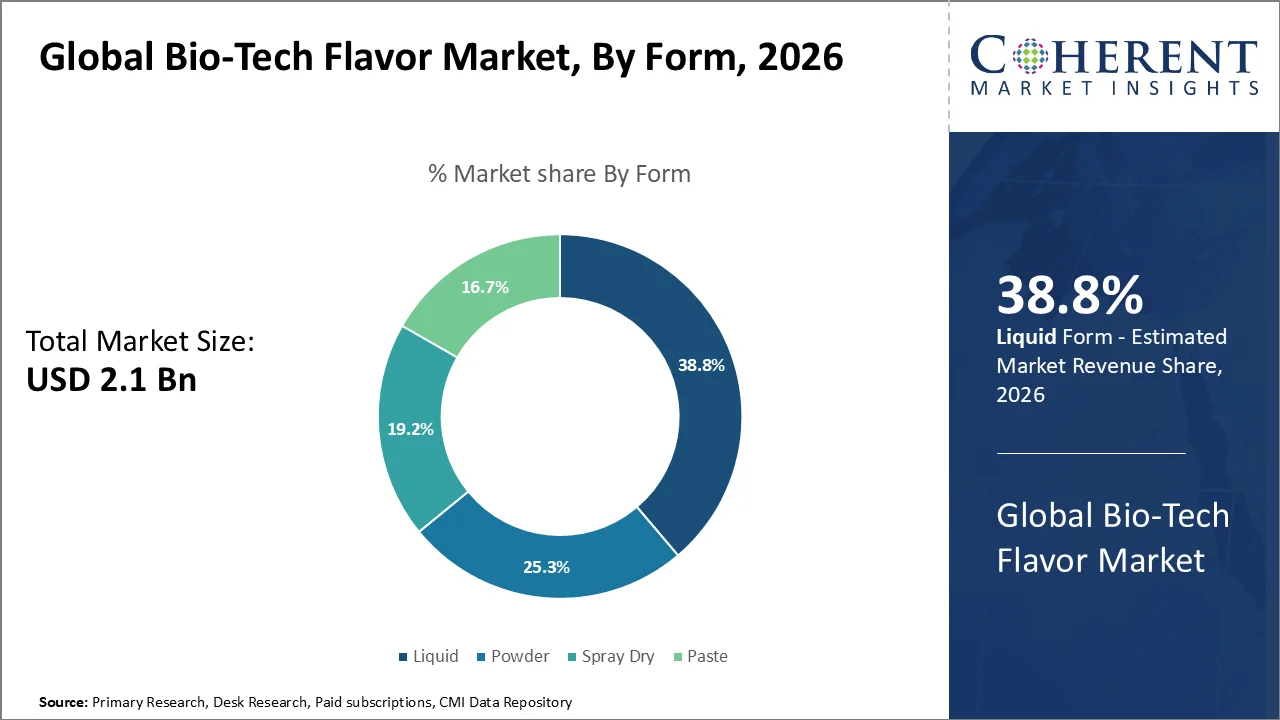
- Liquid expected to hold largest market share of 38.8% in 2026 owing to the rising demand from the food & beverage industry.
- Food acquired the largest market share of 41.1% in 2026 owing to its growing consumer preference for natural and clean-label foods.
- Fruit & Fruit Juice captures the largest market share of 39.9% in 2026 owing to the rising demand for natural fruit flavors. According to the National Institutes of Health (NIH), 15.6% of adults consume 100% fruit juice daily.
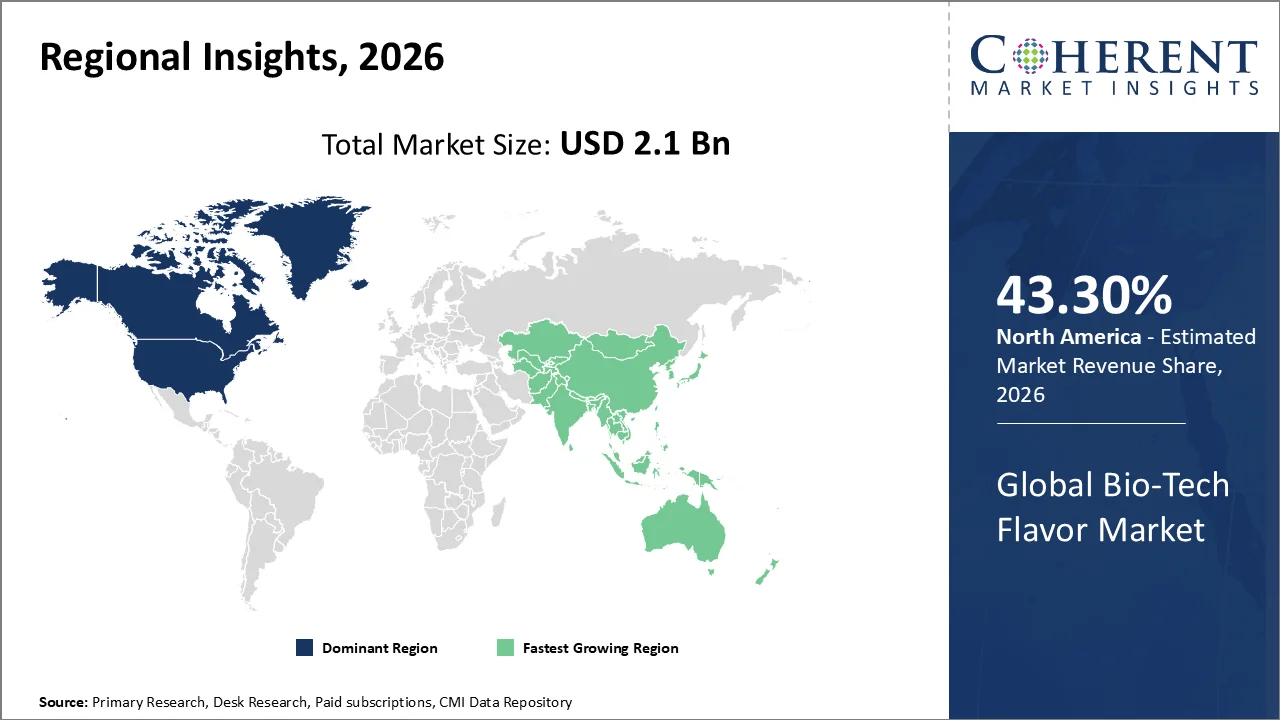
- North America is expected to acquire the dominant share of 43.3% in 2026 owing to its high demand for natural food products.
Current Events and Their Impact on the Bio-Tech Flavor Market
Current Event | Description and its Impact |
U.S. FDA Revokes Authorization for Brominated Vegetable Oil (BVO) |
|
China's Food Additive Standard (GB 2760) Updates |
|
Segmental Insights
- Current Industry Events of 2026
- Market Size Estimation
- Regional Breakdown
- Competitive Landscape
- Customer Intelligence
- Segmental Analysis
- Pricing Analysis
- Key Market Drivers, Challenges & Future Trends
- Customized Insights Section
Liquid expected to hold largest market share
Liquid expected to hold largest market share of 38.8% in 2026 owing to the preference for natural and clean-label products. Manufacturers are increasingly adopting liquid bio-tech flavors because they offer easy incorporation, excellent solubility, and consistent performance across food and beverage applications. They use liquid formulations in beverages, dairy products, sauces, and confectionery to achieve efficient blending and uniform flavor distribution. Advances in fermentation and enzyme technologies help companies enhance the quality, efficiency, and scalability of liquid flavor production. Rising consumer demand for natural and clean-label ingredients, along with the growth of functional beverages and sustainable production practices, continues to encourage manufacturers to expand the use of liquid bio-tech flavors. For instance, in June 2026, IFF unveiled Floral Fusion under its SENSORA platform, a light-activated pro-fragrance for liquid detergents that delivers a long-lasting, evolving floral scent experience on dry fabrics.
Why is Essential Oils Acquiring the Largest Market Share?
Essential Oils hold the largest market share of 42.2% in 2026. Manufacturers are increasingly adopting essential oils in the bio-tech flavor market to meet the growing demand for natural, sustainable, and high-quality flavor ingredients across food, beverages, nutraceuticals, and personal care products. They use biotechnology, including fermentation and enzyme-based processes, to produce consistent essential oil compounds while reducing dependence on seasonal crops and strengthening supply reliability. Consumers' preference for clean-label products and authentic flavors, along with continuous advancements in precision fermentation, is accelerating adoption. Companies also leverage these technologies to achieve sustainability goals and ensure reliable, scalable flavor production. For instance, in May 2026, G.M. Collin introduced a travel-size Puractive+ Essential Oil Complex, offering a convenient on-the-go solution to help maintain balanced, clear skin during summer.
Food acquired the largest market share
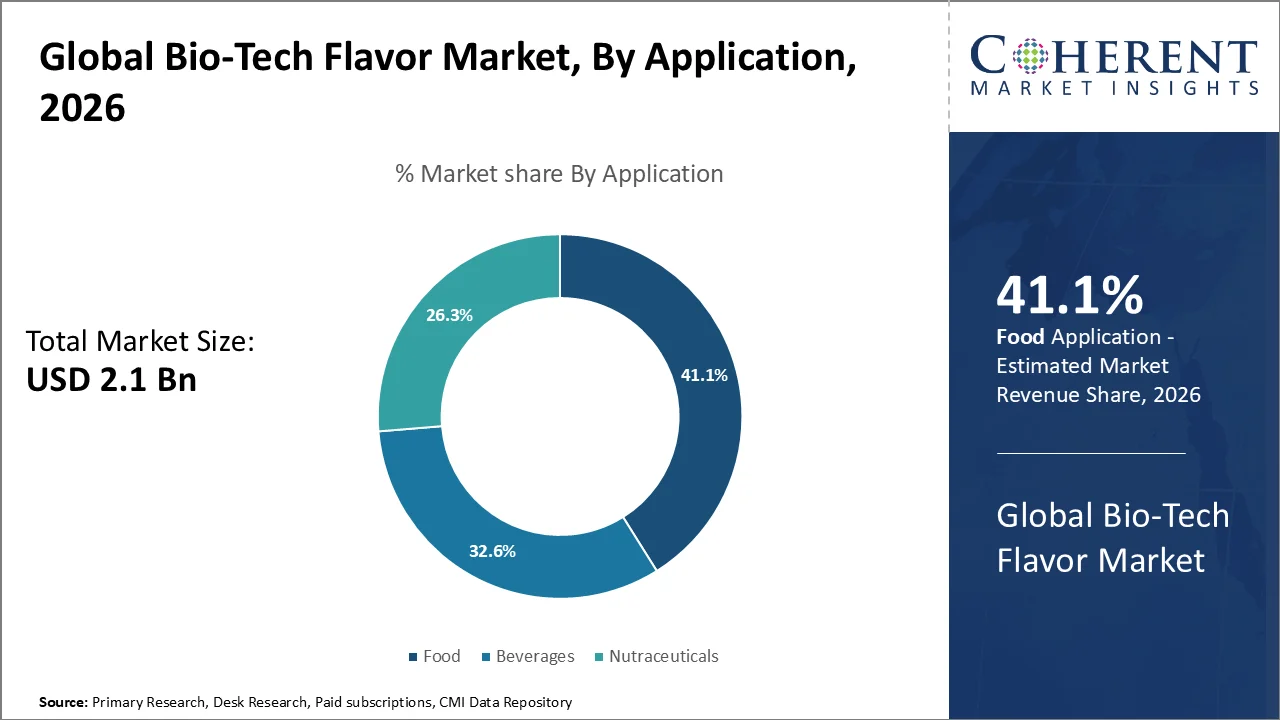
Food acquired the largest market share of 41.1% in 2026 owing to its expansion of the processed and convenience food industry. Food manufacturers are driving the growth of the bio-tech flavor market by increasing their use of natural, clean-label, and sustainable food flavor ingredients. They adopt biotechnology-based flavors to deliver consistent taste, enhance product quality, and reduce dependence on conventional flavor sources. Rising consumption of processed foods, plant-based products, functional foods, and premium food items further encourages market adoption. Companies leverage advances in fermentation and enzyme technologies to develop innovative flavor solutions that address changing consumer preferences and support sustainability objectives across the food industry. For instance, AKA Foods launched the first secure AI system for food innovation, backed by USD 17.2 million in seed funding, helping companies develop and launch products faster, smarter, and more affordably.
Fruit & Fruit Juice captures the largest market share
Fruit & Fruit Juice captures the largest market share of 39.9% in 2026 owing to the clean-label and health-conscious consumer trends. Food and beverage manufacturers are expanding the use of bio-tech flavors in the fruit and fruit juice segment to meet the growing demand for natural, authentic, and sustainable flavor solutions. They utilize biotechnology-based fruit flavors to maintain consistent taste, enhance product quality, and address limitations caused by seasonal fruit availability. Companies are responding to consumer preferences for clean-label juices, functional beverages, and healthier drink options by adopting innovative flavor technologies. Advances in fermentation and enzyme processes help manufacturers produce high-quality fruit flavors efficiently while meeting evolving market expectations.
Bio-Tech Flavor Market Trends
- Growing demand for natural and clean-label flavors is accelerating market adoption as consumers increasingly prefer recognizable and naturally derived ingredients. According to the International Food Information Council, 62% of U.S. consumers consider it important that foods and beverages are made with natural ingredients, supporting the shift toward biotechnology-derived natural flavors.
- Rising popularity of plant-based foods and functional beverages is expanding opportunities for bio-tech flavors. According to PBFA, 70% of U.S. consumers eat plant-based foods, up from 66% in 2022. In 2022, plant-based foods were consumed by 60% of U.S. households.
- Regulatory support and investments in biotechnology are accelerating commercialization. The U.S. Executive Order 14081 on Advancing Biotechnology and Biomanufacturing Innovation promotes domestic biomanufacturing and sustainable bio-based products, while the EU Novel Foods Regulation (EU) 2015/2283 provides a regulatory pathway for fermentation-derived food ingredients, supporting the commercialization of bio-tech flavor solutions.
Regional Insights
North America dominates owing to strong investment in research and development
North America is expected to acquire the dominant share of 43.30% in 2026. Food, beverage, and nutraceutical manufacturers in North America are accelerating the adoption of bio-tech flavors to meet rising demand for natural, clean-label, and sustainable flavor ingredients. Companies are leveraging advanced biotechnology methods, including precision fermentation and enzyme-based production, to create innovative and consistent flavor solutions. The region’s strong food and beverage sector, increasing consumer preference for plant-based products, focus on sustainable practices, and continuous investments in research and development are driving market growth and expanding the use of bio-tech flavors. For instance, in May 2026, T. Hasegawa USA launched advanced powdered flavor technology that helps food and beverage brands recreate authentic milk taste without using dairy ingredients.
Asia Pacific Bio-Tech Flavor Market Trends
Consumers across Asia Pacific are increasingly driving the Bio-Tech Flavor Market by seeking natural, clean-label, and sustainable flavor solutions. Growing health and wellness awareness encourages consumers to choose biotechnology-based ingredients instead of synthetic alternatives. Food and beverage companies expand their offerings, respond to evolving dietary preferences, and adopt advanced fermentation and enzyme technologies to support market development. Manufacturers also invest in research capabilities and develop customized flavors to meet diverse regional tastes, which further accelerates the adoption of bio-tech flavors throughout Asia Pacific.
United States Bio-Tech Flavor Market Trends
Consumers in the United States are driving the bio-tech flavor market by increasing their demand for natural, clean-label, and sustainable flavor solutions. Food and beverage manufacturers are adopting biotechnology-based production methods to meet the growing need for functional foods, beverages, and plant-based products. Companies are advancing fermentation technologies, investing in food innovation, and leveraging strong research capabilities to expand market opportunities. Changing dietary preferences, the demand for healthier ingredients, and supportive regulations are motivating businesses to develop innovative bio-derived flavors for various applications. For instance, TOSLA launches its ready-to-market vegan Signaling Collagen Shot, featuring Geltor’s PrimaColl biomimetic type 21 signaling collagen polypeptide.
China Bio-Tech Flavor Market Trends
Chinese consumers are increasing demand for natural, sustainable, and health-focused food ingredients, which drives the bio-tech flavor market. Food and beverage companies are adopting biotechnology-based flavor solutions to create clean-label products and innovative formulations. Researchers and manufacturers are advancing fermentation technologies, expanding scientific activities, and utilizing government support for biotechnology development to strengthen market growth. The rising popularity of plant-based foods, functional beverages, and premium food products encourages companies to develop bio-derived flavors that meet changing consumer preferences and industry requirements.
Who are the Major Companies in Bio-Tech Flavor Industry
Some of the major key players in Bio-Tech Flavor are Givaudan S.A, International Flavors & Fragrances Inc., Firmenich SA, Symrise AG, Takasago International Corporation, Sensient Technologies Corporation, Kerry Group, and Frutarom Industries Ltd.
Key News
- In March 2025, Isobionics, a BASF Aroma Ingredients brand, launched two natural flavor ingredients, beta-Sinensal 20 and alpha-Humulene 90, produced through an advanced fermentation process.
Market Report Scope
Bio-Tech Flavor Market Report Coverage
| Report Coverage | Details | ||
|---|---|---|---|
| Base Year: | 2025 | Market Size in 2026: | USD 2.1 Bn |
| Historical Data for: | 2020 To 2024 | Forecast Period: | 2026 To 2033 |
| Forecast Period 2026 to 2033 CAGR: | 5.2% | 2033 Value Projection: | USD 3.9 Bn |
| Geographies covered: |
| ||
| Segments covered: |
| ||
| Companies covered: | Givaudan S.A, International Flavors & Fragrances Inc., Firmenich SA, Symrise AG, Takasago International Corporation, Sensient Technologies Corporation, Kerry Group, and Frutarom Industries Ltd. | ||
Analyst Opinion
- The bio-tech flavor market is being shaped by a fundamental shift in how consumers and food manufacturers approach flavor development. This market is not expanding solely due to clean-label trends; it is gaining momentum because biotechnology enables companies to address critical industry challenges, including ingredient sustainability, supply chain volatility, and the need for consistent natural flavor production. For example, precision fermentation allows manufacturers to produce complex flavor compounds that traditionally rely on limited botanical sources, creating more reliable and scalable alternatives.
- Biotechnology-based flavor production is gaining industry acceptance as major food companies increase investment in alternative ingredient technologies. Companies such as Ginkgo Bioworks and International Flavors & Fragrances are advancing fermentation and biotechnology platforms to develop sustainable flavor ingredients. The growing adoption of microbial fermentation demonstrates that the industry is moving beyond experimental applications toward commercial-scale flavor innovation.
- Consumer demand for natural ingredients continues to influence product development, with surveys indicating that a large share of global consumers actively seek food products with recognizable and sustainable ingredients. In response, manufacturers are replacing traditional synthetic flavoring approaches with bio-derived solutions that support transparency, environmental responsibility, and product differentiation. Analysts believe companies that successfully combine biotechnology with sensory performance will gain a competitive advantage as food brands prioritize next-generation ingredient solutions.
- The strongest growth opportunities are expected in applications such as plant-based foods, functional beverages, and premium nutrition products, where flavor quality remains a major barrier to consumer acceptance. For instance, biotechnology-driven flavor systems help improve the taste profiles of alternative proteins and health-oriented beverages, addressing one of the biggest challenges limiting repeat purchases. The market’s future direction will depend less on flavor availability and more on the ability of companies to deliver scalable, cost-efficient, and consumer-approved bio-based flavor innovations.
Speak to the analyst
Want personalized insights?
Take the findings above to one of our principal consultants, or have the report rebuilt around the segments, geographies and competitors you actually track.
Market Segmentation
- By Flavor Type
- Vanilla & Vanillin
- Fruity Flavor
- Microbial Produced Flavor
- Essential Oils
- By Form
- Liquid
- Powder
- Spray Dry
- Paste
- By Application
- Food
- Dairy Product
- Bakery Products
- Confectionery Products
- Savory
- Beverages
- Alcoholic
- Non-Alcoholic
- Nutraceuticals
- Food
- By Source
- Fruit & Fruit Juice
- Berries
- Citrus
- Drupes
- Pepos
- Pomes
- Others
- Vegetable & Vegetable juice Plant & Botanical
- Spices
- Herbs
- Others
- Meat & Seafood
- Meat & Poultry
- Seafood
- Dairy
- Dairy products
- Edible East
- Fruit & Fruit Juice
- By Region
- North America
- U.S.
- Canada
- Latin America
- Brazil
- Mexico
- Argentina
- Rest of Latin America
- Europe
- Germany
- U.K.
- France
- Italy
- Spain
- Russia
- Rest of Europe
- Asia Pacific
- China
- India
- Japan
- Australia
- South Korea
- ASEAN
- Rest of Asia Pacific
- Middle East
- GCC
- Israel
- Rest of Middle East
- Africa
- South Africa
- Central Africa
- North Africa
- North America
Sources
Primary Research interviews
- Interviews with industry participants including biotechnology researchers, flavor scientists, food technologists, product development professionals, regulatory experts, and executives from flavor, food, and biotechnology companies.
- Discussions with academic researchers and professionals involved in precision fermentation, microbial fermentation, natural flavor development, and alternative ingredient innovation.
Databases
- U.S. Food and Drug Administration (FDA) databases and regulatory resources.
- European Food Safety Authority (EFSA) databases and scientific opinions.
- United States Department of Agriculture (USDA) databases.
- Food and Agriculture Organization (FAO) databases.
- World Health Organization (WHO) food safety databases.
- PubMed and other scientific literature databases.
- Patent databases including the United States Patent and Trademark Office (USPTO) and European Patent Office (EPO).
Magazines
- Food Technology Magazine.
- Food Navigator.
- Food Ingredients First.
- The World of Food Ingredients.
- Nutraceuticals World.
- New Food Magazine.
Journals
- Journal of Agricultural and Food Chemistry.
- Food Chemistry.
- Trends in Food Science & Technology.
- Innovative Food Science & Emerging Technologies.
- Journal of Food Science.
- Applied and Environmental Microbiology.
- Biotechnology Advances.
- Nature Biotechnology.
Newspapers
- The New York Times (Food and Science sections).
- The Wall Street Journal (Food and Technology coverage).
- The Guardian (Food and Environment coverage).
- Financial Times (Food Innovation and Biotechnology coverage).
- The Economic Times (Food and Biotechnology coverage).
Associations
- Institute of Food Technologists (IFT).
- International Food Information Council (IFIC).
- Food and Agriculture Organization (FAO).
- International Union of Food Science and Technology (IUFoST).
- American Society for Microbiology (ASM).
- Biotechnology Innovation Organization (BIO).
- International Flavors & Fragrances industry associations and professional networks.
Public Domain sources
- Government publications and regulatory filings from FDA, EFSA, USDA, FAO, and WHO.
- Scientific publications and open-access research articles.
- Company annual reports, investor presentations, and sustainability reports.
- Patent filings and intellectual property databases.
- Conference proceedings and publicly available technical reports.
Proprietary Elements
- CMI Data Analytics Tool
- Proprietary CMI Existing Repository of information for last 10 years.
Get access to 250+ pages report
Every segment, forecast, competitor profile and data table behind the analysis above — available for instant download.
- ESOMAR Member
- ISO 9001:2015 Certified
- D-U-N-S Registered
- GDPR & CCPA Compliant
Missing comfort of reading report in your local language? Find your preferred language:
Transform your Strategy with Exclusive Trending Reports
Frequently Asked Questions
The Bio-Tech Flavor Market is anticipated to grow at a CAGR of 5.2% with USD 2.1 Bn share in 2026 and is expected to reach USD 3.9 Bn in 2033.
Unfavourable weather condition and growing demand for high-quality food ingredient is fuelling growth of the market.
The food segment is the leading application segment in the market.
Low shelf-life and high cost of the raw material is expected to hinder growth of the market.
Major players operating in the market include, Givaudan S.A, International Flavors & Fragrances Inc., Firmenich SA, Symrise AG, Takasago International Corporation, Sensient Technologies Corporation, Kerry Group, and Frutarom Industries Ltd
North America region is expected to hold dominant position in the market over the forecast period. The growth of the market in the region owing to wide demand for RTD food products.