

Infrared Thermometer Market Analysis & Forecast: 2026-2033
Infrared Thermometer Market is estimated to be valued at USD 17.22 Bn in 2026 and is expected to reach USD 28.20 Bn in 2033, exhibiting a compound annual growth rate (CAGR) of 7.3% from 2026 to 2033.
Key Takeaways
- By Technology Type, the Handheld infrared thermometers are projected to lead the global infrared thermometer market with a notable 31% share in 2026. This growth is driven by its non-contact functionality, which enhances infection control, especially in clinical and public environments.
- North America is expected to remain the dominant region in the global infrared thermometer market, holding a substantial 47.1% share in 2026. This dominance is supported by a well-developed healthcare infrastructure, early adoption of advanced diagnostic tools, and a strong emphasis on public health safety protocols.
Market Overview
The global infrared thermometer market is experiencing robust growth, driven by rising demand for non-contact temperature measurement, heightened hygiene awareness, and advancements in infrared sensing technology. Handheld thermometers are widely used in hospitals, clinics, airports, and households due to their speed and ease of use. The healthcare sector remains the primary end user, with growing applications in emergency care and preventive screening.
Current Events and its Impact on the Infrared Thermometer Market
Current Event | Description and its impact |
Regulatory Developments and Certifications |
|
Market Expansion and Public Health Initiatives |
|
Technological Integrations and Innovation |
|
Pipeline Analysis – Infrared Thermometer Market
The pipeline for the infrared thermometer market is steadily expanding, driven by ongoing advancements in sensor accuracy, wireless integration, and multi-use capabilities. Several leading medical device manufacturers and tech start-ups are developing next-generation models featuring AI-assisted diagnostics, cloud connectivity, and multi-parameter vital sign monitoring. Upcoming launches are expected to focus on wearable infrared sensors and smartphone-integrated thermometers tailored for home use and remote patient monitoring.
A key innovation gaining traction is the infrared thermometer with memory function, which allows users and healthcare providers to track temperature trends over time an essential feature for chronic illness management, pediatric monitoring, and post-operative care. This function enhances both convenience and clinical value, particularly in home healthcare and telemedicine scenarios.
Notably, R&D investments are increasingly directed toward miniaturization of infrared sensors, enabling seamless integration into wearable fitness devices, pediatric care tools, and neonatal applications. In parallel, academic institutions and corporate R&D centres are collaborating on enhancing real-time data sharing and interoperability with electronic health records (EHRs).
The pipeline is particularly active in the U.S., Germany, China, and Japan, where regulatory pathways are supporting the fast-tracking of digital health innovations. These developments suggest a strong future for smart, contactless thermometry including infrared thermometers with memory function in both healthcare and consumer markets.
- Current Industry Events of 2026
- Market Size Estimation
- Regional Breakdown
- Competitive Landscape
- Customer Intelligence
- Segmental Analysis
- Pricing Analysis
- Key Market Drivers, Challenges & Future Trends
- Customized Insights Section
Patent Landscape – Infrared Thermometer Market
The infrared thermometer market features a dynamic and evolving patent landscape, reflecting increased innovation in non-contact temperature sensing, sensor miniaturization, and AI integration. Major players such as Exergen Corporation, Omron Healthcare, Braun GmbH, and Withings hold numerous patents related to infrared sensor calibration, dual-mode temperature detection, and wearable thermometry technologies.
Recent patent filings indicate a shift toward smart thermometers with Bluetooth or Wi-Fi connectivity, enabling integration with mobile apps and telehealth platforms. Notable innovations include multi-spot infrared sensing, ambient temperature compensation, and real-time data analytics to enhance fever screening accuracy.
China, the United States, and Japan lead in the number of filings, supported by strong R&D ecosystems and government-backed health tech initiatives. The growing volume of intellectual property registrations in both consumer and clinical thermometry suggests a highly competitive environment, with companies focusing on differentiation through digital functionality, user comfort, and diagnostic precision.
Reimbursement Scenario – Infrared Thermometer Market
Reimbursement for infrared thermometers is typically indirect, linked to broader telehealth and remote patient monitoring (RPM) frameworks rather than direct device funding. In the U.S., Medicare and Medicaid increasingly offer payment parity for telehealth services, including temperature monitoring, under expanded CPT and RPM codes. Over 40 states mandate private insurer parity for telehealth reimbursement.
However, Medicare requires that remote monitoring devices be used as part of a reimbursable service, meaning standalone thermometers generally aren’t directly reimbursed—coverage is bundled into telehealth consultations or chronic care management plans. The device must either fit within existing CPT/RPM billing codes or be part of a value-based care bundle demonstrating improved outcomes.
In Europe and Australia, telehealth monitoring may be reimbursed at parity with in-person care, but device-specific reimbursement is rare. Manufacturers should focus on positioning infrared thermometers as clinical tools within reimbursable care pathways, rather than standalone products.
Prescribers’ Preference – Infrared Thermometer Market
Healthcare professionals increasingly prefer infrared thermometers due to their non-contact operation, quick response time, and reduced risk of cross-infection. In clinical settings such as emergency departments, pediatric clinics, and elder care facilities, prescribers favor handheld and forehead infrared models for their ease of use and hygiene benefits, especially in high-turnover environments.
Physicians also value infrared thermometers with digital displays, data logging, and integration with electronic health records (EHRs) for accurate, real-time monitoring. These features enhance diagnostic efficiency and streamline patient documentation. In pediatric and geriatric care, clinicians often opt for ear or forehead infrared thermometers due to their comfort and reliability in temperature assessment without disturbing the patient.
With the rise of telemedicine and remote patient monitoring, prescribers increasingly recommend smart infrared thermometers for home use, supporting early detection of febrile symptoms. Overall, prescriber preferences are shifting toward technologically advanced, contactless, and clinically validated devices.
Infrared Thermometer Market Trends
- Increasing product launches by key market players
Increasing organic growth strategies such as product launches to expand its product portfolio is expected to boost the growth of the market over the forecast period. For instance, in May 2020, Neptune Wellness Solutions Inc., a leader in natural health and wellness products, announced the launch of Neptune Air, a non-contact infrared thermometer (NCIT) optimized for measuring a person's temperature while reducing cross-contamination risk and minimizing the risk of spreading disease.
- Increasing partnership by the market players
Increasing inorganic growth strategies such as partnership & acquisition by the market players to expand its product portfolio is expected to foster the market growth over the forecast period.
For instance, in January 2020, LumaSense Technologies, provides gas and temperature sensing solutions, announced the distribution partnership with LIMAB U.K., a leading distributor of non-contact laser, for distribution of its range of infrared thermometers and thermal imagers for industrial markets in the U. K. and Ireland.
In June 2025, The Times of India listed the contactless infrared thermometer as one of the “7 essential medical gadgets” recommended during a resurgence in India. Its non-contact feature was emphasized as crucial for safe home monitoring of body temperature.
Segmental Insights
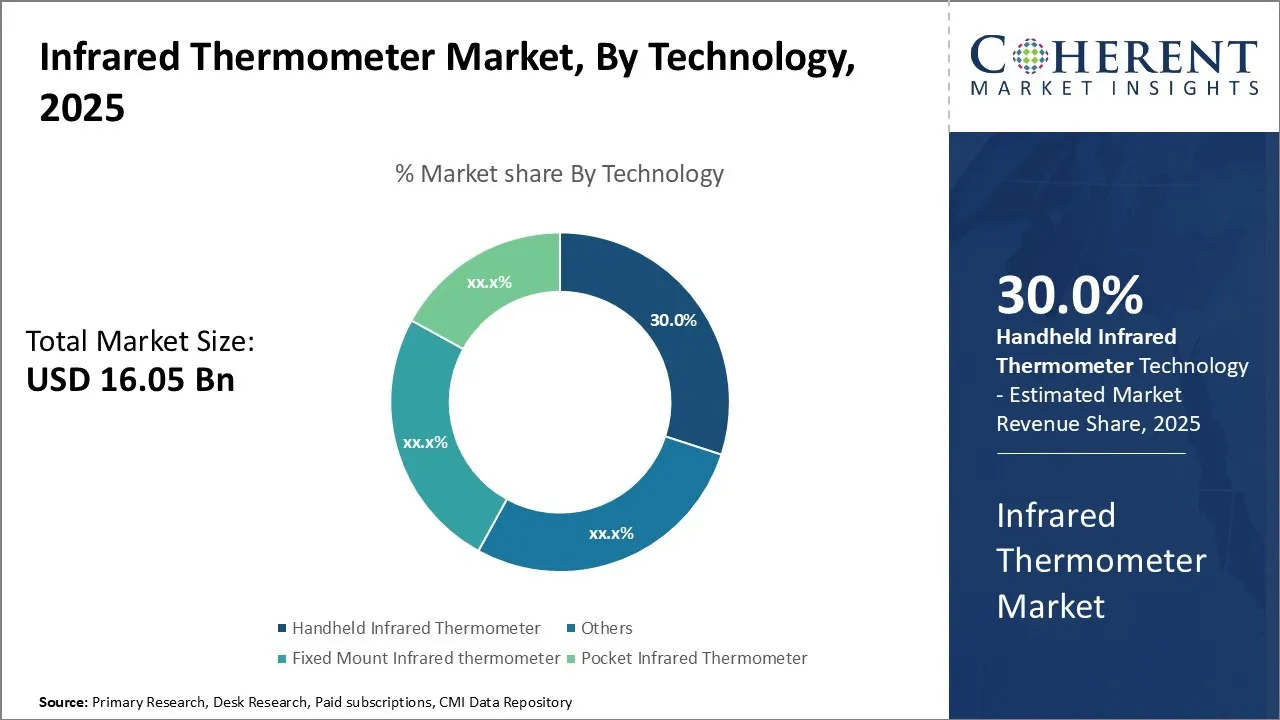
Global Infrared Thermometer Market Insights, By Technology Type
Handheld infrared thermometers are projected to dominate the global infrared thermometer market with a notable 31.0% share in 2026. Their portability, affordability, and fast-read capabilities make them a preferred option for healthcare professionals, airport security, schools, and home users. As frontline temperature screening tools, handheld models enable rapid fever detection with minimal disruption and physical interaction.
Continuous innovation in infrared sensing accuracy, user-friendly interface design, and wireless integration with digital health platforms is further solidifying their place in diverse healthcare and consumer applications. With growing global focus on preventive care and early health diagnostics, handheld infrared thermometers are expected to maintain their leadership in the technology segment, serving both medical and non-medical end users efficiently.
Regional Insights
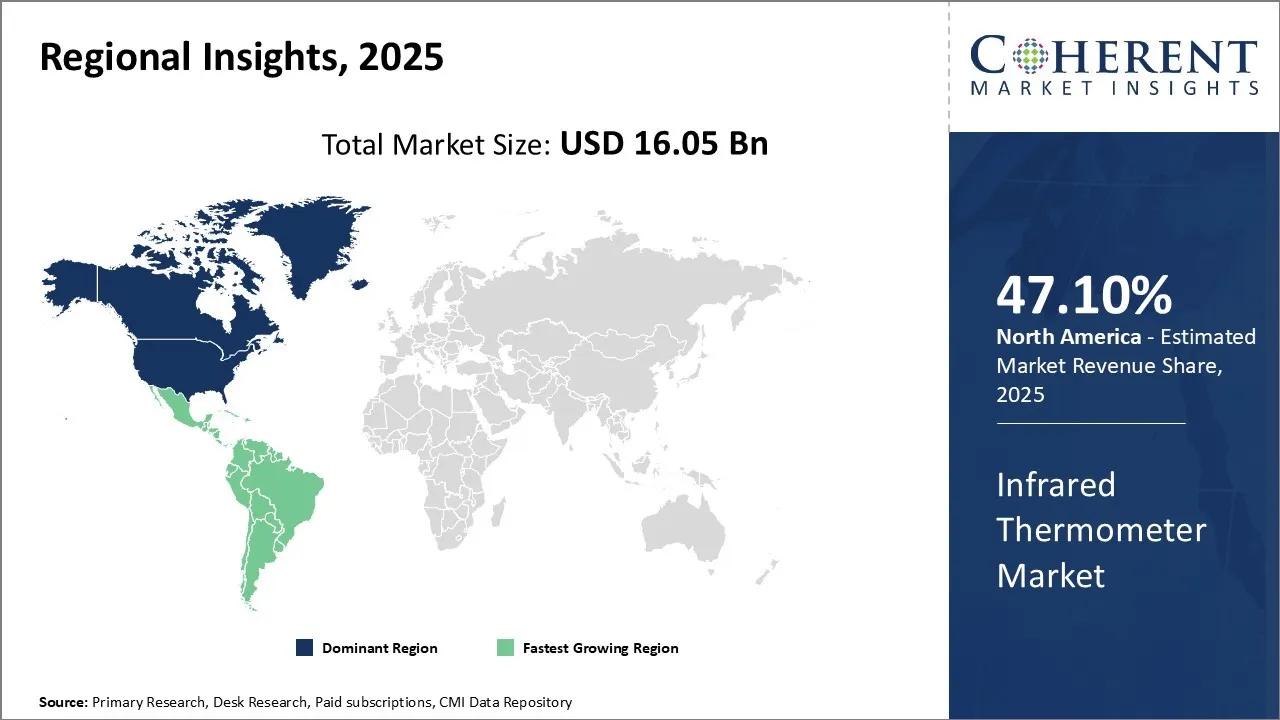
North America Infrared Thermometer Market Trends and Analysis
North America is expected to remain the dominant region in the global infrared thermometer market, holding a substantial 47.10% share in 2026. This regional dominance is supported by a well-established healthcare infrastructure, high per capita healthcare spending, and early adoption of non-contact diagnostic technologies that align with public health and infection control priorities.
The United States, in particular, has seen widespread integration of infrared thermometers for body temperature measurement across emergency departments, elder care facilities, airports, workplaces, and schools as part of routine screening protocols. These devices have become essential tools for quickly and accurately detecting fever without physical contact, minimizing the risk of cross-contamination.
The presence of key manufacturers and swift regulatory clearances from agencies like the U.S. FDA have ensured faster product deployment and innovation in design and functionality. Growing demand for digital, accurate, and rapid temperature assessment tools especially among the aging population and chronic disease patients has strengthened the market.
Ongoing investments in digital health platforms, remote patient monitoring, and infection prevention technologies further reinforce North America’s leadership in the global infrared thermometer of body temperature landscape.
Infrared Thermometer Market Dominating Countries
United States and Canada
The United States leads the global infrared thermometer market, driven by its advanced healthcare ecosystem, high adoption of non-contact diagnostic tools, and strong public health policies emphasizing infection prevention and control. The country's rapid deployment of infrared thermometers across hospitals, urgent care centres, schools, airports, and corporate offices has set global benchmarks for mass screening and early fever detection.
Leading U.S.-based manufacturers and health-tech start-ups continue to innovate in smart thermometer technology, integrating features such as Bluetooth connectivity, AI-based temperature trend analysis, and telehealth compatibility. Favourable regulatory support from agencies like the FDA, combined with substantial healthcare spending, reinforces the U.S.'s market dominance.
Canada complements the U.S. with its publicly funded healthcare system that prioritizes preventive diagnostics and remote care access. The Canadian government’s investment in expanding community health centres and rural clinics has driven demand for portable and contactless thermometry solutions, especially in remote and underserved regions.
Canada’s increasing focus on telemedicine, elder care, and school health programs supports widespread adoption of infrared thermometers. Together, the U.S. and Canada anchor North America’s leadership in the global infrared thermometer market, promoting innovation, accessibility, and public safety at scale.
Market Report Scope
Infrared Thermometer Market Report Coverage
| Report Coverage | Details | ||
|---|---|---|---|
| Base Year: | 2025 | Market Size in 2026: | USD 17.22 Bn |
| Historical Data for: | 2020 To 2024 | Forecast Period: | 2026 To 2033 |
| Forecast Period 2026 to 2033 CAGR: | 7.3% | 2033 Value Projection: | USD 28.20 Bn |
| Geographies covered: |
| ||
| Segments covered: |
| ||
| Companies covered: | Thermo Fisher Scientific Inc., Exergen Corporation, Ra Lifecare Pvt Ltd, OMRON Corporation, OMEGA Engineering inc., Morepen laboratories Limited, CP PLUS International, MGL Euman, Fluke Corporation, SG Corporate Mobility Pvt Ltd., BPL Medical Technologies, Lifeline Medical Inc., Contec Medical Systems, Paul Hartmann AG, Welch Allyn, Microlife Corporation, Geratherm Medical AG | ||
| Growth Drivers: |
| ||
| Restraints & Challenges: |
| ||
Analyst Viewpoint – Infrared Thermometer Market
- The global infrared thermometer market growth is expected to witness stable and long-term growth, driven by increasing demand for non-contact diagnostic tools, heightened infection control measures, and the expansion of telehealth services.
- Analysts note a strong preference among healthcare providers and consumers for handheld and wearable infrared thermometers, which offer fast, accurate, and hygienic temperature readings. The ongoing digital transformation in healthcare is also boosting the adoption of smart thermometers integrated with mobile apps and electronic health records (EHRs).
- Technological advancements such as AI-assisted temperature analytics, multi-parameter sensors, and cloud connectivity are making infrared thermometers more versatile and valuable in both clinical and homecare settings. Analysts emphasize that North America remains the largest market due to early technology adoption, while Asia Pacific is emerging as a high-growth region due to increasing healthcare access.
- Going forward, market players that focus on accuracy, affordability, and digital integration will lead in this competitive and innovation-driven landscape.
Infrared Thermometer Market: Key Development
- In November 2020, FLIR announced the introduction of FLIR SV87-KIT, which offers a low-cost and essay to configure vibration and temperature sensing system that is used in industrial applications.
- In October 2020, CHINO Corporation launched the IR-CZ radiation thermometer. This is used to measure the middle-to-high temperature range.
Market Segmentation
- Global Infrared Thermometer Market, By Technology (Revenue, USD Bn, 2021 - 2033)
- Handheld Infrared Thermometer
- Fixed Mount Infrared Thermometer
- Pocket Infrared Thermometer
- Others
- Global Infrared Thermometer Market, By End User (Revenue, USD Bn, 2021 - 2033)
- Diagnostic Clinics
- Hospitals
- Research Organization
- Others
- Global Infrared Thermometer Market , By Region
- North America
- U.S.
- Canada
- Latin America
- Brazil
- Mexico
- Argentina
- Rest of Latin America
- Europe
- Germany
- U.K.
- France
- Italy
- Spain
- Russia
- Rest of Europe
- Asia Pacific
- China
- India
- Japan
- Australia
- South Korea
- ASEAN
- Rest of Asia Pacific
- Middle East
- GCC
- Israel
- Rest of Middle East
- Africa
- Central Africa
- North Africa
- Central Africa
- North America
- Company Profiles
- Thermo Fisher Scientific Inc.
- Allied Healthcare Products, Inc.
- Exergen Corporation
- Ra Lifecare Pvt Ltd
- OMRON Corporation
- OMEGA Engineering inc.
- Morepen laboratories Limited
- CP PLUS International
- MGL Euman
- Fluke Corporation
- SG Corporate Mobility Pvt Ltd.
- BPL Medical Technologies
- Lifeline Medical Inc.
- Contec Medical Systems
- Paul Hartmann AG
- Welch Allyn
- Microlife Corporation
- Geratherm Medical AG
Sources
The Stakeholders Consulted
- Medical device manufacturers and OEMs
- Infrared sensor and thermal imaging technology providers
- Hospital procurement managers and clinical engineers
- Public health officials and infection control specialists
- Distributors and wholesalers of diagnostic devices
- Telemedicine and remote patient monitoring professionals
- Regulatory bodies and healthcare compliance advisors
- Researchers from academic institutions specializing in biomedical instrumentation
- End-users across sectors such as healthcare, homecare, industrial safety, transportation hubs, and educational institutions
Databases Opened
- U.S. Food & Drug Administration (FDA) – 510(k) Medical Devices Database
- Centers for Medicare & Medicaid Services (CMS) – Device Reimbursement Data
- Ministry of Health and Family Welfare (India) – Medical Equipment Procurement Reports
- World Bank Open Data – Health Infrastructure Metrics
Magazines & Trade Publications
- Medical Design & Outsourcing
- MedTech Insight
- Healthcare Business Today
- HealthTech Magazine
- Medical Device and Diagnostics Industry (MD+DI)
- BioSpectrum – Medical Devices Section
Scientific and Industry Journals
- Journal of Medical Systems
- IEEE Transactions on Biomedical Engineering
- Sensors and Actuators B Chemical
- Journal of Clinical Monitoring and Computing
- Thermology International
Newspapers & Media Outlets
- The Wall Street Journal – Healthcare & Devices
- Bloomberg – Medical Devices and Diagnostics
- Reuters Health
- The Economic Times – Healthcare & Lifesciences
- Business Standard – MedTech Innovations
Associations and Regulatory Bodies
- U.S. Food and Drug Administration (FDA)
- Centers for Disease Control and Prevention (CDC)
- World Health Organization (WHO)
- International Organization for Standardization (ISO – Medical Thermometry Standards)
- Indian Council of Medical Research (ICMR)
Public Domain Sources
- U.S. National Institutes of Health (NIH) – Device Clinical Trials
- European Commission – Health Technology Assessments
- World Bank – Global Health Spending Reports
- National Health Service (NHS, UK) – Digital Health Equipment Data
Proprietary Research Elements
- CMI Data Analytics Tool
- Proprietary CMI Repository of Market Data (covering past 8 years)
- CMI Expert Interviews and Transcripts (focused on diagnostic equipment usage, procurement trends, and digital health adoption)
*Definition: An infrared thermometer is a sensor that consists of a lens to focus the infrared (IR) energy on a detector, which converts the energy to an electrical signal that can be displayed in units of temperature after being compensated for ambient temperature variation.Infrared thermometers have many applications for monitoring various temperature functions. For instance, the infrared thermometer is useful for recording the temperature of patients in hospitals without touching them. At the time of an epidemic or pandemic of diseases that cause fever among the population, such as the SARS coronavirus and Ebola virus disease, infrared thermometers are used to check arriving travelers for fever. The infrared thermometer is useful for measuring temperature under circumstances where thermocouples or other probe type sensors cannot be used or do not produce accurate data for a variety of reasons.
Get access to 250+ pages report
Every segment, forecast, competitor profile and data table behind the analysis above — available for instant download.
- ESOMAR Member
- ISO 9001:2015 Certified
- D-U-N-S Registered
- GDPR & CCPA Compliant
Missing comfort of reading report in your local language? Find your preferred language:
Transform your Strategy with Exclusive Trending Reports
Frequently Asked Questions
The Infrared Thermometer Market size is estimated to be valued at USD 17.22 Bn in 2026, and is expected to reach USD 28.20 Bn by 2033.
The CAGR of the global Market is projected to be 7.3% from 2026 to 2033.
Increasing products launches by the market players and increasing inorganic growth strategies such as partnership & acquisition by the key market players is expected to drive the market growth.
Technology is the leading segment in the market.
Limitation of infrared thermometer, disadvantages of infrared thermometer and product recall are expected to hinder the market over the forecast period.
Major players operating in the market include Thermo Fisher Scientific Inc., Exergen Corporation, Ra Lifecare Pvt Ltd, OMRON Corporation, OMEGA Engineering inc., Morepen laboratories Limited, CP PLUS International, MGL Euman, Fluke Corporation, SG Corporate Mobility Pvt Ltd., BPL Medical Technologies, Lifeline Medical Inc., Contec Medical Systems, Paul Hartmann AG, Welch Allyn, Microlife Corporation, and Geratherm Medical AG.
Infrared thermometers are generally accurate within ±0.5°F (±0.3°C) but can be less reliable due to external factors like distance and surface conditions. Traditional contact thermometers offer more consistent core temperature readings, especially for clinical use.