

Ion Exchange Membrane Market Analysis & Forecast: 2026-2033
Global ion exchange membrane market is estimated to be valued at USD 1,374.3 Mn in 2026 and is expected to reach USD 2,025.9 Mn by 2033, exhibiting a compound annual growth rate (CAGR) of 5.7% from 2026 to 2033.
Key Takeaways
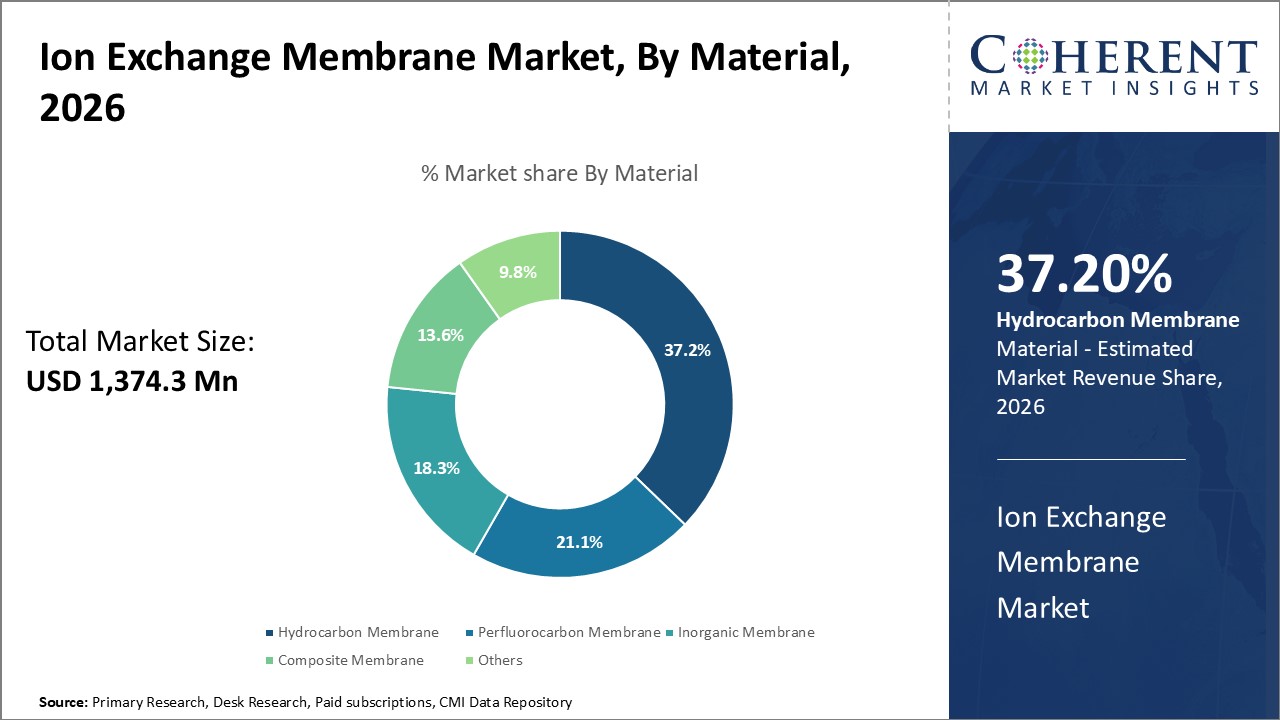
- By material, hydrocarbon membranes account for the largest share of the ion exchange membrane market, holding 37.2% in 2026. Their dominance is driven by cost-effectiveness, ease of processing, and broad application across water treatment, energy generation, and separation technologies.
- In terms of charge, cation segment is estimated to contribute the 34.9% share of the market in 2026, due to its widespread adoption in water treatment.
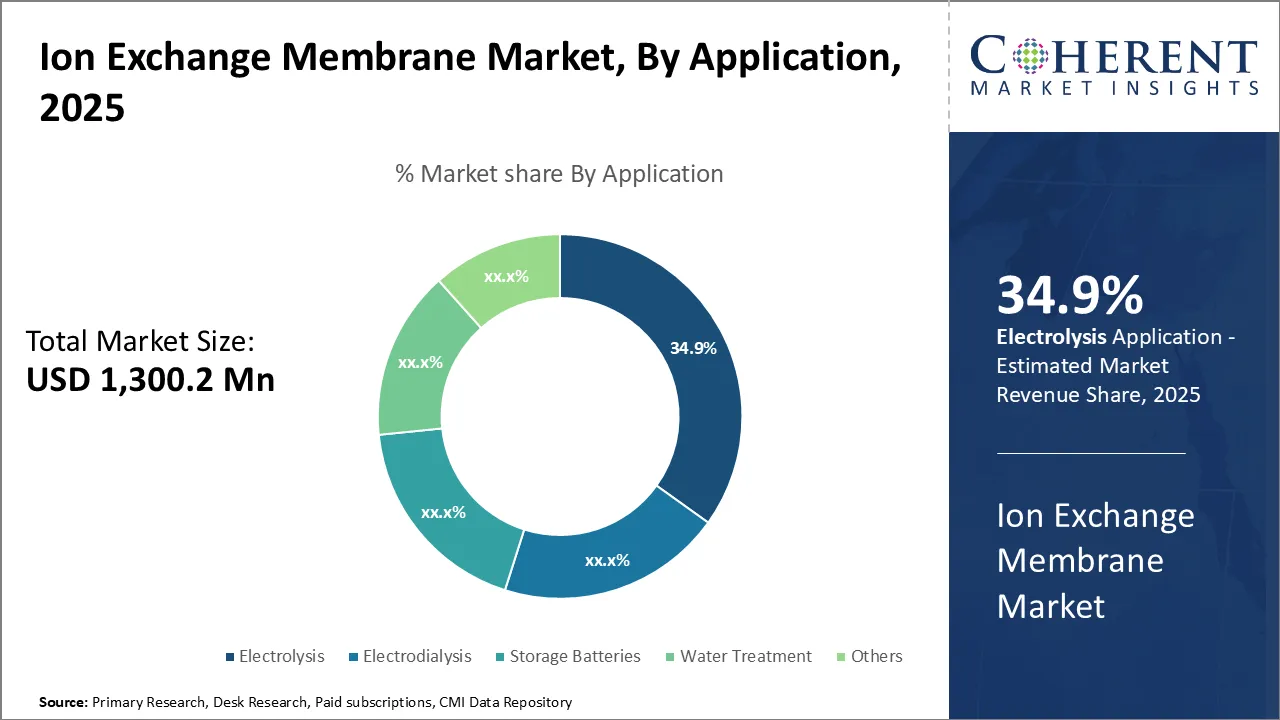
- In terms of application, electrolysis segment is estimated to contribute the 35.9% share of the market in 2026, owing to benefits it provides over alternative processes.
- By end-use industry, water treatment represents the largest share of the ion exchange membrane market, accounting for a significant portion in 2026. The dominance of this segment is driven by the rising global demand for clean and safe drinking water, coupled with growing investment in desalination plants and wastewater treatment infrastructure.
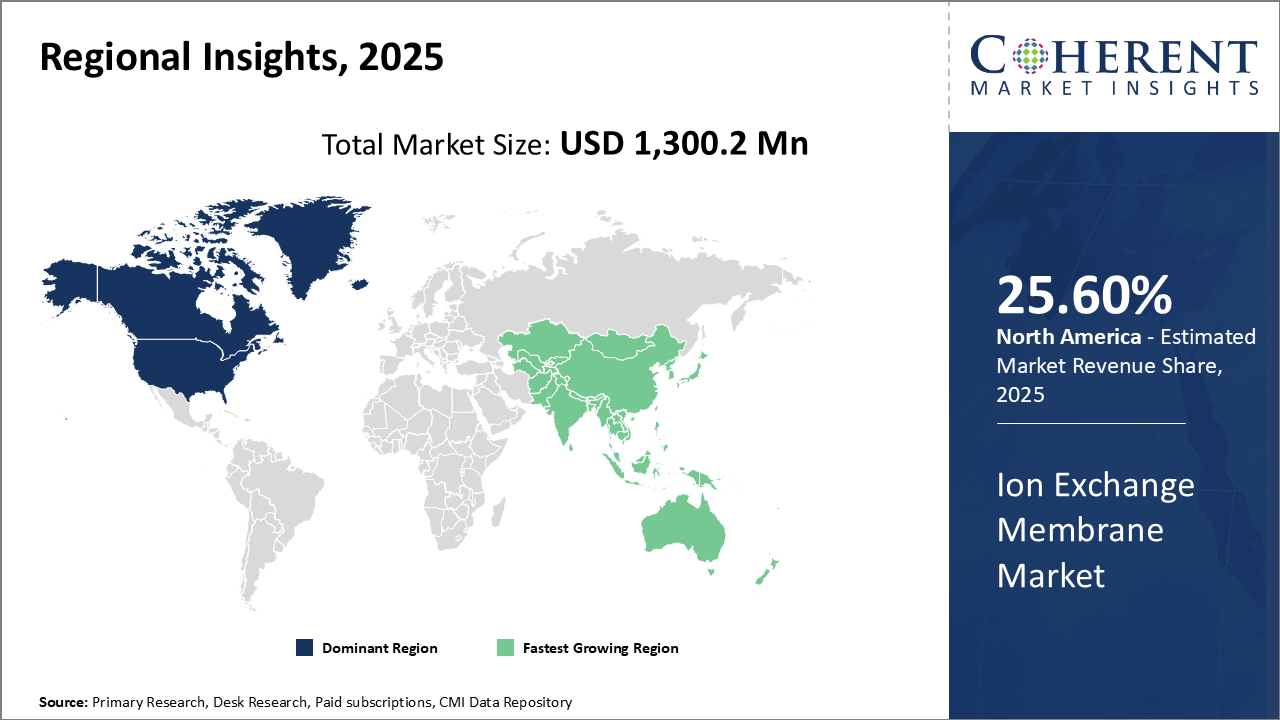
- By Region, North America accounted for 25.6% of the global ion exchange membrane market in 2026 and is expected to maintain its leading position over the forecast period. Growth is supported by strong industrial presence across chemical processing, water & wastewater treatment, electrical & electronics, and power generation.
Market Overview
Global Ion Exchange Membrane Market growth is driven by growing demand for desalination from countries facing fresh water scarcity. The market is expected to witness significant growth over the forecast period, owing to rising focus on reducing dependence on conventional water treatment solutions and increasing adoption of energy-efficient ion exchange membrane technologies for desalination across Middle Eastern and Asian countries. Growth in end-use industries such as chemical processing and power generation can also drive the market growth.
Current Events and Its Impact on the Global Ion Exchange Membrane Market
Event | Description and Impact |
Global Energy Transition and Green Hydrogen Push (Macro-Level) |
|
China’s Chemical Industry Regulations and Supply Chain Shifts (Regional) |
|
Advanced Membrane Technology Breakthroughs (Nano-Level) |
|
Segmental Insights
- Current Industry Events of 2026
- Market Size Estimation
- Regional Breakdown
- Competitive Landscape
- Customer Intelligence
- Segmental Analysis
- Pricing Analysis
- Key Market Drivers, Challenges & Future Trends
- Customized Insights Section
Ion Exchange Membrane Market Insights, By Application: Efficiency advantages sustain electrolysis segment dominance
In terms of application, electrolysis segment is estimated to contribute the 35.9% share of the market in 2026, owing to benefits it provides over alternative processes. Ion exchange membranes find widespread usage in chloralkali electrolysis for production of chlorine and caustic soda. Compared to mercury cell and diaphragm cell technologies, ion exchange membrane electrolysis cells offer higher energy efficiency and lower capital cost. These allow use of cheaper salt solutions and facilitate co-production. Ion exchange membrane cells are also more environment-friendly with no mercury emissions. Furthermore, ion exchange membranes enable extraction of hydrogen through water electrolysis, which is a key reaction involved in hydrogen production. With growing focus on green hydrogen economy, electrolytic water splitting applications are expected to boost demand for ion exchange membranes. Overall efficiency and cost advantages relative to competition have made electrolysis the leading application segment.
Ion Exchange Membrane Market Insights, By Material: Hydrocarbon Membranes Continue to Lead
By material, hydrocarbon membranes account for the largest share of the ion exchange membrane market, holding 37.2% in 2026. Their dominance is driven by cost-effectiveness, ease of processing, and broad application across water treatment, energy generation, and separation technologies. Additionally, their use in desalination and wastewater recycling aligns with global initiatives to address water scarcity, further strengthening demand in the coming years.
For instance, June 2026, Imperial College London announced advancements in hydrocarbon-based ion exchange membranes designed for fuel cells and electrolyzers, offering a cost-effective and environmentally sustainable alternative to perfluorinated membranes.
Ion Exchange Membrane Market Insights, By Charge: Prevalence in water treatment drives leadership of cation membrane
In terms of charge, cation segment is estimated to contribute the 34.9% share of the market in 2026, due to its widespread adoption in water treatment. Cation exchange membranes are used for softening of water by removing calcium and magnesium cations. These find major application in municipal and industrial water treatment plants for producing soft water. Cation exchange also helps to reduce water hardness and total dissolved solids. Given growing freshwater scarcity and stringent drinking water norms, effective water treatment technologies are being increasingly deployed worldwide. This increasing focus on water treatment has propelled the cation segmentgrowth.
Ion Exchange Membrane Market Insights, By End Use Industry: Water Treatment Holds the Largest Share
By end-use industry, water treatment represents the largest share of the ion exchange membrane market, accounting for a significant portion in 2026. The dominance of this segment is driven by the rising global demand for clean and safe drinking water, coupled with growing investment in desalination plants and wastewater treatment infrastructure. Increasing concerns over water scarcity, particularly in Asia-Pacific and the Middle East, further amplify the need for efficient ion exchange membranes in purification and recycling processes.
For example, in April 2025, Arab News reported that Veolia is positioning Saudi Arabia and the wider Gulf region at the forefront of desalination innovation by advancing membrane-based desalination technologies. The shift from traditional thermal processes to more efficient membrane solutions reflects the company’s strategy to reduce energy use and improve water sustainability in the region.
Regional Insights
North America Ion Exchange Membrane Market Trends
North America accounted for 25.6% of the global ion exchange membrane market in 2026 and is expected to maintain its leading position over the forecast period. Growth is supported by strong industrial presence across chemical processing, water & wastewater treatment, electrical & electronics, and power generation. The U.S. and Canada, with stable economies and early adoption of advanced technologies, drive demand for innovative membranes. In addition, the presence of leading manufacturers and active R&D initiatives strengthens the region’s dominance.
For instance, September 2024, Industrie De Nora launched the CECHLO-MS 200 ion exchange membrane electrolysis technology for the North American market, establishing a U.S. center of excellence to localize assembly and enhance support for municipal and industrial water treatment applications.
Asia-Pacific Ion Exchange Membrane Market Trends
Asia-Pacific represents the fastest-growing regional market for ion exchange membranes, driven by rapid economic development and infrastructure expansion in countries such as China, India, Indonesia, and Vietnam. Rising demand from process industries and strong focus on wastewater treatment and desalination projects accelerate adoption of ion exchange membranes. Furthermore, the availability of raw materials and cost-effective labor continues to attract leading manufacturers to set up production facilities across the region, increasing access to both standard and customized membranes..
For instance, February 2024, Veolia Water Technologies redeveloped a brownfield site in Changshu, China to launch its first ion exchange regeneration facility. This facility will service water purification, industrial deionization and mobile water treatment, regenerate‐and‐recycle ion exchange resins, with ~€10 million investment.
Country-Wise Outlook: Ion Exchange Membrane Market
United States Ion Exchange Membrane Market Outlook
The U.S. remains a key leader in ion exchange membrane technology, driven by clean energy policy support, R&D investment, and strong demand from hydrogen, fuel cell, and water treatment projects.
For instance, August 2026, Advent Technologies entered into an agreement with a U.S.-based global semiconductor and wireless technology company to develop electrochemical gas sensors using its advanced Ion Pair membrane, highlighting the potential of ion exchange membranes in next-generation sensing and medical diagnostics.
China Ion Exchange Membrane Market Outlook
China is expanding its role both as a major consumer and producer of ion exchange membranes, particularly through its focus on infrastructure, water treatment, desalination, and green hydrogen programs. There is increasing local capacity to manufacture both generic and customized membranes for regional industrial needs.
For instance, June 2026, Tianhua New Energy debuted a new series of ion exchange membranes at the International Clean Energy Conference and Expo in Tianjin, showcasing high ion selectivity and conductivity membranes designed for energy storage and hydrogen applications, marking a significant domestic technological breakthrough.
Market Report Scope
Ion Exchange Membrane Market Report Coverage
| Report Coverage | Details | ||
|---|---|---|---|
| Base Year: | 2025 | Market Size in 2026: | USD 1374.3 Mn |
| Historical Data for: | 2020 To 2024 | Forecast Period: | 2026 To 2033 |
| Forecast Period 2026 to 2033 CAGR: | 5.7% | 2033 Value Projection: | USD 2025.9 Mn |
| Geographies covered: |
| ||
| Segments covered: |
| ||
| Companies covered: | 3M, IEI, FUJIFILM Holdings Corporation, Parker Hannifin Corp., LANXESS AG, SnowPure, LLC | ||
| Growth Drivers: |
| ||
| Restraints & Challenges: |
| ||
Growing demand from water treatment industry
Global ion exchange membrane market is expected to witness significant growth due to increasing demand from the water treatment industry. Proper treatment of water is essential before it is supplied for various industrial and municipal purposes. Ion exchange membrane technology is widely being used in desalination plants, wastewater recycling units and purifying brackish water. As the global fresh water reserves are under strain due to rising population and industrialization, more countries are turning to advanced water treatment technologies like reverse osmosis plants which employ ion exchange membranes. Their natural advantages such as high selectivity, energy efficiency and ease of operation as compared to other membranes boosts their usage. The municipal sector has also ramped up spending on water treatment infrastructure to provide clean drinking water.
Analyst Viewpoint
- Global ion exchange membrane market growth is driven by expanding applications in wastewater treatment and electrodialysis. Rising environmental concerns along with stringent regulations regarding industrial wastewater disposal are compelling industries to invest in advanced treatment technologies that use ion exchange membranes. Further, growing freshwater scarcity issues worldwide are augmenting the use of desalination through electrodialysis reversal.
- High initial capital requirement for setting up ion exchange membrane plants can hamper the market growth. Also, frequent replacement of membranes also increases the operational costs. To expand their footprint, market players must focus on developing more durable and longer-lasting membranes.
- The Asia Pacific region, particularly China and India, offer lucrative opportunities owing to their massive population and industrial bases that generate huge amounts of wastewater. Government initiatives to provide clean drinking water to all citizens are also driving market growth. In North America and Western Europe, stringent norms are propelling wastewater treatment projects and desalination plants that leverage ion exchange membrane technology. Going forward, innovative product development catering to niche industry requirements will help companies gain an edge in this competitive market.
Ion Exchange Membrane Industry News
- In February 2025, DuPont expanded ion exchange membrane production capacity to meet rising demand in water purification and energy storage, while Lanxess introduced a new generation of anion exchange membranes with enhanced selectivity and durability for desalination and chemical processing.
- In February 2025, Evonik is building a pilot plant in Marl, Germany, for the production of its DURAION® anion exchange membranes, aimed at enabling cost-competitive green hydrogen production. The plant, scheduled to start operation at the end of 2025, will also produce reinforced membranes to meet growing customer demand, supporting up to 2.5 GW of electrolyzer capacity annually.
- In March 2024, Ionomr Innovations releases Iridium-Free Catalyst Coated Anion Exchange Membranes for Low-Cost Green Hydrogen
Market Segmentation
- Material Insights (Revenue, USD Mn, 2021 - 2033)
- Hydrocarbon Membrane
- Perfluorocarbon Membrane
- Inorganic Membrane
- Composite Membrane
- Others
- Charge Insights (Revenue, USD Mn, 2021 - 2033)
- Cation
- Anion
- Amphoteric Ion
- Bipolar Ion
- Others
- Application Insights (Revenue, USD Mn, 2021 - 2033)
- Electrodialysis
- Electrolysis
- Storage Batteries
- Water Treatment
- Others
- End-use Industry Insights, (Revenue, USD Mn, 2021 - 2033)
- Water Treatment
- Chemical Industry
- Energy Storage and Generation
- Pharmaceutical & Biotech Industry
- Oil & Gas Industry
- Others (Food and Beverage, etc.)
- Regional Insights (Revenue, USD Mn, 2021 - 2033)
- North America
- U.S.
- Canada
- Latin America
- Brazil
- Argentina
- Mexico
- Rest of Latin America
- Europe
- Germany
- U.K.
- Spain
- France
- Italy
- Russia
- Rest of Europe
- Asia Pacific
- China
- India
- Japan
- Australia
- South Korea
- ASEAN
- Rest of Asia Pacific
- Middle East & Africa
- GCC Countries
- Israel
- Rest of Middle East & Africa
- North America
- Key Players Insights
- 3M
- IEI
- FUJIFILM Holdings Corporation
- Parker Hannifin Corp.
- LANXESS AG
- SnowPure, LLC
Sources
Primary Research Interviews
- Ion exchange membrane manufacturers and suppliers
- Water treatment plant operators and engineers
- Electrochemical industry executives
- Fuel cell technology developers
- Others
Databases
- Industry-specific trade databases
- Import-export statistics
- Company financials from SEC filings and other regulatory bodies
- Global Trade Data Platforms such as UN Comtrade and ITC Trade Map.
Magazines
- Water Technology Magazine
- Chemical Engineering Magazine
- Membrane Technology Magazine
- Industrial Water World
- Others
Journals
- Journal of Membrane Science
- Desalination and Water Treatment
- Journal of Applied Electrochemistry
- Others
Newspapers
- Chemical Week
- ICIS Chemical Business
- Asian Chemical News
- European Chemical News
- Others
Associations
- International Water Association (IWA)
- North American Membrane Society (NAMS)
- European Membrane Society (EMS)
- American Water Works Association (AWWA)
- Others
Public Domain Sources
- S. Environmental Protection Agency (EPA) reports
- European Environment Agency publications
- International Energy Agency (IEA) data
- World Health Organization water treatment guidelines
- Others
Proprietary Elements
- CMI Data Analytics Tool
- Proprietary CMI Existing Repository of information for last 8 years
Definition
Ion exchange membrane market consists of companies that manufacture and sell membranes used in various separation processes involving ion exchange. Ion exchange membranes are used to selectively transport either positively or negatively charged ions across the membrane, while blocking the passage of ions with the opposite charge. Key applications of ion exchange membranes include electrodialysis, which uses them to desalinate water or concentrate brine, as well as fuel cells and batteries that utilize them in ion transport.
Get access to 250+ pages report
Every segment, forecast, competitor profile and data table behind the analysis above — available for instant download.
- ESOMAR Member
- ISO 9001:2015 Certified
- D-U-N-S Registered
- GDPR & CCPA Compliant
Missing comfort of reading report in your local language? Find your preferred language:
Transform your Strategy with Exclusive Trending Reports
Frequently Asked Questions
The Ion Exchange Membrane Market is estimated to be valued at USD 1374.3 Mn in 2026, and is expected to reach USD 2025.9 Mn by 2033.
The CAGR of the Ion Exchange Membrane Market is projected to be 5.7% from 2026 to 2033.
Growing demand from water treatment industry and rising focus on fuel cells are the major factors driving the growth of global ion exchange membrane market
High cost of ion exchange membranes and issue of fouling and scaling of ion exchange membranes are the major factors hampering the growth of global ion exchange membrane market.
In terms of material, perfluorocarbon membrane segment is estimated to dominate the market in 2026.
3M, IEI, FUJIFILM Holdings Corporation, Parker Hannifin Corp., LANXESS AG, and SnowPure, LLC are the major players.
Asia Pacific is expected to lead the global ion exchange membrane market