

Isoprene Monomer Market Size and Forecast – 2026 to 2033
The Isoprene Monomer Market is anticipated to grow at a CAGR of 4.1% with USD 2,137.8 Bn share in 2026 and is expected to reach USD 2,683.6 Bn in 2033. Rising demand for synthetic rubber in tires, footwear, adhesives, and medical products drives the Isoprene Monomer Market. More than 26 million tonnes of tires are produced globally each year, with an average service life of approximately 4–6 years.
Key Takeaways
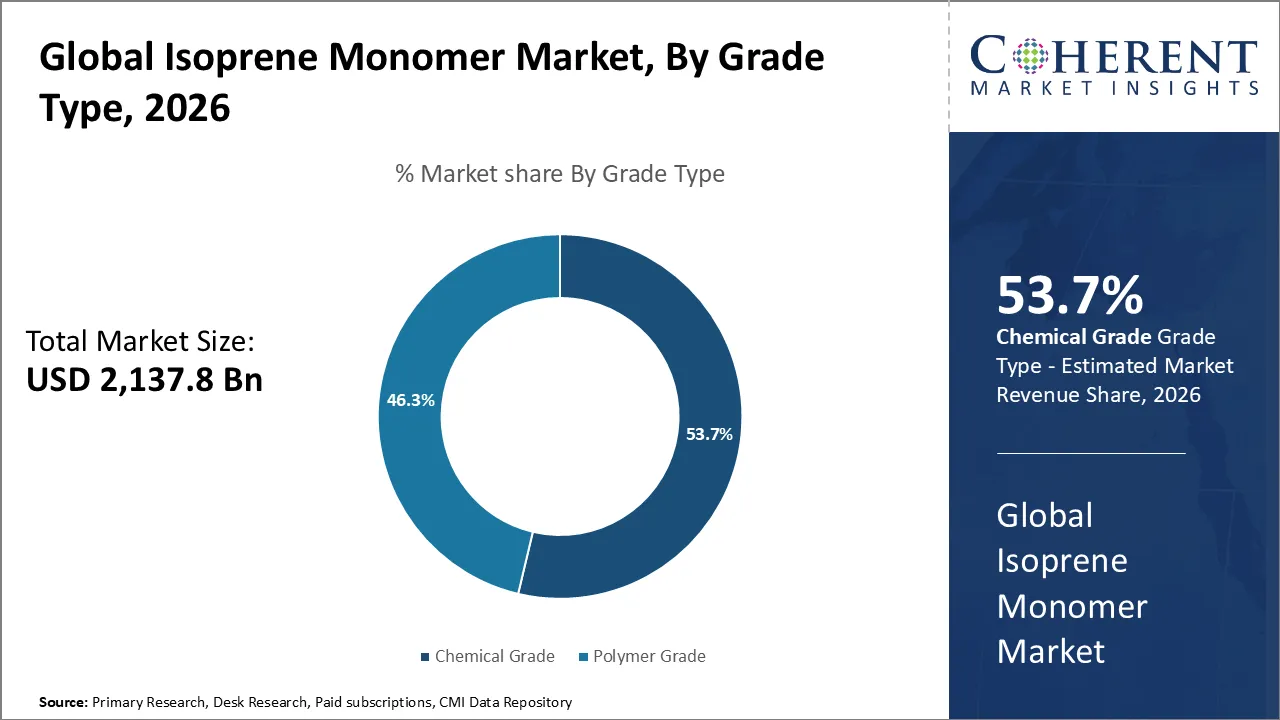
- Chemical Grade holds the largest market share of 53.7% in 2026 owing to its rising demand for synthetic rubber.
- Polyisoprene expected to hold largest market share of 42.7% in 2026 owing to the growing automotive and tire production. According to OICA, global vehicle production rose from 92.7 million units in 2024 to 96.4 million units in 2025.
- Adhesives & Sealants acquired the prominent market share of 38.9% in 2026 owing to its expansion of the packaging industry. According to our research, the global flexible packaging industry is estimated to surpass USD 480 Bn by 2033.
- By Region, North America is expected to acquire the dominant share of 41.8% in 2026 owing to the growing demand for medical products. The United States is the world’s largest medical device market, with medical device exports exceeding USD 103 Bn in 2023.
Current Events and Their Impact on the Isoprene Monomer Market
Current Event | Description and its Impact |
EU Political Agreement on Occupational Exposure Limits for Isoprene |
|
European Commission’s 2025 Isoprene Occupational-Exposure Assessment |
|
Segmental Insights
- Current Industry Events of 2026
- Market Size Estimation
- Regional Breakdown
- Competitive Landscape
- Customer Intelligence
- Segmental Analysis
- Pricing Analysis
- Key Market Drivers, Challenges & Future Trends
- Customized Insights Section
Why is Chemical Grade Acquiring the Largest Market Share?
Chemical Grade holds the largest market share of 53.7% in 2026. The chemical-grade segment of the isoprene monomer market gains momentum from rising demand for synthetic rubber, specialty chemicals, adhesives, resins, and pharmaceutical intermediates. Manufacturers use chemical-grade isoprene to produce polyisoprene and other high-performance elastomers for automotive, healthcare, and industrial applications. Increasing automotive and tire production, expanding pharmaceutical manufacturing, and growing demand for specialty chemicals further stimulate consumption. In addition, emerging economies are expanding industrial and downstream manufacturing capacities, creating new opportunities for chemical-grade isoprene monomer producers and suppliers. In February 2026, NOVA Chemicals Corporation expanded its circular economy initiatives by commercializing two new recycled polyethylene (rPE) grades, SYNDIGO rPE-IN3 and SYNDIGO rPE-IN4, for general-purpose, non-food-grade applications across North America.
Polyisoprene expected to hold largest market share
Polyisoprene expected to hold largest market share of 42.7% in 2026 owing to the rising healthcare expenditure. The polyisoprene segment of the isoprene monomer market gains momentum as automotive, healthcare, and industrial industries increases their use of synthetic rubber. Tire manufacturers value polyisoprene for its elasticity, resilience, and fatigue resistance, while healthcare companies use it to produce gloves, condoms, tubing, and other medical products. Rising vehicle production, replacement-tire demand, and healthcare consumption drive market growth. Furthermore, manufacturers are adopting high-performance elastomers, while expanding industrialization and rubber-processing capacity creates additional opportunities for polyisoprene applications worldwide. In April 2026, LifeStyles Healthcare Australia has launched Skyn Supreme Feel, a new non-latex polyisoprene condom.
Which End-Use Industry segment dominates the market?
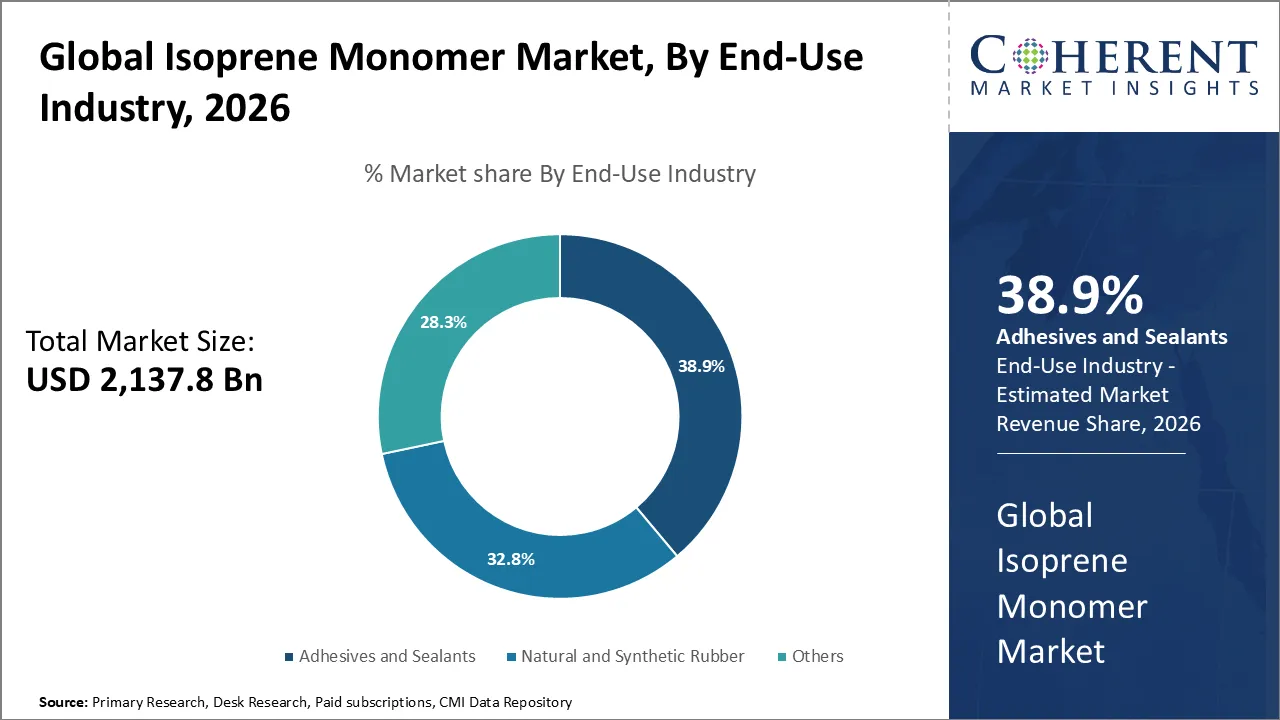
Adhesives & Sealants acquired the prominent market share of 38.9% in 2026. The adhesives and sealants segment of the isoprene monomer market expands as industries seek flexible, durable, and high-performance bonding solutions. Packaging producers use isoprene-based adhesives for labels, tapes, and flexible packaging, while construction firms use sealants in flooring, roofing, insulation, and building applications. Automotive manufacturers also rely on these materials for effective bonding and sealing. E-commerce growth, rising hygiene-product consumption, and expanding industrial activity further drive demand. Moreover, advances in polymer formulation technology broaden the applications of isoprene-based adhesives and sealants.
Isoprene Monomer Market Trends
- Rising demand for synthetic rubber in automotive tires, medical products, footwear, and industrial components supports consumption of isoprene monomer, particularly for polyisoprene production. The automotive sector remains a major downstream market: according to the International Organization of Motor Vehicle Manufacturers (OICA), global vehicle production increased from 92.7 million units in 2024 to 96.4 million units in 2025, a 3.9% increase. This expansion supports demand for rubber materials used in vehicle tires and components.
- Increasing focus on sustainable isoprene production is encouraging research into alternative feedstocks and production routes, including bio-based approaches. At the same time, regulatory attention is increasing around conventional isoprene handling. In June 2026, the European Commission announced a provisional EU agreement to establish occupational exposure limits for isoprene, including a general exposure limit, short-term exposure limit, and biological limit value. The Commission identified isoprene as a substance used in the chemical and rubber industries.
Regional Insights
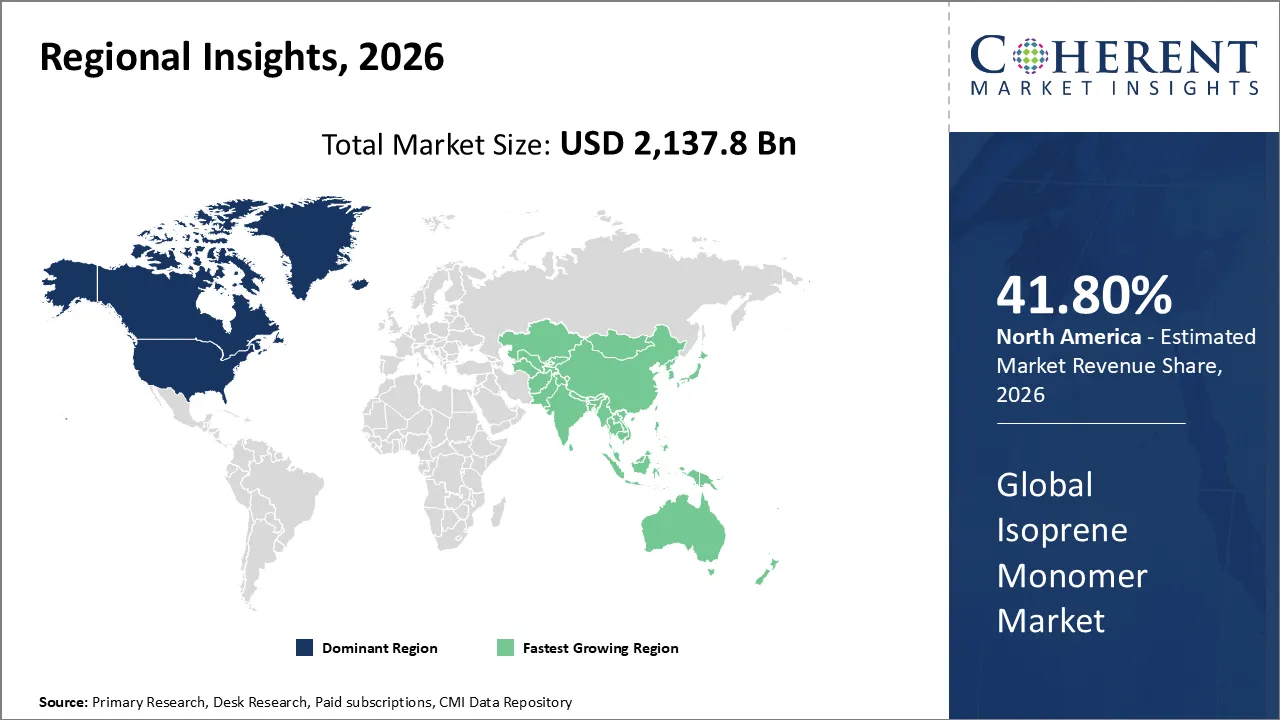
North America dominates owing to increasing investment in domestic chemical production
North America is expected to acquire the dominant share of 41.80% in 2026. North America drives the isoprene monomer market through strong automotive, tire, healthcare, and specialty chemical industries. Tire manufacturers increase demand for isoprene-based synthetic rubber to produce durable and resilient products, while healthcare companies use polyisoprene in medical and elastomeric applications. The region’s well-established petrochemical infrastructure supports reliable feedstock availability and production. Growing demand for adhesives, sealants, and specialty chemicals further expands consumption. In addition, technological advances in synthetic rubber manufacturing and investments in advanced materials strengthen regional market opportunities. Zeon Corporation has signed an MoU with Visolis to accelerate the commercialization of bio-isoprene monomers, sustainable aviation fuel (SAF), and other products.
Asia Pacific Isoprene Monomer Market Trends
Asia Pacific’s isoprene monomer market benefits from expanding automotive production, rising tire manufacturing, and growing demand for synthetic rubber across China, India, Japan, and South Korea. Consumers’ increasing vehicle ownership and replacement-tire purchases boost demand for isoprene-based elastomers. Manufacturers also expand industrial, footwear, adhesive, and healthcare applications, supporting market growth. Companies continue investing in infrastructure, production capacity, and downstream rubber industries, while advances in high-performance and sustainable elastomer technologies create new opportunities for isoprene monomer applications. Cariflex Pte. Ltd., a wholly owned subsidiary of DL Chemical Co., has begun construction on Jurong Island, Singapore, of the world’s largest and Singapore’s first polyisoprene latex plant to expand capacity and better serve global medical and consumer product customers.
United States Isoprene Monomer Market Trends
Strong demand for synthetic rubber in automotive tires, inner liners, seals, hoses, and other components drives the United States isoprene monomer market. Vehicle production and replacement-tire demand increase consumption of isoprene-based elastomers. Manufacturers also use isoprene monomer in pressure-sensitive adhesives, packaging, construction, and industrial products, supporting market growth. Healthcare manufacturers further drive demand through medical gloves and devices.
China Isoprene Monomer Market Trends
China’s large automotive and tire manufacturing sector drives demand for isoprene monomer, particularly for producing polyisoprene and other synthetic elastomers. Rising vehicle production, including electric vehicles, increases the need for high-performance tire materials. China produced a record 34.53 million motor vehicles in 2025, maintaining its position as the world’s largest vehicle producer. China’s well-established petrochemical infrastructure and C5 extraction facilities support domestic isoprene production. Manufacturers also use isoprene-based materials in industrial rubber, adhesives, sealants, and healthcare products. Meanwhile, expanding synthetic rubber production and downstream processing facilities continue to strengthen market demand.
Who are the Major Companies in Isoprene Monomer Industry
Some of the major key players in Isoprene Monomer are Kraton Corporation, Royal Dutch Shell Plc., JSR Corporation, Kuraray Co., Ltd, Amyris, Inc., Precision Dippings Manufacturing Ltd., Exxon Mobil Corporation, and Zeon Corporation.
Key News
- In May 2025, Cariflex, a DL Chemical subsidiary, inaugurated a USD 355 million polyisoprene latex plant at Jurong Island, Singapore, the world’s largest facility of its kind, to expand capacity for medical and protective applications.
Market Report Scope
Isoprene Monomer Market Report Coverage
Report Coverage | Details | ||
Base Year: | 2025 | Market Size in 2026: | USD 2,137.8 Bn |
Historical Data for: | 2020 to 2024 | Forecast Period: | 2026 to 2033 |
Forecast Period 2026 to 2033 CAGR: | 4.1% | 2033 Value Projection: | USD 2,683.6 Bn |
Geographies covered: |
| ||
Segments covered: |
| ||
Companies covered: | Kraton Corporation, Royal Dutch Shell Plc., JSR Corporation, Kuraray Co., Ltd, Amyris, Inc., Precision Dippings Manufacturing Ltd., Exxon Mobil Corporation, and Zeon Corporation. | ||
Analyst Opinion
- China’s isoprene monomer demand is fundamentally tied to its enormous tire and synthetic-rubber manufacturing ecosystem, rather than short-term chemical-sector trends. China produced approximately 1.207 billion rubber tire casings in 2025, while tire exports reached about 702 million units. This manufacturing scale gives isoprene a structurally strong downstream base, particularly through polyisoprene and isoprene rubber used in high-performance tire formulations.
- We believe China’s automotive transition is strengthening the quality requirements for isoprene-derived elastomers rather than simply increasing volume demand. China produced 34.78 million vehicles in 2025, including 16.52 million new-energy vehicles. The rapid expansion of EV production places greater emphasis on tire durability, rolling resistance, and load-bearing performance, creating a favorable environment for specialized synthetic rubber formulations.
- China is also becoming an increasingly important destination for isoprene-based synthetic rubber from overseas producers. Russian exports of isoprene rubber to China reached 136,160 tons in 2025, compared with 93,168 tons in 2024. This sharp increase signals that Chinese rubber processors continue to actively secure external supply even as domestic production capabilities expand, reinforcing China’s importance within the regional isoprene value chain.
- Supply-demand dynamics to remain the key risk rather than a lack of end-use demand. New SIS and SEPS capacity in China, including projects at Jinhai, Ecisco, and Sinopec Shanghai/Baling, could increase domestic isoprene consumption; however, industry analysis indicates that SIS demand remains weak and inventories are ample.
Speak to the analyst
Want personalized insights?
Take the findings above to one of our principal consultants, or have the report rebuilt around the segments, geographies and competitors you actually track.
Market Segmentation
- By Grade type (Revenue, USD Bn, 2021-2033)
- Chemical Grade
- Polymer Grade
- By Application (Revenue, USD Bn, 2021-2033)
- Polyisoprene
- Isoprene Rubber (IR)
- Styrene-Isoprene-Styrene (SIS)
- Others
- By End-Use Industry (Revenue, USD Bn, 2021-2033)
- Adhesives and Sealants
- Natural and Synthetic Rubber
- Others
- By Region (Revenue, USD Bn, 2021-2033)
- North America
- U.S.
- Canada
- Latin America
- Brazil
- Mexico
- Argentina
- Rest of Latin America
- Europe
- Germany
- U.K.
- France
- Italy
- Spain
- Russia
- Rest of Europe
- Asia Pacific
- China
- India
- Japan
- Australia
- South Korea
- ASEAN
- Rest of Asia Pacific
- Middle East
- GCC
- Israel
- Rest of Middle East
- Africa
- South Africa
- Central Africa
- North Africa
- North America
Sources
Primary Research interviews
- Interviews with isoprene monomer producers and manufacturers
- Discussions with petrochemical/refinery operators involved in C5-stream processing and isoprene recovery
- Interviews with synthetic rubber and polyisoprene manufacturers
- Discussions with SIS (styrene-isoprene-styrene), butyl rubber, and specialty polymer producers
- Interviews with raw-material suppliers, distributors, importers, and exporters
- Discussions with downstream tire, rubber-product, adhesive, and polymer manufacturers
- Interviews with process engineers, plant managers, procurement professionals, and technical experts
- Conversations with chemical traders and industry participants regarding pricing, supply-demand conditions, imports/exports, and regional availability
Databases
- UN Comtrade – international import/export statistics and trade flows for isoprene and relevant hydrocarbon classifications.
- U.S. EPA Chemical Data Reporting (CDR) – production, processing, use, and manufacturing information for isoprene in the United States.
- EPA CompTox Chemicals Dashboard – chemical identity, environmental, toxicological, and regulatory information
- European Chemicals Agency (ECHA) database – REACH registration, classification, and regulatory information for isoprene.
- PubChem – chemical identity, properties, synonyms, uses, and regulatory references for isoprene.
- U.S. International Trade Commission (USITC) data
- National statistical databases and customs databases of major producing and consuming countries
- UN Statistics Division / UNdata
- National chemical-production and industrial-statistics databases
Magazines
- Chemical & Engineering News
- Chemical Week
- ICIS Chemical Business
- Hydrocarbon Processing
- PetroChem Wire
- European Rubber Journal
- Rubber World
- Rubber News
- Plastics Technology
- Chemical Engineering
- Hydrocarbon Processing / industry trade publications covering petrochemical production, C5 streams, synthetic rubber, and polymer markets
Journals
- Industrial & Engineering Chemistry Research – process engineering, thermal behavior, kinetics, and safety studies involving isoprene.
- Chemico-Biological Interactions – research covering isoprene monomer/polyisoprene production and occupational exposure.
- European Polymer Journal – polymerization kinetics and polyisoprene research.
- Chinese Journal of Chemical Engineering / Chemical Engineering-related journals
- Polymer
- Journal of Polymer Science
- Macromolecules
- Polymer Chemistry
- Journal of Applied Polymer Science
- Journal of Chemical & Engineering Data
- Industrial Crops and Products, where relevant to bio-based isoprene research
Newspapers
- Reuters
- Bloomberg
- The Wall Street Journal
- Financial Times
- The Economic Times
- Business Standard
- The Hindu BusinessLine
- Nikkei Asia
- The Japan Times
- regional and national newspapers covering petrochemical plant investments, production shutdowns, trade, and industrial developments
Associations
- International Institute of Synthetic Rubber Producers (IISRP) – synthetic rubber industry information and technical/market-related industry data
- International Rubber Study Group (IRSG)
- American Chemistry Council (ACC)
- Society of Chemical Industry (SCI)
- American Chemical Society (ACS)
- Rubber Manufacturers Association / U.S. Tire Manufacturers Association (USTMA)
- European Tyre and Rubber Manufacturers’ Association (ETRMA)
- Japan Rubber Manufacturers Association
- China Rubber Industry Association
- Indian Rubber Manufacturers Research Association (IRMRA)
- All India Rubber Industries Association (AIRIA)
Public Domain sources
- U.S. Environmental Protection Agency (EPA) – CDR, TSCA, CompTox and environmental/regulatory information.
- European Chemicals Agency (ECHA) – REACH and chemical regulatory information.
- PubChem / National Center for Biotechnology Information (NCBI) – chemical properties, identifiers, uses, and safety information.
- UN Comtrade / UNdata – international merchandise trade data.
- U.S. Geological Survey (USGS) – relevant petrochemical and industrial commodity information
- U.S. Census Bureau – trade and manufacturing statistics
- Eurostat – European industrial and trade statistics
- U.S. International Trade Commission (USITC) – trade and tariff data
- International Labour Organization (ILO) – occupational chemical-safety information
- World Health Organization (WHO) / IARC – health and carcinogenicity assessments
- National Bureau of Statistics databases for major producing/consuming countries
- Government ministries and departments of chemicals, petrochemicals, energy, industry, and trade
- Publicly available company annual reports, sustainability reports, regulatory filings, plant announcements, and investor presentations — used strictly as primary-source corporate information rather than third-party market research
Proprietary Elements
- CMI Data Analytics Tool
- Proprietary CMI Existing Repository of information for last 10 years
Get access to 250+ pages report
Every segment, forecast, competitor profile and data table behind the analysis above — available for instant download.
- ESOMAR Member
- ISO 9001:2015 Certified
- D-U-N-S Registered
- GDPR & CCPA Compliant
Missing comfort of reading report in your local language? Find your preferred language:
Transform your Strategy with Exclusive Trending Reports
Frequently Asked Questions
The Isoprene Monomer Market is projected to expand at a CAGR of 4.1% during 2026–2033, supported by demand for synthetic rubber, polyisoprene, adhesives, sealants, and healthcare-related elastomer applications.
Chemical Grade leads the market, accounting for 53.7% in 2026.
Polyisoprene represents the leading application segment, with a 42.7% share in 2026.
Adhesives and Sealants hold the leading position, representing 38.9% of the market in 2026.
North America leads the regional market, with a 41.8% share in 2026.