

Latin America Pharmaceutical Products CMO Market Size and Share Analysis - 2026 To 2033
The Latin America pharmaceutical products CMO market is anticipated to grow at a CAGR of 6.95% with USD 25.5 Bn in 2026 and is expected to reach USD 38.46 Bn in 2033. The Latin America pharmaceutical contract manufacturing market is growing due to the increasing outsourcing of biologics production, the use of AI-based technologies to improve manufacturing processes, and the availability of ESG-focused funding that helps companies invest at lower costs. These factors are helping pharmaceutical manufacturers (Brazil, USD7.92 Bn) become more efficient, competitive, and attractive to global pharma companies.
Key Takeaways
- The contract manufacturing services (CMO) is expected to account the largest share of 60% in 2026, growing demand for generics, and biosimilars in Latin America. As of April 2025, Argentina’s biosimilar market is expanding, with more than 67 approved biosimilar products. Certain biosimilars, including adalimumab, infliximab, as well as etanercept, have reported major price reductions compared with their original biological products, ranging from 39% to 88% depending on the product.
- Small molecule drugs will dominate with 55% in 2026, due to high investment in advanced therapies, complex drug manufacturing, and rising demand for innovative treatments. By 2024, generic medicines made up 38% of Brazil’s pharmaceutical market. At the same time, biosimilar medicines reached 9.72% of the market, growing by 1,533% over the previous three years.
- Oncology drugs will dominate with 30% in 2026, increasing cases of cancer are creating strong demand for advanced oncology medicines and specialized manufacturing services. Brazil has an overall cancer incidence rate of 214.4 cases per 100,000 people each year and an overall cancer mortality rate of 91.3 deaths per 100,000 people each year.
- Pharmaceutical companies drugs will dominate with 45% in 2026, large pharmaceutical companies highly outsource drug manufacturing and research activities to contract manufacturers to reduce costs, improve efficiency, and focus on core drug development activities. Mexico is the second-largest pharmaceutical market in Latin America, with an estimated market value of USD 15–17 Bn in 2025. The market is escalating as the population of the country is about 130 million people, increasing healthcare needs, and rising demand for medicines.
- Brazil is expected to acquire the dominant share of 40% in 2026, the country has a large number of pharmaceutical production facilities, including GMP-certified plants, making it attractive for global pharmaceutical companies looking to outsource manufacturing. There are approximately 186 pharma companies in Mexico and about 650-750 Consumer Health companies.
Segmental Insights
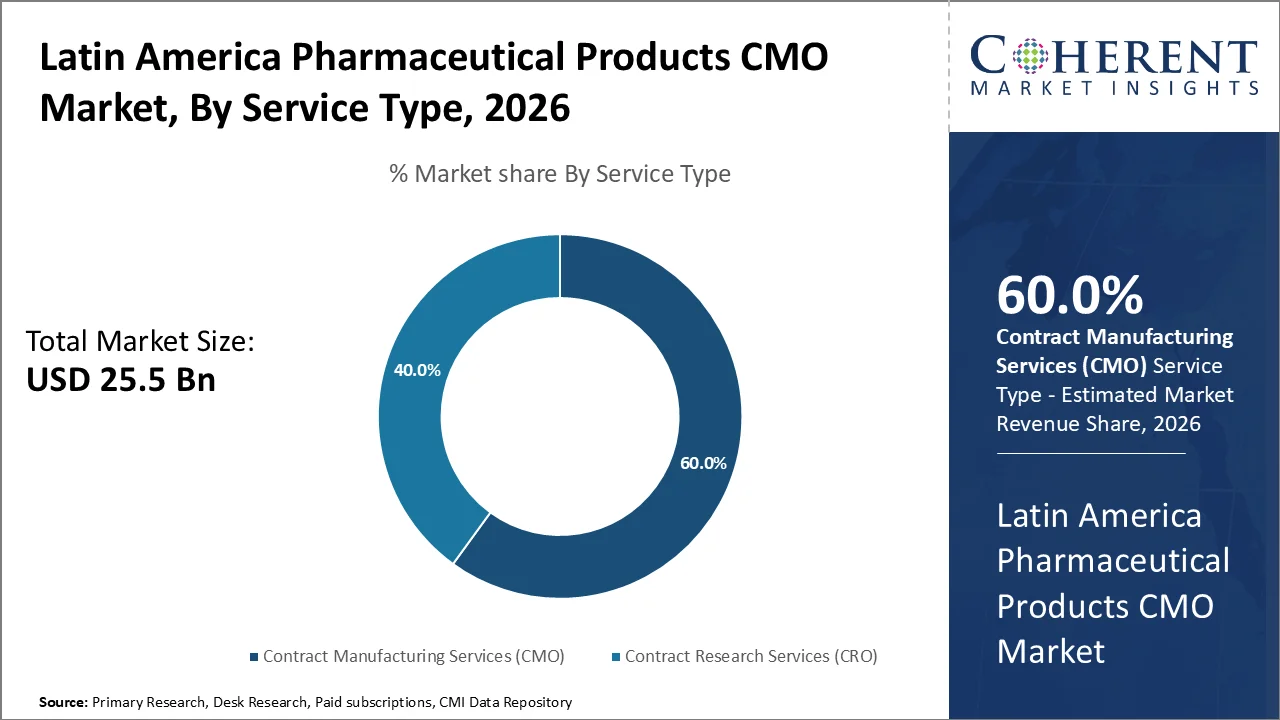
Why is Contract Manufacturing Services (CMO) Acquiring the Largest Market Share?
Contract Manufacturing Services (CMO) is projected to account for the largest share of service type in 2026, representing approximately 60% of the total volume. Driven by economic, as well as regulatory factors that collectively reinforce the outsourcing model across the regional pharmaceutical ecosystem.
The growing burden of the region on chronic as well as infectious diseases, as of 2025, a study by Unicamp found that 45% of Brazilian adults aged 18 and older have at least one chronic noncommunicable disease. This has sustained an uninterrupted demand for large-scale pharmaceutical production, ranging from solid oral dosage forms and injectables to biologics and biosimilars.
Government authorities as well as public health institutions across Latin America continue to mandate reliable and affordable drug supply chains, which in turn compels both multinational pharmaceutical companies and local manufacturers to leverage CMO partnerships for capacity optimization and cost efficiency.
- Current Industry Events of 2026
- Market Size Estimation
- Regional Breakdown
- Competitive Landscape
- Customer Intelligence
- Segmental Analysis
- Pricing Analysis
- Key Market Drivers, Challenges & Future Trends
- Customized Insights Section
Small Molecule Drugs holds the Largest Market Share
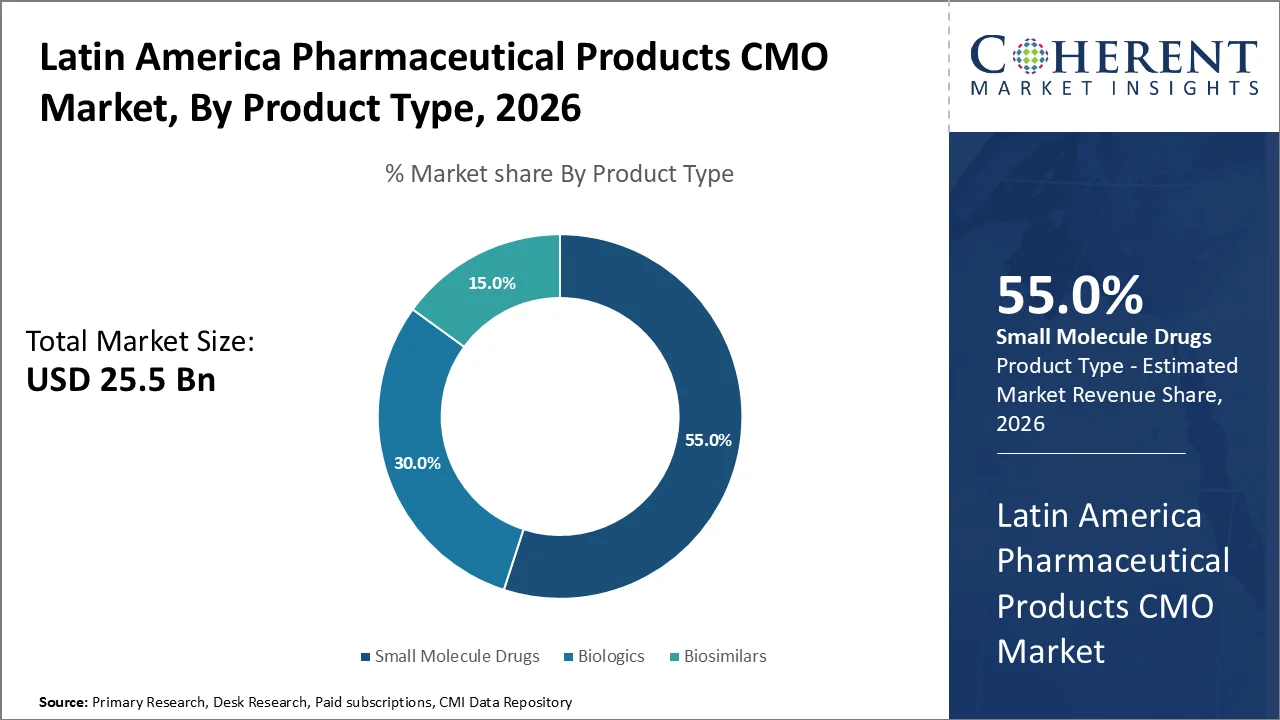
Based on product type, small molecule drugs dominates the market, accounting for a significant 55% share in 2026. Owing to their deeply established manufacturing infrastructure, widespread therapeutic application, as well as the longstanding regulatory familiarity that contract manufacturing organizations across Brazil, Mexico, Argentina, and Colombia have developed over decades of pharmaceutical production. Mexico exported pharmaceutical products mainly to the United States, with exports worth about USD 1.18 billion. Other major export destinations were Colombia (USD 254.3 million), Canada (USD 206.5 million), Panama (USD 120.1 million), and Brazil (USD 94.1 million).
The dominance of small molecule drugs is not a coincidental outcome but rather the result of a well-entrenched pharmaceutical ecosystem that has historically been built upon chemical synthesis as well as formulation technologies. Countries including Brazil, through its national pharmaceutical regulatory authority ANVISA (Agência Nacional de Vigilância Sanitária), have developed strong frameworks that facilitate the approval and commercialization of small molecule drug formulations, which in turn encourages multinational pharmaceutical companies to outsource their manufacturing activities to local and regional CMOs.
Oncology holds the Largest Market Share
Based on therapeutic area, oncology dominates the market, accounting for a significant 30% share in 2026. Owing to the rapidly escalating cancer burden across Latin American nations, the high complexity of oncology drug formulations, as well as the high reliance of pharmaceutical companies on contract manufacturing organizations to handle technically demanding biologics as well as cytotoxic drug production.
The high prevalence of cancer across the region has placed enormous pressure on healthcare systems, prompting both multinational as well as regional pharmaceutical companies to partner extensively with CMOs that possess specialized capabilities in sterile manufacturing. Argentina has a cancer incidence rate of 218 cases per 100,000 people each year (excluding melanoma skin cancer). According to the International Agency for Research on Cancer (IARC), Argentina is considered a country with a medium to high cancer incidence as well as ranks seventh in the Americas for cancer incidence.
According to the Pan American Health Organization (PAHO), cancer has become one of the leading causes of mortality across Latin America and the Caribbean, with the region reporting millions of new cancer cases annually, particularly in Brazil, Mexico, Argentina, and Colombia, which collectively represent the major pharmaceutical manufacturing hubs of the region.
Pharmaceutical Companies holds the Largest Market Share
Based on end user, pharmaceutical companies dominates the market, accounting for a significant 45% share in 2026. Their long-established reliance on contract manufacturing organizations to simplify production, manage operational costs, as well as maintain compliance with stringent regulatory frameworks across the region are the growth inducing factors.
The deeply entrenched presence of major multinational pharmaceutical corporations in countries including Brazil, Mexico, Argentina, Colombia, etc., has historically driven consistent and high-volume outsourcing demand. Between April 2026 and May 2026, Brazil's pharmaceutical product exports increased by USD 14.1 million (15.2%), rising from USD 93.2 million to USD 107 million.
These companies work under complex portfolio management strategies that require them to balance branded product launches, lifecycle management of mature drugs, as well as compliance with both local health authority requirements and international standards such as those set by the Pan American Health Organization (PAHO).
Market Drivers
Continuous Manufacturing (CM) is transforming the Latin America Pharmaceutical Products CMO Industry
Continuous Manufacturing (CM) is a modern way of making pharmaceutical products where materials move continuously through the production process instead of being made in separate batches. This helps companies produce medicines faster, improve product quality, reduce waste, and use less factory space. Common CM technologies include continuous blending, wet and dry granulation, direct compression, and hot melt extrusion. In Latin America, companies such as Eurofarma (Brazil), Laboratorio Chile (Chile), Siegfried (Argentina), Sanfer (Mexico), and Procaps Group (Colombia) have adopted these technologies between 2020 and 2023 for both pilot and commercial production.
The use of Continuous Manufacturing has delivered strong results across the region. Eurofarma reduced its production cycle time by 35–40%, while continuous monitoring lowered out-of-specification (OOS) batches by around 60%. Companies also achieved 20–25% lower energy consumption and reduced work-in-progress inventory by about 30%. In addition, CM supports compliance with FDA Process Analytical Technology (PAT) guidelines, helping manufacturers improve efficiency and expand export opportunities.
Biologics and Biosimilar Manufacturing: A major breakthrough in Latin America Pharmaceutical Products CMO
Biologics and biosimilar manufacturing use advanced technologies to produce complex medicines including monoclonal antibodies as well as other biological drugs. These technologies include stainless steel and single-use bioreactors, cell culture systems, protein purification, freeze-drying, as well as aseptic filling. As demand for biosimilars grows, many pharmaceutical companies in Latin America are increasing investments in these manufacturing facilities.
For example, Bionovis (Brazil) invested around USD 250 million in a biopharmaceutical manufacturing facility with 5,000L and 10,000L bioreactors. This helped reduce Brazil's dependence on imported APIs for Infliximab by 40% and created more than 2,000 jobs. Libbs Farmacêutica (Brazil) also upgraded its biologics production by adopting advanced aseptic filling technology, reducing contamination risk by 99.9%, achieving WHO GMP certification, and expanding biosimilar exports to 12+ countries.
Current Events and Their Impact on the Latin America Pharmaceutical Products CMO Market
Current Event | Description and its Impact |
Expansion of Local Pharmaceutical Manufacturing Policies of Brazil (2024–2026) |
|
Stronger GMP Compliance and Regulatory Harmonization Across Latin America (2024–2026) |
|
Latin America Pharmaceutical Products CMO Market Trends
- An escalating number of multinational pharmaceutical corporations (MNCs) as well as regional drug manufacturers are highly taking non-core manufacturing functions to CMOs in Latin America.
- With universal healthcare coverage expanding as well as procurement programs by government authorities scaling up across Brazil, Mexico, Colombia, etc., CMOs are experiencing high demand for generic drug manufacturing. In 2022, generic drug production made up 65% of the total pharmaceutical manufacturing capacity. This shows that generic medicines holds a major role in pharmaceutical production because they provide affordable treatment and are widely used.
- Biosimilars is one of the most dynamic growth frontiers for Latin American CMOs. As patents for blockbuster biologics expire globally, regional manufacturers are investing in bioreactor capacity, s asterile fill-finish capabilities, as well as cold chain logistics to position themselves as credible biosimilar
- Regulatory authorities across the region including Brazil's ANVISA, Mexico's COFEPRIS, Argentina's ANMAT, as well as Colombia's INVIMA are progressively aligning their frameworks with international Good Manufacturing Practice (GMP) standards.
- Leading CMOs in the region are adopting advanced manufacturing technologies, including continuous manufacturing, process analytical technology (PAT), automated quality management systems (QMS), as well as data-driven batch processing.
Regional Insights
Brazil dominates owing to its deeply entrenched pharmaceutical manufacturing infrastructure
Brazil account 40% market share in 2026, Brazil has a well-established pharmaceutical industry supported by a strong regulatory framework. As of December 2023, the country had 10,125 medicines with marketing authorization, of which 80.1% (8,201) had a single active ingredient. This large number of approved medicines shows the maturity of pharmaceutical market of Brazil and supports its position as an important manufacturing and pharmaceutical hub in Latin America.
Brazil's national regulatory authority, ANVISA (Agência Nacional de Vigilância Sanitária), has progressively harmonized its pharmaceutical manufacturing standards with those of the U.S. Food and Drug Administration (FDA), enabling Brazilian CMOs to easy navigate dual regulatory compliance requirements that North American clients demand.
According to Brazil's Ministry of Economy, the country houses over 500 pharmaceutical manufacturing establishments, a significant proportion of which have expanded their contract manufacturing service portfolios explicitly targeting North American pharmaceutical corporations.
Who are the Major Companies in Latin America Pharmaceutical Products CMO Industry
Some of the major key players in Latin America pharmaceutical products CMO market includes, BASF SE, Bayer AG, Boehringer Ingelheim GmbH, F. Hoffmann-La Roche Ltd., Merck & Co., Inc., Novartis AG, Pfizer, Inc., Pisa Farmacéutica, Fresenius SE & Co. KGaA, Takeda Pharmaceutical Company Limited, Ferring Pharmaceuticals, Inc., and Landsteiner Scientific
Key News
- In March 2026, Crinetics Pharmaceuticals announced that it has submitted an application to Brazil’s health regulator ANVISA to approve PALSONIFY (paltusotine). The medicine is a once-daily oral treatment being developed for adults with acromegaly, a rare condition caused by excess growth hormone.
- In February 2026, Apotex announced that it will create an economic impact of more than MXN 850 million in Mexico in 2026. The company also expects its Mexico City manufacturing facility to achieve its highest production level ever.
Market Report Scope
Latin America Pharmaceutical Products CMO Market Report Coverage
| Report Coverage | Details | ||
|---|---|---|---|
| Base Year: | 2025 | Market Size in 2026: | USD 25.5 Bn |
| Historical Data for: | 2020 To 2024 | Forecast Period: | 2026 To 2033 |
| Forecast Period 2026 to 2033 CAGR: | 6.95% | 2033 Value Projection: | USD 38.46 Bn |
| Geographies covered: |
| ||
| Segments covered: |
| ||
| Companies covered: | BASF SE, Bayer AG, Boehringer Ingelheim GmbH, F. Hoffmann-La Roche Ltd., Merck & Co., Inc., Novartis AG, Pfizer, Inc., Pisa Farmacéutica, Fresenius SE & Co. KGaA, Takeda Pharmaceutical Company Limited, Ferring Pharmaceuticals, Inc., and Landsteiner Scientific | ||
| Growth Drivers: |
| ||
| Restraints & Challenges: |
| ||
Analyst Opinion
- The Latin America pharmaceutical contract manufacturing organization (CMO) market is witnessing a significant transformation, driven by increasing demand for cost-effective drug manufacturing solutions across the region.
- Rising pharmaceutical consumption, coupled with growing healthcare expenditure in countries like Brazil, Mexico, and Argentina, is creating substantial opportunities for CMO players. Mexico’s healthcare spending per person is expected to reach around USD 1,580 in 2026, showing a 4.5% increase compared with 2025. This growth reflects higher spending on healthcare services, medicines, and medical needs in the country.
- The expanding generics market across the region represents one of the strongest catalysts, as domestic pharmaceutical companies increasingly outsource production to specialized manufacturers to optimize operational costs and enhance efficiency.
- However, several restraints continue to challenge market progression. Stringent regulatory compliance requirements, particularly varying standards across different Latin American countries, pose considerable operational complexities for CMO providers.
- Brazil dominates the regional CMO landscape, benefiting from its well-established pharmaceutical ecosystem, robust regulatory framework under ANVISA, and strong manufacturing capabilities.
Speak to the analyst
Want personalized insights?
Take the findings above to one of our principal consultants, or have the report rebuilt around the segments, geographies and competitors you actually track.
Market Segmentation
- By Service Type (Revenue, USD Bn, 2021-2033)
- Contract Manufacturing Services (CMO)
- Active Pharmaceutical Ingredient (API) Manufacturing
- Small Molecule APIs
- Biologic APIs
- Finished Dosage Form (FDF) Manufacturing
- Solid Dosage Forms
- Injectable Dosage Forms
- Semi-solid Dosage Forms
- Liquid Dosage Forms
- Packaging Services
- Primary Packaging
- Secondary Packaging
- Fill-Finish Services
- Active Pharmaceutical Ingredient (API) Manufacturing
- Contract Research Services (CRO)
- Drug Discovery Services
- Target Identification
- Lead Optimization
- Preclinical Research
- In Vitro Studies
- In Vivo Studies
- Clinical Research
- Phase I
- Phase II
- Phase III
- Phase IV
- Regulatory Affairs Services
- Pharmacovigilance Services
- Medical Writing Services
- Drug Discovery Services
- Contract Manufacturing Services (CMO)
- By Product Type (Revenue, USD Bn, 2021-2033)
- Small Molecule Drugs
- Biologics
- Monoclonal Antibodies
- Recombinant Proteins
- Vaccines
- Cell & Gene Therapies
- Biosimilars
- By Therapeutic Area
- Oncology
- Infectious Diseases
- Cardiovascular Diseases
- Neurology
- Metabolic Disorders
- Respiratory Diseases
- Immunology
- Rare Diseases
- Others
- By End User
- Pharmaceutical Companies
- Biotechnology Companies
- Generic Drug Manufacturers
- Academic & Research Institutes
- Government Organizations
- By Region (Revenue, USD Bn, 2021-2033)
- Latin America
- Brazil
- Mexico
- Argentina
- Rest of Latin America
- Latin America
Sources
Primary Research Interviews
- Pharmaceutical Manufacturing Executives
- Contract Manufacturing Organization (CMO) Representatives
- Regulatory Affairs Specialists
- Healthcare Supply Chain Managers
- Others
Databases
- IQVIA Healthcare Database
- Pharma Intelligence (Citeline)
- Latin American Pharmaceutical Market Database (ANVISA)
- World Health Organization (WHO) Global Health Observatory
- Others
Magazines
- Pharmaceutical Technology Latin America
- Contract Pharma Magazine
- PharmaTimes
- Latin American Business Stories (LABS)
- Others
Journals
- Journal of Pharmaceutical Sciences
- Latin American Journal of Pharmacy
- Drug Development and Industrial Pharmacy
- Others
Newspapers
- El Economista (Mexico)
- Valor Econômico (Brazil)
- El Mercurio (Chile)
- Business Standard Pharma Edition
- Others
Associations
- Latin American Federation of the Pharmaceutical Industry (FIFARMA)
- Brazilian Pharmaceutical Industry Association (Interfarma)
- Mexican Association of Pharmaceutical Research Industries (AMIIF)
- Pan American Health Organization (PAHO)
- Others
Public Domain Sources
- U.S. Food and Drug Administration (FDA) Drug Databases
- ANVISA (Brazilian Health Regulatory Agency) Public Reports
- Pan American Health Organization (PAHO) Publications
- World Trade Organization (WTO) Pharmaceutical Trade Data
- Others
Proprietary Elements
- CMI Data Analytics Tool
- Proprietary CMI Existing Repository of information for last 10 years
Get access to 250+ pages report
Every segment, forecast, competitor profile and data table behind the analysis above — available for instant download.
- ESOMAR Member
- ISO 9001:2015 Certified
- D-U-N-S Registered
- GDPR & CCPA Compliant
Missing comfort of reading report in your local language? Find your preferred language:
Transform your Strategy with Exclusive Trending Reports
Frequently Asked Questions
The Latin America Pharmaceutical Products CMO market is expected to reach USD 38.46 Bn in 2033.
Major players operating in the Latin America Pharmaceutical Products CMO market include BASF SE, Bayer AG, Boehringer Ingelheim GmbH, F. Hoffmann-La Roche Ltd., Merck & Co., Inc., Novartis AG, Pfizer, Inc., Pisa Farmaceutica, Fresenius SE & Co. KGaA, Takeda Pharmaceutical Company Limited, Ferring Pharmaceuticals, Inc., and Landsteiner Scientific
The high cost of GMP-compliant manufacturing infrastructure is one of the major factors that is expected to hamper growth of the market over the forecast period.
The rising outsourcing of pharmaceutical manufacturing, growing demand for finished dosage forms, increasing local production initiatives, rising demand for vaccines and biologics, and growing need for cost-efficient contract manufacturing services are driving growth of the global Latin America Pharmaceutical Products CMO market.
The Latin America Pharmaceutical Products CMO market is anticipated to grow at a CAGR of 6.95% between 2026 and 2033.
Among regions, Brazil is expected to account for a largest market share in the global Latin America pharmaceutical products CMO market over the forecast period.
Two key players in the field are Contract Manufacturing Organizations (CMOs) and Contract Development and Manufacturing Organizations (CDMOs).